
You’re probably in one of three positions right now.
You’ve got social channels that look busy but don’t move the business. Or you’ve handed social to a junior hire, a freelancer, or whichever person in the office “gets Instagram”, and now you’re not sure what you’re buying. Or you know your firm needs a sharper presence in London, but every agency website says the same thing about creativity, engagement and growth.
That’s the problem with most advice on social media marketing london. It treats social as a publishing task. It isn’t. For ambitious SMEs, founders and regulated businesses, social is part newsroom, part brand platform, part customer acquisition engine, and part reputational risk surface.
The firms that get results don’t just post more. They choose better angles, sharper timing, clearer distribution and stronger judgement. They understand what belongs on LinkedIn, what should become a short-form video, what should stay off the feed, and what needs legal or reputational scrutiny before it goes live.
That’s the lens that matters in London. It’s crowded, expensive, fast-moving and unforgiving of bland content. A journalist’s instinct helps here. Not because social should feel like a newspaper, but because the same questions still decide whether anyone pays attention. Why this story. Why now. Why should this audience care.
What Social Media Marketing Really Means for a London Business
A London founder walks into a Monday sales meeting with decent follower numbers, steady posting and very little to show for it. The team has been active. The market has not responded. That gap is usually the actual issue.
For a London business, social media marketing is public positioning tied to a commercial outcome. It shapes how buyers, referrers, journalists, future hires and regulators see you before they ever speak to you. Content creation, scheduling and community management matter, but they are execution. The core work sits upstream, in message, judgement and intent.
Your audience is already spending time on social. Competitors are too. The question is not whether to show up. It is whether your presence says anything clear, credible and useful.

Posting isn’t the job
I see the same pattern across London SMEs, especially in crowded sectors and regulated categories. A feed gets filled because someone thinks consistency on its own will produce results. The same message is copied across platforms. Success gets judged on reach, impressions or a vague sense of visibility. Meanwhile, no one tracks whether social is driving enquiries, better leads, stronger recall or fewer reputational headaches.
That approach wastes budget because it confuses activity with progress.
A stronger model works like a newsroom with commercial discipline. Start with the story angle. Decide who needs to hear it and why now. Choose the platform that suits the message. Then set the action you want next, whether that is a quote request, a booking, a DM, a call or simple trust built over time.
For London firms, that last part matters more than many guides admit. Social is also a reputational front line. In regulated sectors, one badly judged post can create compliance problems, invite the wrong kind of attention or force a public clarification that should never have been needed. That is why a journalist’s instinct helps. It sharpens what is worth saying, what needs evidence, and what should stay off the feed until legal or leadership has reviewed it.
The model that holds up in practice
Social media marketing for a London business usually needs four decisions made well.
Story
What is the claim, idea or insight that deserves attention?Distribution
Where will that message make sense in context, not just reach the largest number of people?Conversion
What action should follow attention?Risk
Could this create confusion, complaints, misinterpretation or scrutiny you are not prepared to handle?
If those four points are weak, the post will be weak too.
That is one reason generic agency output often falls flat. It tends to smooth over the edges that make a business believable. A London law firm, clinic, property brand or founder-led B2B company does not need louder content. It needs sharper editorial judgement, stronger proof and a clearer line between brand building and sales support.
What better social looks like
The businesses that get value from social tend to share a few habits:
- They sound specific. The voice reflects the founder, team or firm, not platform clichés.
- They use original material. Real client questions, operational insight, expert commentary and lived experience beat recycled trends.
- They build around one strong idea. A single angle can become a LinkedIn post, short video, comment strategy, sales follow-up and press hook.
- They review risk before publishing. That is especially important for finance, legal, healthcare and other regulated sectors.
- They judge success by business effect. Better enquiries, better fit, faster trust, stronger recall.
That is what social media marketing really means in London. It is not a posting routine. It is an editorial and commercial system that helps the right people understand your business, trust your judgement and remember your name when they need what you sell.
Navigating London's Digital Trends and Regulations in 2026
Trends matter in London because attention shifts quickly and buyer expectations shift with it. But trend-chasing is where many firms go wrong. They copy a format before they understand why it works, then wonder why the results are flat.
Short-form video still matters because it compresses proof, personality and product into a format people already consume. Community management matters because London buyers often decide whether a brand feels credible from the comments section, not the homepage. Influencer work matters when the fit is right, but not when it’s treated like borrowed popularity.
What audiences are responding to
The practical shift is away from polished but empty content and towards material that feels specific.
That usually means:
- Founder-led commentary on LinkedIn for B2B trust, recruitment and investor visibility
- Short vertical video for hospitality, retail, consumer products and events
- Customer conversations in DMs and comments where buying intent often appears before a formal enquiry
- Creator partnerships that feel native to the platform instead of scripted endorsements
Social teams also need to plan for platform behaviour, not just content output. TikTok and Instagram reward speed, relevance and visual clarity. LinkedIn rewards expertise and point of view. WhatsApp is powerful for direct engagement, but it needs care. It’s a relationship channel, not a dumping ground for promotions.
Hyper-local beats generic London branding
Many businesses say they want to “target London”. That’s too broad to be useful.
A café in Soho, a clinic in Canary Wharf and a B2B software firm selling to compliance teams in the City need very different social strategies. The better approach is to build content around actual commercial geography: neighbourhoods, commuter patterns, events, seasonal demand, sector conversations and local partnerships.
A hotel near a major venue should plan around event calendars. A property business should think in terms of local credibility and response speed. A hospitality brand should show atmosphere, not just interiors. A tech firm should build authority around the issues its buyers already discuss.
Audiences rarely reward brands for being present. They respond when a brand feels relevant.
Regulation isn’t a footnote
Experienced judgment is vital. If you’re operating in the UK, your social output sits inside an accountability framework whether you acknowledge it or not.
Three areas need constant attention:
Advertising disclosure
Sponsored content, gifted partnerships and influencer collaborations need to be clearly labelled in line with ASA expectations.Data handling
If social campaigns collect personal data through lead forms, tracking links or remarketing activity, GDPR compliance matters. That includes consent, storage, attribution and how data moves into your CRM.Category-specific risk
Financial services, health, legal, education and tech firms often face tighter scrutiny around claims, testimonials, predictions and public responses.
What that means day to day
Operationally, strong teams build controls before they scale output.
A sensible setup usually includes:
| Area | What good looks like |
|---|---|
| Content approvals | Clear sign-off for sensitive posts and regulated claims |
| Tracking | UTM parameters, platform pixels and CRM integration |
| Moderation | Rules for complaints, abuse, misinformation and escalation |
| Partnerships | Written disclosure terms for creators and ambassadors |
| Data capture | Consent-aware forms and responsible use of audience data |
The mechanics matter because social isn’t just publishing. It’s public-facing decision-making.
London businesses that stay sharp in 2026 won’t be the ones following every trend. They’ll be the ones filtering trends through brand fit, buyer relevance and regulatory common sense.
Choosing Your Service Model In-House Agency or Freelancer
The wrong service model causes most of the pain people blame on social media itself.
If your setup can’t produce good ideas quickly, turn them into platform-ready assets, respond to issues fast and report properly, the output will always feel patchy. That’s true whether you hire internally, use a freelancer or partner with an agency.
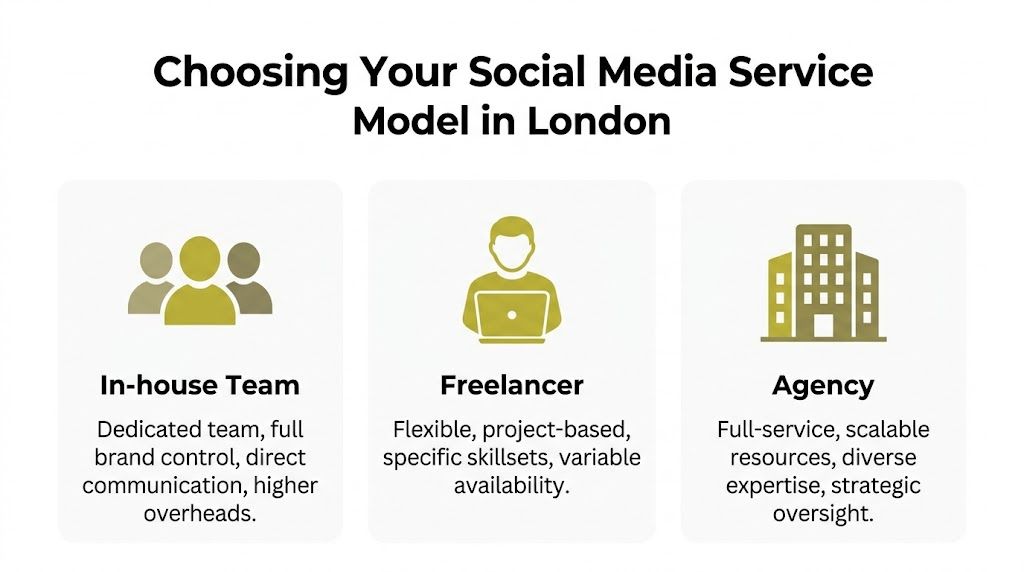
The decision usually comes down to complexity
A simple local business with one channel, modest posting needs and straightforward offers can often manage well with one capable person. A growing SME with multiple audiences, paid campaigns, video needs and reputational exposure usually needs broader support.
If you’re weighing your options, start with this comparison.
Social Media Service Model Comparison
| Model | Best For | Pros | Cons |
|---|---|---|---|
| In-house Team | Businesses with ongoing content volume, strong internal leadership and the budget to hire properly | Deep brand access, direct communication, fast internal collaboration | Higher overheads, narrower skill coverage, difficult to scale specialist needs |
| Freelancer | Start-ups, launch projects, content bursts, founder-led brands needing flexible support | Agile, often cost-effective, good for a defined brief or platform-specific execution | Availability varies, strategy can be thin, continuity and crisis cover may be limited |
| Agency | SMEs and established brands needing strategy, reporting, content, paid support and senior oversight | Broader expertise, scalable resources, stronger processes, clearer accountability | Less day-to-day proximity than a full internal hire, quality varies widely between firms |
In-house works when leadership stays involved
An in-house social hire can be excellent if the business already knows what it wants to say.
This model tends to work best when:
- Your proposition is clear: The hire won’t be left inventing the brand from scratch.
- Decision-makers are accessible: Content doesn’t wait days for approval.
- You can supply raw material: Customer stories, founder insights, sales objections and product updates all feed the content machine.
Where it fails is predictable. One person gets asked to do strategy, filming, editing, copywriting, reporting, design, paid social and customer service. That’s not a role. That’s six roles.
Freelancers are useful, but only for the right brief
A good freelancer can be an excellent option for a launch, a platform-specific campaign or a period when you need flexible support without adding payroll.
But you need to know what you’re buying.
A freelancer is often strongest when the task is defined. Film four Reels. Build a LinkedIn content cadence. Refresh Instagram creative. Set up reporting. Problems start when businesses expect one freelance relationship to cover senior strategy, creative direction, crisis judgement and daily execution indefinitely.
For lighter operational support, some firms also explore hiring social media virtual assistants to handle scheduling, inbox monitoring and administrative workflow. That can help, but only if someone senior still owns the message and the decisions.
Agencies make sense when stakes are higher
Agency support becomes more valuable as complexity rises.
That usually means:
- Multiple platforms with different roles
- A need for paid and organic alignment
- Campaigns that need reporting tied to business outcomes
- Sensitive sectors where posts can create legal or reputational issues
- Senior stakeholders who need strategic input, not just content output
The best agency relationships don’t just increase posting. They improve judgement, consistency and accountability. If you’re reviewing what that kind of support looks like in practice, this overview of https://carlosalbamedia.co.uk/experts-in-social-media/ is a useful benchmark for the sort of specialist, senior-led capability many SMEs need.
Choose the model that fits the complexity of your business, not the cheapest monthly line item.
A quick filter for founders
Ask yourself four blunt questions:
- Do we need someone to execute a known plan, or help create the plan?
- How costly is a mistake on our channels?
- How much content can we realistically supply internally?
- Do we need one skillset or several working together?
Those answers usually point to the right model faster than any pitch deck will.
How to Select the Right London Agency
Most agency selection goes wrong before the first proposal lands.
A founder gets dazzled by a slick portfolio, a list of logos or a promise of “engagement”. None of that tells you how the agency thinks, who will handle the work, or whether they can protect your reputation when something goes sideways.
The London market is crowded with content factories. They produce volume. They often sound persuasive in the pitch. Then the account is handed to junior staff, strategy gets reduced to a posting calendar, and reporting becomes a bundle of metrics that look active but explain very little.
Start with reporting, not aesthetics
The UK social media analytics market is projected to reach USD 2,485.9 million by 2030, according to Grand View Research’s UK social media analytics outlook. That matters because better analytics should lead to better decisions, not prettier dashboards.
Ask to see how an agency reports on:
- Lead quality
- Conversion paths
- Platform-specific performance
- Paid versus organic contribution
- What they changed after reviewing the data
If they can’t explain how social connects to business outcomes, they’re not offering strategy. They’re offering activity.
Questions worth asking in the pitch
Don’t ask broad questions like “How do you approach growth?” You’ll get broad answers.
Ask these instead:
- Who will I work with each week?**
- What does your approval process look like for high-risk posts?
- How do you handle negative comments, complaints or misinformation?
- What would you track in month one, and why?
- What inputs do you need from our leadership team?
- How do you decide which stories belong on which platform?
- What happens if performance stalls after the first quarter?
The quality of the answers tells you more than the credentials slide.
Look for newsroom instincts
This is the part generic buyer guides often miss.
A strong social agency should understand narrative tension, audience interest, headlines, timing and reputational nuance. Those are newsroom disciplines. They matter because social platforms reward clarity and immediacy, while public mistakes spread fast.
Teams with former national journalists and agency operators who’ve worked with international brands tend to bring stronger judgement to three areas:
| Capability | Why it matters |
|---|---|
| Story selection | They know how to spot angles people may actually care about |
| Message discipline | They can tighten weak claims before they become weak posts |
| Risk awareness | They recognise when a “fun” post could create a legal or reputational problem |
That mindset is especially useful for sectors where public trust carries weight. Finance, health, property, hospitality, tourism and founder-led businesses all benefit from sharper editorial judgement.
Warning signs that should slow you down
Some red flags are obvious. Others are dressed up as process.
Watch for these:
- A heavy focus on vanity metrics
- No clear explanation of who owns strategy
- Template content presented as bespoke work
- No examples of issue management or crisis handling
- A junior team fronted by one senior face in the sales call
- Vague language around reporting and attribution
A good agency should make your marketing clearer. If the proposal makes the work harder to understand, expect confusion later.
What a better shortlist looks like
Your shortlist should include firms that can think, write, analyse and advise under pressure. Not just design posts.
That’s why it helps to compare agencies against a practical service benchmark such as https://carlosalbamedia.co.uk/social-media-marketing-company-uk/, where the emphasis is on social as part of a wider brand and reputational strategy, not a silo.
The right London agency won’t promise magic. It will show you a system for finding better stories, distributing them more intelligently, measuring the right outcomes and handling the awkward moments properly.
London Social Media Success Stories
Theory becomes useful when you can see how it solves a real commercial problem.
The examples below reflect the kinds of situations London businesses face every week. The details vary by brand, but the pattern is consistent. Strong social media marketing london isn’t about flooding feeds. It’s about choosing a story people care about, matching it to the right channel, and keeping control when scrutiny arrives.

A hospitality brand that stopped selling and started showing
A restaurant group with a London site had the classic problem. Attractive venue, decent menu, weak social presence. The feed was full of polished plates and generic captions. It looked tidy and said almost nothing.
The smarter move was to rebuild the content around moments of choice. Why someone would pick this place on a Thursday night. What the room felt like before service. Which dishes staff recommended. What nearby theatres, offices or weekend traffic meant for timing and offers.
That kind of content usually performs better because it answers buying questions without sounding like an ad.
A practical hospitality content mix often includes:
- Service rhythm clips that show atmosphere and pace
- Staff-led recommendations that add credibility
- Neighbourhood hooks tied to events, weather or local footfall
- Simple offers framed around occasions, not discounts alone
The difference is subtle but important. People don’t book restaurants because the feed is active. They book because they can imagine themselves there.
A regulated tech firm that treated LinkedIn as a trust channel
Many regulated businesses still use social defensively. Dry posts. Safe language. No point of view. It avoids risk, but it also avoids attention.
That’s a mistake, especially when decision-makers check social before a sales conversation.
A better approach for a London tech SME in a regulated area is to make LinkedIn do three jobs at once:
- Publish credible commentary on the issues buyers already worry about
- Turn senior people into recognisable, trusted voices
- Create a framework for responding if criticism or confusion appears publicly
62% of UK SMEs in regulated sectors faced a social media crisis in 2025, according to Clutch’s London agency research summary. Growth and protection need to sit in the same plan.
The safest social strategy for a regulated business isn’t silence. It’s controlled visibility.
That means clear approval routes, message discipline, prepared holding lines and proper escalation. It also means content that explains, not just promotes. Short expert videos, myth-busting carousels, compliance-aware commentary and founder posts often do more than polished brand statements.
Here’s a useful example of how social content can be framed for business visibility.
A tourism campaign with a wider geographic story
Tourism brands often get boxed into one local identity when they’d benefit from a broader narrative.
A campaign aimed at UK visitors doesn’t have to choose between London relevance and Scottish resonance. In fact, some of the strongest travel and lifestyle work comes from using both. London gives reach, media momentum and commercial scale. Scotland adds distinctiveness, culture and a different emotional register.
That hybrid story can work well for destination brands, visitor experiences, hotels and premium hospitality because it avoids the flatness of “visit us” messaging. It gives the audience something richer to follow, share and remember.
What these examples have in common
Different sectors, same principle.
| Challenge | Better response |
|---|---|
| Low engagement | Build stories around buyer decisions, not brand statements |
| Weak differentiation | Use founder insight, staff knowledge and local context |
| Reputational exposure | Put escalation, approvals and messaging controls in place |
| Disconnected activity | Tie social to bookings, leads, trust or footfall |
The best success stories rarely start with a platform trick. They start with clearer judgement.
Budgeting for Impactful Social Media Marketing in London
A London SME briefs three agencies and gets three prices that barely resemble each other. One quote covers posting and basic design. Another includes strategy, video, paid support and monthly reporting. A third builds in approvals, senior messaging and crisis handling because one poorly judged post in a regulated sector can create a much bigger cost than the retainer.
That is why budget conversations go wrong so often. The question is rarely “what does social media marketing london cost?” The actual question is what the work needs to achieve, how exposed the business is if it goes wrong, and how much judgement the team will need week to week.

What you are actually paying for
A useful social budget has three layers, and problems start when a supplier prices only one of them.
Strategic management
This covers planning, channel roles, editorial judgement, approvals, reporting, campaign decisions and the discipline to spot reputational risk before it reaches the comments. In London, where competition is sharp and scrutiny can arrive fast, this layer matters more than many founders expect.
A journalist’s lens helps here. Strong social strategy is partly about reach, but it is also about angle, timing, evidence and wording. For firms in property, legal, healthcare, finance or founder-led brands under pressure, that judgement often saves more money than it costs.
Content production
This is the visible line item. Copy, design, filming, editing, photography, creator management and reworking assets for different platforms all sit here.
Video often changes the budget fastest. A decent short-form clip may look casual on screen, but the work behind it is not casual at all. Planning, scripting, shoot time, compliance checks and editing hours add up quickly. Sometimes that spend is justified. Sometimes a sharp graphic carousel and a credible founder comment will do more for less.
Paid distribution
Organic content can build trust and test messages. Paid social puts weight behind what is already working and gets content in front of the right audience with more consistency.
That does not mean every post deserves budget. Paying to push weak content usually just spreads weak content further.
Budget by business objective
Channel count is a poor way to set spend. Commercial objective is a better one.
A business trying to raise local awareness may need better creative, stronger founder presence and careful audience targeting across a small number of platforms. A business focused on leads needs conversion tracking, landing page alignment, retargeting and tighter reporting. A hospitality brand chasing bookings needs timing, local intent and content built around decision points. A regulated firm with reputation concerns needs moderation rules, approval chains and prepared lines for difficult public questions.
Each objective changes the scope. Each scope changes the budget.
A monthly posting package is poor value if the real requirement is lead generation, stakeholder trust or fast reputational response.
Influencer spend needs proper controls
Influencer marketing can work well for consumer brands, hospitality, retail, events and personality-led businesses. It can also burn money fast when the brief is vague and the selection process is lazy.
The budget should cover more than a creator fee. It should account for audience fit, content quality, approval rights, disclosure compliance, usage rights if the content will appear in ads, and a way to measure whether the collaboration produced anything beyond vanity numbers. In London, where rates can climb quickly, those details separate sensible tests from expensive theatre.
A practical planning tool helps at this stage. A simple social media marketing strategy template can clarify goals, channels, deliverables and measurement before money goes out the door.
Where London SMEs overspend and underspend
The same patterns show up again and again.
| Area | Common mistake | Better move |
|---|---|---|
| Content | Buying volume without a strong angle | Produce fewer assets with clearer stories and better reuse potential |
| Paid social | Putting spend behind average posts | Fix the message, hook and creative before increasing budget |
| Reporting | Treating measurement as an extra | Include attribution, review and decision-making in the monthly scope |
| Influencers | Choosing reach over relevance | Pick creators whose audience, tone and credibility fit the brand |
| Risk control | Leaving approvals loose | Set sign-off rules and escalation steps before a problem starts |
Smaller firms usually do better with a staged budget than a bloated one. Start with strategy, a realistic content cadence, measurement and a clear process for approvals. Then increase spend once the message is working. For a practical breakdown built around SME priorities, see this guide to social media marketing for small businesses.
Good budgeting is allocation, not thrift. Every line of spend should have a job, a decision-maker and a commercial reason for being there.
Your Next Step Towards Social Media Growth
The hard truth is simple. Most underperforming social channels don’t have a platform problem. They have a clarity problem.
The story is weak. The message is generic. The team is underpowered. Reporting doesn’t explain commercial impact. Or no one has built a plan for what happens when public attention turns unfriendly.
That’s why a sharper model works better. Social performs when it borrows the right disciplines from journalism and PR. Strong angles. Clean messaging. Audience awareness. Fast judgement. A clear line between what should be published, what should be promoted and what should be handled with caution.
There’s also a bigger strategic point here. Social shouldn’t sit in a corner away from the rest of your communications. Data shows that integrated PR-social approaches can yield a 2.5x higher ROI than standalone social media campaigns, according to this UK agency market analysis. That reflects what many experienced operators already know. Social gets stronger when it’s connected to media relations, brand positioning, founder profiling and reputation management.
A practical way to move forward
If your team needs structure before it needs scale, start by tightening the basics:
- Clarify the audience: One message rarely works for every buyer.
- Define platform roles: Decide what each channel is for.
- Audit current output: Keep what supports a business goal. Cut what doesn’t.
- Build a monthly narrative: Campaigns outperform random posting.
- Prepare for scrutiny: Negative attention is easier to manage when roles and responses are already agreed.
If you need help mapping that out, a solid social media marketing strategy template can help organise your thinking before you brief an agency, hire internally or reset your current approach.
The firms that win in London aren’t always the loudest. They’re the clearest, the most consistent and the best prepared. That’s good news for SMEs. You don’t need the biggest team in the market. You need a better story, stronger judgement and a system that turns attention into action.
If you want senior, no-obligation advice on your social media strategy, brand storytelling or crisis readiness, speak to Carlos Alba Media. The agency is led by a multi award-winning former national newspaper editor, with a team made up of former national news journalists and experienced agency specialists who’ve worked with international brands. That means practical counsel, sharper messaging and social strategy built for growth and reputational control, not just more posts.