
Your business has a strong story. The problem is that those who need to hear it still haven't heard it. You know PR can help, but once you start searching for the best pr companies in the UK, the options blur together. Everyone claims strategic thinking, senior counsel and strong media contacts.
That's where buyers get stuck. A startup founder doesn't need the same agency as a listed business facing scrutiny, and a consumer brand chasing attention needs a different skill set from a Scottish SME that wants practical national coverage without a bloated account team. If you're still working out what good selection looks like, Bare Digital's agency selection guide is a useful companion read.
The UK market is big enough to support both global networks and specialist independents. IBISWorld's 2026 industry analysis estimates the UK PR agencies market at about £3.4 billion, which helps explain why you'll see everything from heavyweight London firms to focused consultancies built for founder-led businesses, regional brands and regulated sectors.
1. Carlos Alba Media
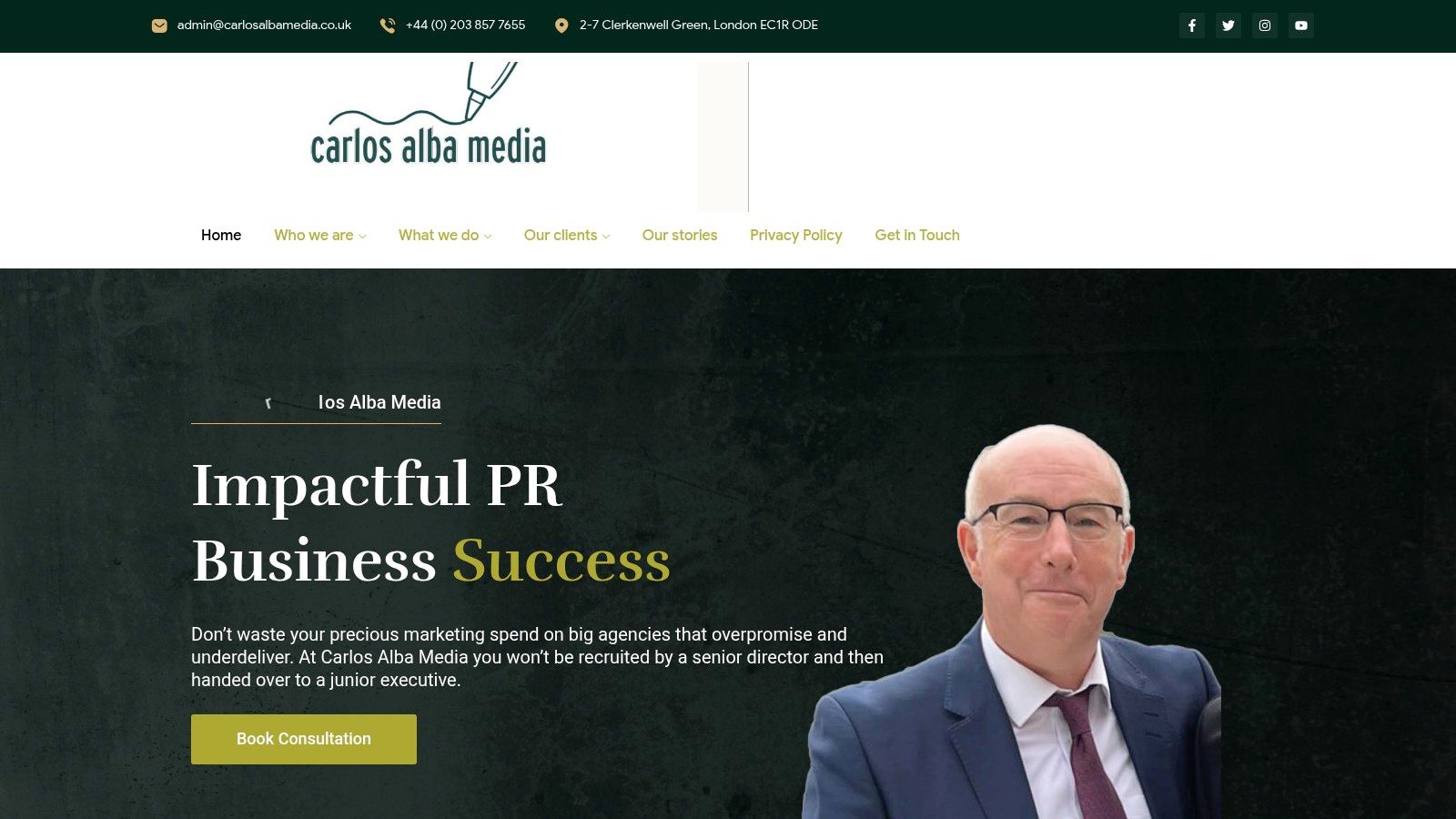
A common buying mistake is treating every PR agency as if it solves the same problem. A founder in Glasgow trying to win national coverage, prepare for press scrutiny and improve search visibility does not need the same agency setup as a consumer brand chasing a splashy London campaign. Carlos Alba Media stands out because it is built for the first type of brief: senior-led, practical and closely tied to commercial outcomes.
The agency is Scottish-led, with teams in London and Glasgow, which matters if geography is part of your decision. For businesses that want UK reach without defaulting to a large London network, that footprint offers a useful middle ground. You get experienced counsel and national media understanding without paying for layers of account management.
The delivery model is the key point. Everyone involved comes from either a national journalism background or agency work with established brands, and the consultancy is led by former national newspaper editor Carlos Alba. That shows up in the work. Story angles are shaped for editors, spokespeople are prepared properly, and digital activity is planned alongside press outreach rather than treated as a separate service.
Why it stands out
Carlos Alba Media is a strong fit for businesses that need PR to connect with wider marketing and reputation work. Services include media relations, SEO-led content, UX and brand strategy, web design and development, social media marketing, media skills training and round-the-clock crisis support with UK media lawyers. Smaller agencies do not always offer that mix under one roof.
The client list points to range rather than a single niche. Work for The Johnnie Walker Experience, VisitScotland, Scotia Homes and Hamilton & Inches suggests the agency can handle tourism, hospitality, property and established brand briefs without forcing the same tone onto each one.
One practical test helps here. Ask who will write the media line, brief the spokesperson and speak to journalists when pressure hits. With Carlos Alba Media, that senior involvement is part of the model, not an upgrade you have to negotiate later.
A few strengths stand out:
- Senior-led delivery: Experienced practitioners stay close to the work.
- Editorial judgement: Former journalists know how to shape a story that news desks can use.
- Joined-up support: PR, digital content, web and social can work together when visibility also needs to drive enquiries or sales.
- Crisis capability: Media training and high-pressure response are built in from the start.
Best fit and trade-offs
This agency is especially relevant for Scottish SMEs, founder-led businesses, tourism brands, organisations in regulated sectors, and teams that want direct access to senior counsel. If you want a more detailed view of what to assess before appointing any agency, their guide on how to choose a PR agency is a useful reference.
There are trade-offs. Pricing is not published, so comparison shopping will require a conversation and a clear scope. And if your brief involves a large multi-market rollout with heavy localisation across several regions, ask early about team structure, specialist support and account capacity. That is the right question with any independent consultancy, no matter how strong the senior team is.
2. Hope&Glory PR
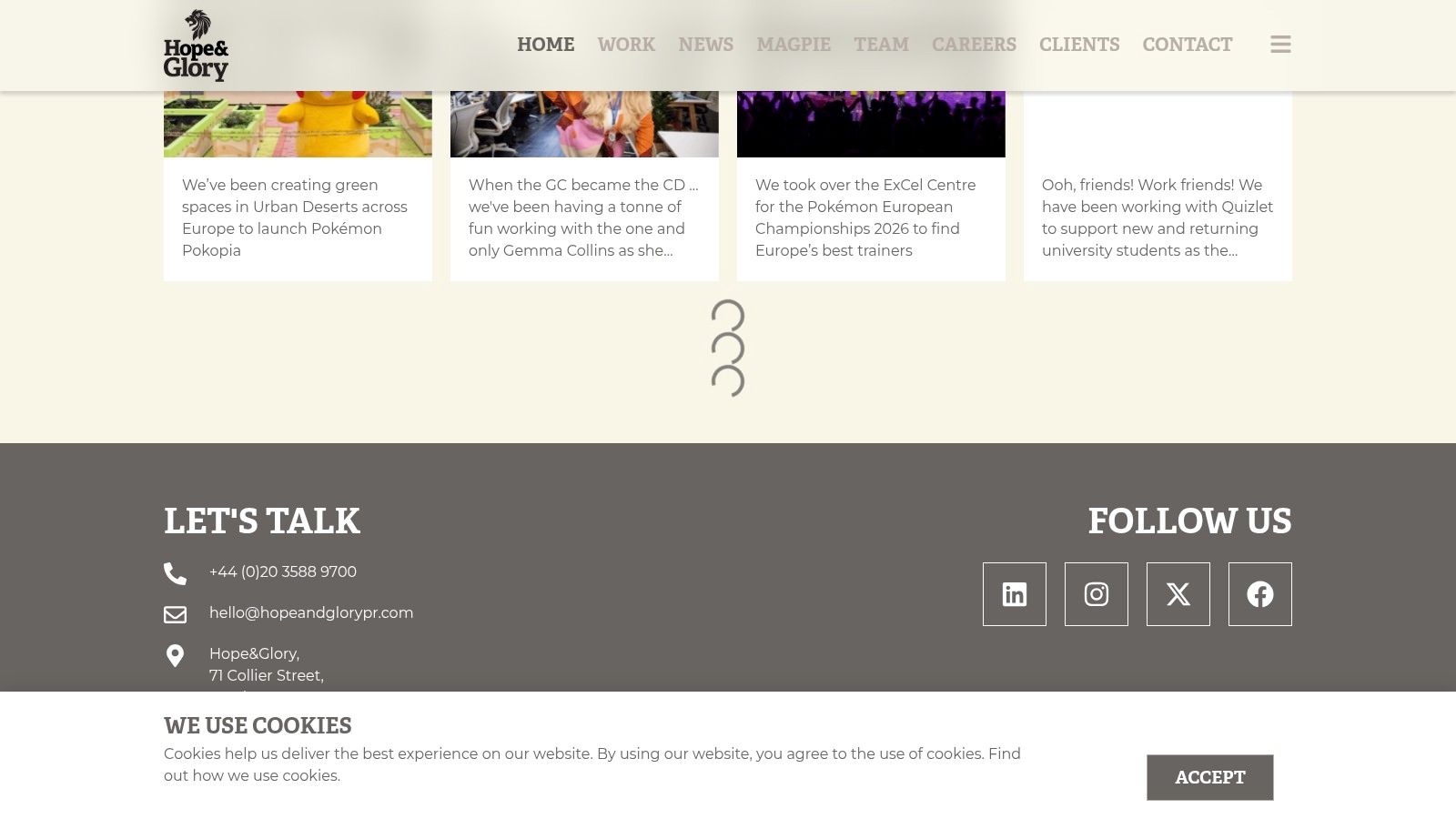
If your brand needs attention fast, Hope&Glory PR deserves a place on the shortlist. This London agency has built its name on consumer campaigns that people notice. Not just media coverage for the sake of a clipping book, but ideas designed to travel across press, social and influencer channels.
That's the key distinction. Some agencies are good at servicing a press office. Hope&Glory is better when the brief is to create a moment, push a brand into conversation and give journalists something with energy behind it.
Where Hope&Glory works best
This is a strong fit for lifestyle, retail, hospitality, culture and consumer tech brands. The agency leans into earned-first creativity, in-house content production and strong media relationships, which is exactly what you want when the challenge is cut-through rather than policy nuance.
For ambitious consumer brands, a basic understanding of what a public relations agency should do helps separate real strategic support from noise. Hope&Glory sits firmly in the camp of agencies that try to make stories travel, not just announce things.
A few practical advantages stand out:
- Creative earned ideas: Good for launches, cultural moments and campaigns that need public conversation.
- Consumer media understanding: Strong fit for high-street and mainstream brand storytelling.
- Integrated social and influencer thinking: Useful when press alone won't carry the brief.
Bold consumer work often looks effortless from the outside. It rarely is. The agencies that do it well know how to package a story so editors, creators and audiences all find a way in.
The trade-offs
Hope&Glory isn't the obvious choice for dense corporate, B2B or heavily regulated briefs where stakeholder handling matters more than mass attention. It's also London-centric in character, which isn't a problem if your target media are national, but it can matter if you need deep regional activation.
You should also expect a certain level of creative ambition in the process. That's a strength if you want a fame-driving agency. It's less useful if your leadership team wants quiet, technical message work with minimal campaign theatre.
Visit Hope&Glory PR if that's the style of agency you need.
3. The Romans
The Romans is for brands that want PR to feel culturally alive. Part of the Mother family, it has a strong reputation for creative earned ideas that are built to be shared, discussed and amplified beyond a press release.
This agency tends to attract businesses that want boldness. If your leadership team keeps saying, “We don't want something safe,” The Romans is exactly the sort of shop you'd call.
Why brands choose The Romans
The agency is especially strong across consumer, sport, influencer and broader culture-led briefs. It combines classic PR instincts with a clear understanding of what spreads online, which is different from chasing coverage. The best work in this space usually starts with sharp media relations, then expands into content and influence.
That combination gives The Romans a practical edge on launches and campaigns that need speed. Agile teams can move fast when a trend opens up or a brand has a chance to insert itself into a wider conversation.
The strongest reasons to shortlist it are simple:
- High-impact creativity: Good for brands that need standout ideas, not safe messaging.
- Influencer and content capability: Useful where earned and creator ecosystems overlap.
- Comfort with rapid launches: Helpful when timing matters as much as the idea itself.
Where caution is sensible
The Romans is less naturally suited to technical B2B, investor-sensitive, legal-heavy or policy-driven briefs. A creative agency can still support those areas, but it may not be the first call if your main risk sits in regulation, scrutiny or stakeholder complexity.
Cost is another consideration. Highly creative campaigns tend to command premium fees because they demand more strategic development, production thinking and coordination. If your brief is modest and your budget is tight, you may get better value from a smaller specialist agency.
You can review the agency at The Romans.
4. Pagefield
Some PR problems don't need a stunt. They need judgement. Pagefield is a strong option when the work sits closer to boardroom risk, public affairs, stakeholder management and issues handling than brand fame.
This London consultancy is senior-led, and that's the right model for organisations facing scrutiny, political attention or a fragile reputation. You're buying experience that can hold up under pressure, not just media pitching.
Best for corporate and issue-led briefs
Pagefield makes sense for organisations that need corporate communications, crisis support, public affairs and digital advocacy working together. If your challenge includes Westminster, trade bodies, local stakeholders, campaign groups or complicated leadership messaging, this kind of firm is often a better fit than a consumer PR shop.
Historically, the UK has been one of the world's key PR hubs, with London at the centre of the sector. Statista notes that WPP, based in London, was among the leading global PR holdings in 2022, and that PR accounted for 8.5% of total WPP revenue in 2023. That wider context helps explain why London remains strong in financial communications, crisis advisory and policy-aware corporate work.
Pagefield's appeal comes down to a few things:
- Senior consultant model: Useful when leadership teams want direct access to experienced advisers.
- Corporate affairs depth: Better suited to institutional complexity than consumer splash.
- Balanced media and stakeholder capability: Important when the audience isn't just journalists.
If your issue could end up in front of regulators, MPs, investors or campaign groups, don't hire a fame agency and hope it adapts. Start with a consultancy built for consequence.
The likely trade-offs
Pagefield isn't where I'd go for playful mass-market consumer PR. It can support public positioning, but its strengths are clearly in serious communications, not headline-grabbing entertainment. Like several London firms, regional implementation may also depend on partners or flexible project teams rather than a well-established local footprint.
Take a closer look at Pagefield.
5. PLMR
PLMR is one of the more useful agencies on this list for organisations operating where media, policy and public trust overlap. If you work in health, education, housing, sustainability or another regulated field, that matters. A good campaign in those sectors often needs political literacy as much as media handling.
Many best pr companies round-ups often fall short. They lump consumer PR, corporate affairs and crisis work into one bucket, even though the skill sets are different in practice.
Strong choice for regulated sectors
PLMR blends PR, public affairs and digital, and the structure is helpful for campaigns that need both public visibility and policymaker engagement. The agency also has devolved-nation reach, including Glasgow, which makes it more practical than a purely Westminster-focused operation for organisations working across the UK.
The need for that kind of integrated response is growing. Ofcom's 2025 UK media-use research found that online sources and social platforms remain central to news consumption, which increases the speed at which reputational issues can escalate, as noted in the background reference to agency selection gaps around crisis and risk.
The practical benefits are clear:
- Policy-aware communications: Useful when announcements have political or regulatory implications.
- Specialist health capability: Stronger fit for health communications than a generalist lifestyle agency.
- UK-wide reach: Helpful for organisations that can't think only in London terms.
What to watch before appointing
PLMR isn't a classic consumer fame agency. If your brief is built around cultural buzz, product desirability or lifestyle storytelling, other firms on this list will feel more natural. The group structure can also mean several specialist teams touching the same account, which is fine if managed well, but worth clarifying in the pitch process.
Ask one direct question early: who owns the strategy when media, digital and public affairs all intersect? If the answer is vague, the relationship can get messy.
Visit PLMR.
6. BIG Partnership
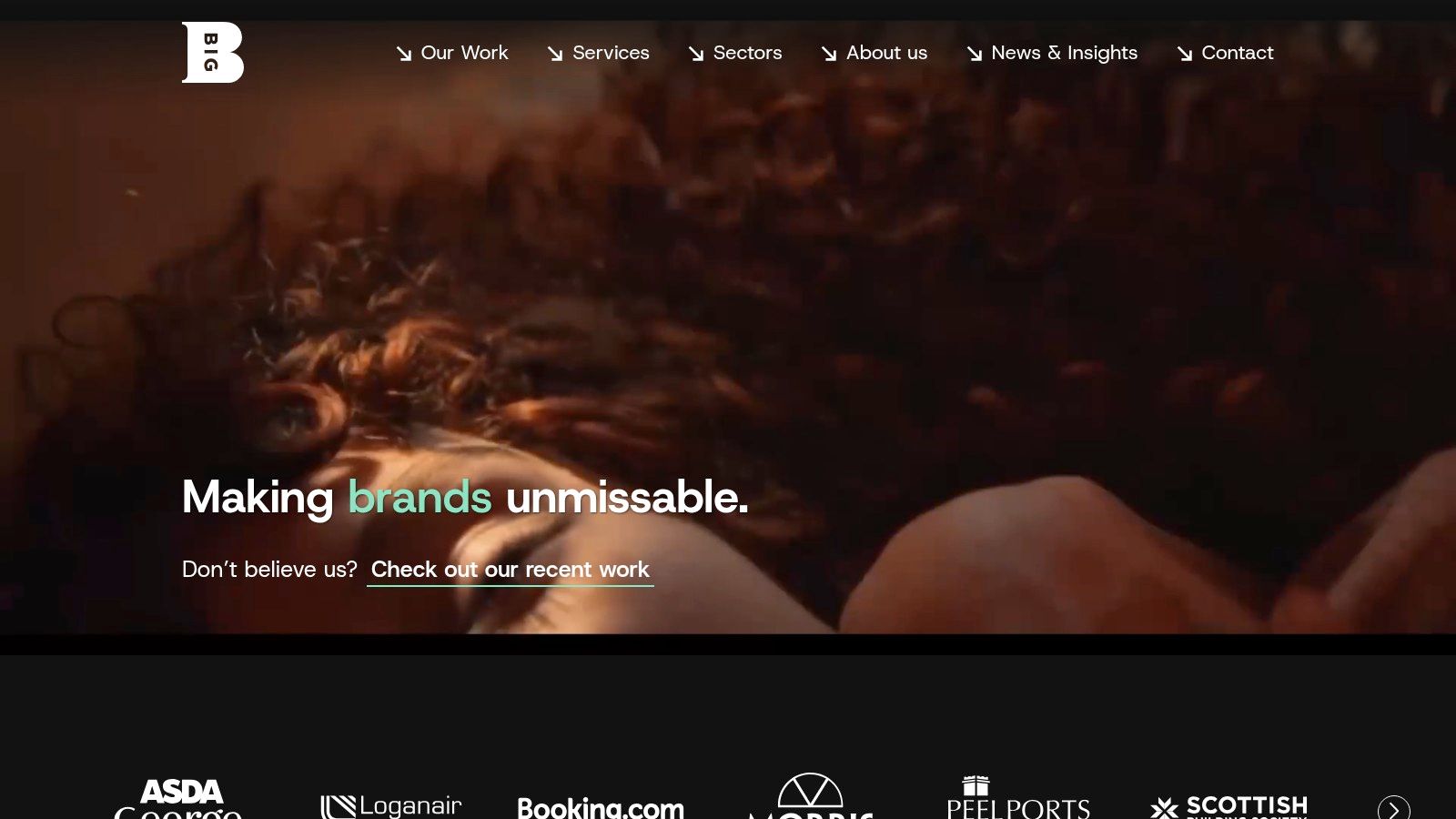
BIG Partnership is a practical option for businesses that want integrated communications and a strong Scottish base without losing UK reach. It has deep roots in Scotland and broad capability across PR, digital, creative, social and public affairs.
That profile makes it attractive to businesses that don't want to manage multiple agencies. If your campaign needs local understanding, national execution and joined-up creative support, BIG is built for that kind of workload.
Best fit for regional-national growth
The agency has particular relevance for property, tourism, leisure, energy, renewables and professional services. Those sectors often need campaigns that can operate across local media, trade press, public consultation, stakeholder engagement and broader brand communications. BIG's structure supports that mix well.
For Scottish and regional organisations, this can be a better fit than a London agency trying to parachute into local dynamics. Knowing the media environment, business community and regional politics still matters, especially when reputations are built over time rather than through one-off national flashes.
A few reasons buyers choose BIG:
- Integrated delivery: PR, digital and creative sit together, which reduces fragmentation.
- Scottish strength with UK coverage: Strong option for brands that need both.
- Sector familiarity: Helpful if your business sits in infrastructure, property, tourism or energy-related markets.
Where it may be less compelling
BIG's strengths are more structural and commercial than flashy. If you want a singularly fame-driven consumer campaign designed to explode across social and tabloids, other agencies may feel sharper. Because it's a larger independent group, you should also pin down the senior team at the start rather than assume who will stay close to the account.
That isn't a criticism. It's normal agency hygiene. The firms that work best over time are the ones where scope, team access and decision-making are clear from the beginning.
You can review BIG Partnership.
7. Citypress
Citypress is a strong middle ground for buyers who want national capability without the feel of a giant network agency. It's independent, employee-owned and spread across Manchester, London, Edinburgh and Birmingham, which gives it broader UK coverage than many London-only competitors.
That footprint matters if your business serves multiple regions and doesn't want everything filtered through a capital-city lens. It also helps when you need a team that can move between consumer, corporate and B2B audiences without switching agencies.
Why Citypress makes the shortlist
Citypress offers a broad service mix. PR, social and influencer support, corporate affairs, financial communications and crisis work all sit within the same business. That versatility is useful for scale-ups and established brands that have outgrown a small boutique but still want accountability and a close working relationship.
The employee-owned model is worth noting because it often supports team stability and long-term accountability. In agency relationships, consistency matters more than most pitch decks admit. The strategy usually suffers when the people who sold the work disappear after the first quarter.
Its strengths are easiest to see here:
- Balanced service mix: Good for businesses with both reputation and growth needs.
- Regional UK presence: Better for national campaigns outside a pure London frame.
- Crisis and issues capability: Helpful when a growth agency also needs to protect the brand.
A reliable PR partner doesn't just produce coverage when the news is good. It stays useful when the story gets awkward, the stakeholder mix broadens and the chief executive suddenly needs a line by 7am.
Trade-offs to consider
Citypress isn't the obvious first choice for deep public affairs work where Westminster expertise drives the brief. And while it can deliver creative campaigns, it isn't defined by a singular stunt-led identity in the way some fame-first agencies are.
That said, many businesses don't need theatre. They need a dependable agency with range, sensible senior counsel and enough regional reach to execute properly across the UK.
Visit Citypress.
Top 7 PR Companies Comparison
| Agency | Implementation complexity 🔄 | Resource requirements ⚡ | Expected outcomes ⭐📊 | Ideal use cases 💡 | Key advantages ⭐ |
|---|---|---|---|---|---|
| Carlos Alba Media | Low–Medium, senior‑led, hands‑on delivery | Moderate, scoped projects; senior time | ⭐ Reliable national coverage and measurable growth | Start‑ups, SMEs, regulated/high‑risk orgs, tourism; tight deadlines | Senior newsroom insight; 24/7 crisis support; cost‑effective vs big agencies |
| Hope&Glory PR | Medium–High, creative, stunt‑driven campaigns | High, in‑house production and creative teams | ⭐ High consumer visibility and social buzz | Lifestyle, retail, tech, hospitality, culture brands seeking fame | Earned‑first creativity; strong media relationships; award‑winning |
| The Romans | High, bold, culture‑shaping creative briefs | High, creative, influencer and multi‑market teams | ⭐ Standout, high‑shareability campaigns | Ambitious consumer brands aiming for breakout moments | High‑impact creativity; rapid launches; international reach |
| Pagefield | Medium, corporate/public affairs focus with senior counsel | Moderate–High, board‑level and political expertise | ⭐ Reputation protection and stakeholder influence | Corporate comms, crisis, public affairs; board‑level counsel | Westminster/public‑affairs strength; senior counsel trusted by leaders |
| PLMR | High, integrated PR, public affairs and policy work | High, specialists, polling/insight and multi‑team coordination | ⭐ Targeted policy impact and sector credibility | Regulated sectors (health, education, housing, sustainability) | Political insight; health comms unit; UK devolved‑nations reach |
| BIG Partnership | Medium, integrated regional‑to‑national programmes | Moderate–High, scalable teams for regional/national delivery | ⭐ Consistent regional and national campaign performance | SMEs to larger organisations needing Scottish/UK scale; property, tourism | Strong regional footprint including Scotland; full‑service integration |
| Citypress | Medium, full‑service PR with analytics and crisis support | Moderate, in‑house analytics and accountable teams | ⭐ Balanced corporate & consumer outcomes with measurable metrics | National brands and scale‑ups seeking senior counsel without big‑network overhead | Employee‑owned stability; proprietary measurement tools; crisis capability |
Your Next Step Start the Conversation
You are in the first agency call. The board wants results, the marketing team wants coverage, and legal wants to know who picks up the phone if a story turns hostile at 6pm. That is the point where agency selection stops being about brand names and starts being about fit.
Use the shortlist in this guide as a filtering tool. Start with your actual need, then narrow by specialism and geography. A London consumer agency suits brands that need reach and cultural relevance. A Scotland-based team can be the better choice for businesses that need regional knowledge, closer senior access, or stronger value for a modest budget. If the issue is regulatory scrutiny, policy pressure, or reputational risk, corporate and public affairs capability matters more than creative sparkle.
Keep the shortlist tight. Two or three agencies is enough.
Then brief properly. Set out the commercial context, the audiences that matter, the outcome you need, the risks in play, and the budget range. Agencies can only give useful advice if they know whether the job is product launch, investor confidence, crisis handling, public affairs support, or a mix of all four.
Ask blunt questions in the first meeting. Who leads the account day to day? Who writes and signs off media materials? What senior input is included after the pitch process ends? How do they report results? What happens outside office hours? Good agencies answer these clearly. Weak ones drift back to credentials, case studies, and chemistry.
Carlos Alba Media is one option for businesses that want senior-led support without layers of account handling. Its positioning, as noted earlier, is built around experienced journalists and brand operators working directly with clients. That tends to suit SMEs, founders, and organisations facing sensitive media issues where response time and judgement matter.
Choose the agency that matches the job, not the one with the biggest profile. That is usually where better work starts.