
You're comparing agency proposals, rewriting the homepage headline for the third time, and still struggling to explain why a buyer should choose you. The proposals all sound plausible. The headline could belong to a competitor. Your pitch deck describes what you do, but not why it matters to the person across the table.
That's rarely a design problem. It's usually a value proposition problem: the business hasn't connected a particular buyer's need to a specific outcome and credible reason to believe. In the UK, where 4 in 10 consumers are increasingly motivated by value for money, value is twice as important as brand, and 80% expect value to matter even more the following year, a familiar name or polished promise may not be enough to win consideration (EY's research on UK consumers and value).
Why Most SMEs Struggle to Explain What They Actually Offer
“Full-service agency” sounds complete to the people who built the business. To a buyer comparing providers, it's a category label. “Senior expertise” may be accurate, but without explaining what that expertise changes for the customer, it remains an assertion, not a reason to enquire.
Founders often add more: another service, another credential, another broad claim about quality. The pitch grows longer and harder to follow. Buyers need to see whether you understand their problem and can solve it without adding risk or unnecessary cost.
A weak headline exposes a weak commercial argument. If your homepage says you help businesses “grow through tailored solutions”, a visitor still has to work out who you help, what kind of growth you mean, and what makes your approach different. Proposals have the same problem when they lead with deliverables instead of the business outcome those deliverables should support.
Consumer retail is not the only market where a clear explanation of value matters. Start-ups and SMEs choosing a PR or digital marketing partner weigh budget, confidence and expected results. Carlos Alba Media's specialist proposition draws on newsroom experience and agency expertise: everyone who works for Carlos Alba Media is a former national news journalist or has agency experience of working with international brands. That background matters when it helps a client reach a relevant outcome. On its own, it is a credential, not a reason to choose the agency.
Treat your UVP as an operating test, not a line of copy. A unique value proposition is a single, testable statement that names who you serve, what painful problem you solve, what distinct outcome you deliver and why you're credible enough to deliver it. Check each part against the questions an editor would ask: why now, why this audience, and why you? If the answers are vague, the message needs work before it goes on your homepage or into a pitch.
What a Unique Value Proposition Actually Is
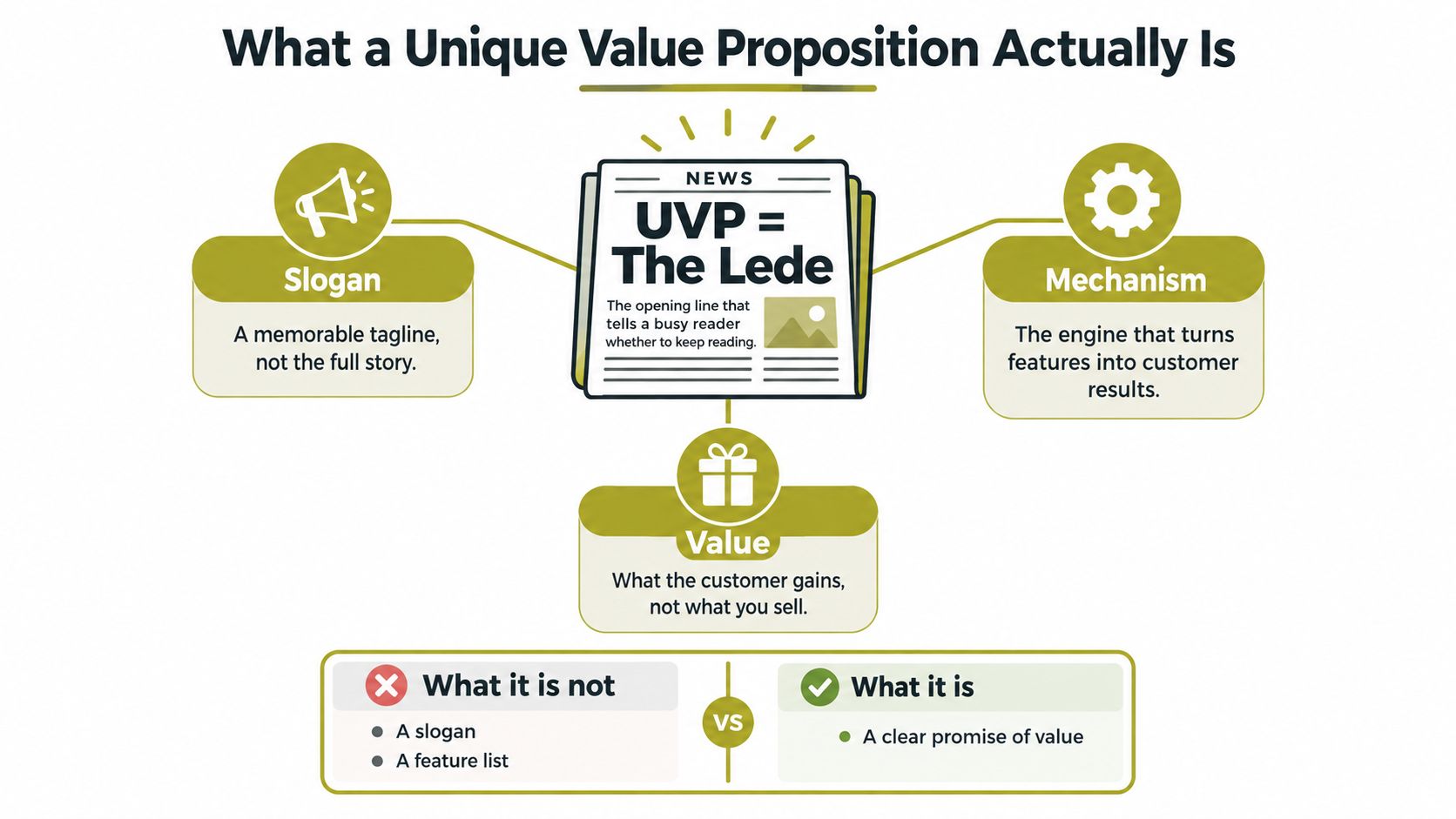
Think of a newspaper front page. A busy reader scans the headline and decides whether the story deserves attention. A unique value proposition plays the same role: it gives a buyer a clear reason to keep reading, while making the value of the offer immediately legible.
It isn't a tagline, a mission statement or a positioning deck. A tagline may be memorable; a mission describes an organisation's purpose; a deck may contain the strategic detail behind a brand. The UVP does a different job. It makes a clear promise about the customer value you deliver and the reason your offer merits consideration.
The four parts behind a credible promise
Start with the buyer. Name the person or organisation you serve, not “everyone who wants to grow”. Next, define the painful job they need to get done. A regulated organisation may need to respond to scrutiny without compromising accuracy; a tourism business may need to turn awareness into bookings.
Then state the differentiated benefit. Describe what changes for that buyer when they choose you, in language they'd use themselves. Finally, give them proof: a relevant result, a clear process, specialist experience or a commitment they can verify.
The shorthand is customer, problem and differentiated outcome. Proof makes that promise believable. A 2021 study of 1,000 UK consumers found that only 34% trusted the brands they used, while 81% said trust was a deciding factor in a purchase; product quality, value for price and transparency were leading trust qualities (UK consumer research on trust in brands). Those findings make a practical point: a distinctive claim still needs evidence.
For a useful comparison of proposition and selling-point language, see Fundl's USP guide for indie hackers. And if you're separating the UVP from broader brand strategy, Carlos Alba Media's guide to brand positioning in marketing offers relevant context.
Before you approve a draft, ask three questions: Would a former national editor believe the claim? Would the buyer repeat it to a colleague? Does it point to an outcome you can measure? If the answer to any is no, tighten the promise or strengthen the proof.
Why Proof Now Outweighs Originality
Being unusual isn't enough. Buyers can be intrigued by a claim and still refuse to act if they can't see why it's credible, relevant or safe to rely on. Differentiation earns attention; proof reduces doubt.
UK consumer research makes that distinction clear. In addition to the value-for-money shift discussed earlier, the trust study found a gap between the role trust plays in buying and the level of trust consumers reported. That should change how SMEs write claims: don't just say you're transparent, demonstrate what a customer can expect, how delivery works and what evidence supports the promised benefit.
Operational details matter too. A 2025 UK consumer study found that 57% distrusted businesses requesting manual bank transfers, 41% would abandon a transaction in that situation, and 66% distrusted businesses that didn't use a recognised third-party payment provider (UK research on payment fraud concerns). The lesson applies beyond payment: a promise loses force if the experience around it introduces avoidable uncertainty.
Make the promise work as a business mechanism
A UVP should describe more than a polished line of copy. Cambridge research cautions that measuring internal efficiency alone can miss whether a business is meeting customer needs, and that overemphasising efficiency at the expense of customer value can inhibit business-model innovation (Cambridge research on business-model innovation).
So connect each promise to how the organisation creates and delivers customer value, and how that value supports commercial returns. If an SME claims senior agency access, make the delivery model tangible through named senior involvement, clear response expectations or relevant work the buyer can inspect. If a tourism operator promises stronger visibility, decide what evidence would make that claim meaningful, such as relevant coverage or the relationship between discovery and enquiries.
A PR partner should be able to tell you what happens after the headline is approved. Who develops the story? How does digital activity support it? How will you assess whether the activity created useful attention or commercial value? Those answers turn a claim into a working proposition.
Practical rule: Don't ask whether a statement sounds unique. Ask what a cautious buyer can verify before signing.
For more on making that evidence part of a brand's customer experience, see this guide to building brand trust.
Frameworks and Templates You Can Use Today
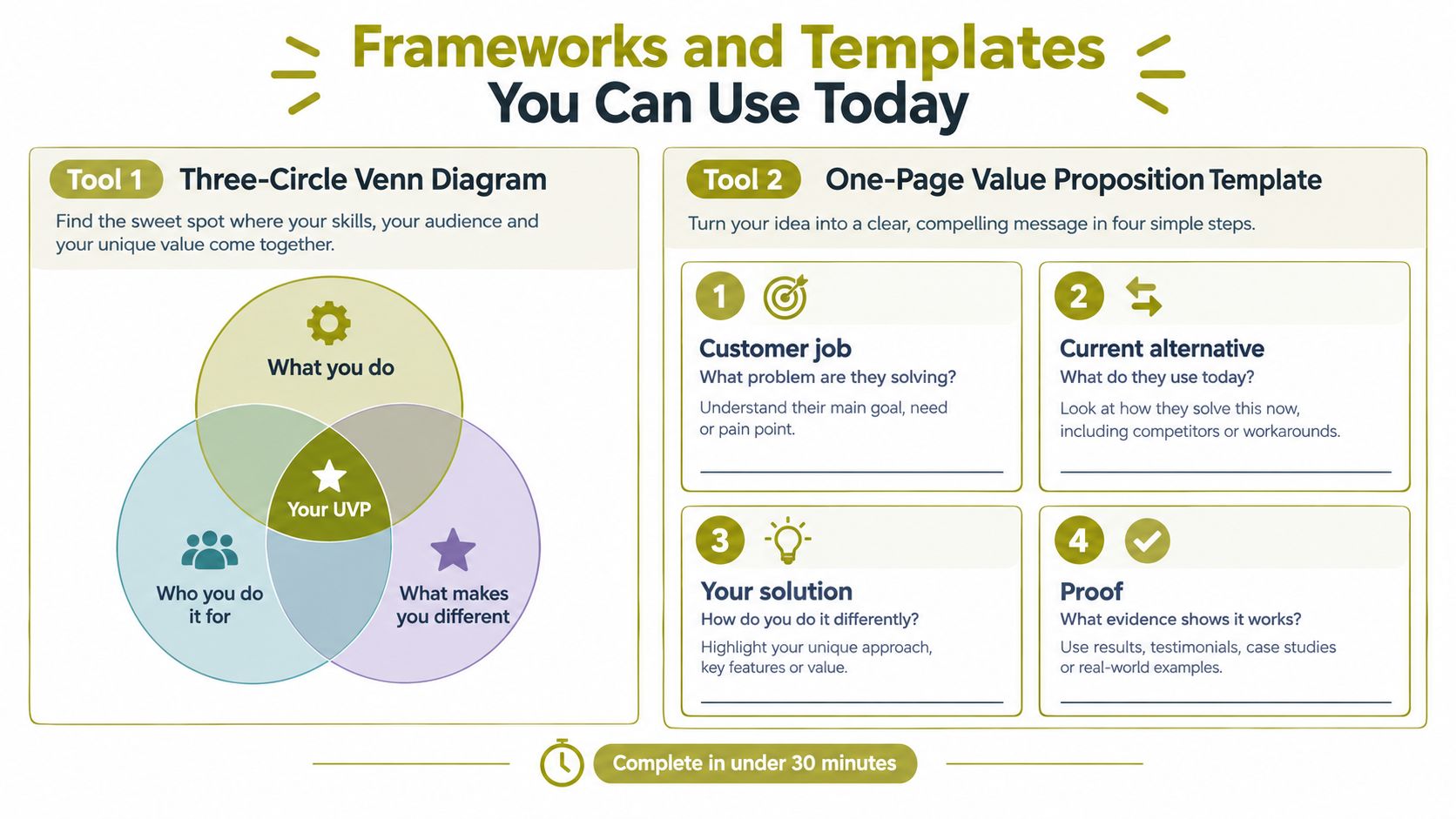
A UVP earns its place when a buyer can understand it, test it and connect it to a real reason to enquire. Keep the first draft to one page. List what you do, who you do it for and how your approach differs. Where those points overlap, you have a candidate proposition, not a publish-ready claim. Check it against the buyer's problem and the proof your organisation can produce.
Use a sentence that forces useful choices
Start with this template:
For [buyer] who struggles with [problem], we deliver [outcome] because [proof], unlike [alternative], which [limitation].
Every bracket has a job. Name the customer and their problem, state the outcome, show why the promise deserves belief, and define the alternative. Vague wording is a signal to investigate, not polish.
For a regulated fintech seeking crisis communications support, a working example might be:
For regulated fintech teams facing media scrutiny, we provide senior-led crisis communications that help them respond accurately and protect stakeholder confidence, backed by clear escalation procedures and access to media-law coordination. Unlike a generalist provider, our approach brings newsroom judgement into the response from the start.
A Scottish tourism operator needs a different proposition:
For Scottish tourism businesses seeking UK-wide attention, we develop newsworthy media stories and digital content that connect visibility with discovery and visitor enquiries, supported by relevant coverage and performance reporting. Unlike a publicity-only approach, we consider how search, user experience and conversion support the journey from interest to booking.
Both examples are drafts, not claims to copy without checking. Before publishing either version, replace broad assertions with proof the organisation can show: a named case example, a verifiable process step or a clear response-time commitment. Processes are part of the promise. A response-time guarantee, for instance, only strengthens the UVP if the team can consistently meet it.
Then test whether the sentence works beyond the page. Read it aloud and ask a customer what they think the organisation does. If their explanation differs from yours, revise the proposition. Use the same discipline when connecting positioning to launch and acquisition decisions. CapyScout's GTM tactics for B2B founders offers useful context for that work.
Matching the UVP to Your Business Condition and Sector
A business doesn't need one unchanging promise for every situation. The core expertise may stay the same, but the customer's urgent job changes as the organisation moves from launch to recovery. A proposition that leads with growth during a period of acute reputational risk can miss what buyers need most.

Match the emphasis to the situation
| Business condition | What the buyer needs most | UVP emphasis |
|---|---|---|
| Launch | Confidence to try an unfamiliar offer | Explain the problem you solve and show why your approach is credible. |
| Scaling | A repeatable way to reach more customers | Connect the promise to delivery capacity, acquisition and customer experience. |
| Stagnation | A reason to reconsider an offer that has stopped gaining traction | Clarify which buyer or problem you serve better than available alternatives. |
| Crisis | A controlled, accurate response under pressure | Lead with preparedness, accountable advice and reliable escalation. |
| Recovery | A credible route back to customer confidence | Show what has changed and how the organisation will deliver differently. |
This isn't abstract positioning. A 2025 survey covered 1,297 UK businesses, 91% of them small businesses, and accompanying Federation of Small Businesses data reported that 27% of small firms expected to shrink, close or sell, the first time the measure had reached that level (UK business survey and small-firm outlook). In uncertain conditions, a promise of resilience, sound judgement or risk reduction may fit the customer's immediate decision better than a broad claim about visibility.
Sector changes the evidence buyers need. Regulated and high-risk organisations may place more weight on rapid crisis access, accurate messaging and media-law coordination than on creative flair. Tourism and hospitality need to connect UK-wide visibility to discovery and conversion. Scottish technology SMEs may prioritise senior counsel, brand search growth and investor credibility, provided those benefits can be substantiated.
A well-built proposition doesn't force those buyers into identical language. It holds onto a consistent capability while making the buyer's main job explicit.
To see how that lifecycle thinking can guide the response when conditions shift, watch this overview.
Embedding the UVP Across Your Website, Messaging and Media Outreach
A UVP that works only in the strategy deck isn't doing its job. It should remain recognisable as it moves from homepage to sales conversation to media pitch, even though each channel needs a different length and emphasis.
Start with the homepage hero. State who you help and the customer outcome in plain language, then use supporting copy to explain the delivery and proof. Write the meta title and description to match that promise, rather than introducing a different claim for search visitors. The About page can expand on why the organisation is qualified to deliver, while the pitch deck should show how the promise connects to evidence and process.
Make the story fit the newsroom
Media outreach requires judgement, not merely a shorter version of the homepage. The Reuters Institute's survey of 1,130 UK journalists found that 63% believed they had substantial editorial autonomy when choosing stories, and 67% reported similar autonomy in selecting story angles. A separate profile recorded an average of 18.5 years of professional experience across respondents (Reuters Institute profile of UK journalists).
That's why a pitch must offer a credible editorial angle, not just repeat a company's preferred message. Carlos Alba Media's specialist nature reflects this distinction: everyone who works for the agency is a former national news journalist or has agency experience of working with international brands. Newsroom understanding can help shape a story around what an editor needs to assess, while keeping the client's facts accurate and relevant.
The same discipline applies to media training. A spokesperson should be able to explain the company's promise consistently on camera, in print and on LinkedIn, without reciting a slogan. Align the team's tone with clear tone-of-voice guidelines, and use a practical guide to campaign calendars to organise how that message appears across planned activity.
Keep three working documents close at hand: a one-page UVP with proof points, an elevator pitch for conversations and a short deck that shows how delivery supports the promise. Review them when the offer or the buyer's needs change. Consistency doesn't mean copying the same sentence everywhere; it means each version makes the same credible case.
The Evidence Audit and Your Next Move
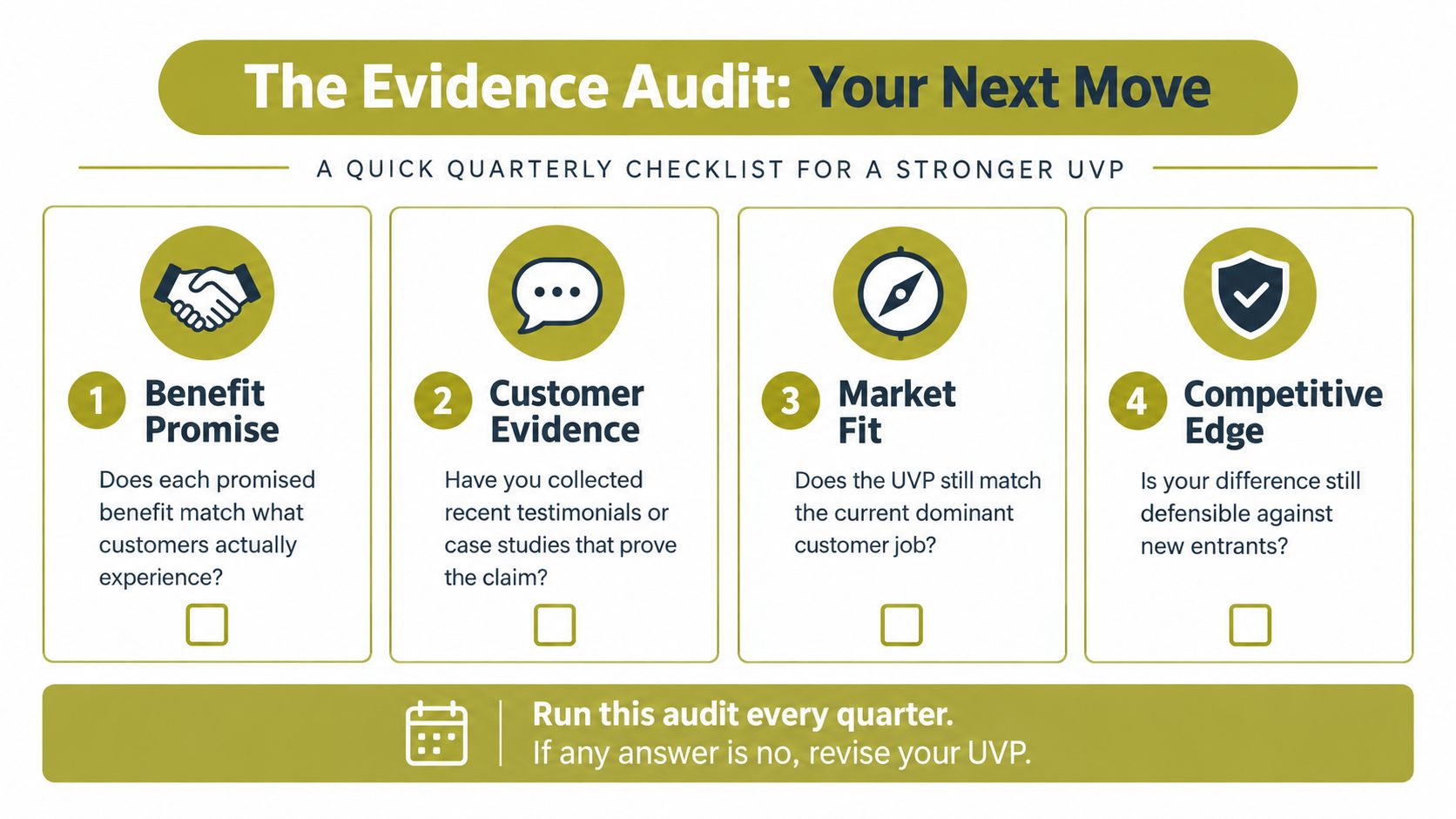
A proposition needs maintenance. Customers change what they need, offers evolve, and a claim that once felt distinctive may become standard. A quarterly review keeps the language tied to the value your team delivers.
Run the audit against proof, not preference
For every promised benefit, ask:
- Benefit promise: Does the customer experience match what the UVP claims?
- Customer evidence: Can you show recent, relevant proof, such as a case example, testimonial or verified result?
- Market fit: Does the promise still address the buyer's current problem?
- Competitive edge: Is your difference still meaningful, and can you explain why?
- Measurement: Do you have a baseline and a target for the outcome you're promising?
- Reporting: Are early signals, such as response time or relevant visibility, separated from later outcomes, such as enquiries, conversion or retention?
Separate what you can measure directly from what you can only infer. Don't claim that a communications activity caused a commercial result unless your evidence supports that conclusion. If an outcome matters to the buyer but you don't yet measure it, make that a reporting priority rather than dressing an assumption up as proof.
UKRI reports that firms consistently investing in innovation are 13% more productive than firms not conducting research and development. Its analysis also associates innovation-grant recipients with higher turnover, employment and productivity growth than non-recipients (UKRI's business innovation evidence). That evidence doesn't mean a positioning statement alone creates growth. It supports a more practical point: make the proposition about repeatable improvements in how you acquire, serve or retain customers.
Take three actions this week. Write a first draft using the five-sentence template. Score it against buyer, problem, benefit and proof. Then review it against recent enquiries and wins, asking customers what made the decision easier. Keep the audit visible and revisit it every quarter.
If your positioning says a lot but gives buyers little reason to enquire, Carlos Alba Media offers brand positioning, PR and digital marketing support grounded in newsroom experience and practical delivery. Visit Carlos Alba Media to discuss how to turn your value proposition into a clear, credible promise across your website and media activity.