
B2B buyers spend only 17% of their time meeting potential suppliers, while 67% research solutions through AI search tools before engaging with sales, compared with just 9% through traditional search engines (UK buyer research). That changes the job. A B2B marketing strategy can't be a list of channels, a trade-show calendar, or a stream of disconnected blog posts. It must help a buying group discover, evaluate, justify and trust a supplier before a salesperson enters the conversation.
For start-ups and SMEs, the practical challenge is sharper. Budgets are constrained, internal expertise is uneven, and attribution often breaks between first click and signed contract. The answer isn't more content for its own sake. It's an evidence-led system that connects positioning, search, thought leadership, media exposure, email, sales enablement and pipeline measurement.
Why Traditional B2B Models No Longer Work
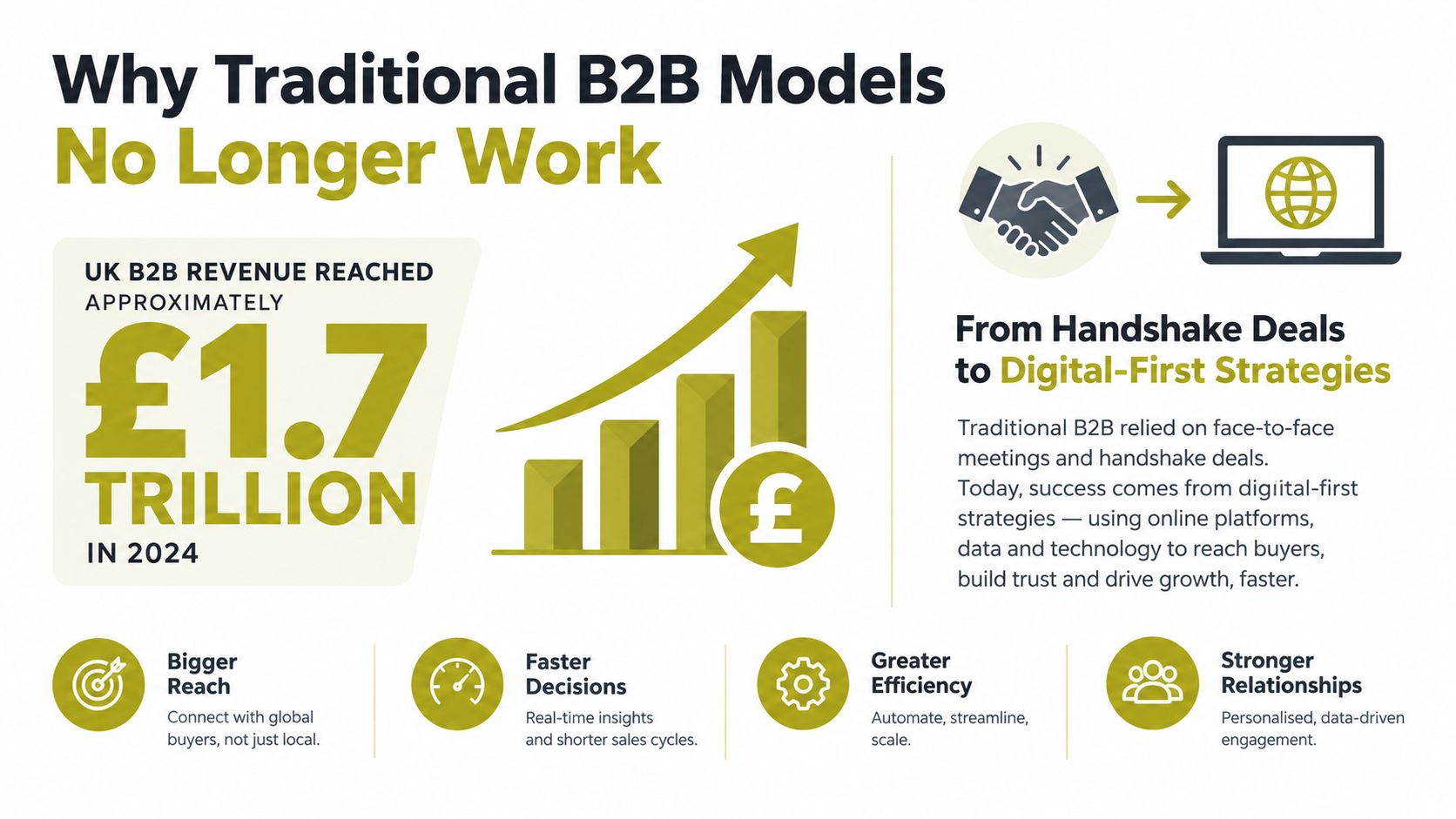
UK companies generated approximately £1.7 trillion in B2B revenue in 2024, representing 44% of all UK business turnover. Digital channels are expected to account for 56% of B2B revenue in 2025, up from 33% in 2021 (UK B2B market data). Those figures expose the weakness of a relationship-only model. Personal introductions still influence deals, but buyers increasingly discover, assess and justify suppliers through digital evidence before a sales conversation begins.
A founder may meet one prospect at an event, yet an entire buying group can form an opinion through search results, company pages, leadership profiles, reviews and shared content. If those assets are absent or inconsistent, the referral loses force. A business can be trusted in a room and remain invisible to everyone else involved in the decision.
Replace the single-channel mindset
Digital marketing is not a publishing schedule. Regular posts cannot compensate for weak positioning, an indistinct offer or a website that gives buyers no reason to continue. A practical strategy must perform three connected jobs:
- Build recognition: Make the organisation known for a defined problem, market or point of view.
- Create demand: Explain the cost of inaction and give the buying group a stronger way to understand the problem.
- Capture intent: Provide a clear route to subscribe, enquire, book a meeting or involve colleagues.
Events, referrals and personal networks can support these jobs, but they cannot carry the entire system. A buyer may hear a company name in a meeting, search for it later, review its website, inspect its leadership team, find independent coverage and circulate an article internally. Every touchpoint either strengthens the business case or introduces doubt.
Practical rule: If growth depends on one person remembering to introduce you, you have a dependency, not a marketing system.
Measure commercial usefulness
Awareness matters when it builds future preference. It is not a sufficient reporting endpoint. Connect each activity to a commercial question: Which buying group did it reach? Which objection did it address? Did it generate a qualified conversation? Did sales use the asset? Did the account progress?
That discipline closes the gap between planning and pipeline attribution. Instead of chasing reach as a vanity metric, teams build a recognisable body of evidence across search, content, email, social and earned media. Smaller businesses gain a clearer basis for deciding what to fund, what sales can reuse and which activities deserve another cycle.
Researching Your Market and Defining Positioning
Research should determine who needs to agree before a deal can progress. Channel selection comes later. Map the commercial problem, the people affected, the evidence each person requires and the objections that can stall approval. This approach replaces a linear buyer journey with a buying-group view, giving resource-constrained teams a clearer route from market insight to pipeline attribution.
A buying group often includes people who never appear in the first enquiry. The person who feels the operational problem may start the search, while finance tests the business case, procurement reviews terms, legal checks risk and a technical stakeholder assesses delivery. Treating one contact as the buyer hides these dependencies and produces content that serves only one part of the decision.

Start with the buying group
Build a research file around five questions:
- Who feels the problem first? Identify the operational manager, founder, finance lead or technical specialist who experiences the cost of the current situation.
- Who can block the decision? Procurement, legal, IT, compliance and finance may enter later, but their requirements can stop progress.
- What must each person prove? One stakeholder may need efficiency, another risk control and another a credible commercial case.
- What language do they use? Interview customers, review sales calls, examine support requests and record the phrases people use to describe the problem.
- What evidence would change their mind? Check whether your proof covers implementation, sector experience, expert commentary, independent coverage and measurable outcomes.
The result should be a positioning statement that names the audience, problem, distinct approach and outcome you can support. Avoid vague claims such as “end-to-end solutions” unless you can explain the work, limits and result in practical terms. Carlos Alba Media's guide to brand positioning offers a useful reference for sharpening that distinction.
Turn positioning into a usable message
Your message must work across the evidence buyers collect. Give the homepage a direct version, the sales deck a commercial version, the opinion article a clear point of view and the technical guide precise detail. The wording can change. The underlying claim should not.
Teams that need a structured starting point can use Sensoriium for structured marketing when the obstacle is prioritisation rather than a shortage of ideas.
Start with a message map, not a content calendar. Link each buyer role to its pain, objection, required proof and next action. Then connect every asset to the account or buying group it supports, so marketing and sales can see which evidence moves a conversation ahead and which content only creates activity. That operating link is where planning becomes attributable pipeline.
Building an Efficient Channel Mix
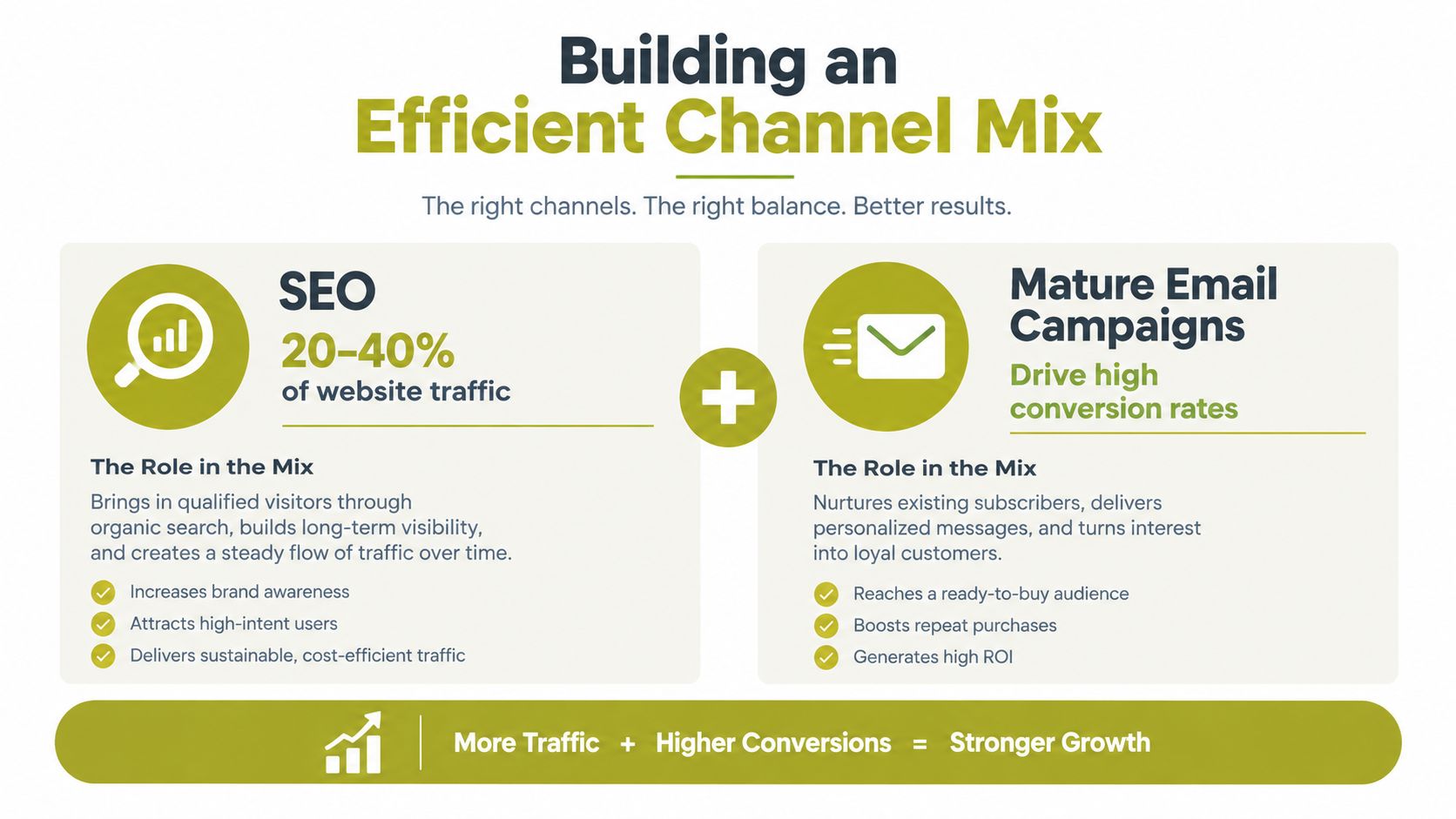
A sensible channel mix starts with assets you own, then adds paid distribution where the economics and evidence support it. UK B2B data places SEO at 20–40% of website traffic, while email-driven conversion rates reach 0.5–2%. Paid LinkedIn typically shows 1.8% conversion and higher costs per lead (UK B2B channel benchmarks).
That doesn't make paid social useless. It makes it a poor substitute for weak fundamentals. Paid media can amplify a strong point of view, reach defined accounts and retarget engaged visitors. It can't make an unclear proposition persuasive.
Build the owned foundation
SEO should capture the questions buyers ask before they know which vendor to choose. Organise content into topic clusters, with a commercially important service or problem page at the centre and supporting articles that answer adjacent questions. Link those pages deliberately, update them when the market changes and use conversion paths that match the reader's level of intent.
Email turns anonymous interest into a relationship you can develop. Offer useful assets, segment contacts by role or subject, and send sequences that help people build an internal case. A finance stakeholder shouldn't receive the same follow-up as a technical evaluator. The list becomes more valuable when every message helps a buying group make progress.
Add paid activity with discipline
Paid distribution earns its place when you can answer three questions:
- What intent are you buying? Search advertising can capture an active problem, while LinkedIn can introduce a defined audience to a useful argument.
- What happens after the click? The landing page must continue the promise, provide proof and offer a relevant next step.
- What will you learn? Test the audience, message, offer and follow-up rather than just increasing spend.
Use paid campaigns to distribute a strong report, promote a distinctive expert view or support account-based activity. Don't use them to hide a thin website or force an unqualified audience into a sales call.
The channel hierarchy should reflect the buying process. Search creates discoverability, content earns attention, email develops familiarity, media coverage adds independent credibility and paid activity increases reach where the message has already proved useful. A channel isn't strategic because it is popular. It's strategic when it performs a defined job.
Targeting Buying Groups with Thought Leadership
Lead generation is too narrow a definition of B2B marketing. A form fill tells you that one person interacted with an asset. It doesn't tell you whether the wider buying group understands the problem, agrees on the priority or trusts your organisation enough to recommend it internally.
In the UK and Ireland, buyers control 57% of the journey before vendor contact, down from 69% in 2024 (UK and Ireland buyer study). That makes consensus-building a marketing responsibility. Your content must work for the person researching, the person approving, the person implementing and the person carrying the risk.
Create content people can pass on
A strong thought-leadership programme gives each stakeholder something useful to share. An operations leader may circulate a practical framework. A chief executive may share a market interpretation. A technical evaluator may need implementation detail. A regulator-facing organisation may need evidence that demonstrates care and competence.
The content should have a point of view, not just a topic. “How to improve your marketing” is a subject. “Why lead volume is masking weak buying-group engagement” is an argument. The second creates a reason to read, discuss and challenge the idea.
The UK evidence supports this approach. 32% of UK thought-leadership enquiries came through content assets in 2025, those leads saw a 20% reduction in form interactions, and the median UK B2B sales cycle from thought-leadership start was 189.5 days (UK thought-leadership data). The figures don't mean every business should produce grand essays. They show that useful authority content can reduce friction before a conventional conversion happens.
Make expertise visible and repeatable
Build a content portfolio around recurring questions:
- Diagnosis: What has changed, and why does the old approach fail?
- Decision support: How should a buyer compare options, suppliers or approaches?
- Internal justification: What can a champion share with finance, leadership or procurement?
- Proof: Which experience, process, expert view or external source supports the recommendation?
Use interviews with subject specialists, customer questions, original analysis and media commentary. A thought leadership content 2026 playbook can help teams develop the editorial discipline behind that work. For a PR-led perspective on the same challenge, see Carlos Alba Media's thought leadership content strategy.
Don't measure thought leadership only by immediate enquiries. Track the accounts reached, the stakeholders engaged, the sales conversations influenced and the objections the content helps remove. The objective is not to sound intelligent. It's to become the organisation buyers trust when several people must agree.
Planning Budgets, Resources, and Measurement
A budget should begin with the commercial outcome, not a list of activities. B2B spend is often modelled at 6–8% of revenue, but the useful question is what the business needs that investment to produce (UK marketing budget guidance). If the target is qualified meetings, work backwards from an acceptable cost per meeting. If the target is pipeline, define which opportunities marketing can credibly influence.
The operating environment is tight. Only 6% of UK B2B marketers receive budget increases of 20% or more, and just 34% say their data is proven in pipeline terms (UK and EMEA B2B marketing report). That combination makes attribution more important, not less.
Build the reverse plan
Start with the sales result and calculate backwards:
- Set the commercial threshold. Define the acceptable cost per meeting, opportunity and customer.
- Agree qualification rules. Specify the account fit, buying problem, authority and timing required before sales accepts a lead.
- Map conversion points. Connect content downloads, enquiries, meetings, opportunities and closed revenue in the CRM.
- Assign channel roles. Decide which channels create discovery, capture intent, nurture interest and support sales conversion.
- Review quality, not just quantity. Ask whether marketing is reaching the right accounts and influencing the right stakeholders.
This framework prevents a common failure: increasing lead volume while sales receives contacts that don't match the offer. A smaller number of well-defined opportunities can be more valuable than a large database with no shared qualification standard.
Fix the evidence gap
Attribution won't be perfect, especially when buyers move between search, AI tools, dark social, email, events and sales conversations. That isn't a reason to abandon measurement. Use consistent campaign naming, connect forms and CRM records, record content influence in opportunity notes, and ask sales which assets appear in active buying conversations.
Measurement principle: Treat attribution as an operating agreement between marketing and sales, not a dashboard that marketing owns alone.
Resource constraints also demand ruthless prioritisation. Choose one priority audience, one commercial problem and a small set of repeatable formats. Improve the conversion path before adding another platform. Automation can distribute weak thinking faster, but it can't decide which claim a buying group should believe.
Leveraging Specialist Expertise for Credibility
The gap between having a content strategy and producing commercial results is substantial. 97% of B2B marketers have a content strategy, yet only 13% say they've seen significant improvement in results and ROI (UK content marketing analysis). The problem usually isn't a blank page. It's generic positioning, weak editorial judgement, inconsistent production and no clear connection to pipeline.
Specialist expertise helps because experienced practitioners know what to remove. They can distinguish a real market tension from a bland trend, turn a technical subject into a clear angle and ask the questions that reveal a useful argument. That matters when buyers already have access to endless information.
Use newsroom discipline
Carlos Alba Media is a Scottish-led agency whose people are former national news journalists or have agency experience working with international brands. Its public PR positioning says team members should have former newsroom or strong agency experience, with newsroom training used to strip filler and find the angle (Carlos Alba Media's specialist PR approach).
That background changes execution. A journalist doesn't begin by asking how many posts a company should publish. They ask what has changed, who is affected, what evidence exists and why an editor or buyer should care. Those questions produce stronger media pitches, sharper executive commentary and content that has a reason to exist.
Choose partners for judgement
A specialist partner should improve more than output volume. Assess whether it can:
- Find the angle: Turn internal expertise into a relevant story, argument or campaign hook.
- Strengthen proof: Identify missing evidence and make claims precise enough for scrutiny.
- Reach the right audience: Combine SEO, digital content, social distribution and earned media around the buying group.
- Support spokespeople: Prepare founders and executives to explain complex issues clearly in interviews and public commentary.
- Connect activity to revenue: Work with sales and leadership to track meaningful influence rather than vanity reach.
For teams coordinating several contributors, Bidwell for comms managers offers a useful reference point for managing communications workflows and responsibilities. The partner still needs to bring editorial judgement, commercial understanding and the confidence to challenge weak ideas.
Carlos Alba Media combines PR strategy with SEO-led articles, social campaigns, multimedia storytelling, web development and conversion-focused digital marketing. Its B2B public relations agency service is relevant when a business needs media exposure and digital authority to work together rather than sit in separate plans.
The right execution partner won't replace internal expertise. It will package that expertise so buyers can find it, understand it and share it. That's the operational bridge between a strategy document and a reputation that supports pipeline.
Carlos Alba Media helps start-ups, SMEs and established organisations build B2B visibility through journalist-led PR, SEO content, digital marketing, web development and media training. If your strategy needs sharper positioning, credible thought leadership and measurable distribution across search, digital and earned media, visit Carlos Alba Media to discuss the commercial problem you need to solve.