
A PR campaign is a coordinated, measurable series of communications activities designed to secure earned media, shape perception, and drive tangible business outcomes such as enquiries or sales. In the UK, public relations and communication activities were estimated to be a £4.3bn market in 2026, with 6,160 businesses and 36,578 people employed in the sector (IBISWorld).
A familiar situation plays out in businesses of every size. A company has a useful product, a credible founder and a timely announcement, but its team sends one press release, posts about it on LinkedIn and waits for journalists to call. Nothing much happens. The problem usually isn't that the business has no story. It's that nobody has turned the story into a campaign with a defined audience, a reason to care, suitable media targets and a way to judge whether the work changed anything.
What a PR Campaign Actually Is
A PR campaign is a planned programme of communication built around a specific reputation or business objective. It may involve research, story development, press office work, interviews, events, social content, stakeholder communication, spokesperson preparation and measurement. The activity works as a connected system, rather than as a collection of isolated promotional moments.
A press release can announce a development. A campaign gives that announcement context, supporting evidence, relevant voices and a route to the people whose opinions or actions matter. If a Scottish technology company wants to attract investors, for example, its campaign might combine founder interviews, customer evidence, commentary on a market issue and carefully timed engagement with business journalists. The objective isn't just to appear in print. It's to make the company more credible to a defined group of decision-makers.
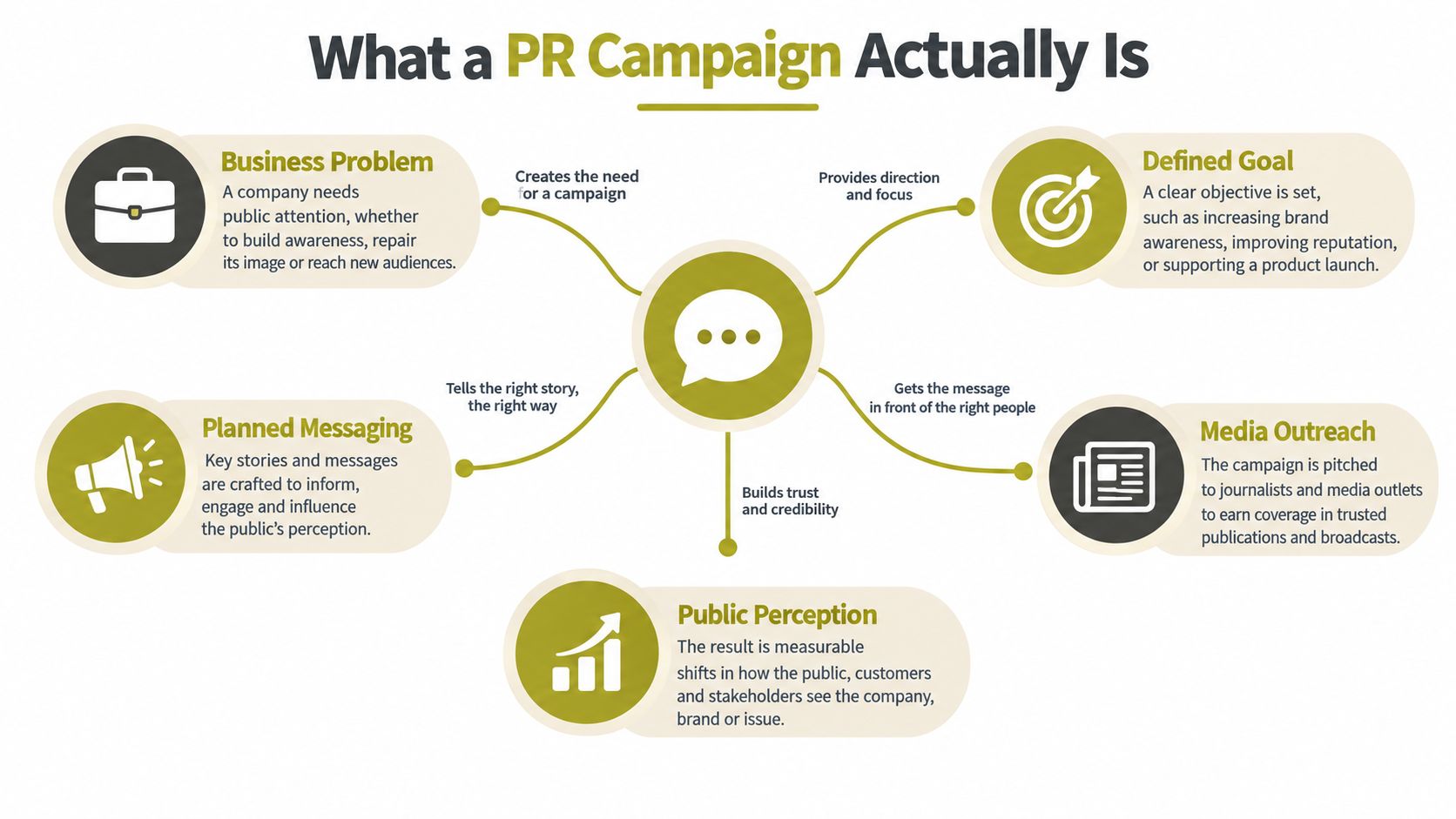
Campaigns have a beginning, a centre and an end
Good campaigns start with a problem. The business may need to launch a product, repair confidence, enter a new market, support recruitment or prepare stakeholders for change. The team then defines the audience, develops a credible narrative and chooses communication channels that can reach that audience.
The UK industry has the scale and professional structure to support this kind of work. The market value of public relations and communication activities rose at a 2.6% compound annual growth rate from 2021 to 2026, while business numbers grew at a 1.3% compound annual growth rate over the same period (IBISWorld). That context matters. PR campaigns aren't informal publicity dressed up with a title. They belong to an established professional services discipline.
A campaign can also change behaviour, not just visibility. For examples of campaigns that changed behavior, look for work where the communications activity connects a public message with a clear response, such as participation, enquiries, applications or purchasing decisions.
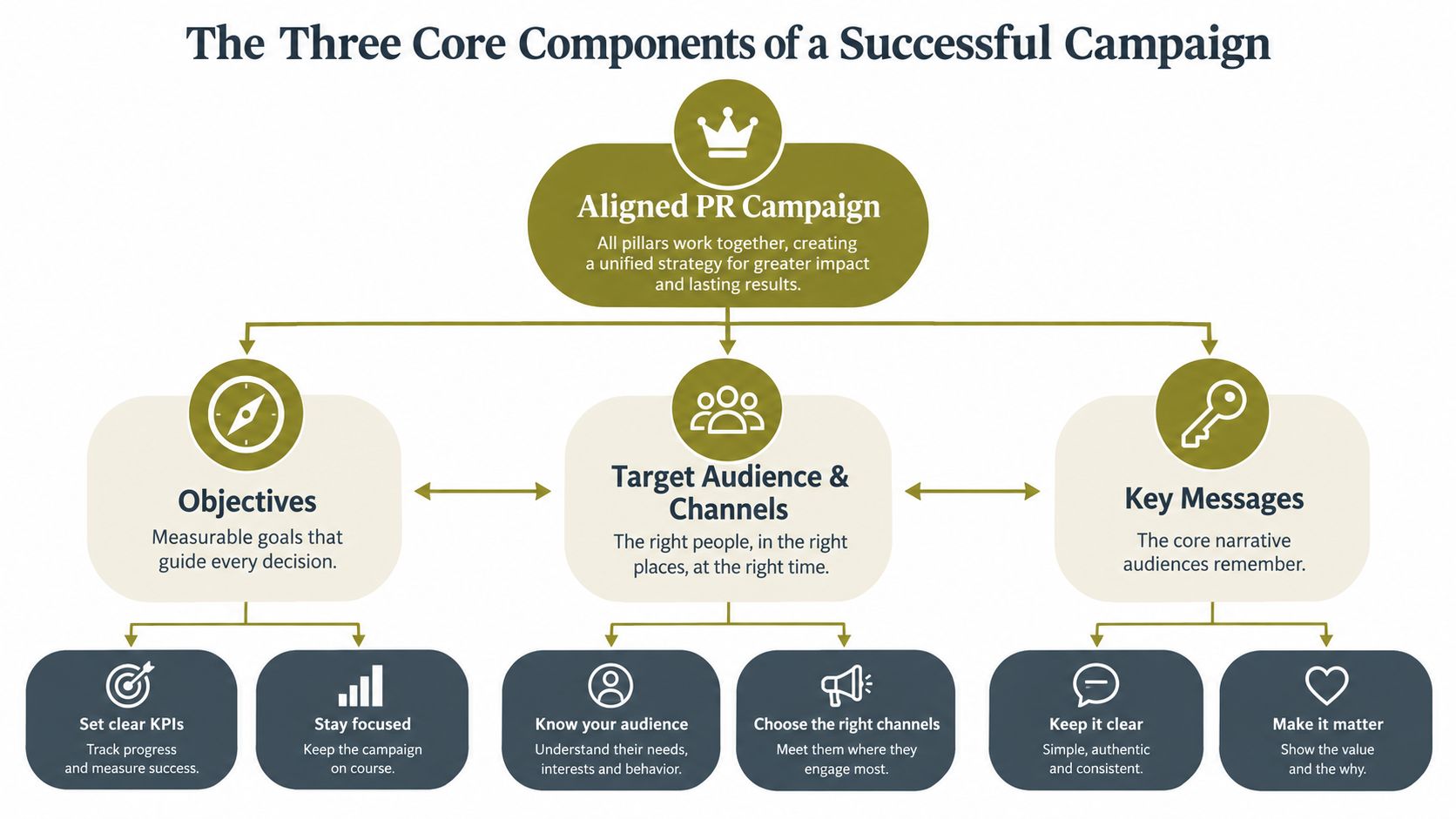
The Three Core Components of a Successful Campaign
A campaign becomes coherent when objectives, audience and messages reinforce one another. Remove one of those elements and the media activity tends to become reactive.
Objectives decide what the work must achieve
“Get more publicity” isn't a useful objective because it doesn't tell anyone what to prioritise or measure. A stronger objective might be to support a product launch, increase qualified enquiries, reassure customers after an incident or establish a founder as a credible commentator.
The objective affects every later decision. If the business wants investor attention, a consumer lifestyle outlet may create awareness but fail to reach the people who can provide funding. If the business needs local recruitment, national coverage may offer prestige without solving the hiring problem.
Audience and channels determine where effort goes
A campaign should identify people by their relationship to the organisation, not only by demographic labels. Customers, regulators, employees, investors and journalists need different evidence and different forms of reassurance.
Media selection follows from that understanding. A trade publication may carry more influence with procurement teams than a larger general-interest outlet. Broadcast exposure can build recognition, while a detailed interview may give a technical buyer the information needed to proceed. A considered media relations strategy for 2026 should therefore account for editorial relevance, timing and the journalist's specialist interests, rather than treating every publication as interchangeable.
Key messages protect meaning
Messages should be concise enough to remember and substantial enough to withstand scrutiny. They need proof, not just polished language. A company claiming to improve an industry should be able to explain how, for whom and with what evidence.
Message discipline doesn't mean every spokesperson repeats a script. It means the campaign has a clear centre, so interviews, press materials, social posts and stakeholder updates don't contradict one another. UK journalists place particular value on accuracy. In Cision research, 81% of UK journalists said ensuring content is completely correct was paramount, while 44% ranked press releases as the most reliable brand news source and 23% placed official spokespeople second (Cision).
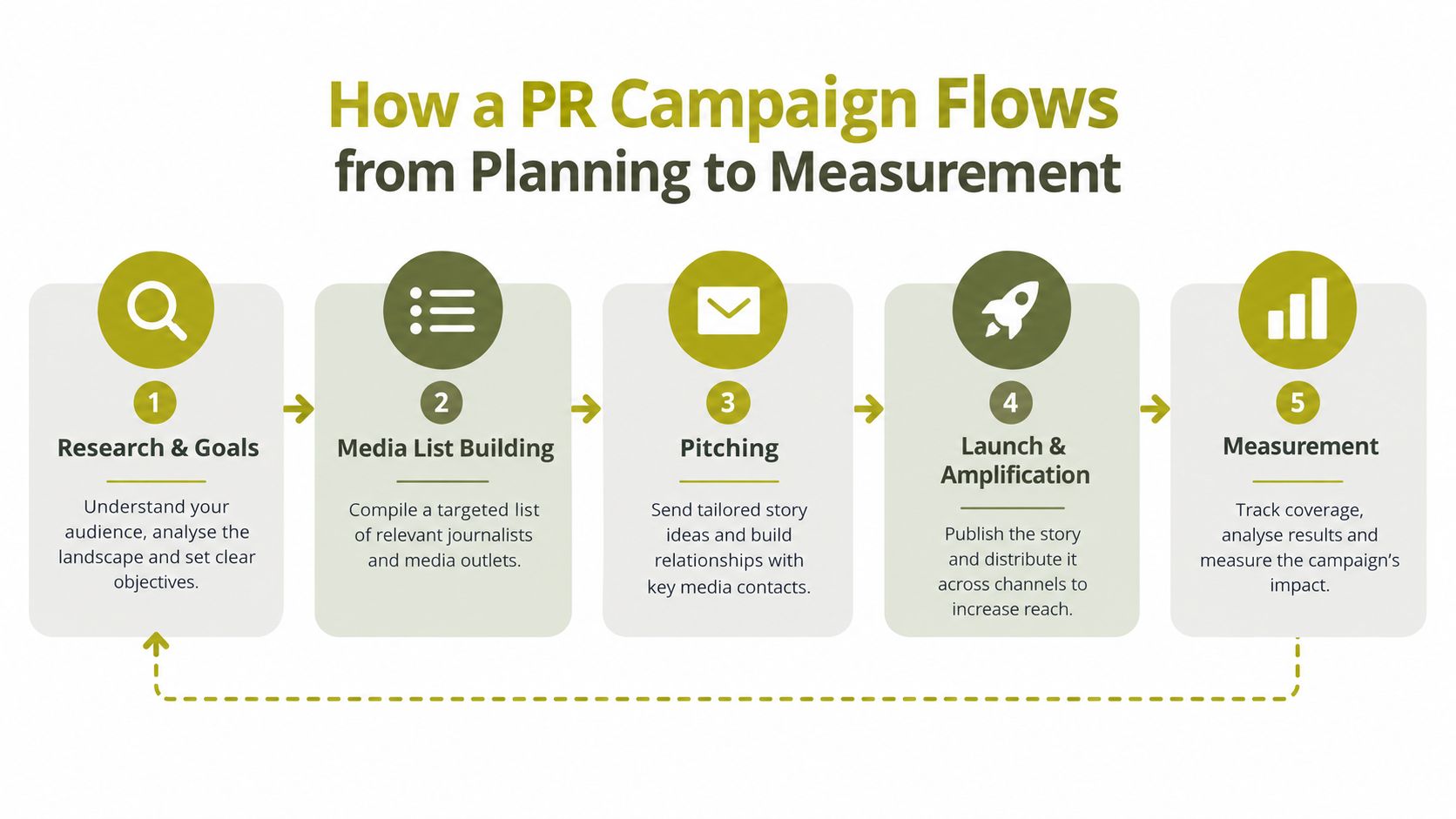
How a PR Campaign Flows from Planning to Measurement
The campaign lifecycle is sequential, but it isn't rigid. Editorial calendars change, competitors announce news and breaking events can make a carefully prepared angle irrelevant within hours.
Research and goals come first
Start by examining the organisation's position, audience concerns, competitors, existing reputation and available proof. Speak to the people closest to the issue. Sales teams often know which objections prevent conversion, while customer service teams hear the language customers use when trust breaks down.
Set the objective and agree the evidence that will indicate progress. This prevents the campaign from becoming a stream of attractive but disconnected ideas.
Build a media list around relevance
A useful media list isn't a directory of famous publications. It names journalists who cover the subject, understand the audience or have recently written about the problem. Read their work before contacting them. Note the formats they use, the evidence they request and whether they prefer comment, data, interviews or contributed material.
Pitch with a reason to publish
Journalists don't need a description of everything the organisation does. They need a timely, relevant story with a clear public interest. A pitch should explain why the issue matters now, why the proposed spokesperson is qualified and what material is available.
Launch, amplify and stay ready
Once coverage begins, the organisation should support it through owned channels, customer communication and internal briefing. A campaign can also require crisis preparation, legal review or media training, especially in regulated or high-risk sectors. Public relations service descriptions in the UK commonly include media relations, crisis communications and spokesperson support because these functions often meet the same need, protecting credibility when scrutiny increases (Prestbury Marketing).
Events can create useful opportunities for interviews and visual coverage, but they require their own planning around attendance, access and follow-up. Organisations considering this route can review public relations events as part of a wider campaign rather than treating an event as the campaign itself.
The video below offers another visual introduction to how PR activity can be organised in practice.
Measure and adjust
Measurement should begin before outreach. Record the baseline, track activity as it happens and use the findings to improve the next decision. A campaign that receives coverage but fails to generate the intended response may need a sharper proposition, a different audience or better conversion paths.
Measuring PR Campaign Success Beyond Vanity Metrics
Coverage volume is easy to count, which is why teams often mistake it for success. A long list of media mentions can look impressive while telling the business very little about whether people understood the message, changed their view or took action.
The established UK approach separates measurement into outputs, outtakes and outcomes. The framework described by the Institute of Public Relations treats these as different stages of effect, not interchangeable labels (Institute of Public Relations).
Outputs show what the campaign delivered
Outputs include the volume and quality of coverage, the type of outlet, the likely target-audience reach and whether the intended message appeared. These measures help answer operational questions. Did the campaign reach relevant publications? Did journalists use the correct facts? Did the spokesperson appear in the intended format?
Outputs matter, but they describe distribution rather than persuasion. A mention in an irrelevant outlet may contribute little, while a smaller piece read by a valuable stakeholder may deserve closer attention.
Outtakes show what audiences understood
Outtakes examine awareness, recall and perception. The organisation can ask whether the audience noticed the campaign, remembered the main point or viewed the organisation differently after exposure. Where practical, teams should compare findings before and after activity.
This layer is particularly important in low-trust environments. Recent UK-facing coverage citing Reuters Institute data reported that only 36% of UK respondents trusted most news most of the time (Cision resources). Earned media may provide access, but access alone doesn't guarantee belief. The quality of the source, the clarity of the explanation and the credibility of the spokesperson all influence what audiences take away.
Outcomes connect PR with the organisation
Outcomes track behaviour, including enquiries, applications or sales lift. The strongest measurement plan uses repeatable benchmarks and attempts to separate PR effects from advertising, promotions and other communications influences.
Practical rule: Don't ask only how much coverage you secured. Ask what changed for the audience and what action followed.
A practical report might therefore combine a qualitative review of message inclusion with website enquiry data, tracked referral paths, stakeholder feedback and sales-team observations. It won't make every influence perfectly isolated, but it gives decision-makers a more honest account than clip counts alone. Guidance on measuring PR effectiveness can help teams turn that principle into a reporting process.
When General Promotion Becomes a True PR Campaign
A social post, announcement or media mention becomes part of a PR campaign when it serves a shared objective and connects with other planned activity. On its own, a post may attract attention. A campaign uses the post to reinforce a narrative already expressed through interviews, stakeholder briefings, editorial coverage and follow-up content.
| General promotion | True PR campaign |
|---|---|
| Reacts to opportunities as they appear | Creates a planned sequence around an objective |
| Focuses on activity and visibility | Connects communication with perception and behaviour |
| Uses one broad message | Adapts a central message for different audiences |
| Ends when the announcement is published | Includes follow-up, response handling and measurement |
A one-off release can work when the news is strong and timely. It usually fails when the organisation expects publication to create demand without explaining why the story matters to a specific audience. The same applies to social activity. Frequent posting doesn't compensate for a weak proposition or an absent route to action.
The trust environment makes this distinction more important. News coverage can provide useful third-party attention, but it isn't a guarantee that audiences will accept a claim. Campaigns need accurate evidence, credible voices and communication that acknowledges reasonable concerns.
Political and civic organisations show how closely campaign materials must align with audience, message and timing. Practical suppliers such as Election Campaign Materials & Political Supplies support the physical side of that work, but printed material only contributes when it forms part of a broader, coordinated communication effort.
Why Former-Journalist Expertise Shapes Better Campaigns
A newsroom-trained practitioner knows that a journalist's first question is often simpler and harsher than a brand expects: why does this matter to the audience now? That discipline improves campaign ideas before anyone starts pitching. It also exposes weak claims, missing evidence and spokespeople who aren't ready for scrutiny.
Accuracy matters as much as originality. UK journalists value correct, properly sourced material, and a former reporter understands the pressure created when a release contains an unclear figure, unsupported assertion or misleading headline. Editorial experience also helps a practitioner distinguish a real news angle from an internal announcement that matters only to the organisation.
Former journalists bring practical knowledge of how stories are commissioned, edited and timed. They understand that a national desk, trade editor, radio producer and digital reporter may need different versions of the same story. They know when to offer an interview, when to provide background and when silence is wiser than a forced comment.
Carlos Alba Media has a specialist nature that reflects this model. Everyone who works for Carlos Alba Media is a former national news journalist or has agency experience of working with international brands. That combination brings newsroom judgement together with experience of brand communications, campaign planning and stakeholder expectations.
The wider UK market treats editorial experience as a concrete qualification. Lantern Comitas describes senior advisers with backgrounds writing for the FT, BBC, Reuters and Bloomberg, while PR Agency One refers to ex-national news journalists and NCTJ-qualified professionals working to place stories across print, online and broadcast media (Lantern Comitas, PR Agency One). Those examples illustrate why newsroom experience affects campaign mechanics, not just agency positioning.
Planning Your First PR Campaign
Start with the business problem, not the desire to appear in the media. Decide whether you need awareness, reassurance, qualified enquiries, stakeholder support or a stronger position in a particular conversation. Then ask a prospective PR partner how it will define success, test your story, handle difficult questions and report outcomes.
Don't assume a campaign needs the largest possible media list. It needs the right audience, a defensible message and people who can deliver it under pressure. Ask who will provide senior counsel, whether the team understands your sector and how it will distinguish useful coverage from noise.
A press release remains a practical campaign asset when it contains accurate, relevant news. Guidance on press release writing can help founders and communications teams prepare material that respects editorial needs rather than reading like an advertisement.
Carlos Alba Media provides public relations, media exposure, digital content, media skills training and crisis communications for start-ups, SMEs and established organisations. If you need a campaign built around credible journalism, clear objectives and measurable outcomes, visit Carlos Alba Media to discuss the story, audience and business result you need to achieve.