
Most advice about digital marketing packages for small business starts with the wrong question. It asks how many blog posts, social updates and ad campaigns an agency can deliver. A cash-conscious founder should ask something more commercially useful: which part of the customer journey is currently losing money?
A package that produces plenty of activity but fails to capture enquiries, generate calls, earn trust or turn qualified visitors into customers is an expensive reporting exercise. UK SMEs already recognise that digital marketing is no longer experimental. Seventy-four per cent trust digital advertising, 81% say it's important to business success, and 64% actively invest in paid digital marketing, according to UK small-business digital marketing data. The challenge now isn't whether to participate. It's deciding where limited budget deserves to go first.
Rethinking the Standard Agency Service Menu
The popular agency menu usually looks reassuring. You get a set number of articles, a batch of social posts, campaign management and a monthly report. The problem is that deliverables aren't outcomes. Four well-written articles won't compensate for a website that hides its enquiry form, and eight social updates won't rescue an offer that gives visitors no reason to act.
More channels don't automatically create better results. A small business can be visible on Google, Instagram, Facebook and LinkedIn while still failing to convert the people who arrive. In a flat-budget market, spreading effort across every channel often creates shallow execution, slow learning and unclear accountability.
Practical rule: fund the conversion bottleneck before funding another channel.
Fix the commercial foundations first
Start with the assets closest to revenue. Review the website's mobile experience, page speed, calls to action, contact process, service pages and trust signals. Check whether the Google Business Profile reflects the current offer, service area, opening information and customer experience. Build a practical system for requesting and responding to reviews, rather than treating reputation as something that happens by chance.
This work may look less glamorous than a content calendar, but it improves the value of every future visit. Search traffic, paid clicks, social referrals and media coverage all become more useful when the destination answers the buyer's questions and makes the next step obvious.
A useful package should therefore be built around a commercial sequence:
- Diagnose the leak: identify where prospects abandon the journey.
- Repair the conversion layer: improve pages, forms, tracking, local presence and trust signals.
- Activate the strongest channel: choose search, social, content, email or PR according to buyer intent.
- Measure business actions: track qualified leads, bookings, calls, sales or applications, not reach alone.
- Expand carefully: add channels only when the first layer has enough evidence and capacity.
For a practical view of how services can be organised, compare the digital marketing agency services list, then challenge the provider to explain which elements your business needs now and which can wait. The right proposal may contain fewer services than the most impressive-looking one. That's a strength when every pound has to earn its place.
Core Components of a High-Performance Package
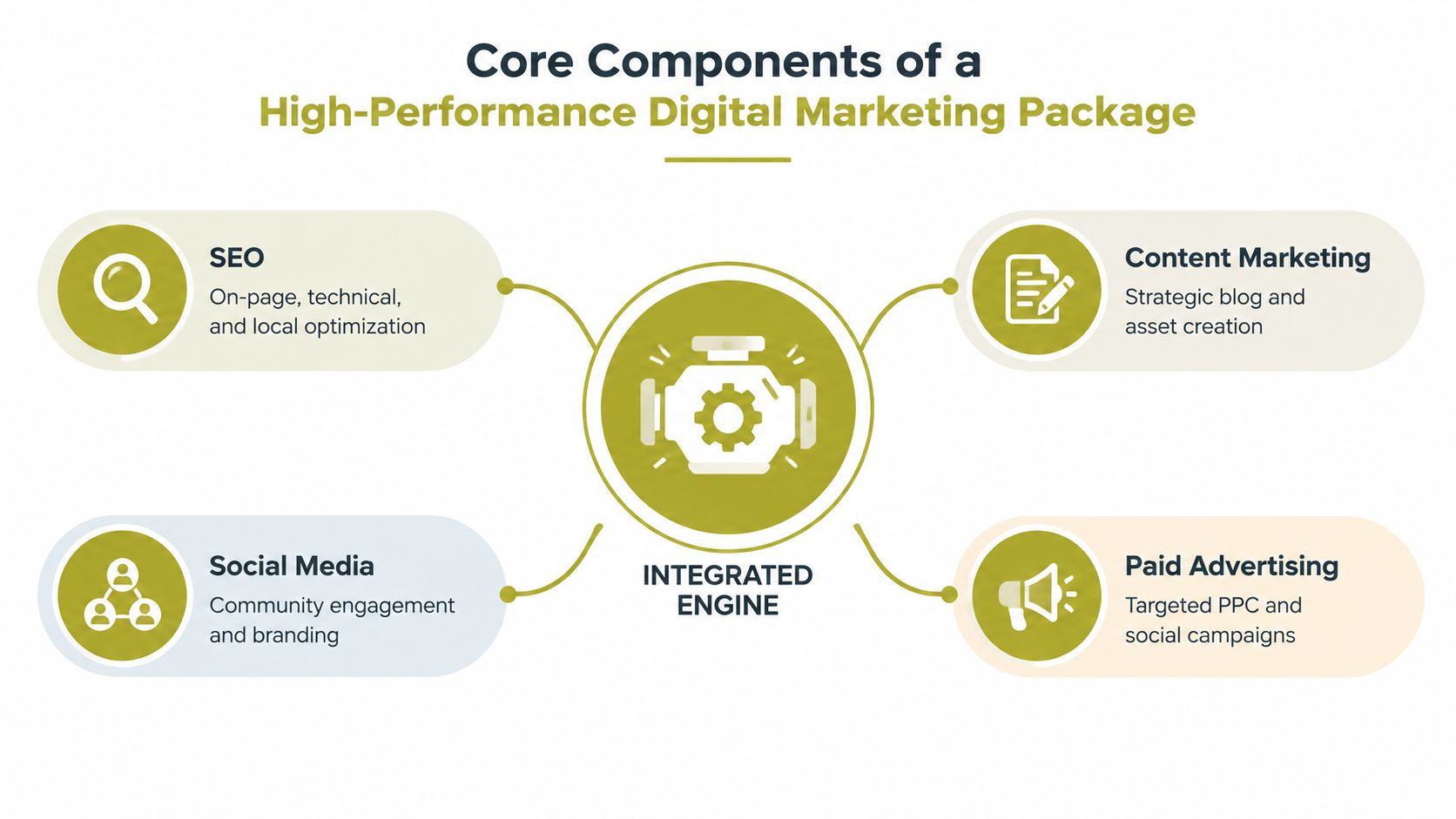
A high-performance package isn't a pile of separate services. It's an operating system in which each discipline supports the next commercial decision.
What each component should deliver
SEO should make the right pages discoverable for the searches your customers use. That includes technical accessibility, on-page relevance, internal linking, service and location pages, and local optimisation. It isn't a promise of rankings. It's a disciplined way to align your site with demand.
Content marketing should answer real buying questions and provide useful material for search, sales conversations, email and social distribution. A content brief should connect to a business objective. “Publish consistently” isn't a strategy if nobody can explain which customer objection the content addresses.
Social media has two jobs. It can build familiarity and trust, and it can distribute useful content or offers to audiences who may not be actively searching. A good package defines the role of each platform, the audience, the creative format and the action you want people to take.
Paid advertising buys speed and control, but it doesn't remove the need for sound messaging or a credible landing page. Search campaigns can capture existing intent, while paid social can create demand and retarget people who already know the brand. Both need conversion tracking and regular optimisation.
The supporting infrastructure
Web development and user experience hold the system together. A technically polished campaign still underperforms when a visitor can't understand the proposition, find evidence or complete an enquiry. Analytics should record meaningful events, connect marketing activity to lead quality and give the owner a report they can use.
Email automation can then nurture people who aren't ready to buy immediately. PR and digital outreach can add third-party credibility, particularly for specialist businesses where trust matters before a prospect makes contact.
For a broader framework for comparing scope, measurement and channel selection, this small business marketing ROI guide offers a useful resource. Use it as a questioning tool, not as a reason to purchase every service listed.
The test is simple. Can the agency show how a search insight becomes a page, how that page supports an advert or sales conversation, and how the resulting action appears in reporting? If the answer is no, you're looking at disconnected production rather than an integrated growth engine.
Pricing Models and Realistic UK Budgets
A broad service menu is a poor use of a flat SME budget. Price matters, but efficiency depends on how much focused work remains after strategy, production, technical setup and media spend are separated. Prioritise the constraint blocking growth, then fund the channel and conversion work that can address it.
UK small businesses commonly pay about £1,000 to £2,000 per month for a managed digital marketing package. Broader agency retainers can range from £500 to £5,000 monthly, depending on channel mix and complexity, as outlined in this UK digital marketing cost guide. Use those figures as context, not as a buying formula. This guide to digital marketing agency pricing packages can help you compare scope, responsibilities and likely outputs before accepting a proposal.
Compare the main pricing models
A fixed-fee retainer provides predictable monthly costs and a defined scope. Choose it when the agency can connect its deliverables to a commercial priority. Check whether you are paying for activity that produces reports or assets without improving enquiries, sales opportunities or retention.
Performance-based pricing can align incentives, but the contract must define the result. Agree what counts as a conversion, who controls the sales process, how lead quality is assessed and what happens when pricing, stock, sales follow-up or market conditions affect revenue.
A hybrid model usually gives an SME the clearest control. Pay a stable fee for strategy, execution and reporting, then set a separate media budget or incentive linked to measurable outcomes. Keep agency fees and advertising spend visible as different line items.
| Monthly Budget | Typical Scope | Strategic Focus |
|---|---|---|
| £500 | Narrow audit, advice or one tightly defined activity | Repairing a specific gap |
| £1,000 to £2,000 | Managed channel support with reporting and optimisation | Building a focused lead or sales engine |
| £2,000 to £5,000 | Broader channel mix, content, technical work and campaign management | Coordinated growth across several priorities |
The UK market's scale makes measurement a practical requirement. Digital advertising reached £35.53 billion in 2024, up 13% year on year, with search representing 47% of total spend at about £16.6 billion, according to IAB UK's digital advertising update. A small business does not need national-advertiser budgets. It does need the same discipline: define the conversion, record it reliably and check whether spend creates commercially useful demand.
A £500 retainer can suit a contained problem. It becomes poor value if it is expected to cover SEO, social, PPC, content, web work and reporting at once. Focus beats dilution.
Tiered Package Blueprints and Channel Economics
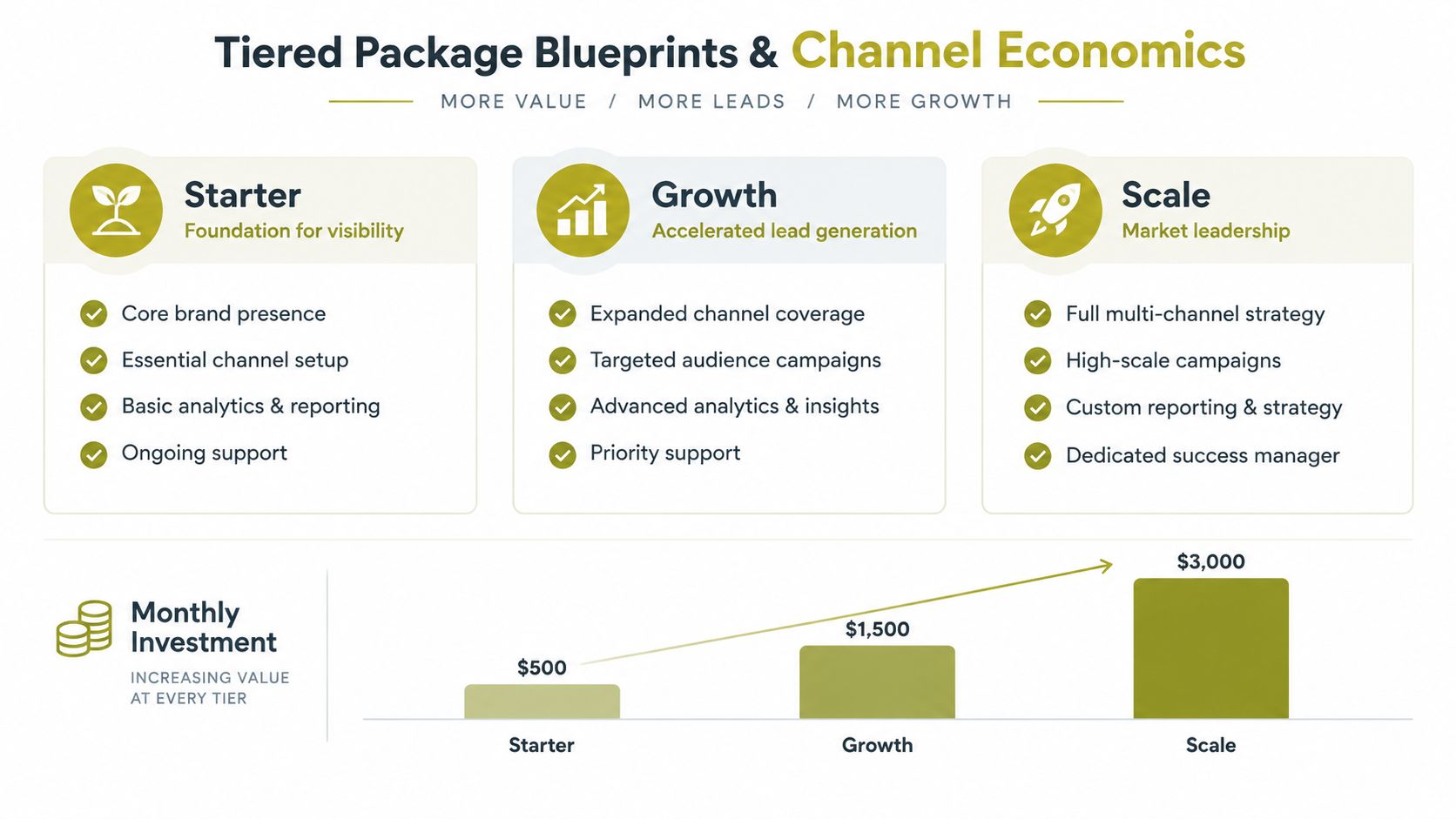
A package should reflect the business's immediate constraint. The following blueprints are planning models, not promises. Adjust them around your sales cycle, existing assets, internal capacity and the difference between agency fees and media spend.
Starter package
Use this tier when the business has weak foundations or limited budget.
- Conversion audit: review the main service page, enquiry path, calls to action and tracking.
- Local visibility: improve the Google Business Profile, core local pages and review process.
- Owned search: prioritise technical and on-page SEO around commercially relevant services.
- Reporting: record enquiries, calls, bookings or sales actions that can be tied to marketing.
Don't split a small budget across every platform. Build a reliable base, then use the evidence to decide whether paid search, content or social deserves the next investment.
Growth package
Choose this tier when the conversion path works and the business needs more qualified demand. Combine focused SEO and content with one paid channel. Search is often the rational first choice where prospects already express clear intent, while paid social can support awareness, retargeting and creative testing.
UK benchmarks show why channel selection matters. SEO and organic search are associated with a £8 to £25 cost per lead and a 2.9% conversion rate. Branded PPC is associated with £18 to £42 CPL and a 6.2% conversion rate, while generic PPC rises to £38 to £95 CPL with a 2.2% conversion rate, according to UK marketing benchmark data. These figures don't predict your results, but they demonstrate why a cash-constrained SME shouldn't assume broad generic acquisition is automatically superior.
Scale package
This tier suits a business with proven conversion infrastructure, a clear sales process and enough capacity to handle increased demand. It may combine technical SEO, strategic content, branded and non-branded paid search, paid social, email automation, digital PR and more advanced reporting.
The order still matters. Scale doesn't mean launching everything at once. Allocate additional investment to the channels that have earned expansion through lead quality, sales acceptance and measurable revenue contribution.
Decision test: if an agency can't explain what each tier stops, starts or improves, it hasn't designed tiers. It has only changed the price.
Review proposals against the blueprint that matches your current constraint. A package that funds one channel properly can be more valuable than a larger menu that leaves every channel underpowered.
The Value of Senior-Level Specialist Counsel
Small businesses often compare agencies by deliverables because deliverables are easy to count. They should also ask who will make the decisions, write the messaging, challenge weak assumptions and handle the account when the market changes.
Carlos Alba Media's specialist nature is built around a specific staffing profile. Everyone who works for Carlos Alba Media is a former national news journalist or has agency experience of working with international brands. That combination matters because good digital marketing depends on editorial judgement, commercial discipline and the ability to understand how different audiences respond to information.
Journalism brings useful commercial instincts
Former journalists understand what makes a story clear, relevant and credible. They know how editors assess information, how a narrative gains attention and why unsupported claims weaken trust. Independent UK PR agencies also position former journalists around newsroom decision-making, editorial insight and media relationships, as described by Lantern Comitas on public relations expertise.
That experience can improve more than a press release. It can sharpen service-page copy, identify a founder's strongest point of view, turn customer evidence into useful content and prepare spokespeople for difficult questions. In regulated or reputation-sensitive sectors, clear judgement is a commercial safeguard.
Brand agency experience adds structure
Experience with international brands introduces another useful discipline. Larger campaigns demand consistency across audiences, channels, approvals and markets. An SME doesn't need the overhead of a large network to benefit from that level of thinking. It needs senior people who can make priorities clear and execute without burying the owner in process.
UK communications agencies explicitly use former journalists as a staffing model, including teams with regional and national broadcasting backgrounds, as shown by Shout Communications. That makes the distinction concrete. You're not buying a vague claim about “storytelling”. You're assessing a team's actual experience of editorial standards, media pressure and public communication.
Explore Carlos Alba Media's agency work when assessing whether its blend of PR, content, web, social and reputation support fits your needs. The right specialist partner won't just complete a task list. They'll tell you which task deserves attention, which can wait and what evidence will justify the next decision.
Sector-Specific Considerations for UK SMEs
A generic package fails when the buying context changes. A hotel, a tourism operator and a regulated B2B provider may all need search visibility, content and reporting, but their conversion signals, reputational risks and seasonal pressures are different.

Tourism and hospitality
Tourism businesses need visual proof, practical information and strong local or destination relevance. A package should connect photography, video, landing pages, search visibility, reviews and media outreach rather than treating social content as decoration. Visitors may compare experiences, transport, availability and reputation before they make contact, so the website must answer those questions quickly.
Hospitality businesses also need to manage changing demand. The package should distinguish between evergreen visibility and timely promotion, then track actions such as bookings, calls, directions and enquiries. A restaurant may prioritise local search and review generation, while a destination business may need editorial coverage and content designed for visitors researching a wider trip.
For a useful explanation of how local visibility supports smaller firms, consult this guide to local SEO benefits for small businesses. Apply its principles to the specific locations, services and customer journeys your business serves.
Regulated and high-risk sectors
Regulated businesses need a higher standard of evidence, approval and reputation management. Content must avoid careless promises, paid campaigns need appropriate review, and reporting should separate attention from qualified commercial outcomes. Crisis communications shouldn't be an afterthought. The agency should know who approves statements, who monitors emerging issues and how spokespeople respond under pressure.
Choose sector fit over generic capability
Ask an agency to show how it would adapt the package to your audience, buying cycle and compliance obligations. UK agencies describe combining editorial expertise with digital PR, content, broadcast and online coverage generation for SMEs and brands, as outlined by Pressbox PR. That combination is especially relevant where trust, public visibility and clear communication influence the decision as much as price.
Your Agency Evaluation Checklist and Key Questions
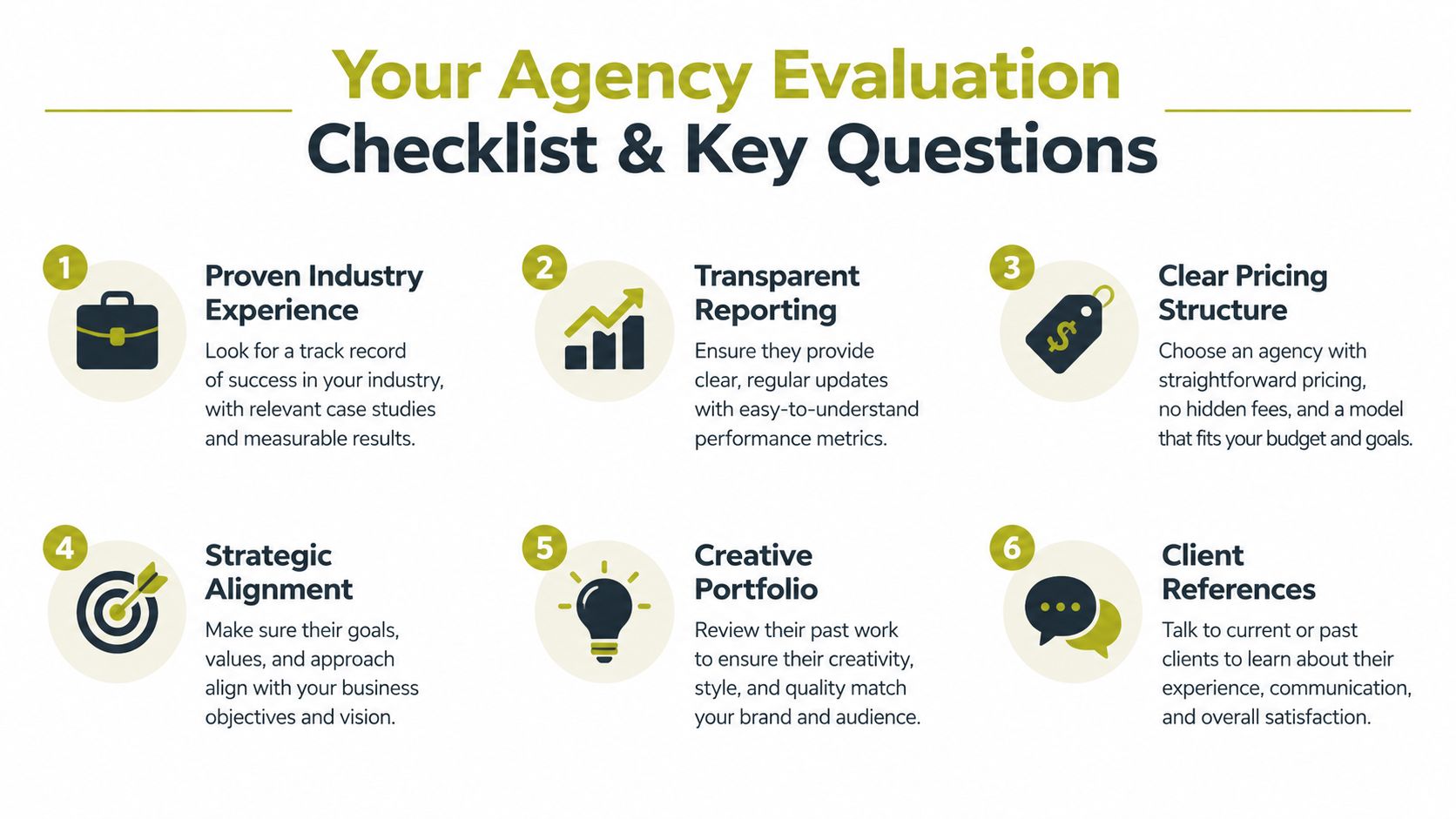
A polished proposal can still conceal weak strategy. Evaluate the agency by asking what it will change, how it will measure the change and who will be accountable for the work.
Start with the commercial diagnosis
Before discussing channels, ask:
- What conversion problem do you see first? A credible agency should identify a likely bottleneck and explain how it would validate that view.
- Which channel would you delay? Strategic confidence includes knowing what not to fund.
- What will count as a qualified result? Define a lead, booking, sale, call or application before reporting begins.
- How will you separate agency fees from media spend? You need to know what pays for labour and what pays the platforms.
- What access and input do you need from us? A plan that ignores approvals, sales follow-up and internal capacity won't survive contact with the business.
Inspect the people and the proof
Ask who will work on the account, not only who appears in the pitch meeting. Request examples of relevant sector work, anonymised reporting where necessary, and an explanation of how the team handles underperforming campaigns.
Reject guaranteed rankings and vague promises of “increased visibility”. Search engines, auction prices, market conditions and sales processes sit outside any agency's complete control. A serious provider will discuss assumptions, testing, lead quality and decision points instead.
Check the reporting sample. It should show what happened, why it happened, what the team changed and what it recommends next. Clicks, impressions and engagement can provide context, but they shouldn't be the final answer when the business needs revenue.
Review the commercial terms
Confirm the minimum commitment, notice period, ownership of creative and data, treatment of unused media budget, approval timelines and charges for work outside scope. Ask whether strategy is included or billed separately, and whether technical implementation requires another supplier.
For wider context on assessing performance agency models, this AdStellar AI agency guide provides another useful comparison point. Use it alongside your own financial model and sales data.
The best partner won't win by promising everything. They'll define a focused first phase, establish measurement, explain trade-offs and earn the right to expand the programme.
Carlos Alba Media combines digital content marketing, SEO, UX, web development, social media execution, PR and senior communications expertise for start-ups, SMEs and established organisations. Visit Carlos Alba Media to discuss a focused package built around conversion infrastructure, channel efficiency and measurable growth.