
The phone rings while your team is still clearing the morning inbox. A client has posted a complaint, a journalist is asking for comment, and your operations lead wants to know whether the issue is real or just noise. In the same few minutes, a founder has to decide who speaks, legal wants certainty, social needs a line, and someone has to monitor what's already spreading.
That's the moment crisis communications training earns its keep. The teams that have rehearsed don't magically know the future, but they do move faster, ask sharper questions, and avoid the worst habit in a live incident, which is trying to invent a process while the public is watching.
The First 60 Minutes and Why Training Matters
A UK SME in a regulated sector can go from normal trading to reputational pressure in a single call, a screenshot, or a post that starts circulating before lunch. A supplier issue becomes a customer complaint. A cyber alert becomes a media enquiry. A staff grievance becomes a public story. In each case, the first hour is where control is either built or lost.
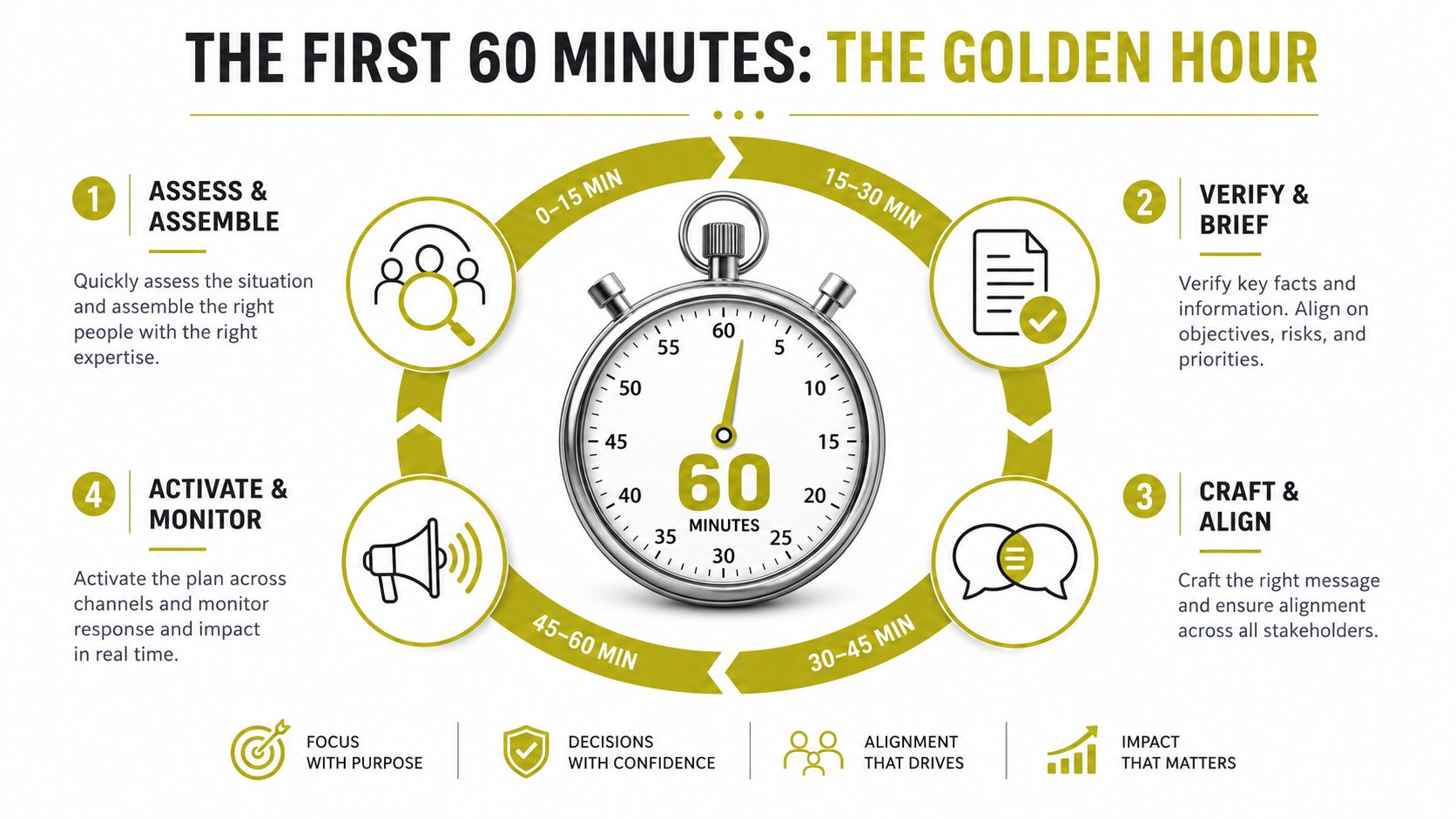
The UK Government Communication Service treats the first hour as a decisive operational window, with teams expected to verify the situation, alert senior management and relevant departments, draft and sign off a holding statement, assemble the core response team, start monitoring, and prepare key messages and Q&A before wider release (crisis-comms planning guide). That matters because speed changes the shape of the incident. The first person to speak doesn't need a perfect script, but they do need a controlled one.
Practical rule: the first hour is for alignment, not perfection. If your team is still debating governance when the press office starts ringing, the issue has already moved faster than your process.
That's why the old idea of “we'll deal with it when it happens” doesn't survive contact with a live desk. A trained team can verify, draft, route, approve, publish, and monitor without rebuilding the machinery in public. An untrained one often spends precious minutes guessing who owns the response.
For UK teams, especially in sectors facing regulator attention or media scrutiny, the training gap is not academic. A crisis desk run on instinct can still produce a statement, but it's far more likely to miss internal coordination, accessibility checks, or the timing of the first external response. For practical examples of how live incidents are framed and handled, see crisis communications examples.
What Crisis Communications Training Actually Is
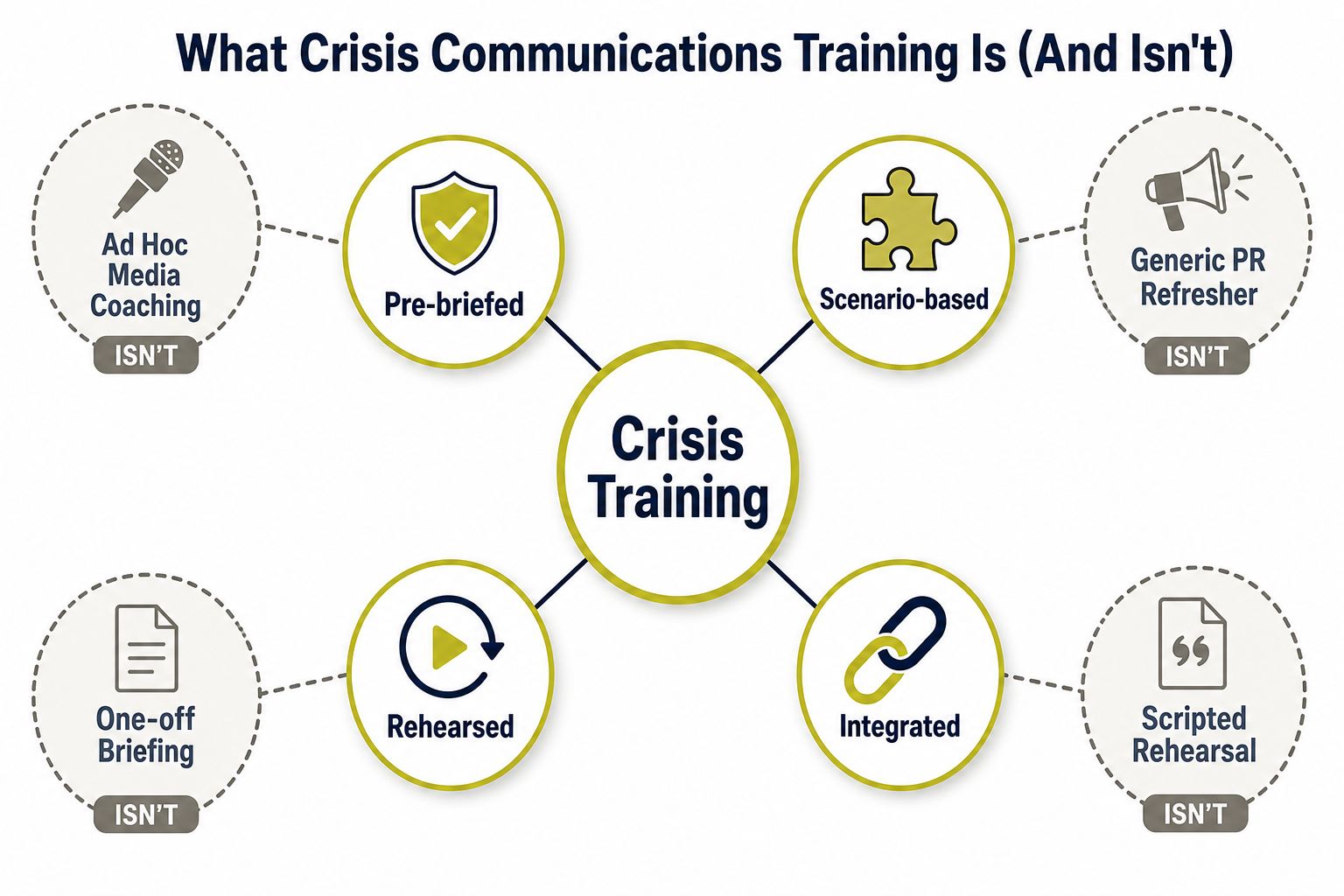
Crisis communications training is not a glossy briefing and it's not a single media session with a few tough questions at the end. It's a structured, repeatable capability that prepares people, plans, and approval routes to function under pressure. In the UK, that sits naturally alongside BS 11200, the British Standards Institution's first formal crisis-management code, published in 2014 and used as a practical benchmark for training, exercising, and testing response structures before a live incident (BCI report PDF).
The standard mattered because it turned crisis communications from an informal PR discipline into a repeatable management process. That shift is what senior teams buy when they invest in training. They're not buying a motivational workshop, they're buying a common structure for roles, decision-making, stakeholder messaging, and post-incident review.
The four building blocks that matter
A serious programme has four parts.
- Knowledge. People need the framework, the approval chain, the holding line, the escalation thresholds, and the stakeholder map.
- Skills. Spokespeople need to answer plainly, stay within facts, and cope with live questioning.
- Rehearsals. Teams need scenario work under time pressure, because theory doesn't reveal where the process breaks.
- Evaluation. Someone has to capture what failed, what slowed the response, and what gets fixed before the next drill.
A weak offering usually misses at least one of those. It may teach a spokesperson how to handle a camera, but never test whether legal can sign off in time. It may give the team a template, but never force them to use it when a journalist is already on the phone.
The UK Government Communication Service crisis framework is built around Plan, Rehearse, Implement, Maintain, Evaluate, Recover. That's the right lens for buyers, because it treats crisis readiness as a system, not a personality trait (emergency planning framework). If the provider can't show how their work fits into that cycle, you're probably buying presentation theatre, not operational readiness.
Training Formats and When to Use Each
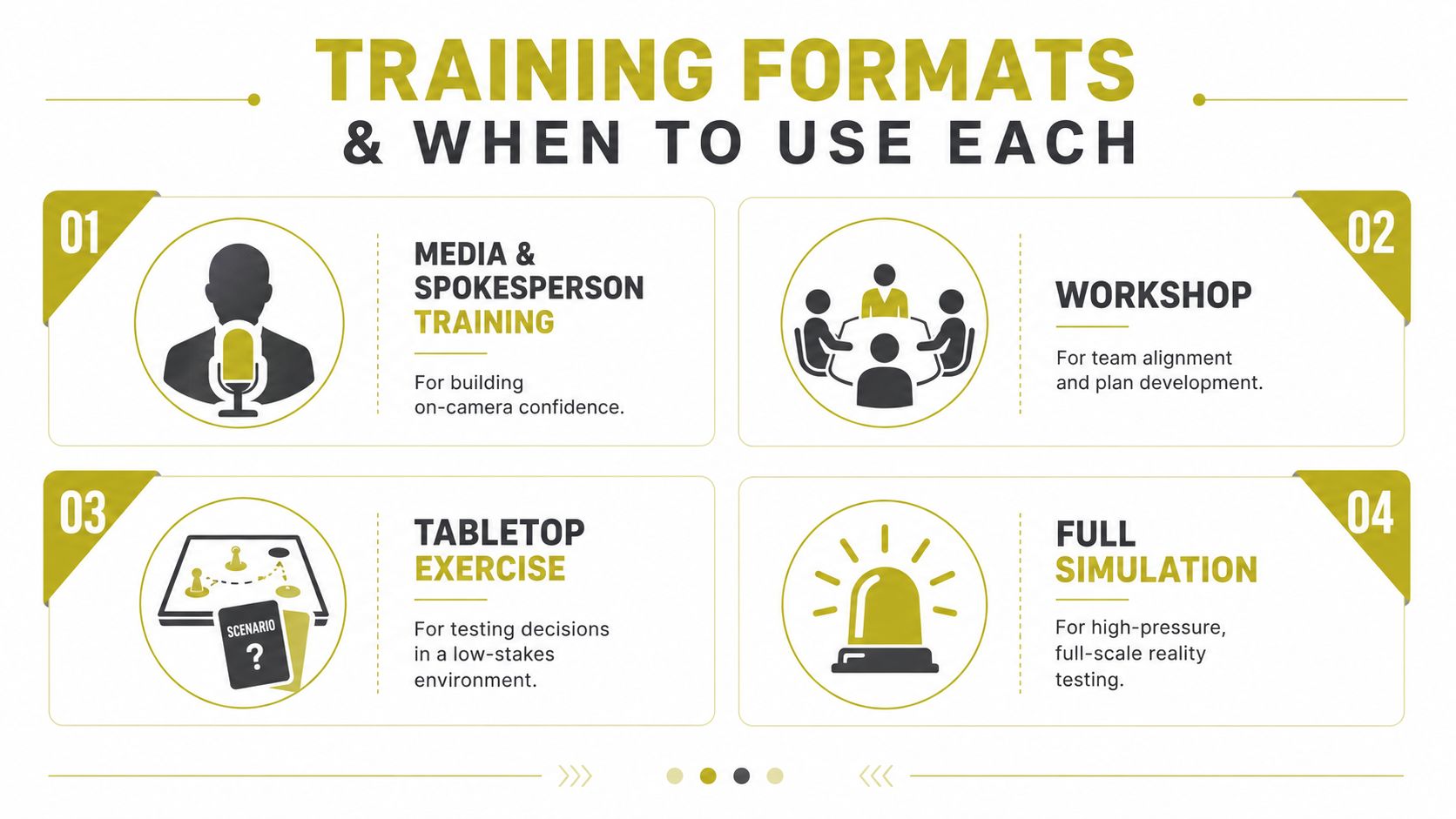
Different formats solve different problems, and mixing them up is where a lot of budgets get wasted. A spokesperson who can handle a studio camera may still fail to get a statement through legal on time. A team that understands the plan may still freeze when a regulator calls and social media is spiking at the same time.
Match the format to the maturity gap
Media and spokesperson training is for delivery. It's about clarity, pacing, message discipline, and staying calm when the questions get sharper than expected. This is the right first step when senior leaders need to appear on camera, speak to journalists, or front a difficult stakeholder briefing.
Workshops are for alignment. They're the best fit when the plan exists but the handoffs between comms, legal, operations, and customer service still feel fuzzy. A good workshop exposes vague ownership and missing decisions before anyone is under pressure.
Tabletop exercises test decision-making. They let teams walk through an incident, weigh options, and see where the approval chain slows down. The value comes from the conversations it forces, not from whether the room reaches a neat answer.
Full simulations are for end-to-end rehearsal. They combine pressure, timing, and live role-play so the team experiences the friction of real work, not just the logic of it.
A training programme should usually start where the gap is biggest. If the founder can't give a clean interview, start there. If the plan exists but nobody can operate it, start with a workshop or tabletop.
The strongest recent UK-relevant benchmark from the BCI is that 36.3% of organisations now carry out emergency communications training at least every six months, up from 24.0% the year before (BCI report). That doesn't mean every team needs the same cadence, but it does show that regular rehearsal has become mainstream practice. For teams building their first programme, the smart move is to stack formats, not choose one forever.
For a practical way to pair media delivery with crisis response, the internal process usually benefits from broadcast-facing coaching as well, which is where broadcast media training fits into a wider programme. A clip-worthy message still has to survive the rest of the incident.
Designing and Running a Tabletop or Simulation
A strong exercise should feel awkward in the right places. In the first hour, a UK team is usually dealing with incomplete facts, pressure from a journalist or customer, and a decision about whether the holding statement goes out before the story settles. If the room ends up admiring the scenario instead of making decisions, you have built theatre, not training.
Build the exercise around decisions
Start with one incident and one business consequence. A cyber event, product issue, safety concern, or executive misstep can work, but the scenario needs enough realism to force trade-offs. Then add injects that mirror the actual pressure points, such as a social media spike, a regulator call, or a journalist approaching for comment.
Use the UK Government Communication Service planning logic as the backbone, then test whether the team can move from detection to publication without rebuilding governance on the fly, as set out in the crisis planning guide. The exercise should time three things, time to verify, time to holding statement, and time to first channel post. Those are useful measures because they reflect how the first-hour operating model really works.
A practical three-hour agenda for a UK SME usually looks like this.
- Set the context. Confirm the scenario, roles, and objectives.
- Run the first inject. Let the team identify the issue, evidence, and escalation route.
- Add pressure. Introduce media, customer, or regulator contact.
- Force a decision. Ask for the holding line, spokesperson, and channel plan.
- Debrief immediately. Capture what slowed the response, what worked, and what gets fixed.
For a template to structure these sessions, see our guide on how to develop a crisis communications plan.
Make the outputs measurable
A tabletop should leave behind a short action log, not a warm feeling. Record who approved what, where delay happened, whether the team used the right channel, and whether internal and external messaging matched. If the group cannot show those points after the session, the exercise did not produce usable evidence for the board.
Facilitator mistake to avoid: overloading the room with media questions and forgetting the internal sign-off chain. Most real delays happen between functions, not in front of the camera.
The best exercises also test accessibility and coordination under pressure, because a statement that looks tidy on a laptop can still fail in the wrong format or on the wrong channel. That issue comes up again in the section on audiences, where format and sender matter as much as wording.
Who Should Attend and How Often
The first hour of a UK incident rarely waits for the comms team to get comfortable. A customer complaint turns into a journalist call, operations spot a fault, legal wants to see wording before anything leaves the building, and the CEO expects an answer that is accurate enough to stand up and fast enough to use. Crisis communications training has to reflect that pressure. The people in the room need to be the people who can approve, correct, publish, and brief without slowing the response.
The easy list is the comms team. The useful list is everyone who can slow down or speed up the response. In practice, that means spokespeople, the founder or CEO, legal, operations, customer service, and digital or social leads all need different levels of training intensity.
| Role | Recommended cadence | Primary format | Measured outcome |
|---|---|---|---|
| Spokesperson | Quarterly refreshers | Media and spokesperson training | Clear, concise delivery under pressure |
| CEO or founder | Annual scenario session | Simulation or tabletop | Decision-making speed and message discipline |
| Legal | Annual or when the risk profile changes | Tabletop | Faster sign-off and cleaner red lines |
| Operations | Annual | Tabletop | Better escalation and fact verification |
| Customer service | Twice yearly or after major change | Workshop plus scenario run-through | Consistent frontline responses |
| Digital or social lead | Quarterly refreshers | Tabletop and live-channel practice | Faster first-channel publication |
The BCI's 92.1% figure for organisations able to activate crisis plans within 60 minutes, and 73.1% within 30 minutes, is a useful benchmark for setting expectations in the UK, as noted in the BCI report. It means the room has to be built around speed, not just accuracy. If legal is not present, or if no deputy spokesperson is named, the plan may exist on paper but still fail in the first hour.
That is also why sending only the comms team is a common mistake. The comms team can draft, but it cannot approve an operational correction. It can prepare a line, but it cannot summon the facts. The live incident always shows whether the organisation has trained the people who hold the levers.
A sensible warning sign is simple. If the last drill was more than a year ago, if no deputy spokesperson is named, or if the holding lines have not been signed off, the organisation is under-training. Those gaps usually show up at the exact moment the board expects confidence.
Broadcast practice matters for anyone who might be on camera. A short, disciplined session with broadcast media training helps spokespeople handle the glare, the pace, and the pressure to fill silence with guesses. That is a different skill from writing a statement, and it should be trained separately.
The same logic applies to escalation paths inside the business. Legal, operations, and customer service do not need the same script, but they do need to know how their decisions affect the first public statement. A decent AI-powered crisis response strategy only works if the people feeding it have already practised how to classify facts, flag uncertainty, and keep the approval chain moving.
Choosing a Provider and Why Newsroom Pedigree Matters
Not every trainer has lived through a breaking story, a hostile interview, or a newsroom deadline. That doesn't make them useless, but it does mean you need to ask sharper questions before you buy. The provider has to understand both the message and the machinery around it.
A useful discovery call starts with three questions. What crisis experience does the trainer have? How realistic are the scenarios for your sector? What output do you receive after the session, and who helps if a real incident happens while the plan is still live?
What separates a senior practitioner from a generalist
Look for three things.
- Background. Former journalist, agency operator, in-house crisis lead, or a mix of those.
- Scenario realism. Sector-specific injects, not generic “the press is calling” role-play.
- Operational support. Clear deliverables, follow-up actions, and the ability to support a live issue.
That's where newsroom pedigree matters. Carlos Alba Media is a useful example because it's founded and run by multi award-winning former national newspaper editor Carlos Alba, and the consultancy describes its team as delivering senior-level counsel with 24/7 media crisis management and newsroom insight. In practical terms, that kind of background matters because crisis work isn't only about writing a statement, it's about understanding what journalists will ask, what details will be challenged, and which facts can survive scrutiny.
If you want to see how crisis response is shaped by live media mechanics, the approach also connects naturally to AI-powered crisis response strategy, which is useful context for teams thinking about monitoring and response discipline. Technology can help, but it doesn't replace judgement.
The questions to ask should be blunt. Will the provider customise for your sector? Will they pressure-test approval routes? Do they give you a written action plan? Can they run a session that mirrors your real channel mix, not a generic newsroom exercise? If the answer is vague, the training probably will be too.
Measuring Training Effectiveness
Training has to change behaviour or it's just a cost line. In the first hour of a real incident, the question is simple, can the team get the holding line approved, brief the right people, and get the first message out without conflicting versions appearing across channels. Measuring that means comparing how people perform before and after the exercise, then checking whether the process is faster, cleaner, and more consistent under pressure.
The UK Government Communication Service model gives you the structure, and the crisis communication timings used by practitioners give you a practical benchmark. If a prepared team can activate its crisis plan within the first half hour, that is a sensible board-level conversation, not a vanity metric to celebrate. A better board pack shows whether the team can meet that window, and what stopped them if they could not.
The metrics worth tracking
Measure time to holding statement, time to first-channel post, plan activation time, and message recall. Those are the numbers that show whether the organisation can move quickly and stay aligned when the room gets noisy. Track whether corrective actions from the exercise are closed before the next drill, because an unclosed action is where the next failure usually starts.
If the team left the room with nice feedback but no fixed actions, the exercise did not improve readiness.
The CDC's crisis communication guidance is useful here because it treats crisis response as a structured process built around verification, notification and coordination, assessment, initial media response, and assignments. It also says organisations should be the first source for information, express empathy and show concern, remain honest and open, and keep open records of who receives what and when. Those are operational behaviours you can observe, not just soft skills (CDC crisis communication guidance).
A drill should also show whether the spokesperson can stay calm on camera, whether legal can clear copy quickly without breaking the flow, and whether the team can keep one version of events across comms, operations, and leadership. That is where room performance matters more than polished slides. A neat debrief means little if the first live call still stalls.
For teams that want a more systematic way to capture the outcome of an exercise and turn it into follow-up work, AI-ready reputation tooling can be useful context. The point is not automation for its own sake, it is making sure monitoring, response, and reporting do not live in separate silos.
Pricing, Pitfalls and Your Next 30 Days
UK pricing depends on depth, format, and how close the provider stays to a live issue. A half-day spokesperson workshop usually costs less than a full-day tabletop. A multi-session programme with retained support sits above both because it includes preparation, customisation, and follow-up. The cost rises again when the scenario has to be built from scratch, senior leaders need individual coaching, or legal and operational teams have to be folded into the work.
The budget error is buying the wrong thing. Many SMEs pay for a polished media session, then find that no one has tested approval routing, internal escalation, or the first social post. Others spend too little by treating training as a one-off event and never refreshing it after the plan changes. In practice, the cheapest option can be the most expensive if it leaves the first hour untested.
Three pitfalls show up again and again.
- One-off delivery. A single session will not hold if roles, contacts, and channels change.
- No legal involvement. The statement may sound good, but it may not survive the sign-off process.
- No post-exercise update. A plan that is not revised after the drill is already drifting out of date.
A practical 30-60-90 day approach works well for most SMEs. In the first 30 days, identify the cohort and confirm the approval chain. By 60 days, run a baseline tabletop and time the holding statement and first post. By 90 days, close the gaps, update the plan, and schedule the next refresh so the exercise becomes part of the operating rhythm, not an annual panic.
Carlos Alba Media runs crisis communications and media training with a newsroom-led approach, so spokespeople, founders, and senior teams can rehearse the first hour before they have to live it. If you need practical support with planning, training, or 24/7 media crisis management, visit Carlos Alba Media and speak to the team about the kind of rehearsal your organisation needs.