
Most advice on public relations events is too soft. It treats the event as the product. It isn't. The event is a device for generating a story, shaping perception, and giving journalists something worth covering.
That distinction matters. A polished room, decent catering and a branded backdrop won't rescue an event with no news value. Editors don't assign reporters because a business has hired a venue. They assign reporters because the event gives them a fresh angle, a credible voice, strong pictures, and a reason to believe their audience will care.
That journalist's view is the useful one. It's also the reason Carlos Alba Media has carved out a specialist place in the market. The agency was founded and is run by Carlos Alba, a multi-award-winning former national newspaper editor, and everyone who works for Carlos Alba Media is either a former national news journalist or has agency experience working with international brands. That combination matters because newsroom judgement and brand discipline are what most events lack.
Beyond Canapés The Modern PR Event as a News Engine
Too many businesses still confuse attention with impact. They plan a launch, invite a media list, put out drinks and hope coverage follows. It rarely works like that. Journalists don't need another room to stand in. They need a reason to file.
The economics of the sector make this harder, not easier. The UK public relations industry reached a market size of £4.3 billion in 2026, with over 6,100 businesses competing, according to IBISWorld's UK industry analysis. In a market that crowded, generic event work disappears into the background. Senior-level consultancies that can connect coverage to business outcomes have the advantage.
What journalists actually see
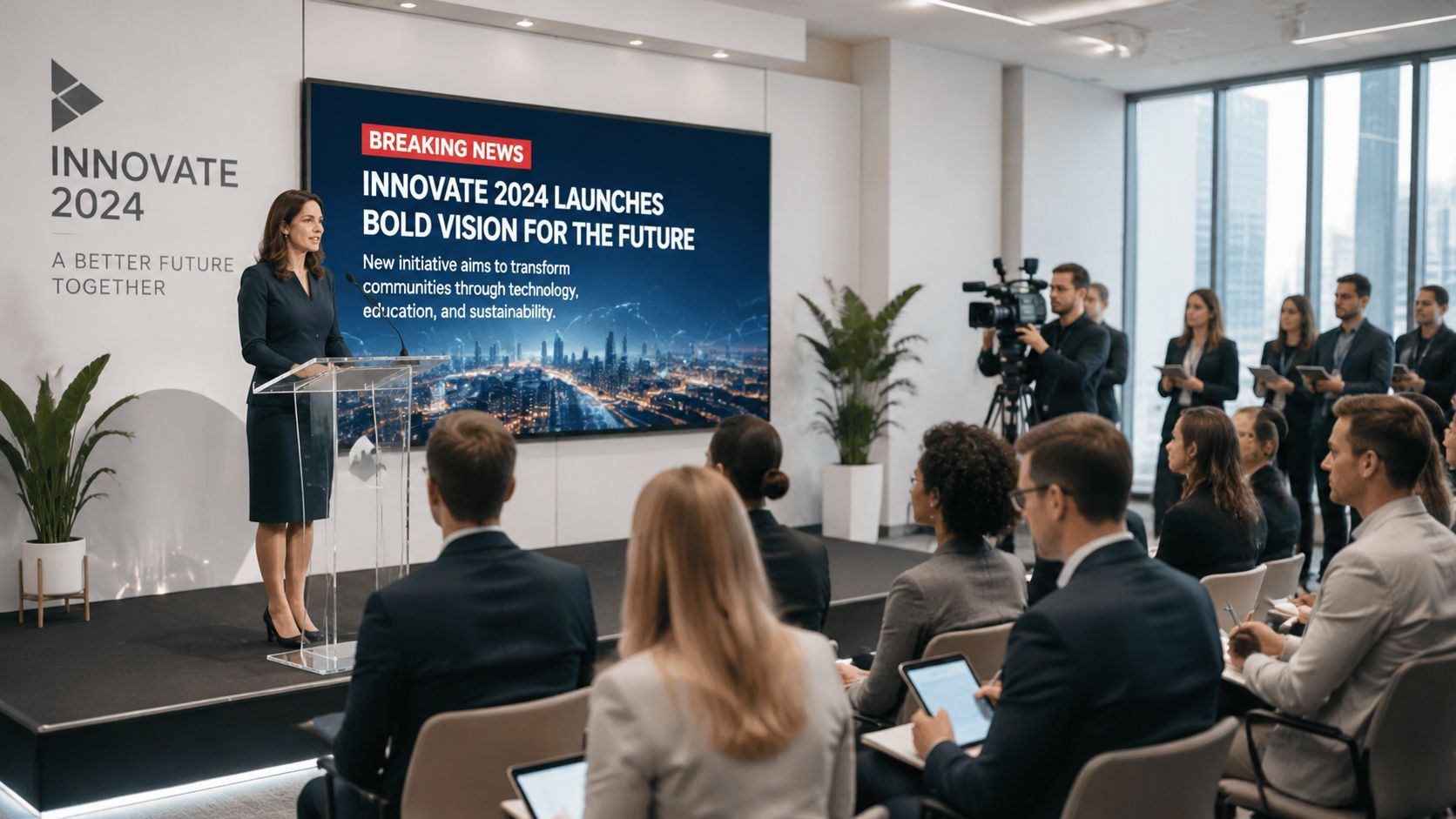
A newsroom doesn't look at your event and ask whether it was expensive. It asks a harsher set of questions:
- Is there news here? A launch without a hook is just a diary item.
- Can we tell it fast? If the story takes too much effort to understand, it gets dropped.
- Do we have access? Editors want usable spokespeople, not people who need every answer cleared.
- Will this produce assets? Photos, clips, data, quotes and reaction all matter.
That's why the best public relations events are built backwards from the headline, not forwards from the venue brief.
Journalists don't attend events to be hosted. They attend to leave with a story.
Experience helps, but news value wins
There's room for theatre. Format, setting and audience interaction can sharpen a campaign when they're used properly. If you're weighing up physical immersion and brand experience, what is immersive event marketing gives a useful overview of how experiential concepts work in practice. The mistake is assuming immersion on its own creates earned attention.
It doesn't. Earned attention comes when the experience supports a credible media angle.
That is why earned media still sits at the centre of serious event PR. If you want a clean explanation of the distinction between exposure you buy and exposure you earn, Carlos Alba Media's guide to earned media is worth reading. The main point is simple. Public relations events only become valuable when the event produces coverage, trust and business movement that advertising alone can't buy.
Defining Your Strategy and Event Objectives
Before anyone books a venue, someone needs to answer a blunt question. What is this event supposed to achieve in practice?
If the answer is "raise awareness", the planning is already drifting. Awareness is too vague to guide decisions. You need an objective that changes what you build, who you invite and what success looks like afterwards.
Start with the business result
A strong event objective usually sits under a commercial, political or reputational goal. That means the strategy work starts with the boardroom question, not the production question.
Examples of useful objectives include:
Secure interviews with target media
That pushes you towards a smaller format, tighter scheduling and stronger spokesperson prep.
Influence stakeholders
If MPs, civil servants, investors or trade bodies matter more than national press, the room and agenda should reflect that.
Support a launch or funding moment
Then you need a date that aligns with the wider business plan, not just diary availability.
Create proof for a sales team
In that case, the event has to generate reusable assets, press coverage and follow-up material.
Match the event type to the objective
Not every event should be a press conference. In fact, many shouldn't.
| Event format | Best used when | Weak point |
|---|---|---|
| Press conference | You have a clear announcement and strong spokespersons | Falls flat if the news is thin |
| Media roundtable | You need depth, nuance and relationship building | Smaller reach on the day |
| Product or service launch | You can show, demo or reveal something tangible | Becomes stagey if the product isn't distinctive |
| Stakeholder briefing | You need credibility with policymakers, partners or sector figures | May generate limited immediate coverage |
| Site visit or live demonstration | The visuals and operational detail are the story | Requires tight logistics and safety control |
The format should serve the editorial opportunity. Not the other way round.
Build a target list like a newsroom would
A lazy media list is one of the quickest ways to waste budget. "National media" isn't a target. Named journalists, producers, editors and programme teams are targets.
Work through it in layers:
- Primary media targets. The few people or desks most likely to cover the story.
- Secondary outlets. Trade, regional, specialist and sector media.
- Non-media stakeholders. Policymakers, partners, analysts, investors or community figures.
- Internal advocates. Senior leaders who'll amplify the event after it lands.
The right event for a Scottish tech SME may be a compact session with sector press, a local broadcast contact, selected business journalists and a handful of policy stakeholders. A bloated guest list often dilutes the value of the room.
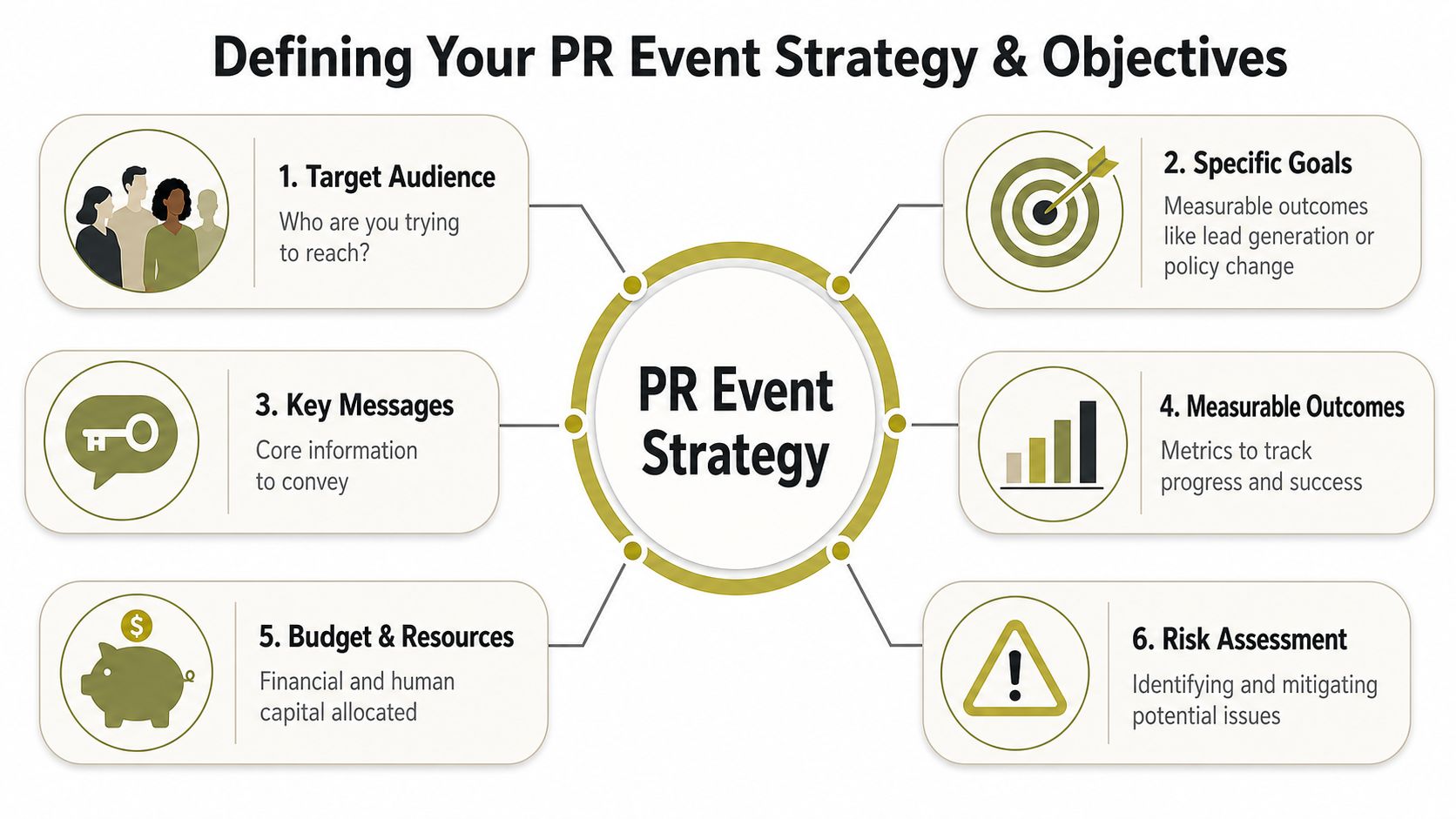
This visual is a useful prompt when shaping the plan:
Write the brief your team can actually use
A working event brief should fit on a page. If it runs long, the thinking usually isn't sharp enough.
Practical rule: if the objective can't guide a yes-or-no decision on speakers, guest list, run order and outreach, it isn't specific enough.
Include these points:
- Core objective. One sentence, commercially grounded.
- Audience priority. Who matters most.
- Story angle. Why anyone outside the business should care.
- Spokespeople. Who is available, credible and briefable.
- Non-negotiables. Timing, legal constraints, messaging boundaries.
- Success signals. What will tell you the event did its job.
That's what keeps public relations events disciplined. Good planning is less about adding ideas and more about removing anything that doesn't support the outcome.
Crafting a Newsworthy Angle That Journalists Need
Editors aren't short of invitations. They're short of stories worth assigning. That's the lens to use when you're shaping the angle for an event.
A newsworthy event usually features one of four things: a revelation, a credible piece of data, an authoritative voice, or access that journalists can't get elsewhere. If it has none of those, don't expect coverage because the catering is better.
Build the angle before you build the assets
The cleanest test is to draft the intro paragraph of the story before the event is finalised. If you can't write a strong opening in plain English, the hook isn't ready.
The angle might come from:
- New information. A launch, announcement, report or partnership.
- A strong spokesperson. Someone who can say more than a rehearsed line.
- A live demonstration. Useful when visuals carry the story.
- An exclusive. A first look, first interview or early access briefing.
A former editor's perspective is particularly useful. Reporters don't need a brochure in disguise. They need the part of the story that would survive first contact with a newsdesk.
Survey-led events need technical credibility
Survey data can create a strong event hook, but only if it meets professional standards. For UK media credibility, event news releases based on surveys must include a full technical outline covering the client, sample size, geography, fieldwork dates and response rate, in line with the CIPR-MRS guidelines on using statistics in communications. Miss those details and many editors will bin the release immediately.
That rule is often ignored by teams who are in a rush to publish the headline finding. It's a basic error. If you're using data to attract media, transparency is part of the story.
A useful press pack for this kind of event should include:
- The lead release with the strongest angle upfront
- Technical notes with methodology clearly stated
- Spokesperson biographies that explain authority, not vanity
- Images and captions ready for immediate use
- Interview availability with exact windows and formats
- Background notes that place the story in context
Give journalists material they can file from
A press kit shouldn't create more work. It should remove it.
That means no bloated decks, no jargon-heavy manifesto, and no five-page corporate history unless it's directly relevant. Give journalists what they need to write fast and accurately. A short media advisory sent in advance is often more effective than an over-designed announcement no one reads properly.
For teams that want a sharper sense of how introductions and story framing affect media response, Carlos Alba Media's advice on writing introductions for news is a practical reference.
If the first paragraph sounds like marketing copy, a journalist will assume the rest of the material is the same.
What works and what doesn't
| Works | Doesn't work |
|---|---|
| A single clear hook | Three competing messages |
| Named access to spokespeople | "Available on request" with no detail |
| Data with full technical notes | Big claims with vague methodology |
| A genuine exclusive | A generic mass invite labelled exclusive |
| Strong briefing for interviewees | Executives winging it on the day |
The sharpest public relations events don't try to impress everyone. They give the right journalists a story they can use, supported by assets that hold up under scrutiny.
Executing Flawless On-Site Media Management
Event day exposes every weakness in the planning. If the angle is fuzzy, the spokespeople are under-briefed or the access plan is muddled, journalists feel it within minutes.
The smoothest events usually look simple from the outside. That's because someone has already removed friction before the first camera crew arrives.
How a professional media flow works on the day
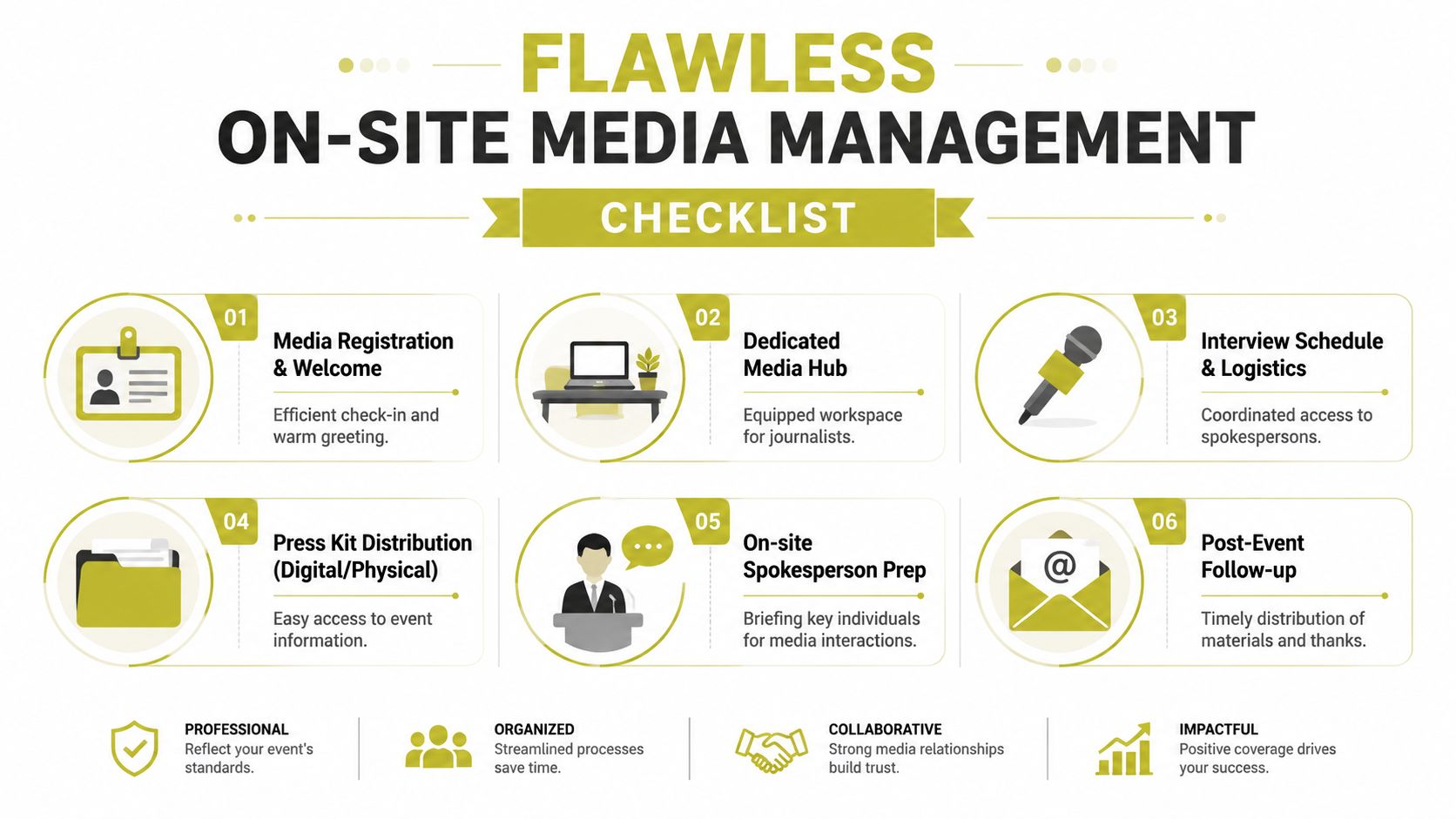
A well-run media event has a rhythm. Journalists arrive, get checked in fast, receive the materials they need, understand who is available, and get their interviews without chasing staff around the room.
The practical sequence tends to look like this:
Media check-in is separate from guest check-in
Reporters don't want to queue behind general attendees. Give them a direct route.
A media lead owns the room
One person should know the schedule, who has arrived, which interview slots are live and what has changed.
Spokespeople are held close
Not hidden. Not wandering. Available when promised.
Broadcast crews get clarity early
They need space, power, timings, sightlines and clean answers on what they can film.
Assets are available immediately
Digital press packs, captions, names, titles and approved visuals should already be prepared.
The attendance mistake that keeps happening
Many brands still assume hospitality is enough to pull media through the door. It isn't. A staggering 78% of UK journalists reject events offering only "free food/wine", and events with pre-briefed exclusives generate 3.2 times more broadcast pickup, according to the UK Research and Innovation media events guidance.
That lines up with newsroom reality. An editor won't release a reporter because the venue sounds pleasant. They'll do it because the reporter is coming back with something other outlets don't have.
Give one journalist a reason to attend before the event, and you're negotiating from strength. Invite everyone to "network over drinks", and you're begging for diary space.
Physical setup still matters
Good production doesn't replace a story, but bad production can absolutely damage one. If the room makes filming awkward, the branding looks amateurish or the staging blocks sightlines, you've created unnecessary resistance.
For exhibition-style environments or branded media spaces, specialist stand builders can be useful because they understand traffic flow, backdrops, interview zones and how structures read on camera. That's especially relevant when an event has multiple media touchpoints in one space.
A simple on-site checklist often prevents most avoidable problems:
- Arrival brief. Everyone on the client side knows timings, names and escalation points.
- Interview grid. Slots are confirmed, realistic and updated live.
- Holding statements. Prepared for awkward questions or last-minute changes.
- Photography plan. Hero shots, candid shots and spokesperson images are all covered.
- Exit protocol. Journalists leave with links, contacts and follow-up timing.
The best on-site media management feels calm because the team has already done the hard work. Journalists notice that. What's more, they remember it the next time you pitch them.
Measuring Event ROI and Proving Business Impact
A busy room isn't proof of value. Neither is a stack of clippings on its own. That has been one of PR's longest-running problems. Teams celebrate outputs while clients ask a harder question. What changed because we did this?
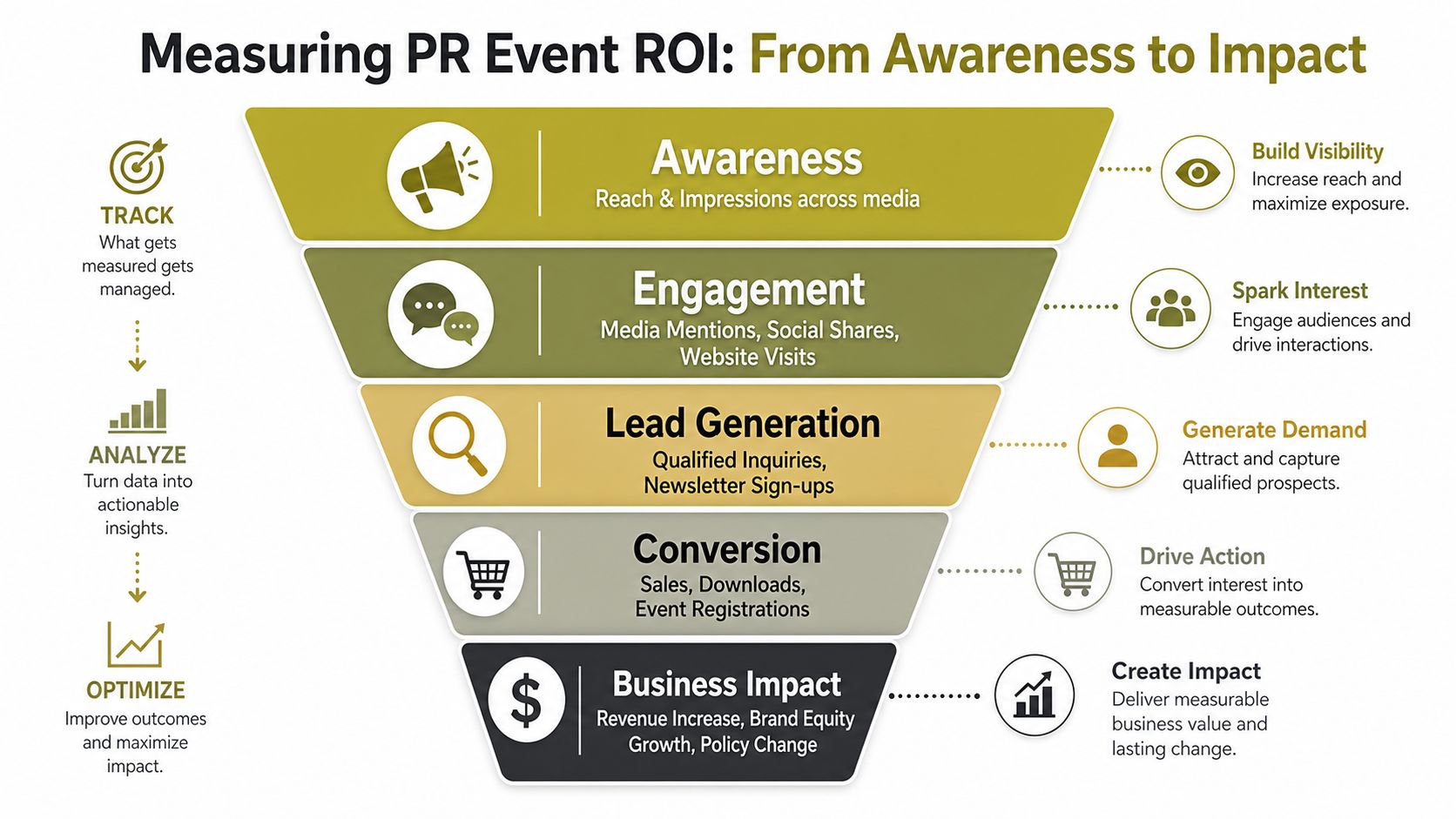
That gap still sits at the centre of event measurement. Up to 52% of practitioners cannot prove the ROI of their activities, while 55% of UK PR agencies prioritise story placements and 60% of journalists measure success by engagement, according to the public relations statistics compiled here. If your post-event report only counts coverage volume, you're often reporting in a language the client doesn't use.
Stop treating coverage as the end point
Coverage matters. It just isn't the whole job.
A serious event measurement model should track movement across a chain, not a single outcome. The useful questions are:
- Did the right media cover it?
- Did the coverage carry the right messages?
- Did target audiences engage with the story?
- Did that engagement lead to enquiries, conversations or commercial action?
- Did the event help the brand move with stakeholders who matter?
That is a tougher standard than counting mentions, but it's also the standard most leadership teams care about.
What to measure after a PR event
| Measurement area | What to look for | Why it matters |
|---|---|---|
| Coverage quality | Outlet relevance, article depth, interview prominence | Not all coverage carries equal value |
| Message pull-through | Whether the key story points survived into coverage | Shows if the narrative landed |
| Audience response | Engagement, shares, comments, referral interest | Closer to how journalists judge resonance |
| Commercial signals | Enquiries, lead quality, meetings, sales conversations | Connects PR to business action |
| Stakeholder effect | Follow-up from partners, policymakers, investors or sector figures | Important where reputation drives decisions |
Build measurement in before the event happens
The easiest way to fail on ROI is to think about it afterwards. If no one agrees in advance what the event is meant to produce, the reporting will drift back to vanity metrics.
A more credible process looks like this:
- Set a baseline. Know what media attention, inbound interest or stakeholder access looked like before the event.
- Tag the key assets. Use trackable links, dedicated landing pages or structured follow-up routes.
- Capture qualitative feedback. Sales teams, founders and stakeholder leads often spot impact before a dashboard does.
- Review by objective. If the goal was policy influence, a pile of lifestyle coverage may look busy but still miss the mark.
Commercial lens: the right report doesn't just say what happened in the press. It shows whether the event moved the organisation closer to the decision it cared about.
The trade-off clients need to understand
Not every strong event produces instant revenue. Some public relations events are built to shift credibility, enter a new market, or strengthen relationships with people who influence future decisions. That's valid. But the reporting still needs discipline.
The key is to connect the event to the next business step. Did media coverage support outreach? Did a stakeholder briefing open doors? Did spokesperson interviews increase trust with investors or regulators? A mature measurement approach accepts that different objectives create different forms of impact, but it never hides behind vague language when the evidence is weak.
That is the difference between reporting activity and proving value.
Navigating High-Risk Sectors and Crisis Scenarios
Some events carry a normal level of media pressure. Others sit under legal, political or reputational scrutiny from the moment the first invite goes out. If you're working in a regulated, controversial or high-profile sector, the event plan needs a crisis spine from day one.
Too many teams bolt that on at the end. They prepare the stage, the speech and the media list, then realise late in the process that one hostile question could dominate the coverage.
Crisis planning has to be built into the event
That isn't theory. With 41% of UK SMEs facing a media crisis in 2025, integrating 24/7 crisis management into event PR is no longer optional, and events with embedded crisis protocols reduce negative coverage by 52% compared to standard reactive plans, according to this research summary on crisis integration and media response.
The practical implication is clear. If the issue could attract challenge, your event team needs more than a running order.
What high-risk event planning looks like in practice
A proper high-risk event plan usually includes these elements:
- Scenario mapping. List the obvious pressure points first. Regulatory questions, campaign opposition, legal disputes, safety issues, executive history, product criticism.
- Spokesperson boundaries. Decide what can be answered, what must be referred, and what requires legal oversight.
- Rapid approval routes. If a problem emerges, no one should be hunting for sign-off.
- Live monitoring. Track media, social reaction and incoming journalist questions during the event itself.
- Fallback materials. Prepare holding statements, updated Q&As and alternative lines for likely flashpoints.
Hostile questions don't become easier because you ignore them
The worst spokesperson brief is the one that pretends everything will stay friendly. Senior interview prep should include the hardest question in the room, not just the preferred ones.
That means rehearsing:
- short answers under pressure
- bridging back to verified facts
- correcting inaccuracies without sounding evasive
- knowing when to stop talking
In higher-risk sectors, media lawyers and crisis advisers often need to be part of the planning, not waiting in the background after trouble starts. Businesses that need a practical framework for that work can review Carlos Alba Media's crisis communications planning guide.
A high-risk event isn't judged only by the coverage you win. It's judged by whether you stay in control when the agenda shifts.
The strongest public relations events in difficult sectors feel ordinary on the surface. That's because the difficult thinking was done early, the spokespeople were trained properly, and the team knew exactly what to do if the day turned.
If you need senior-level support for public relations events, media strategy or crisis-ready campaign planning, Carlos Alba Media offers a journalist-led approach built for organisations that need sharp angles, credible coverage and practical execution. Founded by Carlos Alba, a multi-award-winning former national newspaper editor, and staffed by former national news journalists and professionals with international brand agency experience, the consultancy works with start-ups, SMEs and established organisations across Scotland and the wider UK.