
Corporate reputation in the UK is worth £1.7 trillion, yet approximately 25% of firms ignore it, exposing themselves to unmanaged shocks, according to research highlighted here. That should change how any founder or director thinks about risk.
Reputation isn't soft. It isn't decorative. It sits behind sales conversations, investor confidence, regulator trust, recruitment, retention, and whether a problem becomes a short-lived issue or a defining story. When people talk about managing reputational risk as if it belongs only to PR, they usually realise the mistake when a complaint goes public, a supplier fails, a hacked account spreads false information, or a journalist starts asking the questions they weren't ready to answer.
The practical reality is simple. If you run a business, you already have reputational exposure. The only question is whether you're managing it deliberately or leaving it to chance.
Reputation Is a £1.7 Trillion Asset You Must Protect
Reputation belongs on the risk register, not in a marketing folder.
Boards usually recognise physical, financial and regulatory exposure because those risks arrive with owners, controls and reporting lines. Reputation often does not. It sits across operations, leadership, customer experience, legal judgment and public scrutiny. That makes it easier to neglect, even though the commercial effects are immediate once trust slips.
The World Economic Forum has long identified reputational risk as a major business concern because it tends to grow out of other failures rather than appear on its own, as outlined in its analysis of global risks and corporate reputation. That is the point many leadership teams miss. Reputational damage is rarely a standalone event. It is the public consequence of something operational, cultural or strategic that was not handled properly.
Why reputation gets neglected
Early-stage companies and mid-sized firms often assume this is a listed-company problem. It is not. In practice, smaller organisations can be more exposed because they have less institutional trust to draw on, fewer trained spokespeople and less margin for error when a complaint, allegation or reporting request lands.
I see three recurring weaknesses.
- Leaders treat reputation as a communications issue instead of a management issue. They focus on coverage, messaging and visibility, while the real exposure sits in decision-making, service standards and internal behaviour.
- Teams split the incident from the story. Operations handles the failure. Comms handles the response. Legal handles the wording. No one owns the full picture of how the issue will look once customers, staff, regulators or journalists start comparing facts.
- Businesses rehearse growth, but not scrutiny. They plan launches, hiring and sales targets, yet have no agreed process for a hostile media call, leaked email, executive allegation or viral customer post.
A simple test helps. If an issue could change how customers, staff, investors, regulators or journalists judge your organisation, it is a reputational risk.
What managing reputational risk actually involves
Good reputational risk management is disciplined, not theatrical. It usually comes down to four jobs done well and done consistently.
| Area | What it means in real terms |
|---|---|
| Assessing | Identifying which issues could damage trust, who would be affected, and how quickly the story could spread |
| Preventing | Fixing known weak points in operations, governance, leadership conduct and customer handling before they surface publicly |
| Responding | Confirming facts, assigning decision-makers, speaking clearly and showing credible action under pressure |
| Measuring | Tracking whether trust is holding up across stakeholders, not just whether coverage volume is rising or falling |
The organisations that hold up best under pressure have usually made these decisions early. They know who approves statements, who handles media enquiries, what gets escalated to the executive team and what evidence must be checked before anyone speaks publicly.
A newsroom perspective sharpens that process. Former journalists are trained to test a claim fast. What happened. Who knew. Who was affected. What can be proved. Why does it matter now. At Carlos Alba Media, that discipline shapes how reputational risk is assessed before a story breaks, not after. It helps leaders prepare for the questions that matter, instead of hiding behind language that will not survive first contact with a newsroom.
Modern Sources and Real World Impacts of Reputational Risk
Reputational damage rarely arrives with a label on it. It usually begins as something else. A delivery failure. A staff allegation. A product issue. A misleading post from a third party. A cyber incident. A customer complaint that should have been handled privately but spills into public view.
In today's environment, those incidents spread like a digital wildfire. The old model gave companies more time. A local complaint might stay local. A trade issue might sit in an inbox for a day. That isn't how it works now. Screenshots move faster than statements, and silence gets interpreted before facts are verified.

Where risk usually starts
Most reputational crises fall into a handful of real-world categories:
- Operational failures. A service outage, fulfilment error, safety issue, delayed response, or breakdown in customer care.
- Leadership and culture problems. Allegations involving conduct, governance, bullying, discrimination, or a gap between stated values and internal reality.
- Digital and social escalation. A complaint gains momentum, a clip is taken out of context, a post is misjudged, or misinformation fills the silence.
- Third-party contagion. A supplier, agency partner, contractor or affiliate behaves badly, and your brand gets tied to the story.
- Regulatory and compliance pressure. The issue may begin in policy or procedure, but the public story becomes one of trust, competence and accountability.
What the impact looks like
The financial consequences aren't theoretical. In the UK, reputational risk is the third most frequently cited concern among senior executives, with 68% of FTSE 100 companies reporting that reputation damage directly correlates to a measurable decline in share price within 30 days of a negative event, according to Deloitte UK.
That matters even if you don't run a listed business. SMEs don't watch a share price. They feel the impact elsewhere. Sales calls go colder. Prospects delay decisions. Existing customers ask harder questions. Staff confidence dips. Recruiters hear concerns from candidates. Investors start asking for reassurance rather than growth updates.
A reputational issue becomes commercially dangerous when your stakeholders start changing behaviour before you've finished drafting your explanation.
What works and what fails
There's a clear difference between businesses that absorb a hit and businesses that make it worse.
What tends to work
- Fast fact-finding before public speculation hardens into accepted truth
- One accountable decision-maker who can approve holding lines quickly
- Visible ownership of the issue rather than defensive wording
- A response matched to stakeholder concern, not internal convenience
What usually fails
- Legalistic language that sounds crafted to avoid blame
- Treating social media as the whole crisis when the underlying issue is operational or cultural
- Letting departments contradict one another
- Assuming no comment buys time, when it often creates a vacuum others rush to fill
For founders and SME leaders, the main trade-off is speed versus certainty. You won't have every fact in the first hour. But if you wait for complete certainty before saying anything, you often lose control of the narrative.
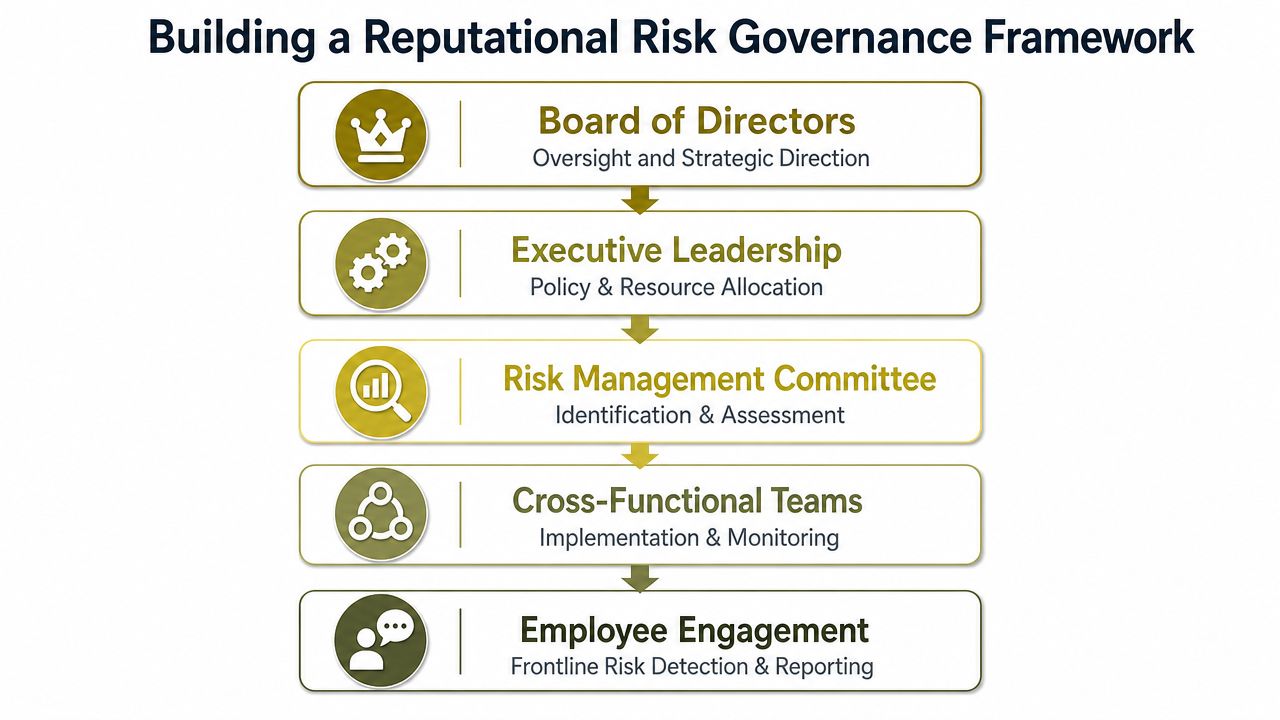
Building a Reputational Risk Governance Framework
Most businesses don't have a reputation problem. They have a governance problem that creates a reputation problem later.
If nobody owns risk identification, nobody updates the risk register, nobody knows who approves a holding statement, and nobody has rehearsed escalation, the first serious incident exposes that weakness immediately. Managing reputational risk needs structure before it needs slogans.
Start with ownership and a risk register
A useful framework begins with one fact. Effective reputational risk management in the UK requires a proactive strategy anchored in ISO 3100 principles, which mandates that businesses systematically identify triggers, assess likelihood and severity, and implement contingency plans before incidents occur, as outlined by CHAS.
For an SME, that doesn't mean creating a heavy corporate bureaucracy. It means deciding, in plain language:
- What could damage trust
- How likely each risk is
- How severe the impact would be
- Who owns prevention
- Who leads response if it happens
Put reputational risks on the same formal register as financial, operational and compliance risks. That single move changes behaviour. Once a risk is documented, reviewed and assigned, it stops being an abstract concern and becomes part of management discipline.
Use a simple likelihood and impact matrix
You don't need specialist software to start. A straightforward matrix works.
| Likelihood | Low impact | Medium impact | High impact |
|---|---|---|---|
| Low | Monitor | Monitor and review | Prepare basic response |
| Medium | Assign owner | Put controls in place | Build contingency plan |
| High | Tight monitoring | Escalate to leadership | Immediate priority and rehearsal |
A hospitality business might map food safety complaints, staff conduct allegations and influencer backlash. A tech SME might map outages, data handling concerns, founder comments online and partner risk. A construction firm might map safety incidents, subcontractor behaviour and regulatory scrutiny.
The important part isn't elegance. It's honest scoring.
If every risk lands in the middle of the matrix, the exercise has failed. Teams usually soften the scoring because they don't want to confront the uncomfortable scenarios.
Build controls that people can actually use
A governance framework needs living tools, not policy documents that gather dust. That usually includes:
- A decision tree for escalation. Staff need to know what gets reported immediately and to whom.
- A stakeholder map. List customers, staff, investors, regulators, suppliers and media contacts who may need different messages.
- Pre-agreed holding statements. These aren't final statements. They're first-response language that buys time without sounding evasive.
- Spokesperson rules. Decide who can speak publicly, who can post, and who should stay off the record.
- Brand consistency guidance. If your internal teams need help aligning tone, messaging and visual standards under pressure, practical resources on creating effective brand guidelines can help reduce confusion during a live issue.
Governance also needs rehearsal. A risk register no one tests won't protect you. Run scenarios. Ask what happens if a customer posts a damaging allegation on a Friday afternoon, if a journalist calls before opening time, or if a supplier issue starts trending before your team clocks on.
That's when weak ownership shows up. Better to find it in a tabletop exercise than on the front page.
Proactive Prevention and Continuous Monitoring
The strongest reputation strategy isn't built in the middle of a crisis. It's built in the ordinary weeks when nothing dramatic seems to be happening.
That's why prevention and monitoring matter more than most businesses think. They aren't defensive admin tasks. They're how you spot friction early, reduce surprises, and build the kind of trust that gives you breathing room when a mistake happens.
Prevention begins with behaviour, not messaging
One of the clearest principles in this space is that UK companies must prioritize transparency and actively monitor their online presence, as negative feedback addressed quickly can prevent long-term trust erosion, while ethical practices and authentic stakeholder engagement form the bedrock of recovery, as described by MetricStream.
That's practical, not philosophical. If your business overpromises, hides delays, ignores complaints, or says one thing internally and another externally, no comms plan will save you for long. Messaging can clarify. It can't cover a pattern of behaviour.
Prevention usually comes down to a few habits:
- Tell the truth early. If there's a delay, say so. If there's a mistake, acknowledge it. If you need time to investigate, explain that plainly.
- Close the gap between brand promise and delivery. The wider the gap, the easier it is for critics to frame the story for you.
- Train front-line teams. Reception, customer support, account managers and social staff often spot risk before leadership does.
- Review vulnerable partners. Agencies, suppliers and contractors can create exposure if your standards and theirs don't match.
Monitoring needs a routine, not a panic button
Many firms only start listening properly when something has already gone wrong. That's too late. Monitoring should be routine enough that unusual signals stand out.
A practical monitoring stack for an SME can include:
- Google Alerts for brand terms, founder names and key product names
- LinkedIn and X searches for executive mentions and industry criticism
- Review platform checks with ownership assigned and response rules agreed
- Customer service logs reviewed for repeated themes rather than isolated complaints
- Media databases or specialist support where risk exposure is higher
If concerns involve fraud, misconduct, hidden conflicts or facts that need deeper verification, there are situations where external business investigations can support a wider risk review. That isn't a substitute for communications planning, but it can help establish what's true before you speak publicly.
For digital listening, a clear process matters more than expensive software. Decide:
- What you monitor
- How often you review it
- What triggers escalation
- Who replies and within what tone
- What gets moved offline
Businesses that want a practical starting point for digital listening can also review these reputation monitoring tools to understand how early warning systems fit into day-to-day brand protection.
Negative feedback isn't the enemy. Unseen patterns are.
The trade-off most teams get wrong
Some leaders worry that active monitoring creates more work or invites overreaction. The opposite is usually true. Routine monitoring reduces drama because you catch issues before they become reputational events.
What doesn't work is obsessive checking with no decision rules. That creates noise and anxiety. What does work is a disciplined system where low-level complaints are handled well, recurring themes get analysed, and anything with legal, safety or media implications gets escalated immediately.
Mastering Crisis Response When Your Reputation Is on the Line
When a crisis hits, the first hour shapes almost everything that follows. Not because you can solve the whole problem in that window, but because stakeholders form an early judgement about competence, honesty and control.
That judgement is hard to reverse later.
A common failure pattern looks like this. A serious issue lands. Teams scramble in private channels. Someone says not to respond until every fact is verified. Customer service says one thing, legal says another, social says nothing, and an executive posts a personal comment that cuts across the internal line. By the time the business publishes a statement, the story has already been framed by someone else.
This is where discipline matters.
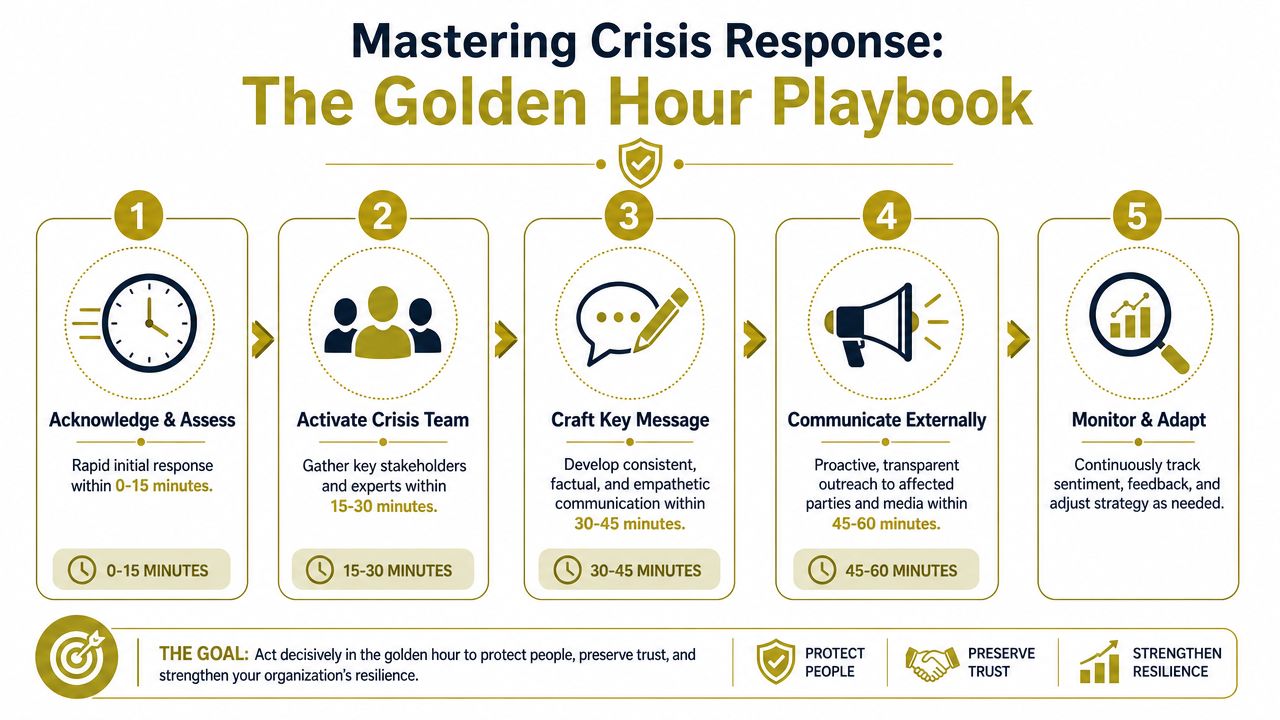
What to do in the golden hour
A strong response sequence is usually simple.
Acknowledge the issue internally
Confirm that an incident exists and assign one person to lead coordination immediately.Verify the core facts
What happened, when, who is affected, what evidence exists, and what remains unclear. Don't guess to fill gaps.Activate the crisis team
Bring together operations, leadership, legal, communications and customer-facing teams. Keep the group tight enough to act.Prepare a holding statement
Early language should be factual, calm and human. It should acknowledge concern, state what is being done, and avoid claims you can't yet prove.Communicate by stakeholder priority
Staff first where appropriate, then affected customers, partners, regulators and media depending on the issue.
A holding statement doesn't need to be long. It needs to be usable.
We're aware of the issue, we're investigating urgently, and we'll provide a further update as soon as we have verified information.
That kind of wording won't win awards. It can, however, stop a vacuum from forming.
A hypothetical example that shows the difference
Take a Glasgow tech SME. Its platform suffers a weekend outage. Customers can't log in, a frustrated user posts about it publicly, and a local journalist starts asking whether client data has been compromised.
Poor response: the company waits, says nothing publicly, lets support staff improvise replies, and tells the journalist it has no comment while engineers investigate. Online criticism grows, clients assume the worst, and the absence of information becomes part of the story.
Better response: the company confirms the outage, explains that investigation is under way, updates customers directly, posts a clear status notice, and names the next update time. It doesn't overstate what it knows. It doesn't speculate about impact. It shows control.
The same principle applies in cyber incidents. If you're dealing with account compromise, ransomware concerns or customer panic after suspicious activity, practical guidance on how to recover from being hacked can help teams align technical recovery with clearer stakeholder communication.
A short explainer can also help leaders visualise the pace and pressure of crisis response:
How journalists think during a live issue
Newsroom experience provides a genuine operational advantage. Former journalists know the questions a reporter will ask before they ask them:
- What's happened
- Who knew and when
- Who has been affected
- Was this preventable
- Why should the public care now
- What proof supports your version
If your response doesn't answer those questions, the next call will. The sharper your internal fact-finding, the more likely you are to avoid contradictory statements, accidental misdirection and language that sounds like evasion.
For businesses building their own procedures, a practical guide to developing a crisis communications plan can help turn those first-hour decisions into something repeatable rather than improvised.
Measuring and Reporting on Reputational Health
If reputation only gets discussed when something goes wrong, leadership will always treat it as episodic. It needs reporting discipline.
That doesn't mean pretending reputation can be reduced to one neat score. It means tracking a sensible set of signals and showing leadership what they mean in business terms. The board doesn't need vanity metrics. It needs evidence of confidence, exposure and trend.
Leading indicators and lagging indicators
A useful way to report reputational health is to separate leading indicators from lagging indicators.
Leading indicators are early signals. They help you spot pressure before it becomes a crisis.
- Customer complaint themes that repeat across channels
- Review sentiment shifts in tone or subject
- Media enquiry patterns that suggest a narrative is forming
- Employee escalation volumes on ethics, service failures or culture concerns
- Spokesperson readiness and response speed in simulations
Lagging indicators tell you what happened after an event or over a period of time.
- Changes in customer retention after a public issue
- Inbound sales quality following a negative story
- Recruitment friction where candidates raise concerns
- Stakeholder confidence reflected in partner or investor conversations
- Longer-term sentiment trends across owned and earned channels
How to make reporting useful
A board paper on reputation should answer three questions:
| Question | What leadership needs to see |
|---|---|
| What's changing | The main patterns, not every data point |
| What matters | Why those patterns affect trust, revenue or operations |
| What's being done | Actions taken, owners assigned, decisions needed |
Keep the language plain. “Increased negative comment volume relating to response times” is better than jargon. “Two recurring themes are likely to affect renewal conversations” is better than a chart with no interpretation.
Report reputation the way you'd report any serious risk. Describe the signal, explain the consequence, assign the action.
For social channels, engagement numbers alone rarely tell the full story. Context matters. Teams that want a clearer view of what interaction quality says about trust can use this guide to measure social media engagement.
The key is consistency. If you report monthly, keep the categories stable enough to spot movement over time. If you change what you measure every quarter, leadership gets activity without insight.
Your Next Steps with Newsroom Grade Expertise
Reputational damage rarely starts with the headline. It starts with a delay, a gap in evidence, or a response that does not survive scrutiny. Leaders who handle this well usually have five things in place before they need them. Clear ownership, known vulnerabilities, usable statements, a tested escalation route, and spokespeople who can stay accurate under pressure.
A newsroom background helps because editorial decisions follow recognisable patterns. Reporters and editors look for conflict, accountability, proof and public interest. If you understand that process, you can spot which issues are likely to gather pace and intervene earlier, with better judgement.
A practical checklist for leadership teams
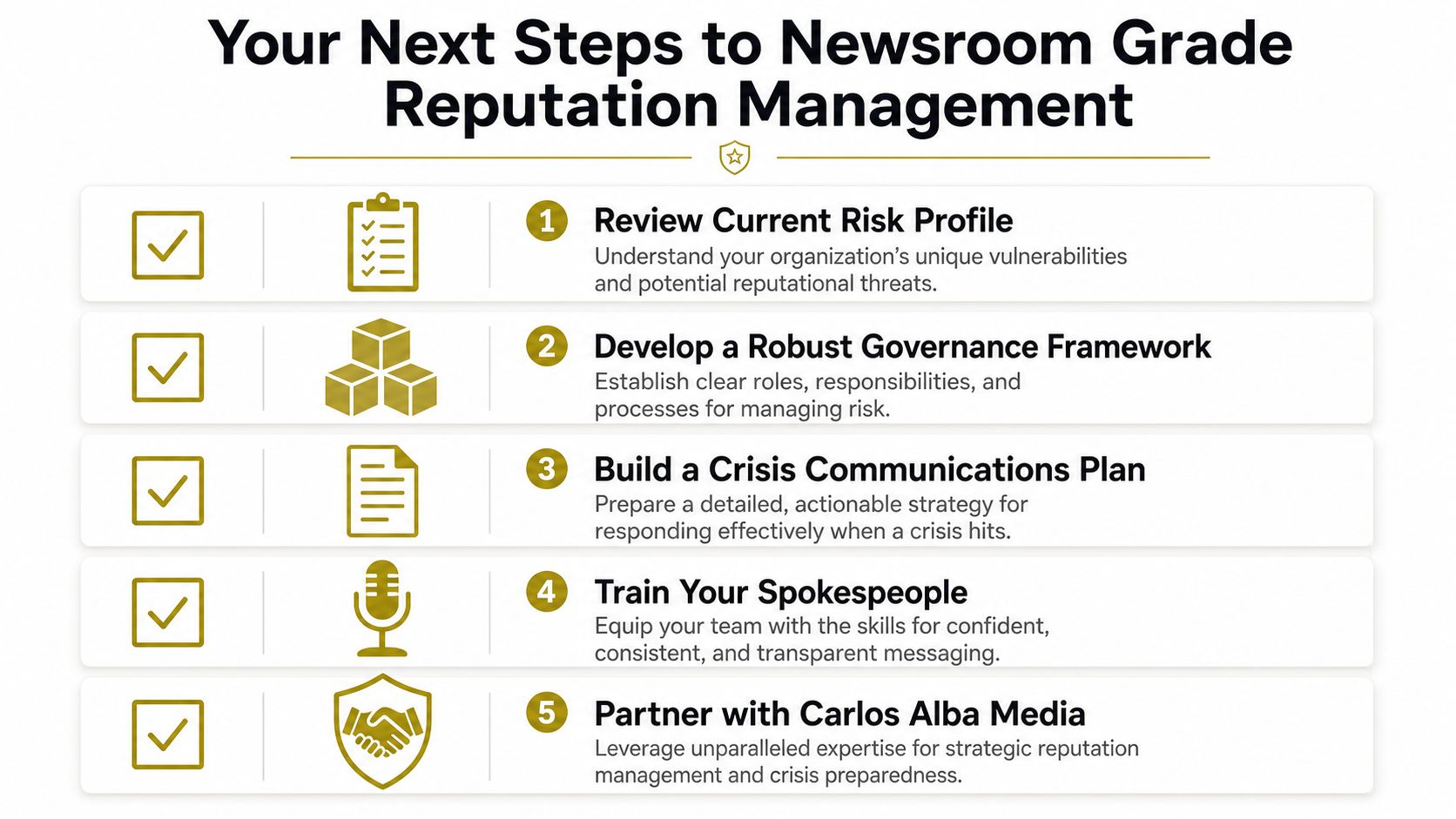
Before the next issue tests your business, check these basics:
- Review your current vulnerabilities. Look at customer complaints, delivery weak points, leadership exposure, supplier risk and any issue that could trigger scrutiny.
- Put reputation on the formal risk register. If it is not documented and owned, it is rarely managed properly.
- Create usable holding statements. They should sound like your organisation and still work under pressure.
- Test your escalation process. Staff should know who to call, what to save, and what not to say publicly.
- Train your spokespeople. A strong interview depends on accuracy, evidence and composure when challenged.
Carlos Alba Media's team includes former national news journalists and agency practitioners with experience advising international brands, as set out on the agency's who we are page. That background provides a practical understanding of editorial decision-making. It helps organisations assess what will interest a journalist, what will keep a story running, and what evidence is needed to change the tone of coverage.
What to do next
If you are a founder, owner or senior leader, audit your current position before a live issue does it for you. Ask:
- What is the highest-risk story in our business today?
- Who is likely to spot it first?
- Who speaks for us in the first hour?
- What proof do we need before we make any public statement?
- Would our current response build confidence or raise more questions?
Those answers usually show, quickly and clearly, whether the organisation is prepared or exposed.
If you want a confidential review of your current exposure, Carlos Alba Media can help you assess vulnerabilities, tighten your crisis process, and prepare for the scrutiny that causes lasting damage when businesses are caught unready.