
You're probably in one of two positions right now. Either your team is trying to do everything in-house and marketing has become a patchwork of half-finished campaigns, rushed content, random paid ads and a website that no one has properly reviewed in months. Or you've already hired outside help once and came away wondering what, exactly, you were paying for.
That confusion is normal because a lot of digital marketing agency work is sold badly. Agencies talk in channels, platforms and deliverables. Business owners think in revenue, reputation, lead quality and time. Those are not the same conversation.
A good agency doesn't just “do marketing”. It builds a system that helps people find you, trust you and act. A bad one keeps you busy with reports full of activity and very little commercial movement. The difference usually comes down to who is doing the thinking, who is doing the work, and whether the agency is built around senior judgement or volume.
What Does a Digital Marketing Agency Actually Do
A digital marketing agency should do one thing above all else. It should reduce waste between your business goals and your customer's decision to buy.
That sounds simple, but the actual work is broad. An agency may shape your positioning, write your website, run Google Ads, improve your SEO, manage social campaigns, analyse conversion paths, build landing pages, fix user experience problems and tighten reporting so you can see what is producing leads or sales.
The real job is coordination
Most businesses don't fail at marketing because they have no ideas. They fail because the parts aren't connected.
Your website says one thing. Your ads promise another. Your content targets the wrong searches. Your social posts are busy but forgettable. Your analytics are messy, so nobody knows which channel deserves more budget. A proper agency brings those parts into one plan.
A good comparison is hiring a general contractor for a renovation. You don't hire them because they personally lay every brick. You hire them because they know which specialist to bring in, in what order, and how to stop the whole thing becoming an expensive mess.
A serious agency is not a supplier of tactics. It is a manager of commercial attention.
That matters in the UK because digital is no longer a side channel. The Office for National Statistics reported that 93% of UK households had internet access in 2024, up from 53% in 2006, which is why digital marketing moved from specialist work to core business infrastructure over less than two decades, as cited in this UK digital marketing statistics overview.
Not all agency models are equal
Many buyers get caught. They assume all agencies offer roughly the same value and differ only on price. That's wrong.
Large agencies often sell senior brains and deliver junior labour. Cheap providers often sell channel execution without much strategy. Specialist senior-led firms take a different route. They keep the strategic work close to experienced operators and avoid burying clients under layers of account handling.
That model matters when the work involves brand reputation, complex messaging or high-stakes growth decisions. It also matters when your content has to carry authority. If video is part of your mix, this guide for social video creators is worth reviewing because it helps clarify where short-form video fits inside a wider digital programme rather than treating it as a standalone gimmick.
If you want useful digital marketing agency work, ask a blunt question early. Who will do the thinking after the pitch? If the answer is vague, keep looking.
The Core Services of a Modern Digital Agency
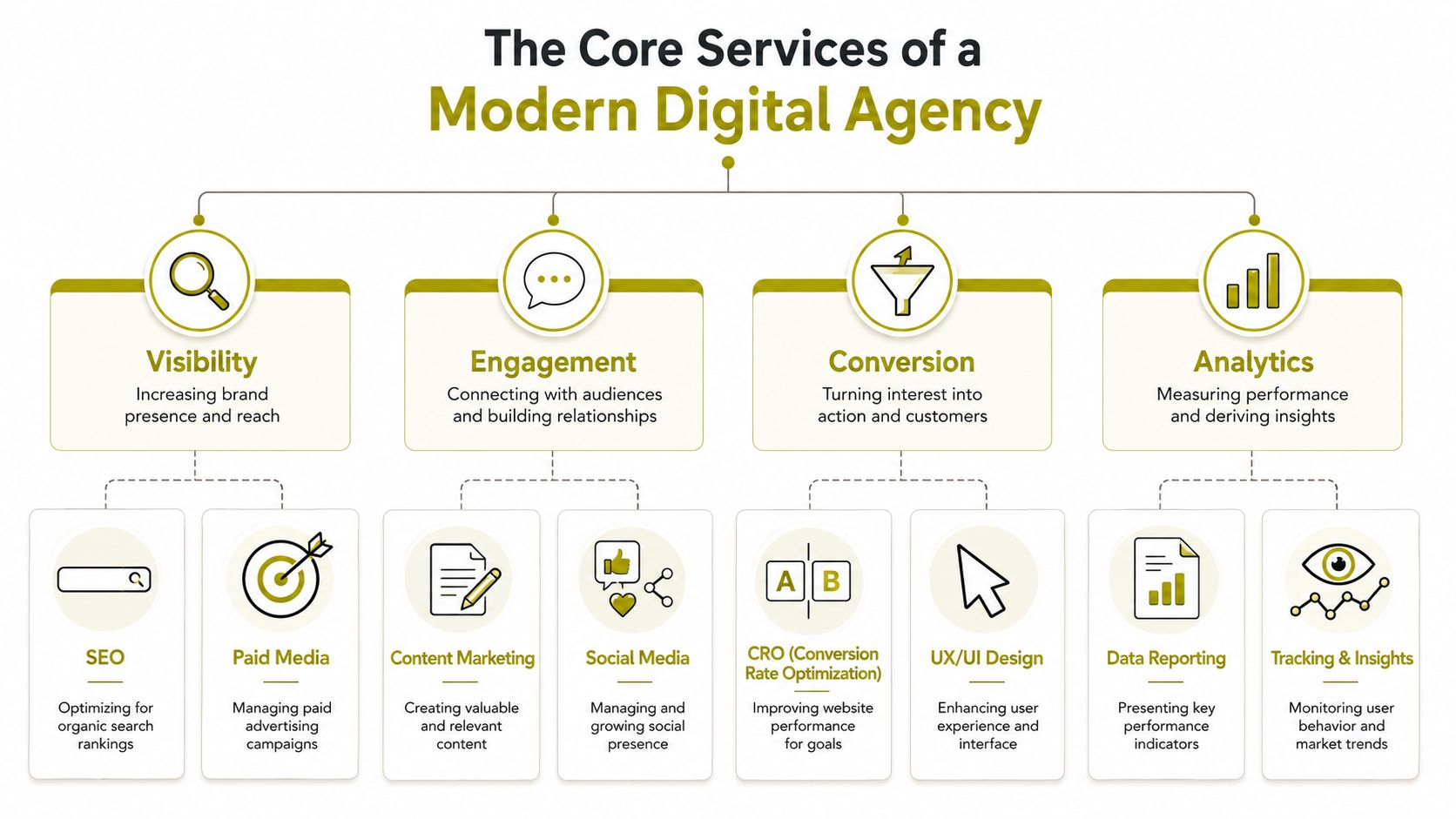
A good agency does not sell disconnected tasks. It builds a system that helps the right audience find you, trust you, act, and gives both sides clear evidence of what is producing revenue. The simplest way to assess that system is through four pillars: visibility, engagement, conversion and analytics.
Visibility
Visibility answers the first commercial question. Can buyers find you at the moment intent appears?
This pillar includes SEO, paid search, paid social, online video distribution, local search optimisation and, in some sectors, digital PR. The goal is not broad exposure for its own sake. The goal is qualified attention from people already close to a decision.
Senior agencies usually handle this better because they know the difference between traffic and demand. A junior team can chase rankings, impressions and clicks. An experienced team asks better questions. Which searches signal buying intent? Which channels support margin? Which pages deserve promotion because they can convert? That judgment is where a specialist firm earns its fee.
Engagement
Attention is fragile. If your message is vague, repetitive or self-important, people leave.
This pillar includes content marketing, social media, email, thought leadership and brand storytelling. Strong agencies use those channels to answer questions, handle objections and give buyers a reason to trust you before the sales conversation starts. If you need a practical framework, this guide on how to create a content marketing strategy is useful because it ties editorial planning to business goals instead of treating content as a publishing treadmill.
Editorial discipline matters here. Agencies with journalistic experience tend to produce clearer angles, sharper interviews, stronger briefs and tighter copy. That is one reason businesses often get better results from senior-led specialists such as Carlos Alba Media than from larger providers built around layered account management and junior production.
Practical rule: If a piece of content does not answer a customer question, reduce purchase anxiety or support a sale, it is filler.
Conversion
Traffic without conversion is expensive theatre.
Conversion work covers landing pages, UX, CRO, web design, form design, calls to action, trust signals and page speed. These are the parts of agency work that turn attention into enquiries, bookings or sales. A strong campaign can still fail if the destination page is slow, confusing, badly structured or built for the wrong device.
This is also where many businesses misjudge agency value. They pay for acquisition and underinvest in the page, offer and user journey. Senior practitioners do not make that mistake. They know small changes to layout, proof, copy hierarchy or form friction can outperform another month of media spend.
Analytics
Analytics keeps the rest honest.
A modern agency should set up tracking, reporting dashboards, attribution views and regular performance reviews so decisions come from evidence. Good reporting does more than list numbers. It shows which channels assist revenue, which content supports conversion, where users drop off and what should change next. If you want a clearer view of the operational side behind this reporting, this guide to agency management tools is a useful reference.
Here's the short version:
| Pillar | What it does | Common services |
|---|---|---|
| Visibility | Helps buyers find you | SEO, PPC, paid social |
| Engagement | Builds trust and attention | Content, email, social |
| Conversion | Turns visits into action | CRO, UX, landing pages |
| Analytics | Shows what's working | Tracking, dashboards, reporting |
You do not need every service at maximum intensity all year. You do need these pillars connected and prioritised by someone senior enough to know what matters first. That is the difference between an agency producing activity and an agency producing commercial progress.
How Digital Agency Workflows Actually Function
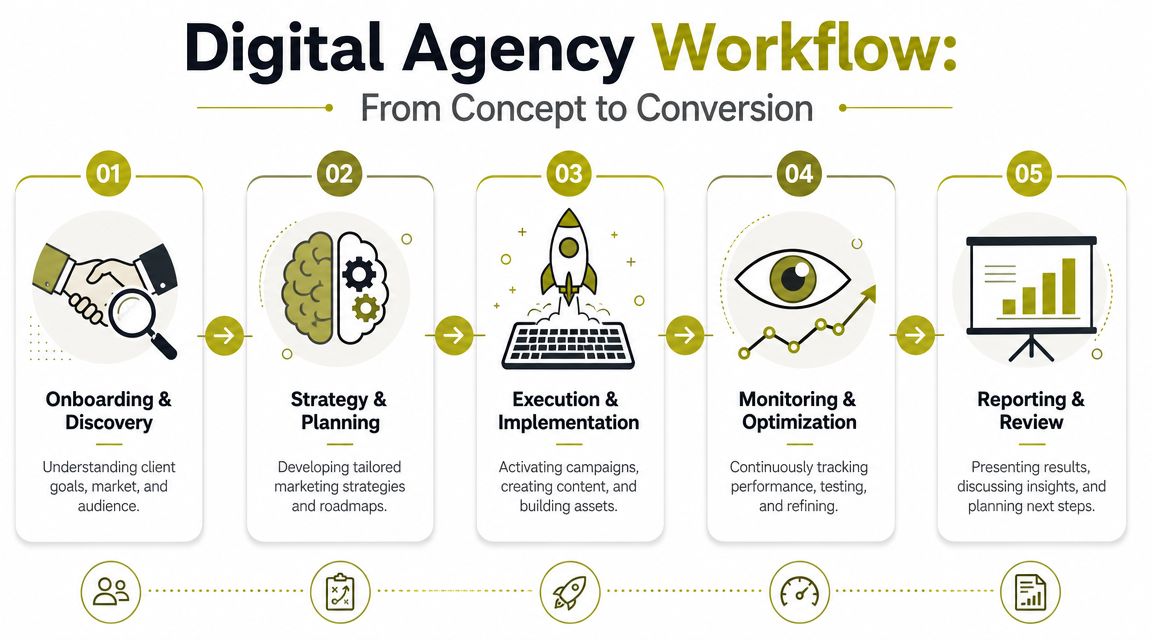
Agency work often looks mysterious from the outside because clients usually see outputs, not the machinery behind them. The workflow is less glamorous than the pitch deck. It's a chain of decisions, approvals, production steps and measurement loops.
Discovery before delivery
Good agency work starts with diagnosis, not execution.
At onboarding, the team should review your offer, margins, audience, current channels, sales process, website, analytics setup and existing assets. If they skip this and jump straight into “posting content” or “starting ads”, they're guessing.
This structure matters because acquisition now depends on connected digital journeys. UK consumers are highly active online, with 93% reported as recent internet users every day or almost every day in the cited guidance, which is why agencies need instrumented touchpoints across search, paid media and analytics rather than isolated campaigns, as discussed in this explanation of how digital agency workflows support conversion.
Strategy turns information into priorities
Once discovery is done, the agency should decide what matters first.
That may mean rebuilding landing pages before increasing ad spend. It may mean fixing analytics before writing more content. It may mean narrowing your audience instead of broadening it. Senior judgment proves its worth. A junior team can produce a long list of ideas. An experienced strategist knows which three will move the account.
Typical strategic outputs include:
- Channel priorities: Which mix of SEO, PPC, social, email or PR deserves focus now.
- Messaging decisions: What claims, proof points and offers should lead your communication.
- Measurement rules: Which conversions count, how they're tracked and how success will be reviewed.
- Production cadence: What needs building weekly, monthly or quarterly.
Clients should expect a roadmap. They shouldn't have to reverse-engineer one from scattered task updates.
Execution is usually split across roles
A lot of confusion comes from not knowing who does what. In a healthy agency setup, the work is usually divided between a few core roles:
| Role | Real function |
|---|---|
| Strategist | Sets direction, priorities and commercial logic |
| Account manager | Keeps delivery moving, coordinates communication |
| Specialist | Executes channel work such as SEO, ads, design or content |
The problem in bigger agencies is that clients often meet the strategist once, then spend the next year speaking mostly to account handlers. That's why many owners prefer direct access to the person making decisions.
If you want to understand the software side of that operational layer, this guide to agency management tools gives a reasonable overview of the systems agencies use to manage tasks, approvals and reporting.
Optimisation is where the real value sits
Most agency work isn't in launch. It's in adjustment.
After campaigns go live, the team should review behaviour, identify drop-off points, revise creative, test copy, refine targeting and improve pages. The point isn't to admire the plan. The point is to keep tightening the system.
That's also where a client's access to senior people matters most. When performance dips, you don't need more dashboards. You need someone who can tell whether the problem is targeting, offer, message, market timing or the site itself.
Measuring Success Deliverables and Key KPIs
Most agency reports are too busy and too weak at the same time. They drown you in charts but avoid the one question that matters. Is this work improving the business?

The pressure for proper measurement is only increasing. UK ad spend was projected to reach £40.7 billion in 2024, and that scale has pushed brands to demand proof in traffic, leads and sales rather than vague visibility claims, according to this UK ad spend projection and ROI context.
What a deliverable should actually look like
Deliverables vary by scope, but they should be concrete.
A sensible agency may provide campaign plans, landing pages, ad creative, content calendars, SEO recommendations, reporting dashboards, technical audits and monthly performance reviews. But the presence of deliverables doesn't prove quality. Plenty of agencies are very good at producing things. Fewer are good at producing the right things.
A proper monthly review should answer these questions:
- What changed: The important movements in traffic, enquiries, lead quality or sales activity.
- Why it changed: The likely causes, not just the surface metrics.
- What happens next: Clear actions, tests or budget shifts for the next cycle.
Vanity metrics versus business metrics
Some metrics matter. Some just look reassuring in a slide deck.
Here's the distinction:
| Vanity metrics | Useful KPIs |
|---|---|
| Impressions | Cost per acquisition |
| Likes and reactions | Lead quality |
| Reach | Conversion rate |
| Click volume alone | Sales-qualified leads |
| Follower count | Revenue contribution |
That doesn't mean vanity metrics are worthless. They can help diagnose creative performance or audience resonance. But they are not the final score.
A good agency reports on outcomes and uses activity metrics only as supporting evidence.
The KPIs worth discussing
The right KPI set depends on your business model, but most owners should insist on a handful of commercial indicators.
- Lead quality: Are the enquiries relevant, affordable and likely to close?
- Conversion rate: Are more of the right visitors taking action?
- Cost efficiency: Are you paying a sensible amount to acquire an enquiry or customer?
- Pipeline impact: Is marketing producing opportunities the sales team can use?
- Retention signals: Are customers returning, re-engaging or buying again where relevant?
One more point. If an agency won't show you the live numbers, that's a problem. You should be able to see what's happening without waiting for a polished monthly narrative.
Understanding Agency Pricing and Retainer Models
Agency pricing confuses buyers because many firms make it sound more complicated than it is. In reality, most digital marketing agency work is sold through three models: retainers, project fees and performance-based deals.
Each can work. Each can also be a bad fit.
Monthly retainers
A retainer is the standard model for ongoing work. You pay a fixed monthly fee for agreed strategic and execution support.
This works well when you need continuous SEO, paid media management, content production, reporting and optimisation. It doesn't work well if your business expects immediate miracles or if the scope changes every week without discipline.
Retainers suit:
- SMEs with ongoing growth goals: They need continuity, not one-off bursts.
- Brands managing several channels: Coordination matters more than isolated tasks.
- Teams without in-house senior marketing leadership: They need external judgement as much as execution.
Project fees
Project pricing is cleaner. There's a defined piece of work, a timeline and a delivery point.
This fits website builds, audits, messaging projects, analytics setups, brand repositioning exercises or a content sprint. The weakness is obvious. Once the project ends, so does the structured momentum unless someone picks up the follow-through.
Performance-based pricing
This model sounds attractive and is often oversold.
In theory, the agency gets paid based on outcomes such as leads or sales. In practice, performance is rarely controlled by marketing alone. Sales speed, follow-up quality, offer strength, market conditions and operations all affect the result. That makes pure performance deals messy unless the scope is narrow and the tracking is clean.
If an agency pushes performance pricing too hard, ask what parts of the result they actually control.
What buyers should watch for
The model matters less than the clarity.
You need to know what's included, what isn't, who is doing the work, how strategy time is handled and how change requests are priced. You also need to separate fee from media spend. Too many buyers hear one number and don't realise ad budget sits on top.
For a broader view of how pricing frameworks vary across markets, this piece on French SEO agency costs 2026 is useful because it shows how retainers and deliverables are structured in practice, even outside the UK. If you want a UK agency-specific breakdown, Carlos Alba Media has also published its own overview of digital marketing agency pricing packages.
The blunt advice is simple. Don't buy on lowest monthly fee. Buy on the quality of thinking, the relevance of scope and whether the model matches how your business grows.
Choosing the Right Partner The Senior-Led Advantage
A lot of businesses choose the wrong agency for the right reason. They want capability, so they buy size. They assume a bigger team means better thinking. Often it means more meetings, more handoffs and more dilution.
That's why the senior-led specialist model deserves serious attention. The UK market supports specialisation because digital performance now sits close to the core of commerce. Internet sales made up 26.3% of total retail sales in Great Britain in December 2024, and UK adults spent on average 4 hours 20 minutes online per day on smartphones in 2024, according to the discussion summarised in this analysis of digital attention and specialist agency relevance.
What senior-led actually changes
It changes speed, clarity and accountability.
When experienced people stay close to the work, they spot weak briefs faster. They ask better questions. They challenge bad assumptions before budget is wasted. They also write better, edit harder and make cleaner strategic calls.
That matters even more when your marketing includes reputation, media handling, executive visibility or content that needs authority rather than generic search filler. A specialist model can also be leaner because you're not funding layers of internal theatre.
One option in that category is Carlos Alba Media's guide to choosing a UK digital marketing agency. The firm operates as a senior-led PR and digital consultancy, and the people delivering the work are former national news journalists or agency professionals with international brand experience. That background is relevant when businesses need stronger messaging, sharper editorial judgement and direct strategic contact.
Agency model comparison
| Attribute | Senior-Led Specialist Agency | Large Full-Service Agency | Low-Cost Freelancer / Small Shop |
|---|---|---|---|
| Strategic depth | Usually high and close to delivery | Can be high in pitch stage, uneven in delivery | Varies widely |
| Speed of decisions | Fast | Often slowed by layers and approvals | Fast |
| Client access to experts | Direct | Often limited after sale | Usually direct |
| Breadth of services | Selective and integrated | Broad | Narrow to moderate |
| Messaging quality | Often stronger where senior writers are involved | Variable by team | Depends entirely on individual skill |
| Process complexity | Leaner | Heavier | Light, sometimes too informal |
| Value for SMEs | Often strong if scope is focused | Can be expensive for the level of attention received | Cheap upfront, risky if strategy is thin |
Who should choose what
A large agency makes sense when you need scale across many markets, multiple departments and extensive production. A freelancer can work well when the problem is narrow and tactical.
But many founders, SMEs and established brands in high-stakes situations sit in the middle. They need serious judgement without oversized overhead. They need direct access to people who've handled pressure, written for real audiences and worked on demanding accounts. That's where senior-led digital marketing agency work tends to outperform bloated alternatives.
Your Role in a Successful Agency Partnership
The hardest truth in agency work is this. You cannot outsource responsibility for growth.
You can outsource specialist execution. You can outsource strategy support. You can outsource production. But if your team is slow, unclear, disorganised or detached from the commercial reality, the agency will hit a ceiling.
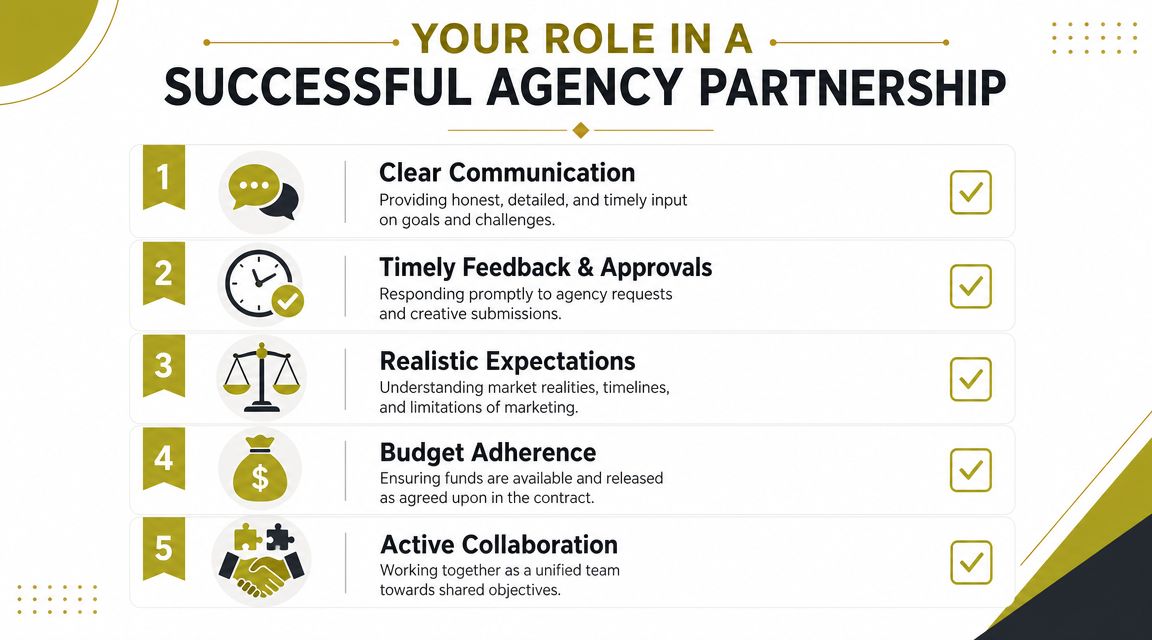
Recent buyer guidance keeps making the same point. Agency performance depends heavily on client-side inputs such as regular meetings, prompt lead follow-up and clear ownership of the process, as noted in this discussion of what clients must contribute to agency success.
What your agency needs from you
This part is routinely ignored in sales conversations, so here it is plainly.
- Clear goals: Don't say you want “more visibility” if what you really need is qualified enquiries in a specific region.
- Fast approvals: Delayed feedback slows production, launch timing and optimisation.
- One accountable contact: Agencies struggle when five internal stakeholders give conflicting direction.
- Sales follow-up discipline: If leads sit untouched, marketing gets blamed for a sales problem.
- Access to information: Good campaigns need product detail, customer insight, objections and internal intelligence.
The best results come from shared execution, not passive expectation.
What healthy collaboration looks like
A good partnership has rhythm.
There are regular check-ins. Decisions get made. Feedback is specific. Problems are raised early. The client tells the agency when the market changes, when a product issue appears or when lead quality shifts.
You don't need to micromanage. You do need to stay engaged.
Red flags when vetting agencies
Before you sign anything, look for warning signs.
- Vague promises: If they guarantee broad success without discussing your sales process, they're selling fantasy.
- No visibility into reporting: You should be able to see performance without waiting for a polished PDF.
- Junior-heavy delivery with senior-heavy pitching: This is common and expensive.
- Channel obsession without commercial context: Tactics are not strategy.
- No questions about your internal process: If they never ask how you handle leads, approvals or customer data, they're not thinking about outcomes.
Digital marketing agency work can be one of the best growth investments a business makes. It can also become a costly theatre production. The difference is usually partnership quality, senior judgement and whether everyone involved is honest about what it takes to win.
If you want direct, senior-level support with PR, SEO, content, web performance and digital strategy, Carlos Alba Media is one option to consider. The consultancy works with start-ups, SMEs and established organisations that want experienced counsel without big-agency overheads, and its team combines former national news journalists with agency professionals who've worked on international brands.