
You're probably reading this with a decent salary, a full calendar, and a startup idea that won't leave you alone. You might be sketching product flows on the train, saving domain names in a notes app, or testing whether anyone would pay for what you want to build.
The short answer is yes, you can start a startup while working. In the UK, though, the primary question isn't just whether you're allowed. It's whether your contract, conduct, intellectual property position, and public profile make it safe to do so.
That's where generic hustle advice falls apart. “Work nights and weekends” sounds fine until your employer claims ownership of your code, your side project overlaps with a client account, or your LinkedIn activity raises questions before you're ready. At Carlos Alba Media, the advice comes from people who've worked in national newsrooms and agencies for international brands, so the lens is practical. Protect the story before you tell it. Protect the asset before you launch it.
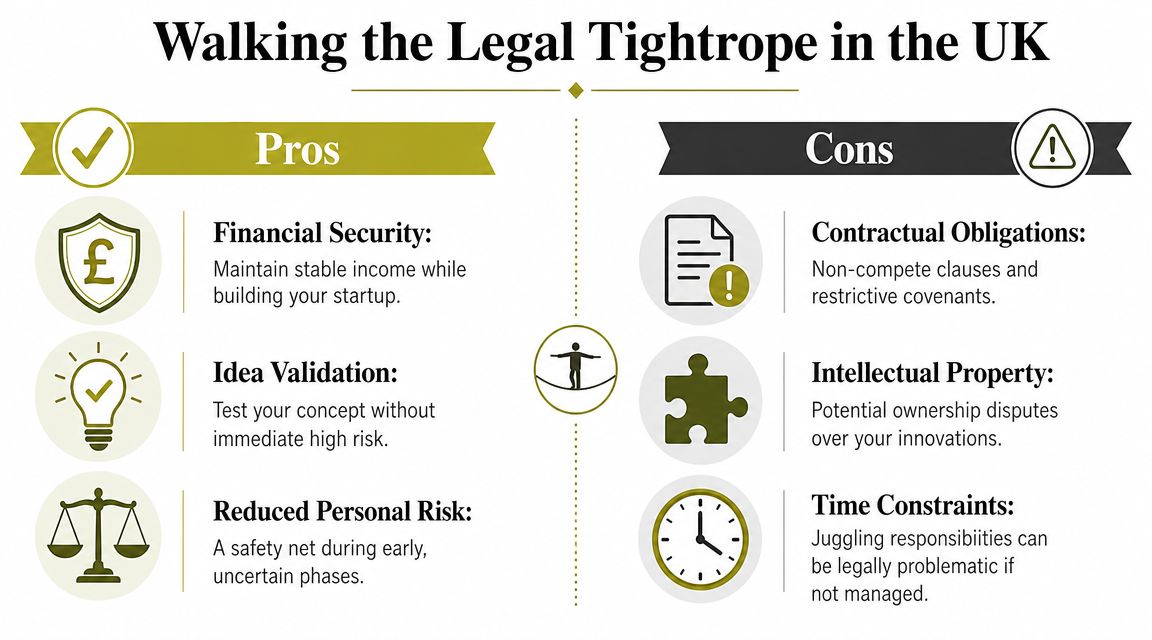
Walking the Legal Tightrope in the UK
Fear about legality is usually vague at first. Founders ask, “Can I start something on the side?” The sharper question is, “What have I already agreed to in writing, and who owns what I create?”
In the UK, the legal risk often sits inside the small print. Guidance around side projects consistently points back to the same pressure points: restrictive covenants, confidentiality obligations, conflict rules, and IP assignment terms. UK guidance also notes that employee inventions can belong to the employer in some cases, depending on the role and contract. That's why the issue isn't just time management or whether your manager seems relaxed about it, as noted in this discussion of moonlighting, side projects, and IP risk.
What to review in your contract
Read your contract as if you were auditing risk for someone else. Emotion clouds judgement. Paperwork doesn't.
Start with these clauses:
- Non-compete terms: Check whether your contract restricts outside commercial activity during employment or after you leave.
- IP assignment wording: Look for language that covers inventions, software, processes, ideas, or anything created “in connection with” your role.
- Confidentiality rules: These often reach far beyond trade secrets. Internal processes, customer information, pricing, strategy, and data can all be protected.
- Disclosure obligations: Some employers require you to declare outside business interests, directorships, or paid work.
- Conflict language: If your startup serves the same market, solves a similar problem, or could one day target the same customers, treat that as a warning sign.
Practical rule: If a reasonable outsider could confuse your employer's business interests with your startup's activity, slow down and review the risk before you build further.
What separates a safe side project from a dangerous one
A side project becomes dangerous when it borrows from your employer in any meaningful way. That includes obvious misuse, such as using a work laptop or work time, but also softer forms of overlap that founders often underestimate.
Use this checklist:
Time
Build outside contracted working hours. Don't blend startup admin into your workday.Equipment
Use your own laptop, phone, accounts, software licences, storage, and subscriptions.Data and code
Never reuse employer code, internal documents, workflows, prompts, research, or client insight.People
Don't recruit colleagues into your venture casually. That can create conflict and discovery risk very quickly.Commercial overlap
If the startup competes directly, take legal advice before doing anything public.
A simple personal risk scan
| Risk area | Lower risk | Higher risk |
|---|---|---|
| Industry overlap | Different market and customer | Same sector or buyer |
| IP position | Narrow contract wording | Broad assignment language |
| Resources | Fully personal tools and time | Any use of employer systems |
| Visibility | Quiet testing | Public launch while employed |
| Disclosure | No requirement or already declared | Clause requires disclosure and you haven't done it |
The cleanest route is simple. Build your startup on your own time, on your own equipment, with your own materials, and keep it clearly separate from your day job. If that separation feels difficult to prove, it probably isn't strong enough yet.
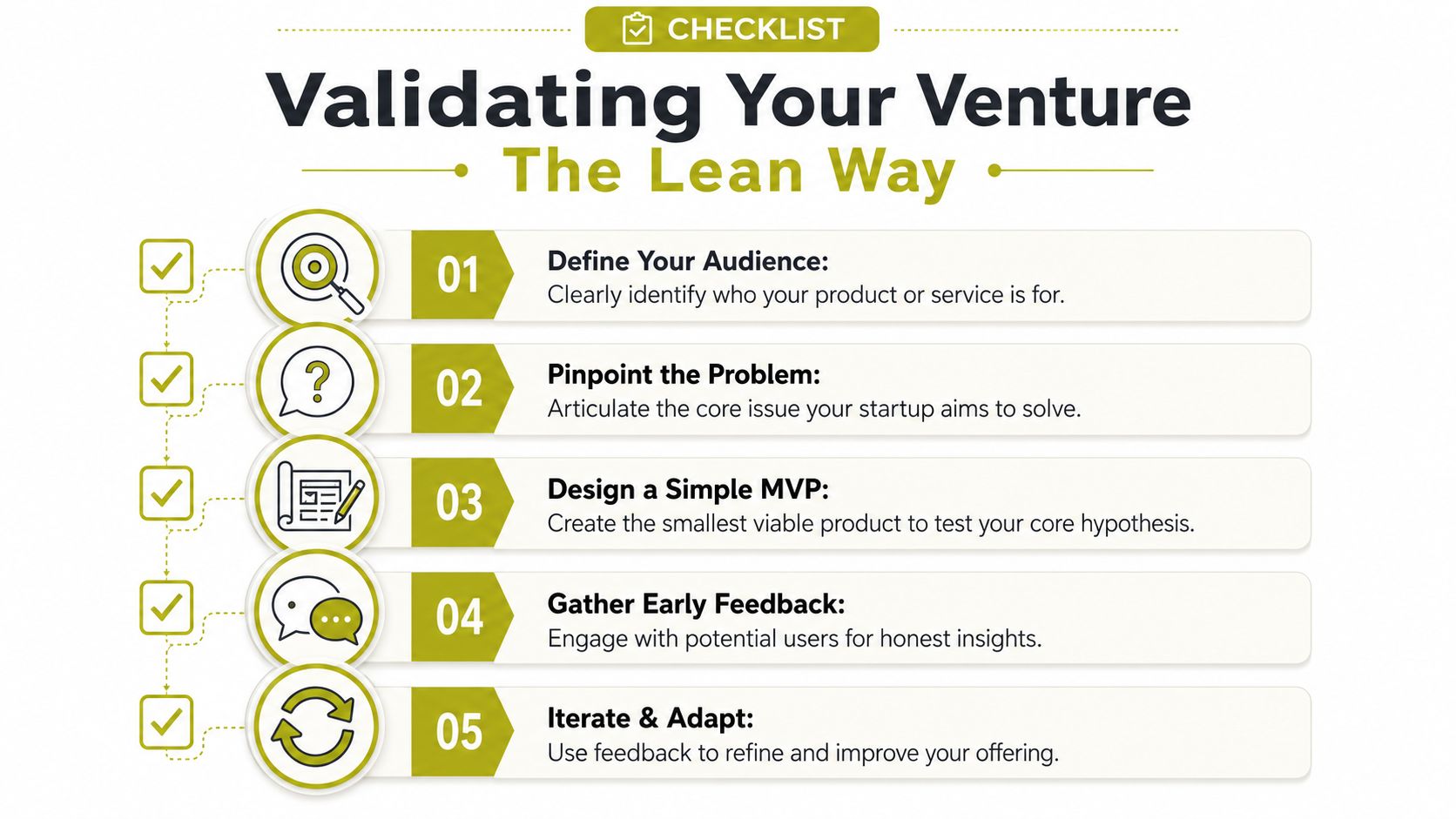
Validating Your Venture The Lean Way
Most employed founders don't fail because the idea is terrible. They fail because they build too much before they learn anything useful.
A side-hustle startup needs evidence, not polish. You're trying to answer three questions fast. Does the problem matter? Will anyone engage? Will anyone pay, or at least take a meaningful step towards paying?
Many employed founders structure around 15 to 20 hours per week for the venture while keeping the day job, which is why side businesses often begin as evenings-and-weekends builds rather than immediate full-time leaps, according to this practical guide on starting a business while working full-time. That benchmark matters because it forces discipline. You don't have the luxury of vague activity.
Start with the smallest useful test
The first version of your startup shouldn't be a product. It should be a test.
Good side-project validation often looks like this:
- Landing page MVP: A simple Carrd, Webflow, or Squarespace page that explains the problem, the offer, and a clear next step.
- Wizard of Oz test: You present the service as if there's a system behind it, but you deliver it manually to learn what users want.
- Customer interviews: Short calls with people who face the problem now, not people who merely find the idea interesting.
- Waitlist or enquiry form: Useful if the next step is meaningful. “Join our newsletter” is weak. “Book a pilot call” is stronger.
What to do each week
A practical weekly rhythm beats bursts of enthusiasm.
| Day block | Best use |
|---|---|
| One evening | User interviews or feedback calls |
| One evening | Build or refine the MVP |
| One short session | Review notes, patterns, objections |
| Weekend block | Improve offer, page, messaging, or outreach |
If you need help tightening your early messaging, this guide on how to create a content marketing strategy is a useful framework for turning scattered ideas into a clearer market story.
Don't ask early users if they “like” the idea. Ask what they do now, what they've tried, what frustrates them, and what would make them switch.
What works and what wastes time
Works well: Direct outreach, simple offers, manual fulfilment, concise landing pages, and honest feedback from people with the problem.
Usually wastes time: Branding exercises too early, expensive development, broad social campaigns before the offer is clear, and building features to avoid speaking to users.
If you're asking, “Can I start a startup while working?” this is the phase that makes the answer practical. Yes, but only if you treat time as scarce and learning as the primary output.
Mastering the Double Life of a Founder
The employed founder who wins isn't the one who works every waking hour. It's the one who protects usable hours and applies them to the few tasks that matter.
That's the difference between productive strain and chaotic exhaustion. A lot of people confuse motion with progress. They spend late nights changing logos, comparing no-code tools, and reading startup threads instead of doing work that moves a decision forward.

Stop chasing balance and build a system
A founder with a job needs a rhythm, not a fantasy routine. Time blocking is the obvious starting point, but it only works if you assign each block a real purpose.
A sensible setup looks like this:
- Deep work block: One uninterrupted session for hard tasks like product decisions, writing sales copy, or analysing interview notes.
- Admin block: Email, invoicing, filing, basic ops. Keep this contained so it doesn't swallow the week.
- Market block: Sales calls, customer outreach, or user research.
- Recovery block: A genuine pause. If every slot is “on”, your judgement drops first, then your performance.
Ruthless prioritisation beats long to-do lists
Most tasks can wait. Some should never be done at all.
Use a blunt filter. Ask whether the task helps you learn about demand, improves conversion, gets you closer to a usable offer, or reduces risk. If it does none of those things, it's probably procrastination wearing professional clothes.
The real enemy isn't lack of ambition. It's fragmented attention.
One operational mistake founders make is talking publicly before they're prepared to do so. If a journalist, podcast host, or industry contact approaches you early, your words need to be clean, consistent, and risk-aware. A practical primer on how to prepare for a media interview can help you avoid saying too much, too soon.
Protect your energy before burnout makes choices for you
Founders often underestimate how much stress comes from secrecy, especially when they're building while employed. You're carrying two identities at once. One pays the bills. The other wants your future.
That strain is manageable if you make it visible to yourself. Track your energy, not just your tasks. Build in short reviews. Notice when your job performance slips, when you become reactive at home, or when the startup starts feeding on anxiety rather than traction. If you need a simple framework, these founder well-being resources are a useful prompt for checking whether your routine is still sustainable.
A strong support system matters too. If you live with a partner or have family commitments, don't announce a startup plan after months of disappearing into your laptop. Agree the shape of the commitment early. Resentment is bad for relationships and terrible for decision-making.
Choosing the Right Business Structure
Once the idea starts to show signs of life, informality becomes a liability. Money comes in, costs appear, contracts need signing, and the line between “experiment” and “business” starts to matter.
For most UK founders who are still employed, the early decision comes down to sole trader or limited company. Neither is universally right. The correct choice depends on risk, optics, admin appetite, and how seriously you need the market to take you in the near term.
Sole trader or limited company
| Structure | Main advantage | Main drawback | Best fit |
|---|---|---|---|
| Sole trader | Simple to start and run | Personal liability sits with you | Early low-risk testing |
| Limited company | Clearer separation between you and the business | More admin and formal responsibilities | Startups with growing commercial intent |
When sole trader status makes sense
If you're testing a service business, freelance-style offer, or simple paid pilot, sole trader status can be the cleaner first move. It's straightforward, easier to understand, and often enough for validating whether customers will buy.
That said, simplicity can create false comfort. If the work carries legal exposure, contractual obligations, or reputational sensitivity, operating in your own name may not feel so simple once real clients arrive.
When a limited company becomes the smarter move
A limited company often makes more sense when you want to separate finances clearly, present a more formal face to customers, or prepare for future investment, hires, or partnerships. It can also help create cleaner boundaries between your employment and your venture, provided the underlying legal position is sound.
Choose the structure that fits the risk you're taking now, not the version of the company you hope to have one day.
This is one area where specific professional advice can save a lot of mess later. If you're weighing liability, ownership, tax treatment, and future plans, a specialist view on proactive business structuring for SMEs can help you avoid setting up something you'll need to unwind a few months later.
At minimum, keep the basics clean from day one:
- Separate bank activity: Don't blend personal spending with business income.
- Record decisions: Note who owns what, especially if a co-founder is involved.
- Document contributions: Code, designs, copy, and customer lists should have clear ownership.
- Use proper contracts: Even informal ventures need written terms when money or IP is involved.
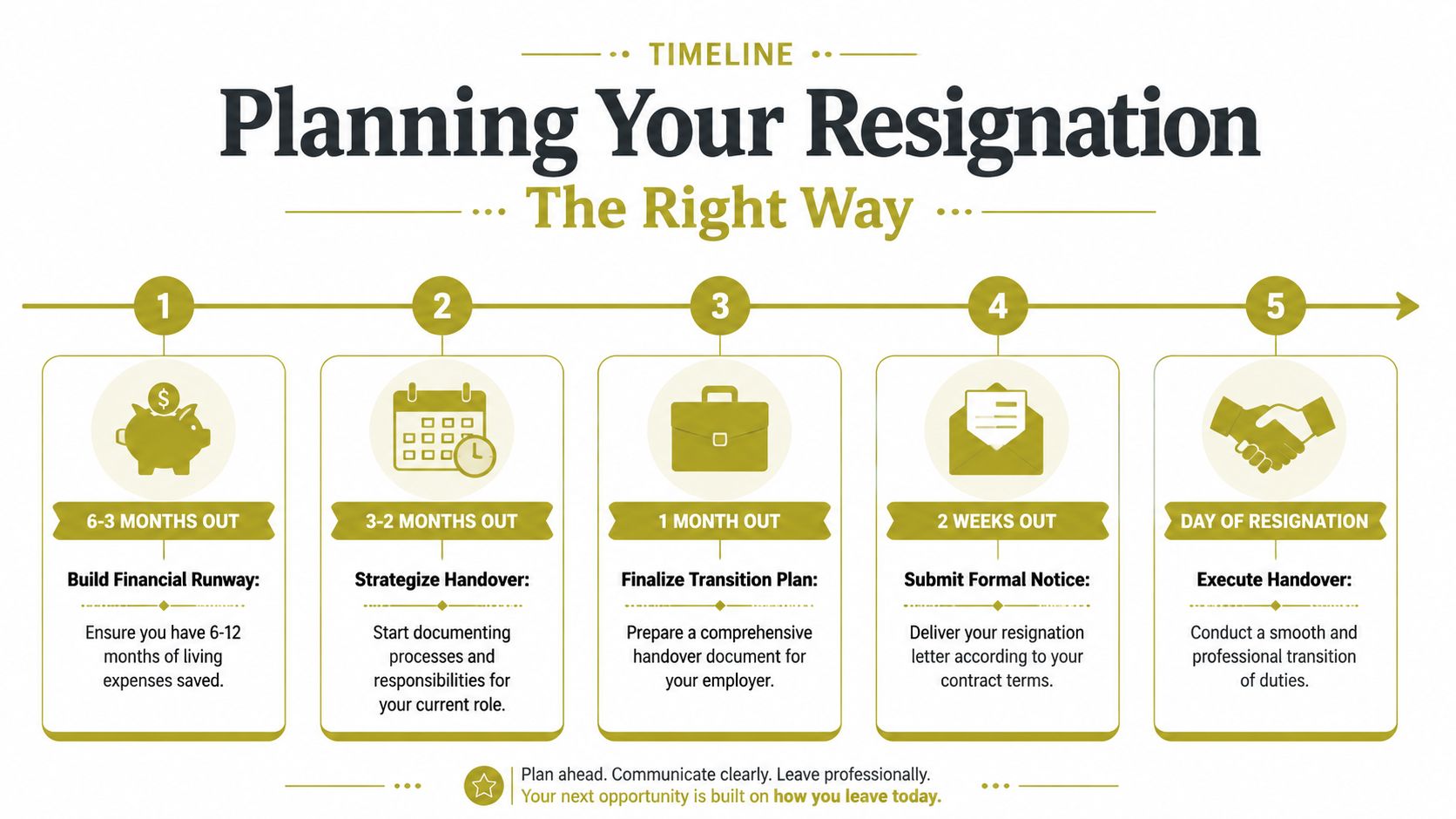
Planning Your Resignation The Right Way
Quitting too early turns a promising startup into a financial stress machine. Quitting too late can leave momentum on the table. The decision isn't emotional, even if it feels that way. It's a timing problem.
The strongest case for staying employed until traction is clearer comes from long-run earnings data. In a large registry-based study, startup employees earned about 17% less over the following ten years than workers at large established firms, and those joining before a startup reached 50 employees earned roughly 10% to 15% less, while those hired after that stage earned about 2% to 4% more, according to the UCLA Anderson review preprint on startup employee earnings over time. For founders, the practical lesson is plain. Keep salary income until the business has enough proof to reduce personal downside.
Signs you're getting close
You don't need perfect certainty. You do need evidence that the business is becoming more than a hopeful side project.
Good signs include:
- Customers are buying repeatedly: Not just praising the concept.
- Your offer is clearer: You can explain who it's for, what problem it solves, and why people choose it.
- Demand is becoming operational: The business needs more time than evenings and weekends can sensibly provide.
- Risk is lower than before: Not eliminated. Lower.
Engineer the exit professionally
A good resignation protects your reputation. That matters more than founders sometimes think, especially in UK sectors where industries are smaller than they appear.
Handle the move in order:
Review your notice period
Follow the contract exactly.Prepare your handover
Document live work, responsibilities, key contacts, and deadlines.Control the narrative
Keep your message concise. You're moving on professionally, not staging a manifesto.Avoid last-week mistakes
Don't use the notice period to recruit colleagues, chase customers through your current network, or become careless with systems and files.
A short explainer can help if you want a visual view of transition planning:
Leave well. Today's manager may be tomorrow's client, investor, referrer, or reference.
What not to do
Don't resign because you're bored. Don't resign because the startup feels more exciting than your job. And don't resign because people on LinkedIn make a dramatic leap sound like a mark of seriousness.
The strongest exits are usually quiet. The founder has tested the market, reduced legal ambiguity, got honest about cash exposure, and created a credible runway into full-time work. From the outside, it can look sudden. In reality, it's methodical.
Building Your Profile Without Risking Your Job
Early visibility is useful. Early visibility is also dangerous.
Founders love the idea of “building in public” until public means employer scrutiny, industry gossip, or a journalist asking for comment before the business can withstand attention. This is where newsroom judgement matters. Publicity is not automatically progress. Exposure without message discipline can create problems faster than it creates customers.
At Carlos Alba Media, that's a familiar tension. Teams with former national news journalists and agency operators tend to approach founder visibility differently. Not as vanity. As sequencing.
One founder who did it well
A founder in a regulated B2B space kept the personal profile low while employed. The company had a basic website, a clean proposition, and a brand voice that spoke to the problem rather than the founder's identity. On LinkedIn, the founder stayed active in industry conversations but avoided grand announcements about “finally taking the leap”.
The effect was subtle but useful. Prospects could find the business. Peers could understand the category. No one had a dramatic post to forward around the office.
The founder also kept press handling tight. If an opportunity surfaced, the response was measured. No overclaiming. No mention of the day job. No comments that blurred employer and startup identity.
One founder who made it harder than it needed to be
Another founder treated visibility as proof of commitment. Personal posts escalated quickly. “Stealth mode” updates became self-congratulatory launch messaging. Contacts from the day job started engaging publicly. A colleague noticed overlap with the founder's sector. Questions followed.
Nothing catastrophic happened immediately. But trust shifted. The startup now had a reputation issue before it had meaningful market proof.
That's the trap. Visibility creates a record. Once you've created it, you don't control who reads it or how they interpret it.
Safer ways to build presence early
Use channels that let the business earn attention without making your employment status the story.
Consider:
- Company-first content: Publish insights, FAQs, and problem-led articles under the business brand.
- Niche communities: Participate in specialist forums, Slack groups, or industry spaces where substance matters more than personal profile.
- Email capture: Build a list of interested users or buyers through useful content and clear offers.
- Selective LinkedIn use: If you do post personally, stay relevant, measured, and professional.
If you want to sharpen that founder-facing approach later, this guide to LinkedIn personal branding is useful for understanding how to build visibility without turning your profile into a running press release.
For earned media, be even more deliberate. A startup can benefit from attention, but only if the story is framed properly and the founder knows where the risks are. This article on how to get press coverage is a practical starting point for understanding what journalists need and what founders often get wrong.
The right sequence is simple. First make the business legible. Then make the founder visible. Not the other way round.
If you're building a startup while employed and want a clearer PR, messaging, or launch plan, Carlos Alba Media can support founders and SMEs with media relations, content strategy, digital marketing, and media training shaped by newsroom and agency experience.