
Your enquiries have stalled. Website traffic is moving, but not turning into calls. Your social posts look busy, yet sales still depend on referrals and founder hustle. That's usually the point where an SME owner types digital marketing consultant london into Google and hopes the right person appears.
That search can help. It can also waste months.
London is crowded, expensive, and full of people who sound strategic until you ask what they will do in week one. If you hire before defining the job properly, you'll pay for activity instead of outcomes. If you hire purely on polish, you'll probably end up with a deck, a reporting dashboard, and no meaningful shift in demand.
The smarter route is simple. Get clear internally, understand what services matter, vet hard, and insist on commercial accountability. If you also need PR, authority, reputation protection, or national coverage, give extra weight to consultants with newsroom experience. They write better, handle pressure better, and understand how stories travel.
First Steps Before You Search For a Consultant
Most founders start too late and too vaguely. They decide they need “more visibility”, “better SEO” or “someone to do digital”. That isn't a brief. It's a recipe for bloated proposals and muddled delivery.
London is a huge market. London's digital advertising market reached an estimated £7.9 billion in 2024, representing 62% of the UK's total digital ad spend, and the city hosts over 3,200 digital marketing agencies according to Criztec's London digital marketing market overview. That density gives you choice, but it also means plenty of firms know how to package themselves.

Define the business problem first
Don't hire for channels. Hire for a problem.
If pipeline is weak, say that. If leads are poor quality, say that. If you've had PR coverage but no conversion path, say that. A consultant worth paying should connect the problem to the channel mix, not the other way round.
Start with these questions:
- Revenue question: What commercial result do you need from marketing over the next operating period?
- Sales question: Where does the current funnel break, first enquiry, booked call, proposal, or close?
- Brand question: Are you unknown, misunderstood, or trusted but invisible online?
- Capacity question: Can your team handle more leads if marketing starts working?
Practical rule: If you can't explain the problem in one plain sentence, you're not ready to hire.
Set a brief that a serious consultant can answer
A useful brief doesn't need to be long. It needs to be specific. Include business goals, target customers, current channels, internal team capacity, existing tools, and what success should look like.
Use your current analytics stack properly. Check Google Analytics, Search Console, your CRM, paid media accounts, email platform, and sales notes. Then line that up against your website content. If you need a sensible starting point for planning, this guide on how to create a content marketing strategy is a good framework for tightening your brief before you speak to anyone.
A quick external shortlist can help too. If you want to compare agency types before reaching out, the Reviews To The Top marketing guide is useful for pressure-testing what kind of support model fits a small business.
Audit budget and internal ownership
Don't ask, “How much does a consultant cost?” Ask, “What can we support properly?”
A consultant can create a strategy, fix measurement, improve your website, brief content, shape PR angles, and direct paid campaigns. But somebody still needs to approve copy, respond to leads, sign off messaging, and keep sales feedback flowing. If nobody owns that internally, the consultant ends up firefighting.
Use this simple pre-hire checklist:
- Choose one primary objective. Not five.
- List the assets you already have. Website, CRM, email list, case studies, press coverage, founder profile.
- Name an internal decision-maker. One person, not a committee.
- Decide what you won't outsource. That stops scope creep early.
- Set a realistic review window. Not daily panic, and not silence either.
If you do this first, your search becomes sharper. You won't be looking for “a digital person”. You'll be looking for a consultant who can solve a defined commercial problem.
Understanding Core Digital Marketing Services
Many small business owners purchase a surface-level service rather than a comprehensive strategy. They request SEO when they require improved conversion paths. They request social media when they need stronger positioning. They request content when the underlying problem is weak commercial messaging.
A proper digital marketing consultant london engagement should connect services to outcomes. Not every business needs every channel, but every business does need clarity on what each service is supposed to do.
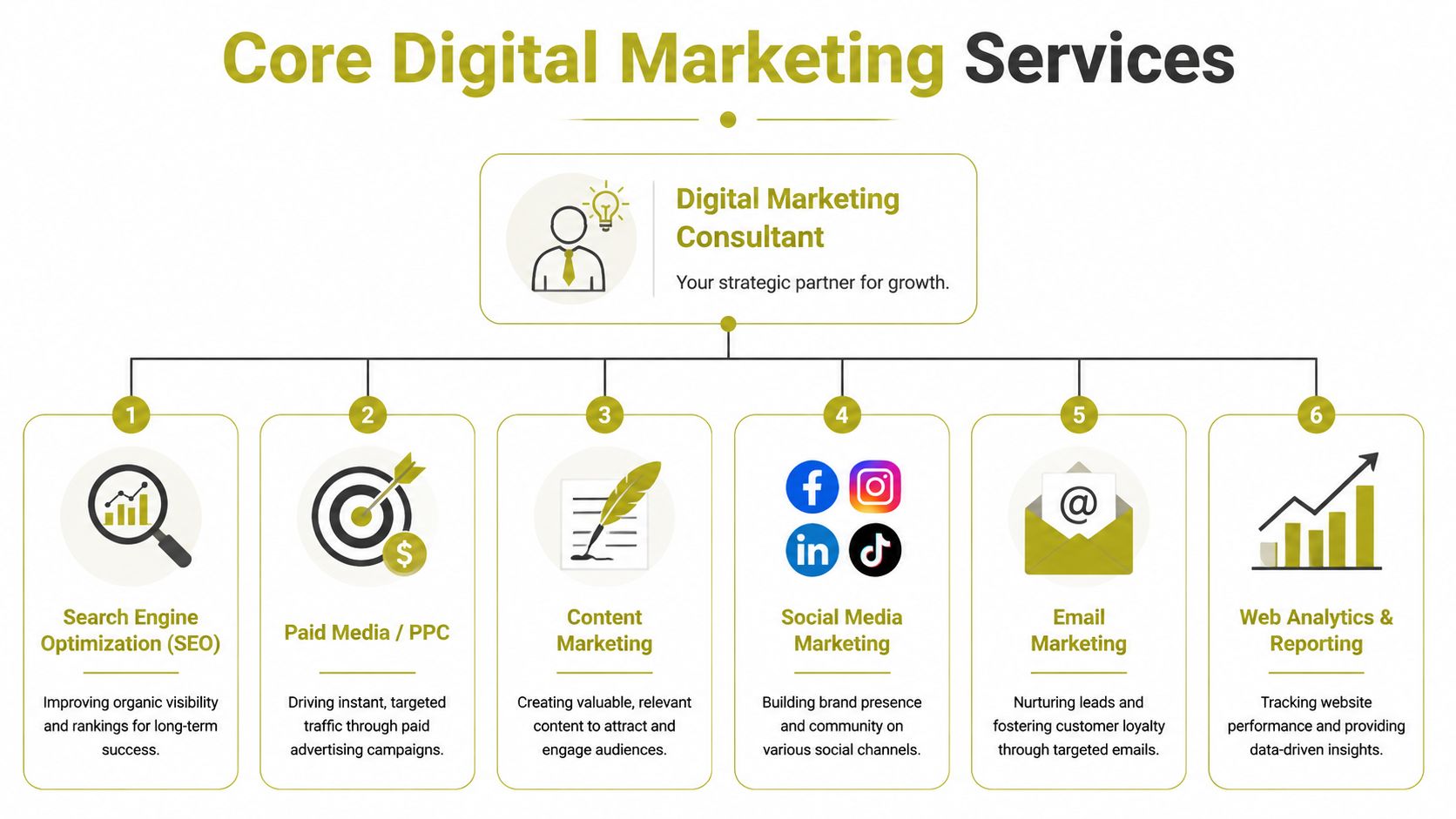
What each core service is really for
SEO is not a bag of keywords. It's authority, site structure, search intent, internal linking, technical health, and content that deserves to rank.
Paid media buys speed. It helps when you need immediate visibility, clear testing data, or demand capture around high-intent terms.
Content marketing should educate, persuade, and move people through a decision. Generic blog output won't do that. A 2021 study found that data-driven, localised content marketing services in London can yield a 35% average improvement in conversion rates, as noted in AME Marketing Agency's summary of that finding.
Email marketing does the patient work. It nurtures leads who aren't ready to buy on day one and keeps existing customers warm.
Social media should support distribution, trust, and response. It isn't a substitute for positioning or sales process.
Analytics and reporting tell you what's working, but only if the consultant sets them up against business goals rather than vanity metrics.
Why newsroom experience changes the quality of execution
This is where many consultants blur together on paper but diverge sharply in practice.
A journalist-trained marketer approaches content differently. They know how to find the authentic story, tighten an angle, write headlines people will click, and separate a claim from evidence. They understand what makes a founder quotable, what makes a case study believable, and what turns a feature into an authority asset instead of a filler article.
That matters across the whole stack:
- For SEO: stronger expert-led content and more credible authority building
- For PR-led search visibility: earned coverage can support branded search and trust signals
- For crisis communications: fast judgement under pressure, not panic posting
- For regulated sectors: tighter language, cleaner sign-off discipline, fewer careless claims
The best content teams don't publish more. They publish material that answers buyer questions better than competitors do.
If your business depends on trust, reputation, or founder visibility, that journalistic edge is not a nice extra. It changes the standard of work.
Integrated services beat isolated tactics
A good consultant won't sell you disconnected activity. They'll ask how your website, search visibility, media coverage, social proof, and lead handling fit together.
For smaller firms, that integrated approach matters more than channel volume. One strong pillar page, three sharp authority pieces, tighter enquiry forms, a cleaner LinkedIn presence, and a proper follow-up sequence can outperform a noisy mix of half-managed tactics.
If you want an example of how that thinking applies to smaller firms, this overview of digital marketing for small business is a useful reference point. The principle is simple. Don't buy fragments. Buy a joined-up plan.
What Really Sets a Top London Consultant Apart
Technical competence is the entry ticket. It doesn't make a consultant exceptional.
What separates the strongest advisers from the rest is commercial judgement. They know what to ignore, what to prioritise, and when not to recommend another tactic. That matters in London because the market is full of agencies that can execute tasks but can't think clearly about your business.

Big London agency is not the default answer
A lot of founders still assume a bigger London shop means stronger work. Often it means more layers, slower decision-making, and junior staff doing the execution while senior people appear at pitch stage.
That model is expensive. Analysis shows big London agencies' overheads can inflate costs by 50-70%, making senior-led, hybrid-location consultancies a more ROI-efficient choice for startups and SMEs seeking national exposure, according to Semrush agency market analysis referenced here.
That's why I'd push most SMEs toward a senior-led hybrid model instead. You want direct access to the person shaping strategy. You want faster feedback. You want less theatre and more doing.
What to look for beyond certifications
The strongest consultants usually show a few habits:
- They challenge your assumptions. If your brief is wrong, they'll tell you.
- They talk about customers before channels. That's how strategy starts.
- They can explain trade-offs clearly. More reach might mean lower intent. More PR might need tighter conversion infrastructure.
- They write well. This gets overlooked constantly. Poor writing ruins SEO, email, ads, landing pages, and media work.
A newsroom background sharpens all of that. Former national journalists understand deadlines, scrutiny, reputation, and how to build a narrative that travels across channels. They don't just ask what you sell. They ask what's newsworthy, defensible, and useful to your audience.
That's especially valuable if your business needs authority, founder profiling, broadcast or print exposure, or crisis readiness alongside digital execution.
Hybrid Scotland London thinking gives SMEs an edge
A London postcode is useful. A London-only worldview isn't.
SMEs trying to grow across the UK often need both national media instinct and efficient delivery. A hybrid Scotland-London structure can do that without loading your fee with unnecessary central London overhead. It also tends to suit firms that need practical counsel rather than committee-heavy account management.
One example is Carlos Alba Media's London social media marketing service, which sits within a broader PR and digital offer shaped by former journalists and agency operators. That's relevant if you need digital activity tied to media outcomes, reputation, and content authority rather than standalone posting.
If you want a useful outside perspective on how media visibility can support search performance, this explainer on Press Release SEO is worth reading.
A lot of buyers also want to hear directly from the person behind the thinking. This gives you a feel for communication style and judgement before a call.
Hire for judgement under pressure, not just channel knowledge. That's what keeps good marketing from turning into expensive noise.
Your Interview and Vetting Checklist
By interview stage, most consultants can sound credible. Your job is to find out how they think when the brief gets messy, the data is incomplete, and the founder starts asking difficult questions.
Don't ask for generic “results”. Ask them to walk you through decisions. What did they diagnose first? What did they stop doing? What did they measure? What changed because of the work?
Ask process questions, not performance theatre
Anyone can cherry-pick a win. What matters is whether they have a repeatable method.
Use prompts like these:
- “Talk me through a difficult project.” You want to hear how they handled weak assets, slow approvals, or internal disagreement.
- “What would you review in our first two weeks?” Serious consultants will mention analytics, messaging, search visibility, conversion paths, CRM, content gaps, and sales alignment.
- “What would make you say no to this brief?” This exposes honesty fast.
- “How do you report progress when results take time?” Good answer: milestone-based reporting tied to leading indicators and commercial context.
If a consultant can't explain their approach in plain English, they probably don't understand it well enough to run it.
Consultant Interview Question Checklist
| Category | Question | What to Listen For |
|---|---|---|
| Strategy | What do you think our real marketing problem is, based on what you've seen so far? | Clear diagnosis, not recycled jargon |
| Prioritisation | If budget is tight, what would you fix first? | Ruthless focus and commercial judgement |
| Audience | How would you refine our target audience or buyer intent? | Specific thinking about customer behaviour |
| Website | What would you change on our website before driving more traffic? | Attention to UX, messaging, conversion flow |
| SEO | How do you decide what content should exist and what should be removed? | Structured content logic, not volume for its own sake |
| PR and authority | How would you build trust if we operate in a sensitive or scrutinised sector? | Credibility, caution, reputation awareness |
| Measurement | Which metrics matter most for a business like ours? | Business metrics, not vanity metrics |
| Working style | How do approvals, feedback, and decision-making work with you? | Clear process and manageable cadence |
| Risk | Tell me about a campaign or recommendation you advised against | Independence and maturity |
| Reporting | What will we see in month one that tells us the work is on track? | Leading indicators, milestones, transparency |
Red flags that should end the process
Some warning signs are obvious. Some are subtle.
Walk away if you hear any of the following:
- Guaranteed rankings or guaranteed leads. Serious consultants don't promise what they can't control.
- One-size-fits-all packages. Your market, offer, and sales cycle matter.
- Over-fixation on impressions. Visibility means little if conversion is weak.
- No questions about sales. Marketing without sales context is decorative.
- Weak writing in proposals or follow-ups. That usually predicts weak execution later.
You should also test responsiveness. Send a follow-up question after the meeting. See how they answer. Good consultants don't just reply quickly. They reply clearly, directly, and with a point of view.
Ask for substance, not just testimonials
Case studies are helpful, but don't stop there. Ask to see an example strategy outline, reporting format, or content brief with sensitive details removed. You're looking for how they structure thought.
A strong candidate leaves you with more clarity after the call than before it. If you leave impressed but still unsure what they'd do, keep looking.
Deciphering Contracts Pricing and SLAs
A contract should protect both sides and remove ambiguity. If it's vague, the relationship usually becomes vague too.
Founders often focus on the monthly fee first. That's understandable, but it's the wrong starting point. Scope, ownership, decision speed, reporting, and implementation responsibility matter just as much. Cheap can become very expensive if nobody defines deliverables properly.

Know what pricing model you're actually buying
Most consultant arrangements fall into three buckets.
Retainer. Best when you need ongoing strategic direction, recurring execution, and regular optimisation.
Project fee. Best for a defined outcome such as a website overhaul, CRM setup, content strategy, or launch campaign.
Performance-linked element. Useful in theory, but often messy in practice unless attribution is clean and both sides control the relevant variables.
None of these is automatically better. The right model depends on what's being delivered and who owns implementation. If a consultant controls strategy but your team controls approvals and execution speed, don't pretend every outcome sits entirely with them.
What the contract must spell out
At minimum, your agreement should define:
- Scope of work: exact services included, and what sits outside scope
- Deliverables: strategy documents, content pieces, audits, reporting, meetings, campaign management
- Access and dependencies: who provides analytics access, brand assets, approvals, and internal contacts
- Timelines: review cycles, response windows, meeting rhythm
- Termination terms: notice period, handover obligations, exit process
- IP ownership: who owns copy, strategy, creative, landing pages, and account data after termination
If any of that is fuzzy, fix it before signing.
SLAs should measure progress that matters
A weak SLA tracks activity. A strong SLA tracks progress toward a business result.
That doesn't mean promising outcomes nobody can guarantee. It means agreeing what “good delivery” looks like. For example: reporting cadence, implementation deadlines, response times, dashboard setup, content approval workflow, or CRM hygiene milestones.
This matters even more for platform work. Partner-assisted HubSpot implementations by strategic marketing consultants achieve an 87% success rate, compared to 45% for DIY efforts, according to Whitehat SEO's write-up on strategic marketing consulting and HubSpot implementation. The point isn't just that expert help performs better. The point is that expert-led projects usually define roles, milestones, and outcomes more clearly from the start.
A contract shouldn't just describe tasks. It should make responsibility impossible to dodge.
A simple way to read any proposal
Before you sign, ask four blunt questions:
- What are we getting every month or every phase?
- What has to happen on our side for this to work?
- How will underperformance be identified early?
- What happens if we part ways?
If the answers are slippery, the contract is not ready.
Launching Your Partnership for Maximum ROI
Finalizing the contract is merely the first step. Significant value depends on how you initiate and maintain the partnership.
The first month should be organised, fast, and honest. Give access early. Share sales objections, old campaigns, customer notes, website data, and examples of deals won and lost. Don't make the consultant reverse-engineer your business from a homepage and a LinkedIn feed.
Set the rhythm properly
Most partnerships go wrong in one of two ways. Either there's constant interruption and no room to do the work, or there's silence until someone gets frustrated.
A better rhythm is straightforward:
- Weekly operational check-ins for active workstreams
- Monthly strategic reviews focused on decisions and next priorities
- Fast approval rules so copy, creative, and messaging don't sit idle
- Sales feedback loops so marketing learns what prospects say
Treat the consultant like a strategic partner
If you hire well, you're not buying a supplier who waits for instructions. You're bringing in outside judgement.
That means you should expect pushback. You should want hard conversations about positioning, weak pages, muddled offers, inconsistent lead handling, or unrealistic timelines. The partnership becomes valuable when the consultant can say, “This won't work, and here's what we should do instead.”
It also means you shouldn't judge too early on the wrong signals. New dashboards, sharper copy, stronger landing pages, cleaner CRM workflows, tighter PR angles, and better sales alignment often show up before the bigger commercial result lands. Those early shifts matter if they're tied to a serious plan.
The right digital marketing consultant london choice won't just help you market more. They'll help you focus better, communicate more clearly, and build demand on firmer ground.
If you want senior-level PR and digital support shaped by former national news journalists and agency professionals, Carlos Alba Media is one option to consider. The agency works across London and Scotland, combining digital marketing, media relations, content, social, crisis communications and brand strategy for SMEs and growth-focused organisations that need practical execution without bloated big-agency structure.