
Ask a journalist why they deleted your pitch and the answer is rarely about the writing. In Cision's 2025 survey, 86% said lack of relevance to their audience or beat was the biggest reason they rejected a pitch (Cision). Not length. Not tone. Relevance, which is a judgement about whether the story belongs in front of their readers this week.
That reframes the job. A media pitch isn't a short advertisement with a press release attached; it's a proposal to a specific editor that a specific audience will care about a specific thing now. Everything below is built on that premise, including the parts most guides skip: how to pick the journalist, how to convert a national theme into a Scottish consequence that survives checking, and how to follow up once without becoming the sender they block.
Most pitches fail at the first gate. Get past it and the rest is craft. Get it wrong and no subject line saves you.
The Pitch Structure Journalists Scan in Seconds
A journalist opening your email is scanning, not reading. The judgement lands in seconds and it's made on structure before it's made on sentences. They check whether the subject names a story, whether the first line says what's new, and whether there's anything usable to build a piece from.
Six parts, always in the same order:
| Element | What to include | Benchmark |
|---|---|---|
| Subject line | The news angle in plain words | 6 to 12 words |
| Opening sentence | The news itself, not company background | The first sentence of the email |
| Evidence | Two or three verifiable facts, one of them a number | Two or three substantiating facts |
| Spokesperson | Named expert and availability | Name plus the interview window, confirmed before you send |
| Assets | Link or offer of visuals, not large attachments | No large files at first contact |
| Length | Whole email | 100 to 200 words (46% prefer); under 300 words (91% prefer) |
Those benchmarks come from UK journalist research compiled in Press Gazette's guide to pitching, which found 91% of journalists prefer pitches under 300 words and 46% prefer 100 to 200 words, with email the preferred channel for 87%. The same guide cites a survey of 200 national news and lifestyle journalists: the average journalist received about 63 PR pitches a day, and fewer than a quarter, 23%, contained anything of interest.
Two conclusions follow. The working target is one news proposition, two or three supporting facts and one explicit call to action. And the subject line plus first two lines have to work as an inbox preview, because on a phone that's all that appears before the thumb decides.
The test: if the first two lines of your draft don't state the news, rewrite those lines before you send. Not the paragraph. The lines.
Format carries a signal too. If you're weighing a full release against something shorter, compare press releases and in-app alerts before committing, because the wrong format tells a journalist you've done a mass send faster than any wording will.
Research the Journalist Before You Write a Word
Relevance isn't a refinement you add at the end. It's the entry requirement, and the numbers show how many pitches fail it. Cision's 2022 State of the Media survey, built on responses from 3,890 journalists across 17 markets including the UK, found 46% of UK journalists received more than 50 pitches a week and 22% received more than 100, while 91% believed only about half of the pitches they got were relevant to their audience or sector (Cision State of the Media 2022).
So the research happens before the writing, and it's deliberately narrow.
- Pick one named person. Not a desk, not a news@ address, not a programme's general inbox. A named reporter or producer whose beat matches the story.
- Read their last three to five pieces. Note the topics, typical length, tone and the kinds of sources they quote. A reporter who builds pieces around data will want your numbers; one who writes profiles will want your person.
- Log the story types they run. Data-led news, features, regional roundups and broadcast packages all need different pitches, and the same angle won't fit two of them.
- Check contact preference and deadline pattern. If they've said publicly how they want to be approached, follow it exactly. If their pieces cluster around a weekly cycle, send before that cycle starts.
- Confirm the audience. National readers, Scottish readers or a specialist sector. The audience decides what counts as a consequence.
A worked example. Say a Glasgow software firm closes a funding round and hires 12 people. The travel editor is the wrong target, even if the product touches tourism, because the story the newsroom can run is money and jobs. A business reporter who covers funding and regional employment is the right one, and the pitch changes shape to match: the amount, the roles, where the hires sit and what it says about the Scottish tech market. Building that list is a discipline in itself, and this guide to building a media list covers how to keep it accurate rather than merely long.
Before you write a word, answer one question: why would this particular journalist's readers care this week? If the answer is vague, don't pitch yet.
Find a News Angle That Matters to Their Readers
Announcements aren't stories. A launch becomes a story when it touches a theme the outlet already covers: household costs, tourism, technology, regulation. The difficult half isn't spotting the national theme, it's attaching a local consequence that holds up when the journalist checks it.
The evidence here is blunt. In journalist research reported by PR Daily, 47% of reporters said PR pitches were seldom or never relevant to their work, yet the same reporters strongly favoured stories that directly affect their audience's community. Narrow and relevant beats broad and vague every time, and a Scottish place name on its own proves nothing.

Pair one local consequence with one verifiable number
| National theme | Local consequence to show | Evidence to supply | Likely beat |
|---|---|---|---|
| Household costs | Glasgow or Dundee families facing a specific bill rise | Local survey, customer examples or council data | Consumer or business reporter |
| Tourism | Highland visitor numbers or seasonality | Regional tourism board figures and an operator case study | Travel correspondent |
| Technology | Dundee or Edinburgh tech hiring and skills | Company payroll data, regional jobs figures or a university partnership | Tech or business editor |
| Regulation | New rules affecting Scottish firms or communities | Named case study plus a compliance expert | Policy or business reporter |
Take a Dundee tech firm with a hiring surge. The weak pitch says it's growing fast. The strong one supplies regional hiring data, names two roles filled from a local university partnership, and offers the operations director for interview on the morning the figures land. A business editor can build that in an afternoon.
Then take a Highland tourism operator. Nobody outside the business cares about a new booking system, but a travel correspondent will look at visitor-economy figures showing seasonality shifting into October, plus one operator who can describe what that means for staffing. The same story with a London postcode would be generic. With named glens, real figures and an available spokesperson, it's reportable.
The same discipline ran through our media relations work on the VisitScotland campaign, where we crafted press releases and pitches and built relationships with travel, culture and sports journalists at home and abroad: national theme, specific place, named voice.
If you're unsure whether your angle clears the bar, the test for what makes a story newsworthy applies identically at national and local level.
For a short walkthrough of how the local-to-national framing works in practice, this is worth four minutes:
One warning. Exaggerated local claims collapse on the first phone call, and when they do you lose the relationship rather than the story. If your data is soft, say what it measures and what it doesn't.
The one-sentence test: can you name the reader who benefits, the local consequence and the source who can verify it? If any of the three is missing, the angle isn't ready.
How to Write the Pitch Step by Step
Email remains the channel, but what journalists want inside it has moved. Cision's State of the Media research surveyed more than 3,000 journalists across 19 markets including the UK, and its 2024 findings report that 54% of reporters wanted compelling data or statistics in an ideal pitch, 49% wanted a unique story angle and 70% valued supporting images (Cision State of the Media). Data, distinctiveness and usable visuals. Adjectives don't feature.
Here's the procedure, in order, with the slip that usually breaks each step.
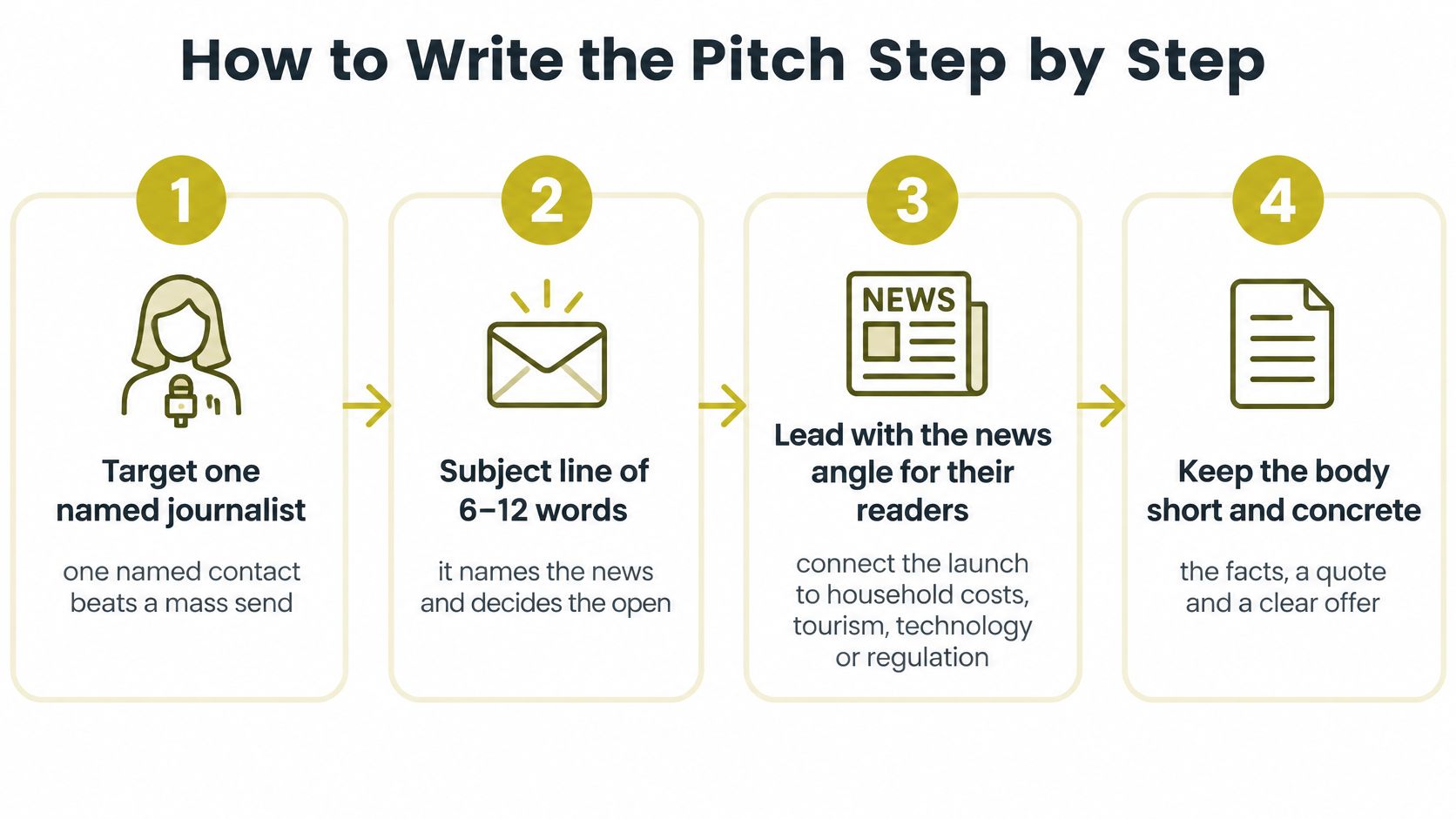
- Target one named journalist. The slip is a distribution list. If you can't name the person, you haven't done the research.
- Write a subject line of 6 to 12 words that names the news. The slip is a teaser ("You won't believe what Scottish retail just did"). Journalists don't open riddles.
- Open with the news in the first sentence. The slip is company history: "Founded in 2011, we are a leading provider of…" Nobody has ever read that far.
- Support it with two or three independently verifiable facts, at least one a number, and cite where it comes from. The slip is a brand claim dressed as evidence.
- Explain your legitimate role in one sentence. You commissioned the research, you hold the data, you're the named expert. One sentence, no history.
- Offer access. A spokesperson with a named availability window, a data set, or a briefing at a stated time. The slip is "we'd be happy to discuss", which gives the journalist nothing to diarise.
- Add contact details and a link to assets. Images and a one-page data sheet behind a link. The slip is a 6MB attachment on first contact.
Steps 2, 3 and 4 are where a national theme becomes a regional pitch. A UK-wide hiring story is generic until the subject line and first sentence attach it to a specific place: which towns, which sector, which local consequence. A before-and-after from a Scottish retailer's data story. Before: "Exciting news from our Q3 performance." After: "Scottish retail jobs grow 8% as hiring shifts to towns." The second tells a business desk what the piece is, who it affects and why today, and it still works for a national editor because the national trend is sitting inside the regional detail.
What a finished draft looks like
Here's a sample that passes every part of the structure:
Subject: Scottish retail jobs grow 8% as hiring shifts to towns
Scottish retailers added 4,200 jobs last quarter, with 60% of them outside Edinburgh and Glasgow, according to new figures.
The same data shows vacancies rising fastest in towns under 20,000 residents, with part-time roles accounting for 41% of the new total.
Dr Anna Kerr, economist on the study, is available for interview on Wednesday between 10am and 2pm.
Data table and images: [link].
Happy to arrange a briefing if that's easier. Contact: [name], [phone], [email].
The subject line is eight words and carries the number. The first line is the story, not the sender. The evidence is two verifiable facts, each tied to the data behind them. The spokesperson has a named window, so the journalist can diarise the piece in one read. Assets sit behind a link rather than in an attachment, and the whole thing runs to roughly 110 words with a single call to action, which leaves nothing to wade through.
Note what the draft doesn't do. It doesn't bury the local angle in paragraph three, and it doesn't stretch one quarter of regional figures into a national claim. The national relevance is implied by the scale of the shift; the regional specificity is what makes it reportable this week. That pairing is the difference between a pitch that gets a reply and one that gets archived.
If you like building frameworks like this before you write, these automated cold email frameworks for founders map neatly onto a pitch sequence, with the caveat that a journalist isn't a prospect and shouldn't be sequenced like one.
Using AI in Media Pitching Without Losing Trust
AI can find the journalist, summarise their last five pieces and tighten your syntax. It cannot take responsibility for a claim. The polling line is stark: in UK journalist polling reported by Presswire, 76% opposed PR professionals using AI to generate pitches or press releases, with 44% strongly opposed, and 74% said they might block professionals who repeatedly sent irrelevant pitches.
Read that second figure carefully. The objection isn't only to machine-written prose. It's to volume without judgement, which AI makes easier to produce.
What to automate and what stays with you
The defensible split is narrower than the software suggests. Let AI organise publicly available information about a journalist's beat, flag jargon, check clarity and generate alternative subject lines you then choose between. Keep news judgement, local context, factual verification, tone, exclusivity and the final send with a person who knows the outlet.
The illustrative failure is predictable. A draft opens "We are excited to announce the launch of our new platform", because that's what the model has absorbed from a thousand press releases. The human edit replaces it with a named local customer, a verified number and a specific interview window. Same facts, different fate.
Disclose when it matters. If AI drafted substantial text or generated the angle, say so if asked, and never let it produce a fact, a quote or a local statistic you can't trace to a document. For a small business, a single automated mass send to 300 journalists can burn a contact book it took years to build.
Automate the research and the checking. Never automate the relationship.
When and How to Follow Up Without Irritating Editors
Timing is a decision you make before you write a word. In a 2023 UK sample of 200 journalists in the State of Journalism research, 61% preferred pitches before midday (PRWeek). A pitch sent at 4pm on a Friday has lost before the subject line is read. Same email, wrong hour. A national theme gives you reach, but the route into a busy desk is often local: one Scottish consequence, one verifiable fact and the right beat.
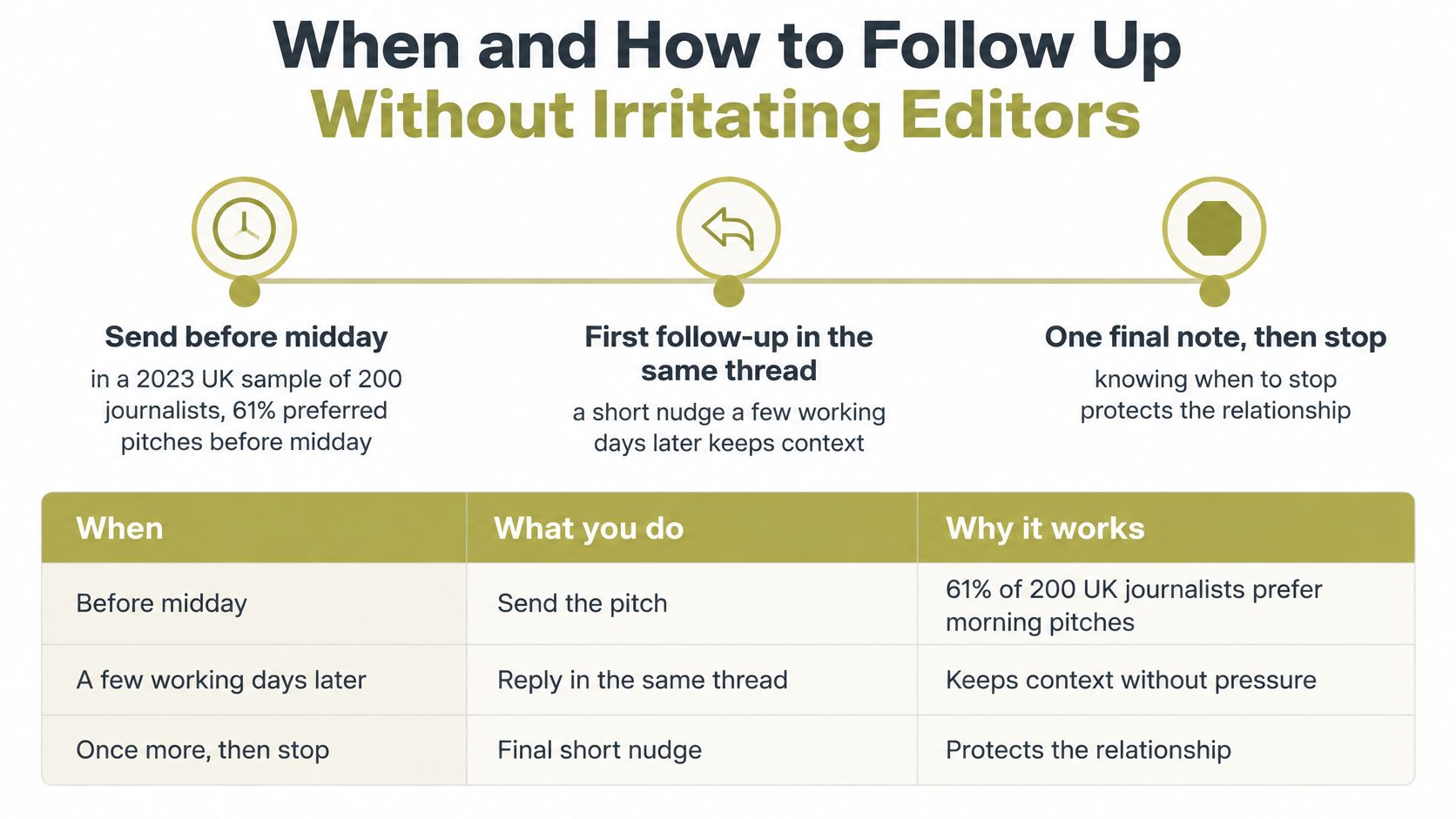
Once it's sent, one follow-up is the limit, and only with something new attached.
| When | Action | Why it matters |
|---|---|---|
| Send day | Send before midday to one named journalist | 61% of UK journalists prefer pitches before midday |
| About day 7 | One follow-up that adds new value | One measured nudge gives the journalist a fresh reason to respond |
| Day 7 onwards | Stop contact and log the outcome | Repeat chasing harms the relationship |
| New news peg | Re-contact only with a new reason | A fresh reason is the only thing that resets a no |
That follow-up has to carry information. Useful version: "One addition to the retail jobs pitch: the economist is now confirmed for Thursday morning, and the town-level breakdown is attached. If the timing is wrong, tell me and I'll leave it there." Irritating version: "Just checking in on this one, did you see my email?" The first gives the journalist a reason to reply. The second asks them to do admin. If the original pitch turns a national jobs story into a local employment consequence, the follow-up should strengthen that link with a named source, a document or a tighter regional example. It should not restate the same angle in new wording.
One measured nudge after about a week is enough. A third message turns persistence into pressure, especially when the journalist has not asked for more detail. If there is no fresh evidence, no confirmed interview and no change in the local picture, leave the inbox alone. The next contact needs a reason that stands on its own.
Track the outcome in a spreadsheet or CRM, not in your head. Record delivery, replies, briefings booked, interviews secured, items published or broadcast, whether the coverage was accurate, and qualified enquiries that trace back to it. Volume is a poor measure of anything. One accurate feature in a title your buyers read outperforms fifty unopened emails, and the second number will flatter you while the first one pays. For a regional story, also note which local consequence made the national theme usable and which journalist beat responded.
The stop rule: after the second contact, move that journalist to a monitored list and wait for a genuine news peg.
What to do when the coverage lands is its own skill, and this guide to how to get press coverage covers the follow-through.
Send Your First Pitch This Week
Pick one angle this week and send it to one named journalist. One pitch, built against the six-part structure, checked against the relevance question and timed for a morning send.
If the national story is already moving, your fastest route in is the local version of it. Take one consequence your area feels, pair it with evidence a journalist can verify independently, and address it to the beat that covers that consequence rather than the news desk in general. A Scottish retail pitch lands because it carries a named town, a countable number of jobs and a spokesperson who can speak this week, not because Scotland makes it automatically interesting. The national value survives in the local version, and the regional title gets a story its rivals cannot copy.
Set aside 30 minutes and work in this order: choose the journalist and read their last three pieces, write the subject line first so the news is fixed before the prose, draft the opening sentence as the news itself, add two verifiable facts, name the spokesperson with a window, link to assets, then run the test. Do the first two lines state the news? If not, rewrite them and send.
The follow-up goes in the diary for seven days' time with a reason already attached to it.
Not having the contacts is the common blocker, and it's a fair one. At Carlos Alba Media every consultant is a former national print and broadcast journalist, and the business is run by a multi award-winning, former national newspaper editor, which means a pitch is judged from the newsroom side before it goes anywhere near an inbox. If you'd rather talk an announcement through than guess, we offer a free consultation with one of our PR experts, and you can reach us at admin@carlosalbamedia.co.uk.
If you're thinking out loud to capture the angle first, how to structure dictated notes will save you a rewrite when the draft comes back in a pile.
Carlos Alba Media writes pitches and builds the media relationships that make them land, working with start-ups, SMEs and established brands across Scotland, the UK and internationally. If you have a story that should be in front of a journalist and aren't sure how to frame it, we can find the angle, verify the evidence and put it in front of the right beat. Visit Carlos Alba Media to start the conversation.