
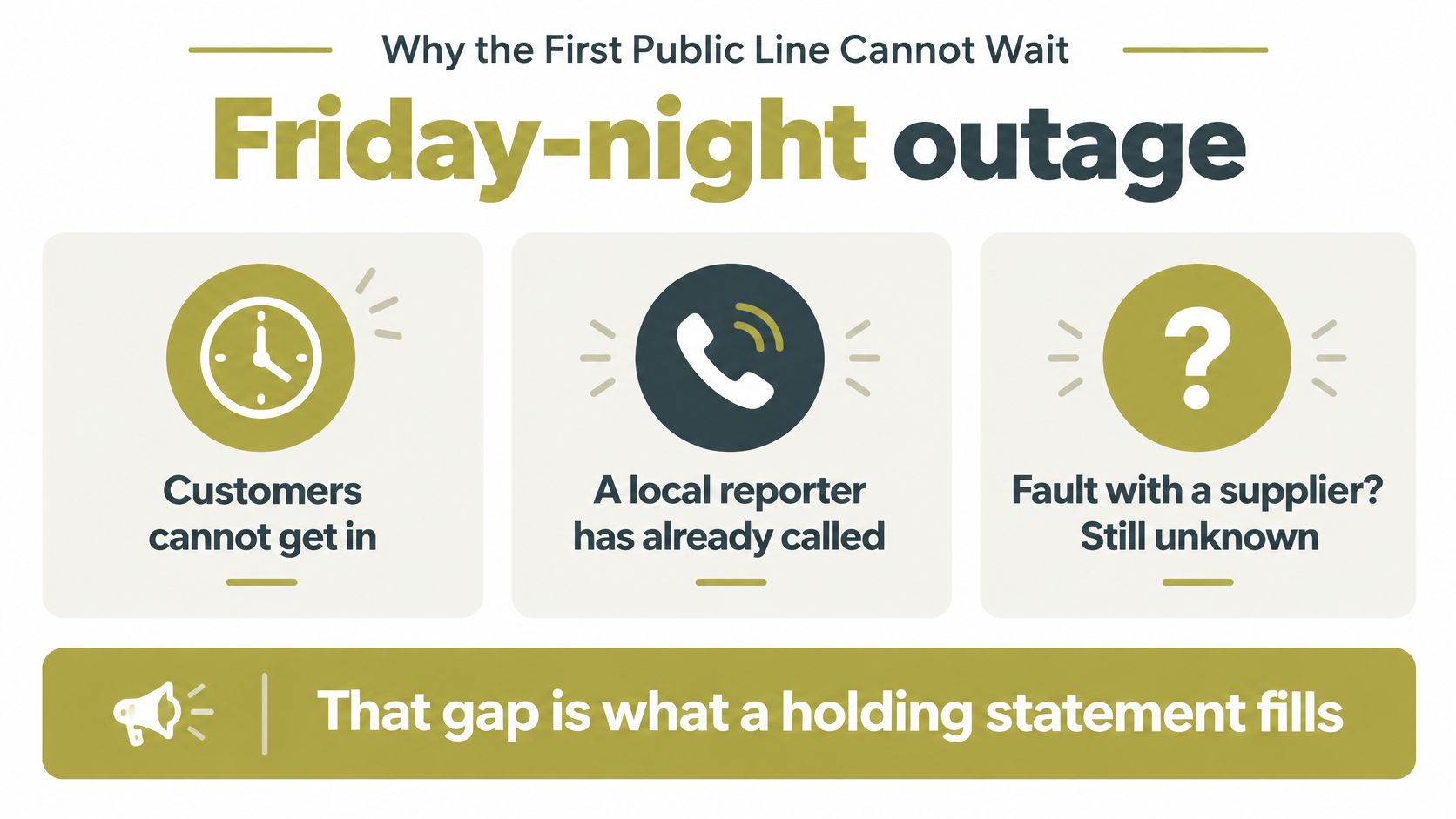
Your phone goes at 7.40 on a Friday evening. A customer has posted that the Glasgow store is shut and that someone was taken away in an ambulance. By the time you open a laptop, a reporter has rung the switchboard twice, and the operations lead is on another call saying she can't yet tell you whether the fault sits with a supplier or with your own equipment.
Two moves are open to you. Stay quiet until the full picture is in, or publish a short, checked line and name the moment you'll be back with more. The second one wins almost every time, and it doesn't require you to guess at anything.
What follows is the working form of that second move. A holding statement template built as safe uncertainty with a clock attached, plus four separate lines for customers, staff, journalists and regulators instead of one warm paragraph sent to everyone.
Why the First Public Line Cannot Wait
When the fault is still unknown, so are its extent, cause and remedy. Yet the story keeps moving: a post circulates, a screenshot reaches a WhatsApp group, and a reporter faces a deadline. Silence does not pause events. It leaves the first account to whoever is speaking.
The facts you most want before publishing are often the facts you do not yet have. That is why the first line must be narrow, checked and timed.
Why Rapid Reaction Beats a Complete Picture
UK broadcast complaints show that audiences can respond while an investigation is still open. Ofcom reported 69,236 complaints relating to 9,638 cases during 2023, nearly twice the number handled in 2022, with the two most complained-about programmes accounting for nearly a quarter of the total (Ofcom on how it deals with complaints). Individual broadcasts drew 407 complaints for an interview on 20 September 2023 and 2,386 for a broadcast on 17 October 2023.
These figures concern complaints about television and radio, not corporate crises. They illustrate how quickly people can react to what they have seen, before the facts are settled. A holding line should not pretend that the investigation is complete. It should make clear what is known, what remains uncertain and when the next update will come.
Keep the first public line to four jobs:
- Awareness. Confirm that you know about the incident and say when you became aware.
- Concern. Acknowledge the impact on people where they have been hurt, frightened or inconvenienced.
- Facts in progress. State that details are being established.
- A clock. Give the time of the next update and where it will appear.
Leave cause, liability, numbers affected and proposed fixes out until checked. An unsupported detail can become the next story, especially if later information contradicts it. A short, accurate line protects room to investigate without leaving customers, staff and journalists to fill the silence with assumptions.
Carlos Alba Media is founded and run by former national newspaper editor Carlos Alba, so the assumption behind this guide is the one a newsroom makes: a reporter will file tonight with or without you, and the only question is whether your line is in the copy.
If an incident affects rotas, safety or a workforce across jurisdictions, staff communication needs to keep pace with the public line. HR crisis guidance for multi-state employers addresses the workforce response alongside the media response.
A Holding Statement Template You Can Fill In
Seven lines, one job each. Nothing in the list requires you to know why the incident happened, which is what makes it usable at 7.40 on a Friday.
The Seven Lines and the Claim Each One Must Not Make
| Line | Purpose | Fill-in wording | Do not say |
|---|---|---|---|
| Awareness | Show you know an incident is reported | We are aware of [incident] and became aware at [time]. | That the full story is already known |
| Priority | Put people or service first | Our immediate priority is [people or service]. | That nobody has been harmed |
| Known fact | State one checked detail | At this stage we can confirm [verified fact]. | Cause, numbers or names not verified |
| Unknown | Mark safe uncertainty | We cannot yet confirm [unverified claim] and will not speculate. | A repeat of the allegation in detail |
| Action now | Say the protective step | We are working with [team or authority] and have [step]. | That the problem is already solved |
| Next update | Give a real clock | We will provide a further update by [time and date]. | As soon as possible |
| Contact | Offer one route in | Media contact: [name, role, phone, email]. | Personal data of staff or customers |
Two lines carry most of the risk. The known fact has to be something two people can independently support. The unknown line has to name the gap without repeating the allegation in detail. "We cannot yet confirm reports of a gas leak and will not speculate" is fine. A paragraph describing the smell people reported is not.
Filled In for a Glasgow Store Closure
Say a city-centre store has closed after a reported injury on the shop floor. At 17:00 the verified facts are the time the doors were shut and the fact that the emergency services attended. That's enough to publish.
We are aware of an incident at our Argyle Street store this afternoon and became aware at 16:20.
Our immediate priority is the person affected, and our staff and customers who were in the store.
At this stage we can confirm that the store was closed at 15:55 and that the emergency services attended.
We cannot yet confirm what caused the incident and will not speculate while the investigation is under way.
We are working with the emergency services and the local authority, and the store will stay closed until a full safety check is complete.
We will provide a further update by 12:00 tomorrow, Saturday 14 June, on this page.
Media contact: [name], [role], [mobile], [email].
Note what the closing time does. It is checkable, it is useful to a customer deciding whether to travel, and it commits you to nothing about cause. The line about cause is where drafts usually fail, because the instinct is to soften it with "believed to be" or "possibly linked to". Both phrases get quoted back at you inside a day.
Two housekeeping lines before it goes anywhere:
- Timestamp and version label. Mark the page v1, 17:05, 13 June, and keep every later version on that same page. A journalist who found it at six needs to see what changed at nine.
- A named contact who knows the statement exists. A dormant press inbox on a Friday night is how a holding line turns into a second story about nobody answering.
The table above is the blank version. Keep it as a one-page document with the brackets intact and anyone in the business can complete it. Only the named approver releases it.
How to Clear the Line in the First Hour
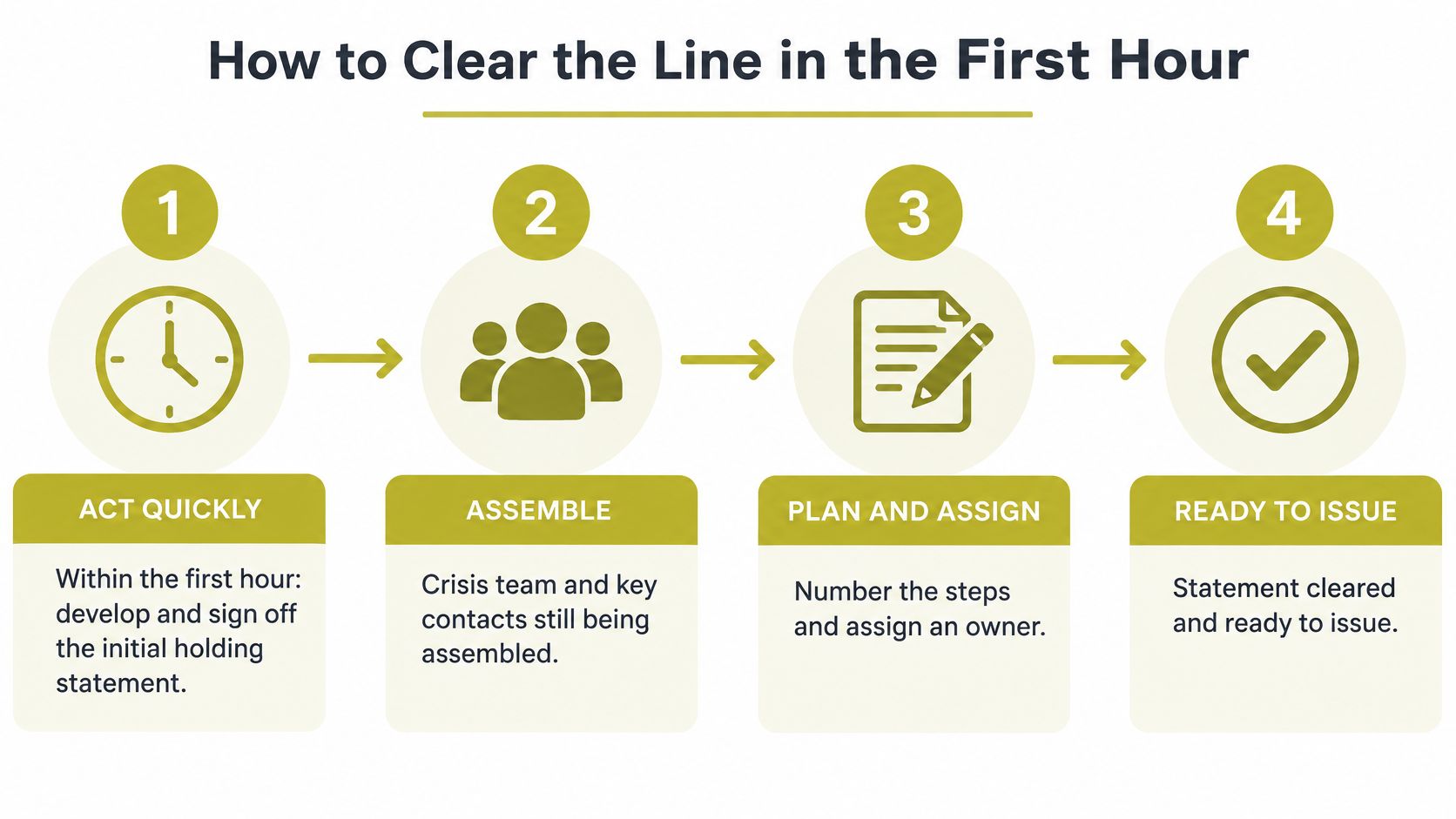
The standard isn't mine. UK Government guidance recommends developing and signing off the initial holding statement within the first hour, while the crisis team and key contacts are still being assembled (crisis communications planning guide). Four conditions make that possible on a Friday night, and none of them is about writing well.
A Realistic Minute Budget
- Verify what you can support, minutes 0 to 10. Write down only facts two people can point to. The operations lead, not the group chat. If a number can't be traced to a system or a named person, it isn't a fact yet.
- Name the audiences and an owner for each, minutes 10 to 15. Customers, staff, and any regulator already in play. One name per audience, or nobody owns the timing.
- Appoint one approver and one spokesperson. Two approvers produce two versions. The approver should be the most senior person who can read a paragraph and say yes without convening a committee.
- Draft from the template, minutes 15 to 30. Awareness, concern, what's being done, what can't be confirmed, next update, contact. Six sentences is often enough.
- Write the Q&A you won't answer yet, minutes 30 to 40. Five hostile questions and one line for each: "We're not able to confirm that yet. We'll include it in the update at 12:00." This is what stops a spokesperson improvising on a live call.
- Check what's already circulating, minutes 40 to 50. Look at the broadcaster's ticker, the local paper's live blog, the platform where the claim started. Correct only what you can evidence, and correct it by publishing rather than arguing in replies.
- Publish the same version everywhere you use, minutes 50 to 60. Website page, social, customer service script, switchboard note. Then put the update time in three calendars, including the person who has to write it.
What Stops the Hour Sliding
The approver test is simple. Every claim in the draft maps to a line in the incident log with a time on it. If nobody can point to the note, the claim comes out. That single discipline does more for accuracy than any amount of legal review.
Don't speculate, don't assign blame, don't repeat an unverified allegation, don't disclose personal data, and don't promise an outcome you don't control.
For a Scottish SME without a night desk, the workable version is a pre-agreed approver on a phone tree and a statement that can be cleared by text message with a read receipt. If a suspected intrusion is involved, the technical response and the public line have to be reconciled before either is issued, and this cyber incident response plan sets out the sequence legal teams expect. If the hour is nearly gone and two facts are solid, publish those two and the update time. Don't wait for the third.
None of it works if the roles and contacts don't already exist, and how to develop a crisis communications plan is where that groundwork goes in.
Lines for Customers Staff Journalists and Regulators
One set of facts, four openings. The verified facts don't change between audiences. What changes is the first thing each of them needs, and that's exactly where generic templates fail: they produce a single warm paragraph that reassures nobody in particular.
Take a suspected intrusion on a customer portal. At 09:00 you know the portal is down, you know an unauthorised party may have accessed a system, and you know nothing yet about which data was involved. The National Cyber Security Centre advises organisations to avoid speculation or premature conclusions about the cause or extent of an incident, while still giving factual updates, and to consider whether regulators such as the Information Commissioner's Office have been informed (NCSC guidance on communicating in a cyber incident).
| Audience | Lead with | Include | Leave out |
|---|---|---|---|
| Customers | What they should do now | Service impact and a help route | Cause and blame |
| Employees | What they may say | Spokesperson route and staff action | Customer personal data |
| Journalists | The on-the-record line | Update time and one media contact | Off-record speculation |
| Regulators | Notification status | Known facts and unresolved questions | A claim that duties are complete |
| Investors | Operational control | What is confirmed and the next update | Revenue or liability estimates |
The Legal Worry Answered Directly
The question comes up in every briefing: can a holding statement be transparent without exposing the organisation? Yes, if each line is sorted into one of three categories.
Verified, in progress, unresolved. Every published line belongs to one of those. Mixing them is what creates legal risk, not the disclosure itself.
For a customer, that means the practical consequence and one instruction: use the phone line, don't reset the password again, check this page. Staff need to know what they may say and where media calls go. A journalist wants the on-the-record line, the update time and one number that answers. A regulator or investor wants status, not comfort: what's confirmed, what's unresolved, whether notification has happened, and that impact isn't yet quantified.
Blanket assurance is what costs you. Calming claims that events later disprove damage trust more than an honest statement that the picture is incomplete.
Where the customer route runs through a chat widget or a live agent queue, the statement and the queue have to say the same thing, and keeping chat and agent handoffs intact deals with the practical side of that handover.
Run the Red Flags Before the High-Risk Version
Before a high-risk statement goes out, check each of these and add the matching status field:
- Personal data. Has anything been accessed, and is the data-impact line accurate as of this minute?
- Public safety. Does the statement tell people to avoid, stop or check something?
- Vulnerable people. Are they affected, and is there a separate route for them?
- Ongoing investigation. Could the line prejudice it, or contradict something a regulator has already said?
- Third-party supplier. Does naming them shift the story onto an organisation that hasn't been told yet?
- Devolved or local authority. Do they need the same facts before they read them in the paper?
What can and can't be said at that stage is a legal question as much as a communications one, and media law and ethics is where those boundaries usually sit.
Keeping Later Versions Accurate
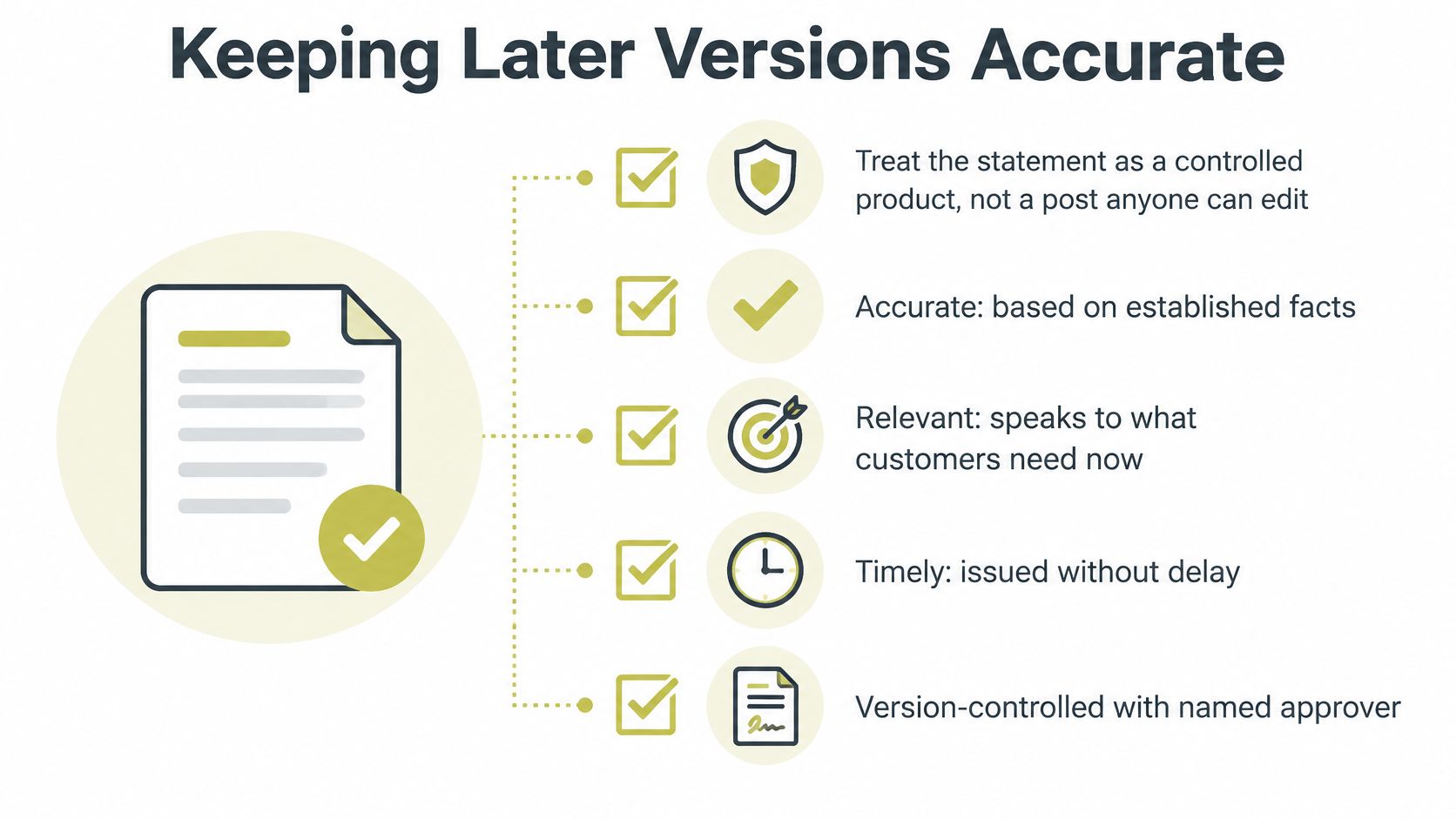
A statement that stays online after facts change can become an inaccurate record of what was known at the time. Give each version a clear timestamp, keep the evidence and approval behind its claims, and make the next update time visible. The Government Communication Service recommends preparing holding statements and key Q&As in advance, then monitoring for inaccurate commentary and disinformation (the GovS 011 communication standard).
Three controls help keep later versions accurate.
One Source of Truth
Prepare short drafts for likely risks before an incident. Agree the tone with legal, operations and the executive owner, but do not pre-approve facts that may change. Once the statement is live, one named person should maintain the master version. Timestamp every revision and record what was known, who approved it and where it appeared. This gives staff and spokespeople a single current line to use.
Three Facts and No More
Keep the first holding line to the three facts audiences most need: what is confirmed, what remains unknown and when the next update will come. Add context where it helps people understand the risk, without implying certainty the evidence does not support. If another detail matters, include it in a later update rather than crowding the opening line. A statement that reads like a briefing note is harder to repeat accurately; a short, clear line is easier for a journalist or customer to pass on.
Measure the Process, Not a Success Rate
Track what the team can verify: time from alert to confirmed facts, time to approval and publication, the proportion of published claims supported by evidence, corrections, whether the promised update arrived on time, and how many stakeholder questions it answered. These measures show where the process is slowing or where claims need stronger support. They do not require anyone to declare the crisis a success.
Monitor social channels while the incident is live, not only after publishing. If an inaccurate claim is spreading, correct it without repeating or amplifying it unnecessarily. Guidance on reputation management on social media can help teams monitor and respond.
Four Cautious Habits That Cause Damage
Waiting for every detail. Silence leaves space for rumour, while legal review continues. Publish what is confirmed, identify what is still being checked and set a time for the next update.
Opaque legal language. Dense wording sounds evasive on a phone-in and is easy to misread in a social thread. Use plain language without promising more than the facts support.
Two spokespeople, two wordings. Conflicting versions create a second story about why the organisation cannot keep its accounts straight. Give each spokesperson the current approved line.
Dropping the concrete update time. Without a stated time, journalists and stakeholders have no clear expectation and will keep asking when to expect more.
If a claim would still need a footnote, it isn't ready for the holding line.
Lock the Update Time Before You Publish
Before anything goes out, four boxes are ticked.
- One approver has signed the version that's about to be published, and their name is in the log.
- Every claim is recorded as known at a stated time, with the note that supports it.
- The next update has a clock on it, not an intention.
- The same wording is ready for the channels you'll use, including the switchboard note and the customer service script.
If a red flag is live, personal data, safety, a vulnerable group, a regulator or a supplier, pause only long enough to add the status field. Not long enough to go silent.
That's also the point where in-house teams usually want another pair of hands. Carlos Alba Media is a Scottish-led consultancy with teams in London and Glasgow, offering senior counsel without big-agency overheads, 24/7 media crisis management alongside leading UK media lawyers, and a bench where everyone is a former national news journalist or has agency experience of working with international brands. That matters when the first call comes from a desk that will publish tonight.
Frontline print journalism has narrowed sharply, from approximately 23,000 journalists in 2007 to 17,000 in 2017, a decline of more than 25%, according to UK Government analysis of the threat to high-quality journalism. Direct national-news experience is a scarce qualification for judging what a holding line does once it's inside a story.
One client has retained the business for more than five years, which is the test that matters on a retainer: the relationship exists before the Friday-night call, not after it.
The next action isn't a statement. It's a saved template, a named approver, a named spokesperson and a first-hour phone tree agreed while the week is quiet.
Carlos Alba Media builds holding statement templates, first-hour phone trees and pre-cleared Q&As with founders and in-house teams across Scotland and the UK, and runs 24/7 media crisis management alongside leading UK media lawyers when the call comes in. If you'd rather not draft your first public line at 7.40 on a Friday, Carlos Alba Media can have the wording, the approver list and the spokesperson briefed before you need them.