
The large majority of UK journalists still have a main employer in legacy media: newspapers, broadcasters and the agencies that supply them. That is why so much PR disappears without a reply. The person opening your email was trained to decide what is new, what is verified and what a reader will care about. Anything that fails those tests gets deleted.
You can get coverage without a launch, a funding round or a famous founder. For a local business, the ordinary route in is an everyday story: one fact, one person, one consequence a reader feels now. I would back that over a slick email about a minor product change. Editors print stories. They do not print announcements.
Run the work in six stages, in order, each with an output and a realistic time. Test the story before you write to anyone. The pitch comes fifth. Campaigns usually fail because the story was thin, not because the email was badly written.
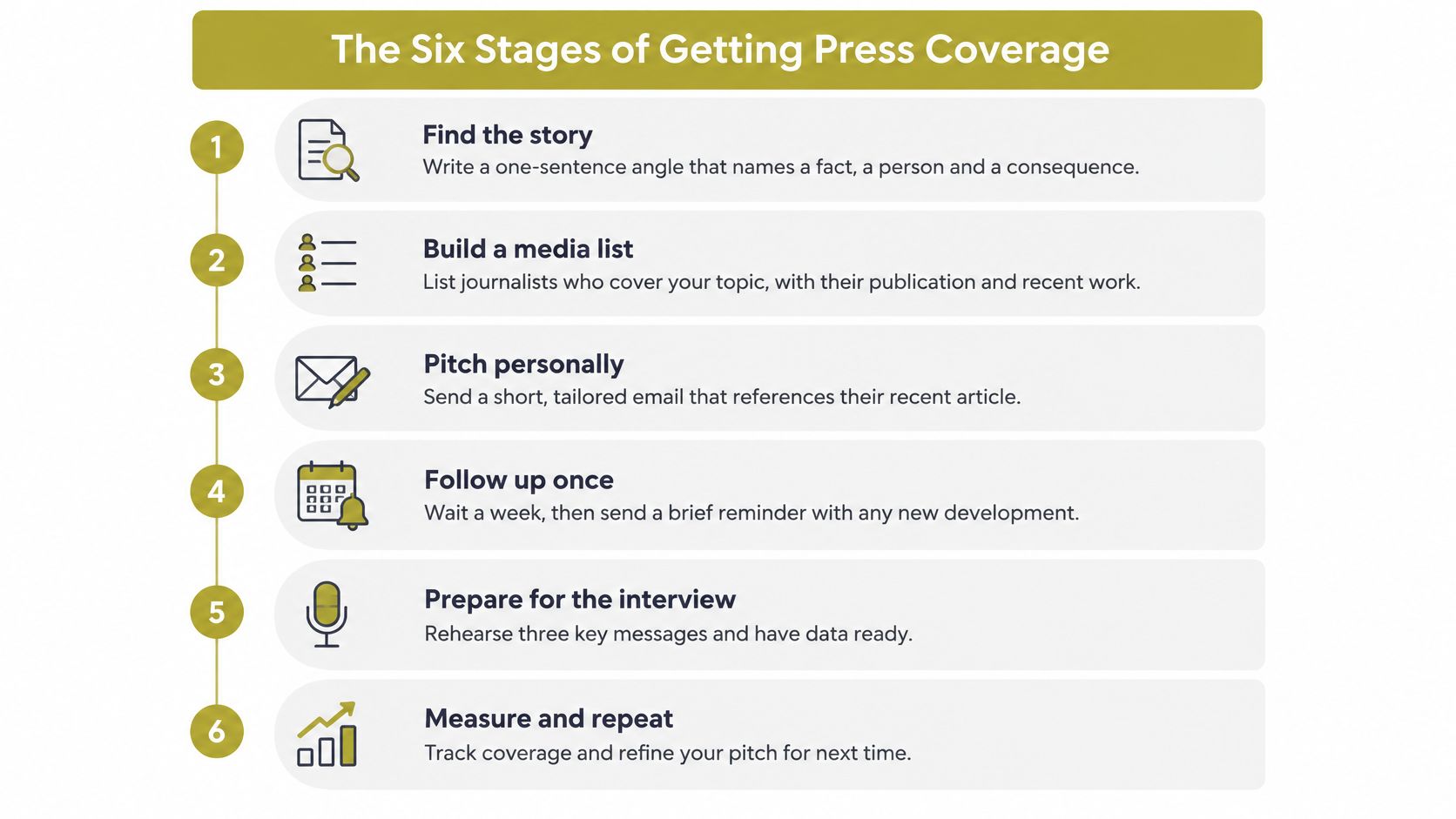
The Six Stages of Getting Press Coverage
PR has a sequence. Skip a step and every later one costs you twice the time.
- Find the story. Write one sentence that names a fact, a person and a consequence, then check it has a reason to matter now.
- Gather evidence. A data sheet, two quotes you can stand behind and one customer example you have permission to use.
- Build the press hub. A press page and pack with a named contact who answers within hours.
- Map journalists. Fifteen to 25 named contacts drawn from coverage published in the last six months.
- Pitch. Personal emails, one follow-up and a concrete offer of an interview, data or exclusive access.
- Measure. Coverage, referral traffic and enquiries logged against a baseline you recorded first.
Here is the same sequence as a visual reference you can work through in order.
| Stage | Output | Typical time |
|---|---|---|
| 1. Find the story | One-sentence angle with a reason it matters now | 1-2 days |
| 2. Gather evidence | Data sheet, two quotes and one customer example | 1-3 weeks |
| 3. Build the press hub | Press page, pack and named contact | About 1 week |
| 4. Map journalists | A list of 15 to 25 named contacts, sorted by outlet tier | 2-3 days |
| 5. Pitch | Personal emails, one follow-up and an offer of an interview | 2-4 weeks |
| 6. Measure | Coverage log, referral traffic and enquiries tracked against a baseline | Ongoing, reviewed at 30 and 90 days |
Those timings assume one person giving PR part of each week alongside their actual job, and they assume a feature rather than breaking news. News moves in hours. A profile, a sector trend piece or a founder interview can take a month to place, and a monthly magazine may work two issues ahead.
The everyday story is where the opportunity sits. A 2025 survey of 250 UK founders found that 60% believed journalists cover entrepreneurship poorly, while only 12% considered coverage adequate, and 74% said the issues most important to founders receive insufficient attention. What they wanted more of was hiring, bureaucracy, ordinary business realities, non-tech sectors and regions outside London. That is a description of most SMEs in Scotland, which makes an ordinary commercial story the default route in, not the consolation prize.
If you can't name the stage you're stuck on, you're almost certainly pitching before the story is ready.
How to Find a Story Journalists Will Print
Three questions decide whether a story exists at all.
- Who outside your building cares? Not your customers in the abstract. A named group of people who would change a decision if they read it.
- Why now? A date, a deadline, a seasonal peak, a regulation coming into force, a contract ending. "No particular reason" is the shorthand for "no story".
- What happens if nothing is written? If the honest answer is nothing, you have an advert, not a news item.
The angle as one sentence
Write the angle before you write anything else, and force it into a single sentence that names a fact, a person and a consequence. Suppose a Glasgow hotel group is looking at its Hogmanay bookings and finds that January midweek demand is now stronger than December. The fact is the shift. The person is the operations director who reordered staffing around it. The consequence is what it means for a city that has spent years chasing weekend trade.
That sentence is the test. If you can't build it, no amount of email polish will rescue the pitch.
Turning local into national
Regional editors want the local version, and national desks want the pattern. Ask whether the same thing is showing up elsewhere, then say so carefully. A Highland engineering firm taking on a dozen apprentices is a regional story about one employer. Twelve firms across three counties doing it while a college cancels its course is a national skills story, and the evidence for the wider claim has to be in your hands before you say it out loud.
Thought leadership can carry the same weight when the numbers are thin. Sprints & Sneakers' B2B thought leadership insights are a useful reference for framing a founder's informed view on a live issue so that it reads as perspective rather than sales copy, which is often the more honest route for a small firm without a dataset.
Handling your own survey data
Survey-led PR is where small businesses get burned. The CIPR, MRS and RSS guidelines on using statistics in communications recommend publishing the sampling universe, sample size, fieldwork dates, weighting and response rate, testing whether comparisons are statistically meaningful, and supplying the full technical specification in the release or editor's notes. A UK government journalist survey cited in that guidance shows why response rates matter: distribution to approximately 36,000 journalists produced 402 complete responses, about 1%, with completion rates around 60%, which points to survey length affecting who finishes.
Practical rule: keep two or three findings you can defend under questioning. A two-point gap dressed up as a crisis gets picked apart in the comments and takes your credibility with it.
Then make the call. If the story only announces your company, reshape it into a trend, a customer result or an expert view before you pitch anything.
Building a Press Hub and Evidence Pack
A journalist replies at 4pm and needs a headshot, a boilerplate and the source for one statistic before they file at 6pm. If any of those takes more than a few minutes to find, the story dies, and you never hear why.
For a shop, a trade supplier or a founder with one solid customer result, that missing file is often the whole campaign. The local story was usable. The proof was not on the page.
Only 13.2% of recently funded UK startups had a dedicated press or news section, 0.9% listed a named media contact, fewer than 2% offered downloadable media assets, and only 4.2% supplied company background or boilerplate, according to research published by Startups Magazine. A desk with two hours will not chase a logo. Build the pack so the friction is gone before you pitch.
| Asset | Why journalists need it | Format |
|---|---|---|
| Named press contact with cover | Replies within hours, not days | Email and phone on the press page |
| Company boilerplate | Consistent background facts | 150 words on the page, plus a downloadable document |
| Executive bios | Credibility for quoted spokespeople | Short bio with headshot, linked from the press page |
| Verified statistics with source notes | Lets them check claims before publishing | Dated, linked PDF or table |
| Broadcast-ready photos and logos | Fast use in print, online and on air | High-resolution JPG and PNG, plus web versions |
| Consent-cleared customer examples | Real-world proof | Named quote with permission on file |
| Short issues briefing | Answers likely follow-up questions | One page covering three to five questions |
Keeping the pack trustworthy
Date every statistic and attach its source. An undated number is unusable six months later. Get written consent before you name a customer, and keep the permission with the quote. Mark facts that expire, such as headcount, prices and opening hours, and put the date they were checked next to each one.
A long pack can still fail if photo rights are unclear. Editors drop a customer name rather than risk a complaint, so one cleared quote is worth more than five you cannot stand behind.
AI press release writing tips show how to use drafting tools without losing the specifics that make a release usable. A faster first draft does not replace the fact sheet. Run the same checks on both.
Start from a press kit template structure rather than inventing a format. Before anything goes out, ask a colleague who has never seen the material to find each item on the list while you time it. Anything that takes more than two minutes is filed in the wrong place.
A food producer with a 150-word boilerplate, three approved quotes and a licensed photo set on one page can answer a Sunday supplement in one email with three links. I would hold a high-street business to that standard before the first pitch leaves the building.
Finding the Journalists Who Cover Your Story
Work from beats, not job titles. Search each outlet's site for your topic, then note who has covered it in the last six months. A reporter's title tells you very little; their last ten pieces tell you almost everything.
- Read the last ten pieces each journalist wrote. Note length, tone and the kind of sources they lean on. A reporter who quotes academics every week won't suddenly build a piece around your sales figures.
- Check submission guidelines. Some desks want exclusives, others only take material that has already run somewhere. Getting this wrong wastes a month.
- Sort outlets into tiers. National, regional, trade, broadcast, niche newsletters. Each needs a different version of the same story.
- Record the lead time. A national feature can need weeks of notice. A radio producer filling a gap on a breaking story may want a guest the same morning.
- Mark the freelancers. They sell to several titles, so one good conversation can produce three pieces.
This is a large, qualified workforce, not a loose network of bloggers. The National Council for the Training of Journalists estimated that 83,500 journalists were working in the UK economy in 2023, and its research found that 81% held a journalism qualification (Reuters Institute analysis of UK journalism employment). Assume professional standards and professional scepticism.
| Outlet type | Best for | Typical lead time |
|---|---|---|
| National newspaper features | Trends, founder stories and business turning points | 2-4 weeks |
| Regional newspapers, such as The Herald or The Courier | Local jobs, investment and regional growth | Days to 2 weeks |
| Trade and sector publications | Product news, sector hires and technical expertise | 2-6 weeks, planned around forward features lists |
| BBC Scotland radio and regional TV | Live comment on current events | Same morning |
| Podcasts and niche newsletters | Specialist audiences and longer interviews | 1-6 weeks |
Two habits kill lists. Emailing a generic news desk address gets you into a shared inbox that nobody owns. Buying a contact list gets you names of people who left those jobs two years ago. For podcasts and newsletters especially, finding the right person's actual inbox is half the work, and How to Contact's guide to finding podcast guest emails covers the search method properly. Build the list itself with a repeatable media list process so it survives staff changes on both sides.
The rule of thumb: if you can't name three journalists who wrote about your topic this year, the story isn't ready for national coverage.
Pitching Journalists Without Wasting Their Time
Employment in UK journalism has changed shape, and that changes how you pitch. The Reuters Institute study of UK journalists found the share working freelance rose from 17% in 2015 to 28% in 2023, the proportion on permanent contracts fell from 74% to 65%, and 32% of respondents were worried about losing their journalism job within the following 12 months. Fewer staff, more people selling to multiple titles, and a strong incentive to publish only what they can defend.
- Put the news in the subject line. "Glasgow hotel group reports January midweek bookings overtaking December" tells the journalist everything. "Story idea" tells them nothing.
- Open with their work. One line referring to a recent piece, but only if you've read it. A generic compliment is worse than no compliment.
- Keep the body under 150 words. The angle, one fact, one named spokesperson, one offer.
- Link to the press hub. Don't attach 12MB of images to a first email. Link, then send files when asked.
- Send Tuesday to Thursday, mid-morning. Monday is triage, Friday is a graveyard.
- Follow up once, after three working days. Bring a new fact. "Just checking in" earns nothing.
- Name the outlets already offered the story. Freelancers need to know whether they're competing with a title that has already run it.
A pitch is a request for someone else's working day. Make it cheap for them to say yes and you'll get more coverage than any amount of clever writing.
Never send a mass email with visible recipients, log every reply with the date, and state any embargo in the first two lines rather than the last. When someone declines, ask one question: what would have made this work? The answers accumulate into a better list than anything you can buy.
Measuring PR Results That Actually Matter
Record a baseline before the first pitch goes out: brand-name search impressions, referral traffic, enquiry volumes and the number of calls you currently take in a week. Without that snapshot, every later number is a guess with a chart attached.
| Metric | How to measure it | What good looks like |
|---|---|---|
| Coverage against target | Count published pieces against the target set before launch | A target set before launch, such as five pieces in three months |
| Message pick-up | Share of pieces that include your key message | Core message in most pieces, not only in quotes |
| Referral traffic | UTM-tagged links in GA4 referral reports | Visits rise on publication day and hold for two weeks |
| Enquiries and sales | Call tracking and a campaign-specific form | Enquiries traceable to coverage and tagged by source |
| Brand search | Search Console impressions for your brand name, compared with the baseline | Impressions rise after coverage and hold |
| Tone | Rate each piece positive, neutral or negative in the coverage log | No unanswered negative coverage |
Tag every link you give a journalist with UTM parameters, because untagged traffic lands in direct and vanishes from your reporting. Use a dedicated number or form for each campaign so a caller can be traced to the piece that prompted them. Keep a coverage log with the outlet, date, the reach figure the publisher publishes, the tone and whether the key message appeared in the first five paragraphs.
Clip counts flatter you. They don't tell you whether the right people saw the right message and acted on it.
Review at 30 and 90 days. PR pays late through search and referrals, and a piece that looked flat in week one often shows up in branded search in month three. A major feature that produces no enquiries still needs explaining, and the usual culprits are a vague message or a landing page with no next step. The measurement framework for PR campaigns is worth setting up before the first email so the review isn't an argument about whose numbers are right.
Deciding Whether to Pitch Alone or Get Help
This ends with a decision, not another checklist.
If your angle passes the three tests, the pack is built and you have 15 named journalists, pitch five of them yourself this week and review the replies after a fortnight. If the angle fails the tests, stop. Reshape it into a trend, a customer result or an expert view before you spend another hour on outreach. If it passes but you don't have the time to research, pitch and follow up properly, get the pack and the list reviewed before you spend money on anything else.
The trade-off is hours against the story. A local or everyday business result is often the route into print and broadcast, but only if someone can match it to the right desks and follow up while the peg still holds. Sending a weak angle to the whole list burns contacts you will need later. Leaving a strong angle in a folder for a month usually means the news peg has moved on.
Carlos Alba Media is a Glasgow PR company, founded and run by Carlos Alba, a former national newspaper editor. Clients do not need to be based in Glasgow or Scotland. The consultancy works with start-ups, SMEs and established organisations across Scotland, the UK and internationally, and offers a free consultation with one of its public relations experts to anyone facing a communications challenge or a media crisis.
The question is narrow. Does your story pass the newsroom test, and do you have the hours to pitch it well?
If you're holding a story you suspect is stronger than the pitch you'd write for it, Carlos Alba Media can pressure-test the angle, build the evidence pack and put it in front of the right journalists. The team works with start-ups, SMEs and established organisations across Scotland, the UK and internationally. Start with a conversation at Carlos Alba Media and bring the facts you already have.