
61% of journalists receive more than 100 pitches a week, 43% said most of those pitches are irrelevant to their specialism or poorly targeted, and only 7% considered the pitches they receive relevant more than half the time, according to Cision's 2026 State of the Media report. A fatter media list will not fix that inbox. It usually adds to it.
How to build a media list that journalists act on means building a living database you can defend row by row. I would measure it by replies and coverage, not by how many names it holds. Tag beat, audience, geography and deadline, then cut anyone who no longer fits.
The Fields Every Useful Media List Needs
A media list is a segmented, dated database of the journalists most likely to cover your story. Every row should answer a practical question about fit and timing before anyone hits send.
Eight fields carry that test.
| Field | What to record | Why it matters |
|---|---|---|
| Journalist name and title | Full name, job title and outlet | Confirms the person still holds the role |
| Beat and subject areas | Two or three beats, such as tourism or small business | Predicts whether a story fits |
| Location | Nation, region or city covered | Decides who takes Scottish and regional stories |
| Platform | Print, broadcast, online, newsletter or trade | Sets the format and asset you pitch |
| Recent relevant link | Latest article or programme on your topic | Proves topical fit before the contact is added |
| Preferred route | Email, phone or direct message, plus stated restrictions | Keeps contact within the journalist's stated wishes |
| Deadline pattern | Typical lead time for stories | Sets when the pitch should land |
| Last verified date | Date you last checked the record | Flags the entries due for re-checking |
The useful columns shift with the brief. A Glasgow tourism business pitching a Scottish travel desk lives or dies on location and last verified date. A correspondent who moved to a Westminster politics job last spring will not take a city feature, however famous the old byline looks. A national product launch cares more about platform and deadline pattern, because a Sunday newspaper and a weekday newsletter want different assets on different days.
Two fields earn their keep at pruning time. Recent relevant link is the one most lists skip, and skipping it is how a travel pitch ends up with a correspondent who stopped covering travel. Last verified date turns decay into a routine: sort the sheet by it and the stale rows surface first, before they waste a send. Together these fields decide which contacts earn a reply, and replies are the metric that tells you the list works.
Practical rule: A contact without a recent link to your topic should not enter the active list.
Carlos Alba Media is founded and run by a multi award-winning former national newspaper editor, so its field list is built to test news value rather than dress a slogan up as a story. Open a blank sheet and add these eight headers before you search for a single name.
How to Segment Targets by Outlet Type and Reach
Treat the UK as several markets, not one national blast. Start with a short routine, then let reach decide who stays.
- Name the brief. Write the audience, geography, sector, news angle and desired format in a single sentence.
- Split the targets. Sort them into national, nation and regional, trade, broadcast, online and specialist outlets.
- Size the segment. Keep a group only when its audience matches that sentence.
Ofcom's 2025 News Consumption research found that online news reached 70% of UK adults, roughly level with television, including on-demand services, at 68%. Adults spent an estimated 61 minutes a day on news. Online accounted for 42% of that time, television 31% and radio 18%. The same research carries a Scotland sample of 663 adults aged 16 and over, so Scottish outlets deserve their own rows rather than a footnote on a London list.
| Segment | Who to list | Reach evidence |
|---|---|---|
| National broadcast | Producers, presenters and correspondents | BBC reached 67% of UK adults; public service broadcasters 74% |
| Online publishers and digital reporters | Search-driven news editors and specialist reporters | Online news reached 70% of adults; 42% of news time was online |
| Television, nations and regions | Regional bulletin producers and correspondents | 53% used nations or regions TV bulletins (2023) |
| Radio newsrooms | Programme producers and local reporters | 18% of news time on radio; 34% used local radio (2023) |
| Local and regional print | Desk editors and local reporters | 22% used local print (2023) |
| Trade and specialist publications | Beat editors and specialist writers | Professional readers who buy, regulate or specify in the sector |
| Newsletters and independent outlets | Newsletter editors and freelancers | A named editor, a fixed send day and an audience you can describe |
Ofcom's 2025 supporting slides put the BBC at 67% of UK adults and public service broadcasters collectively at 74%, which is why national broadcast still earns a segment when you need scale. For place, Ofcom's review of local media found that in 2023 53% of UK adults used nations or regions TV bulletins, 34% used local radio and 22% used print local newspapers. A sheet that stops at London nationals misses that.
What to leave out at the start
Choose two or three segments for the first list and park the rest until a story needs them. A Highland food brand might take a Scottish bulletin producer, a trade editor and one newsletter, and ignore national political correspondents. Grouping outlets by geography, platform and buyer is the same habit described in RichAPI on firmographic data enrichment: sort the organisations by attributes before you contact anyone. For a wider map of who still commissions what, see our note on the UK media landscape.
How to Research and Verify Each Contact
Aim for 20 to 40 plausible contacts on a campaign, not a scraped dump of every address in a sector. A dead name wastes the pitch and marks the sender.
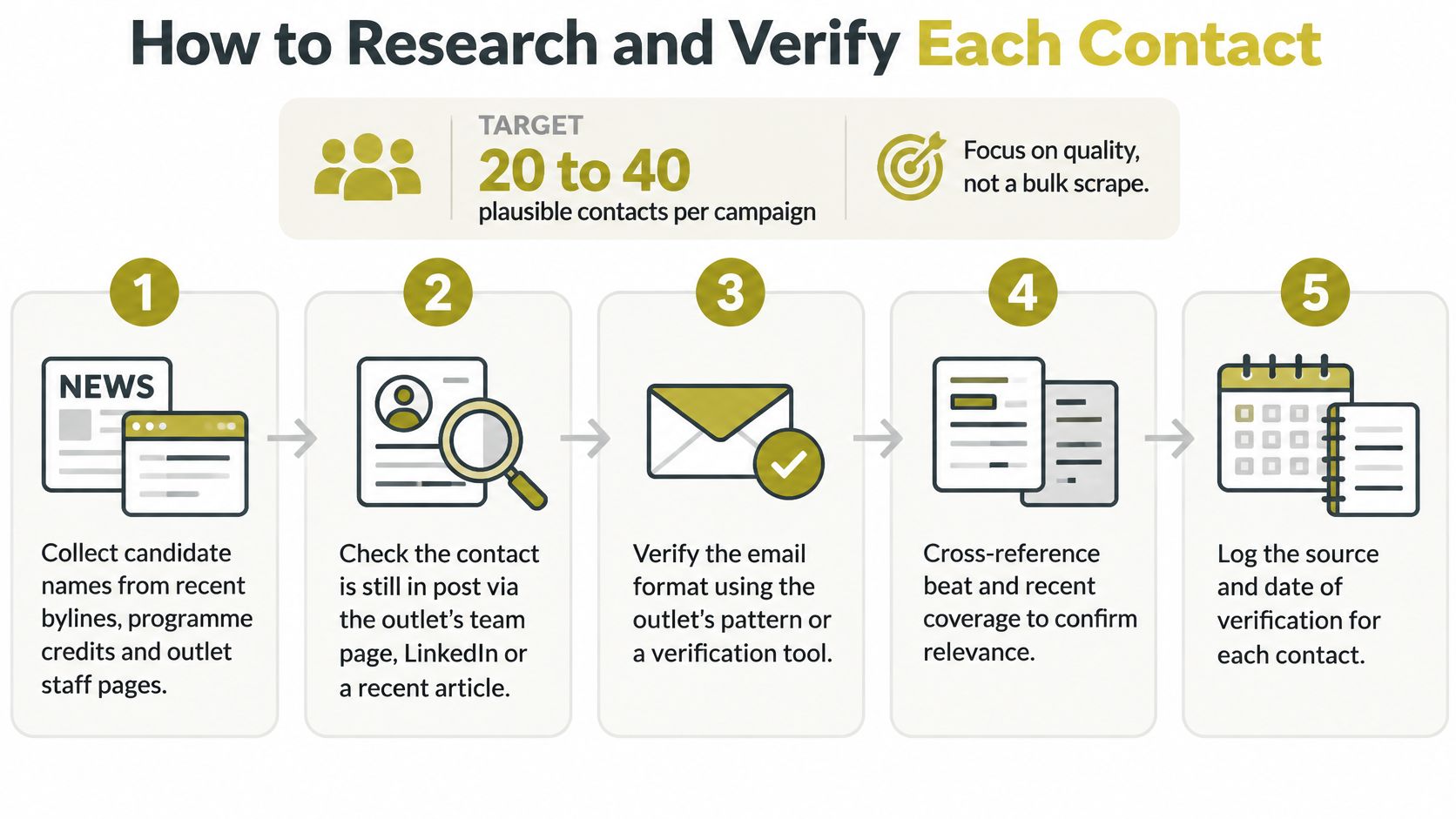
Work through five checks. Each one blocks a specific mistake.
- Collect candidates from fresh output. Take names from recent bylines, programme credits and the outlet's own contact page. An old staff page is the most common source of people who left two jobs ago.
- Read the last three to five pieces or programmes. You are checking the beat, not admiring the writing. A masthead label such as "business" often hides a reporter who now only covers markets or only covers retail.
- Confirm the role, and the email pattern. Reporters, producers, presenters and freelancers need different approaches. Match the address to the outlet's usual format, or run it through a verification tool. A freelancer listed under a title may no longer write there.
- Save one link that proves the topic. Reject the row if you cannot point to a recent article or programme on your subject. Relevance is the test, not seniority.
- Log the source and the date. Write where you checked the person and the day you did it. A row with no date is a guess.
A short walk-through of building the sheet from bylines, rather than from a bought file, is here.
Where a person still has to decide
Automation can flag new bylines, job moves and stale rows. It should not write the approach. In a 2026 survey of 200 UK journalists, 76% opposed PR professionals using AI to generate pitches or press releases, including 44% who were strongly opposed, and only 7% supported fully AI-generated releases, as set out in Cision's lessons from its media survey. Models also invent confident errors. Where AI fact checkers fail is a fair warning before you trust a summary of someone's beat. A person confirms the link, the claim and the final note.
Before a row goes active, tick four things: still in post, beat matches, route is allowed, verified date is this month.
How to Rank Contacts and Pitch Where It Fits
A verified list is still not a send list. Score each contact from 1 to 5 on four tests, multiply by the weight, and add the results. The total runs out of 5. Pitch the top of that ranking. The list earns its keep in replies and coverage; the row count alone proves nothing.
| Criterion | Weight | What to check |
|---|---|---|
| Editorial fit | 40% | Recent article or programme on your topic |
| Audience and geography | 25% | Readers in your market, city or nation |
| Authority and reach | 20% | Audience size and influence within the beat |
| Accessibility and deadline | 15% | An open pitch route and a deadline your timing meets |
Fit carries the heaviest weight because a journalist who covered your subject last month is already halfway persuaded. Reach only matters once that relevance is proven.
Say a regional reporter scores 5, 5, 2 and 5. That is (5 x 0.4) + (5 x 0.25) + (2 x 0.2) + (5 x 0.15) = 4.4. A national reporter whose beat has moved on scores 2, 2, 5 and 3, which totals 2.75. The regional reporter is pitched first. Reach without a current beat is a weaker bet than a smaller outlet that still covers the subject.
Keep the note itself tight: the news point, why it matters to that outlet's audience, and one piece of evidence with a named spokesperson behind it. Presswire's report on what journalists reject found email overwhelmingly preferred for pitches, with relevance the leading decision factor, and that 50% of journalists would block contacts who followed up excessively. A few notes written for the person beat one introduction pasted to forty inboxes.
Send one follow-up after a fair deadline, then stop. Chasing is how good contacts turn into blocked ones.
Log delivery, replies, coverage and any block in the same sheet, so the next campaign starts from evidence rather than memory. Scores move as people reply, change beat or go quiet. A contact who never answers after three well-fitted pitches drops down the ranking regardless of their reach. For the wider discipline of managing press relationships after the first reply, see our page on press relations management.
Tools and Templates for the Media List
Start in one shared sheet. Add the eight fields, then three working columns: score, suppression status and a dated interaction log. A spreadsheet is enough while one campaign owns the names. Move to a CRM when several campaigns reuse the same people and you need reminders, tags and more than one editor. Alerts on bylines, job changes and stale dates can queue a row for review. A person still confirms relevance before the score changes.
Use one pitch template with fixed slots, filled per contact. Keep it short enough to read in one pass on a phone.
- Subject line. Name the news point, not the brand slogan.
- Opening line. Name the journalist's recent piece or programme.
- News point. One sentence.
- Audience line. Why it matters to that outlet's readers, viewers or listeners.
- Evidence. One figure or fact, with its source.
- Spokesperson. Name, availability and the time window.
- Asset. A visual, audio clip or link.
- Sign-off. Your name, role and a direct number.
Mirror those slots in the log: date sent, route, reply status, coverage link and any block signal. Empty slots are a reason to pause, not a reason to send a thinner version to more people. For the assets that sit behind the pitch, the press kit templates page shows the pack we expect a spokesperson to have ready before the first note goes out.
Keeping the List Accurate and Pruning Contacts
Volume feels like progress until the first bounce, or until you pitch a reporter who changed desks six months ago. Journalists move, freelancers switch titles and beats drift. A dated, segmented database beats a static spreadsheet the week after you build it.
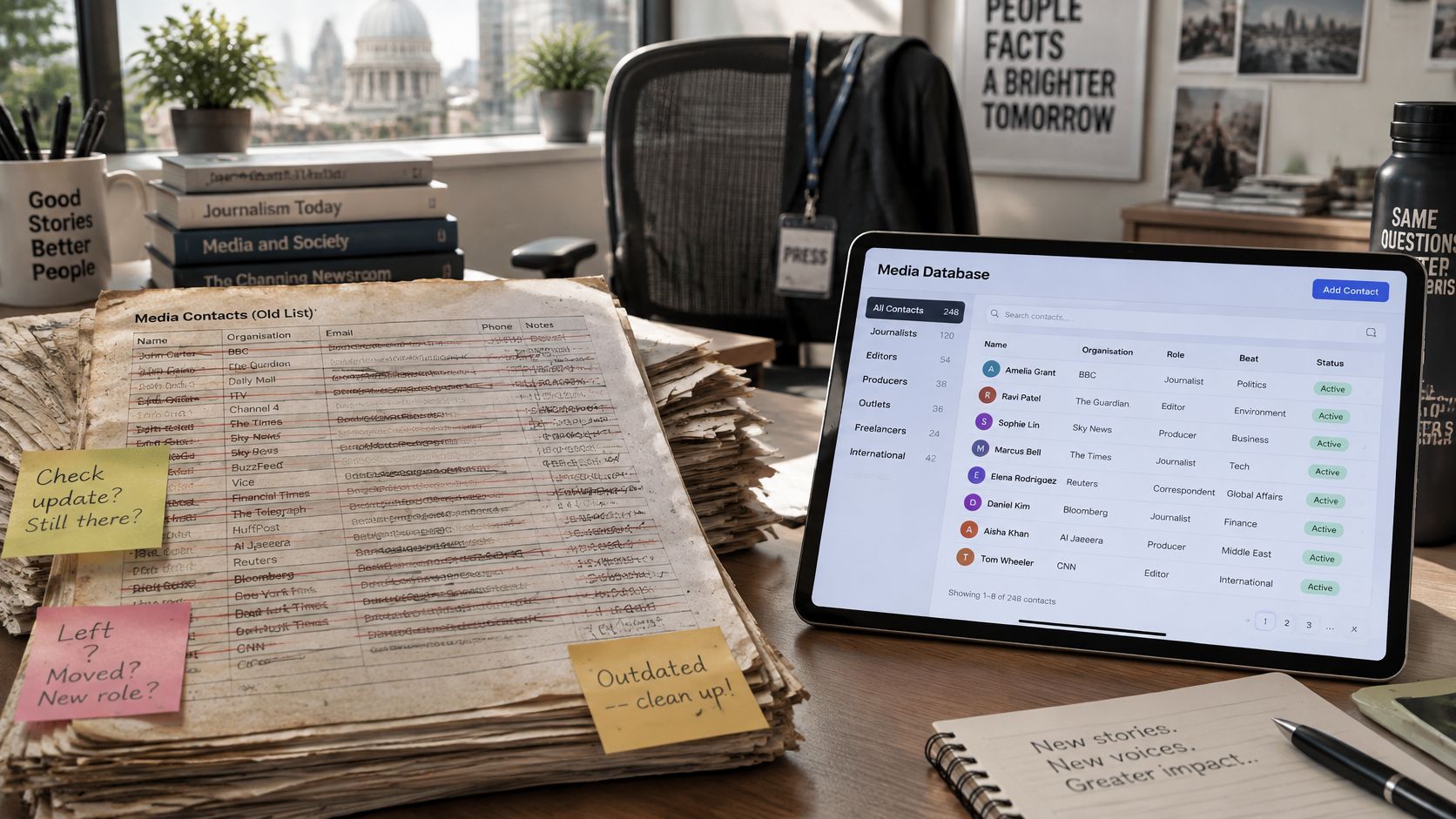
Reverify active contacts every quarter, and again before any major campaign. Treat that check the way a data team treats checks for stale price data. A field that was right in January can be wrong by April, so you date it and test it again.
Who leaves the active list
- Repeated silence. Remove a contact after no response across two separate campaigns.
- A direct request. Remove anyone who asks to be left off, the same day they ask.
- A dead address or a departure. Remove bounced emails and anyone who has left the outlet.
Do not delete those rows. Park them in a suppression field so the next person on the account cannot add them back by mistake. Judge the list on pitch-to-reply, pitch-to-coverage and unsubscribe or block signals. The total number of contacts is not a result.
Freelancers, regional correspondents, broadcast producers and newsletter editors sit on separate routes. A producer is verified against a programme credit. A freelancer is verified against who published them this month, not against a masthead they used last year. Keep one owner for the sheet, log every interaction the same day, and tag the story types each person has accepted. After each campaign, look again at the weights. If high scores keep producing silence, the scoring is wrong, not the journalists.
Put the next reverification in the calendar before you close the file. A list without a date on it is already going stale.
Build Your First Media List This Week
Start small and start verified. A list of twenty checked contacts will outperform a spreadsheet of two hundred guessed addresses, because the first round of pitches tells you whether your fit scoring works.
- Write one sentence with the audience, the geography and the news angle.
- Pick two or three segments from the outlet table. Ignore the rest for now.
- Collect 20 candidates and keep only those with a recent link on the topic.
- Score them on fit, geography, reach and deadline.
- Pitch the top ten in separate emails and log every reply, referral and silence.
Four weeks on, a working list is smaller than the one you started, tagged and dated, with a reply rate you can quote and a suppression field already in use. That reply rate is the measure that matters. If ten pitches earn two replies and a piece of coverage, the scoring works; silence across the board means the weights need adjusting before you add another contact.
If the week is already full, or you do not have senior newsroom routes, we can take the verification and the first approach. Carlos Alba Media is run by a multi award-winning former national newspaper editor and a team of seasoned professionals. People facing a communications challenge or a media crisis can book a free consultation with one of our public relations experts, or email admin@carlosalbamedia.co.uk.
Before the next campaign, ask one question. Which contacts earned their place this time, and which should come off?
A media list only works when someone who has sat in a newsroom decides who is on it and who is not. Carlos Alba Media places news, features and interviews, and supports founders who need that judgement without building a desk of their own. If you want the first verified list scoped against a real story, visit Carlos Alba Media and tell us the audience, the geography and the news angle.