

Half of UK businesses surveyed said Google algorithm updates had affected their website traffic in 2024, according to LOCALiQ's State of Marketing report, summarised in its UK digital marketing statistics. That's a reason to buy accountable search work, not a promise that traffic will always rise.
Good SEO service packages connect a defined workload to enquiries, bookings or sales. Bad ones sell activity without explaining its commercial purpose. The distinction matters even more when customers can encounter your business in an AI-generated answer without visiting your website.
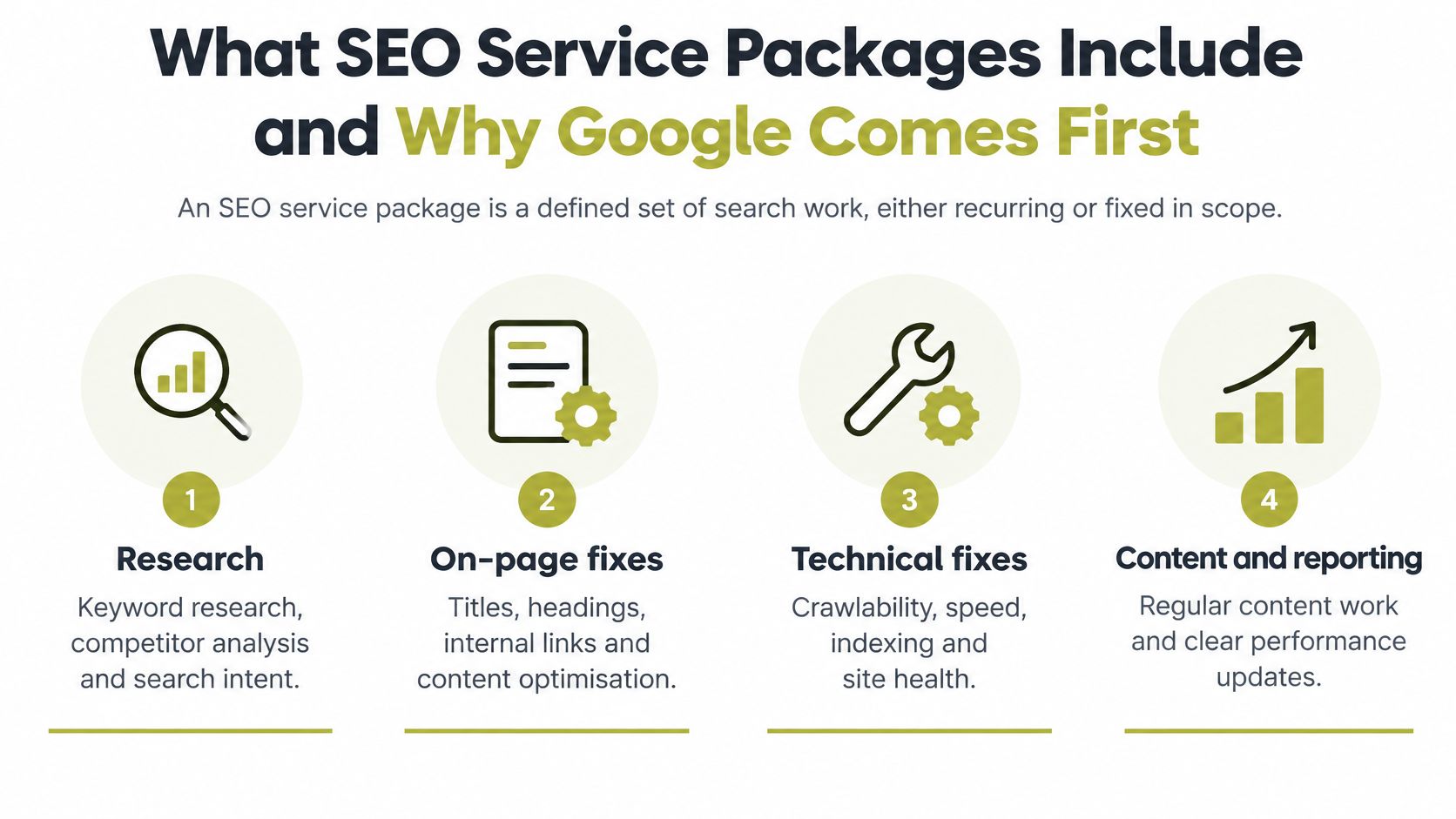
What SEO Service Packages Include and Why Google Comes First
An SEO service package is a defined set of search work, either recurring or fixed in scope, covering research, on-page and technical fixes, content and reporting. Think of it as a maintenance contract for a shop front, not a single repair. Someone must keep the entrance accessible, the information accurate and the route to purchase clear.
Most credible packages combine these components:
- Keyword and competitor research: Identify what prospective customers need, which pages should answer them and where competitors offer better information.
- Technical auditing and fixes: Find obstacles to crawling, indexing and usable page experiences, then assign responsibility for fixing them.
- Content planning and optimisation: Improve service pages, headings, internal links and supporting articles around genuine buying questions.
- Reporting: Connect completed work to search visibility, qualified visits and commercial outcomes.
The distinction between finding a problem and fixing it is important. An audit spreadsheet isn't an implementation service.
Google first, not Google only
Ofcom figures reported in 2025, summarised by Figment Agency, put Google Search usage at 82% of UK online adults, generating approximately 3 billion UK searches per month. The same compilation puts Google's September 2026 UK search share at 91.39%, against 6.08% for Bing.
That concentration explains the default focus. It doesn't justify ignoring Bing, local listings, mobile usability, structured data or the reputation customers encounter after searching your name.
For businesses comparing online-shop and service-site requirements, CIQRA's resource on search visibility for websites and stores provides useful context. The buying decision should still rest on your own website's constraints.
Before signing, require a written checklist covering pages in scope, named tasks and owners, reporting dates, and client inputs. Include access permissions, subject expertise, photography and approval responsibilities. Otherwise, an apparently complete package can stall because nobody agreed who would provide the material or publish the changes.
Retainer, Project and Performance Models Compared
SEO service models compared for UK businesses
| Model | How it is billed | Typical UK cost | Best for | Main risk |
|---|---|---|---|---|
| Retainer | Monthly fee for ongoing work | Not confirmed; quote against named monthly work | Steady growth in competitive or local markets | Fees continue while progress slows |
| Project | Fixed fee for a defined scope | Not confirmed; quote against deliverables and acceptance criteria | Audits, migrations, relaunches | Little ongoing maintenance after delivery ends |
| Performance | Base fee plus bonus for agreed outcomes | Illustrative arrangement only: £500 to £1,500 base, plus bonus per result | Businesses with clean tracking and known lead values | Disputes over attribution; providers avoid hard targets |
| Hybrid | Fixed-fee audit, then monthly retainer | Illustrative arrangement only: £2,000 to £5,000 setup, then a retainer | Sites needing repair before growth | Two sets of fees; needs a clear handover |
The illustrative amounts aren't verified UK market averages or Carlos Alba Media prices. Actual fees remain unconfirmed until the work is scoped. A price without implementation responsibilities tells you very little.
What each model actually buys
A retainer answers the question: who will keep improving the site? It suits businesses that need continuing editorial, technical and local-search attention. Its weakness is inertia, so require a prioritised backlog and an explanation of what happens after the initial clean-up.
A project answers a narrower question: who will complete this defined change? An audit, migration or relaunch should have acceptance criteria, dependencies and a handover. Make sure the quote distinguishes recommendations from implementation, and identifies who handles problems discovered after delivery.
A performance arrangement asks whether the provider will share commercial risk. It only works when both parties agree what counts as a valid result, how duplicates are excluded and which system determines attribution. Don't pay a bonus for enquiries your sales team cannot serve or for existing customers submitting support requests.
The hybrid separates repair from continuing growth. That can be sensible when a site needs foundational work before content expansion. The danger is paying twice for overlapping discovery, so the retainer should begin with an agreed handover rather than another round of diagnosis.
Buying rule: Match the billing model to the problem, not to the cheapest figure on the page.
Compare the full cost
Ask whether the fee includes development, copy approval rounds, analytics configuration, paid tools and content uploading. Confirm VAT treatment and any third-party expenditure in the quotation. Exclusions aren't automatically unreasonable, but hidden exclusions make comparisons unreliable.
Our initial consultancy is provided without any fee, allowing the problem and proposed commercial arrangement to be discussed before commitment. Use that conversation to establish what must change, who will deliver it and what evidence would justify continuing.
Technical and Content Deliverables Worth Paying For
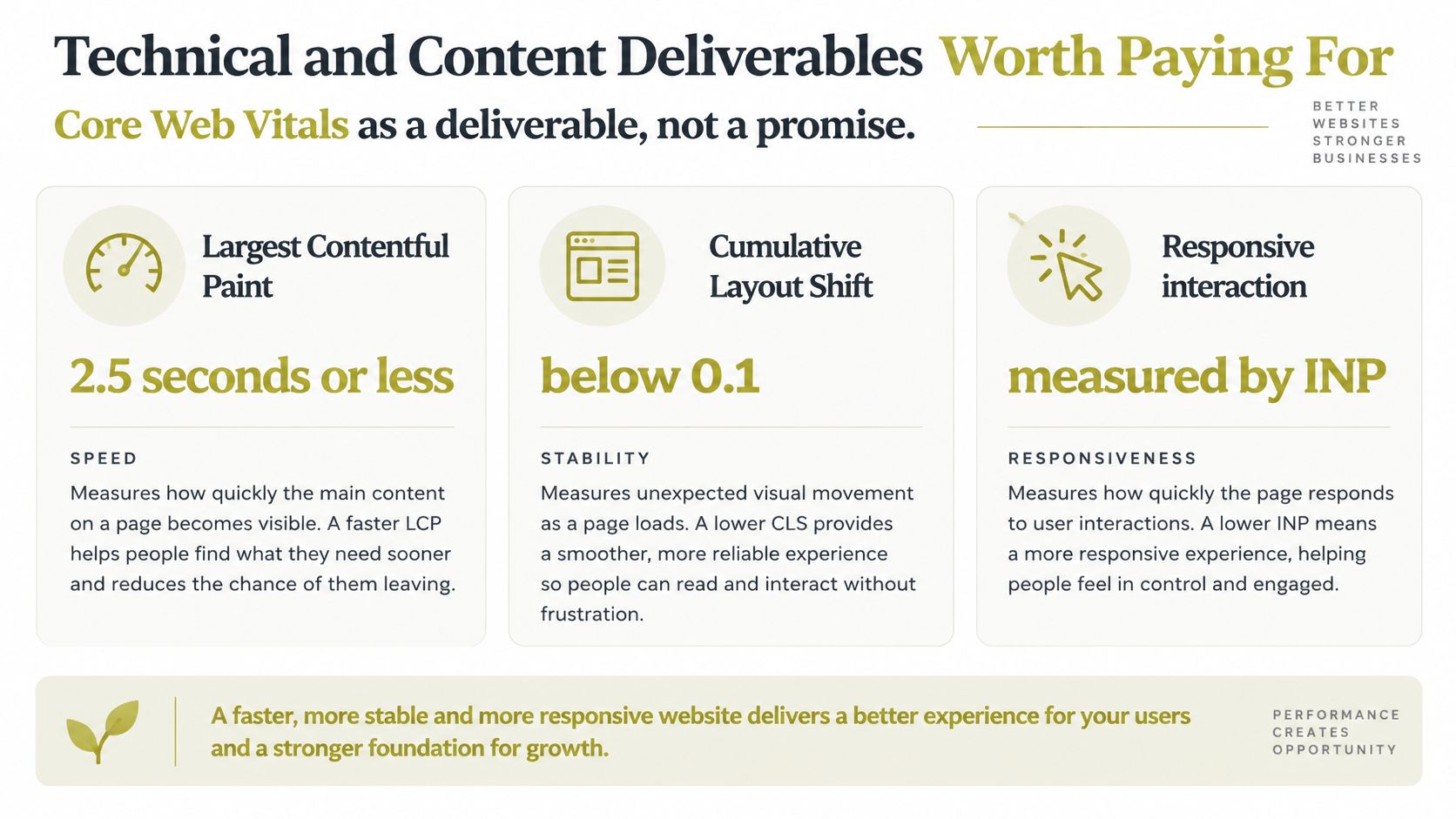
Core Web Vitals should be an engineering deliverable, not a vague promise to improve speed. The package must identify affected templates, specify changes, and test the result on pages customers use.
Oxford Web Services' performance analysis sets out Largest Contentful Paint of 2.5 seconds or less, Cumulative Layout Shift below 0.1, and a median UK mobile LCP of approximately 1.8 seconds, compared with 1.9 seconds globally; it also summarises retail research associating a 0.1-second load-time improvement with about 8.4% higher conversions.
Core Web Vitals thresholds a package should report
| Measure | Threshold or benchmark | What it means |
|---|---|---|
| Largest Contentful Paint | 2.5 seconds or less | How long the main content takes to appear |
| Cumulative Layout Shift | Below 0.1 | How much the page moves while loading |
| Interaction responsiveness | Google's current interaction metric, INP | Delay between a tap or click and the visual response |
| Median UK mobile LCP | About 1.8 seconds | UK benchmark, against 1.9 seconds globally |
These benchmarks guide diagnosis, not revenue forecasts. A hospitality booking page and a retail checkout need their own conversion evidence.
Demand fixes, not just scores
Use Chrome User Experience Report field data alongside Lighthouse diagnostics, separating mobile and desktop. Test home, service, landing and booking templates rather than selecting whichever page produces the best score.
The engineering backlog should address render-blocking resources, oversized images, third-party scripts, cache policy, server response time and missing layout dimensions. Each task needs an owner, a deployment route and a validation check.
Put AI-search readiness under named ownership
The SEO lead should coordinate AI-search readiness, the developer should own crawler access and implementation, and the editorial lead should own factual accuracy. PR specialists should handle third-party corroboration. Don't let an AI label obscure these ordinary responsibilities.
Useful deliverables include:
- Clear first-party information: Consistent organisation, service and author descriptions.
- Accessible evidence: Crawlable pages, appropriate structured data and concise answers supported by substantive explanations.
- Governance: Approved source material, review of AI-assisted drafts and a process for correcting inaccurate claims.
- Monitoring: A documented set of relevant prompts and a record of brand mentions, citations and errors.
Our SEO content creation service is relevant where editorial work must support search discovery and conversion. In the sample tiers below, the full readiness audit belongs in Authority; foundational crawlability and accurate content remain necessary at every level.
Clients should supply current service information, evidence for claims and access to subject specialists. Regulated material needs approval from the designated compliance or legal reviewer before publication, not after an automated draft goes live.
KPIs and Reporting That Prove SEO Worked
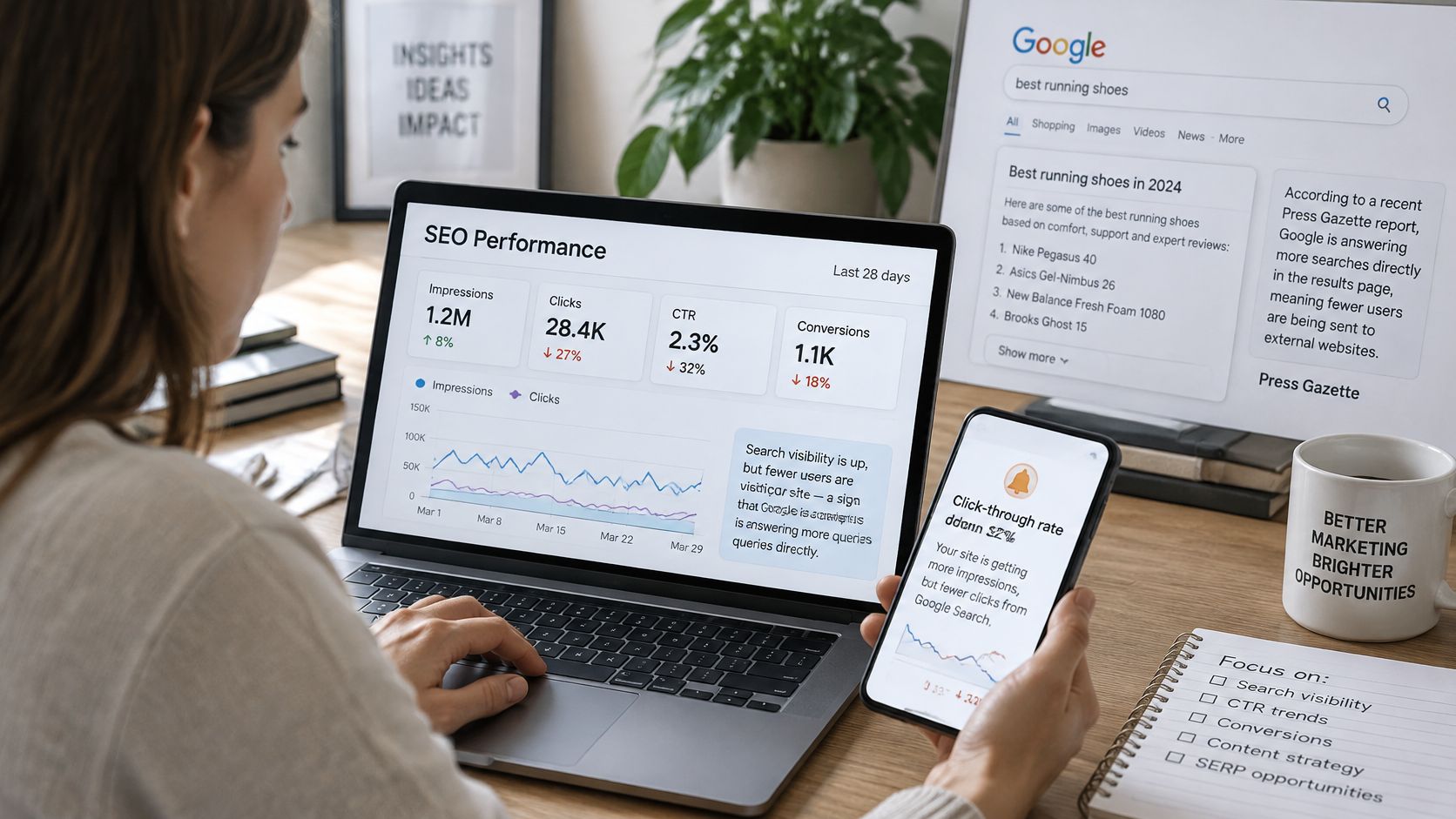
Google can answer a search without sending the user to your website. A package sold solely on traffic therefore risks optimising for an incomplete measure of success.
Press Gazette reported that, in May 2025, 68.8% of searches among the Daily Mail's AI Overview-triggering top terms produced no click to the publisher, compared with 54.9% overall for its top terms. That's publisher evidence, not an SME traffic forecast, but it exposes why clicks alone cannot settle the value question.
A useful reporting review starts with the relationship between search activity and customer action.
KPIs a monthly SEO report should show
| Metric | What it proves | Review cadence | Data source |
|---|---|---|---|
| Non-brand impressions and clicks | Visibility for searches you do not already own | Monthly | Search Console |
| Conversion rate by landing page | Whether visits turn into enquiries or sales | Monthly | Web analytics |
| Phone enquiries and form leads | Commercial outcome of organic visits | Monthly | Call tracking and CRM |
| Branded search growth | Demand created by visibility and PR | Quarterly | Search Console |
| Mentions in AI-generated answers | Presence where clicks are declining | Quarterly | Manual checks or monitoring tool |
| Organic revenue or booked value | Financial return on the package fee | Quarterly | CRM or sales records |
Separate observation from attribution
Say a hotel appears in an AI-generated answer, then receives a branded search and a direct booking. Lower non-brand clicks could coexist with valuable discovery. But a mention doesn't prove that it caused the booking.
Label visibility, consideration and outcomes separately. Branded growth can support an interpretation of increased demand, while CRM records show whether enquiries became business. Neither should be presented as conclusive proof of a customer journey you couldn't observe.
A report should distinguish what happened, what probably contributed and what remains unknown.
For dashboard selection, Keyword Kick's discussion of an SEO reporting tool is useful context. Choose software after agreeing definitions, not instead of agreeing them.
The reporting discussion should focus on how evidence informs decisions.
Every metric needs a named source, an agreed definition and a baseline. Define qualified leads, exclude spam, document attribution settings and show completed work alongside the results. Then ask the question that matters: if fewer people click, how will you prove SEO influenced the sale?
Sample Tiered Packages for Growing UK Brands
A useful SEO package starts with the commercial problem, then sets a scope the team can deliver and assess. The examples below show how page coverage, content and strategic input can increase as a business's needs grow.
Essential for a new service business
A new consultancy with clear services but little useful website content needs to make its offer easy to understand and act on. An Essential scope could cover five core pages, a technical audit and one blog post a month, with a monthly dashboard and quarterly review.
The five pages should explain the services, give visitors reasons to trust the business and make the next step clear. Specify which pages are included, whether the audit's recommended fixes are part of the work, who provides subject expertise and who approves claims.
Before commissioning a new site, founders can compare website builders for small businesses. Check that the chosen platform supports editing access, redirects, page templates and analytics integration.
Growth for a regional operator
A tourism business expanding across a region could need an SEO scope covering ten to fifteen pages, local listings, a quarterly content plan and prioritised speed fixes. Monthly reporting should include conversion data, not just visits.
The key trade-off is depth versus breadth. Improving commercially important service and location pages may beat publishing thin pages for every nearby town. Set out the locations, who manages listings, the development allowance and the approval route in the contract.
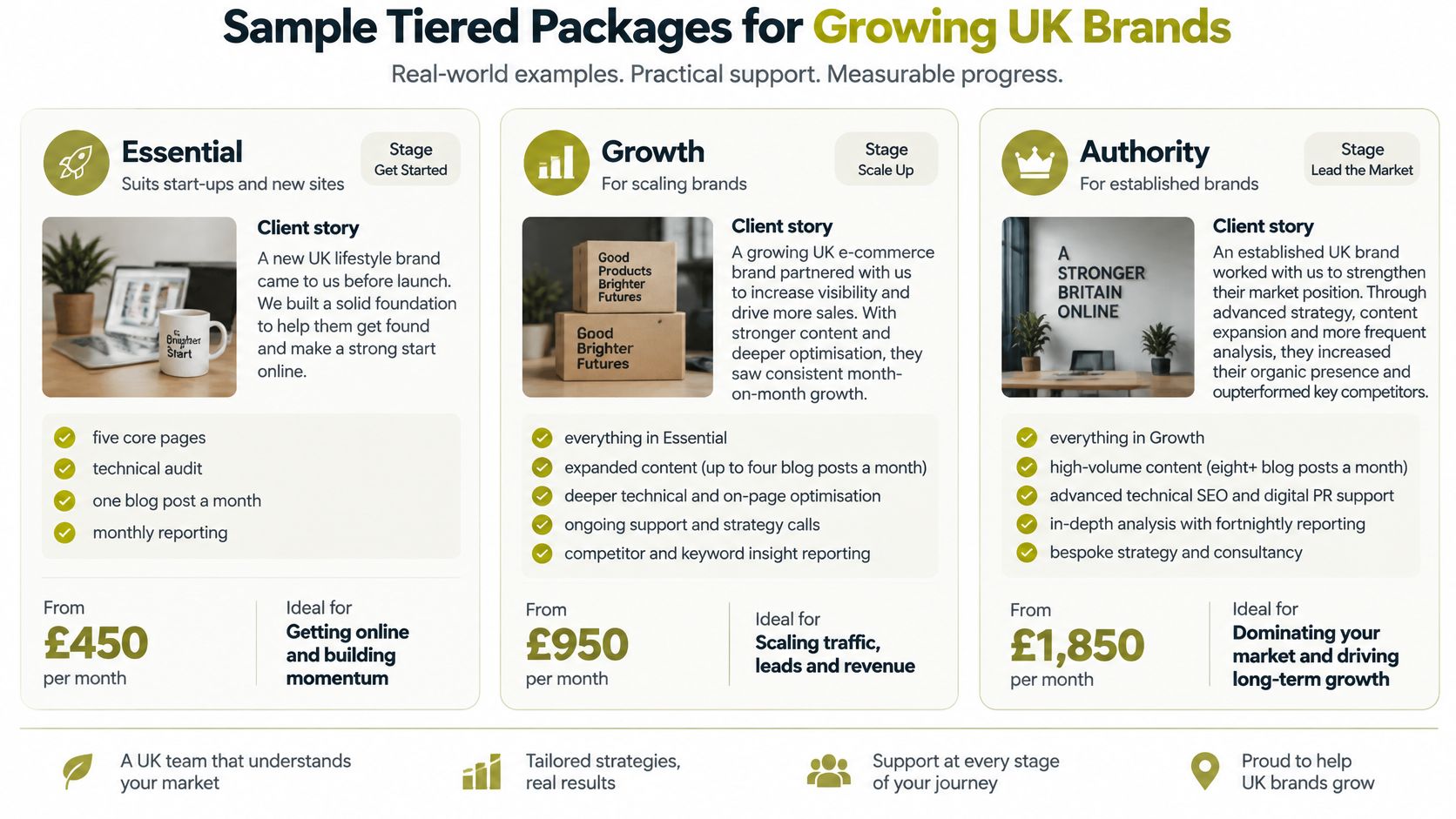
Sample SEO package tiers for UK clients
| Tier | Pages and content | Reporting | Best for |
|---|---|---|---|
| Essential | Five core pages, technical audit, one blog post a month | Monthly dashboard, quarterly review | Start-ups and new sites with clear services |
| Growth | Ten to fifteen pages, local listings, quarterly content plan, speed fixes | Monthly report with conversion data | SMEs in competitive local or regional markets |
| Authority | Full technical programme, digital PR, expert content, AI-search readiness audit | Monthly report and quarterly strategy session | Established or regulated brands needing national reach |
Authority for a nationally scrutinised brand
A regulated technology business may need a coordinated programme across technical SEO, digital PR, expert content and AI-search readiness, supported by monthly reporting and a quarterly strategy session. The aim is to build visibility and trust while connecting the work to commercial outcomes, including when AI-generated answers reduce clicks to websites.
Editorial judgement matters when claims must stand up to scrutiny from editors, customers and compliance teams. Carlos Alba Media has completed 200+ digital content marketing projects, including campaigns for major brands such as RBS, ScotRail and VisitScotland.
Authority work should define how expert claims are supported and how outreach will be conducted. A clear backlink strategy focuses on relevant editorial coverage and audience value, rather than treating link volume as the goal.
A national programme can serve clients beyond Scotland. The package should reflect the audience and market, not assume the business must be based in Glasgow or Scotland.
Red Flags and the Questions That Expose Them
Guaranteed first-page rankings should end the sales conversation. No provider controls search results, and a guarantee can conceal an irrelevant keyword or a result with no commercial value.
Ask which searches matter to your customers and what the provider commits to delivering. A credible answer concerns work, evidence and accountability, not control over an external platform.
Expose vague delivery promises
Use these questions to turn a polished proposal into something testable:
- Scope described only as SEO: Which pages will change, what will be done and who owns implementation?
- An unnamed delivery team: Who conducts the analysis, writes the content and checks its accuracy?
- Client inputs left unstated: What access, source material and approval time must our team provide?
- No direct analytics access: Will we retain administrator access to Search Console, analytics and the underlying accounts?
- Link-buying disguised as outreach: How are placements obtained, what payments are involved and what risks are disclosed?
An audit should expose priorities rather than inflate the task list. Our SEO audit checklist helps buyers examine whether a proposal addresses actual obstacles.
Challenge reporting and contract terms
A rankings-only report cannot tell a business owner whether an enquiry was relevant or a booking was profitable. Ask which metric will demonstrate that the first three months justified the fee, and distinguish early implementation evidence from outcomes that need longer observation.
Other warning signs deserve equally direct questions:
- Vague AI-search claims: What will be audited, which outputs will be monitored and how will errors be handled?
- No factual approval route: Who signs off technical, financial, medical or otherwise regulated statements?
- Long lock-in without a workable exit: What notice applies, what remains payable and how are files, accounts and unfinished work handed over?
- Reports without decisions: What will change because of the findings, and who authorises that change?
Contract test: You should be able to explain what you're buying without repeating the agency's sales language.
Don't confuse a confident presentation with a well-controlled service. A proposal can appear polished while leaving development, compliance, and measurement unresolved.
A good provider can answer these questions in writing without difficulty. If the salesperson deflects reasonable questions before the contract, treat that behaviour as evidence of how the relationship will run afterwards.
Confirm the Package Fits Before You Sign
Choose the smallest scope that can credibly address the commercial problem. That isn't the same as choosing the cheapest package. Underfunding essential implementation can leave you paying for recommendations nobody has the capacity to use.
Run this fit check before agreeing terms:
- Name the commercial outcome. Choose the main objective, such as qualified enquiries, bookings or national coverage. Specify what makes that outcome valuable.
- Select the billing model. Use a project for a bounded change, a retainer for continuing work or a carefully defined alternative where responsibilities justify it.
- Set the scope realistically. Consider important pages, competitive pressure and your team's capacity to provide expertise and approvals.
- Get the agreement in writing. Confirm deliverables, measurement definitions, exclusions, ownership and exit arrangements.
- Approve the approval process. Identify who checks factual and regulated claims before publication.
Make the first conversation concrete
Our initial consultancy is provided without any fee. Bring your website address, the commercial problem, existing reporting and the practical constraints on your team. That gives the conversation a useful basis for discussing scope, pricing and how progress should be assessed.
Don't ask only which package you can afford. Ask which work must happen, what can wait and what your own team can realistically deliver.
Search visibility works best alongside PR, content and reputation. Judge the package by the commercial outcomes it can substantiate, the quality of its evidence and the clarity of its responsibilities, not the length of its deliverables list.
Carlos Alba Media combines SEO, digital content, PR and website expertise to connect search visibility with commercial goals. Visit Carlos Alba Media to arrange an initial no-fee consultancy and discuss the scope, costs and reporting your business needs before committing to a package.