
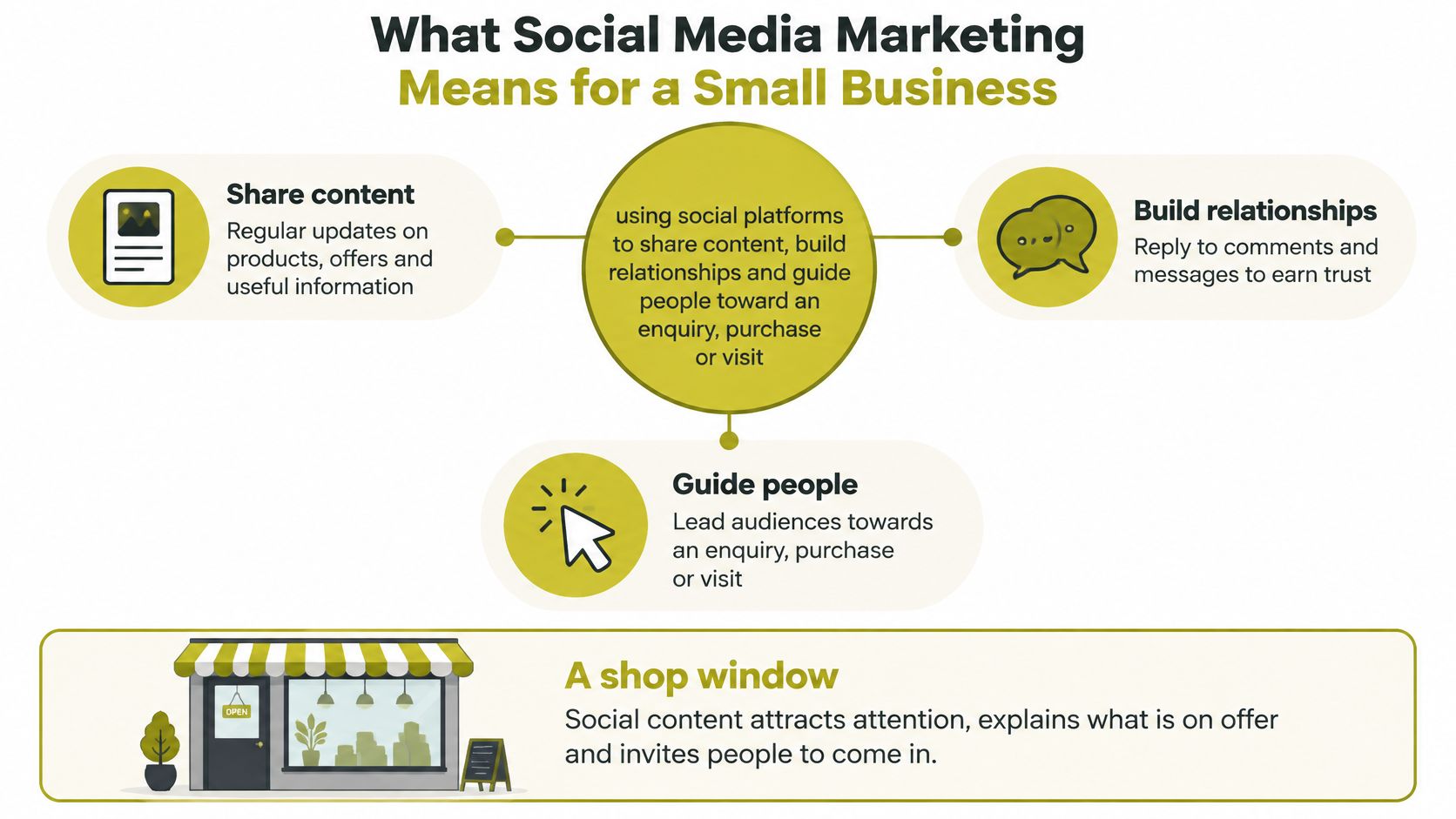
Social media marketing is using social platforms to share content, build relationships and guide people toward an enquiry, purchase or visit. You're probably posting when you get a spare ten minutes, watching likes come in, and still unsure whether any of it produced a customer. That's the common starting point for a small business, and it's understandable. The apps reward activity, so posting feels like progress.
It isn't progress on its own. What is social media marketing becomes clearer when you treat it as a system for measuring outcomes and handling disclosure properly, not as a posting schedule. Each post, advert or reply should have a job, an audience and a way to prove whether it worked.
What Social Media Marketing Means for a Small Business
Think of a shop window and a shop floor. A window shows passers by what you sell. The shop floor is where someone steps inside, asks a question, picks something up and gets an answer. Social media is closer to the shop floor. People can react, ask, complain, share and be answered in public.
That public, two way quality is the point. Ofcom's Adults Media Use and Attitudes report reported that 89% of UK online adults used at least one social media app or site in 2023, while 59% said they actively shared, posted or commented on those services. People who comment and share can carry your content to others, which is why this channel behaves differently from a leaflet or a static advert.
The scale is now commercial, not experimental. The Advertising Association and WARC expenditure report states that social media accounted for 24.7% of total UK advertising investment in 2025. For a small firm, the discipline combines platform choice, audience specific messages, paid promotion, community management and measurement. If you're mapping those pieces for the first time, this guide to social media planning for small businesses is a useful companion on structure.
Practical test: If a post can't be linked to a goal, it's content, not marketing.
Awareness, Consideration and Conversion Goals Explained
Customers rarely move from never having heard of you to paying you in one step. Awareness, consideration and conversion describe stages on that journey, not three unrelated campaigns. Confusing them is where most reporting goes wrong, because each stage needs different content and a different measure of success.
How the three stages differ
Awareness means a person who didn't know you now recognises your name and what you offer. Consideration means they know you and are deciding whether to trust you, so proof matters more than novelty. Conversion means trust turns into action, an enquiry, booking or sale, and friction at that point costs you money.
| Goal | Typical activity | Content that works | Metric to track |
|---|---|---|---|
| Awareness | Reach, video views and new followers | Short video, creator posts and behind-the-scenes clips | Reach, frequency and video completion rate |
| Consideration | Engagement, profile visits and site visits | Reviews, FAQs and product demonstrations | Click-through rate and time on page |
| Conversion | Enquiries, bookings and sales | Offers, retargeting adverts and testimonials with a clear call to action | Cost per enquiry and conversion rate |
Take a Scottish guesthouse. A short film of the rooms and the view from the breakfast table does awareness work, because strangers can grasp the place in seconds. Guest reviews, plus a practical post on what to pack for the Highlands, do consideration work, because they answer doubts and show the owners know their ground. A tracked booking link with a clear, time limited offer does conversion work, because it gives a ready person one obvious next step.
Notice what happens if you swap the measures. Judging the room film by bookings makes good awareness work look like failure. Judging the booking advert by reach makes weak selling look like success, because plenty of people saw it and nobody bought. People seldom buy on first sight, so early content earns attention that later content converts.
Keep it simple. Give each goal one content type, one channel focus and one primary metric. Then you can read a result against the job you set, rather than against whatever number looks largest that week.
Which Platforms Reach Your Audience
Choosing a platform works like choosing where to open a shop. The busiest street in the country is wasted if your customers never walk down it, so follow where your buyers already spend time rather than the app you happen to enjoy. Ofcom's Online Nations Report 2025 reports that 90% of UK online adults use social media, that YouTube users spend an average of 51 minutes per day on the platform, that WhatsApp reaches 90% of UK online adults, that Instagram reaches 78%, and that TikTok reaches 46% of UK smartphone-using adults.
Those figures describe reach and attention, which are different things. Reach counts how many people a platform touches. Attention measures how long they stay once they arrive. A platform can reach many people briefly, or fewer people for longer, and a small firm often gets more value from the second kind. In the table below, read the middle column as reach or attention and the last column as the outcome you would track.
| Platform | UK reach or use | Best for | Main measure |
|---|---|---|---|
| YouTube | Users average 51 minutes a day | High-attention video and discovery | Video completion rate |
| Reaches 78% of UK online adults | Visual brand building and retargeting | Reach, frequency and click-through rate | |
| Reaches 90% of UK online adults | Relationship-led enquiries and customer service | Qualified conversations started | |
| TikTok | Reaches 46% of UK smartphone-using adults | Mobile-first discovery | Video completion rate and click-through rate |
| A major social site or app for UK social media users | Older audiences, local groups and paid promotion | Cost per lead |
Match the platform to the job. YouTube suits explanations people search for and watch properly. Instagram suits visual proof and retargeting people who have already shown interest. WhatsApp suits direct enquiries and service, where a finished conversation is the outcome. TikTok suits discovery by people scrolling on phones. Facebook suits older audiences, local groups and paid promotion.
Three steps before you open an account
- List where customers already mention you: Check reviews, messages, tags and the source field on recent enquiries.
- Compare that list with reach: Keep only platforms that reach your defined audience, not the general public.
- Start with one or two: Add a third only when enquiry data, not enthusiasm, supports it.
A platform earns its place only if you can track what it produces. If you cannot tell whether enquiries came from it, you are maintaining a presence. A working channel shows you what it delivered.
The Tactics Behind Social Media Marketing
Five tactics cover most of what small firms do. The image below sets them out in the order they usually build on each other.
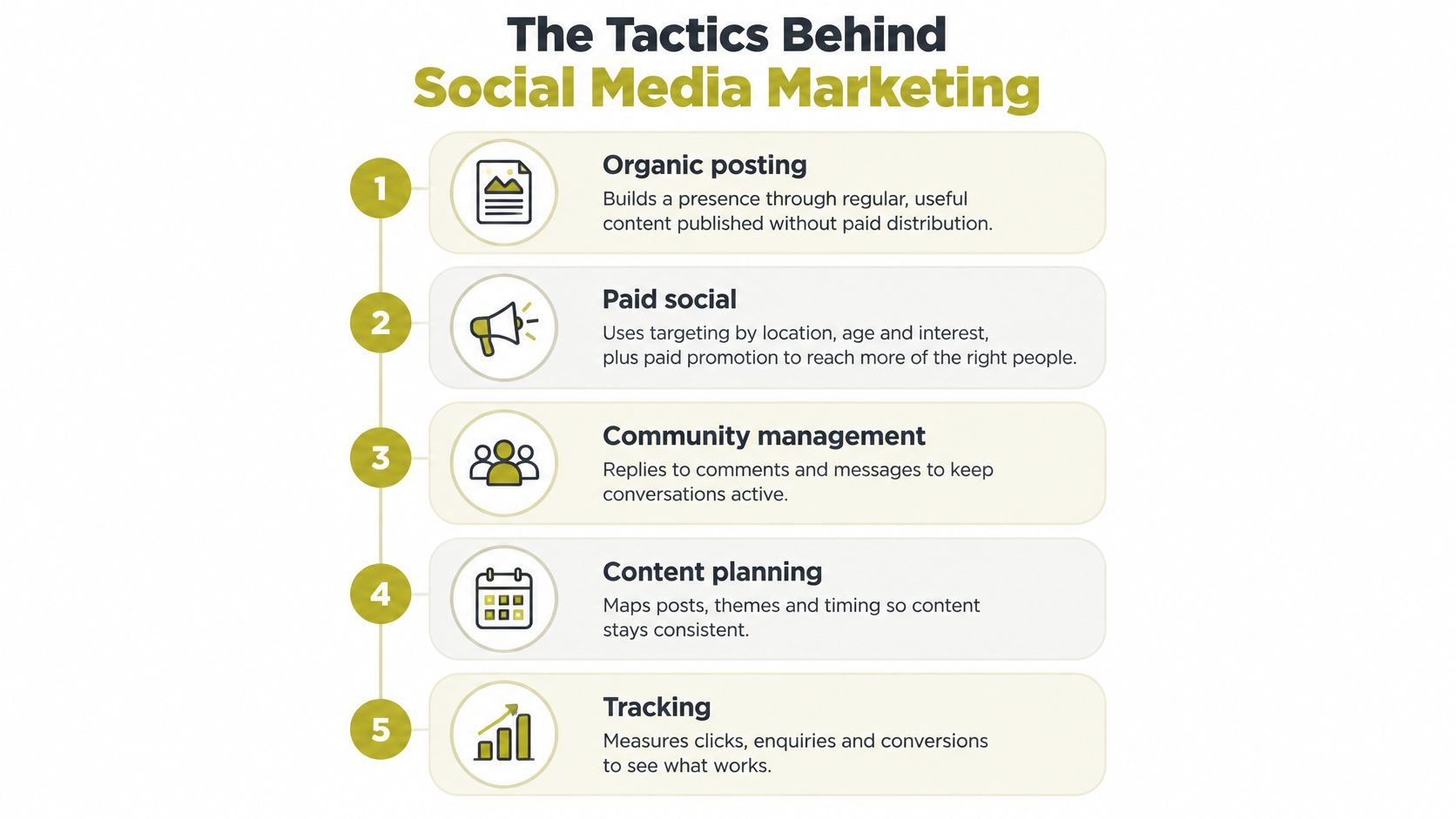
Organic posting is regular, useful content published without paid distribution. A joiner filming how a warped door is planed back to fit teaches something and demonstrates competence. Paid social puts money behind content and targets by location, age and interest, or retargets people who visited your website and left. Community management is answering comments and direct messages promptly, because an unanswered price question is often a lost enquiry. Creator and customer advocacy puts a trusted voice in front of a new audience, with clear disclosure. Founder led content gives the business a face, which suits firms where the owner is the person clients meet.
These aren't alternatives. Organic posts build a library and show you which topics people respond to. Paid promotion then amplifies the proven pieces instead of guessing. Community management turns that attention into conversations, and advocacy borrows trust you haven't yet earned. If you're producing short creator style video yourself, these voiceover tips for AI UGC ads cover the practical side of making it sound natural.
The short film below shows how planned video fits into that mix, and our page on social media marketing videos explains the production side in more detail.
Paid social isn't only for large brands. We Are Social's Digital 2025 report states that UK social media advertising spend reached £9.02 billion in 2024, increasing 13.8% year on year. Start with a small test on one proven post, one audience and one landing page. You'll learn what an enquiry costs before you commit serious money.
Measuring Results Beyond Likes and Reach
Measurement works when you follow a chain. Exposure leads to attention or interaction. That leads to a site visit or a direct message. That leads to a tracked lead or sale. If a link in that chain has no measure, you'll end up reporting the easiest number rather than the useful one.
Set the tracking up first
- UTM tagged links: Add tags to every post and advert so your analytics can name the exact source of a visit.
- One landing page per campaign: Send people to a page built for that offer, with a single call to action.
- An enquiry source field: Record the source in your CRM at the moment someone gets in touch, not from memory later.
- One definition of a qualified lead: Agree what counts, such as a named person, a real requirement and a contactable number.
That last point matters more than it sounds. Without an agreed definition, a newsletter signup and a ready to buy enquiry get counted as the same thing.
| Metric | What it shows | What it misses | Pair it with |
|---|---|---|---|
| Reach | How many people saw the content | Whether anyone cared | Site visits from UTM-tagged links |
| Likes and followers | Interest in the brand | Buying intent | Enquiries logged in the CRM |
| Click-through rate | Action taken after viewing | Whether the visit converts | Landing-page conversion rate |
| Cost per qualified lead | Cost of acquiring a lead | Customer lifetime value | Sales records from the CRM |
Likes, reach and follower counts show interest, not intent. They're useful early signals, but they can't tell an owner whether the activity paid. Cost per qualified lead can, because it divides spend by enquiries that met your agreed definition. That's the monthly number worth reporting.
Also allow for assisted conversions. Social content often starts a purchase that search, email or a direct visit finishes days later, so last click reporting undervalues it. Our explainer on what social media engagement really tells you goes deeper on reading those signals, and if LinkedIn is one of your channels, this round up of LinkedIn analytics tools helps you compare reporting options.
Pick one primary metric per goal, check it against your CRM each month, and stop any activity that hasn't moved it after three months.
Disclosure and Trust Rules UK Brands Must Follow
Many owners assume creator content that feels natural doesn't need a label. That assumption is where the risk sits. Content becomes advertising when there's a commercial arrangement behind it, and that includes paid promotion, gifted products, affiliate links and your own brand's promotional posts.
Legal 500's summary of the ASA and CAP Annual Report 2025 describes UK Advertising Standards Authority monitoring that examined more than 50,000 posts from 509 UK-based accounts and estimated that only about 57% of influencer advertising content was adequately disclosed, while 43% had no disclosure at all. Strong engagement doesn't protect you here. It raises visibility, including to a regulator.
The plain rules
- Label it clearly: Use Ad or #ad where content is paid or incentivised.
- Put the label first: Make it obvious before someone watches, clicks or reads on, not buried among hashtags.
- Share the responsibility: Both the brand and the creator are responsible under the CAP Code, so put disclosure in the contract.
- Substantiate claims: Keep evidence for any factual claim before publication, especially prices, results and comparisons.
If you work in a regulated or reputation sensitive sector, add an approval step and keep documented claims substantiation on file. Our notes on user generated content campaigns cover permissions and reuse, which sit alongside disclosure.
Before any campaign goes live, check four things. Is the commercial relationship named, is the label visible at the start, can every claim be evidenced, and does one named person approve the final version? If any answer is no, don't publish yet.
Tactics, Metrics and Tracking
Sector context explains why some firms get more from this channel than others. The Office for National Statistics article on technology intensity and homeworking reports that 70% of businesses using social media use it to develop their business image or market products, rising to 87% in retail and 86% in accommodation and food services. Businesses selling visual, frequent experiences have more chances to turn exposure into a booking.
The photograph below shows the unglamorous reality behind that, one person managing content, messages and reporting from the same desk.

Say a Scottish day trip operator wants more weekday bookings. At awareness stage, short creator clips of the trip run on Instagram and YouTube, and the operator watches reach and video completion rate to see whether strangers stay to the end. At consideration stage, an FAQ video on TikTok answers questions about pick up points and weather, while customer reviews are shared on Facebook, measured by click through rate and time on page. At conversion stage, a UTM tagged booking link points to one page with one call to action and a limited time weekday offer, measured by cost per enquiry and conversion rate.
Each stage has one content type and one primary metric, so the owner isn't averaging everything into a single meaningless number. The booking link feeds the CRM, which means the operator can see which clip produced which sale and stop paying to promote the ones that didn't.
That structure scales up too. The VisitScotland campaign work included strategic communications planning, audience segmentation and targeting, a multi-platform social media strategy, and content marketing and asset creation. The titles are grander, but the logic is identical. Segment the audience, give each segment relevant content, and track the outcome back to the activity.
Start With One Goal and One Channel
A useful first test fits on one line: one goal, one channel, one metric, one owner. Anything wider makes the result hard to read, because a strong week on one platform can hide a weak month on another.
- Choose one goal: awareness, consideration or conversion, based on what the business needs most this quarter.
- Choose one platform: the one where your target customers already spend time and where you can reply consistently.
- Set tracking up before posting: a UTM tagged link, a landing page with one call to action, and an enquiry source field in your CRM.
Run that focused test for eight to twelve weeks on the single channel. By the end you should have a first cost per qualified lead figure, which turns the next budget conversation into arithmetic instead of opinion.
If time or measurement is the constraint, get the goal, channel and tracking agreed before launch. Carlos Alba Media has completed 300+ social media marketing projects, with services spanning media exposure, digital content marketing, social media marketing, web design and development, media crisis management and media skills training.
If you'd like your social activity tied to enquiries you can count, talk to us about setting up the goal, channel, content and tracking before you spend on promotion. We work with start ups, SMEs and established organisations across Scotland, the wider UK and internationally. Visit Carlos Alba Media to tell us what you're trying to achieve this quarter.