
An email arrives with the subject line Request for Information. You open it and immediately hit the problem. Is this a buyer sounding out suppliers before a contract. A journalist-style records request. A site query holding up a live project. Or something else entirely.
For UK SMEs, that ambiguity matters more than most guides admit. The phrase sounds simple, but it often points to very different processes with very different risks. Handle a procurement RFI like a legal records request and you can look rigid or evasive. Treat a Freedom of Information request like a casual sales enquiry and you can create governance and reputational problems. On a construction job, a vague response can leave a dispute sitting in the paperwork waiting to become expensive.
That's why “what is a request for information” isn't really a definition question. It's a context question.
At Carlos Alba Media, that distinction is unusually practical. The team's background matters here. Everyone working there is either a former national news journalist or has agency experience working with international brands. That means they understand both sides of the exchange: how public information requests are used to surface facts, and how commercial responses are judged when buyers, stakeholders and the media are all watching.
That Request for Information in Your Inbox What Does It Mean
Most business owners don't need another generic definition. They need a fast way to work out what has landed in front of them and what the sender wants.
A useful first check is this: who sent it, what are they asking for, and what happens if you ignore it. Those three questions usually tell you which lane you're in.
Three quick clues
- If the sender is a buyer or procurement team, it's usually a pre-tender market engagement exercise.
- If the sender is a public authority or the request concerns records held by one, you may be dealing with the UK's Freedom of Information framework.
- If the request sits inside a live project file, especially in construction or engineering, it's probably a formal clarification request tied to drawings, specifications or scope.
This matters because the same three letters can point to entirely different expectations.
Most online guides define an RFI only as a procurement step, but that misses a large part of the picture in the UK. Public bodies received 63,976 Freedom of Information requests, with 41% fully granted in the latest annual reporting cited by Indeed's guide to writing a request for information. That tells you many “requests for information” are about access to records, not supplier sourcing.
Practical rule: Don't answer the label. Answer the purpose behind the label.
If you're in public sector sales, there's another wrinkle. An early RFI can shape how a buyer sees the market before formal competition starts. That's why teams looking at optimizing public sector RFIs tend to focus less on volume and more on structured, decision-ready responses.
What works straight away
A short internal triage note is often enough to stop mistakes:
- Name the type. Procurement, FOI, or project clarification.
- Check the obligation. Commercially useful, legally governed, or contractually operational.
- Assign the owner. Sales, legal/comms, or project delivery.
- Set a response line. What will you provide, in what format, by when.
That first hour matters. It protects time, reputation and commercial position.
The Three Faces of an RFI in the UK
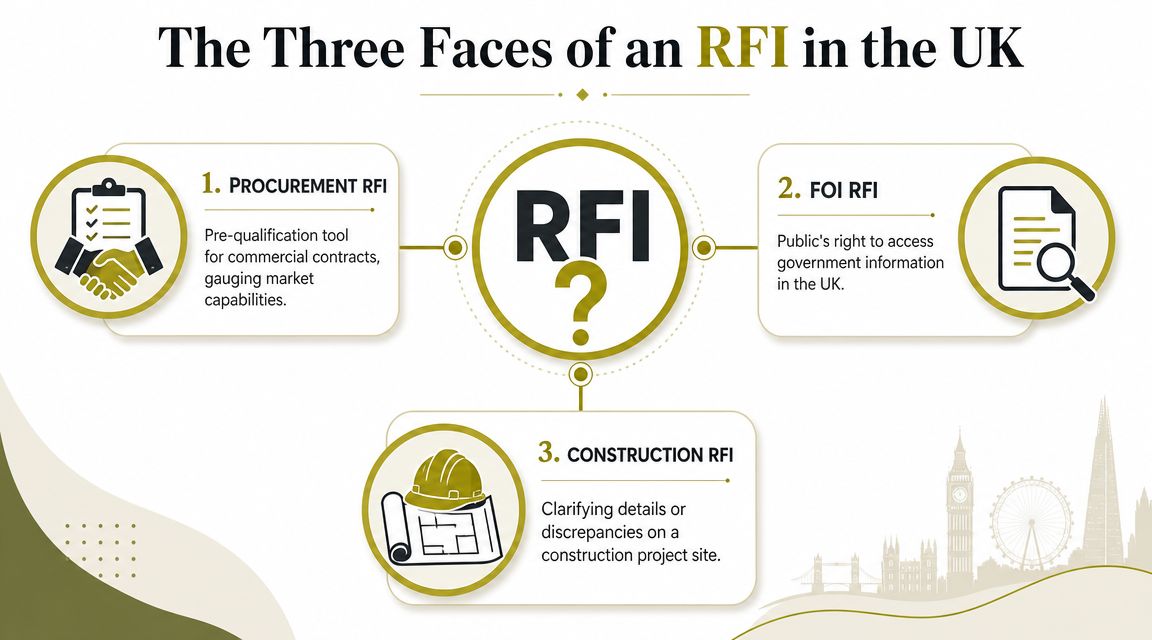
An RFI is best understood as a label used for three different tools. The easiest analogy is this. They all ask questions, but they don't ask for the same reason.
One is exploratory. One is rights-based. One is operational.
Procurement RFI
In procurement, an RFI is an early-stage market engagement tool. A buyer uses it before a formal tender to understand supplier capability, test whether the market can deliver, and tighten up requirements. It isn't usually the point where a contract is awarded. It's the point where buyers work out what good looks like and who appears credible.
For an SME, that changes the approach. You're not trying to submit a full proposal. You're trying to show relevance, clarity and maturity without giving away everything too early.
FOI request
In the UK, “request for information” often means a Freedom of Information request made to a public authority. This is a different category entirely. It isn't about pitching for work. It's about access to recorded information held by bodies covered by the law.
That distinction catches people out because the phrase sounds informal. The process isn't.
Construction or project RFI
On a live project, especially in construction and capital works, an RFI is a formal clarification mechanism. Someone has found a gap, inconsistency or ambiguity in drawings, specifications or scope documents and needs a written answer that can be tracked.
This type of RFI exists to stop confusion turning into rework, delay or dispute.
A good project RFI asks for the missing piece of information. It doesn't ask the other side to redesign the whole job.
The key difference
Here's the shortest useful framework:
| Type | Main purpose | What the sender wants | What matters most |
|---|---|---|---|
| Procurement RFI | Market engagement | Capability and approach | Positioning and relevance |
| FOI request | Access to records | Information held by a public body | Compliance and wording |
| Construction RFI | Delivery clarification | A specific project answer | Precision and traceability |
If you remember only one thing, make it this. The same term can signal a sales opportunity, a public-records process, or a project-control document. Your response should change accordingly.
The Procurement RFI Your First Step to a Major Contract
The commercial version is the one most SMEs know, and it's also the one many underestimate.
A buyer issues an RFI before a formal tender because they don't yet want final pricing or a full bid. They want to understand the market. In UK procurement, that early-stage engagement is used to gather supplier information and refine requirements before competition starts, as outlined in AcqNotes' explanation of request for information practice.

How buyers actually read these
Buyers usually aren't searching for polished marketing copy. They're looking for signs that you understand the problem, can deliver within real-world constraints, and won't become a risk later.
That means a strong RFI response does a few things well:
- Answers the question asked rather than the question you wish had been asked.
- Shows comparable capability without padding the response with generic claims.
- Uses plain language so a non-technical evaluator can follow it.
- Protects sensitive detail where disclosure would weaken your position later.
I've seen SMEs lose ground by treating an RFI like a brochure. Long company histories, vague claims about excellence, and repeated use of “advanced” don't help much. Buyers want a usable picture of fit.
A better way to frame your response
A practical procurement RFI response often works best in four blocks:
Who you are
Brief and relevant. Sector fit, delivery model, footprint, and the capability that matches the requirement.What you can do
Focus on the service or product area the buyer is testing. Keep it concrete.Where the risks are
In this context, smaller suppliers can stand out. If the specification looks unrealistic or incomplete, say so carefully and explain why.What the buyer should consider next
Suggest decision criteria, implementation issues, or clarification points that will improve the eventual tender.
Commercial insight: The best RFI responses don't just describe capability. They help the buyer write a better procurement.
That's especially useful for SMEs competing with incumbents. Large suppliers often have scale, but smaller firms can be sharper in diagnosis. A concise answer that surfaces delivery realities can make a buyer remember you.
A short explainer on public buying mechanics can help if your team is still learning the process:
What not to give away too early
In this context, judgment matters.
If a buyer asks broad capability questions, don't rush into disclosing proprietary methods, detailed pricing architecture, or material you'd normally reserve for a formal proposal. You want to prove competence, not hand over your playbook.
That balance is part commercial discipline, part communications discipline. The wording matters. So does consistency across procurement responses, website messaging and spokesperson language. For teams that need help aligning those pieces, Carlos Alba Media works across PR, digital content and messaging, which can be relevant when a public-facing brand story and a procurement response need to say the same thing in different formats.
The first impression most firms overlook
An RFI is often the first document a buyer reads from you. Before the pitch. Before the tender. Before the meeting.
So treat it like a strategic communication, not an admin task. If the answer is thin, sloppy or evasive, that impression sticks. If it's clear, commercially aware and easy to evaluate, you've already moved closer to the shortlist.
FOI and Construction RFIs Rights and Requirements
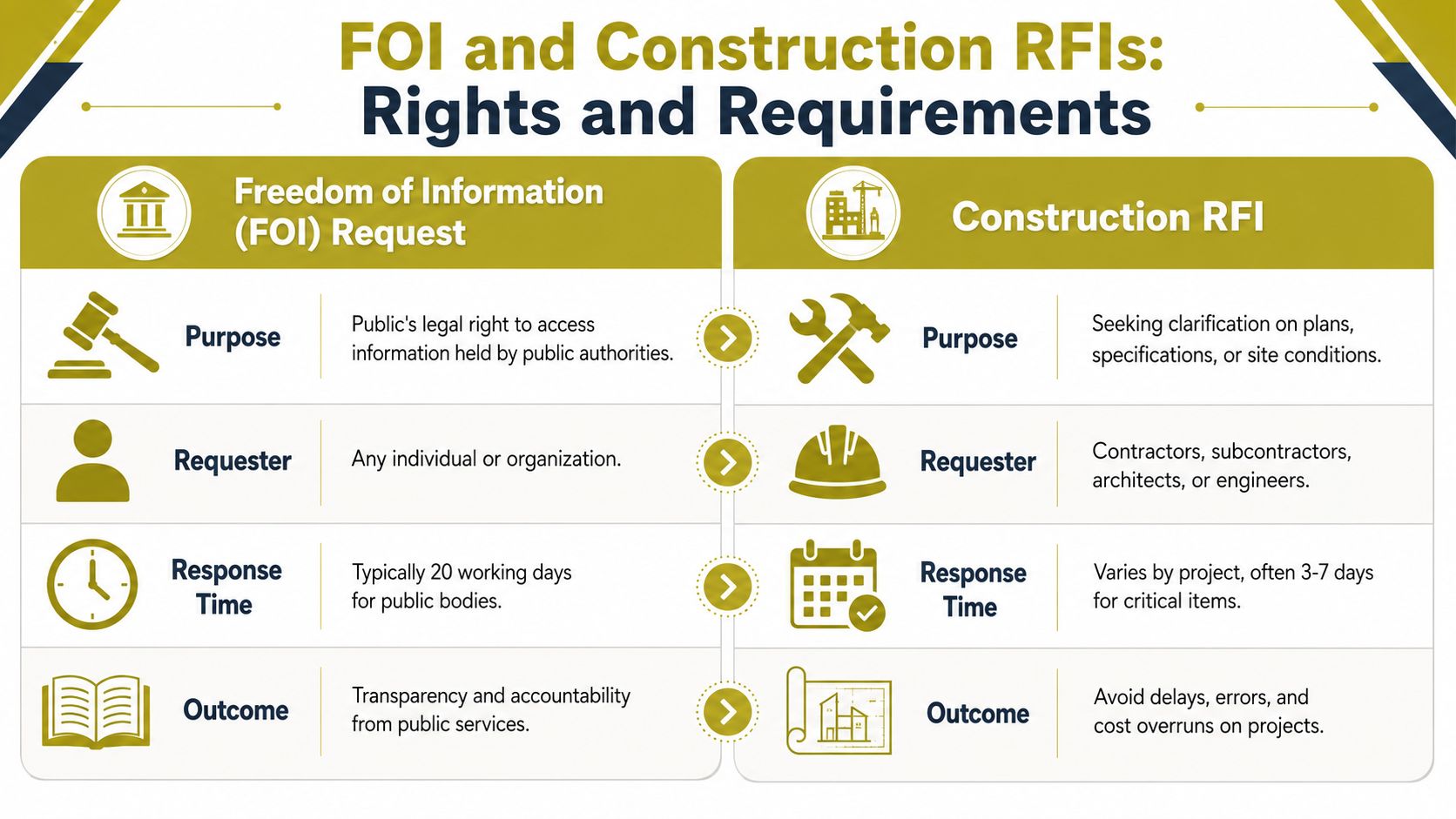
These two categories get conflated because they share the same label. In practice, they behave very differently.
One sits in public law. The other sits in project delivery and contract administration.
Freedom of Information in practice
Under the UK's Freedom of Information Act 2000, which came into force for public authorities on 1 January 2005, anyone can make a request for information, and authorities should normally respond within 20 working days, according to the UK government's FOI guidance and statistics. The same source notes that central government bodies receive more than 50,000 requests a year, which tells you this isn't a niche process. It's routine.
For journalists, campaigners, researchers and businesses, FOI is a way to obtain recorded information that isn't already published. For organisations that may be caught up in an FOI-driven story, the implications are reputational as much as procedural.
If you're new to the process, this guide on how to make a Freedom of Information request gives a practical overview of how the wording and scope of a request can affect the result.
Why comms teams should care
Former journalists tend to recognise the pattern quickly. A records request is rarely just about the file itself. It often sits inside a wider question someone is trying to answer.
That's why poorly handled FOI-related communications can become a story of their own. Delays, inconsistent statements, and casual language in email chains all create avoidable problems.
A sensible approach includes:
- Checking what has been requested rather than reacting to assumptions.
- Separating fact-finding from message handling so the response is accurate.
- Preparing a holding line if the issue could attract media, stakeholder or political interest.
When an FOI issue turns sensitive, the record and the narrative start interacting. You need control of both.
Construction RFIs on live jobs
A construction RFI is much narrower. It exists to close an information gap in drawings, specifications or scope. Good practice is specific, written and time-bounded. The point is to resolve uncertainty before teams build, order, install or sign off the wrong thing.
The risk with this type isn't public scrutiny. It's operational drift.
A weak construction RFI usually has one of two flaws. It's too broad to answer properly, or it lacks enough context for the design team or client representative to make a decision. Both problems slow jobs down.
What a useful project RFI looks like
| Element | Good practice |
|---|---|
| Subject | Names the exact drawing, area, package or clause |
| Question | Asks for one clear clarification |
| Context | Notes the conflict, omission or ambiguity |
| Impact | States the programme or cost consequence if unresolved |
| Response need | Gives a realistic deadline linked to site activity |
That's why experienced project teams keep RFIs narrow. One issue, one answer, one record. It's easier to track, easier to close, and much easier to rely on later if there's disagreement about what was decided.
RFI vs RFP vs RFQ Navigating the Procurement Alphabet Soup
If you sell into larger organisations, these acronyms can blur together fast. They shouldn't, because each one signals a different stage in the buying journey and a different ask from you.
The quickest way to separate them is to focus on the buyer's intent.
- RFI means “tell us about the market and your capability”.
- RFP means “show us your proposed solution”.
- RFQ means “give us your price for a defined requirement”.
That sounds neat on paper. In reality, documents often overlap. A buyer may call something an RFI while asking proposal-like questions. Another may issue an RFQ that still requires supporting method statements. So read the content, not just the acronym.
RFI vs RFP vs RFQ at a Glance
| Document | Purpose | When It's Used | What You Provide |
|---|---|---|---|
| RFI | Gather information and test market capability | Early, before formal competition is fixed | Company fit, experience, delivery approach, high-level input |
| RFP | Seek a proposed solution | When the buyer wants ideas, method and structure | Detailed proposal, solution design, implementation approach |
| RFQ | Obtain pricing for a defined requirement | Later, when scope is clearer | Price, commercial terms, and any required confirmations |
Where firms waste time
The most common mistake is over-answering an RFI. Teams pour days into detailed solution design when the buyer only wants a capability scan.
The second mistake is under-answering an RFP because they still think they're in “early engagement” mode. By that point, the buyer usually expects a worked-through answer, not broad claims.
Construction teams already live with a stricter version of this distinction. There, an RFI is a clarification tool used to close information gaps in drawings or specifications so teams can avoid rework and delays, as described in Construction Coverage's glossary of project RFIs. That same discipline helps in commercial procurement too. Answer the actual gap. Don't flood the process with material no one asked for.
If the buyer asks for information, don't send a proposal. If they ask for a proposal, don't send a brochure.
A useful external primer on understanding RFI RFQ RFP can help sales teams train junior staff who are new to public and enterprise buying cycles.
And if your challenge is less about procurement mechanics and more about who should represent the business in front of buyers, stakeholders and the media, this guide on how to choose a PR agency is worth reading before the next high-stakes pitch or tender process.
RFI Best Practices for UK SMEs and Spokespeople
The firms that handle RFIs well don't treat them as paperwork. They treat them as signals. Someone wants clarity, evidence or reassurance. Your job is to answer that need without creating new risk.
That matters even more now. The UK's Procurement Act 2023 affects around £385 billion a year of public procurement and is intended to make participation easier for SMEs, according to the Inventive overview of RFIs in the new procurement landscape. In practice, that makes pre-tender engagement more important, because early interactions can shape whether a smaller supplier gets into the competitive pipeline at all.
The operating habits that help
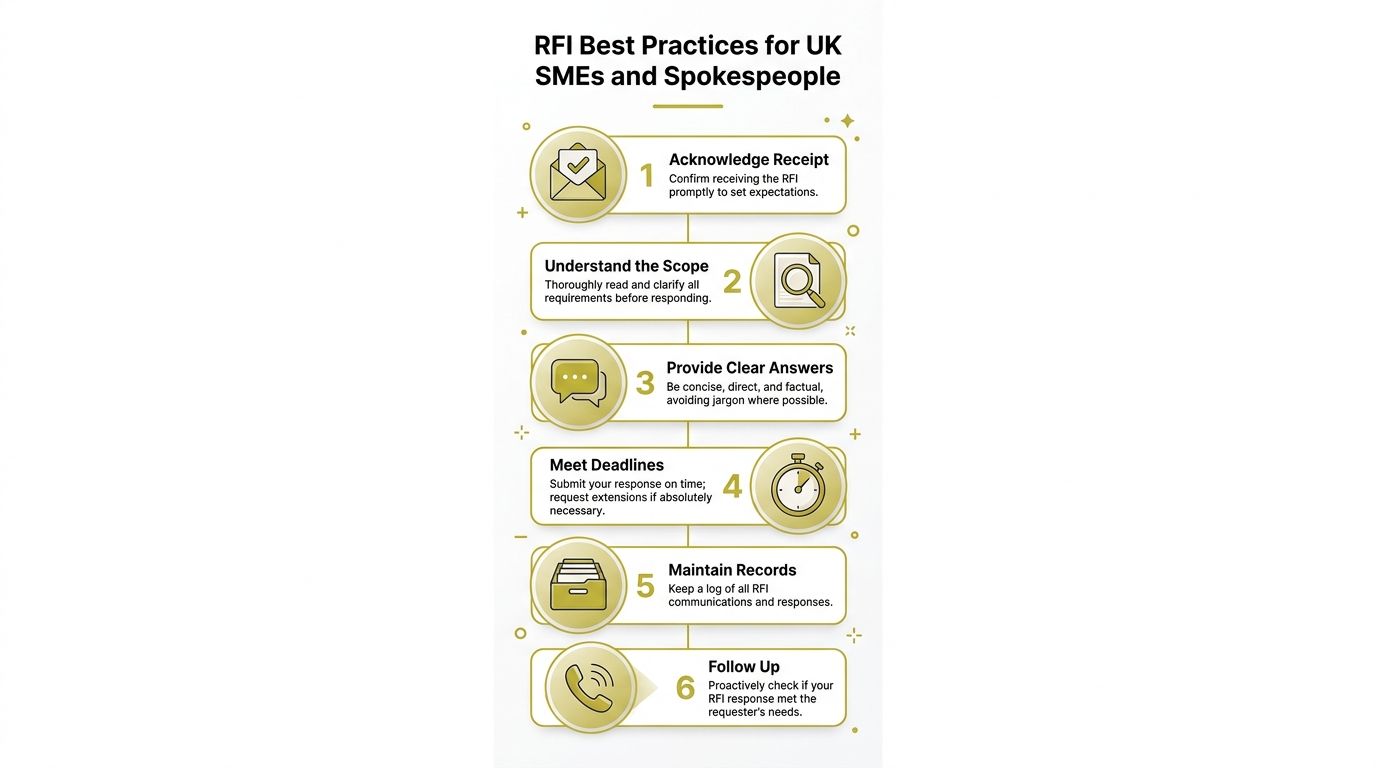
- Acknowledge quickly. A short confirmation buys time and shows control.
- Classify before responding. Procurement, FOI, and project RFIs need different owners and different tone.
- Answer narrowly. Stick to the information requested unless there's a good reason to add context.
- Keep a record. Save the request, your draft, your final response, and any follow-up.
- Escalate sensitive issues early. If reputational, legal or contractual risk is obvious, don't leave it with the most junior person available.
What spokespeople should avoid
Founders often want to be helpful. That instinct is useful, but it can become risky when a request touches sensitive topics.
Don't improvise around an FOI-related issue. Don't over-disclose in a procurement RFI to look open. Don't answer a project clarification verbally if the contract process expects a written record.
A better discipline is simple:
- Identify the purpose.
- Decide the response owner.
- Match the wording to the consequence.
The strongest RFI response is usually the clearest one, not the longest one.
For founders and senior spokespeople, media handling is part of this. If a records issue, procurement process or operational dispute could end up in front of journalists, interview preparation matters. Media coaching can help leaders answer difficult questions without sounding defensive or speculative, and this guide on what media training is explains what that preparation typically involves.
The practical takeaway is straightforward. If you're asking what is a request for information, don't stop at the definition. Work out which system you're in, what duty or opportunity it creates, and what a good response looks like in that setting. That's where SMEs protect margin, avoid noise and put themselves in a stronger position.
If your business needs help handling procurement messaging, FOI-related media risk, or spokesperson preparation around sensitive requests, Carlos Alba Media supports SMEs and established organisations with senior-level PR, digital communications and media training grounded in newsroom and agency experience.