
Posting more often isn't a social media strategy. Neither is chasing a viral clip and hoping attention turns into sales. Strong social campaigns work because someone has made a series of editorial decisions before the first post goes live: whose problem matters, what story will earn attention, which platform is best suited to it, what action should follow and how the team will recognise meaningful progress.
The most useful social media marketing examples are therefore not polished posts presented as magic tricks. They're repeatable systems. Each example below examines the audience problem, creative mechanism, platform role, measurement model, earned-media potential and operational risk. Some are built for reputation, some for discovery, some for advocacy and some for conversion.
That discipline matters in the UK, where social platforms are now a major route to audiences. Ofcom reporting cited by the BBC's coverage of UK media use says 89% of adult internet users use at least one social platform, rising to 97% among 16 to 34-year-olds. Adults also spent an average of four hours and 30 minutes online each day in 2025, creating substantial opportunities across feeds, video and messaging.
Carlos Alba Media brings a relevant combination of newsroom judgement and agency execution. Everyone who works for the consultancy is either a former national news journalist or has agency experience working with international brands. That background supports sharper narrative development, platform strategy, media amplification and measurable growth, without removing the practical constraints smaller teams face.
1. Real-Time Crisis Narrative Control With the Newsroom Approach
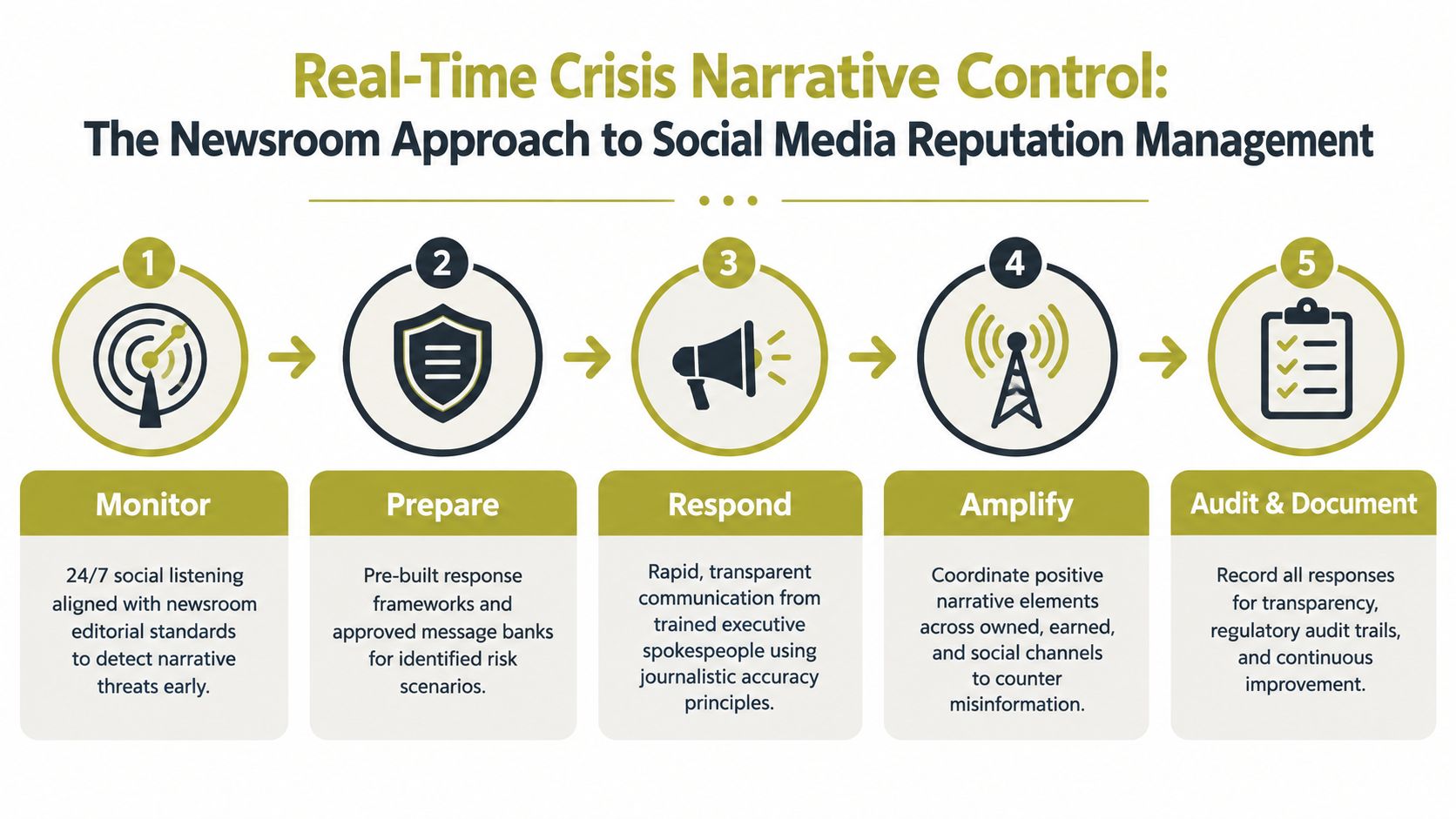
A crisis rarely begins with a complete set of facts. It begins with a post, a complaint, a leaked document or a journalist's question, then develops across several channels at once. A newsroom-trained response treats that uncertainty as an editorial problem: establish what's verified, identify what the public needs to know and publish a clear update before speculation fills the gap.
A FTSE-listed company facing supply-chain disruption might need one narrative adapted across several markets. A regulated financial services firm responding to a regulatory inquiry needs transparency without prejudicing a process. A Scottish technology business dealing with workplace-culture concerns needs leadership communication that sounds human, not lawyered into silence.
The platform role is immediate reassurance and correction, not self-promotion. Listening should cover brand accounts, executive accounts, relevant keywords and credible third-party discussion. Measurement should include response time, factual corrections, sentiment, media queries and whether stakeholders find the official information they need.
Practical rule: A fast response is useful only when the approval route is faster than the rumour cycle.
Build a map of credible accounts, prepare message banks around organisational values and document every response for audit purposes. Train senior spokespeople in broadcast-standard communication, because an off-the-cuff video can escalate a story. A senior professional with newsroom experience should lead the narrative, while legal and compliance colleagues retain appropriate control. Carlos Alba Media's crisis communication management service reflects that need for rapid, governed support.
2. Data-Driven Social ROI Attribution
Likes and comments can reveal interest, but they don't automatically prove commercial value. An agency-standard measurement system connects social activity to web behaviour, enquiries, customer records and sales outcomes. It starts basic, then becomes more refined as the business learns which journeys matter.
An online retailer may compare product-led Instagram posts with educational TikTok content. A software company could connect LinkedIn thought leadership to booked demonstrations, while a tourism operator might distinguish first-touch discovery from retargeting-assisted bookings. These are not claims of guaranteed performance. They're useful ways to frame the question, which is whether a particular social activity helped the business reach a defined outcome.
Start with UTMs on every social link, consistent campaign naming and landing pages that match the promise in the post. Set a baseline before judging creative. A monthly report can show movement, while a deeper quarterly review can examine seasonality, competitor activity, brand search and changes in the sales pipeline.
The UK market gives this work commercial context. The UK digital advertising figures reported by The Guardian put social media advertising spend at £9.02 billion in 2025, up 13.8% year on year. Total digital advertising investment reached £38.07 billion, representing more than 80% of total ad spend, while influencer investment reached £930 million, up 13.6%. Those figures show why budget holders increasingly expect evidence beyond reach.
3. Thought Leadership Serialization
An executive's useful opinion shouldn't disappear after one conference panel or a fleeting interview. Serialization turns a substantial conversation into a planned sequence of posts, short videos, responses, commentary and media opportunities. The creative mechanism is not volume. It's the consistent development of a recognisable point of view.
A Scottish fintech founder might explain one open-banking challenge through several LinkedIn posts, then answer common questions in a recorded video. A hospitality chief executive could discuss recruitment pressures without turning every post into a vacancy advert. A cybersecurity leader might respond to a regulatory change with a practical explanation for customers and journalists.
LinkedIn often suits B2B expertise, while Instagram or TikTok may better suit a consumer-facing founder whose knowledge can be demonstrated visually. The same underlying opinion can travel across platforms, but it shouldn't be copied and pasted. Each version needs its own opening, length, visual treatment and audience invitation.
The measurement model should include meaningful comments, profile visits, direct enquiries, speaking invitations, journalist requests and assisted conversions. Follower growth alone says little about authority. The risk is executive fatigue, corporate language or opinions that haven't been checked for accuracy.
Build an editorial capture habit
Schedule regular insight sessions with senior people. Use journalistic interviewing to find a genuine argument, a useful example or a timely observation, rather than asking for generic “thought leadership”. Tie the calendar to industry events, policy developments and customer questions.
A leader also needs to engage personally. Automated replies and empty agreement weaken credibility. Carlos Alba Media's thought leadership content strategy is relevant where a founder needs a practical editorial process rather than occasional ghost-written announcements.
4. Earned Media Amplification
Social engagement can become a useful news signal, but it isn't automatically news. A journalist still needs relevance, consequence, human interest, conflict, novelty or a strong public-interest angle. The best campaigns prepare for that second life from the start.
A tourism organisation might build a visual campaign around an overlooked local experience, then present the audience response to travel desks as evidence that the idea has wider interest. An SME sustainability project could provide a case study for a business reporter if it reveals a meaningful industry tension. A Scottish technology company's recruitment content might interest regional radio when it illustrates a broader skills issue.
One verified UK example comes from WPR's published case studies. Its work for Wilo reported a 5,915% year-on-year engagement increase, while an NHS Birmingham and Solihull training programme reported a 112.6% uplift in LinkedIn impressions. The same WPR social media case-study page reports an Instagram reach increase of 420% for Alton Towers Resort and a trades campaign that delivered a cost per lead 22% below target. These results belong to the specific campaigns described, not to social media marketing as a universal promise.
Monitor responses daily, identify the strongest story angles and keep spokespeople ready for interviews. Record coverage promptly, then repurpose it across the website, email, social channels and sales materials. Measurement should connect earned coverage to referral traffic, branded search, enquiries and the quality of new conversations, not just headline impressions.
5. Platform-Specific Narrative Adaptation
A single campaign idea can travel across platforms, but a single execution usually shouldn't. LinkedIn users may expect a considered industry argument, Instagram audiences may respond to visual detail and TikTok viewers may prefer demonstration, humour or an immediate answer. Treating every channel as a distribution pipe wastes the distinctive strengths of each one.
A B2B software company could use LinkedIn for a detailed customer problem, Instagram for workplace culture and TikTok for a short product explanation. A hospitality business might show design and food on Instagram, behind-the-scenes service on TikTok and employment opportunities on LinkedIn. A financial firm needs compliance-approved commentary on LinkedIn, timely market observations on X and carefully framed inclusion stories on Instagram.
The editorial discipline sits underneath the formats. Facts, tone and brand position should remain consistent, while the hook, pacing, caption and call to action change. Platform-specific subject experts can help, because competence in LinkedIn conversation doesn't guarantee fluency in TikTok storytelling.
Design for discovery, not only distribution
Search behaviour makes this particularly important in the UK. Ofcom-linked reporting cited by UK social media trends research from Deftsoft says 43% of UK consumers use social platforms to search online at least once a day, while 34% use video-sharing platforms such as TikTok to search daily. A separate survey cited there found 41% now turn to social first when looking for information online.
That creates a practical opportunity for SMEs. Write captions, titles, FAQs and spoken scripts around real buyer questions. Test format, timing and wording, then use platform analytics to identify which themes earn saves, useful comments, profile visits and enquiries. The trade-off is operational complexity. If a team can't maintain three channels properly, one well-run platform is better than thin cross-posting everywhere.
6. Community-Driven Advocacy Programmes
Customers, employees and partners can provide a level of credibility that polished advertising often struggles to create. The system begins by identifying people who already share useful experiences, then gives them prompts and support without forcing them into identical brand language.
A software company might invite customer success managers to explain implementation lessons. A hotel could encourage guests to share practical details about accessibility, food or local experiences. A Scottish technology firm might help employees discuss their work in their own voices. A professional services firm could turn client conversations into approved testimonial videos, provided consent and confidentiality are handled properly.
The channel choice depends on the advocate. Employees may be most effective on LinkedIn, customers may share visual experiences on Instagram and product users may create demonstrations on TikTok. The brand account's role is to notice, respond, credit and curate, not to dominate every story.
Authenticity needs boundaries. Give contributors clear guidance on disclosure, privacy, accuracy and brand safety, then leave room for a real voice.
Track referral sources, assisted conversions, sentiment and the quality of leads generated by advocacy. Don't confuse a large volume of reposts with trust. A single detailed customer explanation may be more useful to a buyer than a burst of low-context exposure.
Make participation easy with prompts, templates and examples. Recognise contributors publicly, develop strong stories into case studies and train staff before asking them to represent the organisation. Carlos Alba Media's user-generated content campaigns approach fits businesses that want community participation without treating customers as unpaid production staff.
7. Strategic Partnership Amplification
A partnership works when two organisations share a relevant audience, a credible reason to collaborate and enough responsibility to execute properly. Tagging another brand rarely creates meaningful co-marketing. The strongest systems combine complementary expertise, shared content and a clear next action.
A destination marketing organisation could work with hotels, attractions and transport providers on a seasonal guide. A technology SME might partner with a complementary software company for an educational webinar. An enterprise organisation could collaborate with incubators and investors on founder-focused content. A consumer brand might co-create a series with a lifestyle creator whose audience aligns with the product.
Each partner should have a distinct role. One may provide research, another a customer story and another distribution. LinkedIn can support the detailed professional argument, Instagram can carry visual inspiration and TikTok can show the experience in action. The shared narrative needs one owner, otherwise approvals become slow and inconsistent.
Agree the operating model before launch
Start with a low-risk format such as a webinar, joint guide or interview. Put content ownership, approvals, usage rights, deadlines, disclosures and measurement in writing. Two or three well-matched candidates are more useful than a long list of loosely connected names.
Track registrations, qualified enquiries, referral traffic, content completion and subsequent sales conversations. Review results with the partner instead of assuming exposure equals success. The main risks are audience mismatch, unequal effort and reputational spillover. A partner's poor response to a complaint can become your problem too, so due diligence matters.
Promote the collaboration across all relevant channels. Audiences won't necessarily understand why the partnership exists unless the content makes the shared value obvious.
8. Micro-Moment Responsive Content
Real-time content is not the same as posting about every trending topic. News judgement matters. A brand should respond when the subject affects its audience, connects credibly to its expertise and offers something more useful than a late attempt at humour.
A financial services firm might explain a breaking economic announcement in plain English. A Scottish tourism operator could respond to a travel trend with practical destination information. A technology company may help customers understand a new compliance development. A hospitality business could provide relevant advice during a seasonal moment, provided the tone doesn't trivialise serious events.
X and LinkedIn may suit fast commentary, while TikTok or Instagram can explain a trend through video. The creative mechanism is context plus speed. The measurement should look at qualified conversation, profile visits, media interest, website activity and sentiment, rather than treating every impression as a win.
Govern speed without removing judgement
Create clear editorial boundaries, an approval route for low-risk topics and a library of verified facts, visuals and spokesperson lines. Monitor industry publications, social channels and news platforms, but don't ask a small team to respond continuously without a rota.
Draft, check context and publish only when the response adds value. Document what happened, including mistakes. If a post misfires, the backoff plan should cover correction, apology and escalation. A rapid deletion without explanation can make a minor error appear deliberate.
The newsroom perspective is useful because it distinguishes a genuine public-interest moment from a manufactured brand opportunity. Timing matters, but relevance protects credibility.
9. Content Hub Strategy
Social platforms are useful discovery channels, but they're rented spaces. A content hub, such as a website, resource centre or email newsletter, gives the organisation somewhere to explain, capture permission and build a relationship beyond an algorithmic feed.
A B2B technology firm might publish an answer to a recurring buyer question, then use LinkedIn posts and short videos to distribute different entry points. A Scottish hospitality group could develop destination guides, itineraries and seasonal advice. A professional services firm might turn executive commentary into searchable articles, then invite readers to subscribe for practical updates.
The social post shouldn't reproduce the entire article every time. It should make the value of the deeper resource clear, while still being useful on-platform. Searchable captions, descriptive headlines and accessible video transcripts can help people discover the material when they're actively looking for answers.
Connect attention to a permissioned audience
Set content pillars around customer questions and business outcomes. Use UTMs on every hub-driving link, make pages easy to use on mobile and offer a relevant reason to subscribe. A newsletter can deepen trust, but over-communication causes unsubscribes and list decay.
Measurement should follow the journey from social discovery to page engagement, email sign-up, return visit, enquiry and sale. The trade-off is slower production and greater editorial responsibility. An owned hub needs accurate information, maintenance and a clear publishing standard. Its advantage is durability. Evergreen content can continue answering questions after an individual post disappears from the feed.
Search and social should support one another, not operate as separate publishing departments.
10. Influencer Partnerships With Editorial Rigor
Influencer marketing becomes less risky when follower count stops being the main selection criterion. The relevant questions are whether the creator has a credible relationship with the audience, whether that audience matches the brief, whether previous content indicates sound judgement and whether the partnership can be measured.
A hospitality business might prefer several local creators with strong destination credibility over one famous account with little connection to the area. A technology SME could work with an industry analyst or practitioner whose expertise matters to buyers. A tourism organisation should check whether travel content reflects genuine experience rather than accepting a polished audience profile at face value.
The campaign may run across Instagram and TikTok, but each deliverable needs a role. One video can create discovery, a saved guide can support consideration and a tracked landing page can capture action. Contracts should specify deliverables, disclosure, usage rights, approval, exclusivity and what happens if the creator misses a deadline.
The UK market shows why this requires judgement. Influencer investment reached £930 million in 2025, according to The Guardian's UK advertising report, but spend alone doesn't establish suitability for a particular brand. Public-sector use of creators, described in Sprout Social's UK trends analysis, also points to a more useful question than whether every organisation should use influencers. The question is when creator-led activity suits trust, compliance and reach objectives.
Audit audience geography, engagement quality, historic partnerships and unusual follower growth. Use unique codes or landing pages, test a small partnership first and keep records of every deliverable. The main risks are undisclosed commercial relationships, audience fraud, brand-safety problems and creative that attracts attention without moving a business outcome.
10-Point Social Media Marketing Strategy Comparison
| Strategy | 🔄 Implementation complexity | Resources required | ⚡ Speed / responsiveness | 📊 Expected outcomes (impact) | 💡 Ideal use cases / tip |
|---|---|---|---|---|---|
| Real-Time Crisis Narrative Control: The Newsroom Approach to Social Media Reputation Management | Very high, 24/7 monitoring, senior-led protocols, editorial approvals | Dedicated senior team, newsroom-trained staff, monitoring tools, pre-prepared response banks | Extremely fast response required; real-time operations | ⭐⭐⭐⭐, preserves credibility, reduces misinformation, protects reputation | Regulated sectors (finance, healthcare), large brands; assign senior newsroom lead |
| Data-Driven Social ROI Attribution: Agency-Standard Performance Measurement | High, multi-touch models, cross-system integration, continuous refinement | Analytics platform, CRM/GA4 integration, trained analysts, historical data | Slow to implement, steady weekly/monthly reporting cadence | ⭐⭐⭐⭐, direct revenue attribution, budget justification, informed reallocation | E‑commerce, SaaS, retail; start with UTM discipline and 8–12 week baselines |
| Thought Leadership Serialization: Converting Executive Commentary Into Social Assets | Medium, recurring editorial process, strict oversight, exec time commitment | Journalists for interviews, media training, content production resources | Slow build (6–12 months) for meaningful impact | ⭐⭐⭐, builds authority, attracts media and leads, long-term reputation lift | B2B tech, finance, professional services; start on one platform and capture monthly insights |
| Earned Media Amplification: Converting Social Engagement Into Mainstream Coverage | Medium-high, fast packaging of social hooks into journalist pitches | PR contacts, real-time monitoring, pitch templates, rapid executive availability | Time-sensitive; must act quickly when momentum exists | ⭐⭐⭐⭐, 10–50x reach multiplier, third‑party credibility, SEO/backlink benefits | Consumer campaigns, tourism, sustainability; brief media contacts proactively |
| Platform-Specific Narrative Adaptation: Journalistic Story Discipline Applied to Social Channels | High, bespoke formats and calendars per platform | Platform specialists, larger content production, editorial governance | Variable, ongoing optimization required after testing | ⭐⭐⭐⭐, higher engagement, better organic reach, reduced audience attrition | Multi-audience brands (consumer tech, hospitality); avoid simple cross-posting |
| Community-Driven Advocacy Programs: Converting Customers Into Authentic Social Advocates | Medium, program design, ongoing nurture and quality control | Community managers, simple UGC toolkits, recognition programs, legal guidelines | Slow-to-medium growth; sustained cultivation needed | ⭐⭐⭐⭐, high trust, low content cost, repeatable authentic assets | SaaS, hospitality, consumer products; start with existing advocates and simple prompts |
| Strategic Partnership Amplification: Leveraging Co‑Marketing for Exponential Social Reach | Medium, partner mapping, governance, coordinated calendars | Partner management, shared budgets, joint content production | Medium, planning cycles then amplified execution | ⭐⭐⭐, expanded reach, cost-sharing, new audience acquisition | Tourism, tech, associations; formal agreements and clear ownership recommended |
| Micro-Moment Responsive Content: Real-Time Social Engagement Aligned With News Cycles | Medium-high, constant monitoring, rapid approvals, editorial judgment | Trained social team, asset library, approval framework, trend monitoring tools | Extremely fast, real-time monitoring and publishing | ⭐⭐⭐, engagement spikes, brand agility, earned media potential | Consumer brands, media-adjacent sectors; set clear editorial boundaries and backoff plans |
| Content Hub Strategy: Building Social Discovery Through Owned Media Infrastructure | High, sustained publishing, SEO and technical maintenance | Editorial team, website/email infrastructure, analytics, lead magnets | Slow, long-term audience migration and list growth | ⭐⭐⭐⭐, owned audience, reduced platform dependency, measurable revenue | B2B, publishing, e‑commerce; design for mobile discovery and use UTMs for tracking |
| Influencer Partnership With Editorial Rigor: Agency-Standard Vetting and Performance Management | Medium-high, rigorous vetting, contractual performance clauses | Vetting tools, legal/contracts, measurement/tracking, creative briefs | Medium, relationship build then campaign cadence | ⭐⭐⭐, niche reach, authentic recommendations, measurable conversions if well-vetted | Consumer products, beauty, hospitality; use audience-analysis tools and performance contracts |
Turn the Examples Into Your Next Campaign System
The ten examples point to a common principle. Social performance improves when a team makes deliberate choices before it starts producing content. Define the audience problem, choose a business outcome, select the platform that can carry the story and build a route from attention to action.
Start with one system, not a collection of tactics. If reputation is the priority, use the crisis narrative model and establish monitoring, approvals and spokesperson readiness. If the business needs discoverability, adapt the content hub or platform-specific search model. If trust is the barrier, consider thought leadership or customer advocacy. If the organisation already has strong expertise but limited reach, partnership amplification or earned-media development may be more suitable than another paid campaign.
The first practical step is a baseline. Record the current level of relevant website activity, enquiries, qualified conversations, sentiment or media interest before publishing the new campaign. Don't choose a national engagement-rate target only because a vendor presents it as a universal standard. Independent benchmark commentary from the Comscore State of Social 2025 UK Edition focuses on consumption and comparisons across brands, media and influencers, while UK benchmark analysis warns that there's no verified national engagement-rate benchmark. A “good” rate depends on the sample, platform, audience and objective.
Next, adapt the template to the resources available. A small team can run a single LinkedIn series, one monthly founder interview, a customer question bank or a focused local partnership. It doesn't need a complicated dashboard at the beginning. Consistent UTMs, clear conversion points, a simple content calendar and a named owner will produce better learning than an elaborate system nobody maintains.
Review the creative as an editor would. Is the opening relevant now? Does the post answer a real question? Can a reader tell who is speaking and why they should care? Does the platform execution feel native? Does the story contain a defensible fact, a useful observation or a human consequence? These checks protect a campaign from becoming polished but empty.
Then test one variable at a time where possible. Compare two openings, formats or calls to action, but avoid declaring a winner from a single post. Consider seasonality, news events, paid support, audience composition and sales-cycle length before attributing an outcome to social alone. Report both what worked and what failed, because an unsuccessful creative test can still improve the next decision.
Carlos Alba Media is relevant when the campaign needs more than content production. Its team combines former national newsroom journalists with professionals who have agency experience working with international brands. That mix supports narrative judgement, senior counsel, media contacts, platform-specific content, interview preparation and practical measurement for start-ups, SMEs and established organisations.
The consultancy's specialist nature is also consistent with a recognised UK communications model. Agencies such as Fair Public Relations, Lantern Comitas and The PHA Group publicly position former newsroom and broadcast experience as a specialist capability. That doesn't make every campaign successful, and it shouldn't replace evidence. It does explain why newsroom discipline can matter when a brand needs relevance, timing, credibility and control.
Use Instagram feed inspiration to explore visual approaches, but don't copy surface style without understanding the system beneath it. Choose the audience, story, channel, workflow and measurement model first. Then make the creative fit the decision.
Carlos Alba Media offers social media marketing, digital content, SEO-led strategy, media exposure, spokesperson training and crisis communications for organisations that need credible growth rather than disconnected posting. If you want to turn these social media marketing examples into a governed campaign with clear narrative and measurable outcomes, visit Carlos Alba Media to discuss your next step.