
In the tech world, it's easy to get lost in the code, the product, and the endless cycle of innovation. But what good is a groundbreaking piece of tech if no one knows it exists? This is where public relations comes in. It’s the art of turning your complex creation into a story that resonates—a story that gets investors, customers, and top talent to sit up and take notice.
Good PR isn’t just about getting your name in the press. It’s about building the kind of trust and visibility that underpins genuine, long-term growth. Think of it as the engine that takes your brand from a garage project to an industry authority.
Why PR for Tech Is Your Most Powerful Growth Engine
You’ve poured everything into building a brilliant piece of software or a game-changing device. But a great product alone is rarely enough to cut through the noise. Without a strong narrative, you’re essentially a world-class musician playing to an empty room.
Strategic PR is the promoter who fills that room with the right people. It’s about translating complex technical features into a compelling message that journalists, customers, and investors can actually understand and get excited about. It’s the difference between announcing "we've updated our algorithm" and declaring "we've just made online retail 50% more secure for millions of people." One is a feature; the other is a story.
Building Trust and Credibility
In the tech sector, trust is everything. Customers need to believe your software is reliable, investors need to have faith in your vision, and regulators need to be confident in your processes. PR is one of the most powerful tools for building this trust, primarily through earned media.
When a respected tech journal gives your product a glowing review or a national newspaper profiles your founder, it creates a powerful halo effect. This isn't an advert you've paid for; it's earned authority. It's a credible, third-party endorsement that tells the world that experts see real value in what you’re doing.
This is exactly why a newsroom-led approach gives you such a distinct advantage. At Carlos Alba Media, our specialist nature and expertise come from the fact that everyone who works for us is a former national news journalist or has agency experience working with international brands. We know what makes a story stick because we’ve been on both sides of the pitch.
The PR vs. Marketing Divide
While often grouped together, PR and marketing serve different, though complementary, functions. Marketing focuses on promoting and selling, while PR centres on building reputation and credibility. For a tech company, understanding this distinction is crucial for allocating resources effectively.
PR vs Marketing: A Tech Company's Quick Guide
| Aspect | Public Relations (PR) | Marketing |
|---|---|---|
| Primary Goal | Build trust, credibility, and a positive brand reputation through earned media. | Drive sales and lead generation through paid and owned channels. |
| Key Channels | Media relations (journalists, bloggers), speaking opportunities, analyst relations. | Advertising (PPC, social ads), email campaigns, content marketing (blogs, ebooks). |
| Control | Low control over the final message; the story is told by a third party. | High control over the message, timing, and placement. |
| Audience | Broad: media, investors, public, employees, regulators. | Specific: target customers and defined buyer personas. |
| Measurement | Media mentions, share of voice, sentiment analysis, brand awareness. | Conversion rates, cost per acquisition (CPA), return on ad spend (ROAS). |
| Credibility | High, as the message is validated by a neutral third party (e.g., a journalist). | Lower, as the audience knows it's a paid promotion from the company itself. |
Both are vital for growth, but they achieve it in different ways. Marketing pushes the message out directly, whereas PR works to have others pull that message in and amplify it for you.
Fuelling the Growth Flywheel
Great tech PR doesn't just build your brand in a vacuum; it directly fuels business growth by creating a self-reinforcing cycle of positive outcomes.
- Attracting Investment: Venture capitalists and angel investors are always scanning the media for the next big opportunity. Positive coverage acts as powerful market validation, making your proposition far less risky in their eyes.
- Securing Customers: A strong media presence builds the brand awareness and credibility that makes your sales team’s job infinitely easier. It warms up leads and helps shorten the sales cycle.
- Recruiting Top Talent: The best engineers, developers, and leaders want to join companies that are making a real impact. PR is how you showcase your vision, culture, and success to attract that A-list talent.
With the UK tech market projected to hit £25.4 billion in 2026, the competition is fiercer than ever. In this environment, the value of earned media is soaring; as one study shows, PR Now Drives More Crypto SEO Value Than Backlinks, especially as modern search tools increasingly cite media coverage. For any UK tech SME looking to stand out, a smart PR strategy isn't just an option—it's essential.
Crafting a Tech PR Strategy That Actually Works
Great PR doesn't just happen. It's never a lucky break or a random viral hit; it’s born from a deliberate, well-thought-out plan. Firing off press releases and hoping for the best is a surefire way to burn through your budget with little to show for it. An effective strategy, on the other hand, is the blueprint for building real brand equity and establishing your company as an authority in its field.
So, where do you start? The first step is to get brutally honest about what you're trying to achieve. Are you looking to attract the next round of venture capital? Maybe you need to shorten a lengthy B2B sales cycle, or perhaps you’re struggling to hire top-tier developers. Each goal demands a unique story, a different approach, and specific channels to reach the right people.
This focus on proactive planning has become absolutely essential. Recent industry analysis shows that UK PR professionals now rank strategy and planning as the top area growing in importance over the past two years. In a world grappling with AI and misinformation, a deliberate, strategic approach is what separates the companies that earn national exposure from those that just add to the noise.
The Three Pillars of a Solid Tech PR Strategy
A robust tech PR strategy stands on three core pillars. Think of them as legs of a stool – each is vital, and if one is weak, the whole thing becomes wobbly. They work in tandem to build a reputation that can weather the inevitable storms of the tech world.
Product PR: This is all about making your technology newsworthy. It’s not enough to list features. You have to answer the journalist's (and the customer's) unspoken question: "So what?" Instead of just announcing an AI update, frame it as a solution that tackles a major industry headache, saving businesses thousands of pounds or countless hours.
Corporate PR: This pillar builds the reputation of the business itself, beyond any single product. It’s where you tell the story of your mission, your company culture, and your vision for the future. This is the narrative that convinces investors you have long-term potential and makes the best talent actively seek you out.
Thought Leadership: Here, you elevate your founders, executives, and key experts into trusted industry voices. By offering genuine insight and sharp commentary on market trends, you position your company not just as another player, but as a leader that is actively shaping the conversation.
The Journalist’s Instinct for a Great Story
To bring these pillars to life, you need more than a plan; you need a story. This is where Carlos Alba Media’s specialist nature and expertise make all the difference. Everyone who works for us is a former national news journalist or has agency experience working with international brands.
This background gives us a unique perspective. Our agency side ensures every tactic is tied to a concrete business goal, while our inner journalist knows how to spot and frame a story that a news editor will actually notice. We call it a newsroom-led approach, and it’s all about translating complex tech into compelling narratives that resonate with the media and, ultimately, your audience. You can find out more about how this works in our guide to choosing between technology PR agencies.
This diagram shows how a well-oiled PR machine becomes a powerful growth engine for your entire business.
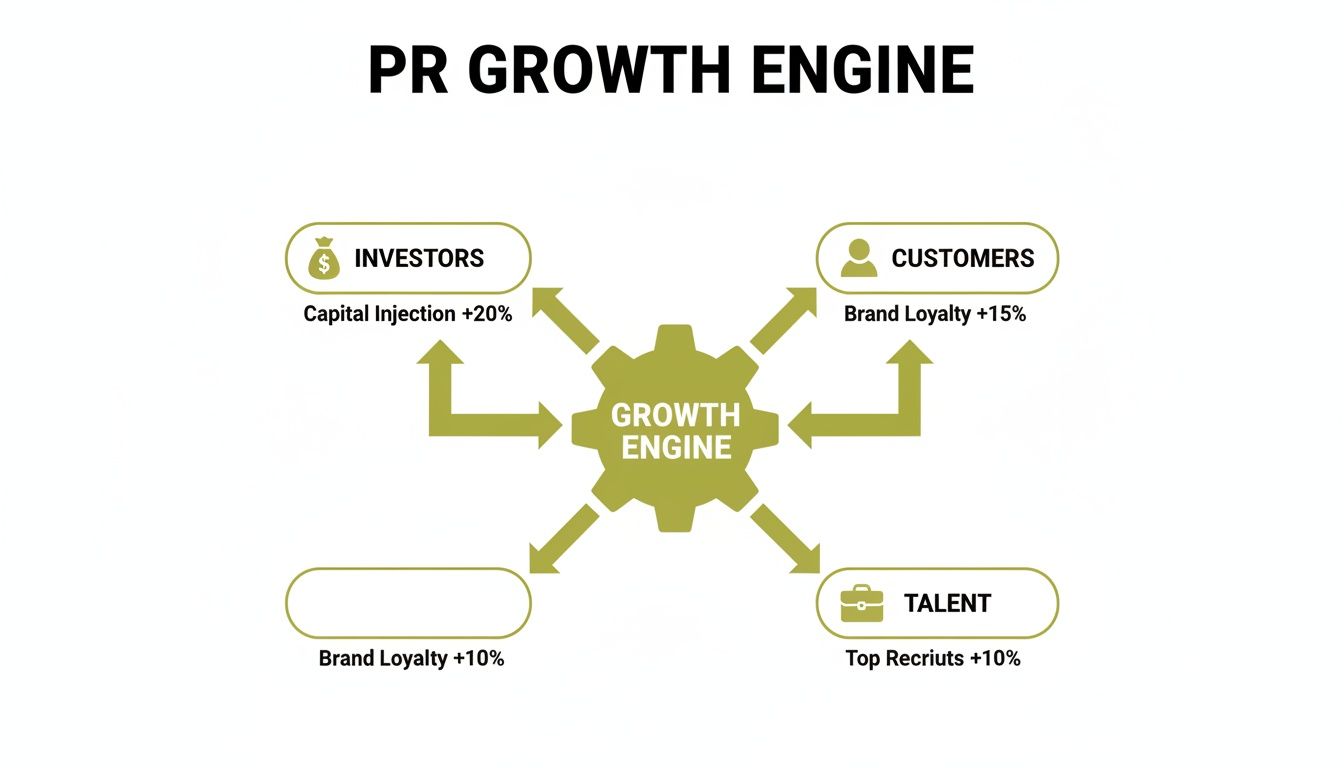
As you can see, a cohesive strategy doesn’t just generate headlines; it directly fuels the core components of business success by attracting capital, winning customers, and drawing in the best people.
When you weave Product PR, Corporate PR, and Thought Leadership together, your company stops just existing in the market and starts actively shaping it. That strategic alignment is what turns a fleeting news item into an enduring industry benchmark.
Getting Your Story Heard By The Right People
You’ve got a killer strategy and a story you’re ready to shout from the rooftops. So, where do you actually tell it? Firing a press release out into the ether and hoping for the best is a fast track to disappointment. The real craft in tech PR isn't just about what you say, but knowing exactly where your audience—be it investors, customers, or future hires—is actually listening.
Think of it this way: you wouldn’t use a sledgehammer to assemble a microchip. Pitching a deep-tech story to a lifestyle magazine is just as misguided. Getting your story in the right place, in front of the right journalist, is every bit as important as the message itself.
Tailoring Your Pitch to the Outlet
Knowing your target media goes far deeper than just recognising a masthead. It's about understanding their world, their pressures, and what makes them tick. A journalist at a national newspaper is swimming in hundreds of emails, scanning for a headline with broad, immediate public appeal. A writer for a niche tech blog, on the other hand, wants the granular detail their expert audience craves.
This is where having an insider's perspective pays dividends. At Carlos Alba Media, our team brings specialist expertise because everyone who works for us is a former national news journalist or has agency experience working with international brands. We’ve lived the newsroom pressure, so we know how to frame a complex tech story to make it utterly irresistible to a busy editor.
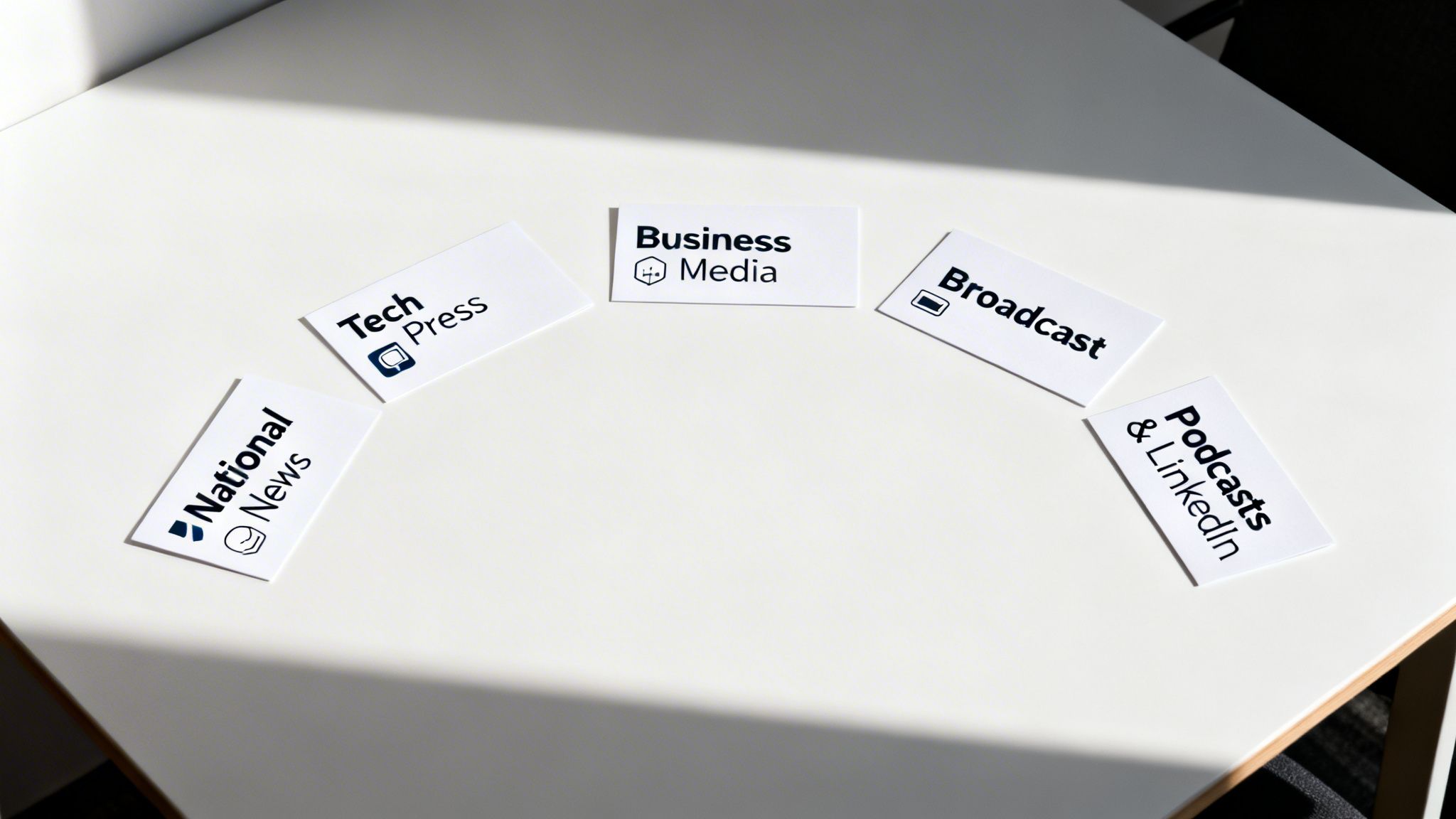
- National News (e.g., The Times, BBC News): Lead with the 'so what?'. How does your tech impact real people, the economy, or a major social trend? Your pitch needs to be concise and hit the human angle hard.
- Specialist Tech Press (e.g., TechCrunch, Wired): Get into the weeds. These journalists are sharp and want to know about your product’s architecture, its market positioning, and why it’s a genuine step forward.
- Business Media (e.g., Financial Times, Forbes): Talk money and markets. Frame your story around investment, market disruption, leadership strategy, or solving a massive commercial headache.
- Broadcast Media (e.g., Sky News, industry podcasts): Make it visual or audibly punchy. You need a charismatic spokesperson, crisp soundbites, or a product demo that looks great on screen.
Finding the Right Channel for Your Story
Today's media offers a fantastic array of channels, each with its own purpose. A smart PR strategy doesn't just pick one; it blends them to create a constant, powerful drumbeat of positive noise around your brand.
While formal announcements still have their place—and writing an effective press release](https://submitmysaas.com/blog/how-to-write-a-press-release) remains a core skill—it's just one tool in a much bigger arsenal.
The goal is to create a media ecosystem around your brand. A feature in the trade press can lead to a podcast invitation, which in turn might catch the eye of a national journalist. Each placement builds on the last, creating powerful momentum.
Let's break down the main playing fields.
Core Media Categories for Tech Companies
| Channel Category | Primary Goal | Example Target |
|---|---|---|
| Top-Tier National News | Build investor confidence and widespread brand credibility. | A feature on BBC News about your company's job creation. |
| Specialist Tech Press | Reach informed buyers and establish technical authority. | A deep-dive product review on a respected industry blog. |
| Business & Vertical Media | Communicate corporate narratives and reach decision-makers. | A CEO profile in a key business publication. |
| Broadcast Media & Podcasts | Achieve broad influence and humanise your brand. | An executive interview on a popular tech podcast. |
| Modern Digital Channels | Engage directly with niche communities and influencers. | A guest post in an influential LinkedIn newsletter. |
By choosing your channels wisely and tailoring your approach for each one, you stop playing PR roulette. Instead, you build a predictable engine for growth, ensuring your story isn't just told, but truly heard by the people who matter most.
Creating Content That Drives Real Results
A great story and the right media contacts are essential, but what are you actually going to give them? In the world of PR for tech, content isn't just about feeding the blog; it's about crafting strategic assets that get people talking and, ultimately, drive the business forward. You have to move beyond run-of-the-mill company updates and create material that delivers a tangible return.
The shift in mindset is crucial. You need to stop thinking like a marketer filling a calendar and start operating like a newsroom. It’s about spotting the story within your data, your people, and your successes and knowing how to package it for journalists. Frankly, this is where experience counts. At Carlos Alba Media, our expertise comes from a very specific place: everyone on our team is either a former national news journalist or has agency experience working with international brands. We know what a real news story looks like because we’ve been on both sides of the desk.

What B2B Decision Makers Actually Want to Read
When you're selling to other businesses, you’re dealing with a sophisticated audience. Fluffy, superficial content gets ignored. They want substance, and the data backs this up. In 2026, UK businesses with over 1,000 employees are projected to invest an average of £369,101 in new technology. To get a piece of that budget, you need to be seen as an authority.
So, what are these decision-makers paying attention to? The most influential formats are long-form thought leadership (32%), research-based news (30%), and executive profiles (29%). You can find more detail on tech spending trends and their implications for PR professionals if you dig around online.
This isn't just a list; it’s a blueprint.
- Long-Form Thought Leadership: This is more than just a long blog post. It’s your company's definitive, expert take on a major industry problem, offering a unique point of view that guides your audience. It shows you don't just sell a product; you understand their world.
- Proprietary Research Reports: Commissioning your own research or analysing your company's unique data creates a story that no one else can tell. This is PR gold. It gives journalists fresh statistics to quote and earns you high-authority backlinks.
- Executive Profiles: People buy from people, not faceless corporations. A well-written profile of your CEO or CTO puts a human face on the brand, building trust and connecting with your audience on a personal level.
- Case Studies: Nothing proves your worth like a happy customer. A detailed case study showing real-world results is the ultimate form of social proof, giving potential clients the confidence they need to sign on the dotted line.
Tech PR Content Effectiveness Matrix
To get tactical, it’s helpful to map content types to your specific goals. A research report is brilliant for brand awareness, but a detailed case study might be what you need to close a late-stage deal.
The matrix below outlines which content formats are typically most effective for achieving common tech PR objectives.
| PR Goal | Most Effective Content Type | Target Channel |
|---|---|---|
| Brand Awareness | Original Research Report, Infographics | Top-Tier Media, Trade Press, Social Media |
| Lead Generation | Detailed Case Studies, Webinars | Company Blog, Email Marketing, LinkedIn |
| Thought Leadership | Opinion Editorials (Op-eds), Long-Form Articles | National Newspapers, Key Industry Journals |
| Investor Relations | Executive Profiles, Market Analysis Reports | Financial Press, Investor Briefings |
| Product Launch | Product Reviews, Customer Testimonials | Tech & Gadget Sites, Review Influencers |
This isn't a rigid formula, but a strategic guide. The key is to be intentional with the content you create, ensuring every piece has a clear purpose and a plan for distribution.
The Smart Way to Repurpose Content
One of the biggest mistakes I see tech companies make is treating a piece of content as a one-and-done effort. To get the most from your PR, you need to make every asset work harder.
A single research report isn't just one story; it's the foundation for a multi-channel campaign. The initial findings become the core of a press release, which then fuels a series of blog posts, social media updates, an infographic, and even talking points for a podcast interview.
This approach squeezes every drop of value from your initial investment. It creates a steady drumbeat of expert messaging across different platforms, keeping your brand visible and top-of-mind. This kind of integrated strategy is also fantastic for search visibility; our detailed guide on SEO for tech startups explores how this synergy can dramatically boost your online presence.
By focusing on these high-impact formats and adopting a strategic, newsroom-led approach, your content will do more than just fill space—it will build authority, capture media attention, and drive real growth.
Measuring The True Business Impact of Your PR
So, how can you be sure your PR investment is actually paying off? For many tech leaders, measuring public relations can feel like trying to nail fog to a wall. We’ve all seen the old-school metrics like a stack of press clippings or the baffling ‘Advertising Value Equivalency’ (AVE). Frankly, they're outdated and do a terrible job of showing what your CEO and investors really care about: business impact.
To prove that PR for tech is more than just a ‘nice to have’, you have to move beyond these vanity metrics. It’s time to get serious and focus on the key performance indicators (KPIs) that connect directly to your company’s growth. This is about tracking how PR activity influences everything from your website traffic right through to the length of your sales cycle.
This modern approach to measurement is the very heart of how we work at Carlos Alba Media. We live by a simple rule: if you can't measure it, you can't improve it. Our specialist expertise is grounded in our team composition: everyone who works for us is a former national news journalist or has agency experience working with international brands. This background allows us to translate PR efforts into tangible results that justify the budget and shape a smarter strategy for the future.
A Tiered System for Measuring Success
The best way to get a complete picture is to organise your metrics into three distinct tiers. Think of it as building a pyramid. You start with the foundational activity, then see how people react to it, and finally, connect it all to bottom-line business goals. This approach lets you see both the immediate outputs and the long-term strategic value of your work.
- Tier 1 Foundational Metrics: These are the building blocks. They measure the immediate reach and quality of your media coverage, telling you if your message is getting out there and landing with the right people.
- Tier 2 Performance Metrics: This is where things get interesting. This tier connects your PR activity to actual user actions. It answers the crucial question: "Did our media coverage make people do something?"
- Tier 3 Business Impact Metrics: This is the ultimate proof of PR's worth. These metrics link your efforts directly to high-level business objectives and the activities that actually generate revenue.
From Impressions to Influence
Let’s break down what each of these tiers looks like in practice. This isn't about getting lost in complex dashboards; it's about asking the right questions and knowing where to find the answers.
The most powerful PR measurement tells a story. It starts with a great media placement, connects it to a spike in website demos, and ends with the sales team confirming that the lead came in after reading that exact article.
By getting comfortable with tools like Google Analytics and your CRM, you can start to connect these dots and tell that powerful story.
KPIs That Matter to Your Board
Here are some specific, meaningful KPIs you should be tracking within each tier.
Tier 1: Foundational Metrics
- Share of Voice (SOV): How often are you being talked about compared to your main competitors? It’s not just about volume; it’s about being mentioned in the authoritative publications that your customers and investors read.
- Message Pull-Through: When journalists write about you, are they including your key messages? This is a brilliant test of how clear and compelling your narrative is. If they’re repeating your points, you’ve nailed it.
- Quality of Coverage: Let's be honest, a feature article in a top-tier trade journal is worth infinitely more than a passing mention on an obscure blog. Track the authority and relevance of the outlets covering you.
Tier 2: Performance Metrics
- Referral Traffic: This is a big one. Use Google Analytics to see how many people are clicking through to your website directly from links in articles. It's a straight line from PR to your digital front door.
- Lead Source Attribution: It can be as simple as adding one question to your "Contact Us" or demo request forms: "How did you hear about us?" If you include "Media/Press Article" as an option, you’ll be amazed at how often it gets ticked.
- Social Media Engagement: Don't just count the likes. Track the shares and, more importantly, the comments on platforms like LinkedIn when your coverage is posted. This shows your content is resonating and being amplified by the right people.
Tier 3: Business Impact Metrics
- Sales Cycle Influence: Ask your sales team. Does dropping a link to a recent positive article into an email help them move a deal along? This qualitative feedback is gold, and it shows PR is a powerful sales enablement tool.
- Investor Meeting Mentions: When a potential investor opens a meeting with, "I saw your feature in…," that’s a massive win. It’s a clear signal that PR is building the credibility you need to secure funding.
- Recruitment Impact: Are your top job candidates mentioning your company's positive media profile during interviews? In the fierce war for talent, this shows that PR is helping you attract the best and brightest.
Navigating Tech Crises and Regulatory Hurdles
In the fast-paced world of technology, a crisis isn’t just a remote possibility; it's a near certainty. Sooner or later, it will happen. Whether it’s a server outage that brings your service crashing down, a data breach that shatters user trust, or an unexpected regulatory probe, the real question is when it will happen, not if.
How you respond in those first few hours will define your company's reputation for years to come. Hoping for the best is not a strategy. When the walls are caving in, you won’t have time to debate who says what or scramble to draft a statement. You need a plan in place long before the storm hits.
Your Crisis Communications Playbook
Think of a crisis plan as your mission-critical checklist in a storm. It’s what keeps everyone calm, coordinated, and focused when the pressure is immense. This should be a living document, regularly updated, but it needs a solid foundation.
At a minimum, your playbook must map out:
- The Crisis Team: A pre-selected group of decision-makers (think CEO, CTO, legal, and PR) with crystal-clear roles. Who is the designated spokesperson? Who coordinates with the engineering team to get the facts straight?
- Internal Communications: How do you tell your own staff what's happening before they see it on the news? Keeping your team informed is the first step to preventing internal panic and damaging leaks.
- Key Messaging: You have to quickly establish what happened, explain what it means for your customers, and show what you’re doing right now to make it right.
A unique challenge in tech is explaining a complex technical problem without jargon. Describing a cascading system failure to journalists, customers, and regulators requires a delicate touch. Your explanation must be simple and honest, without causing more confusion or fear.
When your reputation is on the line, there is no substitute for seasoned expertise. The pressure of a major news story is immense, and you need a team that has been there before and won't buckle.
The Value of Experienced Counsel
This is where having true specialists in your corner becomes non-negotiable. Getting through a crisis takes more than a well-written plan; it demands the steady hand of experts who have navigated the chaos of major news stories and understand the legal tripwires. For a deeper look, you can read our guide on communications crisis management.
At Carlos Alba Media, our specialism is our core strength. Everyone who works for us is a former national news journalist or has agency experience working with international brands. We’ve been on the other side of the phone during breaking news events and know exactly how a story is built from the inside out.
On top of that, we partner with leading UK media lawyers to provide an integrated response that shields you both reputationally and legally. That blend of newsroom instinct and sharp legal insight is the best insurance policy you can have. When a crisis hits, you don't want a generalist—you need a specialist who has already weathered these storms.
Your Top Tech PR Questions Answered
If you’re building a tech company, you’ve probably got a dozen questions about PR. It can often feel like a dark art. Let's cut through the noise and get straight to the answers we hear most often from founders and marketing leaders.
When Is the Right Time for a Startup to Invest in PR?
This is the big one. The mistake many startups make is waiting until their product is launched before even thinking about PR. The reality is, the best time to start is three to six months before a major milestone.
Why so early? Because good PR isn't a switch you can just flip on. That lead time gives your team the space to map out a proper strategy, cultivate relationships with the right journalists, and start warming up the market. You need a story to tell, and that doesn't always have to be a finished product. Securing your first funding round, wrapping up a beta trial with impressive results, or bringing a heavy-hitter onto your board are all powerful story hooks.
The goal is to build momentum so you launch to an audience that is already listening and primed to be interested. An agency with newsroom experience, such as Carlos Alba Media, is brilliant at spotting these early, story-worthy moments and turning them into foundational press coverage.
How Do You Measure the ROI of B2B Tech PR?
It’s tempting to look for a direct line between a press article and a sale, but for B2B tech, that’s rarely how it works. The sales cycle for high-value tech can be long and complex. PR’s job is to build the trust and credibility that greases the wheels, shortening that cycle and making your sales team’s job infinitely easier.
Instead of direct sales attribution, you measure the impact on influence and authority. We track this through a few key outcomes:
- High-quality media placements in the specialist trade publications your ideal customers actually read.
- An increase in your 'share of voice' – basically, how often you’re mentioned compared to your key competitors.
- Inbound leads where people specifically say, "I saw the article in…"
- Qualitative feedback from the sales team. Are they finding it easier to get meetings? Are prospects already familiar with your name? That’s PR doing its job.
Should I Do PR Myself or Hire an Agency?
Look, a founder can absolutely have a crack at DIY PR. But the real question is, should they? Your time is almost always better spent on the product and the business. The hardest part of PR for tech isn't writing a press release; it’s knowing which specific journalist will care about it, and having the credibility for them to even open your email.
That's where a specialist agency is worth its weight in gold. You're not just paying for their time. You're investing in years of carefully built media relationships, strategic insight, and a deep understanding of the tech sector.
This is a principle we live by at Carlos Alba Media. Everyone who works for us is a former national news journalist or has agency experience working with international brands. That background gives us an insider’s view of how newsrooms think—a level of expertise that’s pretty much impossible to build in-house overnight.
Ready to build the visibility your technology deserves? Carlos Alba Media combines newsroom instinct with strategic brand building to deliver measurable growth. Find out how we can help you at https://carlosalbamedia.co.uk.