
You've built something valuable. The science is sound, the product team knows why it matters, and the internal deck looks convincing to people who already live inside the project. Then the friction starts.
Investors want a simple commercial story. Clinicians want clinical relevance without hype. Regulators and compliance reviewers want precision. Journalists want clarity fast. Patient groups want language that respects reality rather than flattening it into marketing copy. Most life sciences SMEs discover at this point that good science doesn't automatically become good communication.
That gap is where medical communications agencies matter. Not as content factories, and not as a more technical version of general PR, but as partners who can turn evidence into language people can act on. In healthcare, that translation has to do more than sound polished. It has to survive scrutiny.
For smaller companies, this matters early. If you're preparing for a fundraise, clinical milestone, launch, partnership discussion, congress appearance, or difficult media moment, weak messaging creates drag everywhere. Teams waste time rewriting the same story for different audiences. Claims get softened at the last minute because no one can trace them back properly. Useful data gets buried under jargon, while the parts that should be handled carefully get overexposed.
The right agency helps you avoid that. It builds a narrative that is scientifically grounded, commercially usable, and workable across multiple channels. That's a different discipline from standard brand communications.
Your Innovation Deserves a Clear Voice
A founder in biotech or medtech often reaches the same point. The business has progressed beyond the idea stage, but the language around it hasn't kept up. The team can explain the mechanism, the unmet need, and the data package in technical detail. Yet when they try to tell the story externally, the message becomes either too dense or too vague.
That's not a writing problem alone. It's a translation problem.
Where strong science often gets lost
Three issues show up again and again:
- Audience confusion: Investors, clinicians, NHS stakeholders, partners, and patients don't need the same version of the story.
- Evidence overload: Teams include every detail because they're worried about oversimplifying.
- Compliance anxiety: People know regulated sectors carry risk, so they strip the message back until it says very little.
A good medical communications agency works in the space between those pressures. It helps decide what must stay, what can be simplified, and what needs a different frame for a different audience.
Practical rule: If your audience can't repeat your value proposition accurately after one meeting, the problem usually isn't the science. It's the structure of the communication.
What a buyer is actually buying
When companies hire medical communications agencies, they're not just buying copy, decks, or publication support. They're buying judgement.
That judgement shows up in very practical ways. Which endpoint should lead the narrative. Which claims need stronger substantiation. Which audience can handle technical nuance and which needs plain English. Which channel is suitable for education and which is likely to create avoidable risk.
For SMEs, that's often more valuable than volume. A smaller number of well-built assets can outperform a long list of disconnected deliverables if they all draw from the same evidence base and serve a clear commercial purpose.
The businesses that communicate well in healthcare usually do one thing consistently. They stop treating communication as the last stage of the process. They treat it as part of product strategy, reputation management, and market development from the start.
What Are Medical Communications Agencies
A founder walks into an investor meeting with strong early data, a polished deck, and one problem. The science is accurate, but the story is fragmented. The clinical team explains mechanisms. The commercial lead talks market potential. Legal has stripped out half the claims. What reaches the room is technically defensible and hard to follow.
Medical communications agencies exist to prevent that kind of disconnect.
They turn validated science into materials that different audiences can understand and use without distorting the evidence. That can mean healthcare professionals, medical affairs teams, regulators, patient audiences in the right setting, internal leadership, investors, or journalists covering complex health stories under time pressure.
The work is often described as specialist writing. That undersells it. A good medcomms agency brings editorial judgement, scientific discipline, and process control. It decides what can be said, how far a claim can go, what proof needs to sit behind it, and how the same evidence should be framed for different audiences without creating inconsistency.
That matters most where scientific rigour and narrative strength have to coexist.
Generalist PR agencies are often stronger at momentum, messaging, and media instincts. Medical communications agencies are stronger at evidence handling, review discipline, and compliance. The gap between those two skill sets becomes obvious in high-stakes situations such as product scrutiny, safety concerns, leadership interviews, or scientifically sensitive reputation work. An agency with journalistic DNA can be especially useful here because it understands how reporters test a story, where nuance gets lost, and how to build a line that is both accurate and readable. That is particularly relevant in medical crisis communication planning for regulated organisations, where speed without control creates avoidable risk.
The strongest agencies also work across the full communication chain. They may support publication planning, congress content, advisory boards, disease awareness materials, internal briefings, executive messaging, and reactive communications when scrutiny increases. The value is not the list of formats. It is the consistency of the underlying scientific narrative.
In practice, that means a manuscript, a speaker deck, a media statement, and an internal Q&A should all reflect the same evidence base and the same claim boundaries. If they do not, the business creates its own compliance problem.
In the UK, this discipline sits inside a mature regulatory and industry framework shaped by long-established standards, including the ABPI Code. For SMEs and regulated startups, medcomms support is not a large-company extra. It is often the function that keeps scientific credibility, commercial ambition, and public explanation aligned.
If you want a broader industry perspective, these shows on medical communications offer useful conversations on how teams are approaching strategy, technology, and delivery.
The Core Services of a MedComms Agency
A lot of buyers first encounter medical communications agencies through one immediate need. A manuscript. A congress deck. An advisory board. A KOL meeting. A website rewrite. That's normal, but it can hide the bigger value.
Most medcomms work falls into connected service clusters, and the return comes from how those clusters reinforce one another.
The evidence layer
The technical foundation gets built here.
- Medical writing: Manuscripts, abstracts, posters, slide decks, evidence summaries, and scientific backgrounders.
- Publications strategy: Sequencing data into credible outputs rather than publishing reactively.
- Clinical trial communications: Turning study progress and results into materials that are clear, consistent, and usable internally or externally.
- Regulatory submissions support: Preparing documents and narrative components that need precision and traceability.
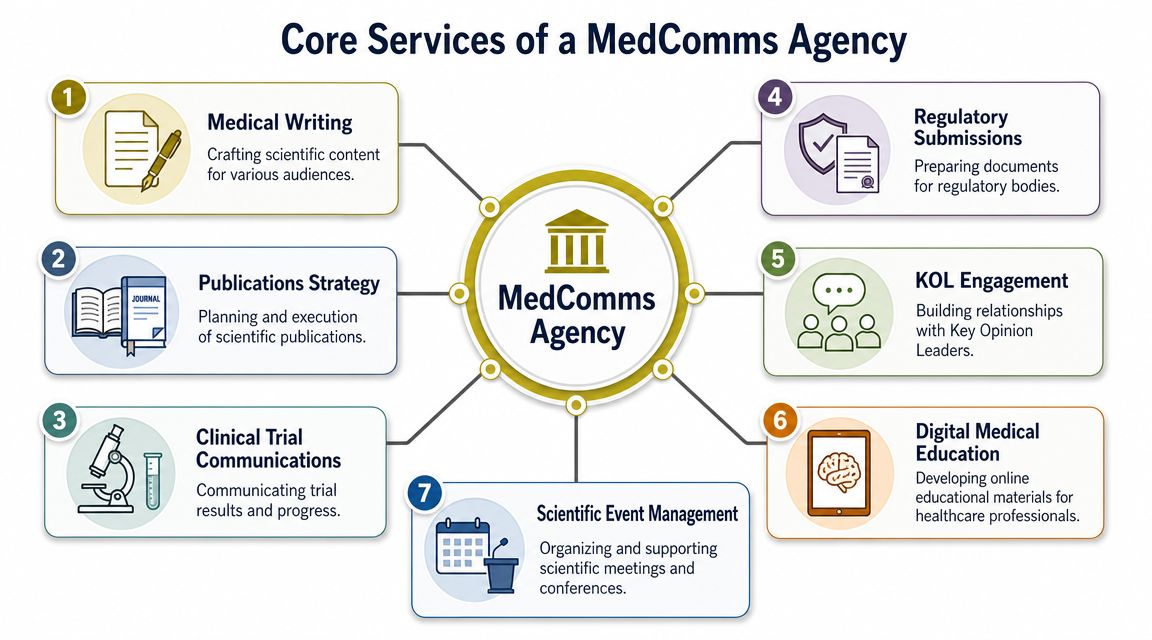
This work is less visible than PR coverage or campaign launch assets, but it often determines whether the rest of the communications stack will hold together. If the references are weak, the source claims are poorly structured, or the scientific narrative keeps changing, every later asset becomes harder to approve.
The engagement layer
Once the evidence base is stable, agencies help put it in front of the right people in the right form.
KOL and advisory work
KOL engagement isn't just about inviting respected voices into a room. It's about structuring the discussion so the company learns something useful, tests message credibility, and sharpens future communications without drifting into promotional shortcuts.
Medical education and scientific affairs
Agencies develop training materials, disease education, symposia content, congress support, and internal resources for field teams or medical affairs colleagues. Good work here respects the distinction between information and persuasion. Bad work blurs them and creates risk.
Digital delivery
Digital channels matter because the same evidence often needs multiple forms. A narrative built from literature and approved data can support a journal manuscript, compliant digital content, HCP education materials, and field-force training when planned properly.
The reputation layer
This is the area many SMEs underestimate until they need it quickly. In regulated healthcare, difficult moments aren't always dramatic scandals. They're often messy periods of uncertainty. Delayed approvals, safety questions, product criticism, activist attention, confused stakeholder expectations, or media interest in partial information.
A medcomms-capable team with strong communications instincts can be valuable here because crisis work in healthcare needs both precision and pace. Carlos Alba Media's guide to developing a crisis communications plan is a useful example of the kind of operational preparation companies should have before the pressure arrives.
The smartest medcomms programmes reuse one robust narrative across several outputs. The weakest ones rewrite the same story from scratch every time.
What works and what doesn't
| Approach | What happens in practice |
|---|---|
| Single evidence base | Messages stay consistent across publications, decks, education, and stakeholder materials |
| Format-led commissioning | Teams order assets one by one and discover contradictions later |
| Planned review workflow | Medical, legal, and regulatory concerns get handled early |
| Late-stage fixes | Copy gets watered down after sign-off conflicts appear |
The point isn't to buy every service. It's to understand that each deliverable sits inside a larger system.
Medical Comms vs General PR A Critical Distinction
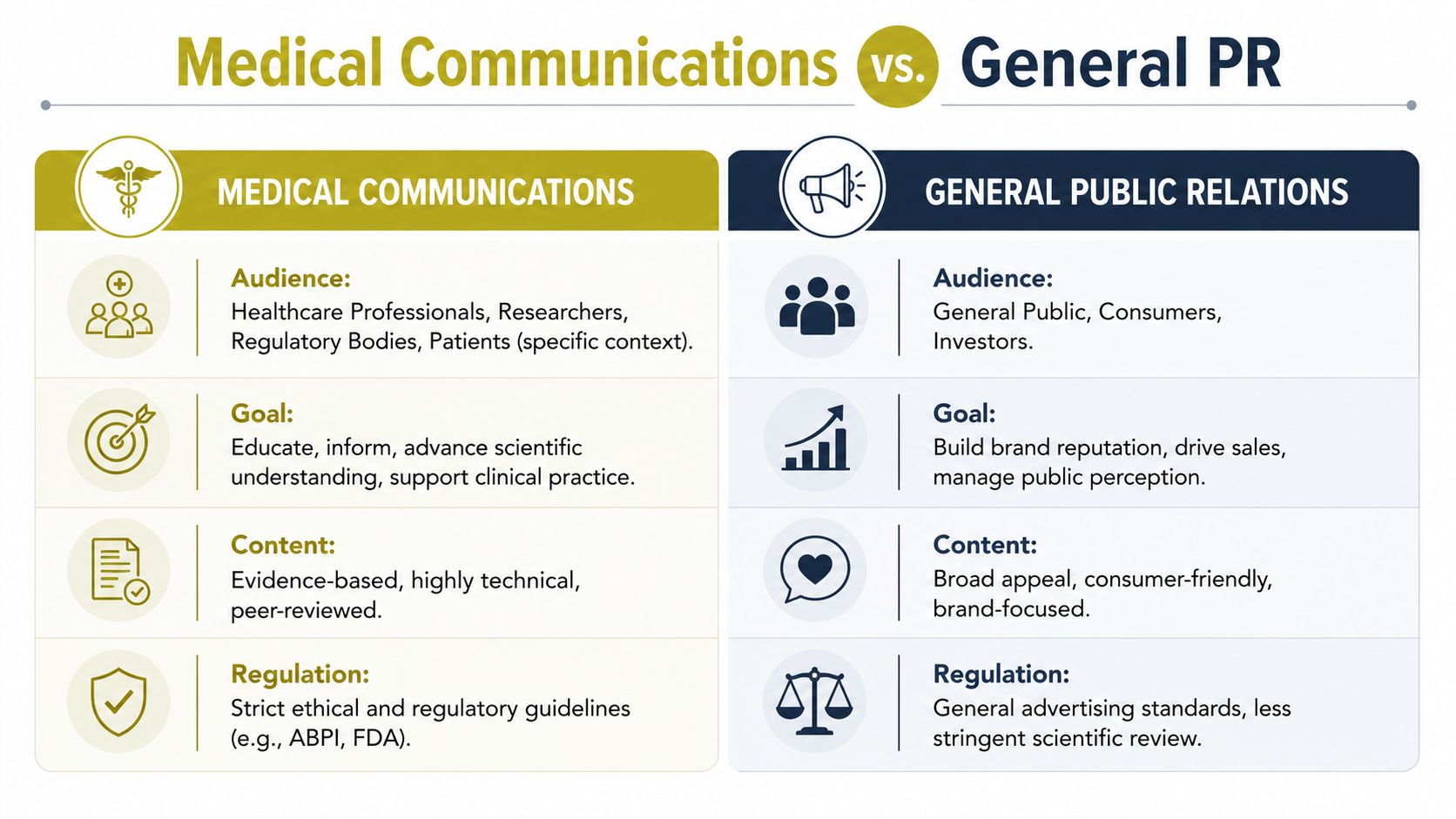
Many buyers assume medical communications is PR with more technical language. It isn't. The difference is structural.
General PR is usually designed to build reputation, shape perception, generate visibility, and support commercial goals through narrative. Medical communications has to do some of that too, but it starts from a tighter set of evidence and compliance constraints.
A visual comparison helps.
Where the line gets drawn
In the UK, agencies working on prescription medicines must align with the ABPI Code, which requires information to be accurate, fair, balanced, objective, and not misleading, as explained in this overview of medical communications agency standards. In practice, that creates a heavier evidence burden than general PR because claims, visuals, and comparative wording all need to be substantiated against approved data and promotional rules.
That changes the workflow. Messaging is usually built from an approved core data pack, then checked for claims compliance, reference traceability, and audience fit before release. In a typical corporate PR environment, a skilled editor and account lead may be enough to move quickly. In medcomms, teams often need separate medical, legal, and regulatory sign-off.
What general PR still does better
Generalist PR often outperforms specialist scientific teams in three areas:
- Narrative compression: turning complexity into language the outside world can absorb quickly
- Media instinct: understanding what journalists, producers, and editors will question first
- Crisis handling under pressure: keeping statements clear when facts are incomplete and stakes are reputational
That's why the best healthcare communications setups don't always choose one discipline over the other. They combine them carefully.
This is also where journalistic DNA matters. Agencies staffed by former national news journalists and people with experience on international brands often bring a sharper instinct for clarity, scrutiny, and public accountability. In crisis communications especially, those habits are useful because every loose phrase can become the story.
For organisations weighing specialist versus broader support, Carlos Alba Media's perspective on PR for healthcare is relevant because it sits at that junction between regulated-sector caution and media-facing clarity.
Here's a practical example of the distinction in action.
What buyers often get wrong
They ask a general agency to “make the science more compelling” without creating a compliance structure. Or they ask a specialist medcomms team to “do PR” without recognising that earned media, corporate reputation, and public explanation require a different rhythm.
The better question is this. Where do you need scientific rigour, and where do you need narrative reach? In many healthcare businesses, the answer is both. The challenge is knowing which discipline should lead each task.
Hiring the Right Agency in the UK
A UK biotech founder briefs two agencies on the same problem. One produces a polished brand story by Friday. The other asks for the source data, intended audiences, approval route, and the claims that cannot be made. The second conversation usually feels slower. It is often the safer buying decision.
Hiring a medical communications agency in the UK is an appointment with consequences. You are choosing a team that will shape how your evidence is interpreted, how your business handles scrutiny, and how confidently senior stakeholders can stand behind the message.
The UK context sharpens that decision. Industry standards are mature, review expectations are high, and even early-stage companies are judged against the communication discipline of much larger organisations. Buyers who come from general B2B marketing often underestimate that. Buyers who come from science sometimes underestimate something else. Clear explanation still matters, especially when a clinical update, pricing issue, safety question, or funding announcement becomes a wider reputation story.
That is why I look for agencies that can combine scientific discipline with real editorial judgement. In practice, that means they can hold up under medical, legal, and regulatory review, but they also know how to frame a difficult message for journalists, investors, NHS stakeholders, or patient groups without distorting the science. Pure medcomms rigour is not always enough. Pure PR instinct is not enough either.
Ask questions that expose how the work will really run
A capable agency should be able to explain its operating model in plain English. If the answers stay vague, the risk usually shows up later in delays, weak drafts, or approval rounds that spiral.
| Area of Inquiry | Essential Question to Ask |
|---|---|
| Compliance workflow | How do you handle medical, legal, and regulatory review when timelines are tight? |
| Evidence handling | How do you build messaging from source data and maintain reference traceability? |
| Audience strategy | How do you adapt the same evidence for clinicians, investors, NHS stakeholders, and patient audiences where appropriate? |
| UK market understanding | How familiar are you with NHS decision-makers, formulary conversations, and UK healthcare language? |
| Therapeutic learning | If you haven't worked in our exact category, how will you get up to speed without slowing the programme? |
| Difficult data | Can you describe how you've handled mixed, immature, or awkward data without overstating it? |
| Reputation risk | What happens if our communications challenge becomes a media issue rather than only a medical one? |
| Measurement | How do you judge whether your work changed understanding or behaviour rather than just produced assets? |
One answer matters more than buyers sometimes expect. Ask what happens when the science is accurate but the wording is still risky in public. Agencies with journalistic training tend to be stronger here. They are used to scrutiny, hostile interpretation, and the fact that a technically defensible phrase can still create a damaging headline.
What strong answers sound like
Strong agencies talk about process, review roles, sign-off points, and audience judgement. They can tell you who checks references, who owns version control, who joins difficult reviewer calls, and who rewrites a statement if an issue shifts from scientific communication into corporate reputation.
Weak agencies stay at the level of presentation language. They promise good storytelling, good relationships, and sector knowledge, but cannot show how those claims hold up when approvals get messy.
If an agency cannot explain how it handles tension between scientific accuracy, legal caution, and commercial pressure, do not hire it.
Team structure matters too. Senior oversight is useful, but SMEs and regulated startups usually need direct access to the people drafting core messages, managing reviewers, and advising leaders in real time. If the experienced people appear only in the pitch, you are buying a different service from the one you were sold.
For a broader due-diligence framework, this guide on how to choose a PR agency is a useful companion.
One final test is simple. Ask the agency to explain your science at three levels: specialist, informed non-specialist, and public-facing. In the UK market, the right partner can do all three without losing accuracy or creating avoidable risk.
Defining and Measuring Success
A lot of agency relationships drift because success was never defined properly. One side thinks the job is to deliver assets on time. The other thinks the job is to change understanding, influence decisions, or support adoption. Both sides may be technically doing their work, but they're measuring different things.
In healthcare communications, output is not the same as value.
Start with outcomes, not activity
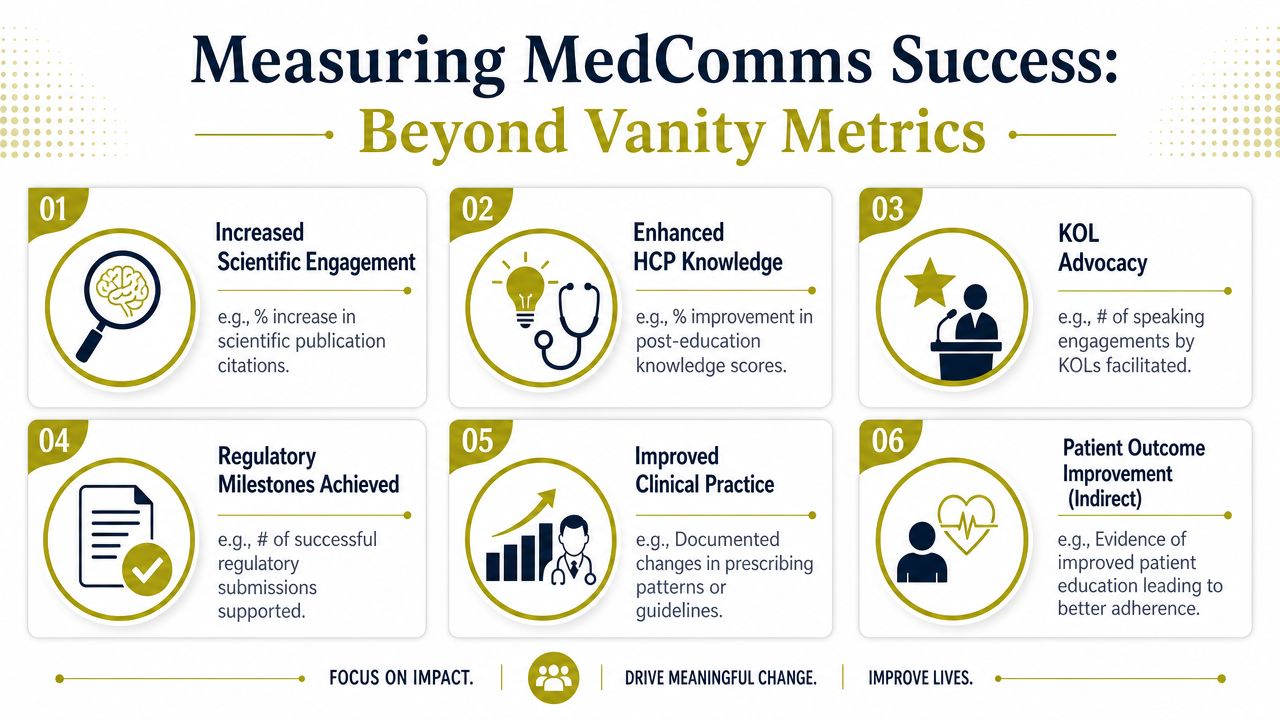
UK life sciences communications increasingly favour channels that can demonstrate measurable engagement, and agencies now combine scientific content with audience analytics, channel attribution, and content-format optimisation rather than relying on awareness alone, as described in this discussion of innovation in medical communications. The practical implication is simple. Publishing more content or running more programmes doesn't prove the communication worked.
That matters even more in the UK context because healthcare communication often has to work across NHS clinicians, formulary stakeholders, and patient groups, each needing different depth, framing, and accessibility.
What useful measurement looks like
A practical measurement model usually includes a mix of these questions:
- Understanding: Did the intended audience grasp the mechanism, relevance, or evidence more clearly?
- Adoption: Did speakers, field teams, or KOLs use the core messages consistently?
- Decision support: Did the material help stakeholders make or advance a real decision?
- Efficiency: Did one evidence base support several outputs without duplication or contradiction?
- Risk reduction: Did the review process catch problematic claims before release?
More content can hide weak strategy
One of the most overlooked truths in medcomms is that activity can mask confusion. Teams commission a manuscript, a deck, a microsite, a congress leave-behind, and training materials. Everyone is busy. Nothing clearly shifts.
That's why the more useful buyer question isn't “How much did the agency deliver?” It's “What changed because of the work?”
The most credible agency reports don't just list outputs. They show whether the intended audience understood, acted, or aligned differently.
For SMEs, this often means setting a smaller number of outcome-led goals at the start. Better message recall among KOLs. Cleaner field-force explanation. Stronger stakeholder understanding of the evidence. More confidence in a difficult Q&A process. Those are harder conversations than counting assets, but they're closer to the commercial truth.
A Checklist for UK SMEs and Regulated Startups
Most SMEs don't need a sprawling agency roster. They need a partner that can protect the science, sharpen the message, and operate calmly when the scrutiny rises.
Use this checklist before you appoint anyone.
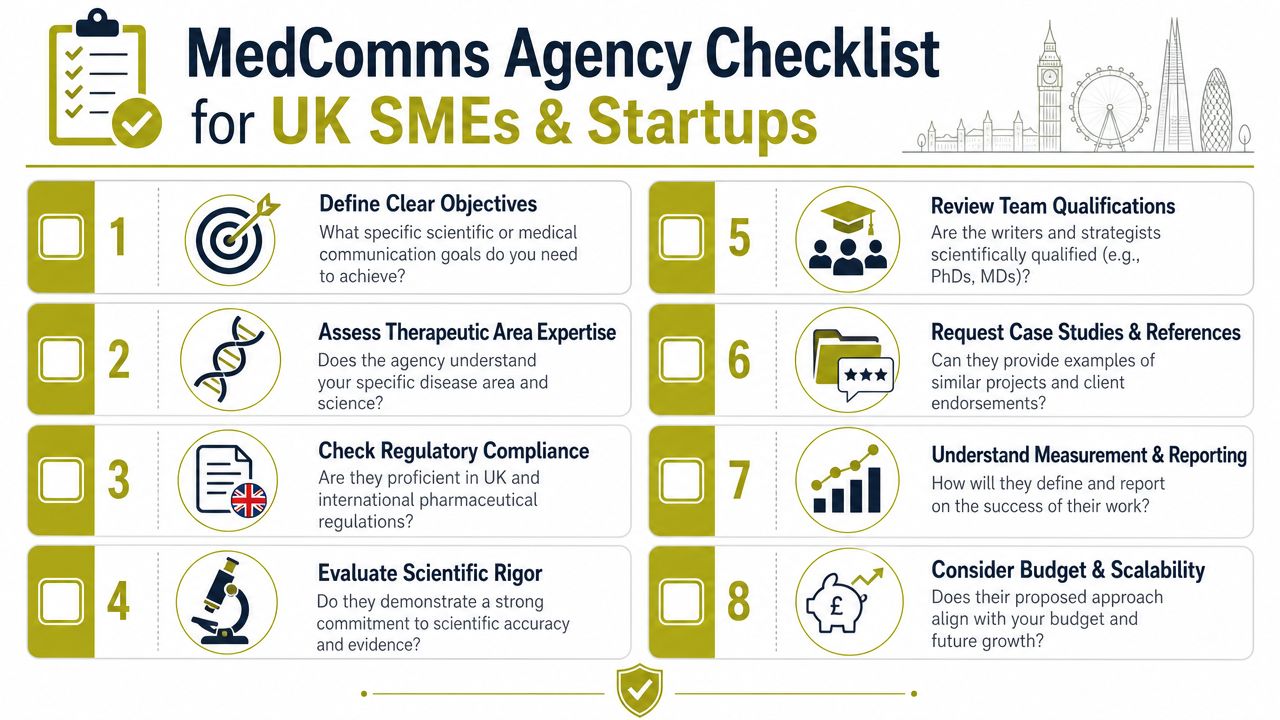
The shortlist test
- Know your audience first: Be specific about whether the immediate audience is clinicians, investors, NHS stakeholders, journalists, partners, or patients in an appropriate context.
- Get the data communications-ready: Organise claims, references, approved wording, and unresolved issues before the agency starts.
- Check UK compliance maturity: Don't assume a good writer understands regulated medicines communication.
- Test how they simplify: Ask them to explain your science in plain English without making it flimsy.
- Probe the review model: Find out who signs off what, and how disagreements are resolved.
- Look for channel judgement: A strong team knows that not every message belongs in every format.
- Ask how they measure impact: If they only talk about deliverables, push further.
- Stress-test crisis capability: In healthcare, the line between scientific communication and reputation management can narrow quickly.
For founder-led companies, one last point is worth holding onto. Communication in this sector doesn't need louder language. It needs clearer language, better evidence handling, and stronger editorial judgement.
That's where a team with journalistic instincts can add unusual value. Carlos Alba Media's model is relevant here because its team consists of former national news journalists or people with agency experience working with international brands. In practical terms, that matters most where scientific accuracy has to meet public clarity, especially in strategic storytelling and crisis communications.
If you need a communications partner that can handle regulated complexity, media scrutiny, and commercial storytelling without adding big-agency overheads, Carlos Alba Media is one option to consider. It works across PR, digital marketing, healthcare communications, media training, and crisis response, which can be useful for SMEs that need senior counsel rather than a patchwork of separate suppliers.