
If you're running a startup or SME, this scenario is familiar. A rule changes, a consultation opens, or a regulator starts circling an issue that affects your margins, hiring plans or product roadmap. You know the policy matters. You also know you don't have an in-house public affairs team, a Westminster network, or time to waste on vague “awareness” activity that never gets near a decision-maker.
That's where lobbying public relations becomes useful. Not as theatre. Not as spin. As a disciplined way to shape the public story around a policy issue so the right people hear your case, understand the stakes, and feel pressure to act.
From a newsroom perspective, policy influence starts long before anyone walks into a meeting. It starts when an issue becomes legible. Journalists need a clear angle. Politicians need a reason to care. Officials need evidence they can use. The public needs a story they can repeat. SMEs that understand that tend to punch above their weight.
What Is Lobbying Public Relations
Lobbying public relations sits in the overlap between media strategy, stakeholder engagement and policy advocacy. It's the work of turning a business concern into a public case that can move opinion and, indirectly or directly, affect decisions.
A simple example. A tech business develops a product that solves a real market problem, but an outdated rule makes procurement harder or slows adoption. The mistake is to treat that as a purely legal or technical issue. It rarely is. The core question is how to frame the problem so journalists, trade bodies, customers, civil servants and politicians all see why the rule is no longer fit for purpose.
That's why the lazy caricature of lobbying misses the point. Most effective campaigns don't begin with a whispered conversation in a corridor. They begin with a stronger narrative than the opposition has.
Where PR changes the policy debate
Good lobbying PR does three things at once:
- Clarifies the problem: It reduces a complex policy issue into a sentence a reporter can use and a ministerial adviser can repeat.
- Humanises the impact: It shows who loses under the current system and who benefits if the policy changes.
- Builds legitimacy: It makes your position look like a public-interest argument, not just a commercial complaint.
Practical rule: If your issue only makes sense inside your office, it won't travel through the media or politics.
Specialist communications teams prove vital. Carlos Alba Media works with former national news journalists and agency practitioners who've worked with international brands. That background matters because newsroom instincts are different from standard marketing instincts. Journalists look for tension, relevance, consequence and timing. If your lobbying PR ignores those tests, your campaign will stay invisible.
What it is not
It isn't the same as general brand PR. It isn't the same as legal advice. It also isn't solved by posting angry threads on LinkedIn or firing off a press release to every contact in your database.
Lobbying public relations is narrower and more strategic. You're trying to shift a decision environment. That means every media hit, briefing note, founder interview, trade comment and stakeholder meeting has to point in the same direction.
Laying the Groundwork for Your Campaign
Most weak campaigns fail before the first journalist email goes out. They fail because the business hasn't decided what it wants, who matters, or what success looks like.
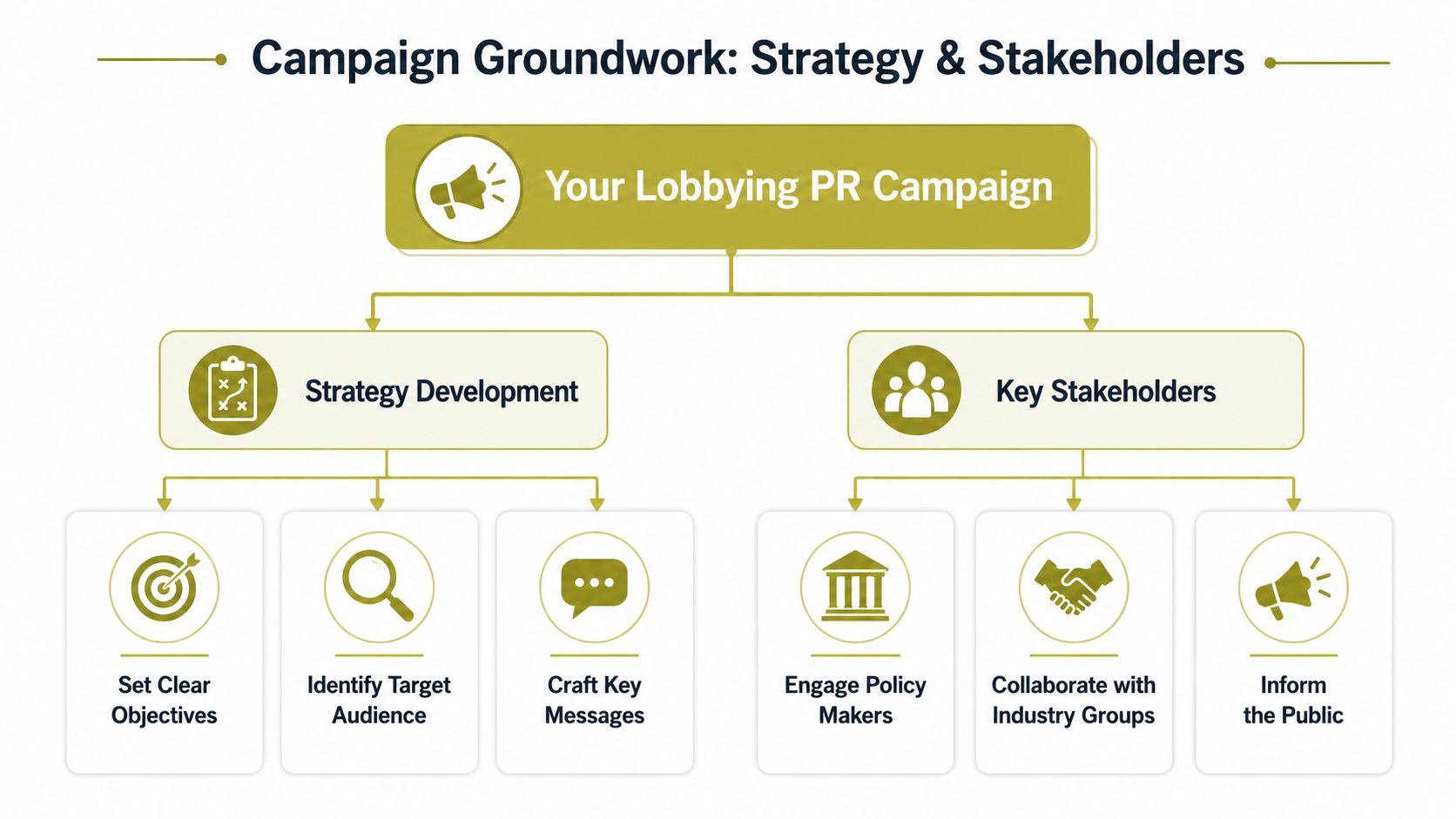
A campaign only gets traction when the objective is tight. “Raise awareness” isn't an objective. “Get ministers to notice us” isn't one either. A real objective has an action attached to it. Amend language. Delay implementation. Secure a meeting. Enter a consultation. Shift a regulator's interpretation. Those are campaignable.
A useful starting point is a proper communications strategy that forces decisions early, before time and budget leak into random activity.
Start with one policy objective
If you're trying to win five things at once, you'll usually win none. Pick the point of pressure that matters most now.
Ask:
- What specific decision are we trying to influence?
- Who can affect that decision directly?
- What's the deadline or live moment?
- What evidence do we have that isn't just opinion?
Founders often want to tell the full company story. Policymakers don't need the full company story. They need the narrow part that relates to the decision in front of them.
Map the real stakeholders
Campaigns often over-focus on elected politicians and ignore the people who shape the route to them. In practice, your stakeholder map usually includes a wider field.
| Stakeholder group | Why they matter | What they need from you |
|---|---|---|
| Ministers and advisers | They respond to political risk and public salience | Clear asks and public justification |
| Civil servants and regulators | They test feasibility and evidence | Specific detail, not slogans |
| Journalists and editors | They amplify or ignore your issue | A timely angle and clean facts |
| Trade bodies and coalitions | They broaden legitimacy | Shared language and aligned interests |
| Customers, staff, affected communities | They make the issue real | Human consequences and practical examples |
One point is easy to miss. The person with the title isn't always the person with the most influence. A specialist reporter, a committee clerk, a policy lead in a trade association or a respected sector voice can shape the conversation before it reaches the top.
Interrogate motive, not just influence
A stakeholder map that lists names is only half done. You need to know what each actor cares about.
- Political actors may care about public reaction, regional impact, or whether your issue creates avoidable controversy.
- Officials tend to care about workability, evidence quality and whether your proposal creates new administrative headaches.
- Journalists care about novelty, consequence and whether the story stands up under scrutiny.
- Partners care about whether joining you helps or harms their own position.
The shortest route to influence is rarely the shortest route on an org chart.
This groundwork feels slow when a policy threat is moving. It still saves time. Once the objective, audience and pressure points are clear, every later decision gets easier.
Crafting a Narrative That Influences
A policy argument can be correct and still go nowhere. That usually happens because the message is full of jargon, internal language and abstract claims that never become a story.
In newsrooms, complex subjects only break through when someone does the translation work. The same applies here. If your campaign line sounds like it came from a compliance memo, don't expect coverage, sympathy or momentum.
A useful discipline is to borrow from brand storytelling without becoming fluffy. The aim isn't to make policy cute. It's to make it understandable.
Find the human hinge
Consider two versions of the same issue.
Version one says a regulation creates “market friction” and “barriers to innovation”. Version two says the rule stops a local employer from expanding, delays access to a useful service, or forces customers into slower and more expensive options. One is sterile. One has consequences.
Former national journalists instinctively ask a handful of questions:
- Who is affected first?
- Where is the tension?
- Why now?
- What's the lived consequence if nothing changes?
- Who can explain this in plain English without sounding rehearsed?
That's how you find the human hinge in a policy story.
Build a message house you can actually use
You don't need a grand manifesto. You need a working message framework that survives interviews, stakeholder meetings and awkward questions.
A practical structure looks like this:
- Core line: One sentence stating the problem and your ask.
- Public-interest case: Why this matters beyond your company.
- Proof points: Short supporting facts, examples or operational realities.
- Spokesperson lines: Natural phrases a founder or sector expert can say on air.
- Rebuttals: Calm responses to the obvious counterarguments.
A weak campaign says, “We oppose this measure.” A stronger one says, “This measure creates a bottleneck for firms trying to hire, invest or serve customers, and there's a workable alternative.”
Speak like a source, not a brochure
The best lobbying PR messages sound as though a journalist could lift them into copy with minimal editing. That means short sentences, concrete nouns and clean verbs.
If a sentence can't survive a hostile interview, it isn't ready for a campaign.
Many businesses make a critical mistake. They over-polish. They remove all edge. They end up with wording nobody remembers. Better to sound precise and credible than “corporate”.
Try pressure-testing your narrative against three audiences:
| Audience | What they listen for | What to avoid |
|---|---|---|
| Journalists | Conflict, relevance, consequence | Dense technical framing |
| Policymakers | Practicality, public acceptability, timing | Self-interested pleading |
| Public audiences | Fairness, impact, common sense | Acronyms and insider language |
A strong narrative doesn't just get attention. It gives every supporter the same language to use when your issue comes up in a meeting, interview or consultation response.
Executing Your Campaign with Media and Digital Tactics
A policy window opens on Tuesday morning. A department announces a review, a trade title wants comment by lunch, and an MP's researcher is already asking who can explain the effect on employers in plain English. That is the moment this work either pays off or falls apart. Campaigns that influence policy are usually the ones that can supply a credible voice, a clean line and usable evidence at speed.
Media relations that move the issue
Coverage helps when it sharpens a live policy argument. It wastes time when it chases attention for its own sake.
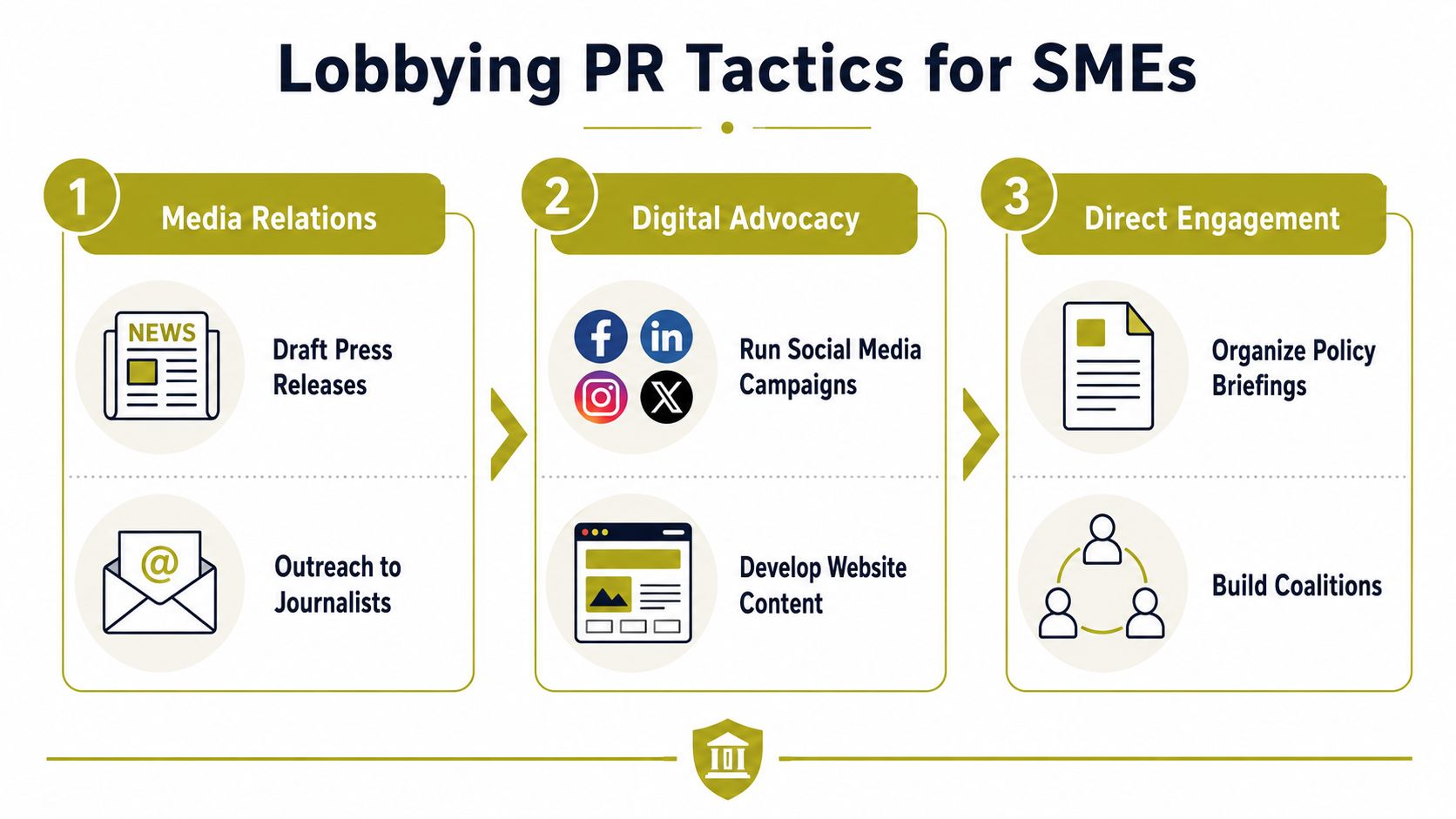
Pitch the pressure point inside the story. Show what the rule, delay or proposal does in practice, who feels it first, and what change would fix it. That could mean a founder interview tied to a consultation deadline, an op-ed with a specific amendment, a trade press reaction line after a ministerial announcement, or a case study that shows how a decision lands on staff, customers or supply chains.
Specialist and regional outlets often beat nationals here. Officials, advisers and trade bodies read them closely because they carry sector detail and local consequence. If I wanted to move an issue in Westminster or Whitehall, I would not measure success by sheer reach. I would ask whether the right reporter, committee clerk, adviser or association head has now seen the argument framed in terms they can repeat.
A practical media sequence looks like this:
- Start with timing. Why is this relevant now, not next month?
- Put forward a real source. Founder, operator, customer, analyst or sector ally.
- Give reporters material they can use fast. A short note, two sharp quotes, and a contact who answers the phone.
- Stay close to the story once it runs. Follow-up calls, rebuttal lines and fresh examples often matter more than the first hit.
Digital channels that support the campaign
Digital activity should carry the same line as your media and stakeholder work. If your LinkedIn posts say one thing, your consultation response says another, and your spokesperson says something softer on air, the campaign starts to look tactical rather than convincing.
LinkedIn is usually the most useful platform for SME lobbying PR because policy professionals, trade associations, journalists and business leaders all monitor it. A good campaign page on your site also does useful work. It gives journalists somewhere to check your case, gives stakeholders something to share, and gives your own team one reference point instead of five conflicting versions.
Useful assets include:
- Briefing posts that explain the issue without jargon
- Founder videos recorded plainly, with one argument per clip
- Landing pages that house your case, supporting documents and coverage
- Shareable graphics that partners can repost without rewriting your point
If your case depends on documents the public body has not published, use formal tools as well as media pressure. A well-timed Freedom of Information request can help surface the evidence behind a policy decision, or at least show where the official explanation is thin.
Teams building the digital side of this work can also borrow from broader PR discipline. PressBeat's guide to strategies for agency growth is useful for one reason. It shows how consistent digital output works better when every asset serves a defined objective.
Direct engagement turns noise into influence
Media coverage alone rarely changes a policy position. It creates salience. Influence usually comes when public narrative and direct contact work together.
That means briefing officials, feeding evidence into trade bodies, responding to consultations, arranging selective roundtables and making sure credible third parties carry the argument too. Public pressure without a route into the decision-making process is mostly theatre. Private lobbying without a public case often lacks urgency.
Research on corporate grassroots lobbying makes the same point in more formal terms. Public mobilisation works best when it sits alongside inside lobbying and organised advocacy rather than acting as a standalone publicity exercise. For SMEs, the practical lesson is simple. Do not ask customers, staff or supporters to make noise unless you know who needs to hear it, what decision is still open, and what action you want taken.
Keep the campaign joined up
A weekly operating rhythm helps because policy stories drift when nobody owns the tempo.
- Monday: Check ministerial announcements, consultations, committee activity and journalist calendars.
- Midweek: Push comment, place bylines, brief stakeholders and chase meeting follow-ups.
- Friday: Review coverage, note what shifted, and update lines before the next pressure point.
Good lobbying PR is not about being loud every day. It is about being relevant on the day that matters.
Navigating UK Lobbying Compliance and Ethics
The legal boundary matters because plenty of UK businesses are doing policy-adjacent communications without being clear on when that activity edges into regulated lobbying. That uncertainty is one reason this area gets mishandled.
The key point is simple. UK transparency law doesn't capture the whole scope of influence. It captures a narrow part of it.
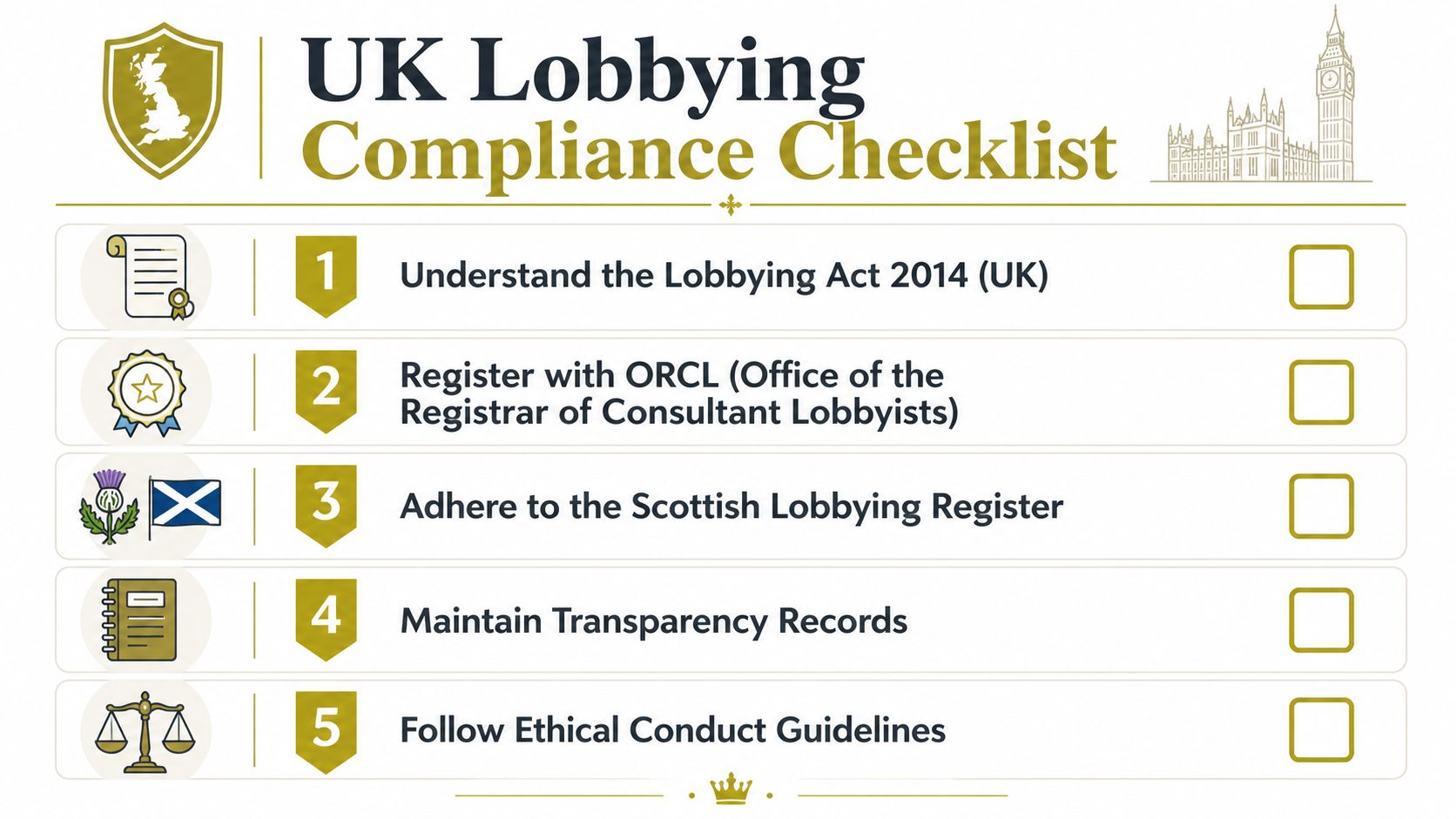
According to analysis of the UK regime, the Transparency of Lobbying, Non-Party Campaigning and Trade Union Administration Act 2014 created the statutory Register of Consultant Lobbyists, but the system covers only consultant lobbyists contacting ministers or permanent secretaries on behalf of clients. The Act received Royal Assent on 30 January 2014, and the register went live in 2015, which makes it a modern baseline for disclosure while still leaving much wider public affairs activity outside the legal definition, as explained in this LSE paper on the UK lobbying regime.
Where the grey area starts
For SMEs, the practical question isn't usually “Are we lobbying in the broad everyday sense?” It's “At what point does our PR activity trigger compliance duties?”
Media relations, stakeholder engagement, issue campaigns and reputation work often sit next to lobbying without falling inside the narrow legal definition above. That's the grey area. You can run a serious public campaign around a policy issue and still not be carrying out reportable consultant lobbying under that UK register.
That doesn't mean the distinction is trivial. If you use an external agency to contact ministers or permanent secretaries on your behalf, the compliance analysis changes. If you're coordinating media pressure with direct top-level government contact, you need to understand exactly who is doing what, for whom, and in what capacity.
A plain-English threshold check
Use this as a practical screen:
- Who is making the contact? Your staff, a trade body, or an external consultant.
- Who are they contacting? Journalists, officials, special advisers, ministers, or permanent secretaries.
- What is the purpose? General reputation-building, issue education, or a direct attempt to influence a government decision.
- Whose interests are represented? Your own organisation's position or a client's position.
- What records exist? Briefings, emails, meeting notes and approvals.
If your activity is mainly public messaging, trade media work and stakeholder outreach, it may sit outside the narrow consultant lobbyist register. If an outside consultant is making direct high-level government contact on behalf of a client, you should pause and check obligations carefully.
Transparency isn't just about legal minimums. It's also about protecting your credibility when opponents start asking who is behind a campaign.
Ethics protects the campaign
Even where the law is narrow, the reputational test is broader. The OECD has argued that lobbying rules need clear disclosure of who is lobbying, who they meet and how decisions may be influenced, a useful principle set out in this open government guide on anti-corruption and lobbying.
That's a sensible benchmark for SMEs. Even when a specific action doesn't trigger registration, you still need good habits:
- Keep clean records: Save briefs, approvals, meeting notes and campaign materials.
- State interests clearly: Don't hide who benefits from the policy position.
- Avoid astroturfing: Manufactured grassroots outrage usually gets exposed.
- Check facts hard: A weak claim can damage both the campaign and the business.
- Use FOI strategically: Public records can clarify who knew what and when. This guide on how to make a freedom of information request is useful if you need documentary context before going public.
Ethical clarity makes a campaign sturdier. It also gives journalists more confidence that your case will withstand scrutiny.
Measuring Success and Knowing When to Hire Experts
A policy campaign can dominate your trade press, generate a spike in LinkedIn engagement and still fail where it counts. The actual test is simpler. Are officials responding, are stakeholders repeating your argument, and has the issue moved closer to a decision point that helps your business?
Measuring that is harder than many teams expect. Analysts reviewing lobbying outcomes have found that observed policy success rates are often around 50%, but that figure does not separate the effect of lobbying from a policy's existing chance of success, as discussed in this analysis of the challenges with measuring lobbying impact. That distinction matters. A campaign can back a proposal that was already likely to pass, or fight hard and still lose because the politics were against it from the start.
Track traction, not vanity
The useful question is whether your communications work is changing the behaviour of people with influence over the outcome.
For SMEs, the strongest signals usually look like this:
| Better signals | Weaker signals |
|---|---|
| Invitations to meetings or roundtables | Raw press clipping counts |
| Requests for follow-up evidence | Social likes with no stakeholder action |
| Mentions of your framing in debate or consultation | General website traffic spikes |
| Support from credible allies | Broad awareness with no decision-point link |
| Movement in regulator or official engagement | Coverage that never reaches target audiences |
In practice, I would rather see one select committee clerk ask for evidence, or one trade body adopt your wording, than a week of noisy coverage that never reaches the people drafting the brief. Public visibility has value, but only if it helps create access, pressure or legitimacy.
Set measures at three levels. First, output. Did the campaign secure coverage, publish the right assets and reach the target audiences? Second, response. Did policymakers, advisers, regulators, journalists or industry bodies engage? Third, outcome. Did consultation language shift, did a meeting happen, did an amendment appear, did enforcement soften, or did a minister address the issue publicly?
That is a more honest scorecard.
When expert help becomes worth it
Some businesses can run an early campaign themselves, especially if the issue is narrow and the spokesperson is credible. The problems start when the story becomes political, contested or time-sensitive.
Bring in experienced support when:
- The issue is politically sensitive
- Your spokesperson needs sharpening for hostile interviews
- You need fast national or trade media response
- The campaign involves multiple stakeholders with competing interests
- Compliance questions are becoming material
- You don't have time to run media, digital and policy work in sync
What an experienced team adds is judgement under pressure. Which claim is strong enough to survive a hostile producer or a civil servant who knows the brief inside out. Which reporter will treat the issue seriously and which one will reduce it to a row. Whether to push publicly now, or hold the story until private conversations have done their job.
For SMEs, that trade-off is usually about cost versus risk. If the issue affects regulation, procurement, licensing, planning, market access or reputation with government, weak execution gets expensive quickly. Good support does not just get coverage. It helps the business avoid wasting six months on activity that never turns into influence.
Frequently Asked Questions
| Question | Answer |
|---|---|
| Can a small company do lobbying public relations without a public affairs team? | Yes, if the issue is tightly defined and the campaign is disciplined. A founder, sector expert or operations lead can often serve as a credible voice, provided the messaging is sharp and the target audience is clear. |
| Is trade press worth more than national media for policy campaigns? | Often, yes. Trade titles are read closely by officials, advisers, competitors and sector bodies. National coverage can broaden pressure, but specialist coverage can be more useful when you need credibility with decision-makers. |
| Should we launch publicly before speaking to policymakers? | Not always. Sometimes private engagement should come first, especially if the goal is to educate rather than confront. In other cases, public coverage creates the urgency needed to secure a meeting. The order depends on timing, sensitivity and whether the issue benefits from visible public backing. |
If your business needs to shape the story around a policy issue, not just react to it, Carlos Alba Media can help with senior-level PR and communications support grounded in newsroom experience. The team is made up of former national news journalists and agency practitioners, which is useful when the task is turning a complex regulatory problem into a public case that journalists, stakeholders and decision-makers will engage with.