
In the UK's famously crowded food and drink scene, a fantastic product is only half the battle. To really make an impact, your brand needs a story that people connect with. This is where a specialist food PR agency comes in—they’re not just publicists, they’re expert storytellers who know how to get your brand noticed in a market where everyone is shouting.
Why Your Food Brand Needs a Specialist PR Agency

Let's be honest: getting noticed is the single biggest challenge for any food or hospitality business today. Before you even start looking for a partner, it's worth thinking through the in-house marketing vs. agency debate to see what makes sense for you. For many brands, the focused expertise and deep industry contacts of a specialist agency provide an undeniable edge.
A general PR agency might get the basics, but a food specialist lives and breathes your world. They get the subtle details—from supply chain quirks and the latest wellness trends to what really makes a food editor at a national newspaper pay attention.
Navigating a Complex and Crowded Market
The UK food and drink industry isn't just competitive; it’s a minefield of shifting tastes and fleeting trends. Take the UK's food delivery market, for example. It’s on track to hit a massive £14.3 billion by 2026. That growth is a huge opportunity, but it also means a flood of new competitors are all chasing the same slice of the pie.
This is exactly where a specialist agency shows its value. They do more than just fire off press releases. Their job is to turn dry market data into compelling stories that actually mean something to journalists and, most importantly, your customers.
A great food PR agency knows how to turn a market statistic into a human story. They’ll position your new vegan range not just as another product, but as a genuine solution for ethically-minded shoppers. That’s how you land coverage a generic pitch could only dream of.
The Power of Newsroom Experience
Think about the advantage of working with an agency like Carlos Alba Media, where the specialist nature and expertise of the team are paramount. Everyone who works for Carlos Alba Media is a former national news journalist or has agency experience of working with international brands. This isn't just a marketing line; it fundamentally changes the results you can expect.
Former journalists have a built-in radar for what makes a real story. They just get it.
Here’s what that means for you:
- They craft pitches that get opened. An editor receives hundreds of emails a day. A pitch from a trusted ex-colleague, written in the language of the newsroom, is far more likely to get read.
- They find the newsworthy angle. They have a knack for spotting the unique hook in your brand’s story—whether it's an innovative production method, a founder's inspiring background, or a brilliant community project—and framing it for the media.
- They have genuine relationships. Their network isn't just a spreadsheet of contacts. It’s a collection of real professional relationships with people in broadcast, print, and online media, built over years of working in the trenches together.
This insider knowledge is the key to securing high-impact "earned media" that builds credibility in a way paid ads never can. When consumer trust is everything, having a respected journalist tell your story in their own publication is priceless.
Defining What You Need and What an Agency Delivers
Before you even think about searching for a food PR agency, you need to get brutally honest about what you actually want to achieve. Simply saying you want “more press” is like telling a chef you’re hungry—it’s a starting point, but it’s not a recipe for success.
A good agency will push you on this. Are you trying to get a new plant-based product into the hands of influential vegan bloggers? Or is your goal a glowing review for your restaurant in a major national paper like The Times? Maybe you want to position your founder as a go-to expert on sustainable farming, lining them up for talks at industry events.
Each of these goals demands a completely different strategy, set of contacts, and skillset. Nailing down your destination is the only way to find an agency that knows the route.
From Vague Ideas to Actionable Goals
Let’s get practical. Here’s how you can translate common business ambitions into concrete PR objectives that an agency can actually work with:
Your Goal: You need to increase sales of a new artisanal cheese line by 20% in the next six months.
- The PR Objective: Secure product placement and rave reviews in at least five key food magazines and three influential foodie newsletters.
Your Goal: You want to drive a 30% increase in online reservations for your restaurant.
- The PR Objective: Organise an exclusive press dinner for top-tier food critics and land three broadcast interview slots for your head chef.
Your Goal: You want to be seen as the authority on sustainable sourcing in your sector.
- The PR Objective: Place three thought-leadership articles under your founder’s by-line in respected trade publications and secure a feature on a top food-focused podcast.
Defining these targets doesn't just focus your search; it gives you the exact benchmarks you’ll use to hold your agency accountable and measure what’s working.
What to Expect From a Specialist Food PR Agency
Once you’re clear on your objectives, you can start assessing what a great food PR agency actually brings to the table. I can tell you from experience, it’s much more than just firing off the odd press release. A true partner offers a whole suite of services designed to build, polish, and protect your brand's reputation.
This is about crafting a consistent and compelling story at every single touchpoint. It’s realising how everything from your social media voice to your custom café branding plays a part in the public’s perception of you. An agency helps make sure that story is the right one.
Specialist expertise is what really separates the good from the great. For example, at an agency like Carlos Alba Media, every team member is either a former national news journalist or has deep agency experience working with international brands. That background is a game-changer.
A former journalist doesn't just write a press release; they craft a story. They have an instinct for what makes an editor’s inbox light up and what gets instantly deleted. This insider knowledge is what turns a standard announcement into a compelling pitch that lands national coverage.
This table breaks down the core services you should look for and the tangible impact they can have on your business.
Food PR Agency Services and Their Business Impact
| Service | What It Is | Business Impact (Example) | Who It's For |
|---|---|---|---|
| Strategic Media Relations | Building genuine relationships with key journalists, editors, and producers. It’s about targeted, personal pitching, not spamming. | A new bakery gets a feature in a weekend supplement, leading to queues out the door and a sell-out weekend. | Any brand seeking credibility and coverage in reputable media outlets. |
| Digital PR & Content | Creating shareable online content (articles, case studies, videos) that's optimised to appear in search results. | A restaurant's blog post on "The History of Neapolitan Pizza" ranks on Google, driving consistent, relevant traffic and bookings. | Brands wanting to improve online visibility and attract customers through search. |
| Influencer & Creator Collaborations | Identifying and managing partnerships with authentic food creators whose followers are your ideal customers. | An organic snack brand partners with a wellness influencer, resulting in a 15% sales uplift and a surge in social media followers. | Consumer-facing brands looking for social proof and direct engagement. |
| Crisis Management | A pre-prepared plan to manage communications and protect your brand during a negative event (e.g., a bad review, supply chain issue). | A food manufacturer quickly and transparently addresses a product recall, retaining customer trust and minimising financial damage. | Essential for all food and hospitality businesses, where reputation is paramount. |
These services aren't just a checklist; they are interlocking parts of a bigger machine. A brilliant food PR agency combines them into a smart, cohesive strategy. They don't just sit back and wait for things to happen—they anticipate opportunities, help you navigate the inevitable challenges, and make sure your story gets heard by the right people, at the right time.
With the UK's PR market set to be worth a staggering £5.87 billion by 2026, it's no wonder that trying to find the right agency can feel like searching for a needle in a haystack. The secret isn't just finding any agency; it's about finding your agency—a genuine partner who lives and breathes the food and drink world.
Let's cut through the noise. The process really boils down to a few key stages. You need to know what you want to achieve, find the right people to help you, and then work with them to get your brand the attention it deserves.
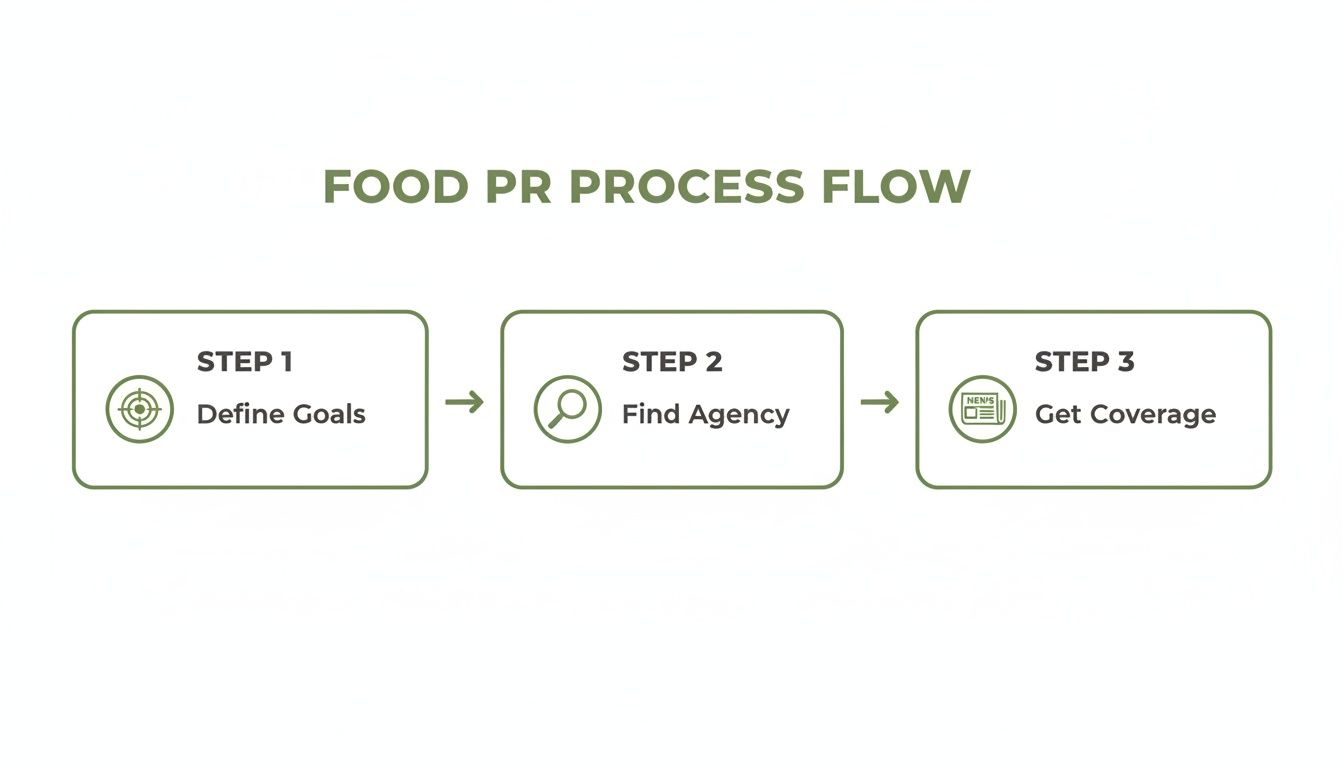
As you can see, that middle step is the crucial bridge. Get it wrong, and even the most brilliant objectives will fall flat. So, how do you get it right? It all starts with a bit of detective work.
Spotting the Real Food Specialists
Your first task is to separate the true food experts from the generalists who just happen to have a restaurant client or two. A proper food PR agency will have a portfolio that reads like the menu at a top food festival.
Dive into their website and look for concrete evidence. Do you see logos from food producers, hospitality brands, or drinks companies that you recognise?
Here's what to look for:
- Relevant Case Studies: Don't just settle for a gallery of press clippings. Look for campaigns that show a clear strategy and measurable results for brands in your niche.
- Industry Fluency: Read their blog and social media. Are they talking about food trends, consumer behaviour, and the challenges you face every day? They should speak your language.
- The Right Media Placements: Where are they getting coverage? If you're an artisan cheese maker, you need to see placements in food glossies and top-tier supermarket magazines, not a feature in a construction trade journal.
This first check is a quick and easy way to filter out the agencies that simply don’t have the deep-rooted connections and know-how to make an impact.
The Power of a Newsroom Background
Here’s an insider tip: look at the team. An agency's real power often lies in its people's previous careers. For instance, an agency like Carlos Alba Media makes a point of hiring former national news journalists and professionals with extensive international brand experience. This specialist nature and expertise aren't just a selling point; they are a game-changer.
A team of ex-journalists inherently understands what makes a story work. They've spent years on the other side of the desk, so they know exactly how to frame a pitch to get an editor's attention. They don't just blast out generic press releases—they craft compelling narratives and use their personal contacts to get your story heard.
In an industry where PR professionals now far outnumber journalists, a personalised, credible pitch from a trusted source is your golden ticket. It's the difference between your email being opened and it being instantly deleted.
Asking the Questions That Matter
Once you've narrowed your list down to three to five promising agencies, it’s time to get them on the phone. Remember, this is a two-way interview. You're not just there to be sold to; you're there to see if they have the strategic chops to be a real partner.
Try asking these questions to get beneath the surface:
- "Looking at our brand, what would be the first three publications you'd pitch to and what angle would you take?" This tests their creativity and shows if they've done their homework.
- "Who would be our day-to-day contact, and what's their specific experience in our sector?" You need to ensure the A-team that pitches you is the same team that will work on your account.
- "Tell me about a campaign for a brand like ours that didn't go to plan. What happened, and what did you learn from it?" This is a brilliant test of their honesty, problem-solving skills, and ability to adapt under pressure.
- "How do you measure success beyond column inches or media impressions?" Their answer should connect PR activity directly to your business goals, like driving website traffic, generating sales leads, or increasing footfall.
The UK PR market is booming, with a predicted 6.67% CAGR through 2033, which is great news for food brands. While large, faceless agencies still exist, this growth has allowed smaller, highly specialised firms to thrive by offering deep expertise and client focus. They are perfectly positioned to create stories that tap into current consumer interests, from health concerns to rising food prices. You can learn more about the PR services market outlook to understand the landscape. Your job is to find the partner who can turn these market currents into a powerful, compelling narrative for your brand.
Creating the Brief and Understanding Pricing Models
Once you've narrowed your list down to a handful of potential agencies, the single most important thing you can do is write a killer brief. This isn't just a bit of admin. It’s the very foundation of your future partnership. A vague brief will get you vague, incomparable proposals, but a sharp, detailed one forces agencies to show you exactly how they think.
Think of it as the recipe for your PR success. It’s where you get crystal clear on your own ingredients (your brand story, your budget) and what you expect the final dish to look like (your business goals). A top-tier agency will take that recipe and build a bespoke strategy just for you.
Crafting a Brief That Gets Results
Your brief is your chance to tell your story—where you’ve been, where you are now, and where you’re trying to go. Don’t be shy with the details. The more you give an agency, the more tailored and insightful their proposals will be. This clarity is absolutely vital for a successful public relations campaign.
Here’s what you need to nail down:
- Your Brand Story & USP: What’s your magic? Is it the founder’s incredible journey, your radically sustainable sourcing, or a family recipe passed down through generations? Get this down on paper. It's the soul of your brand.
- Target Audience: Please, don't just write "foodies." That's far too broad. Get specific. Are you targeting "Health-conscious urban professionals aged 25-40 who shop at Waitrose and follow wellness influencers"? Now that's an audience an agency can work with.
- Business Objectives: What does success actually look like in 12 months? Tie this to real numbers. Think goals like increasing online sales by 20%, securing five new wholesale accounts, or driving a 30% uplift in restaurant bookings.
- Key Competitors: Name two or three brands you’re up against. What are they doing in the press that you admire? Where are their blind spots? This gives an agency the lay of the land and helps them carve out your unique space.
- Budget Range: Be honest about what you can spend. It saves everyone a huge amount of time and means you'll get proposals that are genuinely achievable. An agency needs to know if they're planning a local tasting event or a nationwide broadcast tour.
- Success Metrics (KPIs): How will you know this is working? It could be the quality of media coverage, a spike in website traffic from articles, or a measurable increase in your social media engagement.
This document is your yardstick. With it, you can properly evaluate every proposal and make sure you’re comparing apples with apples.
Demystifying Agency Pricing Models
Getting your head around how agencies charge is crucial. It’s not just about the numbers; the pricing structure itself tells you a lot about the kind of partnership you're walking into. The model should make sense for your business and the scope of work you've outlined.
When you hire a specialist team like Carlos Alba Media, you're not just buying time; you're investing in expertise. The team's specialist nature is rooted in its hiring policy: everyone is either a former national news journalist or has significant agency experience working with international brands. This level of senior counsel provides immense value, as they bring insider knowledge that a junior-led team simply cannot match.
You'll almost always come across one of these three models:
- Monthly Retainer: This is the industry standard for a reason. You pay a fixed fee each month for an agreed scope of work. It’s perfect for long-term brand building and allows the agency to truly embed themselves in your team, acting proactively and spotting opportunities.
- Project-Based Fee: This is a one-off payment for a specific project with a clear start and end date, like a new restaurant opening or a product launch. It works well for businesses that have a very defined, short-term need and a fixed budget.
- Pay-on-Performance: Be wary of this one. It’s rare in serious PR and often a red flag. The fee is tied to securing media hits, which sounds great in theory, but it almost always encourages a focus on quantity over quality. This approach rarely builds a brand's long-term reputation.
For most growing food brands, a monthly retainer strikes the best balance between consistent, strategic support and predictable costs. It fosters a deep, collaborative relationship where your agency is always thinking ahead, ready to jump on opportunities and navigate challenges to keep your brand front and centre.
Measuring PR Success and Calculating ROI

Alright, so the agency is briefed and the work is underway. Now for the big question: how do you actually know if your investment is paying off? Proving that your food PR agency is delivering real value is one of the most crucial parts of the partnership. It’s time we moved past fuzzy vanity metrics like ‘impressions’ and got serious about what truly affects your bottom line.
Impressions—the potential number of times your content could have been seen—are easy for agencies to report, but they’re a notoriously slippery metric to connect to actual business. A feature in a national newspaper might claim a potential reach of millions, but if it doesn't lead to a single new booking or online order, what was it really worth? A modern, results-focused approach demands more substance.
The best PR partnerships are built on transparency and a shared definition of success. This isn't just about getting a monthly report of press clippings. It’s about working together to analyse how PR activity is directly fuelling tangible business growth, whether that means more bums on seats, higher sales, or stronger brand loyalty.
Your agency should be a partner in this analysis, not just a supplier. A team staffed with professionals who have worked with international brands or in national newsrooms, like the experts at Carlos Alba Media, gets this. Their specialist nature and expertise mean they understand that business leaders need to see a clear return on investment, not just a scrapbook of media mentions.
Focusing on KPIs That Matter for Food Brands
To turn your PR spend into a measurable growth engine, you have to track the right Key Performance Indicators (KPIs). These are the metrics that build a bridge between media coverage and your business goals, giving you a clear framework to see what’s working and where the strategy needs a tweak.
Think of it this way: a feature on your new gelato flavour appears in a popular food magazine's email newsletter. The vanity metric is the newsletter's 500,000 subscribers. A meaningful KPI, however, is tracking the referral traffic from that link in Google Analytics and seeing a 40% spike in online orders for that specific flavour over the next 48 hours. That's tangible ROI you can take to the bank.
To get a clearer picture of your campaign's performance, it's helpful to track a mix of metrics. Below is a breakdown of the KPIs you should be discussing with your agency and what they actually tell you about your progress.
Key Performance Indicators for Your Food PR Campaign
This table outlines the essential metrics for measuring your PR success, explaining what each one measures and why it's so important for a food or hospitality brand.
| KPI | What It Measures | Why It Matters for a Food Brand |
|---|---|---|
| Quality of Coverage | The authority, relevance, and sentiment of the media placement. | A glowing review in a top-tier food publication is far more valuable than a brief mention on an unknown blog. It builds credibility. |
| Share of Voice (SOV) | Your brand’s visibility in the media compared to your direct competitors. | An increase in SOV shows your PR is successfully capturing more of the conversation and positioning you as a leader in your niche. |
| Message Accuracy | How well the coverage includes your key brand messages (e.g., sustainable sourcing, unique cooking methods). | This ensures the PR is building your brand identity correctly and communicating what makes you special, not just getting your name out there. |
| Website Referral Traffic | The number of visitors who come to your website directly from links in online articles or features. | This is a direct line from PR coverage to potential customer action, showing you who is interested enough to learn more or make a booking. |
| Impact on Sales/Bookings | Direct revenue or reservations attributed to PR activity. | This is the ultimate measure. Using unique discount codes for specific articles or tracking booking sources connects PR directly to revenue. |
Tracking these KPIs helps you and your agency stay aligned on what success looks like, moving beyond simple press clippings to a sophisticated view of business impact.
Effective measurement isn't a one-off report at the end of the month. It's a continuous process of tracking, analysing, and refining. You can get a much deeper understanding of this ongoing work through expert public relation consulting that puts results at the centre of the strategy. This cycle is what separates a good PR campaign from a great one, ensuring your investment drives real, sustainable growth for your brand.
Nurturing a Long-Term Agency Partnership
Right, you’ve picked your food PR agency. That’s a massive decision sorted, but don’t assume the job is done. The very best results don’t come from a simple client-vendor transaction; they grow out of a real, long-term partnership where everyone is invested in the same outcome.
Like any solid relationship, it needs work. You need clear, honest communication, a healthy dose of mutual respect, and a proactive mindset to spot potential issues before they become full-blown problems.
Even with the best intentions, partnerships can hit bumps in the road. Expectations can get muddled over time, or a brilliant launch campaign can start to feel a bit stale a few months later. The secret is to build a relationship where your agency truly feels like an extension of your in-house team—one that stays hungry and doesn't just fall into a rhythm of ticking boxes.
This means getting into the habit of having regular, frank conversations that go deeper than just looking at a list of press clippings. Talk about what’s hitting the mark, what’s falling flat, and how you can pivot your strategy together to tackle new business goals or react to shifts in the market. A genuine partner won't just tolerate this kind of feedback; they'll welcome it and use it to sharpen their game.
Staying Afloat in a Volatile Market and Managing a Crisis
The food and drink world can be particularly turbulent. One minute you’re flying high, the next you’re dealing with a supply chain nightmare, a string of bad online reviews, or a sudden dip in consumer trust. Your brand's reputation is constantly on the line, and this is where the value of a long-term, specialist food PR agency truly shines.
The market’s unpredictability makes this kind of resilience essential. For example, while UK company insolvencies seemed to be levelling off in 2024, the food sector is still feeling the squeeze. In this kind of climate, smart PR isn’t just a nice-to-have for growth; it's a survival tool. You can get a better sense of the pressures by reading up on how UK food firms navigate these trade credit risks.
Crisis readiness isn't some optional extra you can bolt on later. For any serious food brand, it’s a non-negotiable safety net. When a crisis hits, you don't have time to go agency shopping. You need a team that already gets your business, inside and out, and can move instantly.
This is precisely why having an agency with 24/7 crisis management capabilities and a direct line to media lawyers can be an absolute game-changer.
The Power of Senior-Level Expertise
When the proverbial hits the fan, the experience of the people in the room is what counts. This is where an agency like Carlos Alba Media really proves its worth. Their entire team is built on a very specific type of experience: every single consultant is either a former national news journalist or has a deep background in agency work with global brands.
Why does this matter so much? Because former journalists are wired to think like the media. They instinctively know what a reporter's next question will be, how to frame a statement that builds credibility instead of suspicion, and how to use their contacts to make sure your side of the story is actually heard. It’s about taking control and steering the narrative with confidence when the pressure is on.
But that senior-level counsel pays dividends far beyond crisis mode. It ensures your PR strategy grows with your brand, constantly unearthing fresh angles and new opportunities to keep you in the conversation, year after year. By investing in a partnership built on this calibre of expertise, you’re not just buying PR services—you’re securing a long-term guardian for your brand's reputation and value.
Frequently Asked Questions About Food PR
Stepping into the world of public relations can feel a bit overwhelming, especially when you're busy running a food or hospitality business. It’s only natural to have questions. Here are some honest answers to the queries we hear most often from brands thinking about hiring a food PR agency.
How Much Does a Food PR Agency Cost in the UK?
Let's talk money. The truth is, costs can vary wildly depending on what you want to achieve.
For a focused campaign targeting local media, you might be looking at a starting point of around £2,000 per month. If you’re aiming for the big leagues with a national strategy designed to land you in top-tier publications, that figure can easily climb past £10,000 monthly.
But the real conversation shouldn't be about price; it should be about value. The smartest investment is often a specialist agency that gives you access to senior-level experts without the hefty overheads of a massive global firm. Always start the process with a detailed brief. It’s the only way to get accurate quotes you can properly compare.
When Should My Business Hire a PR Agency?
The best time to bring in a PR agency is when you have a clear goal and are primed for growth. This could be just before you launch a major new product, open a new restaurant, or expand into a different market. It’s also a powerful move when you need to build your reputation and stand out against more established competitors.
Think of it as laying the groundwork. Starting with proactive PR builds a solid foundation of trust and visibility long before you need it. That way, you’re not scrambling to be heard when a crisis hits or a golden opportunity lands on your doorstep.
Can an Agency Guarantee Media Coverage?
To be blunt: no. And you should be wary of any agency that says they can. The final call on what gets published always belongs to the editors and producers.
What a professional agency can guarantee is smart thinking, genuine industry knowledge, and a relentless, strategic effort to get your story in front of the right people.
An agency staffed by former national news journalists, like Carlos Alba Media, understands exactly what makes a story newsworthy. Their specialist expertise dramatically increases your chances of securing the high-impact coverage that truly moves the needle for your brand.
What Is the Difference Between PR and Advertising?
It’s a classic question. The easiest way to think about it is 'paid' versus 'earned' media.
Advertising is what you pay for. You buy an advert, control the message completely, and tell everyone how great you are. PR is what you earn. You gain powerful credibility when a respected third party—like a food critic, a national newspaper, or a trusted blogger—independently says you’re great.
Of course, these two disciplines don't live in a vacuum. The most successful modern campaigns weave PR, marketing, and advertising together to create a single, powerful brand story that connects with customers at every turn.
Ready to stop hoping for coverage and start earning it? Carlos Alba Media blends newsroom insight with digital marketing know-how to deliver results you can measure. Get in touch to discuss your goals.