
You're probably in one of two situations right now. Either your practice already gets enquiries, but your digital presence feels stitched together, or you know patients are looking online first and you're not confident they're finding the right information about you when they do.
This is the challenge in digital marketing healthcare. It isn't just about traffic, impressions, or filling a content calendar. It's about being visible at the exact moment someone is worried, comparing providers, or deciding whether to trust your clinic with something personal.
Healthcare marketing changes when trust becomes the product before the appointment. That's where a newsroom mindset helps. At Carlos Alba Media, the work is shaped by people who are former national news journalists or agency professionals who've worked with international brands. That combination matters in healthcare because it pushes strategy towards verification, clarity, and accountability rather than hype. In this sector, that isn't a style choice. It's a commercial advantage.
The Foundation Trust and Regulatory Guardrails
Healthcare marketing starts in a different place from retail, hospitality, or SaaS. The first question isn't “How do we scale reach?” It's “Why should anyone believe us, and how do we prove we're safe to trust?”
That changes the whole operating model. Copy, creative, paid targeting, analytics, review handling, form design, and follow-up messaging all sit inside a regulated environment where patient confidentiality, privacy, and accuracy aren't side issues. They're the frame around everything else.
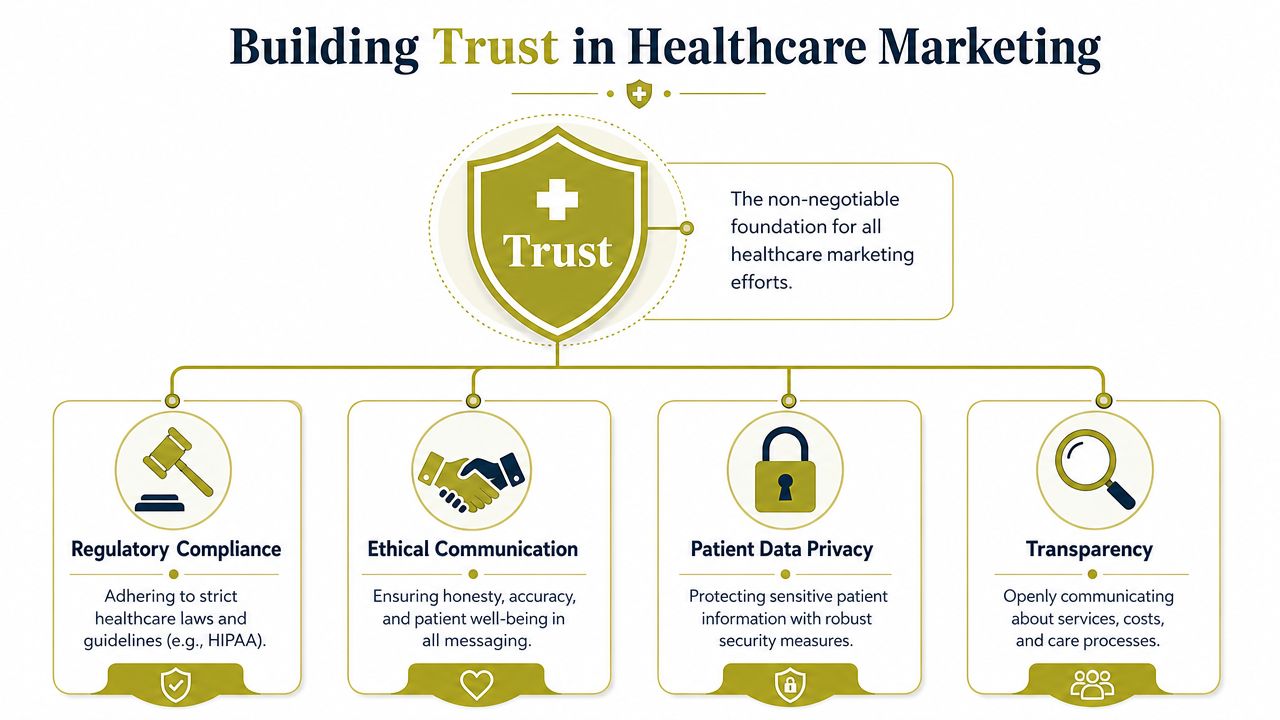
Trust is built before the campaign launches
A lot of weak healthcare marketing fails long before the ad goes live. The service pages are vague. The booking flow asks for too much too early. The ad copy promises too much. The privacy language is hard to follow. The result is a brand that feels risky, even if the clinical care is excellent.
A stronger approach uses four filters before anything is published:
| Filter | What to check | What good looks like |
|---|---|---|
| Accuracy | Are claims precise and supportable? | Clear wording, no exaggerated outcomes |
| Privacy | Are forms, pixels, and follow-up journeys appropriate for sensitive categories? | Minimal data collection, clear consent language |
| Clarity | Would a stressed patient understand this quickly? | Plain English, obvious next steps |
| Transparency | Are costs, process, and expectations visible? | Honest timelines, realistic service descriptions |
Practical rule: If a page would make a regulator, a journalist, and a cautious patient comfortable at the same time, it's usually on the right track.
A journalistic background becomes particularly valuable. Former newsroom staff are trained to check wording, separate fact from assumption, and remove claims that can't be supported. In healthcare, that discipline naturally aligns with compliant marketing. It also improves conversion because people trust what sounds measured and specific.
Compliance should shape the brand voice
Many providers treat compliance as the legal team's problem. That's too narrow. Compliance should shape how the organisation sounds.
That means:
- Write plainly: Avoid inflated medical jargon when a simpler explanation will do.
- State limits: If treatment suitability varies, say so.
- Show credentials carefully: Use clinician bios, service detail, and review processes to reassure without grandstanding.
- Protect confidentiality: Never let social proof, testimonials, or community content drift into identifiable patient information without proper permission and process.
There's another trust issue many healthcare brands miss. Accessible and multilingual content is part of credible communication, not an optional extra. The Office for National Statistics reported that 7.2 million UK residents had limited English proficiency in 2021, which makes plain-English, translated, and culturally adapted content a practical issue for growth and access, not just inclusion (UK limited English proficiency context).
What works and what doesn't
Some tactics consistently help:
- Service pages organised around patient questions
- Consent language that people can understand
- Clinician profiles that explain expertise in human terms
- Landing pages that reduce anxiety instead of creating it
Other tactics usually backfire:
- Overpromising headlines
- Anonymous, generic website copy
- Lead forms that feel invasive
- Stock reassurance with no evidence of process or standards
Trust doesn't come from saying “we care”. It comes from showing how your organisation communicates when accuracy, privacy, and accountability matter.
Mapping the Digital Patient Journey
Most healthcare teams still talk about the patient journey as if it's linear. It rarely is. People move in loops. They search symptoms, abandon tabs, ask family, compare providers, return via mobile, look for reviews, and only then consider booking.
That behaviour matters because digital visibility only works when it matches the patient's actual state of mind. In the UK, online search is now the default environment. Ofcom's 2024 research shows 91% of UK adults were online and 87% used the internet daily, which means healthcare discovery now happens inside a broad digital routine rather than in isolated “marketing moments” (Ofcom healthcare discovery context).
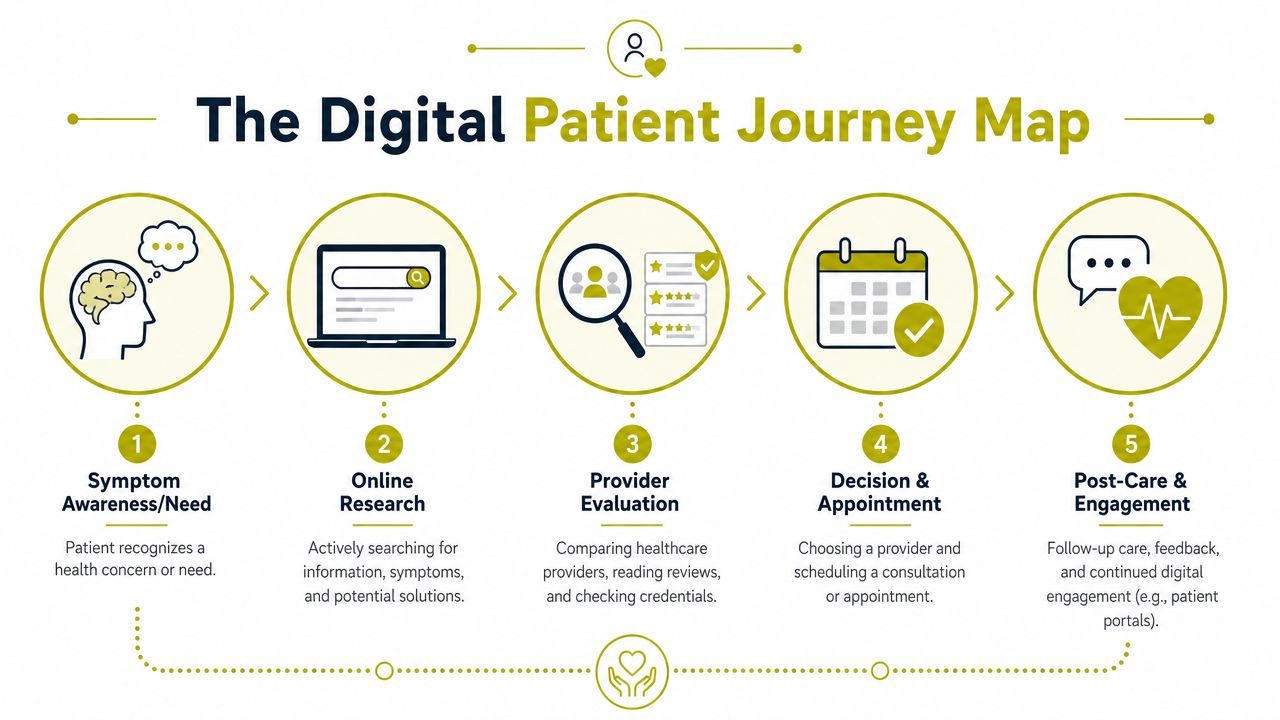
A practical journey map
A useful patient journey map doesn't start with age bands or broad personas. It starts with intent.
Concern emerges
Someone notices a symptom, a change, or a need. At this stage they often want reassurance, not a sales pitch.Information search
They look for explanations, causes, wait times, treatment pathways, and whether the issue sounds urgent.Provider evaluation
Now they compare. They check location, reviews, credentials, services, and whether the site feels credible.Decision point
At this stage, friction kills conversion. Poor mobile UX, unclear forms, limited appointment guidance, or missing service detail often stop the journey.Post-care follow-up
Patients still need reminders, instructions, next-step information, and a reason to trust ongoing digital communication.
What to map for each stage
The simplest way to do this well is to document three things per touchpoint:
- The patient's question
“Is this serious?” “Do you treat this?” “How quickly can I be seen?” - The patient's emotion
Anxiety, uncertainty, urgency, embarrassment, caution. - The required asset
FAQ page, clinician bio, appointment page, short explainer video, review profile, follow-up email.
A lot of practices skip the emotion part and go straight to channel planning. That's a mistake. Healthcare decisions aren't purely rational. A clinically accurate page can still fail if it reads as cold, confusing, or defensive.
A better way to build personas
Useful personas in healthcare aren't cartoon profiles. Build them around behaviour patterns such as:
| Persona type | Typical behaviour | Content needed |
|---|---|---|
| Research-heavy comparer | Reads multiple pages and checks credentials | Detailed service pages and clinician authority |
| High-anxiety first-time patient | Needs reassurance before action | Plain-English FAQs and simple booking guidance |
| Time-pressed local searcher | Wants immediate fit and convenience | Mobile-first local pages and clear contact options |
The patient journey isn't a funnel in the neat agency sense. It's a sequence of trust checks.
If your content, ads, and booking paths don't match those trust checks, the marketing will look active while demand leaks away.
Building Authority with Content and SEO
In healthcare, content and SEO shouldn't be split into separate workstreams. The page that ranks is often the page that reassures. The article that answers a question well is often the first proof that your organisation takes accuracy seriously.
That's why authority building in digital marketing healthcare starts with editorial standards, not keyword stuffing.

Build around service-line clusters
One of the most practical models is the content cluster. Instead of publishing disconnected blogs, create a structured hub around a high-intent service line.
For example, a clinic offering dermatology support might build one cluster with:
- Core service page explaining assessment, treatment scope, and booking
- Supporting FAQ pages answering common questions in plain language
- Clinician profile pages with relevant expertise and review process
- Condition explainer articles for common patient concerns
- Local intent pages where geography changes search behaviour
This approach reflects how people search and how search engines understand relevance. It also helps internal teams keep content consistent, because each page has a defined job.
What strong healthcare content looks like
Not all informative content builds authority. Good healthcare content has a few recognisable traits:
- It answers the likely question quickly
- It avoids drama and overstatement
- It names who reviewed or authored the material where appropriate
- It gives the patient a next step without forcing the sale
Weak content usually has the opposite pattern. It chases keywords, hides basic information, and sounds like it was written to game rankings rather than help a worried reader.
A sensible editorial checklist looks like this:
| Check | Why it matters |
|---|---|
| Plain language | Patients need comprehension before confidence |
| Structured headings | Search engines and readers both need clear hierarchy |
| Medical accuracy review | Healthcare pages carry a higher trust burden |
| FAQ formatting | Useful for readers and increasingly useful for AI-mediated discovery |
| Clear next action | Good content should reduce uncertainty, not leave people stranded |
SEO now includes AI visibility
Search has changed again. Ranking well still matters, but it isn't the whole game. Ofcom's 2025 media-use reporting found that 1 in 6 UK adults uses ChatGPT to search for health information, which means healthcare brands need content that AI systems can surface as trustworthy, structured, and citation-ready (AI search behaviour in UK health discovery).
That shifts the brief. The goal isn't only “get the click”. It's also “be the source selected in the answer”.
A page built for authority usually performs better in both classic search and AI search because the same qualities matter in both places: clarity, structure, expertise, and trust signals.
That means your best defence against zero-click behaviour is stronger source material. Publish pages that are easy to parse, easy to quote, and clearly tied to real expertise.
A useful format for healthcare brands is:
- Question-led headings
- Short direct answers near the top
- Expanded explanation below
- Named expertise or review process
- Related FAQs
- Clear route to appointment or contact
Here's a practical example of the kind of content thinking teams should study before production planning:
Editorial discipline beats content volume
Publishing more doesn't solve an authority problem. Better structure does. Better sourcing does. Better service-page architecture does.
This is one place where specialist support can help, especially when content, PR, UX, and search need to work together. Carlos Alba Media's healthcare digital marketing work is one example of a service model built around that kind of integrated planning rather than isolated SEO tasks.
If you want content to perform in healthcare, treat every page as both a trust asset and a search asset. The teams that do that usually produce fewer empty pages and far more useful ones.
Paid Media and Social Channels with Guardrails
Paid media solves a specific problem. It puts you in front of people quickly when intent already exists. That can work well for service lines with urgent demand, local competition, or poor organic visibility.
It also creates risk faster than almost any other channel if the setup is careless. In healthcare, bad targeting, loose copy, and weak landing pages don't just waste budget. They can damage credibility.
Do this and not that
The easiest way to keep paid activity useful is to apply guardrails before launch.
| Do this | Not that |
|---|---|
| Use direct, factual copy about services, access, and next steps | Make dramatic claims about outcomes or certainty |
| Send traffic to tightly matched landing pages | Dump all clicks on the homepage |
| Use geographic and service relevance | Chase broad audiences with vague creative |
| Review tracking and form setup carefully | Collect unnecessary sensitive detail in ad journeys |
A lot of healthcare ad accounts underperform because the advertiser wants broad reach and the patient needs specific reassurance. The fix is usually narrower segmentation, tighter message matching, and cleaner landing-page intent.
What social is actually for
Social channels aren't only ad inventory. In healthcare, they're often the place where tone gets tested. Patients look at feeds to judge whether an organisation feels professional, current, and human.
That means the organic social brief should be simple:
- Publish useful updates rather than endless self-congratulation
- Show process and people without breaching confidentiality
- Answer common questions in formats people can absorb quickly
- Use comment moderation rules so concerns are handled consistently
If the paid ad promises calm competence but the social feed looks chaotic or neglected, patients notice the mismatch.
For teams running paid social alongside search ads, the operational challenge is consistency. Creative, page copy, comments, and follow-up all need the same level of care. If you need specialist campaign support on that front, paid social services for regulated brands are one route to building tighter controls around message, audience, and platform use.
A practical launch sequence
A disciplined campaign usually follows this order:
- Choose one service line with clear intent
- Write factual ad variants
- Build a landing page that answers the main objections
- Check privacy and data capture
- Test small, then expand what proves relevant
What doesn't work is launching broad campaigns across multiple services, with generic ads and no clear reporting on lead quality. That's how spend rises while confidence in digital falls.
Winning with Local Search and Reputation Management
Take a typical local clinic. It offers strong care, has a decent website, and gets referrals offline. Yet when someone nearby searches for help, the clinic appears halfway down the page, its reviews are old, and its service information feels thin. Nothing is disastrously wrong. It just doesn't look like the obvious choice.
That's common. Local growth in healthcare usually comes from the interaction between three things: search visibility, public trust signals, and the consistency of the patient experience after the click.
A local clinic scenario
Imagine a physiotherapy clinic in a competitive town centre. It doesn't need national reach. It needs to win a set of practical decisions from people nearby who want confidence, convenience, and a clear route to booking.
The clinic improves results when it does three things well.
First, it tightens the local search layer. Business profile information is complete. Services are described properly. Opening details are current. The website has pages that match real local intent rather than one generic “services” page.
Second, it treats reputation management as operational work, not a side task for reception when there's time. Review requests happen after the right moments. Responses are calm and professional. Patterns in complaints are fed back into the patient journey.
Third, it strengthens referral trust digitally. Referring partners, community organisations, and prospective patients all find the same clear signals about expertise, availability, and standards.
Segmentation matters locally
Local marketing gets lazy when every audience sees the same message. That's one reason some campaigns produce traffic but not meaningful enquiries. One analysis found an average healthcare marketing conversion rate of 3.2%, while high-performing brands reached 21.2%, reinforcing that segmentation and message fit matter more than raw traffic alone (segmentation and healthcare conversion context).
For a local provider, that usually means separating pages and messaging by intent such as:
- Urgent need versus planned care
- First-time patient versus returning patient
- Specific treatment query versus general practice discovery
Reputation work that actually helps
Review generation and response handling need a script, not improvisation.
A workable approach looks like this:
- Ask at the right point: After a positive, complete care interaction, not in the middle of treatment uncertainty.
- Make it easy: Short follow-up messages and simple links reduce drop-off.
- Respond without defensiveness: Thank people, acknowledge concerns, and never drift into patient-specific detail.
- Track themes: If the same issue keeps appearing, that's a service problem, not a review problem.
If your team needs a broader framework, this complete guide to online reputation is a useful reference because it connects review handling with wider visibility and trust signals.
For clinics that want a more healthcare-specific process, online reputation management tips for healthcare-facing brands can help shape policy, response tone, and escalation standards.
Local healthcare marketing wins when the profile, the pages, and the reviews all tell the same story.
The clinic that usually wins
It isn't always the clinic with the biggest budget. It's usually the one that removes uncertainty fastest.
That means accurate service detail, a credible public profile, recent reviews, and content built for the actual concerns patients bring into search. Local trust compounds steadily when those basics are handled with discipline.
Measuring Success and Integrating with PR
A healthcare marketing programme isn't mature until it can answer two questions clearly. What is working, and what happens if public attention turns hostile?
Too many teams still separate performance marketing from communications risk. They treat analytics as a reporting exercise and PR as something for emergencies. In healthcare, those functions should be linked from the start because trust can be built and damaged through the same digital channels.
Measure what changes behaviour
The first correction is simple. Stop treating vanity metrics as proof.
Reach can matter. Engagement can matter. But the more useful questions are operational:
| Metric area | What to look for |
|---|---|
| Channel quality | Which channels produce actual consultations or qualified enquiries |
| Landing-page performance | Which service pages persuade and which ones leak intent |
| Lead quality | Whether enquiries fit the service line and location |
| Acquisition efficiency | Whether spend is justified by the quality of booked demand |
The dashboard doesn't need to be elaborate. It needs to be honest. A small number of metrics reviewed consistently beats a huge reporting pack nobody trusts.
Digital adoption has already reset expectations
Patient behaviour has moved on. The NHS App, created in 2018, had been downloaded more than 34 million times by March 2024, confirming that digital convenience is now part of the mainstream healthcare journey in the UK (NHS App adoption and patient expectation).
That matters because it raises the baseline. Patients now expect digital booking pathways, reminders, follow-up communication, and clear mobile access. If your marketing attracts interest but the service journey still feels clumsy, the campaign and the experience are working against each other.
Why PR belongs inside the measurement loop
A strong digital presence does more than generate demand. It gives your organisation a stable public record of who you are, what you do, and how you communicate under scrutiny.
That matters in healthcare because issues escalate quickly. A complaint, local media query, social thread, or misunderstanding about treatment information can turn into a reputation event fast. If your owned channels are thin, inconsistent, or out of date, you have very little control over the frame.
The brands that handle pressure best usually aren't improvising. They already know who approves messaging, where statements live, and how digital channels support the public response.
PR and digital efforts must converge. Search-optimised service content, clear leadership profiles, accurate public statements, and a monitored reputation footprint all reduce confusion during a difficult moment. For organisations that need that integration, healthcare public relations support is one route to connecting growth activity with risk planning.
A practical companion to that work is keeping your foundational local visibility in order. This local SEO checklist for small business is useful as a maintenance reference because it covers the operational basics many teams neglect once campaigns are live.
The real ROI argument
The strongest case for digital marketing healthcare isn't that it gets attention. It's that it helps a healthcare organisation become easier to find, easier to trust, easier to contact, and easier to defend publicly when pressure rises.
That's why measurement and crisis planning shouldn't sit at the end of the plan. They belong at the beginning.
If your healthcare brand needs a digital strategy built around trust, visibility, and reputational resilience, Carlos Alba Media offers senior-led PR and digital marketing support shaped by newsroom discipline and agency-level execution.