
You're probably in the same place as a lot of UK founders. Sales need a lift. Your website exists but doesn't pull its weight. Someone has told you to “do SEO”, someone else says “run paid social”, and another insists you need PR, video, email funnels, a rebrand, and a full content strategy.
That's where most small and mid-sized businesses waste money. Not because marketing doesn't work, but because they buy random tactics before they've decided what kind of support they need.
If you've searched digital marketing agency what is it, the simple answer is this: it's a specialist business you hire to grow your company through online channels. That includes things like search, paid ads, content, email, social media and website development. The useful answer is more practical. You're not buying “marketing”. You're buying capability, speed, judgement and accountability that your business doesn't currently have in-house.
For a Scottish or wider UK SME, that matters. You don't have the budget or time to build a full team for every discipline. You need a partner that can prioritise the right channels, track performance properly, and stop you spending on activity that looks busy but doesn't move revenue.
Your Business Needs to Grow So What Now
You're running a business, leads have gone flat, and every week brings a different suggestion. Fix the website. Start SEO. Run Google Ads. Post more on LinkedIn. Hire a freelancer. Bring in a PR firm. Rebuild the brand.
Founders typically want results like more leads or stronger enquiries, not an agency. They want a clear route to growth without wasting six months on disconnected activity.
Your reality is usually blunt. Budget is limited. Internal capacity is thin. The person “doing the marketing” is often also covering sales support, admin, suppliers, and whatever else needs fixed that day. That works until growth depends on specialist execution, proper tracking, and consistent follow-through.
At that point, you need to make a decision, not collect more tactics. Build an in-house team, keep patching things together with freelancers, or hire an agency that can own the work and the numbers.
That decision matters more for UK SMEs than the generic definitions you'll find elsewhere. You do not need another supplier posting content into the void. You need a partner that can judge what matters first, connect the channels properly, and tie activity back to revenue. A journalistic, story-led approach also has an edge here. It helps your business explain what it does clearly, turn expertise into useful content, and stop sounding like every other firm in the market.
A good agency sits in the middle ground between DIY chaos and the cost of building a full internal team. It gives you strategy, delivery, and accountability in one place. If you want a clearer sense of the channels and capabilities involved, this digital marketing agency services list breaks them down in practical terms.
One more point. Growth problems are often conversion problems, not just traffic problems. If your site gets visits but fails to turn them into calls or enquiries, fix that before pouring more budget into promotion. These actionable conversion strategies are a useful benchmark for what should already be working.
You do not need more marketing activity. You need organised marketing that supports a business goal, tells a convincing story, and earns its keep.
What a Digital Marketing Agency Actually Does
A digital marketing agency runs the parts of online growth that need specialist skill, tight coordination and clear commercial focus. For a UK SME, that usually means one thing. Turning your website, search visibility, ad spend, content and follow-up into a system that produces enquiries and sales, not random activity.
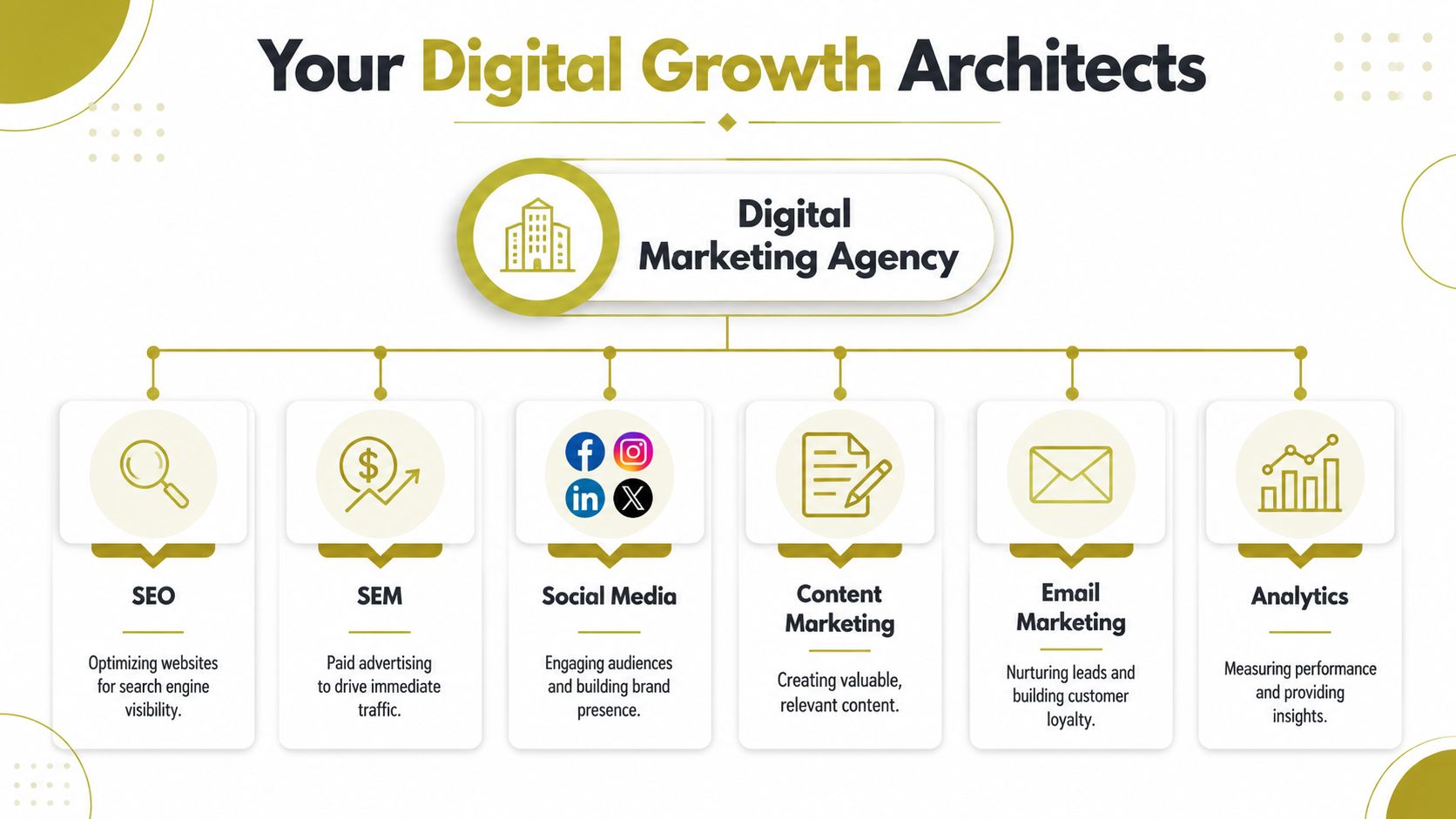
The core services that matter
SEO helps your business appear for the searches that signal buying intent. Good SEO is not a vanity exercise. It is about getting found by the right people at the right moment, then making sure the page earns the click and the enquiry.
Paid media gives you speed and control. Google Ads, Meta campaigns and paid LinkedIn can test offers, reach new audiences and generate demand faster than organic channels alone. It also exposes weak messaging quickly, which is useful if you are serious about improving.
Content marketing gives your expertise a job to do. It should answer buyer questions, support search performance, strengthen sales conversations and build trust before a prospect speaks to you. In this scenario, a journalistic, story-led approach has an advantage. It helps SMEs explain complex services clearly and produce material people will read, not just publish.
Social media marketing distributes your message and supports the rest of the mix. For many SMEs, its value is consistency and visibility, not chasing empty engagement.
Email marketing handles follow-up. It keeps warm prospects moving, brings old leads back into play and gives you a direct channel you control.
Web design and development affect everything else. If the site is slow, confusing or badly structured, traffic becomes waste. No amount of promotion fixes a poor destination.
One area founders regularly underweight is conversion. Traffic on its own does not pay the bills. If you want practical ideas on turning more visits into enquiries or sales, these actionable conversion strategies are worth reviewing alongside your agency discussions.
If you want a clearer view of how these channels fit together, this breakdown of digital marketing agency services for SMEs is a useful reference.
Why businesses hire agencies instead of patching it together
Businesses hire agencies because digital growth now depends on multiple disciplines working in sync. One person posting on social, a freelancer tweaking the website, and somebody else running ads is rarely enough. You get activity, but not a joined-up system.
What matters is coordination.
A good agency sets priorities, connects the channels and keeps the work tied to a commercial target. That might be more qualified leads, lower cost per enquiry, better conversion from traffic you already have, or stronger visibility in a market where larger competitors are crowding you out.
For Scottish and UK SMEs, this matters because budget is usually tight and management time is tighter. You cannot afford to fund disconnected tactics for six months and hope they somehow add up. You need someone to decide what comes first, what can wait, and what should be cut.
Here is the practical version:
- You need joined-up execution: Search, paid campaigns, content, email and website UX need to support the same goal.
- You need prioritisation: The problem is rarely lack of ideas. It is poor sequencing and weak decision-making.
- You need performance visibility: If you cannot see what is driving leads or sales, you cannot budget with confidence.
- You need sharper messaging: Strong agencies do not just distribute content. They help shape a clearer, more convincing story.
This short video gives a straightforward primer on the agency model and the roles involved.
Practical rule: If your website, content, ads and follow-up emails are handled by different people with no shared plan, you do not have a marketing system. You have disconnected tasks.
Digital Marketing vs PR and Creative Agencies
Founders often lump these together and then wonder why the engagement feels muddled. A digital marketing agency, a PR agency and a creative agency can all be useful. They are not the same thing.
A digital marketing agency is usually hired to drive measurable online performance. That means traffic quality, lead flow, conversion, search visibility and campaign efficiency.
A PR agency focuses on reputation, media relations, coverage, messaging and stakeholder trust. It shapes how your business is perceived.
A creative agency builds brand identity and assets. It creates the visual and verbal tools your business uses across campaigns.
Agency type comparison
| Focus Area | Digital Marketing Agency | PR Agency | Creative Agency |
|---|---|---|---|
| Primary job | Grow online visibility, traffic and conversions | Build reputation and media presence | Create brand identity and campaign assets |
| Main outputs | SEO work, paid campaigns, email flows, content, landing pages, reporting | Press releases, media outreach, thought leadership, crisis comms, spokesperson support | Brand strategy, design systems, copy concepts, ad creative, video, visuals |
| What it measures | Performance across channels and commercial outcomes | Coverage quality, message pull-through, reputation impact | Brand consistency, asset quality, campaign concept strength |
| Best for | Businesses that need demand generation and measurable digital growth | Businesses that need trust, credibility, profile or issue management | Businesses that need a stronger brand platform or campaign creative |
| Common mistake | Hiring one and expecting media strategy | Hiring one and expecting lead generation mechanics | Hiring one and expecting technical digital execution |
Where the overlap matters
The strongest modern agencies don't stay in one lane. They combine disciplines where it makes commercial sense.
That's especially useful for SMEs. If your business needs both trust and traffic, the smartest approach often blends newsroom-quality storytelling with search, content, social and website performance. A founder interview can become a media pitch, a search-led article, a sales asset, a social clip and an email sequence. That's how one piece of thinking works harder.
Carlos Alba Media is relevant here because of its specialist makeup. Everyone working there is either a former national news journalist or has agency experience with international brands. That changes the output. You're not just getting content production. You're getting editorial judgement, sharper messaging and a clearer sense of what will earn attention rather than just fill space.
A good digital strategy gets seen. A good PR strategy gets believed. A good creative strategy gets remembered. Strong agencies know when to combine all three.
Key Benefits and ROI for Scottish SMEs
The core value of an agency isn't that it can “do marketing”. It's that it can help you spend less time guessing and more time backing what works.
You get a team, not one pair of hands
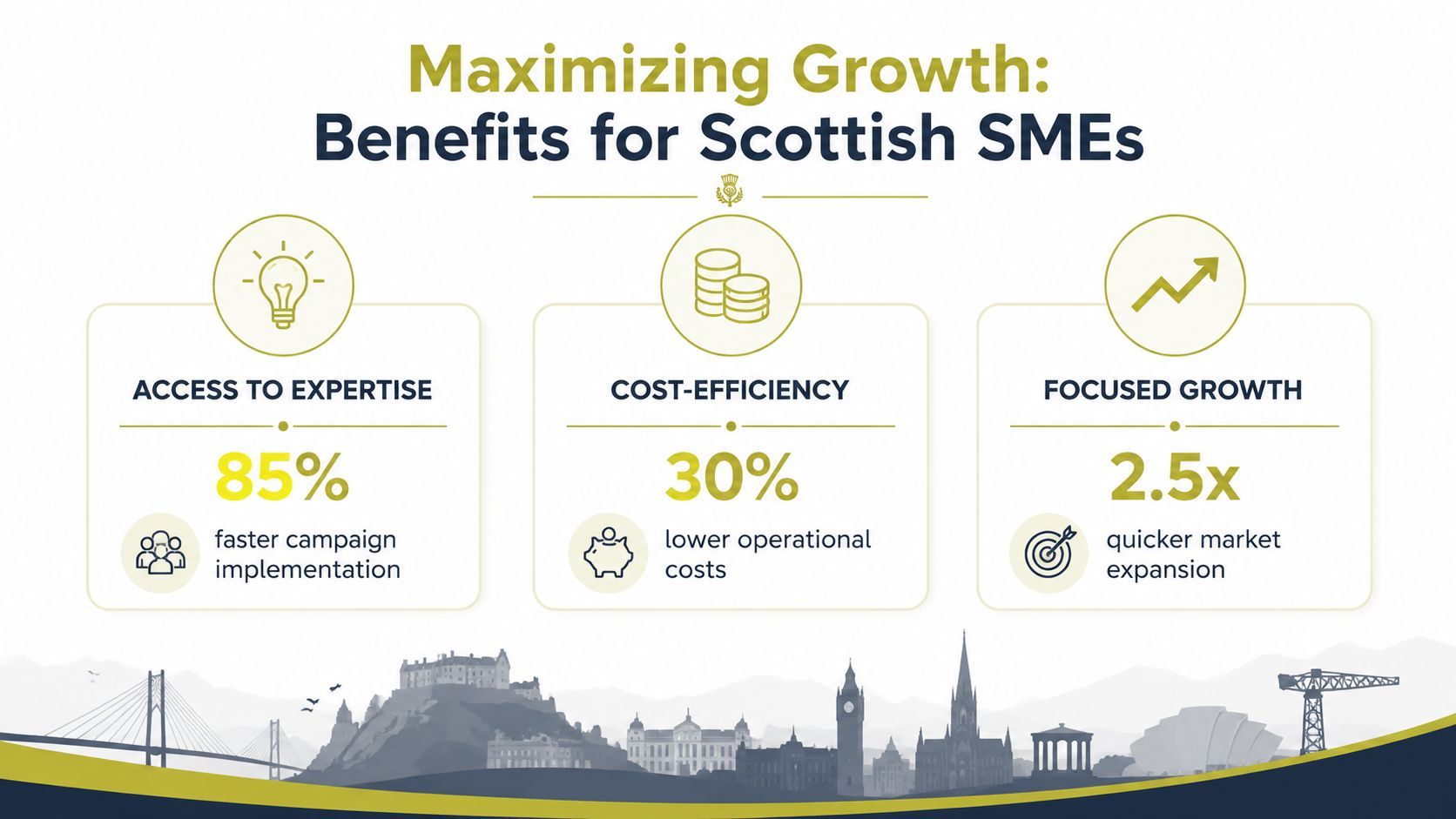
One experienced freelancer can be valuable. One in-house marketer can also be valuable. But neither usually covers strategy, technical SEO, paid media, copy, content, design, analytics and web performance at a high level all at once.
That matters when your business is trying to grow in a competitive market. Agencies bring multi-skill support without forcing you to recruit every role yourself. For Scottish SMEs, that's often the first major advantage. You get broader capability faster.
You move quicker
An experienced agency already has workflows for research, planning, production, launch, reporting and iteration. That means less reinvention and fewer delays.
In-house teams often lose momentum because they're pulled into everything else the business needs. Agencies are hired to keep momentum alive. They don't stop because someone had to jump onto payroll, customer complaints or a supplier issue.
If you run an ecommerce business, conversion work deserves special attention. These proven strategies for ecommerce growth are a useful reference because they focus on the part many SMEs ignore after traffic acquisition.
For businesses looking at regional support, Carlos Alba Media outlines its digital marketing agency work in Scotland, including digital content, web, SEO, UX and social services.
ROI comes from disciplined optimisation
This is the point most founders care about and rightly so. The strongest operational benchmark isn't one flashy metric. It's whether the agency uses data to improve efficiency over time.
The core value of a digital agency is its targeted and data-driven approach. A competent agency uses testing, analytics and reporting to identify which audiences, messages and platforms produce the best ROI, according to the Digital Marketing Institute's explanation of agency operations.
That has practical consequences:
- Audience segmentation matters: Not every prospect should see the same message.
- Budget should move: If one channel is underperforming, spending shouldn't sit there out of habit.
- Your website must be part of the system: Poor UX subtly drags down paid and organic performance.
If an agency can't explain what it's testing, what it's learning, and what it changed as a result, it's not managing performance. It's reporting activity.
For SMEs, that's the whole game. Marketing has to become an investment that can be refined, not a monthly bill you tolerate.
When Is the Right Time to Hire an Agency
The right time isn't “when we're bigger”. It's when the current setup is blocking growth.
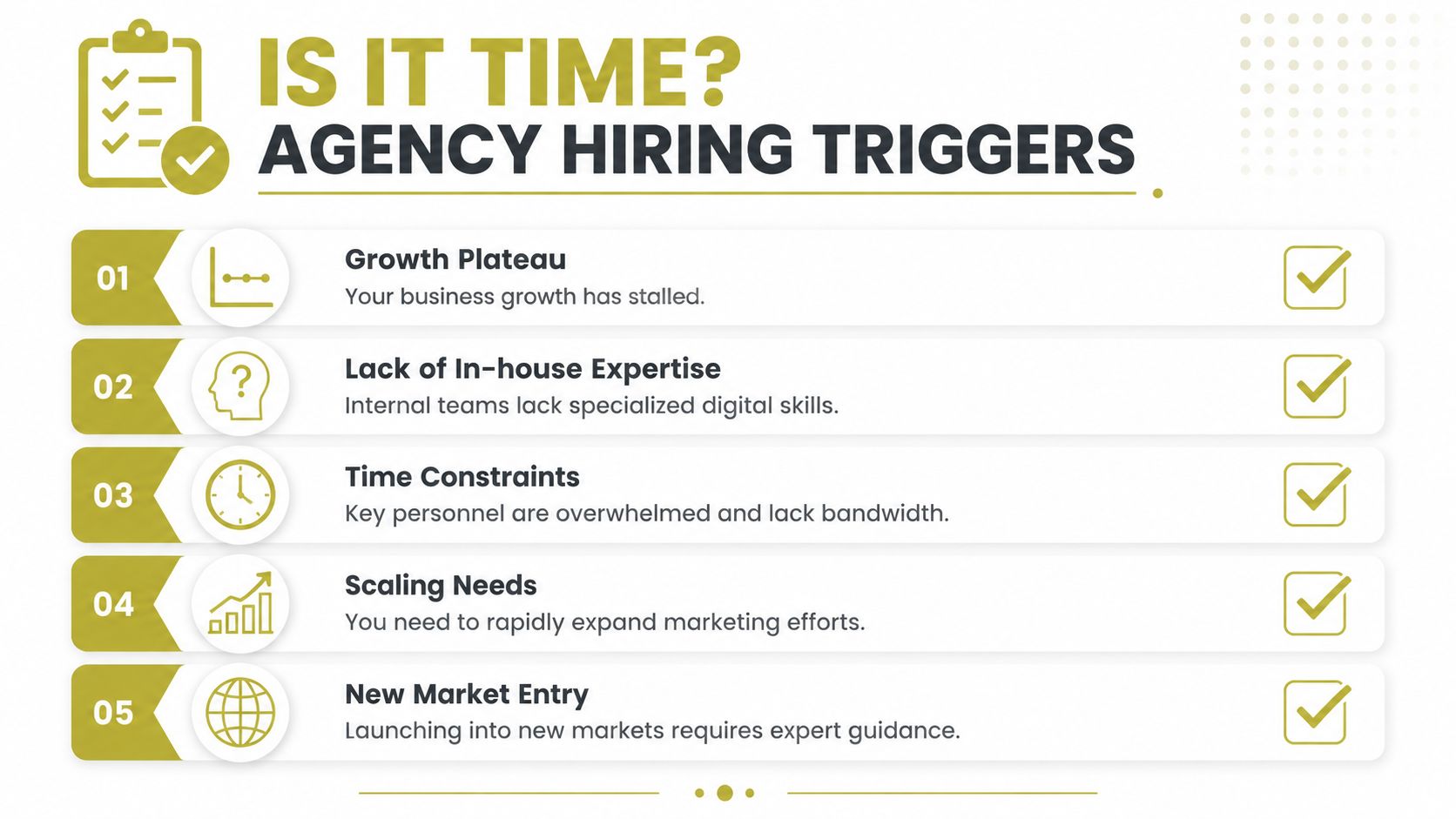
The clearest hiring triggers
Some signs are obvious once you stop pretending things are fine.
- Growth has stalled: You've hit a plateau and don't know whether the problem is traffic, message, targeting or conversion.
- Marketing depends on one overstretched person: That could be you, a generalist marketer, or a sales lead doing marketing on the side.
- You're entering a new market: New locations, new products or new audiences usually need sharper channel strategy.
- Your activity is fragmented: The website, ads, social and content are all being done, but they don't connect.
- You need faster execution: Internal coordination is too slow to launch and improve campaigns consistently.
Agency vs freelancer vs in-house
At this stage, founders need to be honest.
A freelancer is a good choice when you have a clearly defined task. Maybe you need a PPC specialist, a designer, or a copywriter for a set project.
An in-house hire makes sense when marketing is core enough to need daily integration with sales, operations and leadership, and you know exactly which role to recruit.
An agency is the right choice when you need a multi-channel strategy and different specialist skills at the same time. That's the distinction that matters most for SMEs. The key question isn't just what an agency is. It's when an agency creates better ROI than a part-time hire or freelancer. The answer lies in access to a multi-skilled team and strategic support without the overhead of building it in-house, as outlined by Digital Agency Network's guidance on when agencies make sense.
A blunt decision filter
Ask yourself these three questions:
- Do we know which channels drive qualified enquiries?
- Can our current team plan, execute and improve across those channels consistently?
- Is leadership spending too much time managing marketing instead of running the business?
If you answered no, no and yes, you probably don't need more internal effort. You need outside capability.
Hire a freelancer for a task. Hire in-house for ownership. Hire an agency when the challenge is broader than one discipline.
Choosing Your Agency Partner and What to Ask
Most agency buying mistakes happen before the work begins. Founders ask soft questions, get polished answers, and sign with a team that sounds confident but doesn't fit the business.

Start with the commercial fit
Don't begin with “What services do you offer?” That tells you very little. Start with whether they understand your business model, sales cycle and growth constraints.
Ask questions like these:
- How would you prioritise channels for a company like ours in the first quarter?
- What would you need from us internally for this to work?
- How do you define success for a business with our sales cycle?
- Where do SME campaigns usually break down?
- What would you tell us not to spend money on yet?
Those questions force an agency to think, not recite.
Test how they think under pressure
Any agency can describe a win. Ask about a miss.
A better set of questions looks like this:
| What to ask | Why it matters |
|---|---|
| Can you walk me through a campaign that underperformed and what changed afterwards? | You'll learn whether they diagnose problems or hide them |
| Who will actually do the work day to day? | Many agencies sell senior and deliver junior |
| How often do you review performance and change tactics? | You want active management, not static monthly reporting |
| What reporting will we get and how will it connect to business goals? | Vanity metrics waste time |
| How do you handle content, approvals and delays on the client side? | Execution often fails because process is vague |
Understand how pricing works
Pricing usually falls into a few common structures.
Retainers suit ongoing work like SEO, paid media, content and reporting. You're paying for continuity, management and iteration.
Project fees suit defined work such as a website rebuild, a campaign launch, or a content sprint.
Performance-linked models can sound attractive, but they need careful definition. If the targets, tracking and commercial assumptions are fuzzy, the arrangement becomes messy fast.
If you want a practical sense of how one agency structures this, Carlos Alba Media sets out its digital marketing agency pricing and package options.
Look for communication quality, not just capability
Many founders underweight the obvious: you need an agency that communicates clearly, challenges weak assumptions, and doesn't hide behind jargon.
That's particularly relevant if your brand depends on authority, reputation or public trust. Teams with editorial and media experience often write more sharply, question assumptions earlier, and understand how to shape stories that people pay attention to. A journalist-trained team tends to ask better questions because it's trained to find the angle, tighten the message and cut waffle.
That's one reason some SMEs prefer a story-led partner over a pure performance shop. You don't just need traffic. You need a message that lands.
The right agency should make your marketing clearer within the first conversation. If you leave more confused than when you started, walk away.
Your Next Steps to Digital Growth
A digital marketing agency isn't magic. It's a business tool. Used well, it gives a growing SME access to strategy, specialist execution and proper performance management without the burden of building everything internally.
The useful takeaway is simple. If your marketing is fragmented, your team is stretched, and growth depends on skills you don't currently have, agency support is often the sensible move. Not because agencies are fashionable, but because your business needs coordinated capability.
Before you speak to anyone, write down five things:
- Your main commercial goal: More leads, stronger enquiries, ecommerce sales, market entry, or retention.
- Your current bottleneck: Traffic, conversion, weak messaging, poor follow-up, or lack of internal capacity.
- The channels you already use: Be honest about what's active and what's just sitting there.
- What success would look like: Not abstract visibility. Real business impact.
- What internal support you can give: Approvals, access, product insight, customer knowledge.
Then take those notes into agency conversations and ask better questions. Ask how they'd prioritise. Ask what they'd cut. Ask what they need from you. Ask how they'll report progress in a way your business can use.
If you started with the question digital marketing agency what is it, the answer now should be clearer. It's not just a supplier. It can be a growth partner, if the fit is right and the expectations are sharp.
If you want a grounded conversation about PR, search, content, web performance and digital growth from a Scottish-led team, Carlos Alba Media is one option to consider. The agency combines former national news journalists with agency professionals who've worked with international brands, which suits SMEs that need both sharper storytelling and stronger digital execution.