
Most advice about hiring a digital marketing agency online is wrong. It tells you to compare prices, ask for case studies, and pick the firm that “fits your budget”. That's how founders end up paying twice. First for the cheap agency, then for the senior team that has to clean up the mess.
The true decision isn't cost. It's capability under pressure. Can this agency help you grow, protect your reputation, and make sensible channel choices when search is shifting, platforms control attention, and your team doesn't have time for endless rework?
That matters in the UK because digital is where the market is. 97.8% of the UK population were internet users in January 2025, with 54.8 million people online, and 79.0% of UK internet users active on social media, according to DataReportal figures referenced here. If you choose well, a digital strategy can reach almost the whole country. If you choose badly, you can waste a serious amount of time, budget, and credibility in public.
I'd treat your first serious agency hire like a senior leadership appointment, not a supplier purchase. The agency will influence your messaging, your visibility, your website performance, your lead quality, and in some sectors, your legal and reputational exposure too.
Beyond Price Tags Finding Your Strategic Partner
The cheapest agency rarely gives you the best value. It often gives you the lowest day rate attached to the least experienced people, the weakest strategic thinking, and the slowest response when something goes wrong.
That's the trap. Founders think they're buying output. They're buying judgement.
A proper digital marketing agency online should act like an extension of your leadership team. That means pushing back on bad ideas, spotting channel risk early, and telling you when your brief is muddled. If an agency says yes to everything in the first call, be careful. Sensible partners challenge assumptions.
What you're really buying
You're not hiring an agency to “do some SEO” or “post on LinkedIn”. You're hiring one to answer harder questions:
- Which channels deserve budget now when search behaviour is changing and attention is concentrated on a handful of major platforms?
- What message will convert with buyers, investors, journalists, partners, or regulators?
- What can damage trust if it's handled badly?
- Who is accountable when results stall?
Practical rule: If the agency talks more about deliverables than decisions, they're probably a production shop, not a strategic partner.
A lot of the usual advice on selecting the right digital agency is useful, but I'd add one blunt filter. Don't ask, “Can they do the work?” Ask, “Would I trust them in a bad month?” Good agencies earn their keep when performance dips, a story breaks, a campaign misfires, or a board member wants answers.
The vendor mindset costs more
A vendor waits for instructions. A partner improves the brief, spots blind spots, and protects your brand from lazy marketing decisions. That difference won't always show up in a pitch deck. It shows up in meetings, in the quality of questions, and in how the agency thinks about risk.
If you're an SME owner, stop shopping for the lowest quote. Start looking for the team you'd want beside you when the stakes go up.
Defining Goals Before You Search
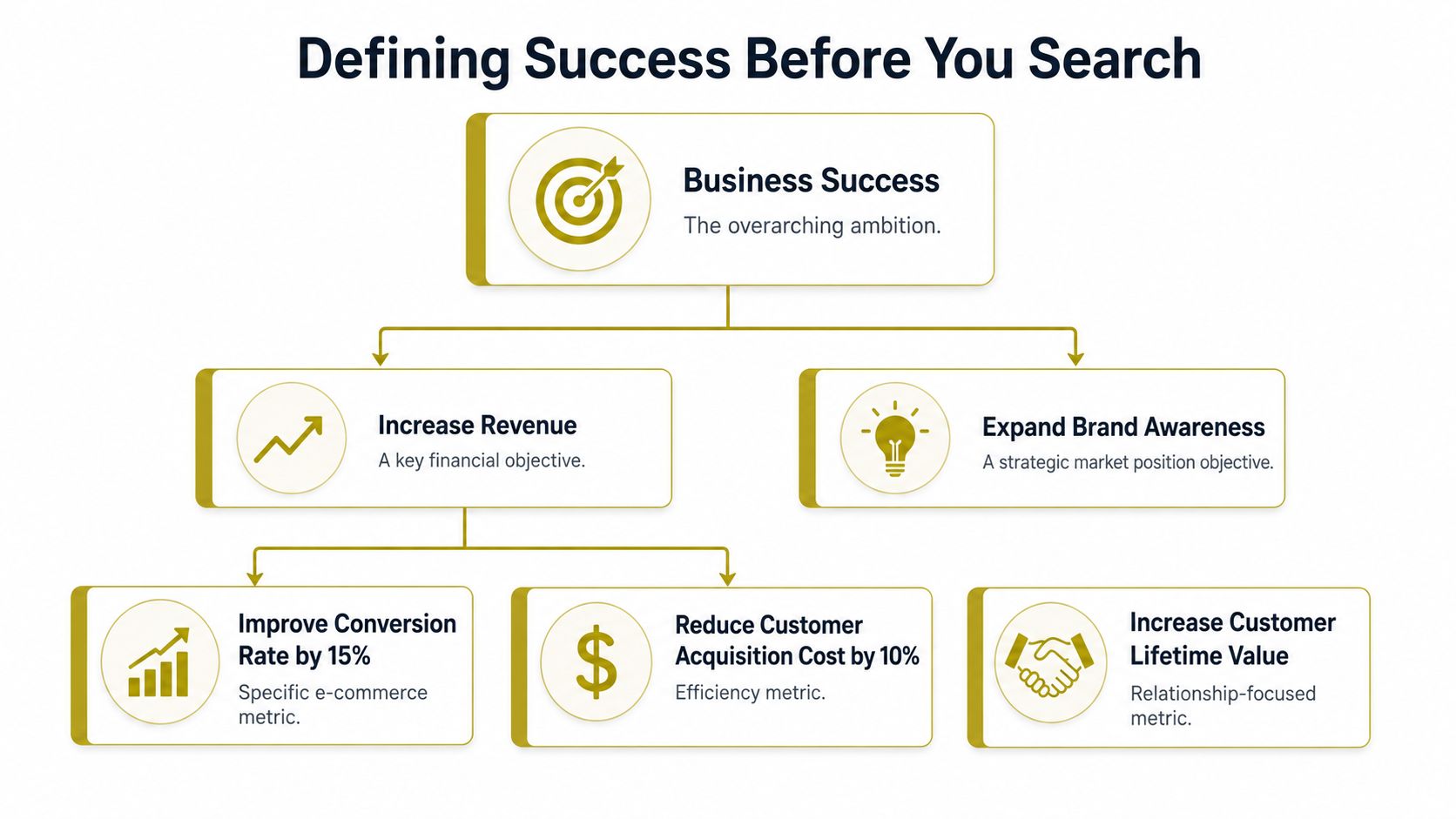
Don't start with “we need marketing”. Start with what the business needs to achieve.
That sounds obvious, but most founder briefs are vague. They ask for traffic, followers, rankings, content, ads, or “more awareness”. None of that helps an agency build the right plan. A decent agency can't rescue a lazy brief.
Start with the business problem
Write down the commercial problem in one sentence. Be specific.
Examples:
- We need better-quality inbound leads because sales is wasting time on poor-fit enquiries.
- We need stronger brand credibility before a fundraise, launch, or expansion.
- We need to recover lost visibility after a website migration or drop in search performance.
- We need to build trust in a regulated market where careless claims create risk.
That first sentence changes everything. It tells a serious digital marketing agency online what success should look like, what channels matter, and what should be ignored.
Turn goals into channel choices
A founder in a B2B software firm might think they need SEO. They might need sharper positioning, better landing pages, founder profiling in the press, and paid search around high-intent commercial terms. A hospitality brand might think it needs social content. It may really need stronger local search visibility, conversion-focused website copy, and digital PR that earns trust quickly.
Use this simple framework before you approach agencies:
Business objective
Revenue, credibility, recruitment, market entry, reputation repair, investor visibility, or customer retention.Marketing outcome
More qualified leads, stronger branded search, better conversion from existing traffic, improved media visibility, or clearer authority in your niche.Service requirement
SEO, paid search, digital PR, social media, content strategy, website redesign, conversion copywriting, or crisis support.Internal constraint
Limited approvals, weak in-house content capacity, compliance sign-off, no proper analytics, poor website CMS, or unclear ownership.
If you can't explain the business problem in plain English, you're not ready to brief an agency.
A brief that attracts the right agencies
A strong brief doesn't need to be long. It needs to be sharp. Include:
- What the business does and who it sells to
- What needs to change over the next period
- What's already been tried
- Which channels matter most
- Who signs off
- What internal bottlenecks exist
- What success would look like
Here's the blunt truth. In a market this connected, you don't need to ask whether digital matters. You need to ask who can use it well. The UK opportunity is huge, with 97.8% of the population online, 54.8 million internet users, and social media reaching 79.0% of UK internet users, as noted in this UK digital marketing overview. That scale makes clarity more important, not less.
One practical SME example
Say you run a specialist financial services firm. You want growth, but trust matters more than raw traffic.
Your brief might look like this:
| Area | Clear brief |
|---|---|
| Business goal | Win more qualified enquiries from UK decision-makers |
| Marketing need | Build authority and improve lead quality |
| Likely services | Thought leadership content, digital PR, conversion-focused website updates, selective SEO |
| Risk factor | Compliance review slows approvals |
| Success signal | Better-fit conversations with buyers, not just more form fills |
That's a useful starting point. It weeds out agencies that only know how to sell generic packages.
Evaluating True Agency Expertise
A polished proposal tells you almost nothing about who'll do the work. That's the first thing founders get wrong. They buy the pitch team, then get handed to juniors.
Real expertise sits in the delivery bench. You need to know who writes, who edits, who handles strategy, who deals with journalists, who manages paid media, and who fixes technical issues when your site starts leaking leads.

Case studies don't prove judgement
Case studies can be useful, but they're usually marketing documents. They show selective wins, not how the agency thinks. I care more about the team's background than the PDF.
If you need PR, thought leadership, media handling, or high-stakes messaging, former journalists are often far more useful than generic content teams. They know how editors think, what makes a line credible, and how weak claims get ignored. If you need enterprise-style brand discipline, people who've worked on international accounts often bring tighter processes and better client handling.
That's one reason specialist consultancies stand out. At Carlos Alba Media, the team is made up of former national news journalists or people with agency experience on international brands, and the agency's service mix covers PR, SEO, web, social, and digital strategy. That kind of background matters if you want senior counsel rather than junior task management.
Ask to meet the people doing the work
Don't stop at the founder or sales lead. Ask to meet the people responsible for delivery. Then ask questions that expose whether they understand your reality.
Use questions like these:
- Who will own strategy month to month?
- Who writes the content and who edits it?
- How do you handle approvals in regulated sectors?
- How do you adapt when search visibility changes but clicks don't follow?
- What happens if a campaign underperforms for two months?
- Who joins the call if we face negative press or a reputational issue?
A senior team should answer directly. If they hide behind jargon, they probably don't have a clear process.
Good agencies don't just sell activity. They explain trade-offs, likely constraints, and what they'd deprioritise.
Why senior-led matters more for SMEs
Most UK businesses are small or medium-sized. The ONS reported around 5.5 million UK businesses were active in 2024, and the vast majority were SMEs, a point discussed in this analysis of agency risk and SME ROI. For those businesses, the return from a senior-led agency isn't only about growth. It's about avoiding expensive mistakes in compliance, reputation, and execution.
That's where low-cost agencies can become a liability. Junior-heavy teams often need more rounds, more supervision, and more rescue work. They can publish weak content, mishandle a reactive issue, or chase vanity metrics that don't help sales.
If your business depends on trust, a cheap retainer can become very expensive.
Look for thinking across channels
A serious digital marketing agency online shouldn't treat SEO, paid, PR, web, and social as separate silos. Buyers don't experience your business that way. They see your site, your search listing, your press coverage, your founder profile, your reviews, and your social presence together.
For B2B firms in particular, lead generation only works when those pieces line up. If you want a useful outside perspective on optimizing B2B lead generation, review how outreach, positioning, and conversion paths support each other. Then ask your shortlisted agencies whether their strategy reflects that reality.
A strong team also needs a view on AI-shaped search. Later in the process, make them show it.
Here's a useful conversation starter before that next meeting:
Decoding Proposals and Shortlisting Contenders
Once the proposals arrive, stop reading like a buyer and start reading like an operator. You're not looking for polish. You're looking for signs of disciplined thinking.
Most proposals fail quickly. They're stuffed with generic service descriptions, vague promises about visibility, and charts that never connect activity to commercial outcomes. If an agency can't tailor a proposal to your brief, they won't tailor the work either.
What a credible proposal should include
A serious proposal usually shows five things.
First, it reflects your business problem accurately. Not just your sector, but your actual challenge.
Second, it prioritises. Good agencies don't recommend every channel at once. They explain what matters now and what can wait.
Third, it names the team and the level of seniority involved.
Fourth, it sets sensible KPIs. Not fluffy metrics that look nice in a report.
Fifth, it makes the operating model clear. Meetings, reporting, approvals, dependencies, and timeline.
Watch for this: if “impressions” dominate the proposal and commercial outcomes barely appear, the agency is selling theatre.
The search question most agencies still dodge
A digital marketing agency online should now be able to explain how it plans for search visibility in a world shaped by AI summaries, zero-click behaviour, and platform concentration. That isn't a niche issue. It's central to channel planning.
As noted in this discussion of agency strategy gaps in AI-shaped search, UK buyers should press agencies on how they combine SEO, paid search, PR-led visibility, and owned content when clicks from search results can become less predictable. If an agency still talks as though rankings alone solve the problem, it's behind.
Ask this directly: How do you build visibility and demand if search sends fewer clicks than it used to?
Strong answers usually include:
- Brand authority work through expert content, press coverage, and founder visibility
- Paid search discipline around high-intent terms rather than broad waste
- Website improvement so the traffic you do get converts properly
- Content built for decision stages rather than volume for its own sake
Use a scoring matrix, not gut feel
When you've got three plausible contenders, force structure into the process. Score them.
| Evaluation Criterion | Agency A Score (1-5) | Agency B Score (1-5) | Notes |
|---|---|---|---|
| Strategic alignment | |||
| Understanding of our sector | |||
| Seniority of delivery team | |||
| Clarity of KPIs | |||
| Approach to AI-shaped search | |||
| Website and conversion thinking | |||
| Reporting and communication | |||
| Risk and reputation awareness | |||
| Cultural fit | |||
| Commercial clarity |
Use the matrix in the meeting. Don't fill it in later from memory.
Red flags that should end the conversation
I'd move on quickly if you see any of these:
- Copy-paste language that could apply to any business
- Unnamed delivery staff or vague talk about “our team”
- No view on priorities because everything is apparently urgent
- No challenge to your brief, which usually means weak strategic confidence
- Overloaded service lists that mask lack of specialism
- Foggy pricing with too many assumptions hidden in the small print
If you want a benchmark for how agencies present monthly retainers and packaged scopes, compare their proposal against a transparent agency pricing and packages structure. You're not looking for the same prices. You're looking for the same level of clarity.
Negotiating the Partnership and Onboarding for Success
The contract matters more than founders think. It sets the tone for every difficult conversation later.
In the UK, digital advertising is a mature market. UK digital ad spend reached £35.5 billion in 2023, up 13.8% year on year, according to IAB UK and PwC figures referenced here. That level of spend creates hard expectations. Clients want measurable return. Agencies want room to do proper work. The contract is where those expectations either line up or break apart.
What should be nailed down before signature
Don't just check the monthly fee. Check the mechanics.
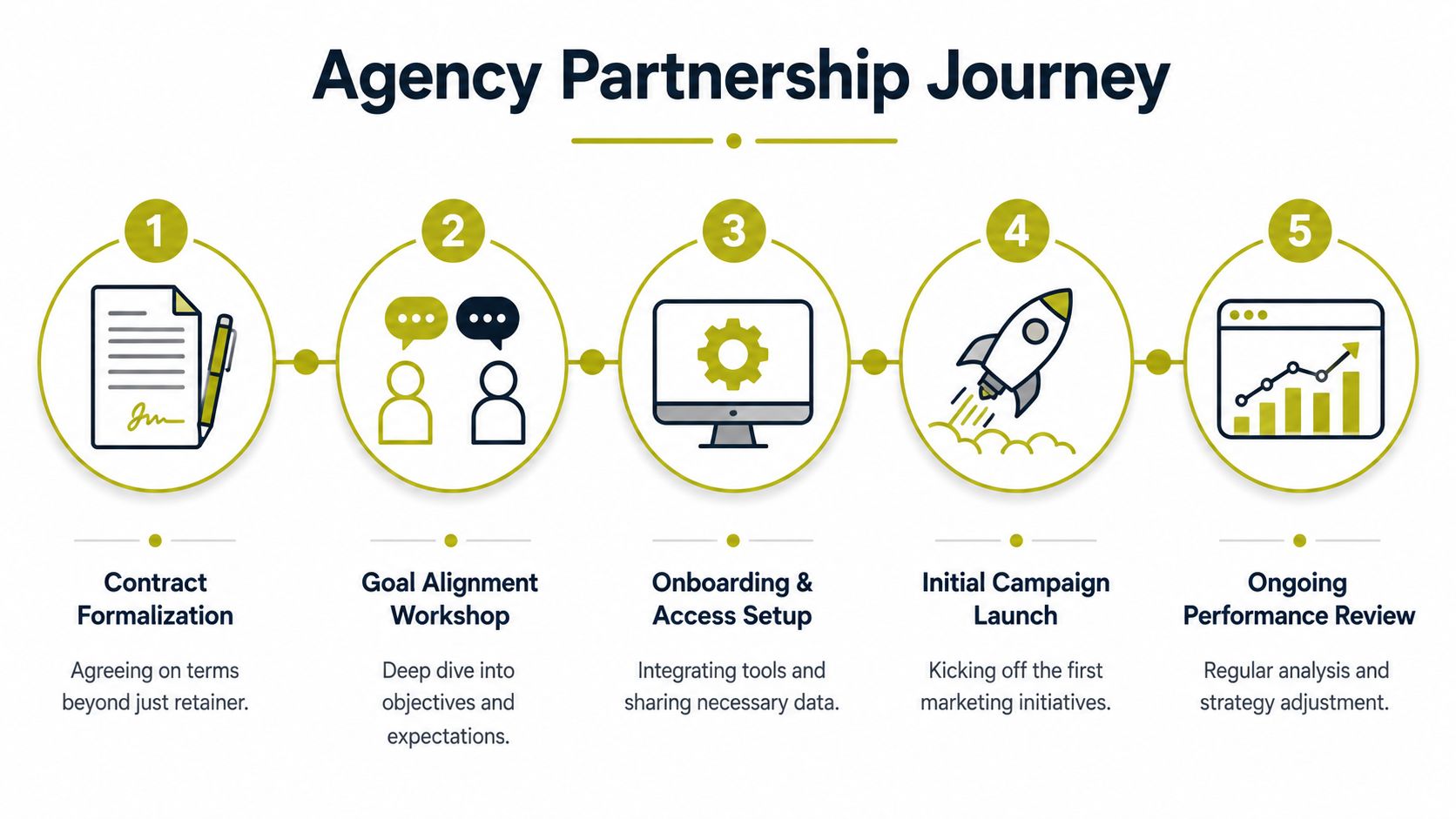
I'd expect the agreement to cover:
Scope and exclusions
What is included, what is not, and what triggers additional fees.Access and dependencies
Who provides analytics access, CMS access, ad accounts, brand assets, legal sign-off, and subject-matter input.Response times and cadence
Weekly call, fortnightly review, monthly report, urgent escalation path.Ownership
Who owns copy, creative, data, campaign assets, landing pages, and accounts if the relationship ends.Exit terms
Notice period, handover obligations, and what happens to work in progress.
A vague contract doesn't create flexibility. It creates arguments.
The first month tells you a lot
A professional onboarding process is never chaotic. It should feel organised, calm, and slightly demanding. Good agencies need information from you, and they won't pretend otherwise.
Expect a proper kick-off workshop. That meeting should clarify objectives, audiences, offers, commercial priorities, internal politics, and approval routes. It should also expose problems early. Weak tracking, confused positioning, clashing stakeholders, and unrealistic deadlines need to be surfaced now.
What a healthy onboarding sequence looks like
A sensible first stretch often includes:
Strategic alignment session
Business goals, target audiences, priority services, and current bottlenecks.Audit and access setup
Analytics, Search Console, ad accounts, CRM inputs, CMS permissions, and existing content.Measurement framework
Agreed KPIs, reporting format, lead definitions, and attribution expectations.Initial work plan
What gets done first, who approves it, and what the decision points are.Review rhythm
A regular calendar for reporting, feedback, and strategic updates.
Don't leave KPI definitions fuzzy
If “lead” means one thing to your sales team and another thing to your agency, your reporting will become nonsense. Fix definitions early.
Be equally clear about what success won't mean. More traffic with no improvement in lead quality isn't success. More social engagement without commercial relevance isn't success. Press coverage that attracts the wrong audience isn't success.
A good partnership starts with clean expectations, blunt conversations, and documented accountability.
Crisis Readiness for Regulated and High-Profile Sectors
If you operate in finance, healthcare, legal services, property, education, public affairs, or any sector where trust is fragile, your agency choice is partly a risk decision.
A lot of agencies can run ads, write blogs, and schedule posts. Far fewer can handle a hostile journalist, a reputational flare-up, a compliance-sensitive campaign, or a late-night issue that needs fast judgement. That gap matters.
Growth is only half the job
In regulated and high-profile sectors, marketing and reputation are tied together. A weak claim, sloppy landing page, reckless social post, or mishandled complaint can undo months of sensible brand work. That's why I'd always test an agency's crisis readiness during the sales process.
Ask direct questions:
- Who leads if negative coverage lands?
- What is your escalation process?
- How do you work with legal advisers when wording is sensitive?
- Can you brief spokespeople for interviews under pressure?
- How do you balance fast response with factual accuracy?
If the answer sounds improvised, walk away.
Why former journalists matter here
This is one area where specialist experience makes a clear difference. Former national news journalists understand deadlines, newsroom behaviour, hostile questioning, and what makes a line defensible. They know that silence can be damaging, but so can panicked overreaction.
That's especially relevant if your digital marketing agency online also handles PR, executive profiling, or media relations. The same team shaping your visibility may one day need to protect it.
In sensitive sectors, the agency isn't just helping you get noticed. It's helping you stay credible.
Look for a written crisis process
Don't accept “we'll handle it if it happens”. That's not a process.
A credible agency should have a defined approach to triage, messaging approval, spokesperson preparation, monitoring, and stakeholder communication. If crisis planning matters to your business, review a practical crisis communications plan framework and compare it against what the agency proposes.
That exercise tells you something important. Whether they think like a campaign supplier, or like advisers who understand consequence.
The right agency should help you grow, yes. But in the tougher sectors, it should also lower risk, sharpen judgement, and give your leadership team confidence when the pressure rises.
If you want senior-level PR and digital support from a team built around former national news journalists and agency professionals with international brand experience, Carlos Alba Media is one option to consider. The firm works with SMEs, founders, and established organisations across PR, digital content, SEO, web, social, and crisis communications, with teams in London and Glasgow.