
A decision usually feels hardest at the exact moment you can least afford delay. A journalist is asking for comment. A customer has posted a damaging video. Your legal adviser wants caution, your sales lead wants speed, and the founder wants the whole thing gone before lunch.
That's where most SMEs come unstuck. They don't lack intelligence. They lack a repeatable way to decide what matters, who decides, what evidence counts, and how to move quickly without making the problem worse.
In PR, crisis work, and fast-moving SME operations, a decision making framework isn't corporate theatre. It's how you stop panic from driving the room.
Why Gut Feel Is Not Enough in a Crisis
A familiar pattern plays out in small and mid-sized businesses. Bad news breaks. Slack fills up. Someone suggests saying nothing. Someone else starts drafting a statement no one has approved. The managing director asks for “options” but doesn't define the decision. Half an hour disappears. Then an hour. By the time a response goes out, the delay has become part of the story.
Gut feel works when the problem is familiar and the stakes are low. It fails when the issue is public, emotional, legally sensitive, or moving faster than your internal chain of command.
In the UK, people rely more heavily on official statistics and structured information when making important personal decisions, especially when they lack personal experience on a topic, according to the Office for Statistics Regulation's findings on personal decision-making. The same instinct shows up in business pressure. When leaders face uncertainty, they need a structure they can trust.
What goes wrong when teams improvise
The first failure is usually unclear ownership. Everyone has an opinion. No one knows who has the final call.
The second is mixed criteria. One person is judging legal exposure, another is judging press optics, another is worried about investor reaction. All valid. None aligned.
The third is evidence drift. Teams jump between screenshots, hearsay, customer emails, and social commentary without agreeing what's verified.
A practical crisis response needs a sequence such as:
- Confirm the decision. Are you deciding whether to respond, what to say, or who speaks?
- Confirm the facts. What do you know, what do you suspect, and what still needs checking?
- Confirm the consequence. What happens if you reply now, later, or not at all?
- Confirm authority. Who signs this off?
Practical rule: If your team can't state the decision in one sentence, they're not ready to make it.
That's why a proper framework matters. It creates speed through order, not speed through noise.
Teams also now face problems that didn't exist a few years ago. A shaky clip can be real, manipulated, edited out of context, or amplified by accounts with unclear motives. If you're assessing whether footage should trigger a public response, a guide to video authenticity analysis is useful because it forces a basic discipline before anyone reacts publicly.
If your business still handles crisis decisions by instinct and scattered messages, build process before the next issue lands. A good starting point is a clear crisis communications plan that defines roles, approvals, and escalation paths before pressure hits.
What Is a Decision Making Framework Really
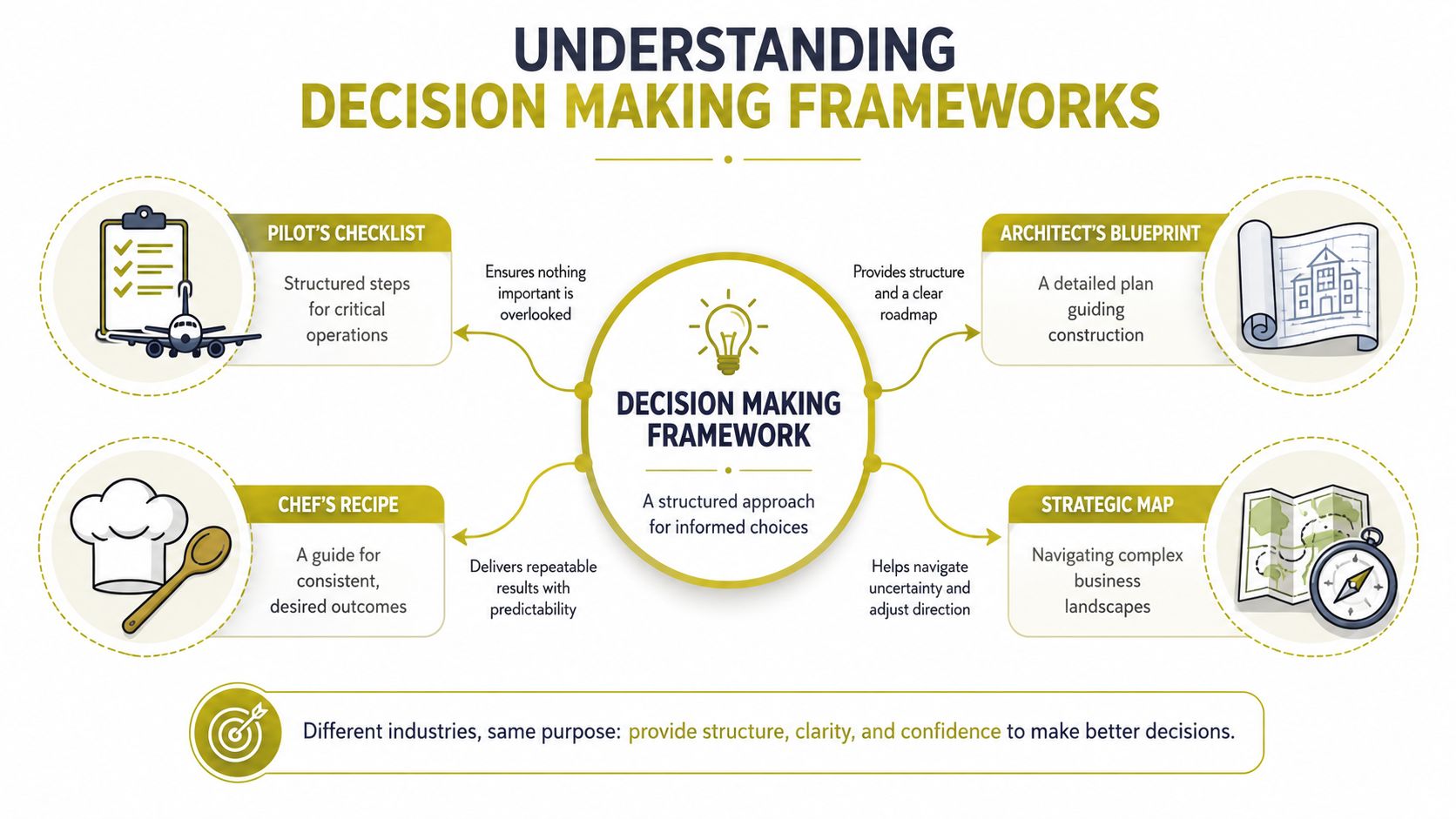
A decision making framework is best understood as a working scaffold. It doesn't make the decision for you. It makes sure you don't skip the parts that matter.
Consider a pilot's checklist. The checklist doesn't fly the aircraft. It prevents experienced people from missing essential steps under pressure. In business, the same logic applies. A framework helps a founder, marketing lead, or comms team move from reaction to judgement.
What a framework must contain
At minimum, a useful framework needs four parts.
| Element | What it does in practice |
|---|---|
| Clear objective | Defines the decision so the team doesn't solve the wrong problem |
| Decision criteria | Sets the standards you'll use, such as risk, timing, customer impact, or brand fit |
| Input and authority | Separates who contributes from who decides |
| Documented rationale | Records why the choice was made, which matters later |
Without those parts, meetings become circular. People repeat preferences instead of assessing options.
Why flexibility matters more than perfection
A framework isn't a script. It should flex with the size of the decision.
If you're choosing a speaking opportunity for a founder, the framework can be lightweight. If you're handling an allegation, regulatory complaint, or product safety concern, it needs more scrutiny. The structure stays. The depth changes.
That distinction matters because teams often overcorrect. They either use no framework at all, or they build a monster spreadsheet no one touches in a real-world crisis.
A workable model usually answers these questions:
- What are we deciding?
- What information is verified?
- Which criteria matter most here?
- Who needs input?
- Who makes the call?
- How do we record the reasoning?
A framework is there to reduce avoidable error. It isn't there to replace judgement.
Defensible decisions beat clever ones
A decision feels stronger when you can explain it cleanly to a board, investor, regulator, or journalist. That's the ultimate test. Not whether the choice sounded sharp in the room, but whether it can stand up afterwards.
That's why documentation matters. In PR and operations, memory gets rewritten fast after a difficult outcome. A short written record of context, options considered, decision taken, and reasoning protects the team from hindsight theatre. It also helps people learn from previous calls rather than relive the same argument every quarter.
The strongest frameworks aren't impressive. They're usable. Teams return to them because they make hard choices clearer, faster, and easier to defend.
Common Frameworks PR and Marketing Teams Can Use
Not every decision needs the same tool. That's where teams often waste time. They apply a heavyweight process to a simple issue, or they use a casual chat to handle a decision that needs hard structure.
The better approach is to match the framework to the kind of pressure you're under.
RACI for approvals and accountability
RACI is useful when a team keeps tripping over ownership. It separates who is Responsible, Accountable, Consulted, and Informed.
In PR, that's valuable for campaign sign-off, press office response chains, and partnership launches. If your team regularly asks, “Who's approving this?”, you need RACI.
A simple use case:
- Responsible might be the PR manager drafting the statement
- Accountable might be the managing director
- Consulted could include legal and operations
- Informed could be sales, customer support, and investors
RACI is weak when the issue is highly fluid. It clarifies roles, but it doesn't tell you how to think through uncertainty.
OODA Loop for fast-moving situations
OODA stands for Observe, Orient, Decide, Act. It suits social media flare-ups, breaking reputational stories, and moments when facts are still developing.
Its strength is rhythm. You don't wait for complete certainty. You move in cycles.
A comms team might use it like this:
- Observe the posts, comments, media enquiries, and internal reports.
- Orient around context. Is this a customer complaint, activist pressure, competitor attack, or genuine service failure?
- Decide the next action. That might be hold statement, direct outreach, temporary pause, or executive comment.
- Act, then reassess.
OODA works best when one person has clear authority and the team can update quickly.
Cynefin for choosing the response style
Cynefin is less common in SMEs, but it's useful because it stops teams treating every problem the same way.
Here's the short version.
| Situation type | Better response |
|---|---|
| Clear | Use established process |
| Complicated | Bring in expertise and analysis |
| Complex | Test, learn, adapt |
| Chaotic | Act first to create stability |
If a journalist asks for routine comment on a funding announcement, that's clear. If there's a technical product failure with disputed responsibility, that's complicated. If customer sentiment is shifting in unpredictable ways, that's complex. If false claims are spreading and no facts are settled, that may be chaotic.
Cynefin is helpful because it stops senior teams reaching for the same old response template.
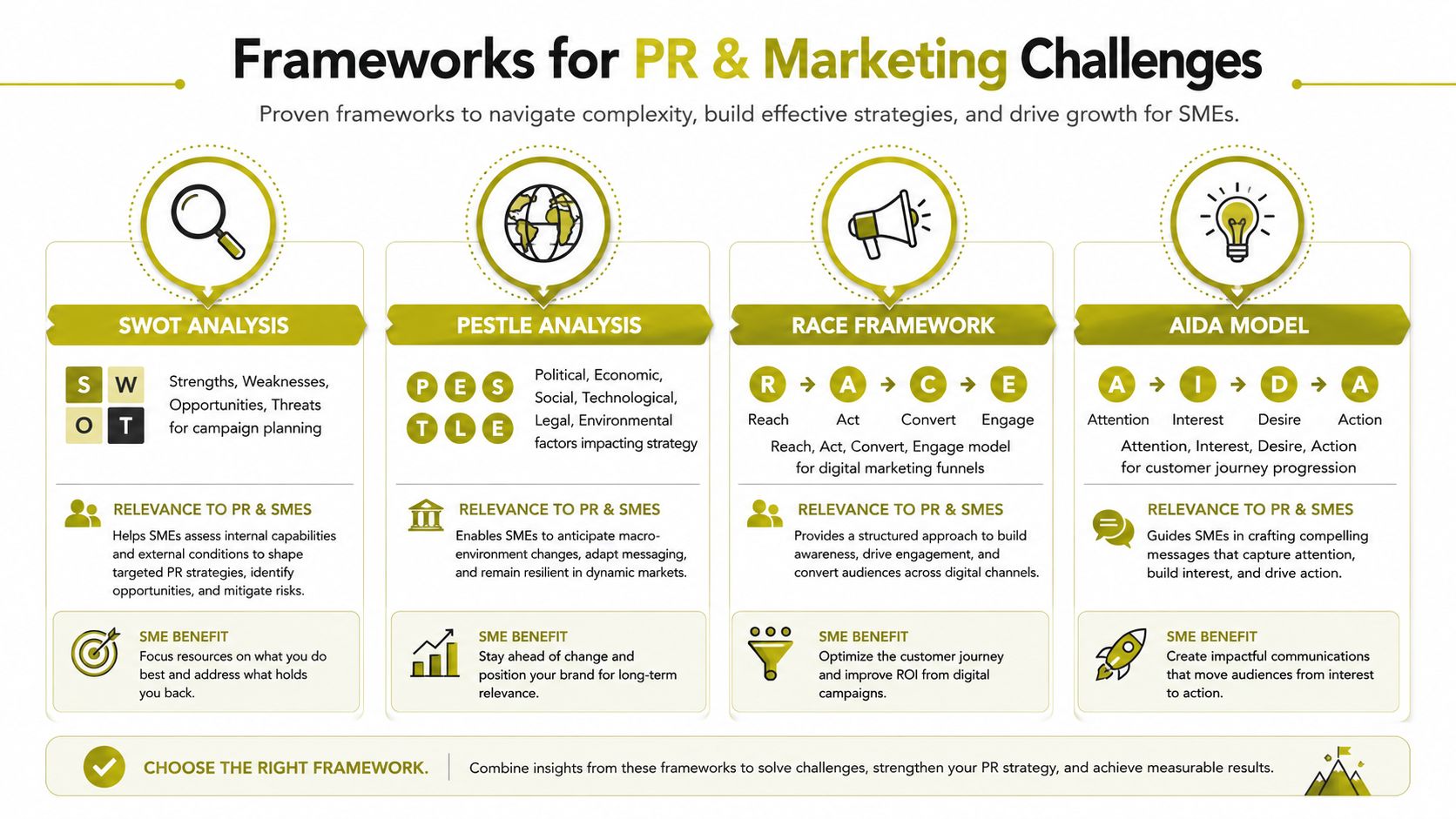
SWOT, PESTLE, RACE and AIDA for planning decisions
These frameworks are often dismissed as basic. Used properly, they're still useful.
- SWOT helps when you're deciding whether to back a campaign, launch, or market move.
- PESTLE is stronger when external conditions matter, such as regulation, political pressure, or public mood.
- RACE is practical for digital planning because it forces a sequence from reach through to engagement.
- AIDA is still a good sense-check for message design, especially when copy is too inward-looking.
For Scottish-based tech SMEs trying to sharpen market communications, that planning discipline becomes even more important when audience segments behave differently. An effective segmentation strategy helps stop teams from making one broad decision for users who need very different messages.
ADR thinking for documenting the why
Even in highly technical fields like UK government technology, simple frameworks such as the Architecture Decision Record are used to keep decisions transparent, consistent, and traceable, as described in the UK government blog on the ADR framework. That matters outside technology too.
For PR and marketing teams, ADR-style notes are powerful because they force a short record of:
- context
- options considered
- chosen direction
- reasoning
That's especially useful for channel strategy, messaging shifts, brand positioning, and AI-related publishing decisions. If your team is also reworking content to improve AI search visibility, an ADR-style note can keep the rationale clear when someone later asks why the content structure, schema, or editorial priorities changed.
Use this test: if the decision will be questioned later, write down the why today.
No framework is magic. The value comes from choosing the lightest one that still gives you clarity.
How to Build Your Custom Decision Framework
Most SMEs don't need a textbook model. They need a framework that fits the everyday decisions they make every week. Press statements. Sponsorships. Product launch messaging. Complaints. Partnerships. Interview requests. Paid campaign pivots. Executive LinkedIn posts that carry legal or reputational risk.
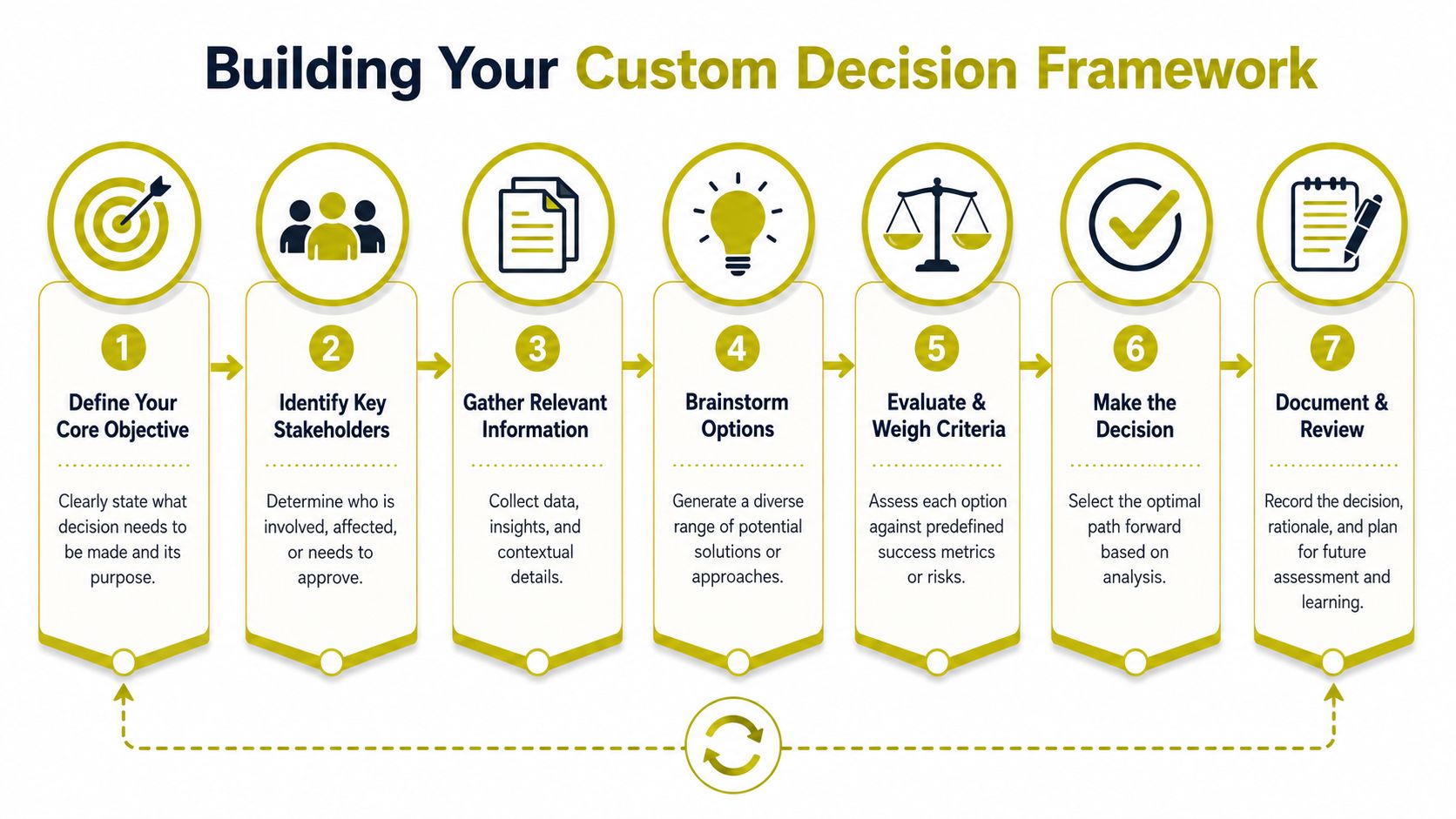
Start with one page. If your framework needs a workshop to understand, it's already too heavy.
Start with scope, not ambition
The first mistake is trying to create one framework for every possible decision. Don't.
Pick a category first. For example:
- Media decisions such as interview acceptance, comment requests, and reactive statements
- Marketing decisions such as campaign approval, channel shifts, or messaging changes
- Crisis decisions such as escalation, public response, and spokesperson selection
- Commercial decisions such as partnerships, event participation, and brand associations
A narrow scope makes the framework usable.
Set criteria before the room gets noisy
Your criteria should reflect how your business judges a decision. Good criteria are specific enough to force trade-offs.
A useful set might include:
| Criteria | What to ask |
|---|---|
| Strategic fit | Does this support the business objective? |
| Reputational risk | Could this damage trust if handled badly? |
| Audience impact | How will customers, staff, investors, or regulators read this? |
| Legal or compliance exposure | Does this need specialist review? |
| Timing | Does delay increase risk, or would delay improve accuracy? |
| Resource demand | Can the team deliver this properly now? |
You don't need weighted scoring for every decision. Sometimes a red-flag criterion is enough. If legal exposure is high, the matter escalates. If audience impact is low, the team can decide without senior involvement.
Working principle: Set the rules before the personalities enter the conversation.
Map who gives input and who decides
A lot of poor decisions come from confusion, not bad judgement. The founder thinks legal has final say. Legal thinks it's advisory. Marketing thinks they own channels. Comms thinks they own reputation.
Write the workflow down.
- Initiator. Who raises the issue?
- Fact owner. Who verifies the information?
- Consulted voices. Which functions must comment?
- Decision owner. Who has final authority?
- Executor. Who puts the decision into effect?
- Review owner. Who checks the result later?
This doesn't have to be complicated. It has to be visible.
A strong real-world benchmark comes from the UK government's own automated decision-making model, which mandates a 7-point ethics, transparency, and accountability framework, including quarterly reviews and bias assessments, as set out in the government framework for automated decision-making. The principle is useful well beyond government. Good frameworks are explicit, reviewable, and accountable.
A short explainer can help if your team needs a visual walkthrough of how to turn a messy judgement into a repeatable process.
Build the one-page template
A practical template can fit into a shared doc, Notion page, or approval form. It should include:
- Decision title
- Decision owner
- Deadline
- What we know
- What is unverified
- Options considered
- Criteria applied
- Decision taken
- Reasoning
- Actions required
- Review date
That final item matters. Teams usually remember to decide. They forget to review.
Keep it light enough to survive contact with reality
A custom decision making framework fails when it becomes ceremonial. If staff only use it when they have spare time, it won't exist when pressure arrives.
Stress-test it against three types of decision:
- Low-risk and routine
- Time-sensitive and public
- Sensitive and high-stakes
If the framework works only for one of those, adjust it. Remove friction where you can. Add checks where you must.
The best version is usually the shortest version that still protects the business.
Adapting Frameworks for Crisis Comms and Regulated Sectors
Generic frameworks often collapse in regulated environments because they assume speed and openness can always sit together. They can't. In healthcare, finance, education, and other sensitive sectors, you're often balancing public reassurance, legal constraints, customer understanding, and record-keeping at the same time.
That's why crisis comms in regulated sectors needs an adapted decision making framework, not a borrowed one.

Add a compliance lens without freezing the process
A useful adaptation is to split decisions into two layers.
The first layer asks, can we say or do this at all?
The second asks, if we can, what's the clearest way to do it?
That sounds obvious, but teams often merge those questions and get stuck. Compliance concerns swallow the room. Or comms runs ahead and creates a legal problem.
A regulated-sector framework should include explicit checks for:
- Claim substantiation. Can the business support what it wants to say?
- Audience vulnerability. Is the message reaching people who may misunderstand risk or process?
- Sector obligations. Does disclosure trigger any formal duty?
- Documentation. Is the decision recorded well enough for later scrutiny?
Make room for shared decision principles
A major gap remains in current guidance. No public framework effectively shows SMEs in regulated sectors how to integrate shared decision-making principles into crisis communications without breaching compliance, a problem highlighted in the discussion of shared decision-making in the UK NHS context.
That matters because regulated comms often fails at the point of explanation. The organisation knows the rules. The audience doesn't. If you're launching a health product, handling a patient-facing incident, or explaining a service interruption, the decision framework should force one more question: Will a non-specialist understand the choice in front of them?
That's especially relevant in sectors where public understanding varies widely. A healthcare communications approach has to respect both compliance and clarity, which is why specialist public relations for healthcare requires more than a standard campaign workflow.
The fastest compliant message is rarely the most technical one. It's the clearest accurate one.
Build a plain-English pressure test
Before sign-off, run the message through a simple challenge:
- What action does the audience need to take?
- What part could be misunderstood?
- What does the audience need now, not eventually?
- What wording removes confusion without softening the facts?
Many founder-led businesses struggle because they know the product, policy, or issue too well. Their framework needs a forced translation step. Not to simplify the truth, but to make the truth usable.
In crisis work, clarity is part of risk management.
Measuring Success and Avoiding Common Pitfalls
A framework earns its place when it improves decision quality and lowers avoidable friction. That doesn't always mean every outcome is positive. A sound decision can still lead to criticism. Ultimately, the test is whether the team moved clearly, consistently, and for the right reasons.
Measure success by process as well as result.
What good implementation looks like
Look for signs such as:
- Faster alignment. Fewer repeated debates about who approves what
- Cleaner escalation. Teams know when an issue stays local and when it goes up
- Better rationale. Senior leaders can explain the decision without backfilling the logic afterwards
- Fewer reversals. Decisions aren't being undone because key checks were missed
- Higher team confidence. Staff know how to bring a recommendation, not just a problem
Those indicators matter more than a neat template sitting untouched in a shared drive.
The mistakes that weaken a framework
The most common pitfall is bureaucracy. Teams build a process so heavy it guarantees delay.
The next is poor adoption. If leaders bypass the framework whenever pressure rises, staff will stop respecting it.
The third is stagnation. A decision making framework should be reviewed against real incidents, launches, and misfires. If it never changes, it slowly loses relevance.
Senior counsel insight: A framework should sharpen judgement, not mechanise it.
That's the value of experienced editorial and communications thinking. Carlos Alba Media's specialist nature is rooted in its team of former national newspaper journalists. Founder Carlos Alba is described on the agency website as a multi award-winning former national newspaper editor with decades of experience, including serving as Scotland Editor for The Sunday Times. That background reflects the discipline good decision-making needs under pressure. Everyone who works for Carlos Alba Media is a former national news journalist or has agency experience of working with international brands.
A strong framework won't remove pressure. It will stop pressure from making the decision for you.
If your business needs senior-level PR judgement, sharper crisis decision-making, or practical communications support without big-agency overheads, Carlos Alba Media brings newsroom discipline, strategic clarity, and experienced counsel to fast-moving situations.