
Post every day, be seen everywhere, and trust will follow. That's the most popular advice about a PR communication strategy, and it's backwards. Publishing is cheap. Being believed isn't. A full social grid can still leave customers, regulators and journalists unsure what you stand for, which claim is true, or who can defend it in an interview. Start with proof and trusted coverage, then use owned and social channels to carry that proof further.
What a PR Communication Strategy Must Contain
A full inbox of posts isn't a strategy. A PR communication strategy is the management plan for what priority people need to understand and do, which proof will carry each claim, and how you'll judge success. It isn't a press release calendar, and it isn't a content schedule with better graphics.
That distinction matters more now because 43% of UK PR and communications professionals identified strategy and planning as their fastest-growing area of work in 2025, according to the Public Relations and Communications Association and OnePoll. Tactics without a plan look exposed quickly. Think of a route map. Objectives are the destination, audiences are the people who must arrive, messages are the directions everyone repeats, channels are the roads, and measurement marks the miles.
The five rows before any tactic
| Part | What it must contain | Question it answers |
|---|---|---|
| Objective | One reputational or behavioural outcome with a date | What must change, for whom, and by when? |
| Audience | Named groups with a stake, not a broad demographic | Who can help, block, buy or be harmed? |
| Key message | One claim, its proof, and words safe to quote | What stays true if taken out of context? |
| Channel | Earned, owned, social and direct routes by trust and intent | Where will this audience actually meet the claim? |
| Measurement | Reach, accuracy, coverage quality, response and trust | How will we know the objective moved? |
An objective names one outcome and a date, such as winning retailer listings by spring or restoring confidence after a service failure. Vague aims like raising awareness don't tell anyone what to stop doing. An audience is a named group with a stake, such as customers, employees, investors, regulators, journalists or a local community. Women aged 25 to 44 is a demographic, not a stakeholder.
A key message pairs one claim with evidence and wording a spokesperson can say aloud if it's quoted alone. If the line needs three caveats to stay honest, it isn't ready. Channel choice then matches earned, owned, social and direct routes to trust and intent, rather than habit. Measurement covers reach, message accuracy, quality of coverage, audience response and any shift in trust.
A Scottish technology SME and a regulated utility use the same five rows. The evidence bar and clearance process change, not the logic. Teams planning the crisis side of this work can also learn from guidance on confidential coordination for incident response teams, which is useful context for keeping sensitive internal discussion separate from public lines.
Draft one sentence for each row before you choose a channel. If you can't finish a sentence, that gap is your first job.
Where Trusted Coverage Still Beats Social Reach
Channel choice is a trust decision, not a volume decision. Ofcom reports that 82% of UK adults accessed news online in the past month, while 76% watched broadcast television news, yet traditional providers continue to score higher for trust than social media, search engines and AI. Among users, 66% of print-newspaper users and 65% of broadcast-TV users rated those sources highly for trust, compared with 39% for social media or video-sharing platforms and 51% for search engines or AI.
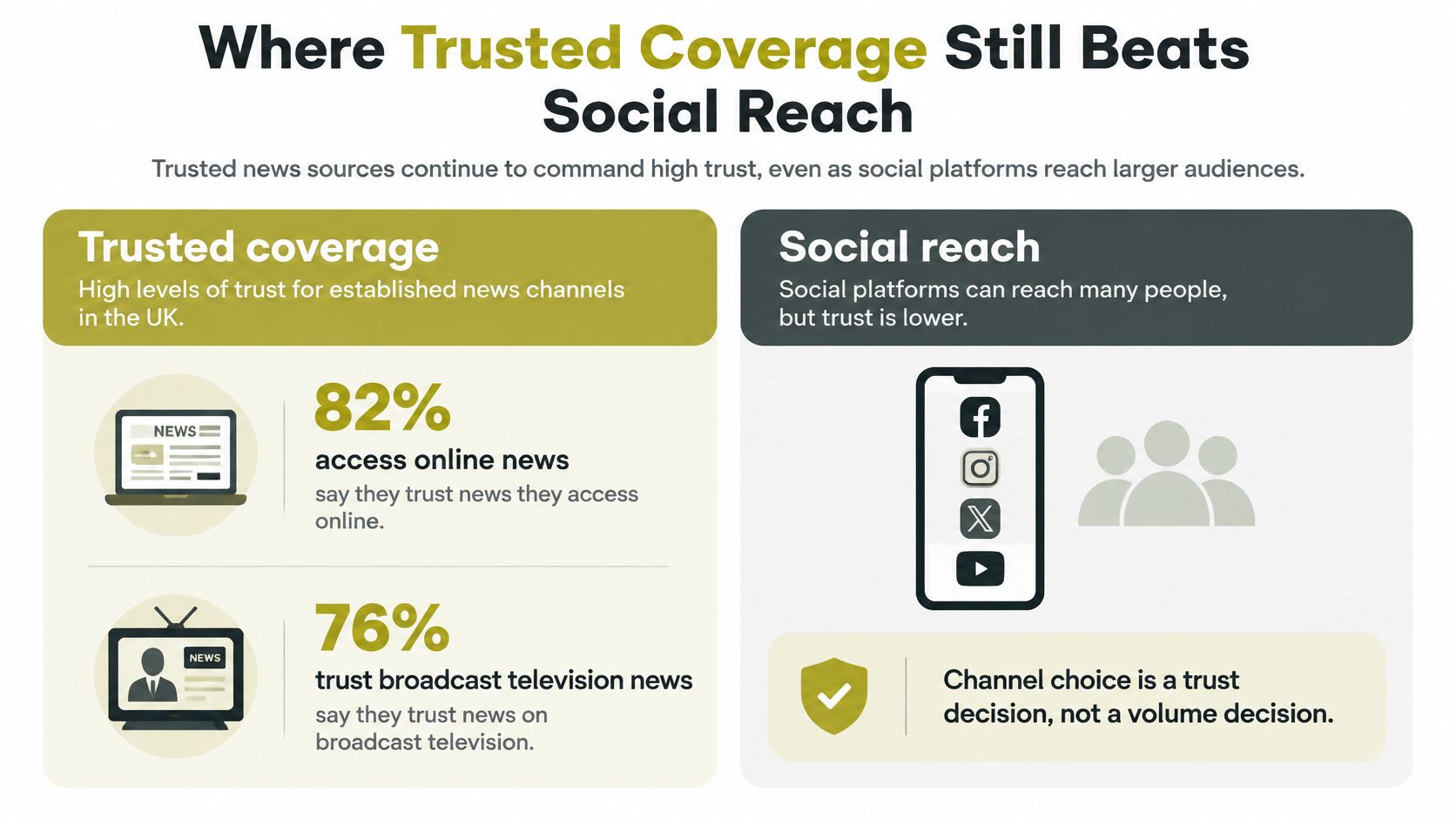
Think witness and loudhailer. A journalist, editor or broadcaster can test and validate a claim. Social and owned channels then carry that validation further and explain the detail in your own words. Cheaper publishing doesn't buy the same reputational value, because the audience knows you approved your own post.
Assign each route a job
| Route | Trust or reach signal | Strategic job | Prioritise when |
|---|---|---|---|
| Broadcast television news | 76% watched; 65% of users rate it highly for trust | Credibility anchor for a wide audience | The stake is national, safety-related or contested |
| Print and specialist news | 66% of print users rate it highly for trust | Depth, scrutiny and third-party validation | A feature, investigation or trade audience needs proof |
| Online news | 82% accessed news online in the past month | Discovery alongside earned reporting | The story must be findable after broadcast or print |
| Social and video platforms | 39% rate them highly for trust | Amplification and interaction | A journalist-led story already exists to extend |
| Search engines and AI | 51% rate them highly for trust | Discovery with a weaker trust score | Facts must be findable but not left to an automated summary |
| Local news and information | 95% of UK adults use local news or information | Community relevance and regional proof | Customers, neighbours or a Scottish market must recognise the story |
Prioritise a journalist-led story when the claim is newsworthy, contested or safety-related, or when investors, regulators or national customers must act on it. Use regional newsrooms for Scottish and local proof, national broadcast when the stake is wide, and owned content to publish the evidence behind the headline. Social posts should extend the life of that coverage with clips, quotes and links, not try to replace the reporting.
Local routes deserve more respect than many plans give them. Ofcom also found that 95% of UK adults use local news or information, with word of mouth, social media and television among the most common access routes. For tourism, hospitality and lifestyle brands, a trusted regional title or travel desk can do more reputational work than a brief national splash that the wrong audience ignores.
Map each message to geography, audience trust, newsworthiness and conversion intent before you pitch or post. Our overview of the UK media landscape and how its outlets differ helps teams make that first sort. Apply one final rule to every draft.
Don't publish a social line that a newsroom would refuse to stand up.
How One Claim Survives Many News Sources
A claim rarely stays in one place. Ofcom reports that six in ten UK adults use an online intermediary, such as a search engine, social network or news aggregator, for news, and adults use an average of 6.9 individual news sources across platforms. If a figure changes between a press release, a social post and an executive interview, the same person may spot the inconsistency. Repetition can make a small error look like a wider failure of care.
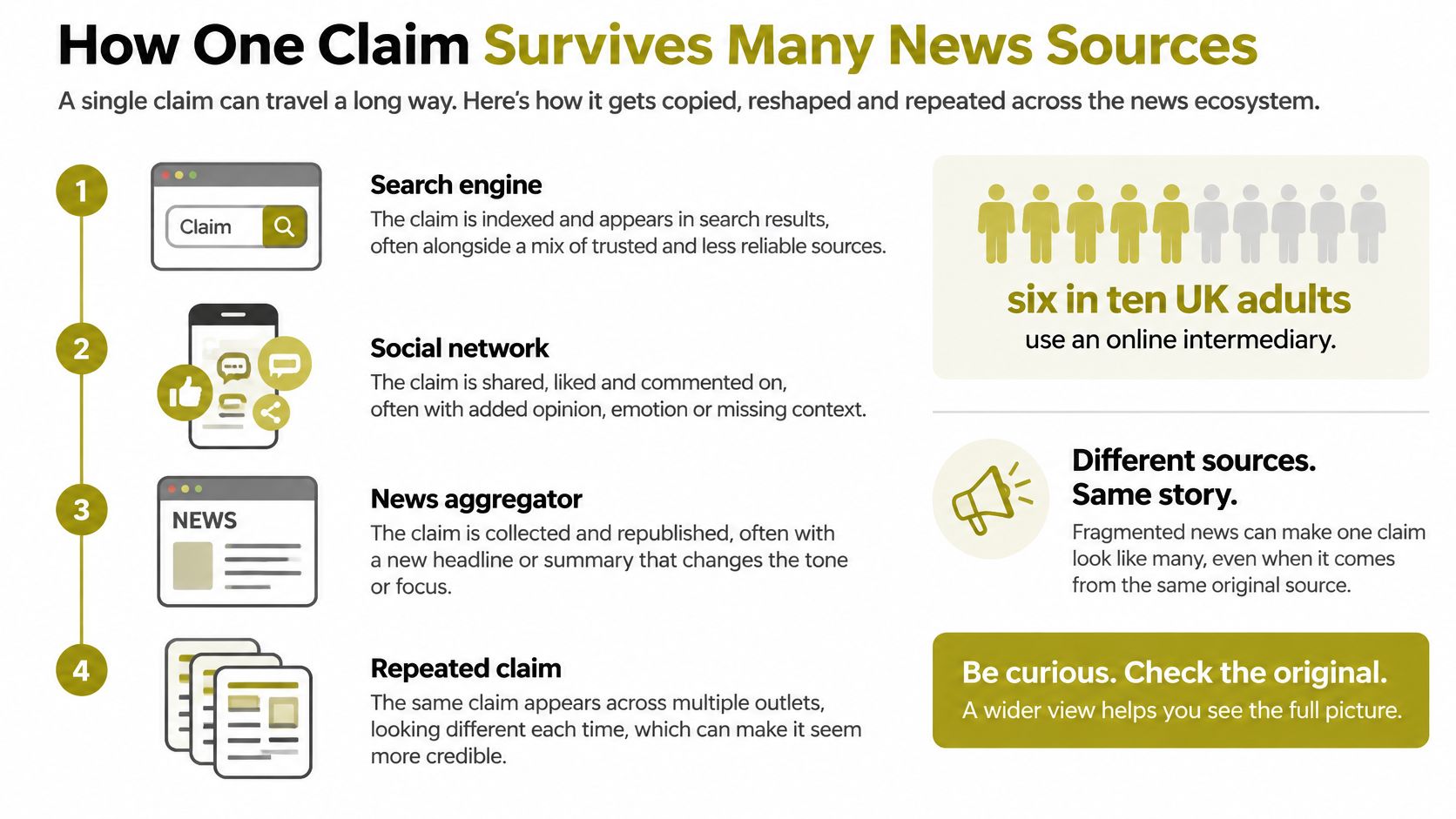
A claims register keeps the evidence attached to the message. For each material assertion, record the approved wording, source, publication date, owner and evidence status. When a fact changes, update the register before changing any public-facing material. That way, a presentation or caption cannot acquire a newer version of the claim unnoticed.
Same fact, different shape
A single checked claim can serve several formats, much as a map can guide different journeys without changing the location:
- Broadcast answer: One short sentence a spokesperson can deliver naturally, followed by the proof point.
- Search explainer: A plain-language page defining terms, dating the evidence and linking to the primary source.
- Data graphic: One comparison, with its source and date visible on the image.
- Social post: A concise hook that points to the evidence rather than adding another claim in the caption.
Audience planning should account for who people are and how they find news. Reach varies sharply between platforms, and no one platform suits every group. Keep the facts consistent across formats, while adapting the wording and detail to the audience. Tone-of-voice guidelines for consistent public wording can help keep that adaptation recognisable without making every message sound identical.
During a live issue, the register gives teams a reliable basis for a fact-checked holding statement, timed updates and spokesperson briefing lines. Clear ownership helps prevent an unverified claim from filling an information gap.
Working rule: Same facts, different format, no new claim without an owner.
Review recent public statements against the register. Retire or correct any claim that cannot be tied to a source, date and owner.
How to Build the Strategy in Six Moves
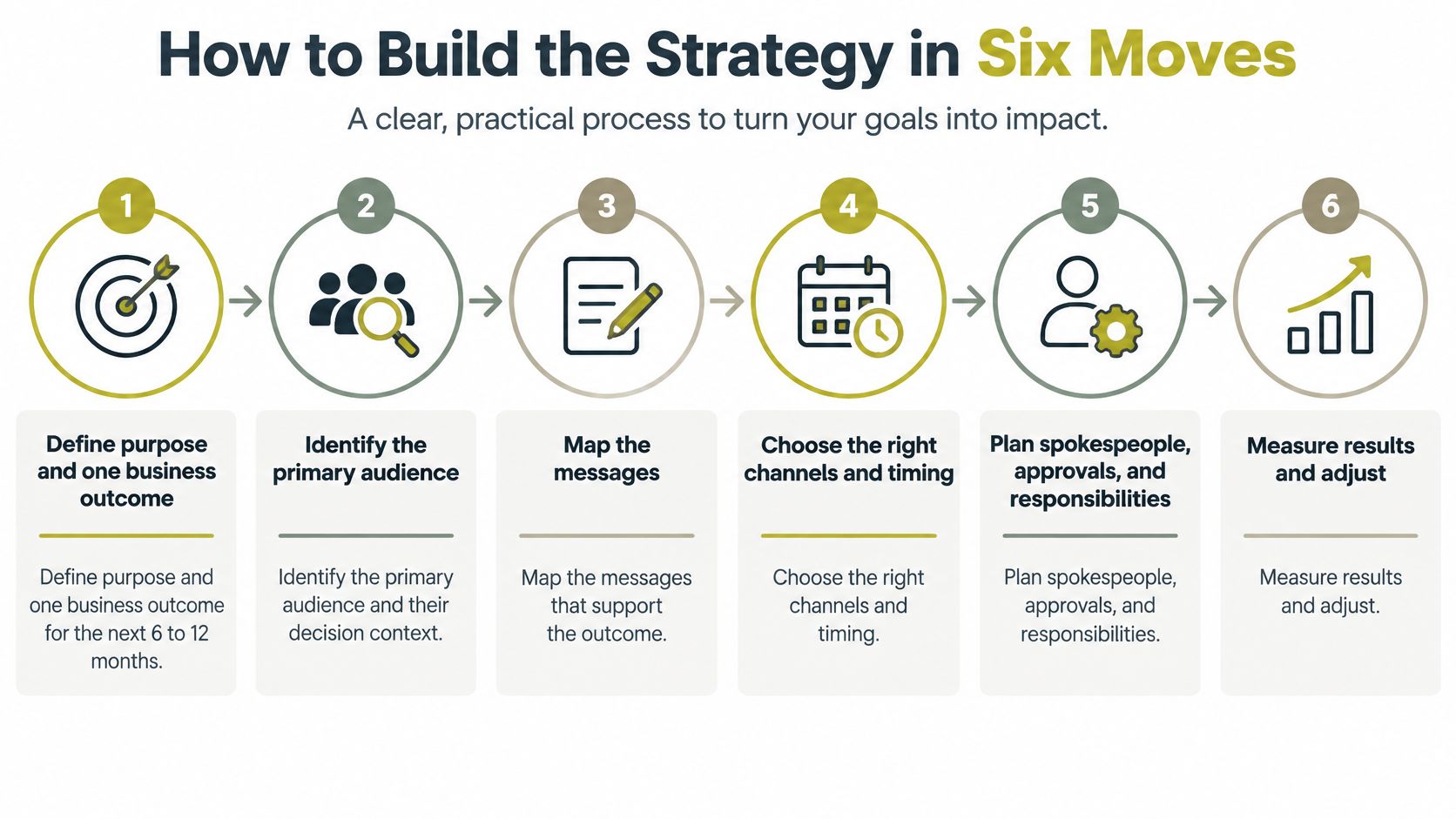
Finish this sequence before anyone designs a campaign asset. It's short enough for a small team and strict enough to stop channel-first thinking.
Moves one to three
- Define character and outcome. Start with what the organisation stands for and one business outcome for the next 6 to 12 months, such as winning a regulator's confidence, filling a visitor season or reaching investors. We begin client work by helping clients define their brand's character and what it stands for, because a slogan can't substitute for proof.
- Name the people who matter. List who can help, block, buy or be harmed. Include customers, employees, industry partners, regulators, investors, journalists and, where relevant, neighbours. Give each group one desired response, not a generic hope that they'll engage.
- Write no more than three messages. Each needs a claim, source, date and owner. Park unsupported statistics in a separate list. The common slip here is writing polished lines nobody can evidence under a journalist's second question.
Moves four to six
- Match messages to channels. Use geography, newsworthiness and trust to decide what's earned, what's owned and what only amplifies. Starting with the channel is the usual failure, because a platform then dictates a claim it may not be trusted to carry.
- Prepare the people. Name spokespeople, draft a short broadcast answer, a longer explainer and a holding statement, and agree who clears comments out of hours. Rehearse the hardest likely question, not only the friendly launch questions.
- Set measures before launch. Decide the target signals with leadership while you can still change the plan. Measuring only impressions tells you a post travelled, not whether the right people believed or acted on it.
| Measure | What it tracks |
|---|---|
| Message accuracy | Coverage matching the claims register |
| Coverage quality | Stories from priority media, not clip volume |
| Referral or search behaviour | Visits and searches reaching the evidence base |
| Audience response | Enquiries, replies or actions by priority group |
| Trust | Simple read among priority groups |
For message accuracy, a strong signal is priority coverage using the approved claim without correction. For coverage quality, one well-placed feature in front of buyers can beat a pile of low-value mentions. Referral behaviour shows whether readers seek your evidence, while enquiries and replies show whether a priority group moved.
Close with a one-page strategy the leadership team can sign. Put the outcome, audiences, three messages, channel roles, measures and first 90 days of activity on that page. If it needs an appendix to make sense, simplify it.
What SMEs and Regulated Sectors Change
The five parts stay the same. Effort, risk and clearance don't. An SME usually has one or two spokespeople, a tight budget and no large in-house team, yet it still needs customers, partners, regulators and investors to hear a consistent story. Its bias should be fewer messages, stronger local and trade media, and owned explainers a founder can defend in an interview.
A regulated or high-risk organisation in energy, finance, transport, environment or health-adjacent work adds legal review and a higher evidence bar. Regulators, lawyers, employees and affected communities can constrain the business even when customers are satisfied. Speed still matters, but an uncleared line can create a second problem.
The AI discovery problem
Ofcom reports that 73% of UK adults access news through online intermediaries, including social platforms, search engines, aggregators and AI tools, and 56% say they are less trusting of an AI-written news story than one written by a person. That creates a tension between discoverability and credibility. An automated summary can flatten a claim, misquote a spokesperson or detach a figure from its date and context.
Don't chase AI visibility instead of journalists. Keep a clear, dated evidence base with corporate facts, executive biographies, customer proof, regulatory information and announcements in plain, machine-readable pages. Treat original reporting by people as the trust layer, then measure both whether your facts can be found and whether they stay accurate when summarised.
| Decision | SME bias | Regulated or high-risk bias |
|---|---|---|
| Objective horizon | One commercial or reputation outcome over 6 to 12 months | Outcome plus licence to operate, safety or compliance exposure |
| Audience priority | Customers, partners, investors and local media | Those groups plus regulators, lawyers, employees and affected communities |
| Message bar | Founder-ready claims with named proof | Pre-cleared claims, dated evidence and a correction route |
| Channel bias | Regional and trade journalism, then owned and social extension | Broadcast and specialist media first; social only after the line is cleared |
| Spokesperson model | One or two trained voices | Named deputies, legal review and out-of-hours cover |
| AI and search | Clear public facts so discovery does not invent a story | Human review so summaries cannot detach claims from context |
| Measurement | Coverage quality, enquiries and message accuracy | Those measures plus stakeholder confidence and correction speed |
Watch the edge cases. A tourism SME facing a safety incident temporarily borrows the regulated rules on clearance, named deputies and corrections. A listed or licensed firm telling a local community story still needs the local news route, because national reach won't persuade neighbours who don't recognise their place in the story.
Three Strategies That Show the Rules in Use
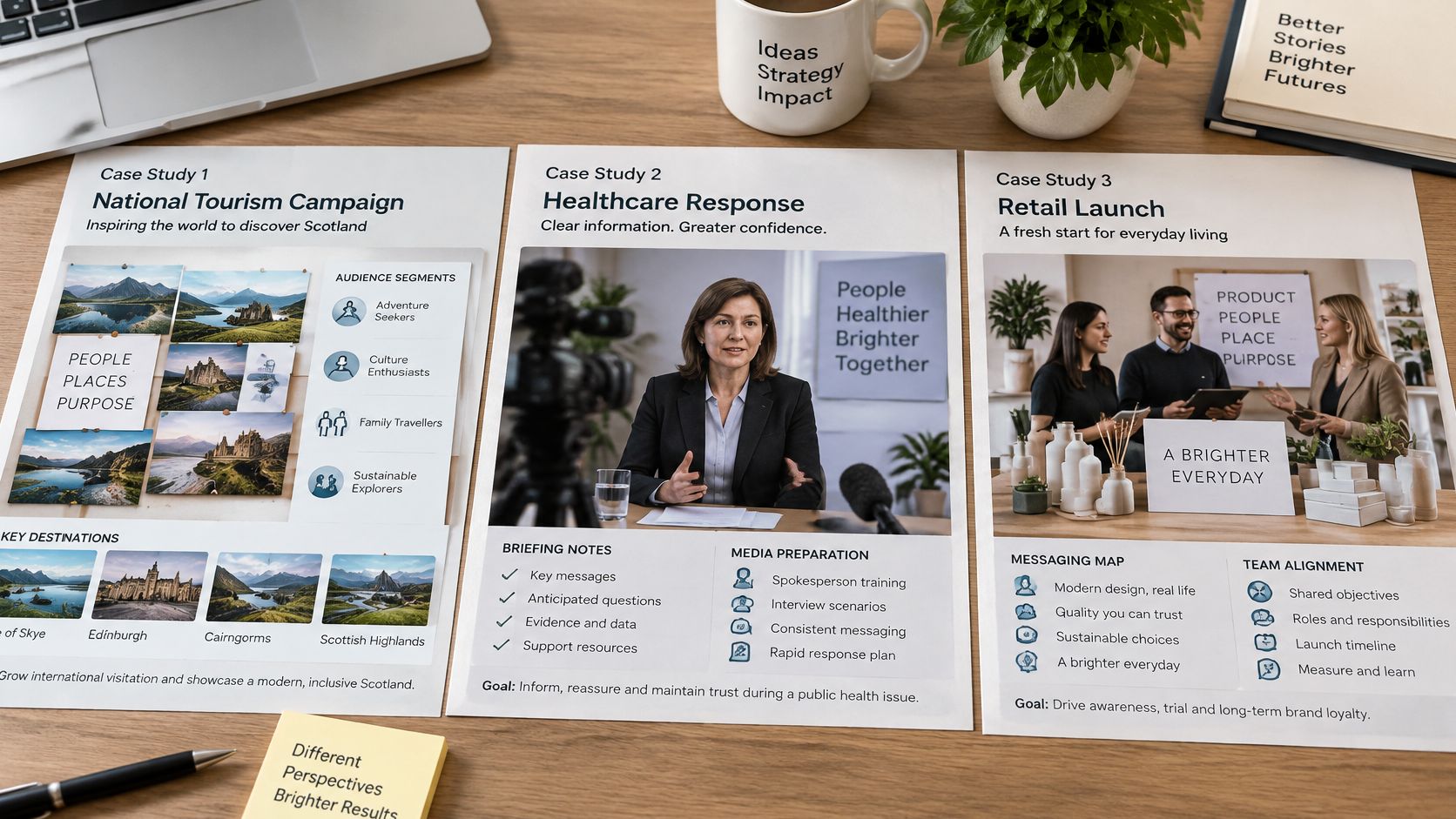
These are illustrative composites built from the framework, so you can see the decisions without mistaking them for a named client engagement. Each case uses the same discipline at a different scale.
A national tourism brief
Say a national tourism brief in the style of VisitScotland campaign work needs visitors at home and abroad to choose Scotland for culture, events and sport. The work included strategic communications planning, audience segmentation and targeting, a multi-platform social media strategy, and content marketing and asset creation. Media relations involved crafting press releases and pitches and building relationships with travel, culture and sports journalists, both domestically and internationally.
Partnership work engaged event organisers, local tourism boards, hotels, airlines and cultural institutions to align messaging, gather assets and amplify the message. The lesson is order. Journalist-led travel coverage establishes desire and credibility, partners supply local proof, and social and content assets extend the story. They don't replace the travel desk.
The short video below is a useful prompt for discussing how a visitor story changes when it's told for screen rather than print.
A Scottish technology SME and a regulated operator
A Scottish technology SME needs customers, partners and investors to hear the same proof without three versions of performance. Its plan uses one founder spokesperson, a trade feature for technical buyers, a short investor explainer and local business media for regional credibility. Every performance claim sits on the claims register with a date, so a pitch deck can't outrun the public evidence.
A regulated operator facing a service or environmental incident works faster but tighter. The first hour brings a holding statement from approved facts, a named spokesperson, legal awareness of what can't yet be said, and updates promised on a timetable. Broadcast and specialist reporters are briefed before social speculation fills the gap, and owned channels then carry the same facts for people searching later.
One outcome, named audiences, proof-backed lines, a trust-led channel order, and measures set in advance.
That pattern is everyday work for teams who've done it from inside newsrooms or on international brands. The judgement looks fast because the hard questions have been asked many times before.
Decide When to Brief a Specialist Team
Keep the work in-house if your five rows are complete, every claim has an owner and your spokesperson can handle a short, sceptical interview. This is more likely to work when no regulator, safety issue or likely national news interest is involved. Extra channels can add cost without strengthening trust.
Brief a specialist when the story could reach national media, a regulator or investors, when messages conflict across channels, or when the team has little experience preparing a story under deadline. Newsroom judgement helps shape an angle, anticipate questions and decide what a reporter will accept as proof.
Carlos Alba Media is founded and run by former national newspaper editor Carlos Alba, and its seasoned team combines newsroom insight with agency experience across media, digital and brand work. The consultancy supports start-ups, SMEs and established organisations in Scotland, the wider UK and internationally. Its guide to choosing a PR agency and testing senior expertise offers questions to take into a first meeting.
If you are facing a communications challenge or media crisis, you can book a free consultation with one of the agency's public relations experts. Bring your one-page strategy and ask them to test the intended outcome, key messages, channel order and measures. Add channels only when the strategy can withstand the questions a journalist might ask.
If your claims, spokespeople or channels would struggle under newsroom scrutiny, Carlos Alba Media can help shape a strategy around proof, trusted coverage and clear measurement. Visit Carlos Alba Media to discuss your PR communication strategy.