
You've got a launch date, a list of journalists and a half-written press release. Someone wants national coverage. Someone else wants more enquiries. Nobody has agreed who approves the story, or who answers the phone if a journalist asks a difficult question.
A useful PR plan template resolves those decisions before you start pitching. It connects the business problem to the audience, the message and the work someone will do. It also gives you a way to stop activity that looks busy but delivers little.
The PR Plan Template, Field by Field
Aim for a working plan of about four pages, answering the eleven questions below. Keep supporting material, including media lists and evidence logs, in separate files so the main document stays usable.
The hypothetical example follows a Scottish visitor attraction seeking more off-season group bookings. Its figures and deadlines illustrate planning choices, not industry benchmarks.
PR plan template components with worked examples
| Component | Question it answers | Example entry |
|---|---|---|
| Situation and baseline | What is the problem today? | Off-season group bookings flat for two years, with enquiries mostly from individuals |
| Objectives | What must change, by when? | Raise off-season group enquiries from 12 to 15 a month by March |
| Audiences | Who must act or believe something? | Corporate event planners and tour operators in Edinburgh and Glasgow |
| Key messages | What three points does every spokesperson make? | Small-group guided experience; direct booking with no commission; local supplier network |
| Proof points | What evidence backs each message? | Guest survey results, verified visitor numbers, a named local supplier list |
| Spokespeople | Who speaks, and on which topics? | Operations director on visitor data; founder on origin and heritage |
| Channels | Where do these audiences look? | Trade travel press, regional broadcast, LinkedIn for planners |
| Timeline | When does each activity happen? | Rolling 12-week calendar with approval deadlines set two working days before each release |
| Owners and approvals | Who drafts, who signs off? | Marketing lead drafts; managing director approves within 24 hours |
| Metrics | How will success be shown? | Qualified group enquiries, referral sessions, relevant coverage in named outlets |
| Risk and crisis contacts | Who speaks when something goes wrong? | Named incident lead, deputy, legal adviser and holding statement owner |
Complete the rows in order. Objectives need a baseline; messages need evidence; channels follow audiences. If you choose a newspaper first and invent an objective afterwards, you're planning around an outlet rather than a business need.
The messages and proof points should be checked together. A claim about local suppliers isn't ready for publication until someone has checked the supplier list and permission to name them.
Practical rule: A row isn't finished until a named person owns it. A department name isn't enough.
Copy the rows into a spreadsheet or document and add columns for your entry and owner. Replace the illustrative details with your business's facts. Mark anything you can't complete as a research gap, with someone responsible for closing it before launch.
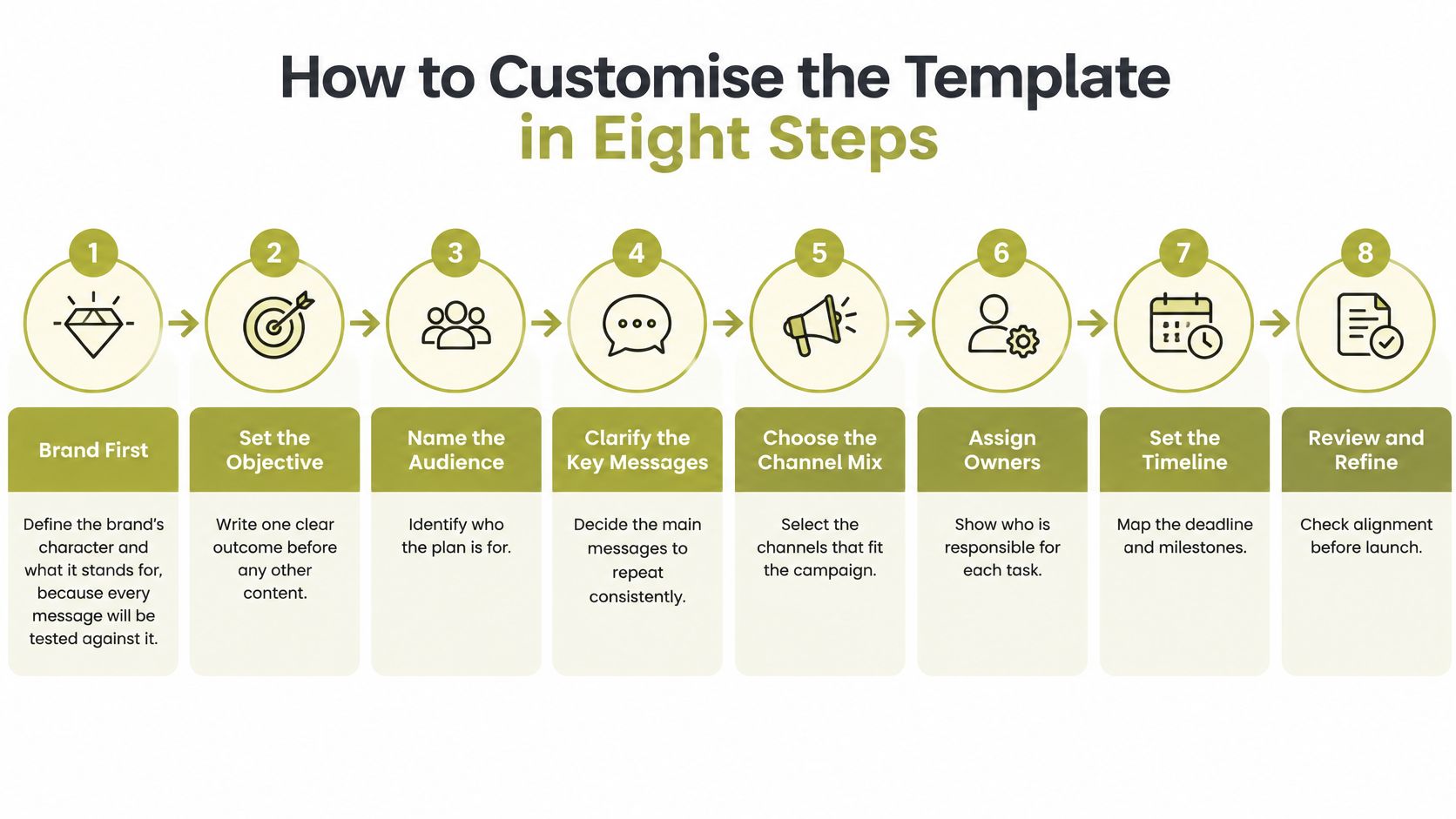
How to Customise the Template in Eight Steps
Begin with the brand's character and what it stands for. At Carlos Alba Media, that's how we start client work: messages need a clear identity behind them, not just polished wording.
The Chartered Institute of Public Relations' planning and evaluation guidance recommends research, precise objectives, message development, creative planning and evaluation. That's a better foundation than a list of publicity tactics.
Define the business problem. Record the current position using enquiry records, coverage or customer feedback. The common slip is promising improvement before anyone knows the starting point.
Separate customers, partners, regulators and investors into distinct audiences. Rank them by their influence on the outcome; treating everyone as equally important spreads a small team too thin.
Set a specific objective. Give it an outcome, a number and a deadline. Don't substitute an activity, such as issuing a release, for the change you need.
Build messages from evidence you can produce. Unsupported claims tend to unravel when a journalist asks a straightforward follow-up question.
Choose channels, spokespeople, assets and news hooks together. Check whether the story needs photography, an interview or supporting documents. Picking channels before ranking audiences is the usual mistake.
Assign owners, deadlines and an approval route. Avoid sending drafts to everyone for general comments; identify who checks facts and who has final authority.
Execute through a rolling media calendar. Leave room for a relevant late news hook. A calendar filled to capacity gives the team no room to respond.
Evaluate outputs, audience response and business outcomes against agreed thresholds. Feed the decisions into the next plan rather than filing the report untouched.
Use this visual as a reminder of the planning sequence.
Check what's missing
If you can't complete a step in a single planning meeting, identify the missing information. Another meeting won't fix an absent booking report, an unverified claim or an undecided business priority.
Writing Objectives, Audiences and Key Messages
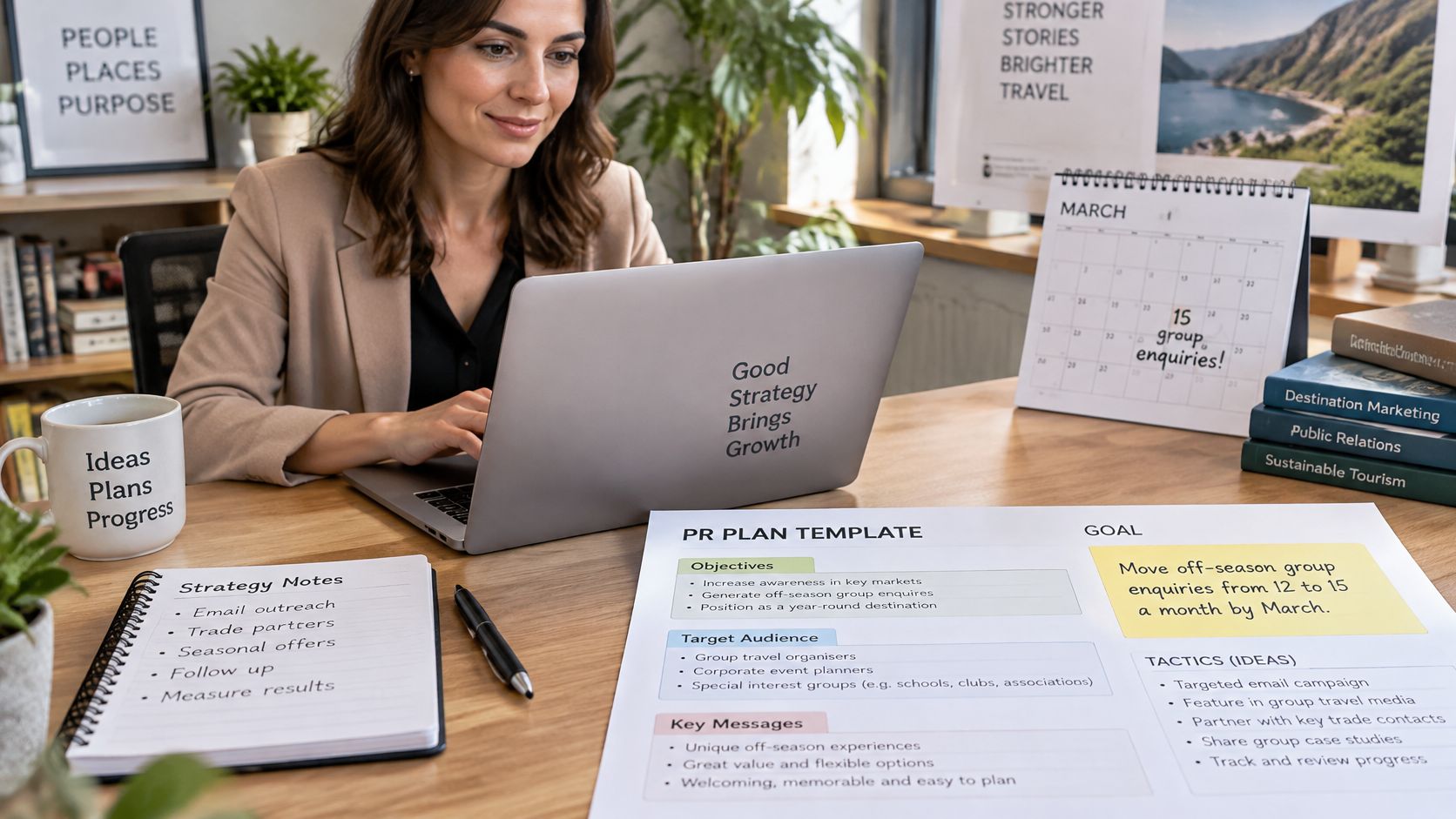
A checkable objective names the outcome, number, audience and deadline. For the illustrative attraction, that means increasing monthly off-season group enquiries from 12 to 15 by March, specifically from corporate planners and tour operators.
Raise awareness isn't enough on its own. Without defining whose awareness, of what, and how you'll check it, nobody can judge progress.
Keep the objective beside your planning notes while drafting.
Give each audience a job
Primary audiences should take the action that supports the objective. Secondary audiences help them act: a hotel concierge might recommend the attraction, while a tourism partner might distribute its group-booking information.
Write the required action or belief beside each group. A corporate planner needs confidence that the visit will run smoothly; a tour operator needs practical information about availability and booking arrangements.
Build three messages per audience, each paired with evidence. Guest survey results might support a service claim, while verified visitor records support a demand claim. Test whether a journalist could repeat each message accurately in a sentence without your help.
Make AI disclosure a publication decision
The YouGov UK media attitudes to AI report states that 86% of British adults consider disclosure important and around seven in ten say AI-generated content and news is insufficiently regulated; it also cites KPMG and University of Melbourne findings that only 42% of UK respondents were willing to trust AI, despite 69% using it for work, study or personal purposes.
Distinguish grammar assistance from higher-risk fabricated images, synthetic spokespeople and automated claims. Where accurate, a standard disclosure could read: Drafted with AI tools and checked by our team.
Prepare answers to “Was AI used to create this?” and “How were personal data and copyright protected?” Keep a source log, assign human review and agree who approves the disclosure line before publication.
Use the video alongside your message-planning discussion.
Choosing Channels and Building the Timeline
Credibility and audience fit matter more than the size of an outlet's name. Written evidence submitted to a UK Parliament committee reported that 80% of the public trusted television news and 70% trusted radio, with broadcast generally trusted more than print and online sources.
That makes spokesperson preparation particularly important for broadcast. A promising slot isn't useful if your expert can't explain the story clearly under questioning.
Channel options compared for a UK PR plan
These are working lead-time allowances for the illustrative campaign, not guaranteed editorial schedules.
| Channel | Best for | Typical lead time | Main risk |
|---|---|---|---|
| National broadcast | Mass awareness and high-trust exposure | Two to four weeks for planned features | Spokesperson must be ready at short notice |
| Regional broadcast | Local visitors and regional partners | One to three weeks | Story can be dropped for breaking news |
| National and trade print | Sector credibility and business audiences | Four to eight weeks for features | Long lead time means fixed angles |
| Online news and features | Search visibility and referral traffic | One to four weeks | Coverage can disappear quickly |
| Owned website and newsletter | Existing customers and enquiry capture | Same day to one week | Reaches only people already engaged |
| LinkedIn and social | Planners, partners and recruitment | Same day | Reach is easy to mistake for results |
Segment audiences before coordinating partners. Then align messages with event organisers, tourism boards, hotels and cultural institutions, gather usable assets and choose channels. Our VisitScotland work included strategic communications planning, audience segmentation and targeting, a multi-platform social media strategy, and content marketing and asset creation.
For outlet selection, use our guide to the UK media landscape. If creators could reach a distinct audience, Sup's resource on influencer marketing for agencies is useful when considering that additional channel, rather than treating it as earned editorial coverage.
Protect space for reactive work
For this example, use a rolling 12-week calendar. Allow two to eight weeks for feature pitches, one to two weeks for planned releases, and capacity to respond to relevant news within hours.
- Keep topic ownership clear. Use a designated spokesperson for each subject.
- Pitch ahead of demand. Offer seasonal features before the peak, not during it.
- Review every Monday. Check deadlines, asset readiness and emerging news before committing more work.
Metrics That Show the Plan Worked
Every metric needs a pre-agreed threshold and a data source before launch. If nobody can explain where a result comes from, it doesn't belong in a management report.
Reject advertising-value equivalency, which the Chartered Institute of Public Relations doesn't accept as a valid measure. An imagined advertising price doesn't show whether the right people understood your message or contacted the business.
Metrics, thresholds and data sources
The thresholds below are illustrative decision rules, not UK performance benchmarks.
| Metric | What it shows | Example threshold | Data source |
|---|---|---|---|
| Qualified enquiries | Leads from the target audience | Meets the agreed monthly enquiry target | Enquiry form or CRM |
| Referral sessions | Visits from coverage links | Set from baseline | Web analytics |
| Relevant coverage | Articles in named target outlets | Target outlets named before launch | Media monitoring |
| Journalist response rate | How often pitches receive a reply | Set from baseline | Pitch tracker |
| Sentiment in target outlets | Tone of coverage | Majority neutral or positive | Monitoring tool |
| Stakeholder feedback | Partner, regulator or investor reaction | No escalation during the period | Logged calls and emails |
There's no credible universal UK benchmark for press coverage or sales conversion. News value, timing, targeting, brand recognition and available assets all affect results. Set thresholds from your own baseline and available resources, not an agency's most successful campaign.
A historical IAB UK study conducted by MTM among 800 businesses found that 58% of UK SMEs were looking for new ways to communicate with customers during social distancing. The practical point is broader than publicity: useful communication also helps customers understand changes and take action.
Decide what earns campaign credit
Agree attribution before launch. Use a dedicated landing page, tagged links or a how-did-you-hear-about-us field, and record when the source remains unknown.
For combined reporting, Sup Growth's reporting frameworks for social media metrics can help organise the social component. Our guide to measuring PR effectiveness supports the wider assessment.
A large audience isn't a business outcome. Show what the right audience did next.
Review monthly against the baseline. Record a decision for each red result and remove metrics nobody uses. For an SME, qualified enquiries and coverage quality deserve more attention than raw volume because limited budgets make each conversion important.
Setting Crisis Severity Levels Before You Need Them
A product complaint shared widely online needs a different response from a single negative review. Set severity levels in advance so the right people can act quickly, without guessing who can approve a statement.
Crisis severity levels and first responses
Treat these timings as internal targets, not legal deadlines. Assess the potential harm as well as the media attention. A low-profile safety issue may need faster escalation than a widely shared complaint with no risk to customers.
| Level | Trigger example | Sign-off | First response target |
|---|---|---|---|
| Level 1, minor | Single negative review with no media interest | Community manager | Reply within four working hours |
| Level 2, moderate | Product complaint shared widely on social media | Managing director and communications lead | Holding statement within two hours |
| Level 3, serious | Regulator enquiry or media call about a safety issue | Managing director and legal adviser | Confirmed facts within one hour |
| Level 4, critical | Injury, data breach or threatened legal action | Named crisis lead with external counsel | Acknowledgement within 30 minutes |
A response target never justifies speculation. If facts are unconfirmed, acknowledge the issue, say what you are checking and give stakeholders a time for the next update.
Remove decisions from the emergency
Agree the decision routes before an incident. Record names and current contact details, not just job titles.
- Who replaces the founder? Name an authorised spokesperson and deputy.
- When does legal join? Set triggers for safety concerns, personal data, regulatory scrutiny or threatened proceedings.
- Who hears what? Share consistent facts with customers, employees, regulators and journalists, while addressing each group's practical needs.
- Who publishes? Name the person who can update the website and send stakeholder communications if the usual administrator is unavailable.
Keep verified contacts, approved holding statements and a decision log. Record the time, source, decision, wording and approver for each action. Social media is only one response channel. Direct calls, email or an accessible website update may matter more.
Before sign-off: Separate confirmed facts from what you are investigating. Don't promise an outcome the incident team cannot guarantee.
Carlos Alba Media has completed 100+ crisis management projects. Use its guide to developing a crisis communications plan to set out the escalation process, approval route and first-response steps.
Confirm Owners and Book Your First Plan Review
Use the next five working days to turn the document into an operating routine. Don't wait for perfect wording before settling accountability.
Save the baseline. Put the evidence behind each objective in a shared folder. Include the reporting period and the person responsible for maintaining it.
Confirm every owner. Replace department labels with people's names, including the incident lead and deputy. Check that each person accepts the responsibility.
Agree approval timings. Write down who checks facts, who approves publication and how long they have to respond. Specify the backup route when an approver is unavailable.
Book the monthly review. Invite the people who own the metrics and can change activity. Give them access to the results before the meeting.
Approve the AI disclosure rule. Confirm the wording, human reviewer and sign-off owner before releasing material created with AI assistance.
Make the review a decision meeting
Ask owners to arrive with a recommendation, not just an update. They should be ready to continue, change or stop an activity, with a reason tied to the objective.
Revisit the template each quarter and rewrite it when audiences or the news environment change. Keep a version date so nobody pitches from an outdated message sheet or uses an obsolete contact list.
For teams wanting an outside check, our specialists can review the plan with you. The useful questions are practical: can the spokesperson defend the claim, can the approver meet the deadline, and can the team recognise a result worth acting on?
You don't need to be based in Glasgow or Scotland to work with us. Keep the template short, keep every row owned and make the review an appointment the team attends.
Carlos Alba Media offers a free consultation with a public relations expert if you're facing a communications challenge or media crisis. Bring your draft objectives, approval route and crisis contacts so the discussion starts with the decisions you need to make. Visit Carlos Alba Media to discuss your PR plan and next steps.