

A tiny “hic” interrupts the feed, then another, and another. Your baby may look perfectly content while their chest gives a small jump, yet the sound can be startling enough to make any new parent wonder whether something has gone wrong.
In most cases, it hasn't. Baby hiccups are usually a normal reflex, often linked to feeding, swallowed air, reflux, or the way a young nervous system is learning to coordinate breathing and swallowing. They may look dramatic, but they generally settle without treatment.
This guide explains why babies get hiccups, what you can gently try during and after a feed, and which accompanying symptoms deserve medical advice. It draws on UK NHS guidance and research from University College London, with the same careful, plain-English approach expected from specialists in medical communications. For organisations that need to explain health topics clearly and responsibly, Carlos Alba Media's specialist medical communications perspective reflects a team made up entirely of former national news journalists or professionals with agency experience working with international brands.
A Calm Start to Understanding Baby Hiccups
Your baby has just finished feeding. You have held them close, perhaps gently wound them, and settled them against your shoulder. Then their body gives a small, rhythmic jerk and the familiar sound starts. They may remain relaxed, alert, or drift towards sleep.
That mismatch can feel unsettling. Parents often connect hiccups with eating too quickly or discomfort, so a bout may seem like evidence of distress or a feeding mistake. Baby hiccups usually reflect a normal reflex, as the developing nervous system learns to coordinate the diaphragm, breathing and swallowing.
They can begin during a breastfeed, bottle feed, or soon afterwards. Swallowed air, a full stomach, milk moving back upwards, or the timing of a feed may activate the reflex. This does not mean feeding has gone wrong.
Core reassurance: If your baby is feeding, breathing and settling normally, hiccups are usually harmless and can be left to pass.
Research from University College London found that hiccup bouts in young babies lasted a median of 7 minutes. That gives the repeated “hic” a useful context: it may continue for several minutes while your baby remains comfortable. The sound alone does not tell you that your baby needs treatment.
For organisations that need to explain health topics clearly and responsibly, Carlos Alba Media's specialist medical communications perspective reflects a team made up entirely of former national news journalists or professionals with agency experience working with international brands.
Watch the wider picture rather than counting each hiccup. Calm support is enough, and forceful remedies are unnecessary. Frequent episodes do not automatically indicate poor technique or illness. Understanding the diaphragm's role makes these normal developmental signals easier to interpret.
How Hiccups Happen Inside Your Baby
Think of the diaphragm as a soft trampoline beneath the lungs. It moves down when your baby breathes in and relaxes when they breathe out. Normally, the brain and nerves coordinate that movement smoothly, but a hiccup happens when the diaphragm contracts suddenly and without conscious control.
The sequence is straightforward:
- A trigger irritates or activates the reflex pathway. Feeding, swallowed air, stomach fullness, or movement of milk can send signals through nerves connected with the diaphragm.
- The diaphragm jerks inwards. This is the quick, involuntary contraction that makes your baby's tummy or chest appear to jump.
- The voice box closes briefly. Air moving towards the throat meets the closed vocal cords, producing the recognisable “hic” sound.
- The reflex repeats. Nerve signals between the brain, breathing muscles and voice box can create a short series of contractions.
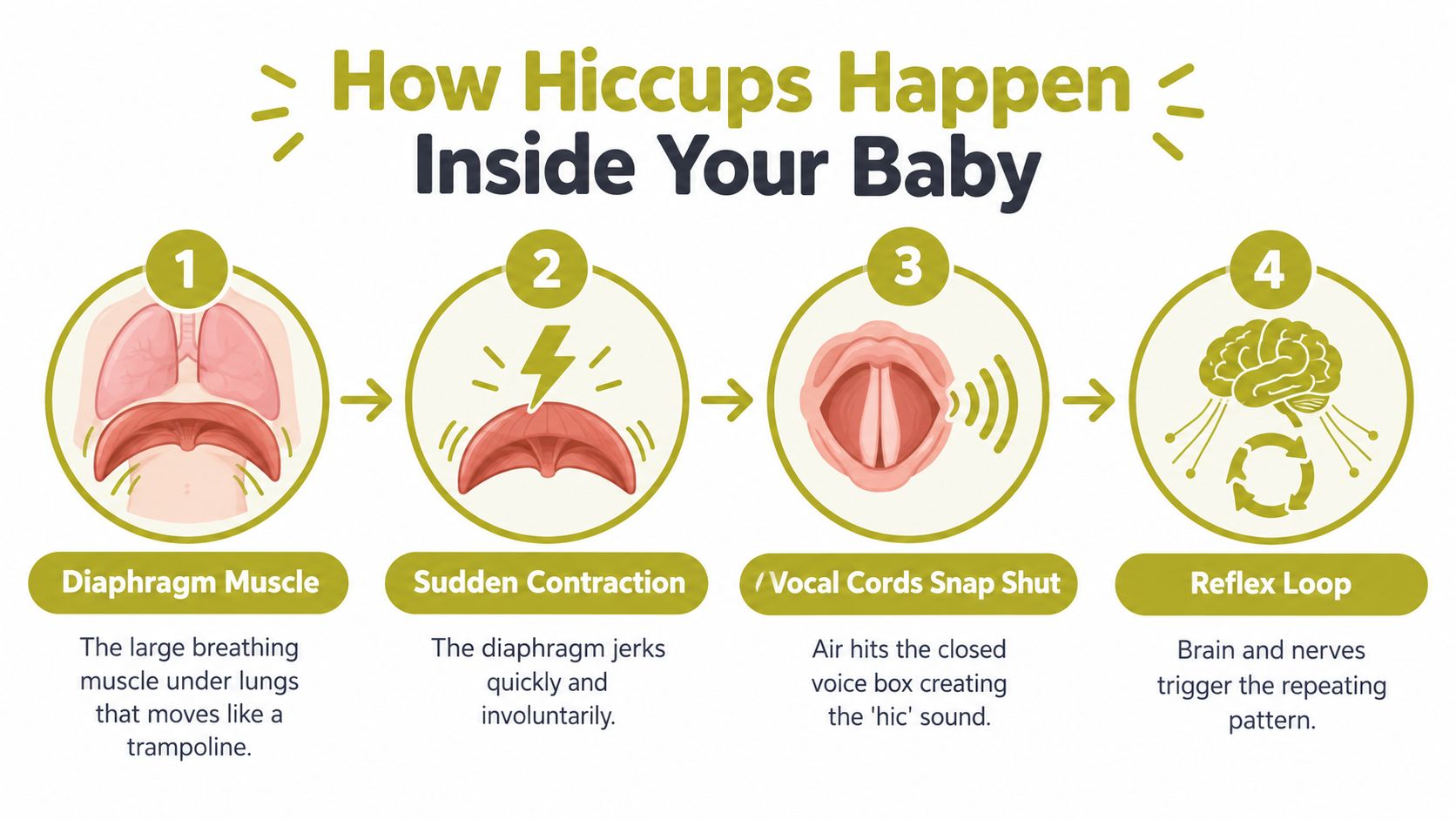
The important point is that your baby isn't choosing to hiccup, and the movement isn't usually a sign that they can't breathe. The brief closure that creates the sound is part of the reflex itself. Between contractions, your baby should return to their usual breathing pattern.
Why young babies trigger the reflex easily
Newborns are still learning to coordinate several actions at once. Sucking, swallowing and breathing must happen in a carefully timed sequence, particularly during a feed. Their diaphragm and swallowing mechanisms are also still developing, so a small change in pressure, pace or air intake can activate the reflex more readily than it might later in childhood.
That immaturity explains why hiccups often appear around feeds without meaning that breastfeeding or bottle-feeding is going badly. It also explains why the same baby may hiccup in different situations, including after crying, coughing or becoming overstimulated.
The reflex is therefore both mechanical and neurological. The stomach and food pipe can influence it, while the brain and nerves help create the repeating pattern. That broader picture matters because it moves the explanation beyond “your baby swallowed too much air”.
Common Triggers That Set Off Hiccups
Feeding is the trigger parents notice most often, but it isn't the only possible influence. NHS guidance links infant hiccups with feeding-related events such as swallowing air, while reflux can allow milk to move back up and provoke the diaphragm. These factors often overlap rather than appearing as one isolated cause.
A baby who is very hungry may gulp. A bottle with a fast flow can encourage quick swallowing. A larger feed can leave the stomach feeling full, and milk moving back towards the throat can stimulate nearby reflexes. None of these observations proves that a parent has done anything wrong. They show how a young body responds to ordinary feeding conditions.
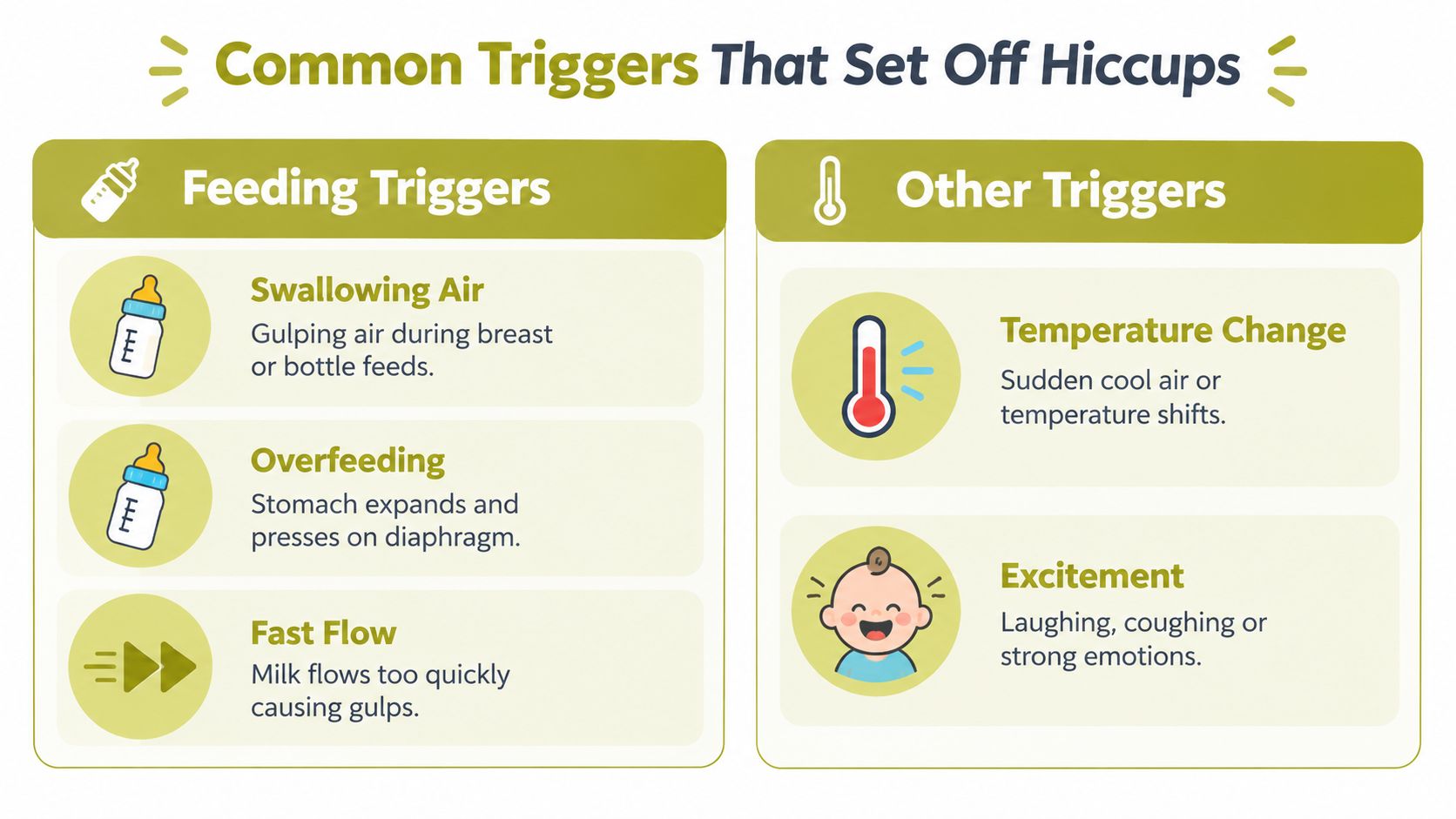
What to look for around a feed
| Trigger | Why It Happens | Typical Sign |
|---|---|---|
| Swallowing air | Your baby takes in air while sucking and swallowing | Hiccups begin during or soon after feeding |
| Fast flow | Milk arrives faster than your baby can comfortably coordinate | Gulping, pauses, or unsettled feeding |
| A very full stomach | Stomach expansion may affect the nearby diaphragm | Hiccups appear after the feed has finished |
| Reflux | The developing muscle at the bottom of the food pipe may let milk move upwards | Hiccups alongside spit-up or milk returning |
| Overstimulation | Crying, excitement or stress can disturb an immature reflex system | Hiccups follow fussing, coughing or intense activity |
The NHS explains that reflux can occur because the muscle at the end of the food pipe is still developing. It may open when it shouldn't, allowing milk and stomach acid to come back up, which can sometimes cause hiccups. NHS guidance on reflux in babies describes this as a developmental process, not automatically a disease.
Temperature changes and excitement are also commonly noticed by parents, although feeding-related triggers are particularly relevant in infants. Look for patterns without turning every episode into an investigation. If hiccups happen after a calm feed but your baby remains comfortable, the pattern is usually reassuring. If they repeatedly occur with distress, vomiting or feeding difficulty, the accompanying symptoms matter more than the hiccups themselves.
Why Hiccups Are So Common in Newborns
Newborn hiccups can feel frequent because several systems are developing at the same time. The brain is learning to organise breathing, the diaphragm is responding to new signals, and feeding requires precise coordination between sucking, swallowing and breathing. A reflex that appears occasionally in an older child can therefore show up more readily in a newborn.
University College London researchers offered a useful developmental perspective. Their work suggested that hiccup-related brain activity may help a newborn learn to monitor breathing muscles such as the diaphragm, reframing hiccups as more than an annoying after-effect of feeding. The reflex may form part of the brain's early practice in recognising and organising respiratory movement. UCL's report on newborn hiccups and brain development explains this possible role in early neurodevelopment.
A UCL infant study directly observed hiccups in 6% of the infants studied, 13 out of 217, with bouts lasting a median of 7 consecutive minutes and ranging from 1 to 16 minutes. These observations, reported in the NHS explanation of hiccups, show that hiccups are measurable in infant research, not something parents happen to report at home.
A developmental signal, not a parenting error
This doesn't mean every hiccup has a beneficial purpose, or that parents should ignore signs of illness. It does mean that ordinary episodes can sit within normal neurological development. The immature neuro-respiratory control system, meaning the developing connection between the brain, breathing muscles and reflexes, helps explain why newborns are particularly prone to them.
Your baby's hiccups can reflect a system practising coordination, not a system failing.
As babies mature, feeding and breathing usually become more coordinated and the reflex often becomes less noticeable. You don't need to count each episode or compare your baby with another child. Watch how your baby behaves before, during and after the hiccups. Comfort, feeding, breathing and growth provide a more useful picture than frequency alone.
Gentle Ways to Soothe and Prevent Hiccups
Most hiccups don't need to be stopped. If your baby is calm, breathing normally and feeding well, waiting may be the kindest response. You can still make feeds more comfortable by reducing swallowed air and giving your baby time to pause.
Try these gentle approaches:
- Pause the feed: If hiccups begin while your baby is drinking, stop briefly, support their head and neck, and allow them to settle. Continuing immediately can mean more gulping.
- Wind calmly: Hold your baby securely and gently rub or pat their back. Some babies need winding during a feed, while others settle without producing a burp.
- Review the pace: Keep your baby comfortably supported and avoid rushing. If bottle-feeding, make sure the teat isn't delivering milk faster than your baby can manage.
- Use an upright cuddle: Holding your baby upright after feeding may help milk and swallowed air settle. When your baby sleeps, always place them flat on their back on a firm sleep surface.
- Offer comfort, not shock: Quiet holding, soft talking or a familiar dummy, if your baby already uses one comfortably, may help them relax. Never frighten, shake or startle a baby to end hiccups.
- Let the episode finish: If your baby seems unconcerned, give the reflex time to stop naturally. Hiccups often resolve without intervention.
Safe boundary: Don't give a young baby water, sugar, honey or another substance to treat hiccups unless a healthcare professional has specifically advised it.
A slower, calmer feeding routine can help you notice when your baby needs a break. If you want a gentle, values-led approach to settling fussiness more generally, this faith-inspired parenting advice may offer additional ideas, although it isn't a substitute for medical guidance.
For parents exploring wellbeing education, reflexology courses in Scotland can provide background on complementary practices, but any technique involving an infant should be discussed with an appropriately qualified healthcare professional first.
When Hiccups Need Medical Attention and Myths to Forget
A common myth says hiccups prove that a baby has fed incorrectly. Another suggests that a baby needs water to break the cycle. Neither assumption is helpful. Hiccups can follow normal feeding, and giving water or other substances to a young baby can be unsafe unless a healthcare professional has recommended it.
Reflux creates another area of confusion. NHS-linked hospital guidance says reflux is common because the lower oesophageal sphincter, the muscle that helps keep stomach contents down, is still maturing. The same guidance distinguishes this normal developmental pattern from true gastro-oesophageal reflux disease, which is rare in infants. UK hospital guidance on infant reflux and GORD provides that important distinction.
Look at the whole pattern
Contact your GP, health visitor or another appropriate healthcare professional if hiccups repeatedly occur with:
- Persistent distress: Your baby remains very unsettled or appears to be in pain.
- Feeding problems: They struggle to feed, refuse feeds, cough or choke during feeding.
- Repeated vomiting: Milk is brought up frequently or forcefully, rather than occasional mild spit-up.
- Poor growth: Your baby isn't gaining weight as expected.
- Breathing difficulty: Your baby has trouble breathing, changes colour, or seems unusually unwell.
The hiccups themselves are rarely the emergency. Breathing difficulty, marked lethargy or a baby who appears seriously ill requires urgent medical help. When you contact a professional, describe when the hiccups happen, how your baby feeds, whether milk comes back up, and how your baby behaves afterwards.
Most babies with occasional hiccups are well. If you need clear, trustworthy health communication for families, communities or regulated organisations, Carlos Alba Media's public health campaign expertise can turn complex guidance into accessible content that people can understand and act on.
Carlos Alba Media offers senior-level PR, digital content marketing and public health communications shaped by former national news journalists and agency specialists who have worked with international brands. Visit Carlos Alba Media to discuss clear, credible content that helps your audience understand health information and know when to seek support.