
Most advice on SEO for press releases is stuck in an old argument. One side says press releases are for journalists, not Google. The other treats them like a backlink trick. Both views miss how the job works now.
A press release that isn't newsworthy won't get picked up. A press release that's written only for media won't capture the full search value of the story once it goes live. UK businesses have already started shifting in that direction. In the UK, the term digital PR is projected to be the most searched in the sector throughout 2025, reflecting a move towards using press releases not just for media exposure but as part of SEO for organic discoverability, according to Reboot Online's digital PR statistics.
At Carlos Alba Media, that shift isn't theoretical. It's how the work needs to be done. Everyone who works for Carlos Alba Media is a former national news journalist or has agency experience of working with international brands. That matters because newsroom instinct changes how you build a release from the first line. You stop asking, "What do we want to say?" and start asking, "Why would an editor care, and what would a potential customer search for when this story lands?"
That combination is where modern SEO for press releases lives. It isn't about stuffing keywords into a corporate announcement. It's about creating a piece of content that can survive two tests at once. It must feel credible enough for a journalist to trust and structured enough for search engines to understand.
Why Most Press Releases Fail Before They Are Written
Most press releases fail long before anyone writes the headline. They fail at the idea stage.
Businesses often treat a release like a formatting exercise. Add a logo, write a quote from the founder, mention the company website, send it out. That approach produces copy that looks like PR but doesn't behave like news, and it rarely performs in search either. Editors ignore it because there's no real angle. Search engines ignore it because the topic isn't clearly framed around what people are looking for.
The old press release model is over
The traditional model assumed distribution was the main job. Write something polished, push it to a list, hope for coverage. That isn't enough now. Search has changed how stories are found, checked and reused. Journalists search by topic, by sector, by location and by company name. Prospective customers do the same. Investors and partners do it too.
That means a release now has two audiences with overlapping habits. People in newsrooms want something timely, clear and quotable. Search engines want a strong topic signal, clean structure and supporting context. If you miss either side, you weaken the outcome.
A press release isn't a memo with a media list attached. It's a searchable media asset.
Newsroom SEO works because editors think differently
Former national news journalists tend to spot the flaw early. The problem usually isn't the writing. It's that the announcement isn't being framed as a story.
A newsroom asks sharper questions:
- What's new: If nothing has changed, there probably isn't a release.
- Why now: Timing often makes an average announcement usable.
- Why should anyone outside the business care: Internal excitement isn't a news angle.
- What's the strongest proof point: A claim without evidence is usually cut.
- What would someone type into Google to find this story: That's where SEO enters the planning, not as an afterthought.
Specialist teams possess a key advantage. Carlos Alba Media operates as a specialist UK agency, with teams in London and Glasgow, and everyone who works there is either a former national news journalist or has agency experience of working with international brands. That kind of background produces tougher editorial judgement before a draft ever starts.
What usually goes wrong
The same problems come up repeatedly:
| Mistake | What it causes |
|---|---|
| Leading with company praise | Journalists lose interest fast |
| Targeting broad keywords with no story angle | Search relevance stays weak |
| Using vague claims instead of evidence | Coverage becomes harder to earn |
| Writing for syndication networks alone | Little real media value |
| Sending a release without assets | Editors move on to easier stories |
If you want SEO for press releases to work, start with the premise that the release has to earn attention. The format doesn't make it important. The angle does.
The Foundation Keyword Research and Story Angling
The first serious job isn't writing. It's deciding what the story is and what language the market uses to find it.

A weak angle can't be rescued by clever optimisation. Strong SEO for press releases starts when you match a real piece of news to a search pattern that already exists.
Start with the editorial hook
Before looking at keywords, define the type of story you're holding. In practice, most workable release angles fall into a few buckets:
Launches and launches with context
A new service is rarely enough on its own. A new service tied to a specific market problem is stronger.Data-led announcements
Original figures, survey findings or operational insights often travel better because reporters can build around them.Regional relevance
A Scottish or London-based SME often gets better traction by owning the local angle instead of chasing a generic national phrase.Partnerships, hires and milestones
These only work when the move signals something bigger. A senior hire, for example, needs a business reason that matters outside the company.
The easiest way to sharpen an angle is to ask what a reporter would use in the headline if they covered it independently. If the answer is just your company name, the angle probably needs more work.
Then match the language to search behaviour
Once the angle is real, keyword work becomes useful. You're looking for terms that connect to the story naturally. That includes what customers search, but also what journalists, analysts and trade publications search when they're checking a development or sourcing background.
A practical workflow looks like this:
- Map the core topic: Write the obvious phrase first.
- Add audience intent: Include commercial, informational and local variants.
- Check modifier language: Words like "launch", "expansion", "study", "report", "partnership" and sector-specific terms often shape how news gets discovered.
- Review newsroom wording: Journalists often prefer plain language over marketing labels.
- Choose one primary phrase and a few natural variants: Don't build a release around a laundry list.
For brands trying to improve their editorial storytelling, this guide on digital storytelling for brands is useful because it helps connect narrative structure with audience intent.
Practical rule: If the keyword makes the story sound less believable, the story angle needs revising.
Build the angle and keyword together
SMEs often make the wrong trade-off. They either pick a keyword with decent search intent and force a release around it, or they write an honest release and ignore how people search. The better approach is to develop them together.
Here is a simple comparison:
| Approach | Likely outcome |
|---|---|
| Keyword first, no news angle | Search-driven copy with no pickup value |
| News first, no search framing | Better journalism, weaker discoverability |
| Angle and keyword built together | Usable by editors and visible in search |
What a stronger planning note looks like
Instead of this:
- Announcement: We have launched a new service.
Use this:
- Story angle: A Glasgow fintech has launched a compliance support service aimed at helping regulated firms respond faster to media scrutiny and stakeholder questions.
- Primary search theme: sector-specific service + regional relevance
- Secondary themes: compliance communications, crisis readiness, regulated sectors, Glasgow business
That gives the writer something solid. It gives the release a reason to exist. And it makes the SEO part feel embedded rather than bolted on.
Crafting the SEO-Optimised Press Release
The writing stage is where good strategy gets wasted or sharpened. Most poor releases don't fail because they're too short or too long. They fail because the structure hides the story, the language sounds synthetic, or the important search cues are placed in the wrong spots.
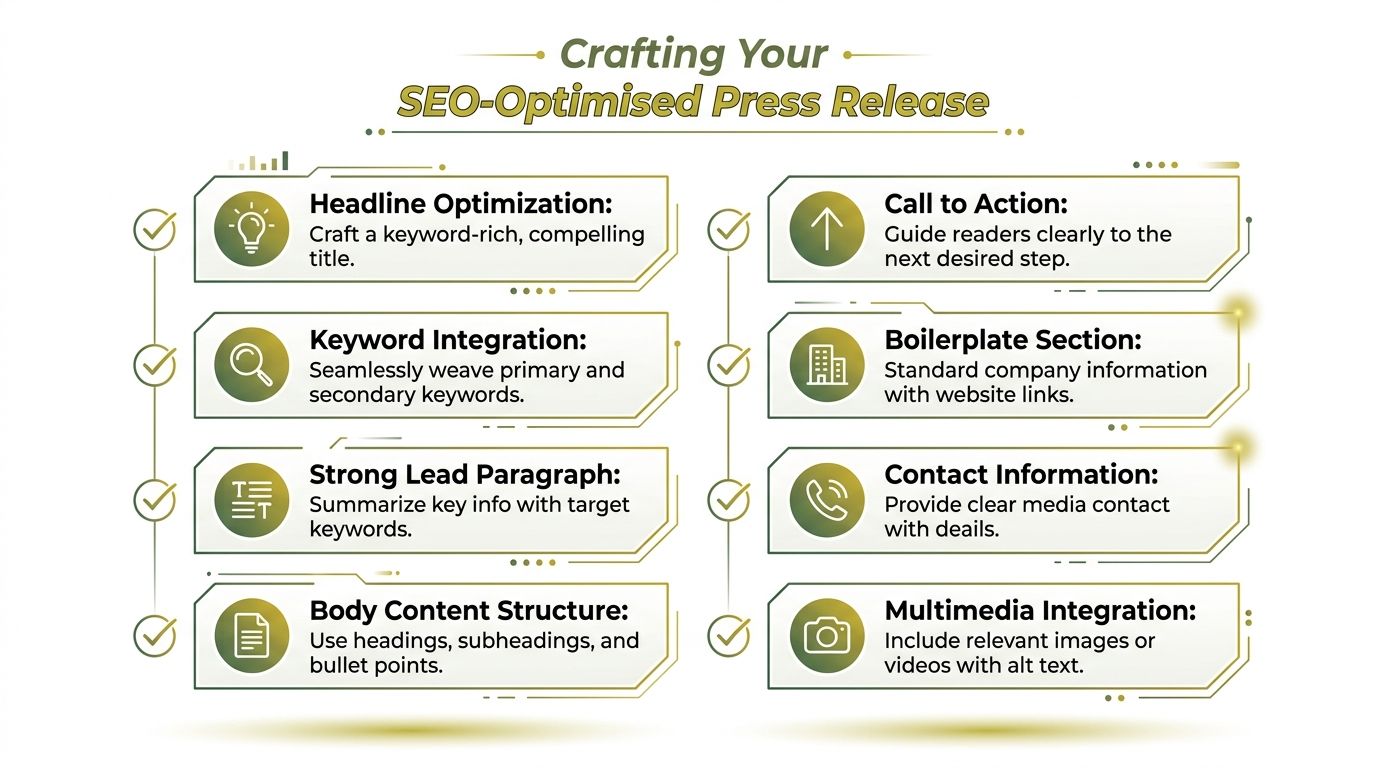
For UK-focused SEO press releases, the first 250 words need to contain the core message and primary keywords, and headlines should stay under 70 characters to avoid truncation in Google's UK search results, according to Digital Third Coast's guidance on SEO-friendly press releases. The same guidance warns that forcing keywords damages readability, while natural use of synonyms signals relevance better.
Write the headline like an editor, not a brand manager
The headline has one job. State the news clearly enough for a journalist to grasp it immediately and for search engines to identify the topic fast.
Weak headline:
- Leading company unveils exciting new chapter for growth
Stronger headline:
- Glasgow software firm launches compliance platform for SMEs
The stronger version does three things. It names the subject, states the action and introduces a useful search theme. It also avoids the inflated language that makes editors suspicious.
A few rules help:
- Put the subject near the front: Brands, places and core topics shouldn't be buried.
- Prefer plain verbs: Launches, expands, partners, appoints, opens, reports.
- Skip internal jargon: If a trade journalist wouldn't use the term, think twice.
- Keep the promise factual: Curiosity is fine. Vagueness isn't.
If you need examples of professionally structured release copy, this page on press release writing services shows the kind of editorial discipline that makes a difference.
The lead must do the heavy lifting
The first paragraph should answer the core newsroom questions fast. Who is announcing what, where, why now, and why it matters.
A useful formula is:
Company + action + audience relevance + supporting detail
For example:
A London cyber security consultancy has launched a new incident response support service for mid-sized firms, designed to help in-house teams manage media scrutiny and stakeholder communications after a breach.
That opening gives Google a clean topic signal and gives a journalist enough to decide whether to keep reading.
Don't save the key fact for paragraph four. Most editors won't get that far, and search engines place extra weight on the opening.
Use body copy to support, not smother
A well-built release usually contains:
- A tight second paragraph that adds context, such as market timing, use case or business rationale.
- One strong quote that sounds like a person, not a board presentation.
- A short supporting section with details a journalist might reuse, such as rollout scope, availability or sector relevance.
- A boilerplate that confirms who the company is and why it has standing to comment.
Useful body copy often looks cleaner when broken with sub-heads or bullets, especially for product or service announcements.
A simple body structure
- Lead paragraph: News and core relevance
- Context paragraph: Why now
- Quote: Add judgment, not repetition
- Details: Specs, markets, locations, sectors, timing
- Boilerplate: Business identity and contact route
A common mistake is using the quote to repeat the lead in softer language. Quotes should add point of view, conviction or useful framing. If the founder says only that they're "delighted", cut it.
Here is a sharper contrast:
| Weak quote | Stronger quote |
|---|---|
| We are thrilled to announce this exciting launch. | Clients don't struggle because they lack information. They struggle because decisions need to be made quickly under scrutiny, and that's what this service is built to support. |
A short visual walkthrough can help teams spot these differences in real time:
Link lightly and with intent
In most cases, one or two links are enough. They should go to the most relevant landing pages, not just the homepage. If the release is about a product, link to the product page. If it's about a report, link to the report page. That keeps the path logical for both readers and search engines.
Boilerplate is not an afterthought
A good boilerplate reinforces authority without bloating the release. It should say what the business does, who it serves, where it operates and where to verify more.
That matters because SEO for press releases isn't just about the article body. It's about whether the whole page feels credible, focused and easy to interpret.
Technical SEO for Multimedia and Indexing
The written release is only part of the job. The technical layer decides whether the content is easy to index, visually eligible for search surfaces and useful once other sites republish or reference it.
Stop obsessing over dofollow links
A lot of SME advice on press release SEO still assumes the main value sits in direct link equity from wire distribution. That view is dated.
A 2025 CIPR study found only 12% of UK business press releases on major wires contained any dofollow links, which changes how smart teams should judge distribution value and link strategy. The actual lesson isn't that press releases have stopped mattering. It's that many links now function more as discovery, click-through and brand visibility assets than as straightforward ranking levers.
That shifts the trade-off:
| Old assumption | Better modern view |
|---|---|
| Every embedded link should pass ranking value | Many links won't, so make them useful for users |
| More links is better | Fewer, more relevant links are cleaner |
| Wire placement alone creates SEO value | Earned pickup and on-site relevance matter more |
Images need to be optimised properly
Multimedia often gets treated like decoration. It shouldn't. Images help journalists use the story quickly and can support visibility if handled correctly.
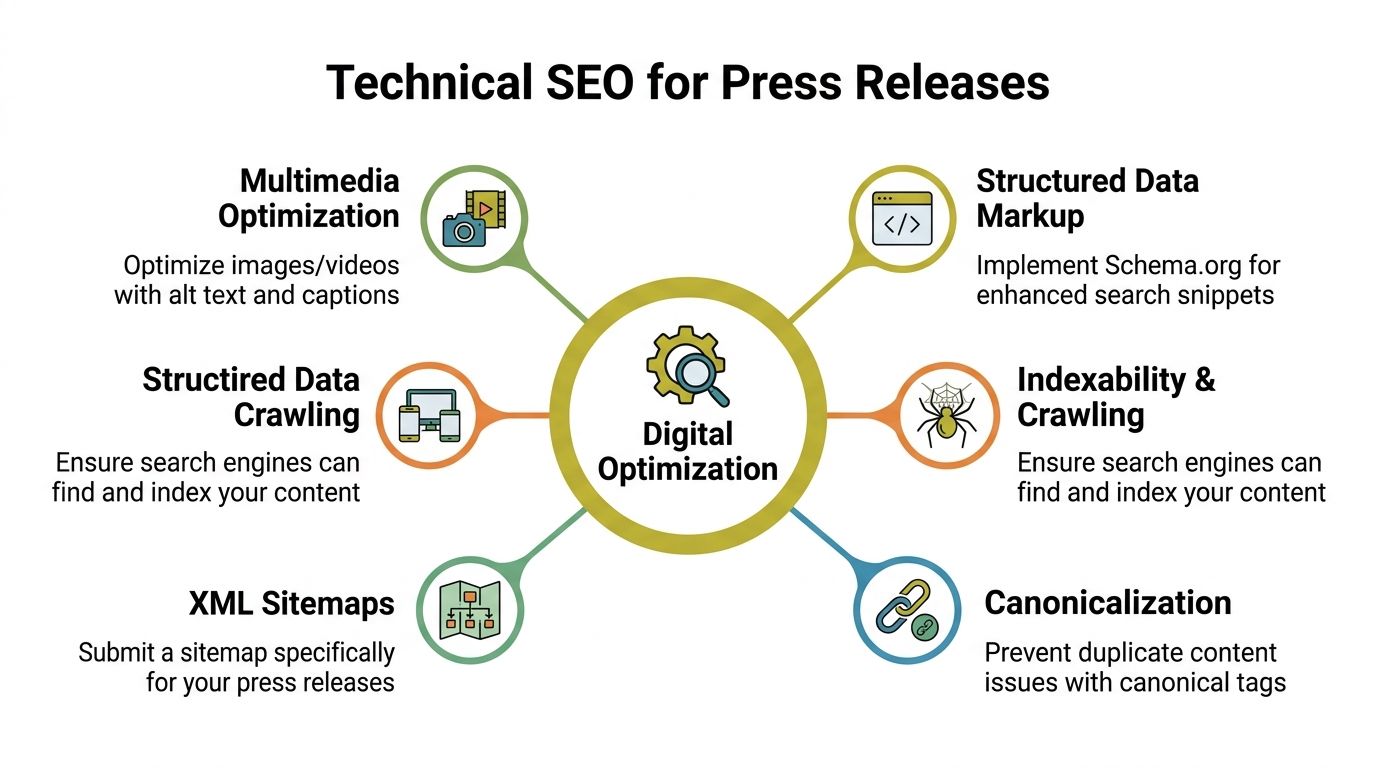
For UK-focused releases, image file names should include relevant keywords, and alt text should be descriptive at 4 to 7 words. Press releases using visuals with descriptive alt text and images with minimum dimensions of 60 x 90 pixels are eligible for inclusion in Google News, based on Prowly's press release SEO guidance.
A simple checklist helps:
- File name: Use descriptive wording tied to the story topic.
- Alt text: Keep it factual and concise.
- Image choice: Prefer executive headshots, product shots, charts or location imagery with editorial value.
- Landing page fit: Make sure the image matches the target page and release copy.
Indexing and site signals matter more than most teams realise
If your release lives on your site, make it easy for search engines to find and understand. That's where technical housekeeping earns its keep.
Useful elements include:
- A crawlable press release page
- Clear internal linking from relevant site sections
- Canonical tags if versions appear in multiple places
- XML sitemap inclusion
- NewsArticle schema where appropriate
For teams working through the broader technical side, a solid SEO audit checklist for site performance helps connect release pages with the rest of the site architecture.
Technical SEO won't rescue a weak announcement. It will, however, stop a strong one from being wasted.
Think in systems, not assets
The release text, the image metadata, the target page, the schema and the crawl path all work together. If one piece is sloppy, the whole asset becomes harder to surface and easier to ignore.
That's the practical reality of SEO for press releases. Search visibility doesn't come from one trick. It comes from aligning editorial quality with technical clarity.
Smart Distribution and Measuring Real Impact
A press release can be well angled, properly written and technically clean, then still go nowhere because distribution is lazy.
The worst habit in this part of the process is the spray and pray approach. Businesses push the release to generic networks, collect a report full of placements, and assume the campaign worked. It usually didn't.

According to PR Newswire UK's discussion of whether press releases help SEO, a critical pitfall is the vanity link strategy on low-quality networks. The same source notes that success is measured by media pickup, and releases supported by an online press room with assets see a 30 to 40% higher pickup rate from UK journalists.
Targeted outreach beats bulk distribution
Journalists don't want another generic blast. They want relevant, usable material sent by someone who understands their beat.
A stronger distribution model usually includes:
- A focused media list: Trade press, regional titles, national desks and specialist reporters with a real reason to care.
- A short customized pitch: One paragraph that frames the angle for that specific contact.
- A working press room: Logos, spokespeople photos, contact details and supporting assets in one place.
- A selective wire role: Use wires as one part of distribution, not the whole plan.
If you're trying to think more clearly about cross-channel reach after publication, this practical guide for creators and marketers offers useful ideas on how content can be repurposed and distributed without relying on one outlet or one platform.
What real success looks like
A lot of reporting in PR still leans on inflated metrics. Potential reach. Number of syndications. Impression estimates. None of those tell you much about whether the release changed anything meaningful.
A more serious scorecard looks like this:
| Metric | Why it matters |
|---|---|
| Media pickup | Shows whether editors found the story usable |
| Backlinks from credible coverage | Indicates earned authority, not just syndication |
| Referral traffic | Tells you whether coverage sent visitors |
| Keyword movement | Shows whether the topic gained search visibility |
| Click-through rate | Tests whether headlines and snippets worked |
Build the online press room before you need it
This is one of the simplest improvements a company can make. If a journalist has to chase basic assets, pickup odds drop. If everything is available immediately, the story becomes easier to use.
A useful press room should include:
- High-resolution logos
- Leadership headshots
- Short executive bios
- Company background
- Media contact details
- Recent releases and supporting documents
The easier you make the editor's job, the better your odds of coverage.
Distribution should fit the story
Not every release deserves national outreach. Some stories are best aimed at trade publications. Others should lead with regional media because place is the strongest hook. Some are better published on your own site and used as a supporting asset in direct journalist outreach.
That judgement is where experienced PR operators earn their keep. Distribution isn't admin. It's editorial strategy under time pressure.
Conclusion Becoming Your Own Best Publicist
The companies that get results from SEO for press releases don't treat the release as paperwork. They treat it as a media asset with two jobs. It has to be strong enough for a journalist to use and clear enough for search engines to understand.
That changes every step. You choose a real angle before drafting. You match the story to search language without forcing it. You write the opening for both busy editors and indexing systems. You support the release with proper assets, clean technical signals and smarter distribution. Then you measure what matters, especially pickup, traffic, search visibility and earned links.
Journalist-led expertise gives you an edge. Carlos Alba Media is explicitly a specialist UK agency where every team member is either a former national news journalist or has agency experience with international brands, a model that enables the newsroom insight needed for SEO-optimised press releases with editorial credibility, as outlined in Carlos Alba's professional background. That newsroom instinct is hard to fake. It helps you spot weak angles early, sharpen language fast and understand what editors are likely to trust.
If you're building authority beyond press releases alone, it's worth learning how outreach disciplines overlap. Resources that help teams master guest post outreach can sharpen the same skills that improve media pitching, namely relevance, targeting and clear value.
The practical takeaway is simple. Don't write a release because the calendar says you need one. Write it when you have something worth saying, shape it like a story, optimise it with discipline, and distribute it like someone who understands how news moves.
If you want senior-level help creating press releases that are built for both media coverage and search visibility, Carlos Alba Media brings a rare mix of newsroom judgment, SEO expertise and practical UK PR experience.