
The call usually comes at the wrong time. You're between meetings, legal wants sign-off on a statement, and a producer from a national broadcaster says they need someone live this afternoon. The subject sounds simple enough until you realise it isn't. They don't just want facts. They want a calm, quotable human being who can explain the issue clearly, hold the line under pressure, and avoid creating tomorrow's headline by accident.
That's the moment many leaders discover the gap between knowing their business and being ready for television. They're not the same skill. A capable chief executive can still ramble, look evasive, over-answer, or repeat internal jargon that means nothing to viewers at home.
Broadcast media training closes that gap. It teaches spokespeople how newsrooms think, what interviewers are trying to get from them, and how to deliver useful answers without surrendering control of the conversation. If your role also involves owned live content, it helps to understand the production side too, which is why guides on how to broadcast events live can be useful alongside interview preparation.
For practical preparation before any appearance, it's worth reviewing how to prepare for a media interview. The strongest interviewees don't wait for the camera light to go red before deciding what they stand for.
Facing the Camera Your Definitive Guide to Broadcast Media Training
A first-time broadcast request often produces the wrong instinct. People try to sound more “official”. They stiffen their posture, swap plain English for corporate phrasing, and answer the exact wording of the question rather than the concern behind it. In a newsroom, that usually lands badly. Producers want clarity. Viewers want relevance. Reporters want usable lines.
Broadcast media training is the process of preparing someone to meet those demands without sounding scripted. At its best, it turns an interview from a defensive exercise into a strategic opportunity. You stop treating the journalist as an obstacle and start treating the exchange as a professional performance with clear rules.
What the newsroom is looking for
Editors don't need perfection. They need someone who can help them tell the story accurately and briskly. That means:
- A strong opening answer that gets to the point quickly
- Plain language that a general audience can follow
- A stable tone even when the line of questioning tightens
- A memorable phrase that can survive editing without losing meaning
The camera punishes hesitation and rewards clarity.
A trained spokesperson knows that every answer has two audiences. One is the journalist in front of them. The other is the person watching from a kitchen, train platform, or office reception area with only half an ear on the segment. If your answer doesn't land with that second audience, it won't do the job.
Why this matters more than most leaders assume
Many business leaders assume media handling is an extension of presenting to investors, speaking at conferences, or running team briefings. It isn't. Broadcast compresses everything. Time is shorter. Language must be tighter. Non-verbal cues matter more. One weak phrase can become the line everyone remembers.
That's why proper training isn't remedial. It's operational. It helps a spokesperson decide what to say, what not to say, and how to say it in a way that survives the edit and protects the brand.
The Core Components of Effective Media Training
A good training programme works like a flight simulator. You don't wait for the storm to start before learning the controls. You rehearse under realistic conditions until the right habits become automatic.
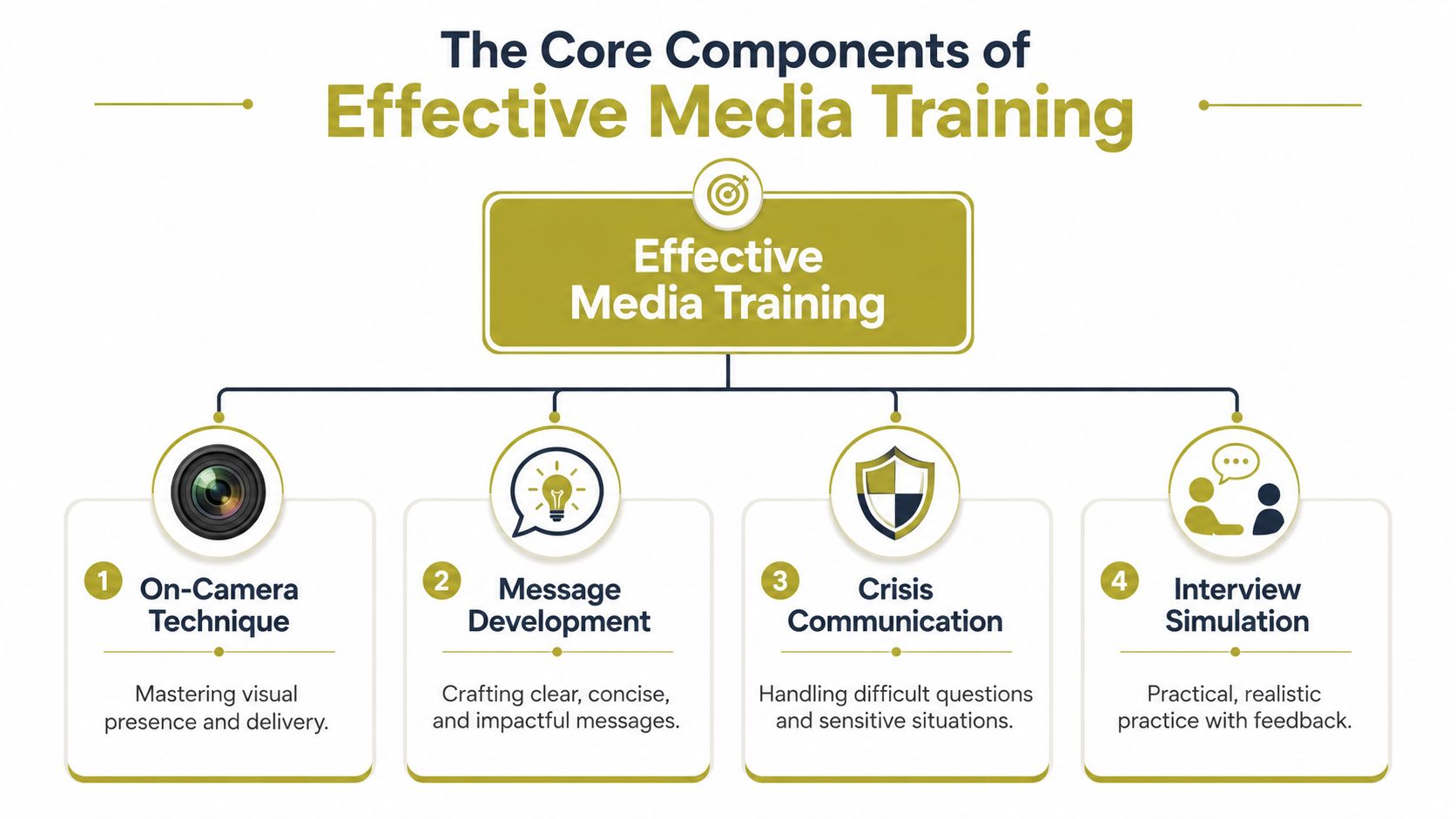
On-camera technique
The camera magnifies small mistakes. An interviewee who keeps glancing away can look uncertain. A rushed speaking pace can sound defensive. A chin angled too high can read as arrogant when the person simply has a poor monitor position.
Technical coaching matters. A thorough UK broadcast media training programme must incorporate simulated in-studio mock interviews with professional lighting, cameras, and recording equipment to replicate real televisual conditions, because that practice significantly reduces on-camera anxiety and improves message delivery, as outlined in what broadcast media training involves.
In practical sessions, trainers should review details such as:
- Eye line so you know whether to address the presenter, the lens, or the remote monitor
- Posture and framing so your body language supports your message rather than distracting from it
- Voice control so pace, pauses, and emphasis sound deliberate rather than strained
Message development
Most poor interviews fail before the first question. The spokesperson hasn't identified the message worth remembering. They know too much, not too little, and they try to say all of it.
Strong message development strips the subject down to its essentials. What must the audience understand? What phrase do you want quoted? What misconception needs correcting? In newsroom terms, you're building lines that are accurate, compact, and usable.
A useful way to test a message is with this simple filter:
| Question | What a strong answer sounds like |
|---|---|
| Can a non-specialist understand it immediately? | Plain, specific, free of internal jargon |
| Can it survive being clipped to one sentence? | Clear even when isolated from the full interview |
| Does it answer audience concern, not just corporate preference? | Relevant, not self-congratulatory |
Handling difficult questions
Many executives overcomplicate things. They think the trick is to dodge cleanly. It isn't. The trick is to answer enough of the question to retain credibility, then move to the point you need on the record.
Practical rule: If you ignore the question entirely, the interviewer will simply ask it again, usually more sharply.
Useful interview handling includes acknowledging a concern, correcting a premise when necessary, and moving to a grounded point of fact or action. It also includes restraint. In many interviews, one brand mention is enough. More than that and the answer starts to sound like an advert, which weakens credibility.
Crisis simulation
The final pillar is pressure-testing, a phase where training earns its keep. A spokesperson should face hostile framing, interruptions, incomplete facts, and emotionally loaded questions before they face them on air.
Crisis simulation should include replay and critique. Watching yourself back is often uncomfortable, but it shows exactly where the interview drifts: over-explaining, defensive facial expressions, filler words, or an answer that starts strongly and then unravels. Theory alone won't fix that. Recorded practice often will.
The Tangible Benefits for Your Brand and Career
The return from broadcast media training shows up in places that matter commercially. It sharpens reputation, improves leadership visibility, and reduces the chances that a live interview turns into an avoidable problem.
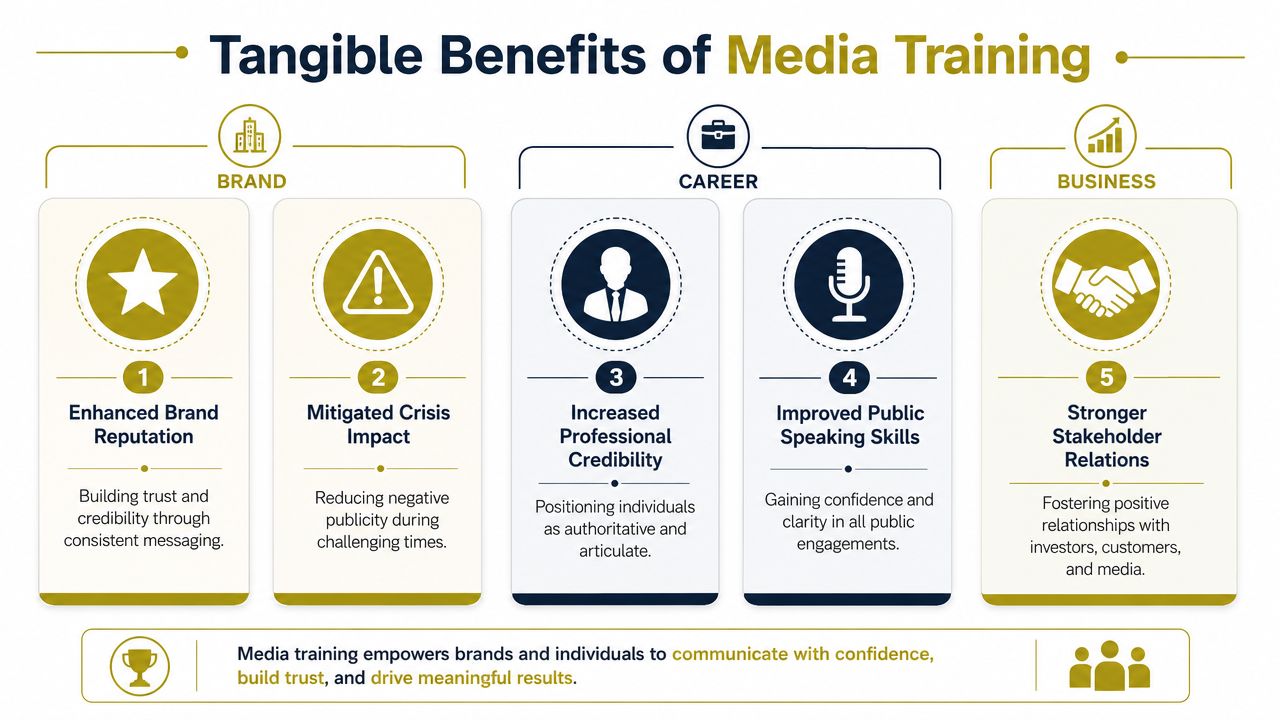
Brand and reputation
A trained spokesperson gives the business a better chance of being understood. That sounds modest, but it matters. News coverage moves fast, and journalists often build a segment around the clearest available material. If your representative offers a concise, credible answer, that answer is more likely to shape the piece than a muddled one.
Good training also helps brands avoid the classic errors that damage trust:
- Overclaiming in a format built for scepticism
- Sounding evasive because answers are too legalistic
- Using slogans instead of explanation when audiences want substance
Career and executive credibility
Leaders who can handle broadcast well tend to become the people organisations rely on in tense moments. That doesn't only affect media appearances. It improves board communication, investor briefings, conference speaking, and internal leadership presence.
There's also a broader point about structured training. According to a 2022 National Union of Journalists survey, 75% of students who completed a broadcast journalism course reported finding employment within six months, which underlines the professional value of formal skills development in this area, as referenced in this broadcast journalism course overview.
Commercial value after the interview
The smartest teams don't treat a good interview as a one-off moment. They repurpose it. Strong clips can support sales conversations, investor updates, recruitment content, and thought-leadership campaigns. If you want to turn longer appearances into shorter usable excerpts, tools such as AI video clipping tools can help teams extract sharper assets from broadcast or webcast footage.
A strong interview doesn't end when the programme does. It keeps working if your team knows how to reuse it.
Training therefore benefits both the immediate performance and the afterlife of that performance. It improves what gets said, how it lands, and how far it travels.
Who Needs Broadcast Media Training and When
The obvious candidates are chief executives and founders. In practice, they're only part of the picture. The best spokesperson for a story is often the person closest to the issue, not the person with the highest title.

Founders and senior leaders
Founders need training before funding rounds, major launches, difficult restructures, or moments when the business moves from trade coverage into national attention. The challenge here isn't knowledge. It's compression. Founders often know too much context and need help reducing complexity without losing authority.
Senior executives need it when they inherit visibility. A promotion, an acquisition, a public dispute, or a regulatory issue can turn someone from internal decision-maker into public representative very quickly.
Subject experts and operational voices
Head of product, chief medical officer, technical director, regional manager. These people often make the strongest interviewees because they know the detail and sound less polished in a good way. But they still need coaching. Expertise alone can produce answers that are accurate and unusable.
Full media training, including regular refreshers, helps interviewees handle broadcast work confidently and in their own natural style, avoiding radical changes to accent or dialect while reducing risk and stress, as discussed in these modern media training dos and don'ts.
For brands trying to turn expertise into visibility, resources such as Image Studio's thought leadership guide can help teams identify which internal voices are credible enough to develop into external commentators.
PR and communications teams
Comms teams need training too, even if they never go on camera. They're often responsible for prep packs, message discipline, risk spotting, and deciding who should speak. A poor media decision usually starts behind the scenes, not under the studio lights.
A useful companion to interview preparation is an effective crisis communications plan. If roles, sign-off routes, and fallback positions aren't settled in advance, the interview tends to expose that confusion.
Later in the process, it helps to see examples of how interview coaching works in practice:
The right trigger points
You don't book broadcast media training only when a crisis arrives. The better triggers are earlier:
- Before a market-moving announcement when you know journalists will want reaction
- After a leadership change when a new public face needs rehearsal
- Ahead of a campaign or launch when visibility is part of the commercial plan
- When a specialist becomes a regular commentator and needs consistency under pressure
The common mistake is waiting until the diary is already full and the first interview is tomorrow morning.
Choosing Your Broadcast Media Training Provider
Not all media training is equal. Some providers teach generic confidence. Better providers teach interview performance under realistic editorial pressure. The difference becomes obvious the moment a spokesperson is challenged in a way that feels like a real newsroom exchange.
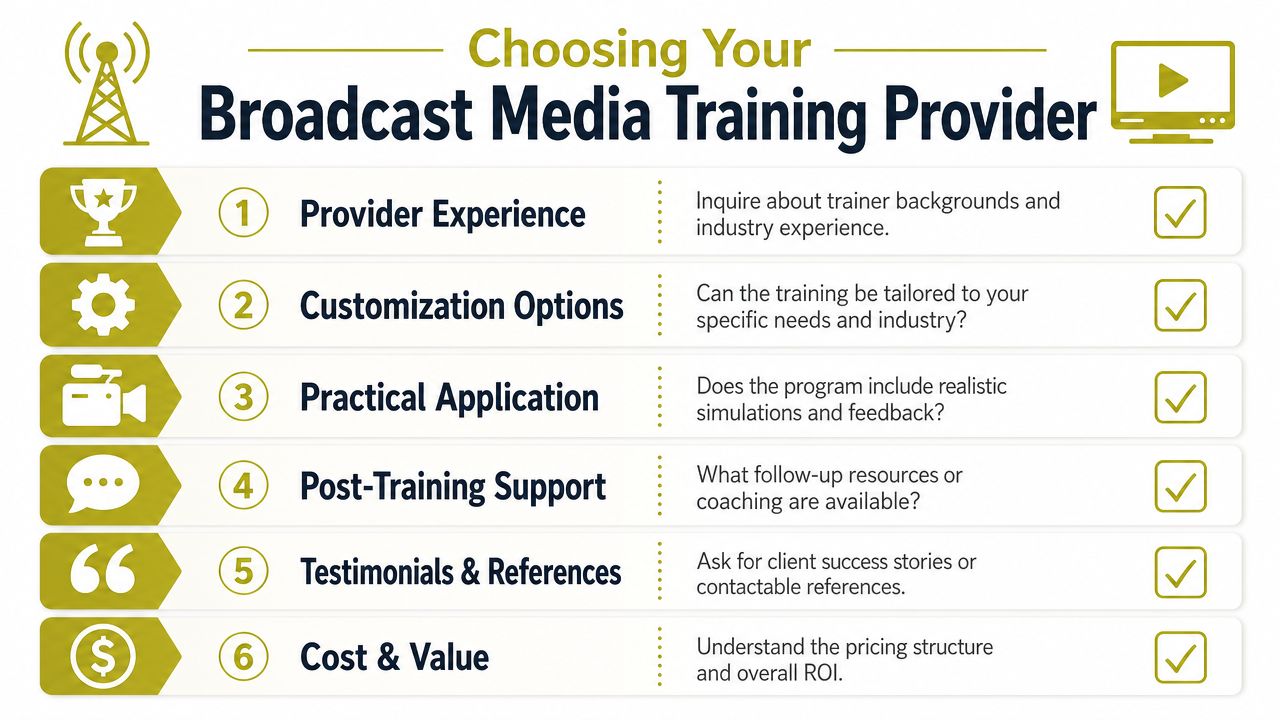
Start with the trainer's background
This is the first question I'd ask. Who is doing the coaching, and what rooms have they worked in? Providers led by former senior journalists bring an insider's understanding of deadlines, editorial framing, and what counts as a usable answer.
Carlos Alba Media is explicitly run by Carlos Alba, a former national newspaper editor with a 20-year career in national journalism, most recently as Editor of Sunday Times Scotland, which is set out on Carlos Alba's professional profile. Carlos Alba Media's specialist nature matters here, and everyone who works for Carlos Alba Media is a former national news journalist or has agency experience of working with international brands.
That background changes the quality of feedback. A former national journalist won't just say “tighten that answer”. They'll explain why the line would or wouldn't make the cut, how a producer may frame the segment, and where the risk sits in a loose phrase.
What to test before you buy
A buyer should push beyond the brochure. Ask practical questions.
- How realistic are the simulations. If there's no proper recorded practice, it's probably too theoretical.
- How customized is the training. Sector nuance matters. A retail founder, a health spokesperson, and a financial services executive don't face the same risks.
- What feedback do participants receive. Good coaching should be specific enough to change behaviour on the next run-through.
- Is there follow-up support. Spokespeople often need a refresher before a live opportunity, not only on the training day.
The provider should be able to tell you what weak answers look like from a newsroom point of view, not just from a presentation-skills point of view.
A quick comparison
| Provider type | Likely strength | Likely weakness |
|---|---|---|
| Presentation coach | Delivery and stage presence | Limited newsroom realism |
| General PR trainer | Messaging and brand alignment | May lack senior editorial experience |
| Former national journalist-led trainer | Editorial insight, sharper challenge, realistic interview dynamics | Requires proper tailoring to your sector |
If you're assessing the market, it helps to compare specialist media training companies against these criteria rather than choosing on familiarity alone.
Understanding Pricing and Measuring ROI
Broadcast media training is priced by complexity, not just by hours. A short group workshop costs less to deliver than a bespoke one-to-one session with message development, filmed practice, sector-specific scenario design, and post-session coaching. Location matters too. So does whether the provider is bringing studio-style equipment, whether senior leaders need individual runs, and whether the brief includes crisis work.
What you're actually paying for
There's a big difference between generic confidence training and broadcast-specific preparation. The cheaper option may cover broad communication habits. It won't necessarily rehearse the exact pressures of a hostile live interview, a doorstep clip, or a fast-turnaround studio appearance.
A useful procurement lens is this:
- Generic workshop for baseline awareness across a wider team
- Bespoke spokesperson training for people who are likely to appear on air
- Crisis rehearsal for high-risk sectors or organisations facing active scrutiny
The best value often comes from matching the format to the role rather than putting everyone through the same session.
How to judge return
ROI in media training is rarely one neat line item. It shows up in outcome quality. Did the spokesperson land the key message? Did the coverage reflect the intended framing? Did the interview create reassurance instead of confusion?
Use a simple scorecard after each interview or media cycle:
| Measure | What to look for |
|---|---|
| Message penetration | Did the core point appear in the final coverage or clip? |
| Quote quality | Were the usable lines clear, accurate, and on brand? |
| Risk reduction | Did the spokesperson avoid creating new issues on air? |
| Follow-on value | Did the interview produce clips or commentary worth reusing? |
A finance director may still ask for harder proof. Fair enough. In that case, compare activity before and after training across your own organisation's media outputs, inbound enquiries, stakeholder feedback, and the quality of journalist follow-ups. The precise indicators will differ by business, but the principle is constant. Better interviews create more useful coverage and fewer expensive clean-up jobs.
Frequently Asked Questions About Media Training
Will media training make me sound robotic
Only bad training does that. Good coaching doesn't turn people into presenters reading approved lines. It helps them answer naturally with more discipline. The goal is to sound like yourself on your best day, not like a script with a pulse.
A useful test is whether your answers still sound conversational when the wording changes. If they collapse the moment the question is phrased differently, you've memorised language rather than learned technique.
How often should spokespeople refresh their training
Refreshers matter whenever responsibilities change, public visibility increases, or a business enters a more sensitive period. A spokesperson who was sharp a year ago may still need rehearsal before a major announcement or difficult interview cycle. Skills fade, habits creep back, and formats change.
Short refreshers are often more effective than waiting for a complete retraining day after a long gap.
How should I handle a sensitive or crisis interview without a legal team in the room
This is one of the most overlooked areas in UK broadcast work. A frequently unanswered question is how to handle sensitive or crisis interviews without a legal team, because generic bridging advice often skips the UK-specific issues around broadcast liability and defamation under the Broadcasting Code, as noted in this discussion of broadcast media training gaps.
In practice, that means three things matter before you go on air:
- Know the line you can defend. Don't improvise allegations, motives, or causal claims.
- Separate empathy from admission. You can acknowledge concern without speculating beyond established facts.
- Prepare stop points. Some subjects require a holding answer rather than a fuller one.
If a point would worry you in writing, it should also worry you on camera.
What's the most common mistake first-time interviewees make
They answer the question they heard, not the story they're in. Journalists may ask about a narrow point, but viewers are usually trying to understand a broader issue: safety, trust, cost, accountability, disruption. If you miss that wider concern, your answer can be technically correct and still feel unsatisfactory.
Should every brand use the CEO as the spokesperson
No. The best spokesperson is the person with authority, clarity, and relevance to the issue. Sometimes that's the chief executive. Sometimes it's the technical expert, operations lead, or regional figure closest to events. Hierarchy matters less than fit.
If you need senior, newsroom-led support with interviews, crisis preparation, or wider PR strategy, Carlos Alba Media offers specialist counsel shaped by former national news journalists and agency professionals with experience working with international brands. For founders, SMEs, and established organisations that need calm, practical guidance before the cameras arrive, that perspective is hard to beat.