
Only 37% of UK brands had formally documented tone of voice guidelines, even though 82% of marketing leaders said a consistent brand voice was ‘critical' or ‘very important' for audience trust and differentiation, according to a 2019 UK content strategy report cited by Nielsen Norman Group. That gap explains why so many brands sound polished in one place, flat in another, and oddly unlike themselves when pressure rises.
In practice, tone of voice guidelines aren't a branding extra. They're an operating document. They shape how a founder answers a journalist, how a sales team follows up after an event, how a support team handles frustration, and how a social post lands when a story moves quickly. At Carlos Alba Media, that matters because the agency is specialist by design. Everyone who works for Carlos Alba Media is a former national news journalist or has agency experience of working with international brands. That mix changes how voice work gets done. Newsrooms teach you that wording carries consequence. Agency work teaches you that consistency has to survive scale, approvals, multiple channels and real deadlines.
Why Most Brand Voices Sound Inconsistent
Brand voice usually breaks down in the handover.
In one week, a founder speaks to press, marketing publishes a campaign, sales follows up after meetings, support replies to complaints, and an external agency drafts thought leadership. If each person works from instinct, the brand starts to change shape depending on who is typing. I see this often with SMEs that have grown quickly and with larger organisations where too many approvals have diluted the original intent.
Ownership is the first fault line. If nobody is responsible for setting the standard, everybody creates their own version of it. The homepage sounds polished. The press release sounds inflated. LinkedIn turns chatty. A customer response becomes defensive. None of those choices happen because people are careless. They happen because the business has not translated brand positioning into clear writing decisions. That is why voice work should start with a sharper definition of what the brand stands for, not just how it wants to sound. A useful starting point is a clear brand positioning framework in marketing.
Another problem is that many guidelines stop at adjectives.
"Friendly", "expert" and "human" are not enough for a team dealing with legal review, technical subject matter, investor scrutiny, or a reputational issue that needs a same-day response. In regulated sectors, vague guidance creates risk. In specialist sectors, it creates confusion. In smaller firms, it wastes time because every draft turns into a debate about tone rather than a decision about purpose.
Good voice guidance has to work under pressure.
From a newsroom perspective, that is the actual test. A usable standard helps people choose words quickly when facts are sensitive, deadlines are short, and several stakeholders want changes. Generic marketing advice rarely addresses that. It assumes a calm content calendar and a single audience. Real businesses do not operate like that.
AI has added another layer. Teams can now produce copy faster, but speed often flattens distinction. If prompts are weak or examples are generic, the output tends to sound interchangeable. Reviewing examples of how to create natural marketing prose can help teams spot language that is technically clean but empty of character.
The brands that hold a consistent voice usually get three things right:
- They assign clear ownership for the standard.
- They define how the voice changes by audience, channel and level of sensitivity.
- They give teams examples for difficult situations, not just ideal ones.
That last point matters more than many brand documents admit. A voice is not proven on the About page. It is proven in a correction note, a regulatory update, a holding statement, and a reply to an unhappy customer. If the guidance cannot help in those moments, inconsistency is built in from the start.
The Core Components of Effective Voice Guidelines
A good document is brief enough to use and detailed enough to prevent guesswork. If it reads like a brand manifesto, teams won't open it. If it only lists a few adjectives, they won't know what to do with it.
The most effective tone of voice guidelines usually contain a clear set of building blocks that translate strategy into day-to-day writing choices. If the voice sits on top of weak positioning, the document will drift into vagueness. That's why it helps to align the work with a sharper brand foundation, including the principles covered in brand positioning in marketing.
What the document must include
| Component | Purpose | Example |
|---|---|---|
| Brand values summary | Connects tone to what the organisation stands for | “We are trusted, practical and ambitious” |
| Core voice characteristics | Defines the stable personality of the brand | “Authoritative but not arrogant” |
| Do's and don'ts | Shows how the voice appears in real writing | Do: use plain English. Don't: hide behind jargon |
| Channel guidance | Adjusts tone by format and audience expectation | Social is lighter. Investor messaging is tighter |
| Vocabulary list | Clarifies preferred and avoided language | Say “help” rather than “facilitate” |
That table looks simple because it should. Teams need something they can scan quickly before they publish or reply.
The difference between useful and decorative guidance
The strongest voice characteristics are paired. A single adjective is too loose. “Warm” could mean conversational, overfamiliar, patronising or less stiff. Pairing forces discipline.
Examples that work well include:
- Clear but not blunt
- Confident but not boastful
- Expert but not academic
- Human but not informal
Those pairings stop teams from overcorrecting. They also help when multiple writers are involved, because they give a shared threshold for what is on brand and what isn't.
Good tone guidance should settle arguments quickly. If it creates more room for interpretation than the copy itself, it isn't finished.
What to include beyond the basics
A practical document also needs examples people can borrow from. That means:
- Opening lines: for emails, web pages, statements and announcements.
- Response patterns: for complaints, delays, service issues and media questions.
- Word choice guidance: approved terms, overused phrases to avoid, and sector language that needs plain-English translation.
- Escalation notes: where tone must tighten because legal, compliance or reputational risk is higher.
One mistake I see often is overprescription. Teams are handed rules so rigid that every sentence sounds processed. Another common failure is under-specification. The document says “sound helpful” but never defines how.
The middle ground works best. Set principles firmly, then show flexible examples. A writer should leave the document knowing the voice, hearing the voice, and being able to apply the voice in a live situation.
Auditing Your Current Voice to Find Your North Star
A useful tone of voice audit starts with evidence, not aspiration. In practice, brands rarely have a single voice. They have a patchwork built over time by different teams, agencies, founders, compliance reviewers and customer-facing staff. The result is familiar. The website sounds considered, outbound emails sound templated, support messages sound abrupt, and media comments are often the only place the brand speaks with real clarity.
That matters more in complex organisations. In regulated sectors, inconsistency is not just untidy. It can create risk if reassurance turns into overclaiming or if plain English disappears when a message needs legal precision. For SMEs, the pressure is different but just as real. Small teams often reuse copy across channels because time is tight, which means weak language spreads fast.
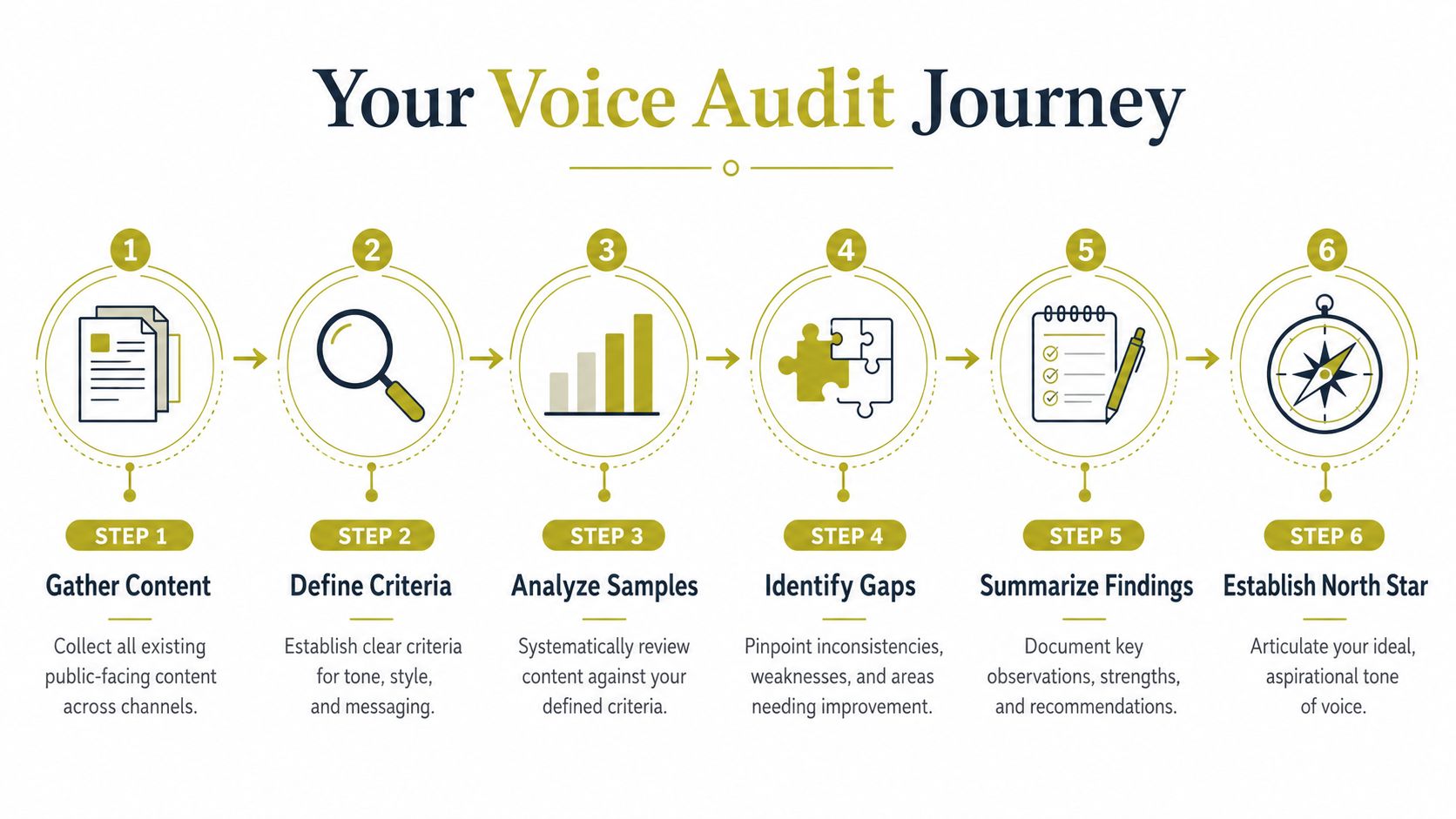
Start by collecting live material from the places customers, journalists, prospects and partners encounter you. Five channels is a sensible minimum:
- Website pages such as the homepage, service pages and About copy.
- Email journeys including enquiry replies, nurture emails and operational messages.
- Social posts across the platforms you actively use.
- Support language such as FAQs, chat templates or phone scripts.
- Internal communications because they often reveal how people naturally explain the business.
Then add the higher-stakes material that shapes reputation. For some brands that means press releases, founder LinkedIn posts and investor updates. For others, especially in specialist or regulated fields, it means complaint responses, incident statements, product documentation and compliance-approved customer communications.
Review the material for patterns, not for whether you personally like the writing.
I use five checks in workshops and editorial audits:
- Clarity: does the copy answer the reader's likely question early?
- Character: does it sound like a recognisable organisation, not a generic template?
- Consistency: do different teams sound related, even when the context changes?
- Audience fit: is the language pitched correctly for buyers, journalists, patients, investors or technical stakeholders?
- Situation fit: does the tone adjust properly when the subject is sensitive, formal or urgent?
A newsroom habit helps here. Read for what the wording is doing, not just what it says. An apology can be factually correct and still sound defensive. A service page can be accurate and still bury the point. A founder may speak with confidence in interviews while the website copy strips out any personality. Those gaps are useful because they show where the authentic voice already exists and where process has flattened it.
If your team wants an outside benchmark before agreeing final direction, expert advice on finding your brand voice can help frame the discussion.
The audit should produce three working outputs that people can use:
- A pattern summary: repeated strengths and repeated failures across channels.
- A gap list: places where current language conflicts with the brand you want to project.
- A north star statement: one concise description of how the brand should sound at its best.
This stage also benefits from mapping voice issues against the buyer experience. Brands often sound polished at awareness stage touchpoints and much weaker once a prospect asks detailed questions or a customer has a problem. That is why I often line audit findings up with the full customer journey mapping process, especially for SMEs trying to prioritise limited time and for specialist firms where trust is won or lost in later-stage interactions.
Audit the language people use.
That is the version you can improve. The language in leadership decks is useful context, but it is not the same thing as the voice the market hears.
Building Your Actionable Tone of Voice Framework
Once you've audited the mess, you can build the system. At this stage, most brands either become sharper or disappear into abstraction.
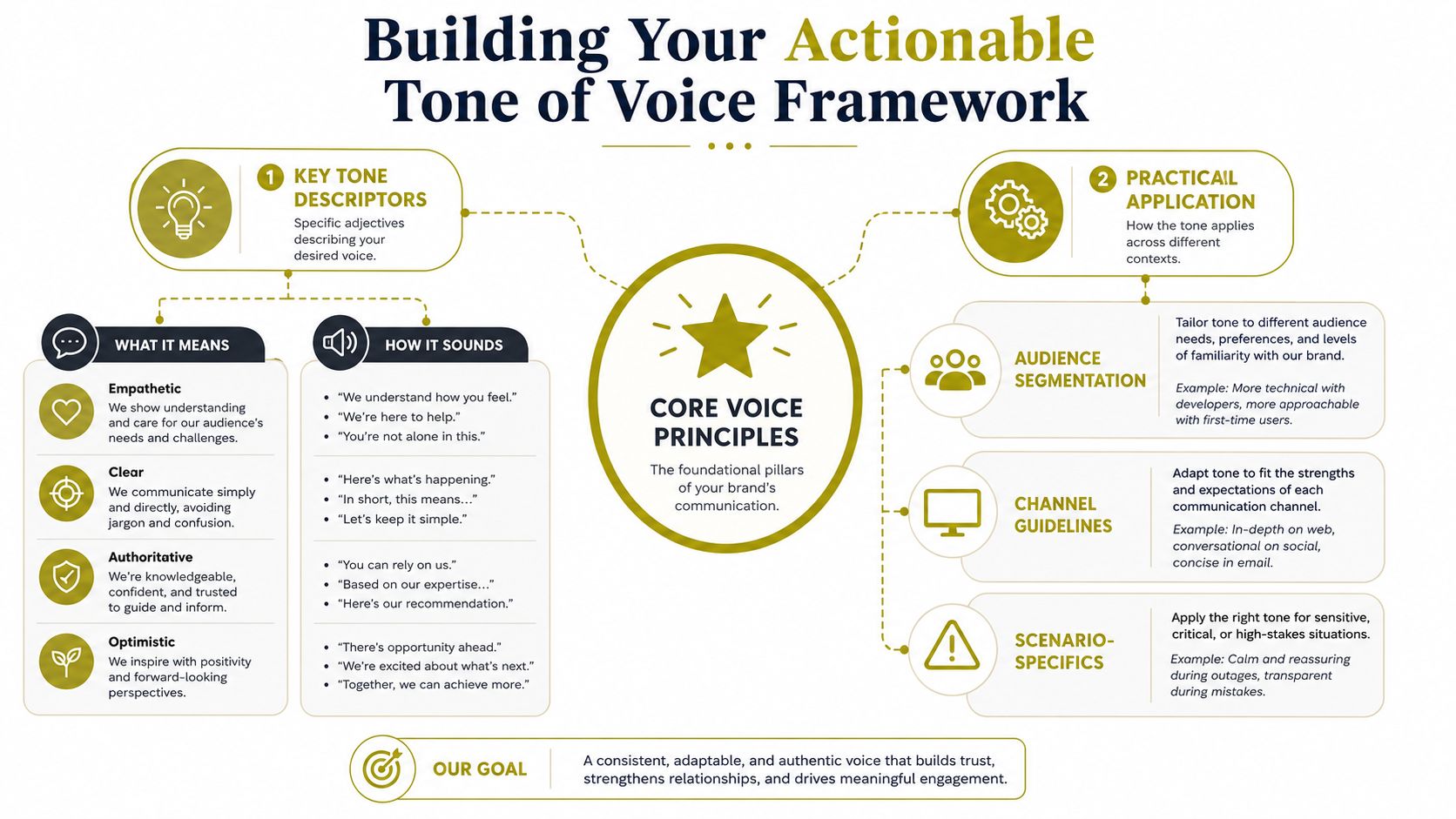
The shift is simple. Move from values to voice, then from voice to decisions. “Trusted” is a value. “Calm, plain-spoken and evidence-led” is a voice expression of that value. “Use direct answers before background detail” is a writing rule that supports it.
Start with three or four pillars
Teams typically don't need seven voice traits. They need three or four that are distinct, memorable and usable.
A practical framework often looks like this:
| Voice pillar | What it means in practice | Watch-out |
|---|---|---|
| Clear | Short sentences, plain terms, direct openings | Over-simplifying technical points |
| Reassuring | Calm phrasing, no drama, no blame | Sounding vague when certainty is needed |
| Authoritative | Lead with facts, not fluff | Sliding into stiffness |
| Human | Write to people, not departments | Becoming casual in serious situations |
Each pillar should include two things. First, a short explanation. Second, examples of how it sounds in live copy.
Translate principles into writing rules
This is the part teams use. If your pillars don't become rules, they remain branding theatre.
For example:
- If you want to sound clear, define sentence length expectations, preferred vocabulary and how quickly a message should reach its point.
- If you want to sound reassuring, decide how to handle delay notices, mistakes and complaints.
- If you want to sound authoritative, specify when to cite evidence, how to frame expertise, and which claims need approval.
- If you want to sound human, give examples of acceptable contractions, natural phrasing and empathy lines.
A before-and-after format helps more than a paragraph of explanation.
Before: “We are currently experiencing a temporary issue impacting service delivery.”
After: “Some customers are experiencing delays. We're working to fix it and will update you as soon as we can.”
Build for situations, not only channels
Many documents stop at “website”, “email” and “social”. That isn't enough. Tone changes more sharply by situation than by platform.
Include scenario guidance such as:
- Launch messaging
- Customer complaints
- Service disruption
- Executive commentary
- Press statements
- Recruitment content
A launch can be upbeat. A complaint response should be calm and specific. A press statement may need legal oversight but still shouldn't sound evasive. Those distinctions are what make tone of voice guidelines usable.
Keep the framework teachable
If your whole framework can't fit into a short internal workshop and a one-page cheat sheet, it's probably too heavy. The best documents are structured, but they don't sound bureaucratic. They give writers enough confidence to move quickly without drifting into guesswork.
That's the point. The framework shouldn't just describe the brand. It should make better writing easier.
Adapting Tone for Regulated and Specialist Sectors
Regulated brands rarely have a tone problem. They have a decision problem.

Writers are being asked to do several jobs at once. They need to sound clear to customers, accurate to specialists, safe for compliance teams, and credible under scrutiny. If the guideline only says "be human" or "sound expert", every department interprets that differently. The result is predictable. One page reads like a legal disclaimer, the next like a social caption, and neither feels like the same organisation.
I see this often in sectors where trust is hard won and easy to lose. Healthcare, financial services, education, professional services, and public interest organisations all face the same pressure. The audience needs plain English. The organisation still needs control.
That is why generic brand voice advice falls short here. A stronger approach sets boundaries for high-risk communication without draining the life out of it. For SMEs, that matters even more. Smaller teams do not have time for long approval loops or rewrites after legal review. They need a framework that helps people get it right earlier.
Why specialist sectors struggle
The friction usually sits between four valid priorities. Legal protects precision. Marketing protects clarity and differentiation. Subject experts protect technical accuracy. Leadership protects reputation.
Without a shared standard, each group edits for its own risk. Copy gets longer, colder, and less useful.
Healthcare is a good example. Patients need information they can understand quickly, especially under stress. Clinical teams need language that is accurate and defensible. Organisations working in areas such as public relations for healthcare cannot treat tone as decoration. A single phrase can change how a message is understood, quoted, or challenged.
Specialist sectors also deal with a second problem. Internal experts often write for peers, while customers read as non-experts. Good tone guidance closes that gap. It helps specialists keep authority without defaulting to terminology that excludes the reader.
Use a tone matrix for risk, audience and context
In regulated environments, I recommend a tone matrix because it gives teams something operational. It shows how far the tone can stretch in a given situation, and where it cannot.
A useful matrix covers four things:
| Scenario | Audience | Risk level | Tone guidance |
|---|---|---|---|
| Product launch | Customers | Medium | Positive, clear, evidence-led |
| Complaint response | Existing customer | High | Calm, specific, accountable |
| Service disruption | Public | High | Direct, transparent, reassuring |
| Educational content | Mixed audience | Medium | Plain English, expert, accessible |
This approach works well because consistency is not about identical wording. It is about repeatable judgment. A service update and a thought leadership article should not sound the same. They should still reflect the same standards for clarity, confidence, and care.
Here's a useful explainer on the broader thinking behind tone decisions in complex communication environments:
What good adaptation looks like
Good adaptation is controlled, not cautious.
A financial brand can be plain-spoken without sounding casual. A healthcare provider can show empathy without sounding sentimental or making promises it cannot support. A technical manufacturer can simplify language for buyers without irritating engineers or oversimplifying the product.
The practical fix is to define three categories. What language is approved. What language is preferred. What language requires review or should not be used at all. That gives teams room to write, while protecting the business in the areas that carry legal, regulatory, or reputational risk.
From a newsroom perspective, this is the standard worth holding. If a sentence would confuse a reader, invite misreporting, or create avoidable exposure, it is weak copy no matter how polished it sounds. In regulated and specialist sectors, the best tone of voice guidelines help teams write with confidence under pressure, not just sound better in a workshop.
Training Teams and Measuring Voice Consistency
Teams do not keep a brand voice consistent because a PDF exists. They do it because the guidance is easy to find, easy to apply, and backed by a clear review process.
That matters even more for SMEs and specialist firms. In practice, the people shaping your voice are often spread across marketing, sales, customer service, leadership, and external partners. In regulated sectors, add compliance and legal to that mix. If the framework is too abstract, people will ignore it. If it is too rigid, they will work around it.
From a newsroom perspective, good training reduces hesitation. It helps people make sound decisions quickly, especially under pressure.
Train with tools people will actually use
Start small and make it practical. A one-page working guide will get used more often than a long document full of theory.
Include the parts teams reach for during real work:
- Core voice pillars
- Approved and avoided phrases
- Examples for common scenarios
- Escalation points for sensitive or high-risk content
- AI prompting notes for first drafts
Then train on live material, not made-up examples. Review a real customer reply. Edit a product update that sounds too technical. Rework a founder quote that reads well in isolation but does not sound like the rest of the business. People remember the standard better when they have applied it to their own copy.
Ownership matters too. New starters should see the guidance early, and one person should have final editorial authority when views differ. That role does not need to sit with a large brand team. In a smaller business, it may be the marketing lead, founder, or agency partner. The point is consistency in judgment.
Build voice checks into workflow
Training on its own is not enough. Teams need prompts at the point of publishing.
A simple review process works well for both SMEs and larger organisations:
- Does this reflect the brand, not just the writer's personal style?
- Is the key message clear in the opening lines?
- Is the tone right for the audience, channel, and level of risk?
- Have we cut filler, jargon, and claims we cannot support?
- Does this need legal, compliance, or leadership review before it goes live?
This matters for AI-assisted drafting as well. Generative AI is useful for speed, but it often produces flat, interchangeable copy unless you give it clear constraints. Feed it the voice pillars, audience context, approved wording, and review triggers. Then edit it with care. Fast output is not the same as publishable output.
Editorial note: AI should speed up drafting. Final tone decisions still need human editorial judgement.
Measure consistency in places that affect trust
You do not need a large measurement framework to see whether voice guidance is working. Start with the channels where inconsistency creates confusion, delay, or reputational risk:
- Customer support responses
- Website and landing page copy
- Sales emails and follow-ups
- Social media replies
- Press statements and leadership communications
Review those outputs on a set schedule. Score them against your own framework, not personal taste. Look for recurring drift. In my experience, it usually appears during busy periods, urgent announcements, leadership rewrites, or content produced by several teams at once.
For regulated businesses, measure more than style. Check whether approved terminology is being used consistently, whether risky phrasing is being escalated correctly, and whether specialist language is being translated clearly for non-expert audiences. That is where generic brand guidance often falls short. A useful framework has to protect clarity and control at the same time.
Keep the guidance current
Voice guidelines need maintenance. New services, new spokespeople, new regulation, and new channels all create fresh edge cases.
A simple rhythm is usually enough:
- Quarterly reviews of live content
- Short refresher sessions for teams that publish often
- Targeted updates when a new risk, product, or audience appears
At Carlos Alba Media, we treat voice consistency as an editorial discipline, not a branding exercise. The test is straightforward. Can different people produce copy that sounds credible, clear, and recognisable without slowing the business down? If the answer is no, the guidance still needs work.
If your organisation needs tone of voice guidelines that work in practice, not just on a brand deck, Carlos Alba Media can help. Carlos Alba Media is a specialist Scottish-led agency with teams in London and Glasgow, and everyone who works there is a former national news journalist or has agency experience of working with international brands. That newsroom discipline, combined with senior agency delivery, helps start-ups, SMEs and established brands build language that holds up across media, digital, crisis communications and day-to-day customer touchpoints.