
Most SME leaders don't lack ambition. They lack space.
The day starts with staff issues, client emails, supplier delays and a sales target that still needs attention. By mid-afternoon, “strategy” has been pushed into the same mental drawer as “sort the website” and “review pricing”. Important, yes. Urgent, no. So it slips again.
That's usually the point where growth starts to feel messy. Marketing activity becomes reactive. New opportunities look tempting but disconnected. Teams stay busy without always moving in the same direction. A business can survive like that for a while. It rarely scales cleanly.
At Carlos Alba Media, the bias is towards facts, judgement and clear lines of priority. That comes from a team made up of former national news journalists and people with agency experience working with international brands. In a newsroom, you don't confuse noise with significance. In strategy, the same rule applies. You need to know what matters, what can wait, and what story your business is trying to tell the market.
Why Your Business Needs a Strategy Beyond Survival
A lot of founders treat business strategy planning as a document for banks, boards or funding rounds. That's too narrow. In practice, strategy is the filter you use to decide what deserves time, money and leadership attention.
Without that filter, every decision feels plausible. Launch another service. Run more ads. Rebrand. Hire. Cut prices. Chase a bigger client. Add a new channel. The problem isn't a lack of options. It's that options compete with each other.
UK-focused evidence gives this more weight than instinct alone. Companies with written business plans grow 30% faster, and 71% of fast-growing firms use strategic plans or similar long-range planning tools, according to strategic planning statistics compiled in this business planning guide. That matters because a written plan forces trade-offs into the open.
Strategy is a market narrative, not just a spreadsheet
A useful strategy answers questions your team and your market are already asking.
- Why this business: What space are you trying to own?
- Why now: What market change or customer need makes your offer timely?
- Why you: What can you credibly deliver that rivals can't match in the same way?
That's where a journalist's mindset helps. Strong reporting starts with angle, evidence and relevance. Strong business strategy planning does too. If your positioning is vague, your marketing will be vague. If your priorities are muddled, your operations will be too.
Your strategy isn't what you say in a slide deck. It's what your business repeatedly chooses to do.
Founders who want a clearer distinction between company-level direction and the choices made within a specific business line often benefit from analyzing corporate and business strategies before they start planning. It sharpens the conversation fast.
What survival mode gets wrong
Survival mode focuses on motion. Strategy focuses on consequence.
A business in survival mode often says yes too often, measures too little and carries on with activities that no longer justify the effort. A strategic business doesn't become less busy. It becomes more deliberate.
That's the shift that matters. Not from busy to calm, but from reactive to chosen.
Conducting Your Strategic Diagnosis
If your diagnosis is soft, the strategy built on top of it will be softer.
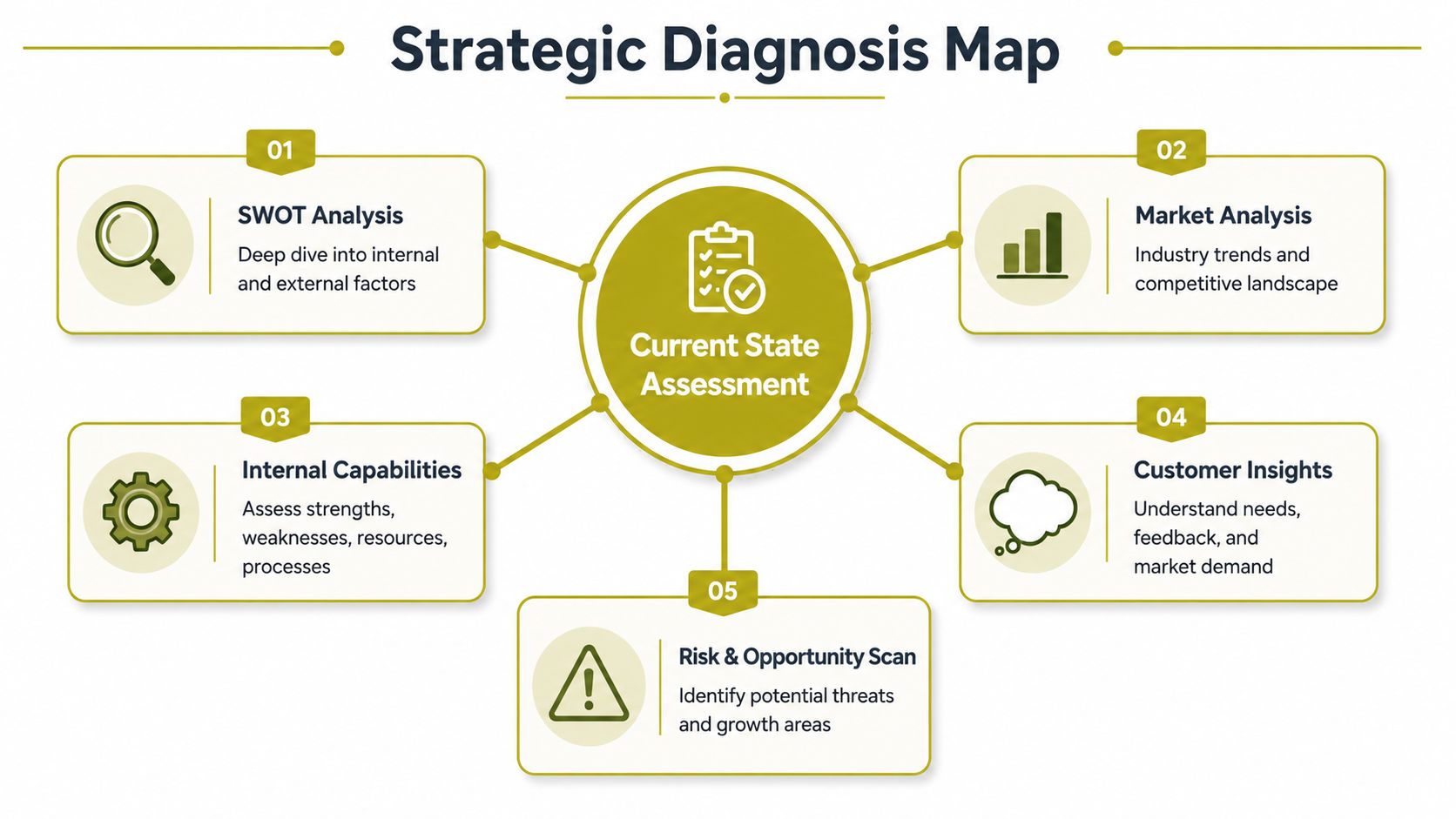
Many SMEs rush this stage because they already feel they know the business. They know their customers, know the competitors, know the pressures. But what leaders often know informally and what they've tested properly are two different things. Strategic diagnosis is where assumption meets evidence.
Start with what the market can actually see
SWOT is often done badly because businesses make it internal and flattering. They list “great service” under strengths, “limited budget” under weaknesses and stop there. A stronger version looks at how those issues appear to buyers, referrers, journalists, partners and prospects.
Ask harder questions.
| Area | Weak diagnosis | Strong diagnosis |
|---|---|---|
| Strengths | “We care about quality” | “Clients stay because senior staff lead delivery and the work is consistent” |
| Weaknesses | “Brand awareness could improve” | “Our website and search presence don't reflect the level of work we actually do” |
| Opportunities | “Social media growth” | “A live industry debate fits our expertise, but no one in the business owns thought leadership” |
| Threats | “Competition” | “Rivals are clearer on specialism, so they're easier to remember and refer” |
The difference is specificity. A useful SWOT should shape action. If it can't, it's still a workshop exercise.
Add a reputation and visibility lens
For service businesses, perception is part of the product. Buyers often decide before a sales call whether you feel credible, specialist and worth shortlisting.
That means your diagnosis should look beyond operations and finance.
- Search presence: What appears when buyers search your business, leadership team or category?
- Message consistency: Does your website, LinkedIn presence and sales material tell the same story?
- Proof: Can prospects quickly see evidence, outcomes, sectors served and senior expertise?
- Market signals: Are competitors visible in media, events, awards, partnerships or commentary where you are absent?
A proper competitor review should cover offer, pricing posture, language, authority signals and public profile. A structured framework can be particularly helpful for this purpose. Carlos Alba Media's competitor analysis framework is one practical way to assess how rivals position themselves and where gaps exist in the market conversation.
Practical rule: Don't just analyse who competes with you. Analyse who is shaping buyer expectations before your sales process even begins.
Use PESTLE without turning it into theory
PESTLE only becomes useful when it changes a decision.
A small firm doesn't need a long essay on political, economic, social, technological, legal and environmental factors. It needs to know which external shifts affect demand, margin, risk or positioning. For example, economic pressure can change how buyers evaluate value. Technological change can alter what they expect from delivery, reporting or response times. Legal and regulatory changes can raise the reputational cost of getting communications wrong.
Try this short diagnostic pass:
- Political and legal: What regulation, procurement rule or compliance issue could slow sales or expose the brand?
- Economic: Are customers becoming more cautious, more price-sensitive or slower to approve spend?
- Social: What themes matter more to your audience now than they did a year ago?
- Technological: Which tools or platforms are changing your category's baseline?
- Environmental: Does sustainability affect bids, operations or public scrutiny in your sector?
Turn diagnosis into a decision brief
A good diagnosis ends with tension, not a summary.
You should be able to say, in plain English, where the business stands and what choice now matters most. Something like this:
We have strong delivery but weak visibility. We're respected by existing clients but under-recognised by the wider market. The immediate strategic issue isn't capability. It's focus, proof and presence.
That kind of statement is useful because it can guide the next decisions. It tells you what problem strategy needs to solve.
Setting Goals and Defining Your Route to Market
Goals fail when they sound impressive but don't alter behaviour.
A business says it wants growth, better clients, stronger margins or a bigger profile. All sensible. None specific enough to direct a team. In business strategy planning, the job isn't to write aspirations more elegantly. It's to convert ambition into choices people can act on.
Set a destination that can survive a difficult quarter
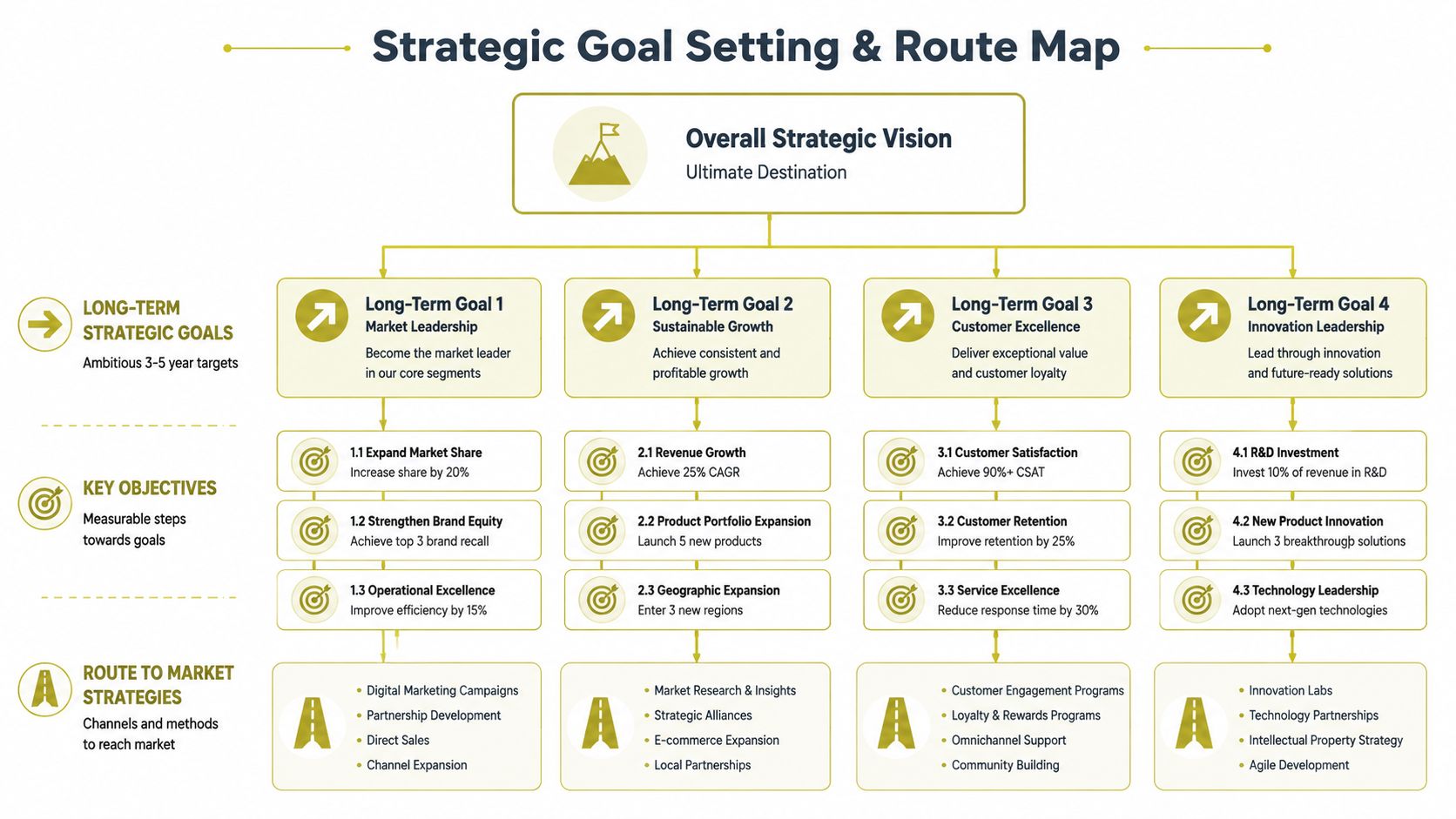
A long-term strategic goal should stretch the business without becoming fantasy. Some leaders like the language of a big audacious goal because it creates energy. That can work. But ambition only helps if it also survives scrutiny.
Use three tests.
- It must be commercially meaningful. If achieved, does it improve the business in a way that matters?
- It must sharpen positioning. Does it make you more recognisable in the market?
- It must influence priorities today. If nothing changes this quarter, it isn't yet a strategy.
A weak goal sounds broad. A stronger one forces definition. Instead of “become a recognised brand”, define the market you want to be known in, the kind of client you want more of, and the kind of work you want to be chosen for.
Here's a useful way to frame it:
| Goal type | Weak version | Stronger version |
|---|---|---|
| Growth | “Grow the business” | “Grow through a narrower set of higher-value services” |
| Reputation | “Increase awareness” | “Become known for specialist expertise in a defined category” |
| Market focus | “Win more customers” | “Win more of the right customers through clearer targeting and proof” |
Break ambition into operating objectives
Long-range strategy still needs short-range discipline. That's where SMART objectives earn their keep.
Each objective should answer one question: what has to happen for the larger goal to become more likely?
Some objectives will sit in marketing. Others will sit in sales, delivery, hiring or product development. The point is alignment. If your strategy says premium specialist but your route to market depends on bargain messaging and generic outreach, the plan is already fighting itself.
A route to market isn't just a channel choice. It's the practical expression of your position.
- A niche specialist usually needs authority-led content, case evidence, referrals and precise messaging.
- A premium offer needs stronger proof, stronger onboarding and a sales process that reinforces confidence.
- A volume play needs operational consistency, efficient acquisition and messaging built for clarity at scale.
Brand and commercial planning intersect. A useful resource for that overlap is Carlos Alba Media's work on digital marketing and branding, especially when a business needs its market position and lead generation approach to stop pulling in different directions.
A short explainer on strategy mapping can help if you want to visualise how the layers fit together.
Match the route to what buyers need to believe
In practice, route to market comes down to buyer confidence.
If a prospect needs reassurance, show proof. If they need education, lead with insight. If they need speed, reduce friction. If they need trust, tighten the story across every touchpoint.
The route that works best is usually the one that makes your offer easiest to understand and safest to buy.
That's why strategy and messaging can't be separated. The route to market should make your position more obvious, not compensate for a fuzzy one.
Building Your Action Plan with Clear KPIs
The point where most plans weaken is simple. They stop at intent.
Leaders agree the strategic priorities. The document looks sensible. Then daily work takes over, and the plan becomes background reading rather than a management tool. That gap between planning and execution has been studied for years. Foundational strategic planning guidance notes that 90% of organisations fail to execute their strategies successfully, and that 85% of leadership teams spend less than one hour per month on strategy while 50% spend no time at all, according to the Balanced Scorecard Institute's strategic planning basics.
Turn strategic priorities into owned initiatives
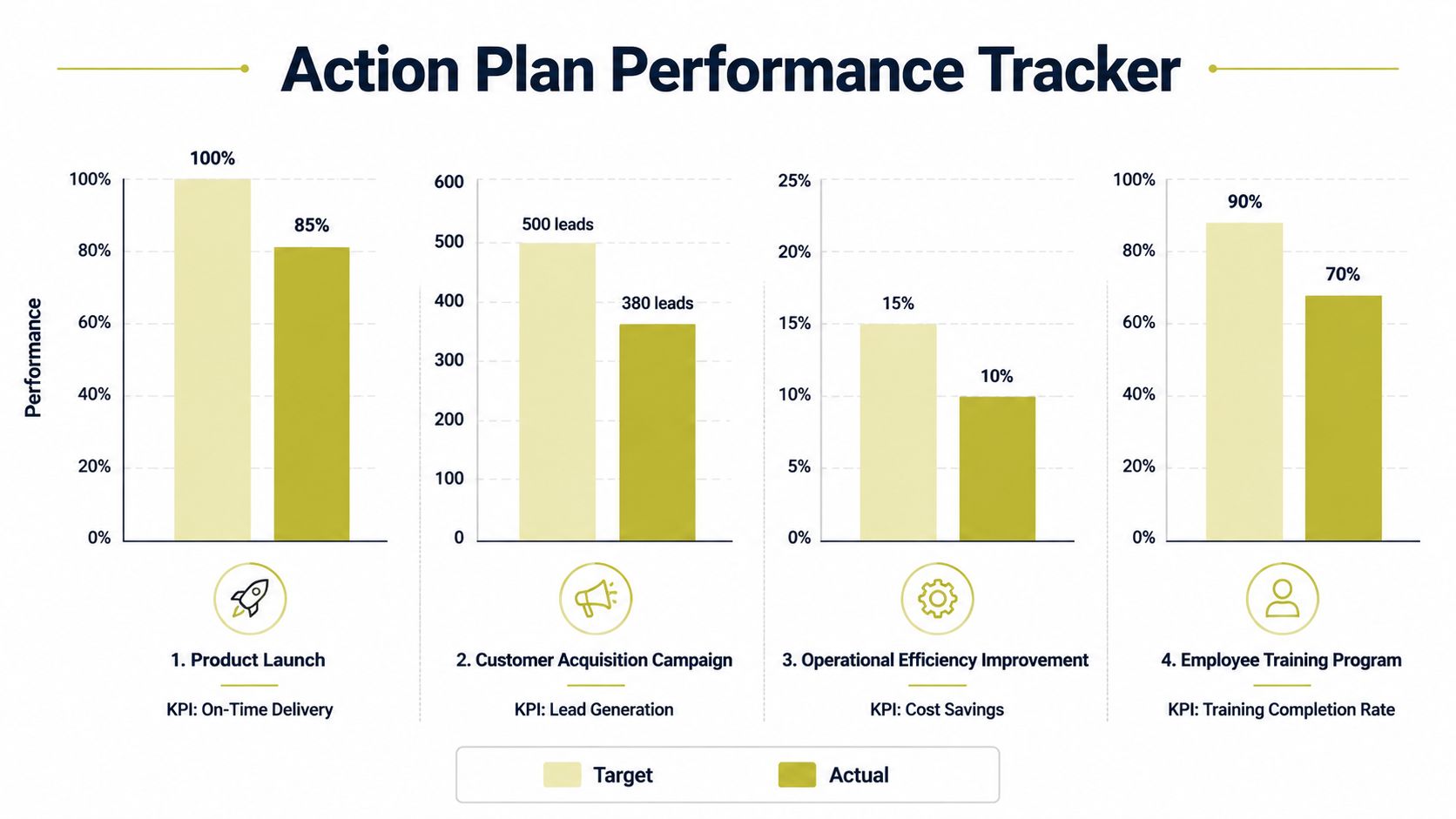
An action plan needs fewer moving parts than often assumed. If the plan contains too many active priorities, teams stop knowing what matters most.
A practical approach is to translate each strategic goal into a small number of initiatives with one owner, one deadline rhythm and a handful of measures. For many SMEs, that means keeping actions visible on a monthly or quarterly cadence rather than burying them in annual language.
Use this checklist when building the plan:
- Named owner: One person is accountable, even if several people contribute.
- Decision deadline: Set review points for choices, not just delivery milestones.
- Evidence of progress: Use measures that show movement, not activity alone.
- Operational consequence: Make clear what changes if the initiative succeeds or slips.
If you're building a strategy with a strong reputational or marketing component, a documented communications strategy can help align message, channel and responsibility.
Use KPIs that reflect business health, not vanity
The Balanced Scorecard became mainstream in the early 1990s because it links strategy to measurable performance across more than one lens. That's still useful. SMEs often over-focus on one category of metric, usually revenue or campaign response, and miss whether customer experience, delivery quality or team capability is supporting the plan.
A more balanced KPI set usually covers four areas:
| Perspective | Useful questions | Example measures |
|---|---|---|
| Financial | Is the strategy producing commercial return? | Revenue growth, margin quality, pipeline value |
| Customer | Are we becoming easier to trust and choose? | Retention, sales conversion quality, feedback themes |
| Internal process | Can we deliver consistently? | Lead handling, proposal turnaround, campaign delivery discipline |
| Learning and capability | Are we building repeatable strength? | Team skills, leadership visibility, content production consistency |
For PR and digital marketing, meaningful KPIs often sit around visibility quality, message consistency, lead relevance and conversion performance. Vanity metrics can still be monitored, but they shouldn't run the plan.
A KPI is useful only if it helps someone decide what to do next.
Build review habits, not just dashboards
Dashboards matter. Review discipline matters more.
A monthly leadership discussion should ask three things. What moved. What stalled. What now needs a different decision. That keeps strategy active and prevents teams from hiding behind completed tasks that didn't produce business value.
The businesses that get more from business strategy planning usually don't have perfect systems. They have clear priorities, visible ownership and regular conversations tied to evidence.
Planning Resources Budgets and Managing Risk
This is the part many strategy documents avoid because it forces honesty.
Every strategic decision uses scarce resources. Time, cash, senior attention, delivery capacity, internal goodwill. That means business strategy planning isn't mainly about what you want to do. It's about what you're willing to fund, protect, postpone or stop.

Resource planning is a trade-off exercise
Most SMEs don't fail to plan because they're careless. They fail because every good idea appears to deserve attention. New service lines look promising. Marketing channels feel worth testing. Operational fixes remain unfinished. Leadership ends up trying to advance everything at once.
Research on strategy implementation captures how common this is. Strategic initiatives are often reported as failing at rates between 50% and 90%, and 73% of managers say implementation is harder than formulation, according to this analysis of strategy implementation failure rates. The guidance attached to that research is blunt. Keep the plan focused on 3 to 4 clear strategic priorities, make ownership explicit, and correct course regularly.
That advice matters because budgets don't rescue overloaded strategy. Focus does.
Use stop, do, start before you touch the budget
A budget should follow strategic intent, not substitute for it.
Before assigning spend, list the activities that absorb money or time today. Then sort them into three categories.
- Stop: Work that no longer supports the chosen direction, even if it feels familiar.
- Do better: Work that matters but needs stronger ownership, tighter process or clearer return.
- Start: New initiatives that directly support the priorities you've chosen.
This is especially important for service businesses where labour is the main constraint. Senior people often become the hidden bottleneck. The strategy may look affordable on paper, but if it depends on the same few people doing more of everything, it isn't funded properly at all.
A grounded practical guide for service businesses can help leaders connect forecasting decisions to real delivery capacity rather than abstract budget lines.
If the plan requires more effort than your team can realistically absorb, it isn't ambitious. It's under-costed.
Budget for execution, not just launch
One of the most common planning mistakes is over-funding the visible start and under-funding the less glamorous middle.
For example, a business may approve spend for a new website, brand refresh or campaign burst, but fail to ring-fence time for follow-up content, sales enablement, reporting discipline or media handling. That turns strategy into a launch event instead of an operating system.
A practical budget discussion should cover:
| Budget area | Common mistake | Better question |
|---|---|---|
| Marketing | Funding activity without clarifying objective | What commercial outcome is this meant to support? |
| People | Assuming current team can absorb new work | Who owns this, and what are they no longer doing? |
| Tools | Buying platforms before process is clear | What decision or workflow will this improve? |
| Agency support | Using external help tactically only | Where does outside expertise reduce risk or increase pace? |
In some cases, specialist support makes sense because it adds senior capability without permanent overhead. Carlos Alba Media is one example for businesses that need PR, digital marketing, brand positioning or crisis communications folded into a wider strategic plan.
Risk belongs inside the strategy, not in a separate drawer
Too many SME plans assume a steady environment. Real businesses don't get that luxury.
A resilient strategy should identify where failure, delay or reputational damage is most likely. For some firms, the biggest risk is commercial concentration around a small number of clients. For others, it's operational fragility, founder dependency, poor public messaging or exposure during a media issue.
A useful risk review asks:
- Where could execution break down first?
- What would damage trust fastest if it went wrong?
- Which risk needs preparation now rather than reaction later?
For businesses with a public profile, crisis planning deserves early attention. Media scrutiny, a customer complaint, a legal issue or a leadership misstep can quickly disrupt a carefully built growth plan. Businesses with a response structure, clear spokespeople and agreed lines of escalation recover faster because decision-making doesn't collapse under pressure.
The strongest plans feel narrower than expected
That can be uncomfortable. Leaders often worry that a tighter plan means missed opportunity. Usually the opposite is true. Clear prioritisation protects execution quality, messaging clarity and leadership focus.
A broad wish list looks ambitious. A funded plan with named owners is what moves.
Bringing Your Strategy to Life with Quick Wins
The best strategy documents create movement quickly. Not because every change happens at once, but because people can see what's different straight away.
Many SMEs often lose momentum. The plan gets written, shared in a meeting, then parked while old habits return. The fix isn't another workshop. It's a short list of visible actions that prove the strategy is now affecting decisions.
What quick wins should look like
Quick wins shouldn't be random tasks chosen for ease. They should make the strategy more believable.
Good examples include tightening homepage messaging so the specialism is obvious, removing low-value activity that consumes senior time, assigning ownership to one neglected growth initiative, or building a simple monthly scorecard that leadership actively reviews. None of those changes are dramatic. All can shift behaviour.
A useful test is whether the action does one of these:
- Clarifies focus: It makes the business easier to understand internally and externally.
- Releases capacity: It removes work that no longer deserves energy.
- Improves proof: It strengthens credibility in the eyes of buyers or stakeholders.
- Creates accountability: It gives one person clear ownership and a review point.
A practical first month
For most SMEs, the first month after planning should be disciplined rather than busy.
- Cut one distraction: Stop one activity, meeting or offer that doesn't support the chosen direction.
- Rewrite the core message: Make sure the website, sales deck and LinkedIn presence describe the same value clearly.
- Name the owners: Each priority needs one accountable lead.
- Set the review rhythm: Put recurring strategy reviews in the diary now, while intent is still fresh.
- Create a live decision log: Track what has been approved, deferred or dropped, and why.
Effective strategy is built on trade-offs under constraints. Many guides miss the central SME question, which is what to stop doing to free up resources. The more valuable plan is the one with explicit stop, do and start decisions, as argued in this piece on strategic planning trade-offs.
Small wins matter when they change how the business chooses, not just what the team completes.
A strategy that lives in calendars, budgets, briefs, meetings and market-facing messages will keep improving. A strategy that stays in a PDF won't. Start with the next clear decision, make the trade-off explicit, and build momentum from there.
If your business needs a sharper growth plan, clearer market positioning or senior support across PR, digital marketing and reputation management, Carlos Alba Media can help turn strategic intent into practical execution.