
A business founder once asked me why three agencies had ignored the most important part of his story. The answer was simple. They were pitching outputs, not news.
That gap is where many PR firms are born, and where most of them go wrong. A journalist learns fast that editors don't care how much a client wants coverage. They care whether the story stands up, whether the timing works, whether the claim is credible, and whether the person pitching it understands the audience. If you want to know how to start a PR firm that lasts, start there.
Introduction From Newsroom to New Firm
The usual advice says find a niche, build a website, buy a media database, then start selling retainers. That's not wrong. It's just incomplete.
The stronger way to build a firm is to think like a newsroom first. In a newsroom, you don't begin with what you want to say. You begin with what matters, what can be proved, who needs to hear it, and why now. That discipline is what separates firms that win trust from firms that send forgettable outreach.
At Carlos Alba Media, the specialist nature of the model matters. The team is built around people who are former national news journalists or people with agency experience working with international brands. That mix changes the work. It means story development gets tested against real editorial judgement, and client counsel is shaped by people who understand both media scrutiny and brand pressure. If you need a basic definition of the category, this explanation of what a public relations agency does is a useful starting point.
Your niche is really your beat
Journalists don't usually describe themselves as generalists forever. They develop a beat. Politics. Business. Health. Courts. Technology. Hospitality. They learn the language of that world, the tensions inside it, the names that matter, and the issues that keep resurfacing.
A PR founder should do the same. Don't ask, "What services can I sell?" Ask, "Which beat can I own well enough that clients trust me with high-stakes communications?" That could be Scottish tech SMEs, hospitality brands, regulated healthcare businesses, founder-led consumer brands, or executive reputation work.
Practical rule: Build the firm around editorial judgement first, then wrap commercial services around it.
A newsroom-led agency has a different centre of gravity. It doesn't rely on volume. It relies on angles, timing, message discipline, and senior counsel. That's more demanding to build, but it's also more defensible once the market gets crowded.
Define Your Editorial Beat and Business Model
The UK market is big enough to reward specialism. The UK public relations market was estimated at about £3.0 billion in 2024 and is projected to grow at a compound annual growth rate of 4.8% from 2025 to 2034, reaching roughly £4.8 billion, according to PRLab's market overview. That doesn't mean a new firm should try to serve everyone. It means the market already has enough depth for focused agencies to carve out a clear position.
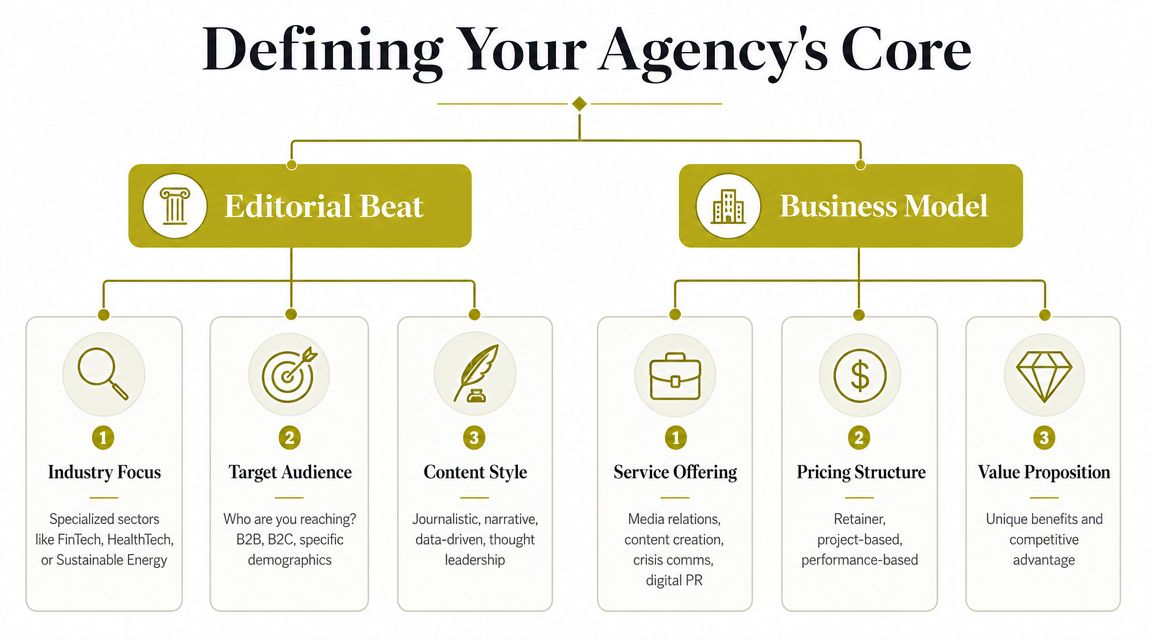
Choose a beat clients will pay to protect
A useful beat has three qualities. It has recurring news tension, identifiable decision-makers, and reputational consequences.
A weak beat sounds broad, such as "businesses that need PR". A stronger one sounds like "venture-backed tech founders who need investor-facing media credibility" or "premium hospitality brands that need national features and crisis cover". The narrower version gives you language, examples, and a buyer.
Use this filter before you commit:
| Question | Good sign | Bad sign |
|---|---|---|
| Do you understand the sector's pressure points? | You can name the issues that trigger media interest or reputational risk | You only know the services you want to sell |
| Can you identify the buyer? | Founder, marketing lead, managing director, in-house comms lead | "Any business owner" |
| Can you write a positioning line in one sentence? | Clear, specific, defensible | Generic and interchangeable |
| Would a client see why you're different? | Yes, because your expertise is obvious | No, because the offer sounds like every agency website |
Build the model around expertise, not busyness
A newsroom-led agency shouldn't be designed around low-value admin. It should be designed around judgement.
That affects service lines, delivery, and margins. If your value comes from senior editorial thinking, your model should reserve your time for strategy, messaging, media training, crisis advice, and the kinds of pitches that require experience. Delegate formatting, scheduling, clipping, and routine reporting wherever you can.
A simple structure works well in year one:
- Core retainer work for ongoing media relations, positioning, press office support, and executive visibility
- Project work for launches, thought leadership campaigns, or profile-raising around a funding round
- High-stakes advisory work for crisis response, interview prep, statement drafting, and reputation protection
Clients don't pay premium fees for activity logs. They pay for judgement under pressure.
Pick a legal form that matches your risk appetite
One of the biggest differences between UK and US-style advice is the legal setup. In the UK, the choice between sole trader, limited company, and LLP isn't a formality. It shapes your admin burden, credibility, and exposure.
A practical comparison looks like this:
| Structure | Often suits | Main advantage | Main trade-off |
|---|---|---|---|
| Sole trader | A solo founder testing demand | Simpler to start and run | Less separation between personal and business risk |
| Limited company | Founders planning to grow, hire, or take on larger clients | Clearer business identity and separation | More filings, director duties, and admin |
| LLP | Partners building together | Flexible partnership structure | More complexity than many first-year founders need |
If you're serious about serving retained clients, handling sensitive counsel, and hiring contractors, many founders will at least consider a limited company early because it signals permanence and separates the business more clearly. But that extra credibility comes with obligations. Choose the structure for the business you are building, not the one you imagine in a pitch deck.
Your UK Legal and Financial Blueprint
Most guides on how to start a PR firm spend too long on logos and not long enough on legal structure, tax administration, and cash discipline. That's backwards. If your firm gives strategic advice, drafts statements, handles reputational issues, or works with regulated sectors, your compliance choices affect the business from day one.
A gap in generic agency advice is exactly that point. As Prowly's agency guide notes, one of the most overlooked issues is UK compliance, including whether to operate as a sole trader, limited company, or LLP, because each route changes legal duties, Companies House filing requirements, corporation tax administration, and overall business risk.
What founders usually underestimate
New PR founders often focus on winning the first client and leave the structure until later. That works right up to the moment a client asks for a contract, asks which entity they're hiring, or asks for proof of insurance.
These are the practical questions to settle early:
- Who is contracting with the client? Your name personally, or a registered company
- Who carries the liability? You as an individual, or the business entity
- What admin will you have to maintain? HMRC obligations, Companies House filings, records, invoicing, and tax planning
- How credible do you need to look from month one? That matters more when selling strategic counsel than commodity execution
If you're weighing structures while also planning to use freelance specialists, this guide to business structure for contractors is useful context because it frames some of the practical setup trade-offs founders run into when building a flexible delivery model.
Your first-year paperwork should be boring
Boring is good. It means you can find everything, sign everything, and invoice without confusion.
Set up the basics before you pitch aggressively:
- Choose the trading structure and register it properly.
- Open a separate business bank account so personal and business spending don't blur.
- Use written contracts for clients, contractors, and suppliers.
- Take insurance seriously, especially professional indemnity if you're providing advice that clients rely on.
- Create a simple finance rhythm for invoicing, chasing payment, and reviewing cash each week.
A lot of founders start while still employed, and that creates another layer of risk around contracts, restrictive covenants, and conflicts. If that applies to you, this piece on starting a startup while working is worth reading before you announce anything.
Price with your legal and operational reality in mind
Cheap retainers usually hide expensive mistakes. If you charge as though you're selling junior outreach hours, but you give founder-level advice, reviewing sensitive wording, and being available when a story turns hostile, your pricing will break the business.
Your legal structure, insurance, contractor model, and reporting obligations all shape the floor beneath your pricing. That's why value-based pricing isn't a luxury. It's often the only way to avoid building a firm that looks busy but stays fragile.
A PR firm selling senior counsel should charge for risk carried, judgement applied, and access to experience. Not just time spent.
Crafting High-Value Services and Pricing
The first client rarely buys "PR" in the abstract. They buy a specific outcome. They want a founder sharpened for media interviews. They want a launch turned into a story. They want calm, senior handling when a complaint becomes a headline.
That's why broad menus don't help much. UK small-business guidance, reflected in this summary on defining and validating a sharp service wedge, stresses proving demand for a focused offer before launch. For a PR founder, that means one sector, one strong wedge, and early validation. Generalist positioning makes it harder to win those first accounts.
What a strong service wedge looks like
Here is a common early-stage scenario.
A founder has contacts in hospitality, some national media experience, and a decent network on LinkedIn. The weak version of the agency offer says: "We do PR, social media, content, events, branding and strategy." The strong version says: "We help premium hospitality brands generate editorial coverage, sharpen founder visibility, and handle reputation issues with newsroom-level response."
The second offer is easier to sell because it sounds like a solution rather than a list.
Consider structuring the first offers around three commercial blocks:
Signature retainer
Ongoing media office support, story development, press outreach, reactive comment opportunities, and monthly strategic counsel.Authority package
Messaging workshop, founder profiling, thought leadership articles, interview prep, and a clear editorial calendar.Crisis and response support
Holding statements, media handling, spokesperson prep, rapid press office support, and coordination with legal advisers where needed.
Price the judgement, not the task list
A former national journalist doesn't bring the same value as a junior account executive copying names out of a database. A strategist who has worked with international brands doesn't think the same way about positioning, approvals, or reputational exposure.
That difference should show up in pricing. Not because prestige matters, but because the work itself is different. Senior teams spot weak angles faster, kill bad stories earlier, and make stronger ones more publishable.
Use these principles when setting prices:
| Pricing model | Best use | Watch out for |
|---|---|---|
| Monthly retainer | Ongoing press office, visibility, and strategic counsel | Cramming in undefined extras |
| Project fee | Launches, funding news, campaigns, profile building | Scope creep after kick-off |
| Advisory day rate | Workshops, media training, executive sessions | Underpricing prep and follow-up |
Sell the first client with insight, not theatre
A founder doesn't need a glossy deck first. They need proof that you understand the business and can turn that understanding into action.
A better first pitch often looks like this:
- You identify a company already close to your beat.
- You review its current media footprint, spokesperson profile, and obvious message gaps.
- You send a short note with two or three credible story angles, one weakness in current positioning, and one immediate fix.
- In the meeting, you speak like an editor. What is new? Why now? Who cares? What evidence exists?
That approach feels different because it is different. It replaces sales patter with editorial diagnosis.
Winning Your First Clients and Proving Value
Client acquisition in PR should start with credibility, not volume. If your first plan is a giant cold list and a generic deck, you're already acting like a supplier instead of an adviser.
The strongest early pipeline is usually built from people who already know your work, your judgement, or your reputation. Former colleagues. Editors. Producers. In-house marketing leads. Founders you've helped informally. Lawyers, designers, developers, and investors who hear businesses say, "We need proper media support."
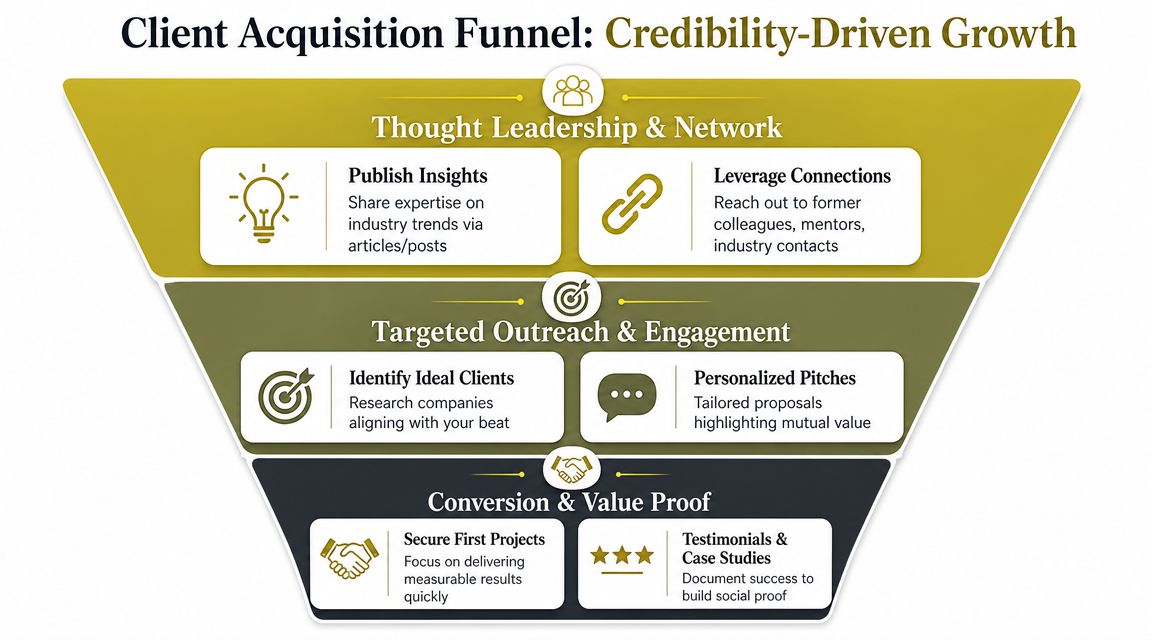
Use warm authority before cold outreach
Start with a short list of organisations that fit your beat. Then work in concentric circles.
- First circle is your existing network. Ask for conversations, not referrals on demand.
- Second circle is visible expertise. Publish commentary, short LinkedIn analysis, bylined opinion, and reactions to real news in your sector.
- Third circle is personalized outreach. Not "we're a full-service agency". A concise note showing that you understand their market and can see a story angle they have missed.
If you need fresh ideas for outbound activity around defined buyer groups, these B2B lead generation strategies are a useful planning reference. The key is adapting lead generation logic to a credibility-led service, not turning PR outreach into generic sales automation.
A practical service reference for younger companies is this look at PR for startups, because startups often need both visibility and message discipline before they need a large outsourced team.
Show value in the language buyers now care about
A modern PR buyer doesn't only want a clipping report. They want to know whether visibility turned into commercial momentum.
That shift matters. As Cision's UK-focused analysis explains, digital advertising accounted for 79.7% of total UK ad spend in 2024, and buyers increasingly expect agencies to connect coverage to measurable digital outcomes. For a new firm, that supports positioning as a measurement-led reputation and demand agency rather than a pure media-relations shop.
That changes how you report:
- Track coverage quality, not just quantity. Was the message intact? Was the audience right? Did the spokesperson look credible?
- Connect media activity to digital signals where possible, such as branded search interest, website engagement, inbound enquiries, or conversion conversations.
- Explain business relevance. A trade title mention may matter more than a national hit if it reaches investors, buyers, or regulators.
Later in the sales process, a short video can help founders think more clearly about how agencies position and sell their services.
Hire for media judgement before headcount
Many founders hire account handlers too early and strategists too late. That creates activity without authority.
Carlos Alba Media's staffing philosophy is a useful example of the opposite model. It draws on former national news journalists and people with agency experience working with international brands, which means the client gets people who can shape a story, pressure-test a line, and understand what editors or brand teams will reject.
Keep your early stack lean but not amateur. The essentials usually include:
| Need | Tool examples | Why it matters |
|---|---|---|
| Media database and outreach | Cision | Contact quality and list discipline |
| Monitoring | Meltwater | Fast awareness of coverage and issues |
| Project management | Asana | Clear ownership and deadlines |
| CRM | HubSpot | Pipeline visibility |
| Accounting | Xero | Clean invoicing and cash visibility |
| Analytics | GA4 and Looker Studio | Better reporting on outcomes |
Assembling Your A-Team and Tech Stack
A PR firm becomes real when delivery no longer depends on one person's stamina. That doesn't mean hiring a big permanent team straight away. It means building a reliable operating spine.
The strongest early agencies don't recruit by job title first. They recruit by judgement gaps. If you can already win stories and handle clients, you may need sharper design support, stronger SEO thinking, cleaner reporting, or legal backup for sensitive situations before you need a full account team.
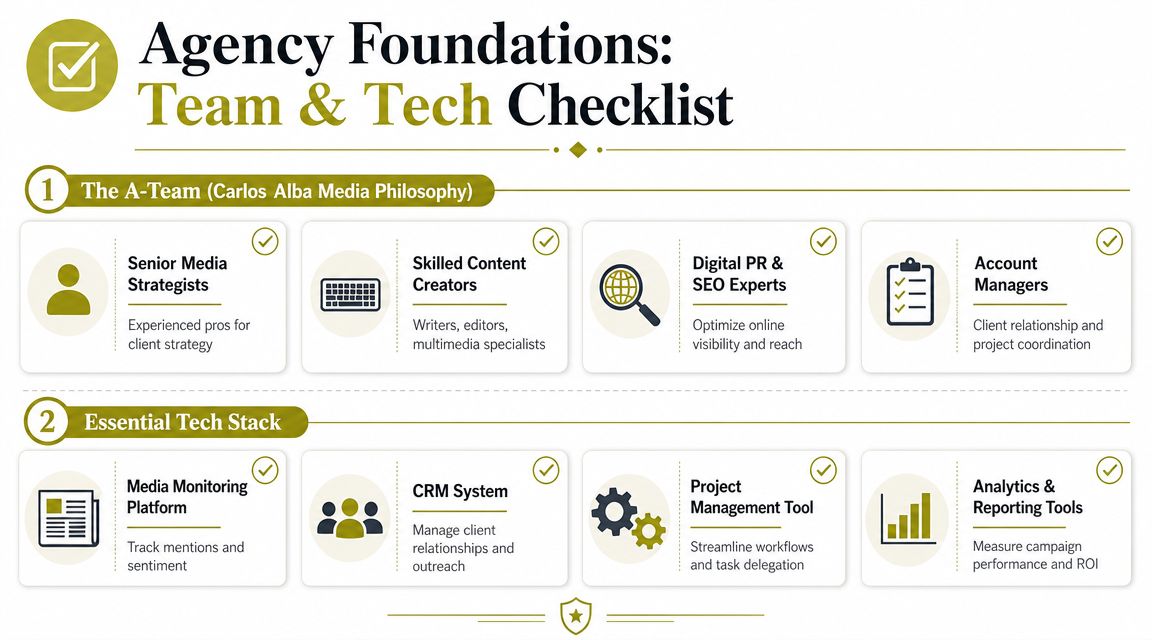
Who to bring in first
A newsroom-led agency should protect quality before scale. That often means a core of senior operators, then trusted specialists around them.
A practical early mix looks like this:
- A senior strategist or founder lead who owns messaging, client counsel, and media judgement
- A strong writer or editor who can turn raw expertise into publishable copy
- A digital PR or SEO specialist if your offer includes search-led authority building
- A dependable account or operations manager once client delivery starts to stack up
For specialist work, use partners before payroll. Media lawyers, designers, developers, videographers, and crisis specialists can sit outside the core until demand justifies a full-time hire.
The first bad hire in a PR firm doesn't just cost salary. It weakens judgement in front of clients.
Tech should support discipline, not disguise chaos
Founders sometimes buy too much software because it feels like progress. It isn't. Tools only help if the agency already has clear habits.
Keep the stack tied to operational needs:
| Function | What good practice looks like |
|---|---|
| Media monitoring | Alerts are reviewed daily and routed to the right person |
| CRM | Every lead has an owner, next step, and date |
| Project management | Deliverables, deadlines, and approvals live in one place |
| Reporting | Templates are standardised so every client sees the same level of clarity |
| Finance | Invoices go out on time and payment follow-up is scheduled |
A 90-day operating rhythm for the team
In the first month, document how the work moves. Don't keep it in your head.
In the second month, pressure-test that process on live work. Where do approvals stall? Who signs off quotes? How quickly can you turn a reactive comment request? Which tasks need a checklist?
In the third month, fix what keeps repeating. Standard operating procedures don't make a PR firm robotic. They protect quality when deadlines tighten and clients panic.
A simple launch checklist often includes:
- Client onboarding pack with contacts, approvals, tone, key messages, and crisis escalation points
- Proposal template that can be adapted quickly without starting from zero
- Press list standards so media outreach stays targeted
- Reporting template tied to outcomes rather than vanity metrics
- Contractor briefs that are short, clear, and reusable
Your 90-Day Launch Plan and Milestones
Most new firms fail in the gap between the idea and the operating system. That's why the first three months matter so much. They force you to decide whether you're building a firm or just freelancing with a logo.
The survival context is sobering. According to the ONS data cited in this discussion of UK business survival rates, only about 53% of new UK businesses survive to age five. For a PR founder, that makes early process discipline essential. Client onboarding, pricing rules, and cash-flow controls can't wait until "things get busy".
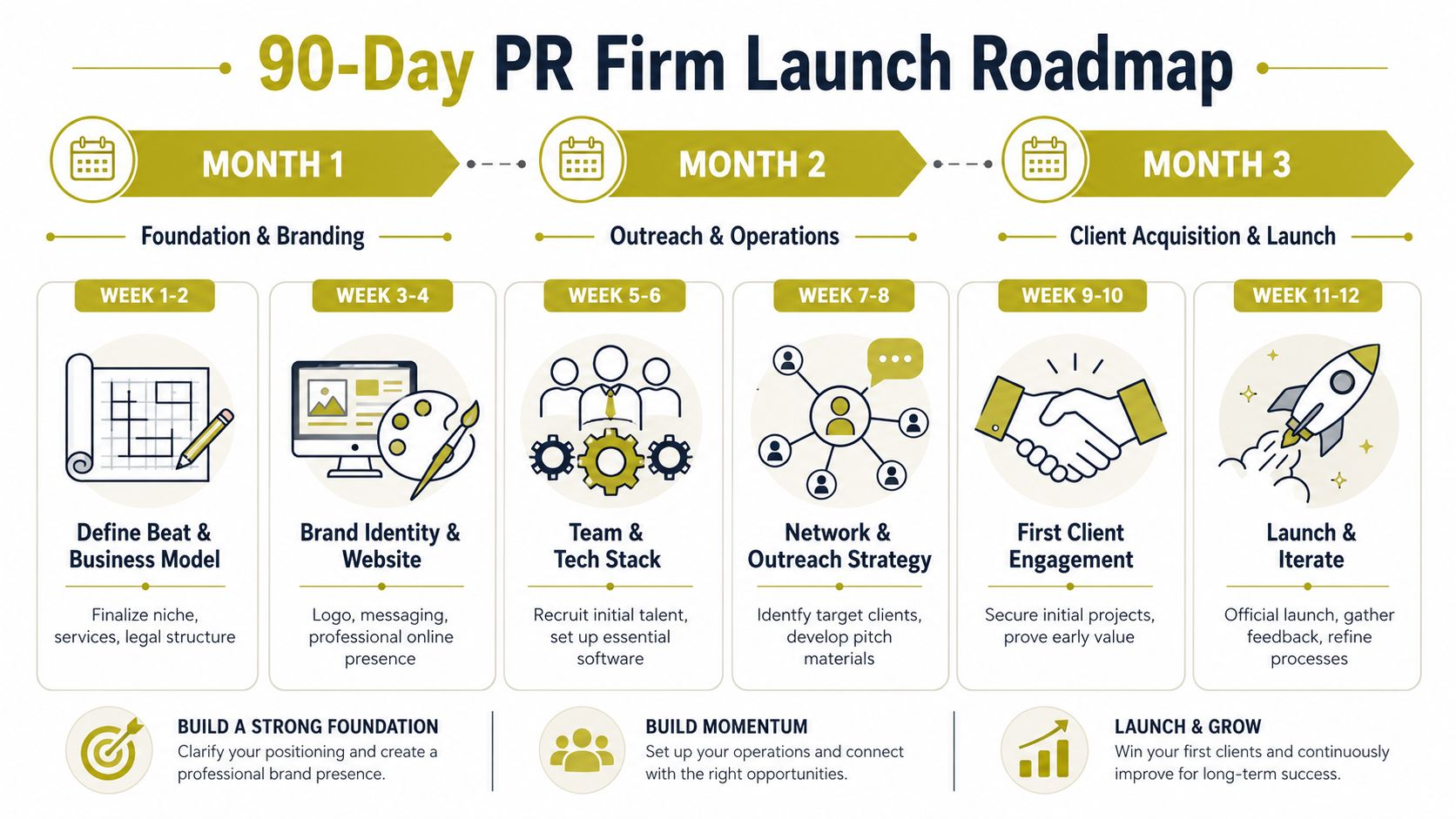
Month one
Use the first month to remove ambiguity.
Choose the business structure. Set up banking, insurance, contracts, accounting, and a simple website. Write the positioning in plain English. Define your beat, your service wedge, your ideal client, and the first offer you can sell confidently.
Don't spend weeks polishing branding while basic decisions remain unresolved. A clean site with sharp copy beats a beautiful site with a vague proposition.
Month two
This is the month for contact, not contemplation.
Publish a launch note. Reconnect with your network. Build a target list of organisations that fit your beat. Send customized outreach. Ask for meetings. Share analysis on current stories in your sector so people can see how you think.
You are not trying to look large. You are trying to look clear, sharp, and useful.
Month three
By now, the firm should be proving something in the market.
Deliver for the first client with obsessive care. Tight briefs, fast follow-up, accurate copy, clear approvals, strong reporting. Then document what worked and what broke. The first account should improve your process, not just your revenue.
A good first quarter leaves you with more than a client. It leaves you with a method.
The founders who last are rarely the ones who sounded busiest at launch. They're the ones who set standards early, protect their positioning, and refuse to build around chaos.
Conclusion Building a Firm That Matters
A PR firm worth building doesn't begin with bulk outreach or inflated promises. It begins with editorial standards.
If you want to know how to start a PR firm in the UK, start with a beat you can own, a business structure you can run properly, and services that reflect real senior judgement. Build around message discipline, credible storytelling, and the ability to advise clients during critical situations. Then add the systems that keep quality consistent.
Newsroom habits still matter. Accuracy. Timing. Clarity. Knowing the difference between a claim and a story. Knowing when not to pitch. Knowing how to protect a spokesperson before they walk into a difficult interview.
That kind of firm won't look like every other agency website. Good. It shouldn't. In a market full of noise, a newsroom-led PR business gives clients something more valuable than activity. It gives them judgement they can trust.
If you want support building a sharper communications model, Carlos Alba Media offers senior-level PR and digital marketing counsel shaped by newsroom experience, including media relations, crisis support, media training, and brand visibility work for startups, SMEs, and established organisations.