
You've probably lived some version of this already. Your team has built a strong product, the demos land well, early customers get it, and the technology solves a real problem. Yet outside your own network, almost nobody seems to know you exist.
That's common for Scottish and UK tech SMEs. Founders often assume the hard part is building the product. In practice, the harder part is earning attention from the people who matter: buyers, investors, partners, analysts, and journalists who don't owe you a hearing.
That's where B2B Tech PR stops being a nice extra and starts becoming commercial infrastructure. In the UK, the technology sector reached an estimated £1 trillion valuation in April 2022, making it the first European country to hit that milestone, which tells you how crowded and competitive the market has become for attention, trust, and category space (UK tech valuation data).
At Carlos Alba Media, that challenge is familiar. The agency is Scottish-led, and the people doing the work are former national news journalists or agency practitioners with experience on international brands. That background changes how stories get built. It means less fluff, fewer recycled press releases, and more focus on what an editor, producer, or technical buyer will actually care about.
Your Tech is Brilliant But Is Anyone Listening
A founder in Glasgow launches a software platform that solves an expensive operational problem. The product works. The team knows the category inside out. They've spent months refining the offer, getting through security reviews, and tightening onboarding.
Then they announce it with a generic release full of phrases like “advanced solution” and “market-leading platform”.
Nothing happens.
That's not because the product lacks value. It's because the market doesn't reward technical merit on its own. Buyers are busy. Journalists are flooded. Investors hear polished claims all day. If your story doesn't carry urgency, relevance, or proof, it won't travel.
What founders usually get wrong
Most tech SMEs start PR too late and too narrowly. They treat it as a launch task rather than a reputation system. They want a quick headline when what they need is a sustained pattern of visibility.
A strong B2B Tech PR programme does a few things at once:
- Clarifies the commercial problem: It translates features into business consequences.
- Builds third-party trust: It puts your claims in places buyers already respect.
- Creates repetition: It helps the same core message show up across media, search, events, and sales conversations.
Practical rule: If your story only makes sense after a thirty-minute founder explanation, it isn't ready for PR.
Why this matters more in the UK tech market
The UK tech sector's scale means your company isn't competing only on product capability. You're competing on credibility and memory. Buyers need to recognise your name before they shortlist you. Journalists need a reason to believe your announcement matters beyond your own office. Investors need to see signs that the market is taking you seriously.
That's why real B2B Tech PR is less about “getting coverage” and more about building evidence that your company belongs in important conversations. For Scottish firms especially, there's often an extra hurdle. You may have a strong regional footprint but limited exposure in London, national trade media, or international sector press. Good PR closes that gap without forcing you to mimic a larger, louder company.
B2B Tech PR vs Consumer PR The Critical Difference
Consumer PR tries to persuade a broad audience to want something. B2B Tech PR tries to persuade a narrow audience to trust something important.
That difference changes everything.
Selling a consumer smartphone is about desire, convenience, identity, and mass attention. Selling a specialist cloud security platform, industrial IoT system, or compliance tool is about risk, integration, procurement, proof, and internal buy-in. One can move fast on hype. The other has to survive scrutiny.
Different audiences, different job
In B2B Tech PR, your audience usually isn't “the public”. It's a group of people with different concerns inside the same buying cycle.
| Audience | What they want to know |
|---|---|
| CTO or technical lead | Will this work in our environment? |
| Procurement | Is this credible, stable, and low risk? |
| Operations lead | Will adoption be manageable? |
| Founder or board | Will this support growth and reputation? |
That means your messaging can't be one-dimensional. A flashy headline might attract a click, but it won't help if the body of the story lacks technical substance or commercial context.
What works in B2B Tech PR
The strongest campaigns usually rely on angles such as:
- Problem framing: showing that you understand the operational pain better than rivals do.
- Credible commentary: giving journalists and trade editors insight they can use.
- Proof-based storytelling: customer evidence, implementation detail, benchmarks, and specialist opinion.
What doesn't work is the lazy formula many SMEs fall into.
- Feature dumping: Long lists of capabilities with no business meaning.
- Empty category claims: Saying you're “disrupting” a market without explaining how.
- Mass-market targeting: Pitching the wrong outlets because they look prestigious.
The test is simple. If your story would fit just as easily for a skincare brand, a travel app, and a cyber security platform, it isn't B2B Tech PR. It's generic publicity.
The sales cycle changes the PR strategy
Consumer campaigns can chase bursts of attention. B2B campaigns have to support a slower decision path. A prospect may see your name in trade media, hear your founder on a podcast, read a technical article, visit your site later, and only then ask for a meeting.
That's why B2B Tech PR has to work over time. It must create familiarity before the sales team ever gets involved. It also has to arm that sales team with credible material they can use when deals get serious.
The Core Strategies in Your B2B PR Engine
B2B Tech PR works best when you stop treating tactics as separate services. Media relations, thought leadership, analyst engagement, content, social distribution, and events should reinforce each other. If they don't, you get activity without momentum.
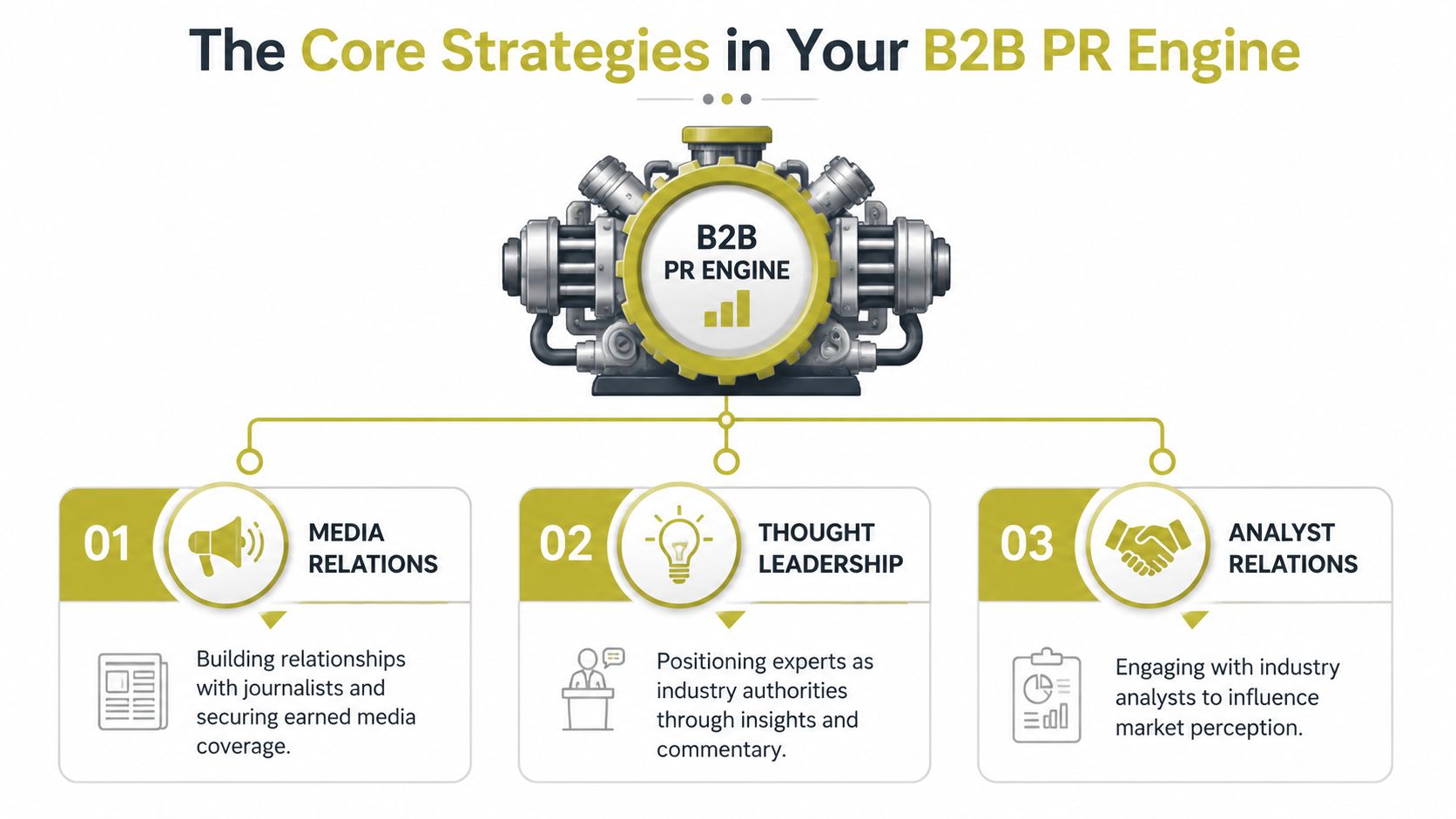
Media relations that start with the editor's lens
Founders often think media relations is about sending announcements to a list. It isn't. It's about finding the angle that gives a journalist a reason to care now.
Former national news journalists tend to be ruthless on this point. They ask the right questions early. What's new here? Why should this matter this week? What wider issue does it connect to? Where's the tension, consequence, or proof?
That newsroom instinct matters in sectors where products are complex and claims are easy to overstate.
What usually earns attention:
- A timely hook: regulation, funding context, market pressure, customer behaviour, or a live industry issue.
- A credible spokesperson: someone who can explain the category without sounding rehearsed.
- A usable story package: clear briefing, strong data points where available, sensible quotes, and fast follow-up.
Thought leadership that buyers can actually use
Thought leadership is often mishandled because companies confuse it with self-praise. Real thought leadership isn't a founder saying they're passionate about innovation. It's a company publishing useful interpretation of an issue buyers are already trying to solve.
Good examples include commentary on procurement friction, AI implementation risk, compliance shifts, or integration mistakes that delay deployments. The point is to help the audience think better, not just remember your brand.
A practical way to plan it is to ask three questions:
- What does our buyer keep getting wrong?
- What do we know because we work close to the problem?
- What can we say plainly that others hide behind jargon?
That output then feeds articles, speaking opportunities, interview lines, and sales follow-up.
Analyst relations and market positioning
If you sell into enterprise, analyst relations often matters more than early-stage founders expect. Analysts, specialist commentators, and sector researchers shape how categories are understood. They can influence whether your company is seen as a serious option or a peripheral one.
This doesn't mean chasing every briefing opportunity. It means being disciplined about where external market opinion affects buying confidence.
For teams also tightening commercial outreach, these Get Up Productions B2B lead strategies are a useful complement because PR tends to work best when it feeds a wider lead generation system rather than sitting off to one side.
Why the engine has to be connected
A media hit on its own fades quickly. A strong opinion article with no distribution underperforms. An analyst briefing with no supporting proof rarely sticks. The gain comes from joining the parts up.
- Media relations earns third-party validation.
- Thought leadership deepens authority.
- Analyst engagement sharpens category credibility.
- Events and social extend the life of each asset.
- Content gives every interaction somewhere useful to land.
One option for SMEs that want senior support without large-agency layers is Carlos Alba Media, which combines PR and digital marketing with teams led by former journalists and experienced agency operators.
Fueling Your PR with Content and SEO
PR without content is fragile. You might earn attention for a week, but if your website doesn't help buyers continue the journey, the value leaks away.
That matters even more now because UK digital behaviour has made discoverability inseparable from credibility. 97% of UK adults were online in 2024 and 81% used smartphones to go online, which is why earned media, search visibility, and technical content now work together in B2B buying journeys (UK digital adoption and PR measurement context).

Your site has to finish the story
A journalist may introduce your company. Search often decides whether the prospect keeps going.
If someone reads a trade piece about your platform and then lands on a vague homepage, the opportunity stalls. If they find a clear technical guide, a sharp product page, a relevant founder article, and evidence that you understand their problem, the same visit becomes commercially useful.
That's why content and SEO aren't separate from B2B Tech PR. They're the infrastructure underneath it.
What content actually supports PR
The best-performing content usually sits in a few practical formats:
- Technical explainers: plain-English breakdowns of difficult topics your buyers need to understand.
- Founder or expert commentary: viewpoint pieces with a real opinion, not corporate wallpaper.
- Case-study style narratives: not inflated success stories, but specific examples of the problem, the intervention, and the result in qualitative terms.
- Comparison and evaluation pages: content that helps buyers assess options without feeling sold to.
Former journalists are often strong at this work because they know how to shape information for busy readers. They cut waffle. They find the line that matters. They write with enough clarity that an editor, buyer, and search engine can all make sense of the page.
A lot of tech content fails for the same reason weak PR fails. It says what the company wants to say, not what the buyer needs to know.
A useful starting point is this founder's guide to SEO for tech startups, which lays out how search visibility supports growth for early-stage and scaling firms.
Build content around buyer questions
If you're planning your content calendar, don't begin with keywords alone. Start with recurring sales questions, objections from procurement, implementation concerns, and misconceptions in the market.
That gives you content with both PR and SEO value. A trade journalist may quote your expert article. A buyer may find the same article through search. Your sales team may then use it in outreach.
This short video is worth watching if you're tightening that content process inside a broader PR programme.
Measuring What Matters B2B Tech PR KPIs
Most founders become sceptical about PR when reporting is weak. That scepticism is fair. If your monthly update is just a stack of links and a vague claim about “reach”, you still don't know whether the work is helping the business.
In B2B Tech PR, measurement should follow the sales funnel because awareness-stage visibility, consideration-stage engagement, and decision-stage proof are different outputs and shouldn't be forced into one blended KPI (sales-funnel PR measurement guidance).
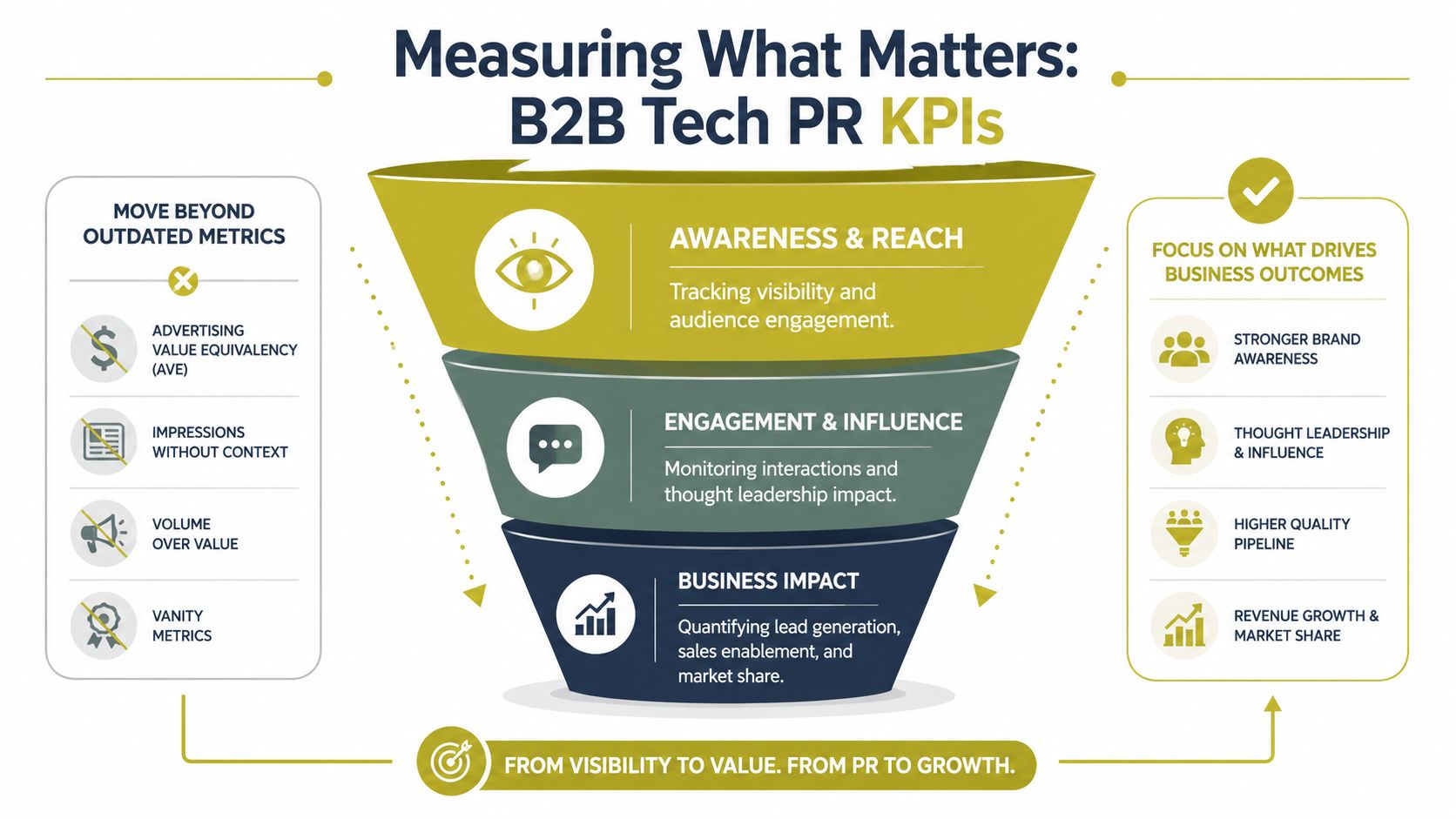
Top of funnel means visibility with the right audience
At the awareness stage, the question isn't “how many clips did we get?” It's “did the right people start seeing our story in the right places?”
Useful signals include:
- Coverage quality: was the outlet relevant to your buyers?
- Message pull-through: did the article reflect your core problem statement?
- Audience fit: does the publication influence the people involved in purchase decisions?
A specialist trade mention can be more valuable than broader coverage if it reaches technical decision-makers who buy.
Mid funnel means interest, recall, and movement
As prospects move closer, PR should help reinforce why you're credible and distinct. Stronger reporting then starts looking at behaviour around the content.
| Funnel stage | Better KPI questions |
|---|---|
| Awareness | Are we visible in the channels our buyers trust? |
| Consideration | Are prospects engaging with the stories and themes we want to own? |
| Decision | Are we supplying proof that helps close doubt? |
At this stage, good teams look at patterns such as whether earned stories are driving referral visits, whether thought leadership is being used in nurture, and whether your key messages are showing up consistently enough to shape perception.
Measurement check: If one report tries to prove awareness, engagement, and deal support with the same metric, the model is broken.
Bottom of funnel needs proof, not noise
Later-stage PR should give buyers confidence. That means customer evidence, implementation insight, external validation, and clear differentiation against alternatives.
This is also the point where founders should stop asking for vanity metrics and start asking sharper questions:
- Which stories helped sales answer objections?
- Which pieces of coverage supported trust in live opportunities?
- Where are we building evidence that we belong on the shortlist?
A PR programme becomes much easier to defend internally once reporting matches the way deals really move.
How to Choose the Right B2B Tech PR Agency
Plenty of agencies can talk confidently about brand awareness. Fewer can explain how they'd make a complex Scottish or UK tech SME newsworthy to the right audience, then report back in a way that helps a founder make decisions.
The fastest way to sort serious partners from polished generalists is to ask better questions.
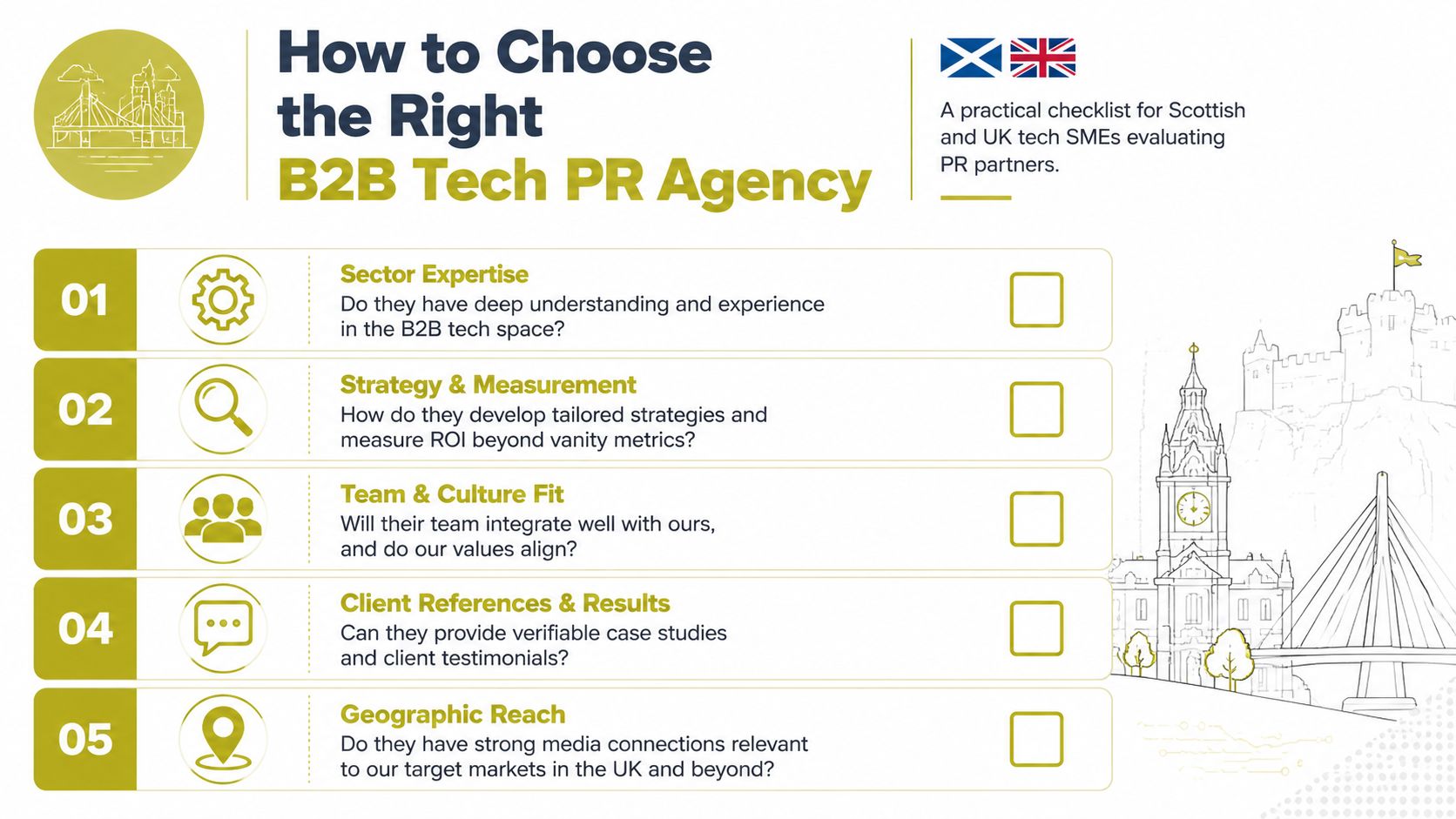
Ask about the team, not just the brand name
A common problem with agency selection is buying senior chemistry in the pitch and getting junior execution in the account. You need to know who will shape your story, speak to journalists, and challenge weak messaging.
Ask questions like:
- Who will lead the account day to day?
- What is their background in journalism, tech, or sector PR?
- Can they explain a technical proposition clearly without hiding behind buzzwords?
For companies comparing options, this page on B2B public relations agency support is useful context on what a specialist offer can include.
Ask how they define success
A UK-relevant standard in enterprise-focused B2B Tech PR is multi-channel visibility plus structured reporting, not simple clip counting. Reporting should cover areas such as coverage quality, message pull-through, backlinks, referral traffic, engagement, and visibility across channels including newsletters, podcasts, owned content, social, and paid amplification where relevant (multi-channel PR reporting guidance).
That immediately gives you a sharper filter. If an agency still leads with AVE, raw volume, or generic “exposure”, keep looking.
Ask for evidence of judgement
The best B2B Tech PR agencies don't just produce content. They exercise editorial judgement. They know when a launch isn't ready. They know when a comment opportunity is worth taking. They know when a founder's instinct to “announce something” will land badly.
Use a simple checklist in meetings:
- Story judgement: Can they tell you why your current angle won't land?
- Sector fluency: Do they understand the buying dynamics in your category?
- Measurement discipline: Can they map activity to awareness, consideration, and deal support?
- Access to senior counsel: Will you get advice quickly when an issue breaks?
Look for fit with your growth stage
A start-up raising profile needs something different from a scale-up entering new markets or an established SME protecting reputation during a sensitive period. The right partner should adapt the programme to your actual commercial stage, not force you into a standard package.
If you leave the pitch still unclear on what stories they'd pursue, what channels matter, and how they'd measure progress, the proposal is probably too vague.
Handling Sector Nuances and Crisis Communications
A FinTech company wants to announce a new product linked to payments compliance. The founder is excited and wants bold headlines. The problem is that one careless phrase could imply regulatory approval that doesn't exist, or overpromise on what the product can do in live environments.
In that situation, good PR is part translator, part risk control. The announcement has to be credible, legally safe, commercially useful, and understandable to non-specialist media without losing technical accuracy. That's not routine publicity work. It's specialist handling.
Regulated sectors punish vague messaging
HealthTech, FinTech, AI, cyber security, and deep-tech businesses all carry their own traps. In one sector, the risk is compliance language. In another, it's inflated technical claims. In another, it's fear created by a product issue that wasn't explained clearly enough.
Founders sometimes think the answer is to say less. Usually the answer is to say things more precisely.
A deep-tech firm facing a product reliability issue, for example, shouldn't hide behind legalese or release an evasive statement full of abstractions. It needs a clear holding line, a plan for stakeholder communication, and someone senior enough to balance transparency with risk.
In a crisis, speed matters. Clarity matters more.
What crisis-ready B2B Tech PR looks like
When pressure hits, the practical questions are immediate:
- Who speaks first: founder, technical lead, or external spokesperson?
- What can be said now: confirmed facts only, with no speculation.
- Who needs direct contact: customers, staff, investors, regulators, partners, or media.
- What happens if the story spreads online: response lines, escalation routes, and monitoring.
For leaders thinking through online fallout as well as media handling, these business reputation crisis strategies are a useful companion read.
A formal crisis communications plan for UK organisations is worth having before you need it, not after.
Why sector context changes everything
The same product issue can land very differently depending on the sector. A delay in an internal workflow tool may frustrate users. A failure in a platform used for sensitive data, healthcare workflows, or financial operations raises different stakes and attracts different scrutiny.
That's why specialist counsel matters. The team handling your B2B Tech PR should understand not only how to win attention, but when to slow things down, tighten language, bring in legal review, and protect trust that took years to build.
If your company has strong technology but weak market visibility, the gap usually isn't effort. It's story discipline, channel choice, and senior execution. Carlos Alba Media works with Scottish and UK organisations that need practical PR, digital marketing, and crisis support shaped by former national news journalists and experienced agency professionals.