
You're probably in a familiar position. Your clinic, practice, health service or healthcare start-up does good work offline, but online it feels fragmented. The website looks acceptable but doesn't convert. Search visibility is patchy. Paid campaigns make your compliance lead nervous. Social content gets polite engagement and very little else.
That's where many healthcare SMEs get stuck. They don't need louder marketing. They need marketing that can carry clinical credibility into digital channels without creating regulatory, reputational or data-handling problems.
A generic agency will usually offer SEO, PPC, social and web design. A healthcare organisation needs more than a service list. It needs judgement, evidence discipline and a clear view of what patient trust looks like online.
Why Choosing a Healthcare Agency Is Different
Healthcare buyers often assume their challenge is visibility. Usually it's translation. You already have expertise, service quality and subject authority. The hard part is converting that authority into digital trust without oversimplifying, overstating or breaching the rules.
That matters more now because the patient journey is already digital. In the UK, the NHS App had reached more than 33 million registered users by early 2025, and users were viewing test results, appointments and messages through the app, according to this healthcare marketing statistics overview. That's the key shift. Patients aren't treating digital touchpoints as optional extras. They're using them as part of routine care and service access.
For a founder or director, that changes the brief.
Digital trust now sits inside service delivery
If people are already searching, reading, booking and checking information digitally, your marketing can't sit apart from operations. Service pages, booking journeys, FAQs, clinician profiles, local listings and reputation management all become part of the patient experience.
A specialist healthcare agency understands that the website isn't just a brochure. It's part information architecture, part reassurance mechanism, part conversion path.
Practical rule: In healthcare, every digital touchpoint must do two jobs at once. It must inform clearly and reduce risk.
That's why communications discipline matters. A loose claim in a cosmetic campaign, an unclear treatment benefit, or a poorly worded symptom page can create more than confusion. It can trigger complaints, undermine trust and complicate legal review.
Generic digital advice usually misses the hard part
Most agencies know how to chase impressions and clicks. Fewer know how to structure medically sensitive content, build sign-off processes with compliance teams, or write with the caution a regulated sector demands.
That's where specialist public relations and digital communications matter. A healthcare brand often needs the same judgement used in high-stakes media environments, especially when patient reassurance, stakeholder trust and message accuracy all matter at once. Carlos Alba Media's work in public relations for healthcare sits in that space, where reputation management, digital visibility and evidence-led messaging overlap.
A healthcare agency isn't just there to help you grow. It's there to help you grow without creating avoidable exposure.
The Non-Negotiable Capabilities of a Top Healthcare Agency
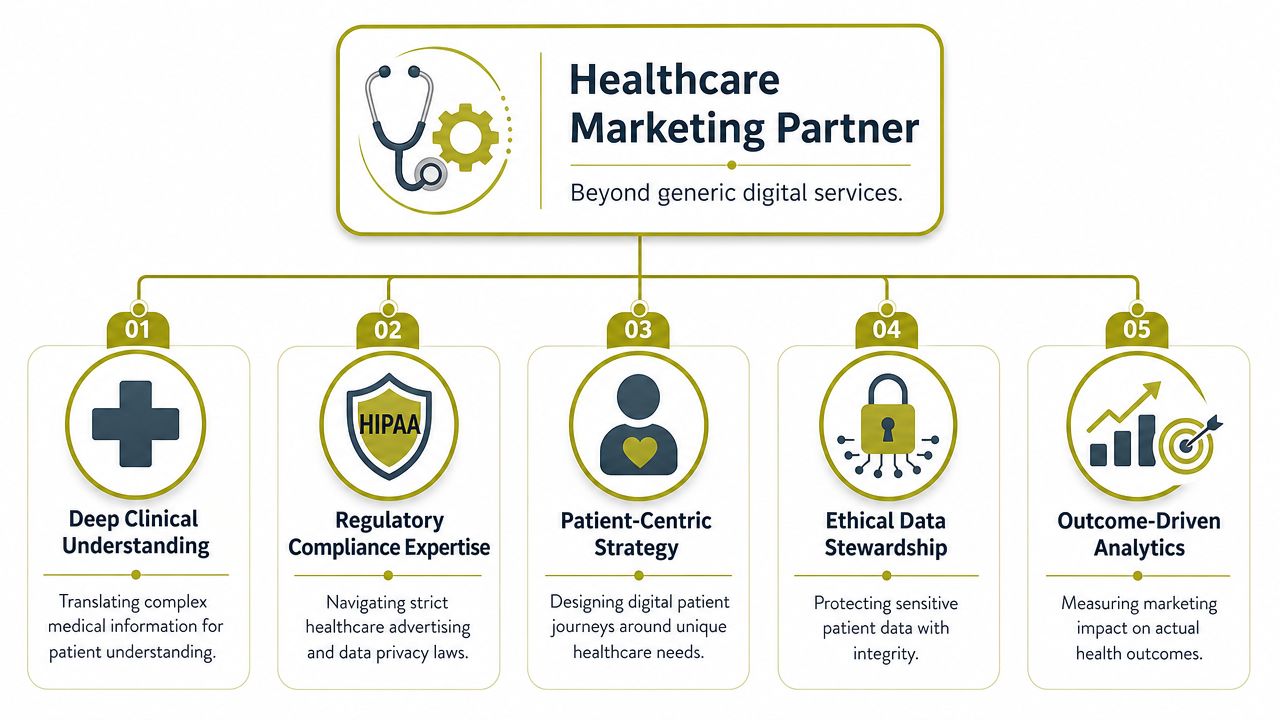
A credible digital marketing agency for healthcare should make you feel more confident, not more exposed. If the pitch is all creative concepts, channel jargon and lead-generation promises, you're probably talking to the wrong firm.
Compliance has to sit inside the work
In UK healthcare, the ASA's CAP Code applies strict rules to healthcare, medicines and medical-device advertising, and the MHRA continues to enforce controls on promotional claims in health-related communications, as outlined in this analysis of healthcare digital marketing strategies in 2025. That means an agency can't treat compliance as a final review stage. It has to build compliance into briefs, copy, design, targeting and reporting from the start.
Ask how they handle:
- Claims review: Who checks medical assertions before copy goes live?
- Testimonials and proof points: What's the standard for using patient stories or treatment outcomes?
- Audience targeting: How do they approach sensitive categories and remarketing risk?
- Escalation: What happens when a campaign idea raises a legal or ethical question?
If the answer is vague, they're not healthcare-ready.
Senior judgement matters more than service breadth
A lot of agencies sell healthcare experience because they once ran ads for a clinic group or built a hospital microsite. That isn't the same as operational fluency in a regulated environment.
The stronger agencies usually have a visible review culture. They can explain who writes first drafts, who edits them, who checks them against the brief, and who signs them off. That's one reason journalistic discipline is so useful in healthcare. Former national news journalists are trained to verify claims, tighten language, pressure-test wording and spot reputational risk before publication. Agency professionals who've worked with international brands bring process, governance and campaign rigour. You want both instincts in the room.
The right healthcare agency doesn't just ask, “Will this perform?” It also asks, “Can we defend this wording if challenged?”
That's the practical distinction.
The five capabilities worth testing
You don't need an agency that claims to do everything. You need one that can show competence in the areas that affect healthcare growth.
- Clinical translation: Can they turn technical treatment language into patient-friendly copy without flattening nuance?
- Local intent capture: Many patient decisions begin close to the point of need, so a firm grasp of local search optimization is useful when you're assessing how an agency handles maps, reviews, service areas and location pages.
- Data handling discipline: They should be comfortable discussing consent, data minimisation and what should never sit inside a casual marketing workflow.
- Crisis readiness: If your organisation faces scrutiny, adverse coverage or a complaint spike, can the same team handle the communications response?
- Measurement maturity: Can they connect activity to enquiries, booked consultations and lead quality rather than solely reporting traffic spikes?
What often fails in practice
The weak model is common. Junior-led account management. Generic wellness content. No clear sign-off structure. Search traffic reports with no downstream analysis. Design decisions made without regard to accessibility, consent flows or booking friction.
The better model is tighter. Senior review. Clear editorial standards. Plain-English patient content. Measured use of paid channels. And a willingness to tell you when a campaign idea is too risky, too vague or too weak to publish.
That's what specialist capability looks like in healthcare. It's less about flair. More about controlled effectiveness.
Matching Digital Services to Your Patient Journey
Most healthcare marketing plans start with channels. That's backwards. Start with the patient journey for a specific service line, then choose the channels that support each decision point.

A private GP service, physiotherapy clinic, diagnostics provider and mental health practice won't need the same mix. Their patients ask different questions, hesitate for different reasons and convert through different pathways.
Map the journey before you buy the channels
A useful planning sequence looks like this:
Pick the service line
Don't brief an agency on “the business”. Brief them on one service first. Knee pain assessments. ADHD evaluations. Dental implants. Occupational health. Specificity sharpens targeting, messaging and landing page structure.
Define the patient's decision stages
Some people are symptom-led. Some are referral-led. Some already know the treatment name and are comparing providers. Others are still deciding whether they need help at all.
Match channels to intent
Search often captures active demand. Local listings support comparison. Paid search helps when intent is strong and competition is visible. Social tends to work better for credibility, familiarity and remarketing-safe awareness, depending on the category.
Assign a measurable action
Every page and campaign should point somewhere concrete. Call. Enquire. Book. Download prep information. Request a callback.
A lot of teams improve quickly when planning gets disciplined.
Build content around need, not around output quotas
Best-practice guidance recommends audience research, content-gap analysis and documented messaging rules, and it also warns against publishing generic health content that isn't locally discoverable or lacks a clear next step. The same guidance recommends local SEO paired with search ads, clinician-led videos and prominent scheduling pathways because users typically search near the point of need, as discussed in this healthcare digital marketing guidance video.
That should shape your content plan.
- Awareness content: Symptom explainers, condition FAQs, “when to seek help” pages
- Consideration content: Treatment pages, clinician bios, referral information, what-to-expect pages
- Decision content: Booking pages, pricing clarity where appropriate, location pages, trust signals, contact routes
A useful benchmark is whether the content answers a real patient question and gives the reader a logical next step. If it doesn't, it may still attract visits, but it probably won't help the business.
For teams reviewing options, these proven patient growth strategies offer a helpful external perspective on connecting visibility work to patient acquisition rather than just content production.
What good channel matching looks like
A strong healthcare digital plan usually has clear role separation:
- SEO handles durable visibility for recurring patient questions.
- Paid search supports immediate visibility for high-intent service terms.
- Clinician-led video builds reassurance where trust and explanation matter.
- Email helps with follow-up, reactivation and service education where appropriate.
- Landing page UX reduces friction once a patient decides to act.
If you're reviewing agency options, it helps to compare their recommendations against broader digital marketing and branding work. The question isn't whether they offer every channel. It's whether they can explain why each channel belongs in your patient journey.
A short visual explainer can also help internal teams align on that journey before budgets get committed.
If an agency can't map its activity to a patient decision stage, it's probably selling tactics, not strategy.
Your Agency Interview and Selection Checklist
The agency interview is where polished decks usually outperform weak thinking. Your job is to make that impossible.
Don't ask, “Do you work in healthcare?” Almost every agency will say yes. Ask questions that reveal process, judgement and operating maturity.
Questions that get past the pitch
Start with operational questions, not creative ones.
- On medically sensitive content: “Walk me through your sign-off process for a treatment page that contains clinical claims.”
- On data handling: “How do you approach consent, form design and lead routing when patient information may be involved?”
- On stakeholder management: “Who on your side speaks to compliance, legal or senior clinicians if an issue arises?”
- On reporting: “Show me how you distinguish between a busy month and a productive month.”
- On local market execution: “How do you improve discoverability for a service in a defined catchment, and how do you judge whether enquiries are qualified?”
You're looking for specifics. Named steps. Named roles. A clear workflow. Healthy caution where caution is needed.
What a strong answer sounds like
A good healthcare agency usually answers in process terms. It explains how the brief is documented, how claims are checked, how edits are tracked, how pages are reviewed, how forms are tested, and how results are tied back to business actions.
A weak one usually falls back on buzzwords. Agile. Omnichannel. Storytelling. Performance-led. Full funnel. None of those phrases tell you how the work will be controlled.
What to listen for: Agencies that know healthcare well often sound slightly less flashy and much more precise.
Agency Interview Checklist
| Category | Question to Ask | What a Good Answer Looks Like |
|---|---|---|
| Strategy | How do you decide which service line to prioritise first? | They talk about business goals, patient demand, internal capacity, margin, and conversion readiness rather than “doing everything at once”. |
| Compliance | How do you review content that includes medical or treatment claims? | They describe a documented approval route, named reviewers, and a process for challenge and revision. |
| Content | Who writes and edits healthcare copy? | They can explain the mix of subject familiarity, editorial review and final client sign-off. |
| SEO | How do you handle local service visibility? | They discuss service pages, local intent, listings, reviews and conversion paths, not just rankings. |
| Paid media | What do you avoid in regulated healthcare campaigns? | They acknowledge claim sensitivity, audience targeting risks and the need for careful message control. |
| UX | How do you assess whether our website is losing patients? | They mention page speed, form friction, mobile behaviour, accessibility and contact-path testing. |
| Reporting | What do your monthly reports show besides traffic? | They focus on calls, forms, bookings, lead quality and actions taken from the data. |
| Team | Who will actually run the account day to day? | They introduce the working team, clarify senior oversight and don't hide delivery behind new-business staff. |
| Crisis handling | What happens if a campaign draws complaints or scrutiny? | They have an escalation path, response ownership and a review process for pausing or correcting activity. |
| Contracting | How do you handle notice periods, data access and handover? | They answer directly and don't resist transparency around ownership or exit. |
One more test worth using
Ask the agency to critique your current website or campaign in plain English, live in the meeting. Don't give them time to prepare slides. The useful firms will spot structural issues quickly. They'll talk about clarity, risk, friction, discoverability and trust signals.
The ones who only know how to pitch usually struggle when they have to think on their feet.
Building a Meaningful Healthcare KPI Framework
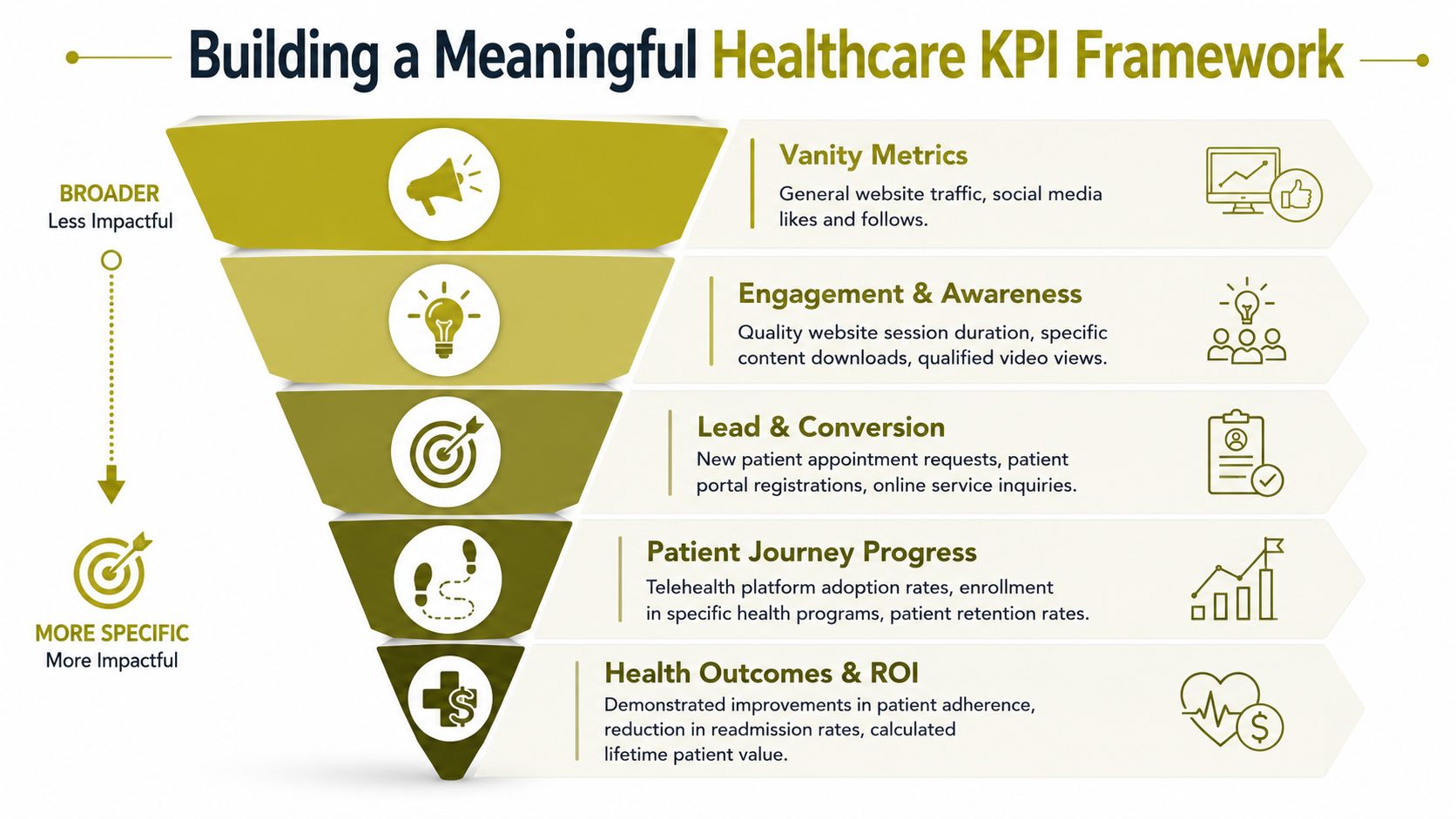
Healthcare reporting often looks busy and says very little. More traffic. Better engagement. More impressions. Those numbers may be directionally useful, but they don't tell you whether the work is helping the organisation grow.
That's the gap many agency reports still leave open. As noted in this review of healthcare digital marketing agency measurement gaps, many guides stop at traffic and engagement rather than connecting content, calls, bookings and trust signals to a defensible ROI model.
Start with business actions, not channel metrics
A healthcare KPI framework should begin with the action that matters commercially or operationally. Usually that means one of the following:
- Booked appointments
- Qualified enquiry forms
- Relevant phone calls
- Registrations for a specific service
- Repeat engagement for an ongoing care pathway
From there, work backwards. Which channels influenced those actions? Which pages assisted them? Where did users drop out? Which service lines generated weak leads versus strong ones?
That's how you move from reporting activity to reporting usefulness.
A practical KPI stack
The cleanest way to structure reporting is in layers.
| Layer | What to Track | Why it Matters |
|---|---|---|
| Visibility | Search presence, local discoverability, review visibility | Shows whether patients can find you in the first place |
| Engagement | Service-page visits, clinician profile views, key content interaction | Indicates whether traffic is relevant enough to consider care |
| Conversion | Calls, forms, booking actions, callback requests | Shows patient intent moving into action |
| Quality | Enquiry relevance, service-line fit, no-show patterns, sales or admin feedback | Stops teams celebrating poor-fit leads |
| Outcome | Consultations delivered, retained patients, commercially meaningful service growth | Connects marketing to the organisation, not just the channel |
Notice what's missing. Vanity metrics at the centre of the report.
A report isn't useful because it contains a lot of data. It's useful when it helps you decide what to change next.
Attribution in healthcare needs realism
Healthcare journeys are rarely neat. Someone may find you through search, read two pages, leave, ask a family member, return later on mobile, call the practice, then book after speaking to reception. If your agency acts as though every conversion belongs neatly to one ad or one keyword, the reporting is too simplistic.
A better approach is practical attribution. Track the digital touchpoints you can observe. Record the offline steps that matter. Use privacy-safe analytics. Review booking data with context from front-desk teams or service administrators. Look for patterns, not fantasy certainty.
That's also why communications strategy matters. Reporting only improves when the organisation agrees what counts as success, what actions deserve tracking, and which signals indicate trust rather than idle browsing. A clear communications strategy gives that measurement work a proper frame.
What to ask for in monthly reporting
A healthcare founder or marketing lead should expect:
- A short executive summary: What changed, why it changed, and what the agency is doing next.
- Service-line reporting: Not just site-wide summaries.
- Conversion analysis: Which pages, campaigns or sources generated action.
- Lead-quality feedback: Are the enquiries suitable?
- Drop-off diagnosis: Where users hesitated or abandoned the journey.
- Next-step recommendations: Specific tests, edits or budget moves.
If the report is heavy on charts and light on decisions, push back. In healthcare, performance needs evidence, but it also needs interpretation.
Onboarding Your Agency and Spotting Contract Red Flags
The first month tells you a lot. Good onboarding creates control quickly. Bad onboarding creates confusion that can sit in the account for a year.
A healthy start usually includes deep discovery, access mapping, stakeholder introductions, current-state auditing and a clear agreement on sign-off. The agency should want to understand your services, patient pathways, internal sensitivities and approval bottlenecks before it starts publishing or spending.
What strong onboarding looks like
Expect the agency to ask for more than logos and passwords. They should want:
- Service priorities: Which treatments or offers matter most right now
- Audience nuance: Who you're trying to reach, and who you shouldn't target casually
- Existing constraints: Legal review, clinician availability, operational bottlenecks
- Baseline data: Current enquiries, booking flow issues, local visibility, review position
- Ownership map: Who approves copy, who owns analytics, who controls domains and listings
The project itself should be managed tightly. If you want a useful external primer on delivery discipline, this guide to project management for SEO is worth reading because it mirrors the kind of structured workflow healthcare accounts need.
Contract red flags that deserve scrutiny
Not every red flag is dramatic. Some are hidden in friendly language.
- Unclear data ownership: You should retain access to analytics, ad accounts, website assets and key platform logins.
- No reporting schedule: If reporting frequency and format aren't defined, accountability gets soft.
- Long lock-ins without performance review points: Flexibility matters, especially early in the relationship.
- Vague deliverables: “Ongoing optimisation” is not a deliverable on its own.
- Senior people vanish after the sale: If the pitch team disappears, ask why.
- No exit plan: Handover terms should be explicit before work starts.
The partnership test
A good healthcare agency doesn't try to trap you in complexity. It creates clarity. You should know who is doing the work, how decisions are made, how risk is managed, what success looks like and what happens if the relationship ends.
That matters even more in regulated sectors, where the cost of muddled ownership and sloppy processes can be far higher than a disappointing campaign.
If you need senior-led support that combines digital strategy with newsroom-grade judgement, Carlos Alba Media is one option to consider. The agency works across PR, digital marketing, brand strategy and crisis communications, and its team includes former national news journalists and agency professionals with experience supporting international brands. For healthcare SMEs, that mix is useful when the brief requires visibility, evidence discipline and careful message control at the same time.