
You've built something real. The product works, customers are showing interest, and there's a clear reason your company should matter. Then the launch goes out, the inbox stays quiet, and the coverage you expected never lands.
That usually isn't because journalists “don't get it”. It's because most startup PR is written from the founder's point of view, not the newsroom's. Founders talk about effort, vision and internal milestones. Editors look for relevance, timing, evidence and a reason their audience should care today.
That gap is where good PR for startups lives or dies. The founders who earn attention consistently are the ones who learn to frame a story the way a reporter screens it: What's new? Why now? Who does it affect? What proves it? Why should my editor give this space?
Why Most Startup PR Fails and How to Succeed
Most startup PR fails for a simple reason. It treats coverage like a reward for hard work, when journalism doesn't work that way.
Editors don't publish stories because a founder has worked nights, hired a new team member or believes strongly in the mission. They publish because a story fits the outlet, the audience and the news agenda. If your pitch doesn't help them do that quickly, it's ignored.
The newsroom filter founders often miss
A national newsroom runs on triage. Reporters scan hundreds of emails, messages and alerts. They're not asking whether your company is impressive in isolation. They're asking whether your story is stronger than the others competing for the same slot.
That's why vague claims fail. So do breathless launches, generic “we're disrupting” language and press releases written like ads.
Editors don't need your excitement. They need your angle.
The strongest PR for startups starts with a mental shift. Stop asking, “How do we get press?” Start asking, “What would make a journalist confident this is worth covering?”
Why specialist support matters in the UK market
This is also why experienced support can make a real difference. In the UK, the communications market is large and mature. The UK Communications and Advertising sector reported 90,900 businesses in 2024, with total turnover reaching £98.6 billion in 2023, and 96% of the sector's businesses are small or medium-sized enterprises, according to Walkers Sands on measuring PR for startups. That matters because startups aren't trying to force PR into a niche system. They're operating in a deep, SME-led market built around specialist support and lean delivery.
For founders, that creates a practical advantage. You don't need a giant retained team to get senior input. You need people who understand how stories are selected, shaped and defended inside a newsroom.
That's the useful distinction with a specialist consultancy such as Carlos Alba Media. The team's background matters because everyone works from either former national news journalism or agency experience with international brands. That changes the advice. The question isn't “How do we look busy?” It's “What would survive an editor's first ten seconds?”
What success looks like instead
Good startup PR is structured. It has a message, evidence, assets, targets and a reporting system. It doesn't rely on luck, volume or charisma.
If you approach it that way, media attention becomes more predictable. Not guaranteed, because no honest practitioner would promise that. But predictable enough to improve with each campaign, each angle and each conversation.
Crafting Your Story and Core Message
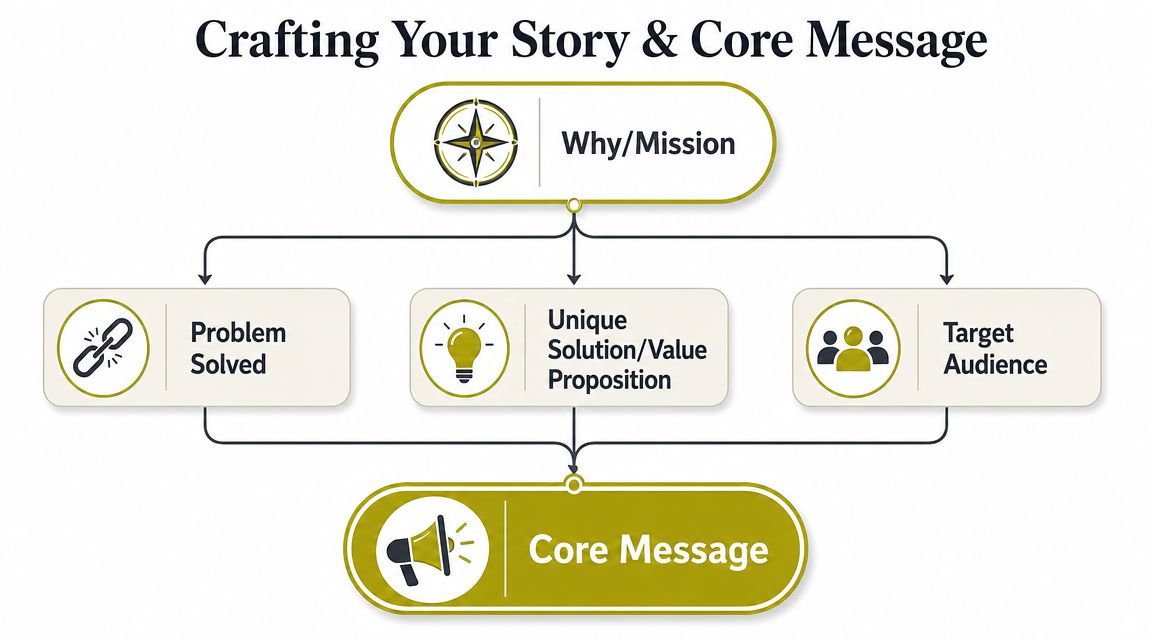
A startup story usually starts too wide. Founders begin with the full company history, the technology stack or the market vision. Journalists begin much narrower. They want the clearest possible explanation of what changed, why it matters and who can verify it.
That means your story needs a backbone before you pitch anyone.
Start with the problem, not the product
Founders often lead with features because that's what they've spent months building. Reporters care more about the friction your company removes.
A stronger opening sounds like this:
- Weak framing: We've built an AI-powered workflow platform for modern teams.
- Useful framing: Mid-sized operations teams still lose time stitching together tools that don't speak to each other. This startup built a way to cut that admin burden into one system.
The second version gives the journalist a problem and a consequence. It creates immediate context.
Ask yourself four questions:
- What persistent problem are you solving?
- Why is that problem urgent now?
- What is different about your approach?
- Who feels the benefit first?
If your answer to any of those is fuzzy, your story is still in draft form.
Find the real news hook
Not every strong company has a strong news story on a given day. That's an uncomfortable truth, but it saves founders from wasting time.
A business can be valuable without being currently newsworthy. The hook often sits in one of these places:
- A change in the outside world that makes your solution newly relevant
- Original evidence you can share credibly
- A founder perspective that explains an industry shift better than competitors do
- A customer pattern that reveals something larger than your own business
A newsroom asks whether the story stands up without your brand name doing all the work. If the answer is no, you probably have a sales message, not a press angle.
Practical rule: If the pitch only makes sense to people who already know your company, it isn't ready.
Build one message, then adapt it for three audiences
A common startup mistake is writing one broad message and sending it everywhere unchanged. That rarely works because customers, investors and potential hires listen for different things.
Here's a simple working model:
| Audience | What they want to know | What your message should emphasise |
|---|---|---|
| Customers | Will this solve a pressing problem? | Clarity, benefit, proof, ease |
| Investors | Why does this matter commercially? | Market relevance, traction signals, founder judgement |
| Potential hires | Is this credible and worth joining? | Mission, momentum, leadership, seriousness |
The core message should stay stable. The emphasis changes.
For example, a climate startup might keep the same central line, but present it differently:
- to customers as operational savings or compliance simplicity
- to investors as relevance in a shifting category
- to hires as the chance to work on a problem with real-world weight
Keep the language plain enough to survive editing
If a sentence can't be read aloud cleanly, it probably won't survive an interview or a sub-editor's rewrite. Strip out jargon, slogans and invented category labels unless they're strictly necessary.
Use this stress test:
- Can a reporter repeat it accurately after one read?
- Can a customer understand it without a demo?
- Can your founder say it on camera without sounding rehearsed?
If not, simplify.
Good PR for startups doesn't begin with media lists. It begins with a sentence clear enough for someone else to carry.
Building Your Press Kit and Media Assets
Once the message is sharp, you need materials that reduce friction. Journalists work to deadlines. If they have to chase basic information, resize poor images or decode a blochure disguised as a press release, they'll often move on.
A startup press kit should feel less like a brand folder and more like a working file for a reporter.
What a journalist actually needs from you
Most founders overbuild the kit and underdeliver the essentials. A useful press kit usually includes:
- Founder bio: Not a full CV. Give the reporter a short paragraph explaining who the founder is, why they started the company and what relevant experience matters.
- Company backgrounder: One page is enough. Include what the company does, the problem it addresses, the sector it operates in and a concise boilerplate.
- High-resolution images: Proper founder headshots, product screenshots if relevant, and logo files in standard formats.
- Spokesperson details: Who can respond quickly, who is authorised to comment and how they can be reached.
- Press release: Only when there is actual news to announce.
Each item should answer a newsroom problem. The bio helps with intros. The backgrounder saves fact-checking time. Images help production teams. The release gives a reporter verified wording they can cross-check.
What to leave out
Most startup kits are padded with materials nobody asked for. Remove:
- Long brand manifestos
- Dense investor deck slides
- Marketing claims without evidence
- Multiple versions of the same asset with unclear labelling
The rule is simple. If it doesn't help a journalist publish faster and more accurately, it doesn't belong in the core pack.
A press kit isn't there to impress your own team. It's there to make a deadline easier.
Writing a release that isn't fluff
A startup press release should sound factual, not triumphant. Reporters are looking for usable information. They'll usually ignore inflated language and go straight to the first paragraph for the hard news.
A practical release structure looks like this:
- Headline that states the news plainly
- Opening paragraph with the who, what, where, when and why
- Short supporting detail that explains significance
- Quote that adds judgement or context, not repetition
- Boilerplate on the company
- Media contact
If your release reads like copy from a landing page, rewrite it. If you need examples of how to strip the fluff out, this guide to press release writing is a useful reference point.
Organise the assets like a professional source would
Folder structure matters more than founders think. Name files clearly. Separate logos, photos and releases. Keep one version current. Make sure every visual is approved before outreach starts.
That sounds basic, but it's one of the clearest dividing lines between startups that feel media-ready and startups that create extra work.
Mastering Media Outreach and Building Relationships
Outreach is where many founders undo good preparation. They build a solid story, then send it to a bloated list with a generic subject line and a rambling email. That approach doesn't fail because journalists are unfriendly. It fails because it ignores how reporters sort relevance.
The better model is narrow, evidence-led and repeatable.
Build a small target list
For any single story, start with a handful of journalists who match the topic. Neil Patel's guidance recommends identifying 3 to 5 journalists per story who match industry, topic and publication fit, supporting pitches with facts, stats and case evidence, and following up after about one week if there's no response, as outlined in this advanced guide to startup PR.
That's a much better discipline than building a huge list and hoping volume covers weak targeting.
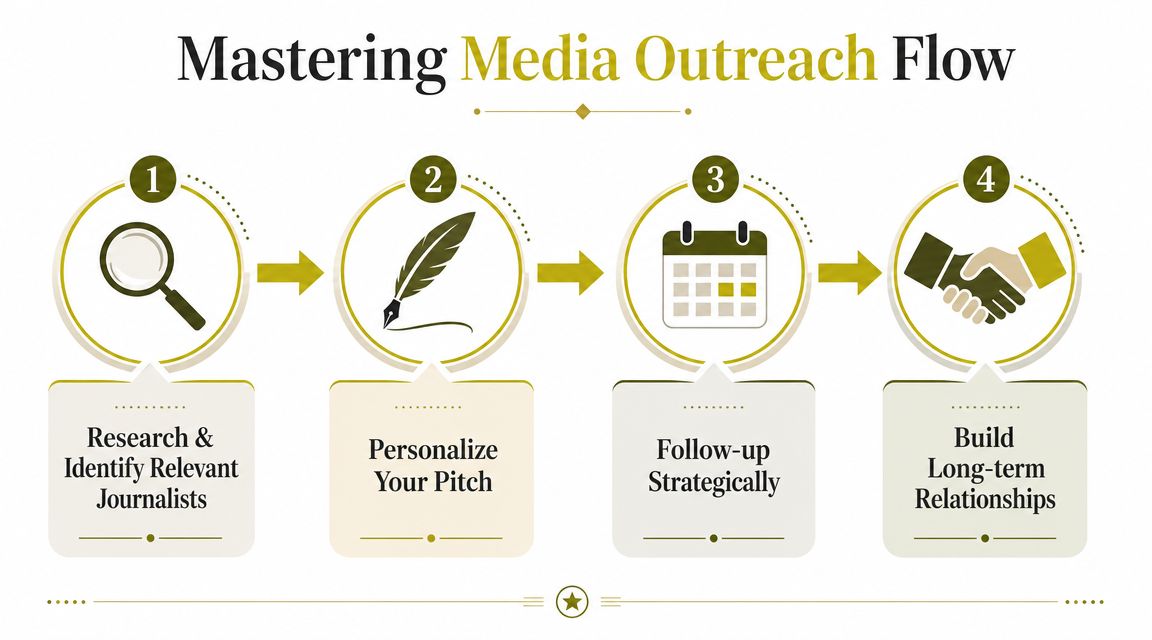
A small list forces better judgement. You have to ask:
- What does this journalist already cover?
- Does this story match their beat?
- Does the publication serve the audience we need to reach?
- Can we support the angle with evidence?
That's how newsroom thinking enters the process.
Write the email reporters will actually read
The best pitch emails are short. They respect the recipient's time and make the story legible in seconds.
Subject lines matter more than many founders realise. Clean formatting and consistency help emails look credible at a glance, and these subject line capitalization best practices are useful if you want to avoid amateurish styling choices that can undermine a serious pitch.
A working pitch email usually contains:
- A direct subject line tied to the news angle
- A first sentence showing why the story fits that journalist
- A brief summary of the story and why now
- One or two proof points or available sources
- A clear next step such as interview availability or supporting material
Here's the difference in practice.
Bad pitch
Hi, we're an innovative startup revolutionising the future of workplace efficiency with a cutting-edge platform and would love to be featured in your publication. We think your readers would find this exciting.
Good pitch
Hi Sarah, you've recently covered workflow bottlenecks in growing finance teams. We've got a relevant story on how smaller firms are handling that pressure, plus founder comment and customer evidence if useful. Happy to share details or arrange a quick briefing.
The second one sounds like it was written by someone who reads the publication.
A broader explanation of that relationship-led approach sits in this guide to media relations.
Later in the process, it helps to hear the mechanics discussed rather than just read them. This short video is useful for that.
Follow up without becoming a nuisance
Follow-up is part of the job. Pestering is not. If there's no response, wait about a week, then send a short note that adds something useful or politely resurfaces the idea.
A bad follow-up asks, “Just checking you saw this.” That creates work for the journalist and no value.
A better follow-up does one of three things:
- adds a fresh angle
- notes new evidence
- offers a tighter version of the same opportunity
Treat outreach as a system
The other useful point in Neil Patel's guidance is that PR should be iterative. Build campaigns, invest in journalist relationships, then test and reassess the value of each placement. That matters because startup teams often assume a failed pitch means the story was wrong. Sometimes the issue is outlet fit, evidence quality, timing or email framing.
Good outreach is not a numbers game. It's a pattern-recognition exercise.
That's where former journalists tend to be especially useful. They've sat on the receiving end of the email, watched what got deleted and know which details gave an editor confidence to say yes.
Measuring PR Impact and Setting Budgets
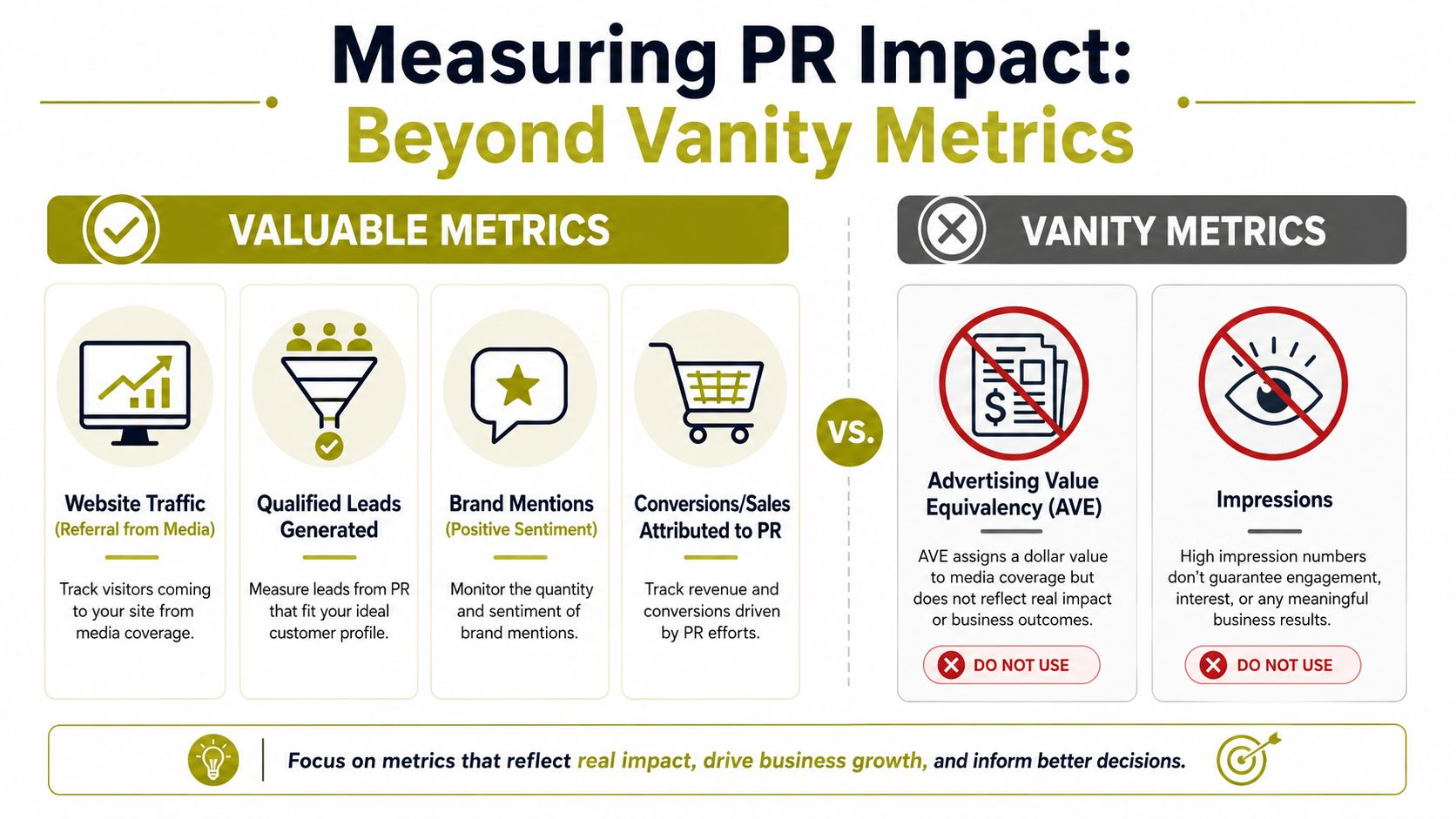
The weakest way to judge PR is to count noise. Coverage volume, impressions and inflated valuation models may look tidy in a report, but they don't tell a founder whether PR is helping the business.
Startups need a tighter system. If PR is meant to support growth, then measurement has to connect with outcomes that matter.
Keep the KPI set lean
Firebrand's startup PR guide recommends no more than 5 ongoing KPIs, quarterly reporting for most programmes and spending no more than 10% of the PR budget on measurement and reporting. It also notes that startups should usually benchmark against trend improvement rather than larger-brand comparisons, and that 20% year-on-year growth is considered strong progress for most KPIs, while “milestones” or “firsts” can be better targets when fixed numbers would mislead, according to the Firebrand guide to PR measurement for startups.
That advice is sound because startup teams don't need a dashboard full of vanity. They need a small reporting system they'll maintain.
A sensible KPI mix might include:
- Media quality: Were you featured in outlets your customers, investors or partners read?
- Referral traffic from coverage: Did the article send useful visitors?
- Inbound interest: Did relevant conversations increase after coverage?
- Message pull-through: Did the journalist use the point you wanted the market to understand?
- Commercial assistance: Did PR help open a sales, hiring or fundraising conversation?
Measure the long game as well as the click
Not every strong result appears as an immediate visit or enquiry. In startup PR, some of the most valuable effects show up later. Investor outreach gets warmer. Partnership conversations start faster. Prospective hires arrive already familiar with the company.
That's why you should track assisted impact over time, not just direct response on the day.
If you want one metric that gives useful market context, share of voice can help. This practical guide to calculating share of voice is worth reading if you want to compare your visibility against close competitors without defaulting to superficial clip counts.
The right question isn't “How many mentions did we get?” It's “Did PR move us closer to trust, access or revenue?”
Budget with discipline
Most founders either underfund PR or expect immediate certainty from it. Both are mistakes.
The better approach is staged. Fund the basics first:
- message development
- media assets
- targeted outreach
- reporting against a few defined business outcomes
Then review quarterly. If the work is generating useful movement, you increase commitment. If not, adjust the angle, the audience or the delivery model.
What matters most is that measurement doesn't become its own bureaucracy. Firebrand's recommendation to keep reporting lean is especially important for startup teams. Time spent producing decorative reports is time not spent improving the story, the pitch or the target list.
Deciding Between DIY PR and Hiring an Agency
Most founders can handle some PR themselves at the start. In fact, they should. Early on, nobody knows the product, market tension or customer pain better than the founder.
But DIY PR breaks down when time gets tight, the story gets more complex or the stakes rise. Fundraising, regulation, crisis exposure and national media interest all demand sharper handling than “I'll send a few emails after lunch”.
The real decision points
The choice isn't just budget. It's capability, speed and risk.
DIY makes sense when:
- the founder can still own media conversations directly
- the company has a simple story and a clear niche
- the opportunity cost of time is manageable
- expectations are realistic
Agency support makes sense when:
- messaging needs sharpening for different audiences
- media targets are broader or more senior
- timing matters and delays could cost coverage
- the founder's time is better spent on product, sales or fundraising
If you're weighing options, this guide on how to choose a PR agency gives a sensible framework.
DIY PR vs Agency PR A Startup's Decision Framework
| Factor | DIY PR (In-House) | Hiring an Agency (e.g., Carlos Alba Media) |
|---|---|---|
| Story knowledge | Deep founder knowledge of the business | External perspective that can sharpen angles |
| Time commitment | High. Outreach, follow-up and asset prep all sit with the team | Lower day-to-day load for founders |
| Media understanding | Often learned by trial and error | Established process and editorial judgement |
| Relationships | Usually limited at first | Existing contacts and experience handling journalists |
| Speed under pressure | Can slow down if PR is a side task | Faster execution if systems are already in place |
| Cost structure | Lower cash outlay, higher founder time cost | Direct spend, but less internal strain |
| Best fit | Very early stage, narrow story, founder-led outreach | Growth stage, bigger moments, reputation-sensitive work |
Check references properly
If you're considering an agency, don't just read polished website copy. Ask for examples of how they think, how they handle deadlines and who does the work.
You can also look at wider directories such as all testimonial agencies to see how firms present client proof and specialist positioning. That won't replace due diligence, but it can help you compare how agencies communicate credibility.
What founders often underestimate
The cost of DIY PR isn't just missed coverage. It's muddled positioning, weak interviews, poor timing and opportunities that never become stories because nobody framed them properly.
That doesn't mean every startup should hire an agency immediately. It means you should be honest about whether PR is still a side task or whether it has become a commercial function.
If your startup has a real story but your outreach isn't landing, Carlos Alba Media is one option for founders who want senior-level PR support shaped by former national news journalists and agency practitioners. That kind of background is useful when you need sharper messaging, stronger media handling and a process built around what editors publish.