
In 2023, renewables generated 135.9 terawatt hours and accounted for 43.1% of UK electricity generation according to industry commentary citing UK government energy statistics. That changes the communications brief completely. You're not promoting an alternative any more. You're communicating a major part of national infrastructure, with all the scrutiny that brings from planners, regulators, investors, local communities and newsrooms.
That's why renewables public relations in the UK has become a specialist discipline. Generic lifestyle PR won't cut it. A wind, solar, storage or bioenergy business needs people who understand planning fights, local objections, broadcast deadlines, legal risk and the difference between a trade splash and a regional backlash. At Carlos Alba Media, that specialist edge comes from a team made up of former national news journalists and agency professionals who've worked with international brands. That matters because newsroom instincts and brand discipline together produce stronger judgement than either on its own.
Why Renewables PR Is Now Mission Critical
A decade ago, plenty of renewable energy communications still leaned on broad environmental positioning. Today, that's too thin. When a sector supplies a substantial share of the country's electricity, the conversation shifts to reliability, infrastructure, investment, grid constraints, land use and trust.
That's the central strategic change many leadership teams underestimate. They still treat PR as campaign support when it now sits much closer to corporate affairs. A planning application can trigger national coverage. A grid connection delay can become a trade story. A local protest can spread online and define your reputation before your project director has spoken publicly once.
The story has moved from values to consequences
In the newsroom, a “green energy” line on its own rarely survives the first edit. Journalists ask sharper questions. Who benefits? Who objects? What does it mean for a local area? What's the downside? Is there a policy row behind it? Is this a jobs story, a cost story, a planning story or a politics story?
That shift catches out founders and in-house teams. They prepare a mission-led announcement and then wonder why the first reporter asks about pylons, subsidy arguments, community compensation or bird impact. The answer is simple. Infrastructure journalism follows consequences, not slogans.
Practical rule: If your message only sounds good in a sustainability report, it probably won't survive a live interview.
Why specialist experience matters
A former national journalist sees the weak spots in a press release before it goes out. An agency operator sees the stakeholder chain behind the headline. Put those together and you get a more effective renewables public relations function.
That's the useful lens here. Not theory. Real pattern recognition from people who know how editors frame risk, how producers brief interviews, how regional reporters chase local reaction and how corporate comms needs to protect the business while still sounding human.
A strong renewables PR operation now does four jobs at once:
- Protects licence to operate: It helps projects earn local legitimacy, not just attention.
- Translates complexity: It turns technical milestones into language non-specialists can follow.
- Absorbs pressure: It gives leaders a disciplined response when scrutiny lands fast.
- Supports growth: It builds confidence with partners, investors, regulators and future hires.
If that function is missing, the business feels it quickly. Coverage becomes reactive. Messaging drifts between audiences. Spokespeople overpromise. Stakeholder engagement starts too late. Small issues become reputation problems because nobody shaped the narrative early enough.
Crafting Your Core Message Beyond 'Green'
The weakest renewables messaging usually sounds worthy and vague. It talks about sustainability, innovation and commitment to the future. None of that is wrong. It's just not enough when the audience is deciding whether your project deserves support, investment or planning consent.
A durable message has to do harder work. It must stand up in a resident meeting, a boardroom, a trade interview and a tough regional radio slot.
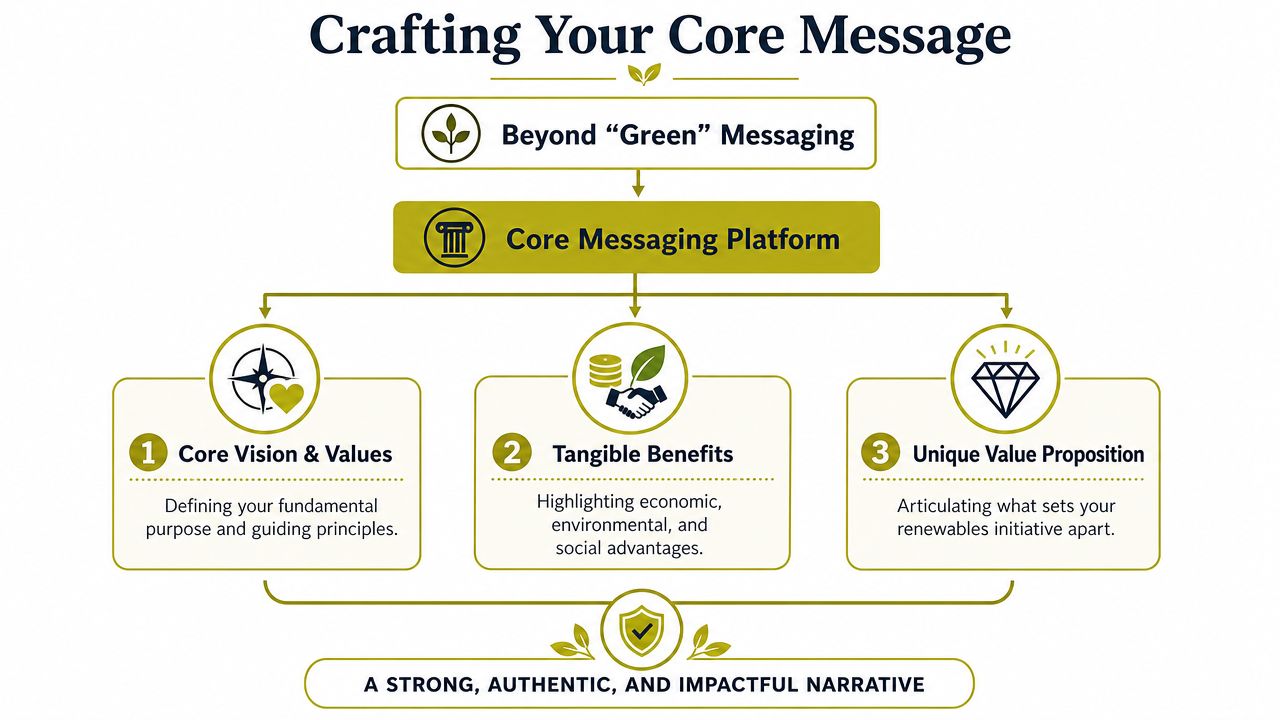
Build three layers, not one slogan
Start with your core vision and values. This is the part leadership usually likes most. Why the company exists. What standards it follows. What kind of contribution it wants to make. Keep it clear and plain. If it sounds copied from a tender document, rewrite it.
Then move to tangible benefits, which often determine whether most PR programmes either gain traction or lose credibility. The message has to explain what changes because your project exists. That could include local supply-chain opportunities, energy resilience, skills, long-term area investment or improved system flexibility.
The third layer is your unique value proposition. This is the differentiator. Why your project, technology or delivery model matters in a crowded and sceptical environment. This is often where storage integration, grid expertise, local partnership design or a particularly thoughtful consultation process can carry more weight than a generic “green” claim.
A useful test is whether each layer answers a different stakeholder question:
| Stakeholder question | Message layer that should answer it |
|---|---|
| Why do you exist? | Core vision and values |
| Why should anyone care? | Tangible benefits |
| Why you rather than another developer? | Unique value proposition |
Affordability needs disciplined language
One of the most mishandled areas in UK renewables PR is cost. UK government and Ofgem data show energy affordability remains a central public concern, and the more credible campaigns address that directly by explaining long-term price stability and local economic benefits rather than promising immediate, universal bill savings, as discussed in this analysis of renewable energy communications in the UK.
That means the phrase “cheaper energy” needs careful handling. It may work in a narrow context with strong evidence and tight wording. Used lazily, it creates an easy attack line. The minute household experience doesn't match the message, trust takes a hit.
The better message isn't “this will instantly cut everyone's bills”. It's “this strengthens resilience, supports a more stable system over time and brings local value that can be clearly explained”.
What works and what gets exposed
Use this as a working filter when shaping your narrative:
- Works well: Tying environmental benefit to practical outcomes people recognise, such as energy security, local participation, infrastructure resilience and visible community gain.
- Works poorly: Floating abstract claims about transformation without any local relevance or operational explanation.
- Works well: Acknowledging trade-offs. Every serious project has them.
- Works poorly: Acting as if objections only come from ignorance or bad faith.
When leaders get this right, the company sounds more confident. Not louder. Just more grounded. That's the tone that survives scrutiny.
Mastering Media Relations with a Journalist's Mindset
A former journalist can usually predict the fate of a renewables press release in under a minute. Most are deleted for one of three reasons. They aren't new, they aren't clear, or they read like internal self-congratulation.
Newsrooms don't exist to validate your project timeline. They exist to find stories their audience will care about now. That distinction matters because many energy businesses still pitch process when they need to pitch consequence.
What editors actually look for
A national desk wants scale, conflict, policy relevance or a wider market signal. A regional newsroom wants local jobs, planning implications, resident reaction, visible change on the ground or a recognisable local angle. Trade titles want technical credibility, commercial significance and operational detail that general media would strip out.
That means the same project update often needs three different framings.
| Media type | What usually makes it newsworthy |
|---|---|
| National | Policy tension, major investment relevance, supply security, political impact |
| Regional | Community effect, planning row, local economy, named location and voices |
| Trade | Technology, financing structure, delivery milestone, sector precedent |
A battery storage milestone might be dead on arrival at a national title unless it connects to grid resilience or a policy question. The same milestone can work well in specialist energy media if the technical and market significance is explained properly.
The newsroom test for every pitch
Before sending anything, ask:
- Why today? If there's no urgency, there may be no story.
- Why this audience? A trade editor and a breakfast producer need different intros.
- Where's the tension? No tension usually means no coverage.
- Who can say it credibly? The best spokesperson isn't always the chief executive.
Media relations becomes a craft rather than mere administration. The contact list matters, but the framing matters more. If you want a useful primer on the discipline itself, Carlos Alba Media has a clear guide to media relations and how it works in practice.
Most reporters don't mind technical detail. They mind unclear technical detail.
Common mistakes that get ignored
Here's what regularly kills a promising story:
- The headline says nothing: “Company X announces exciting new phase” tells an editor almost nothing.
- The quote is corporate mush: If the spokesperson wouldn't say it on air, don't write it into the release.
- The angle is internal: New hires, awards and partnerships need an external consequence to earn real interest.
- The pitch arrives unprepared: If a journalist bites and your team can't supply images, a spokesperson, timings or local context quickly, momentum goes.
Former national reporters tend to be ruthless about this because they've been on the receiving end. They know the difference between a clean pitch and a burden.
Preparing spokespeople for the questions they won't enjoy
The strongest interview prep for renewables isn't about soundbites first. It's about pressure points. Can the spokesperson answer plainly on land use, visual impact, affordability, consultation, delays, wildlife concerns or policy uncertainty?
A good prep session includes hostile but realistic questions, followed by tighter second attempts. Broadcast interviews in particular reward calm specificity. If your spokesperson tries to pivot away from every difficult line, the audience notices and the interviewer pushes harder.
One final newsroom truth. Relationships still matter. Not in the old sense of favour-trading, but in the practical sense that journalists remember who wasted their time and who helped them do their job. Reliable people get called back.
Building Trust with Communities and Key Stakeholders
Media coverage can shape perception quickly, but it doesn't replace local consent. For renewables projects, the deeper test is whether people who live near the development believe they've been heard, respected and given honest information early enough.
That's where many projects stumble. They communicate in bursts around milestones and consultations, then go quiet. Communities read that silence as distance or defensiveness. Once that mood sets in, every update is filtered through distrust.
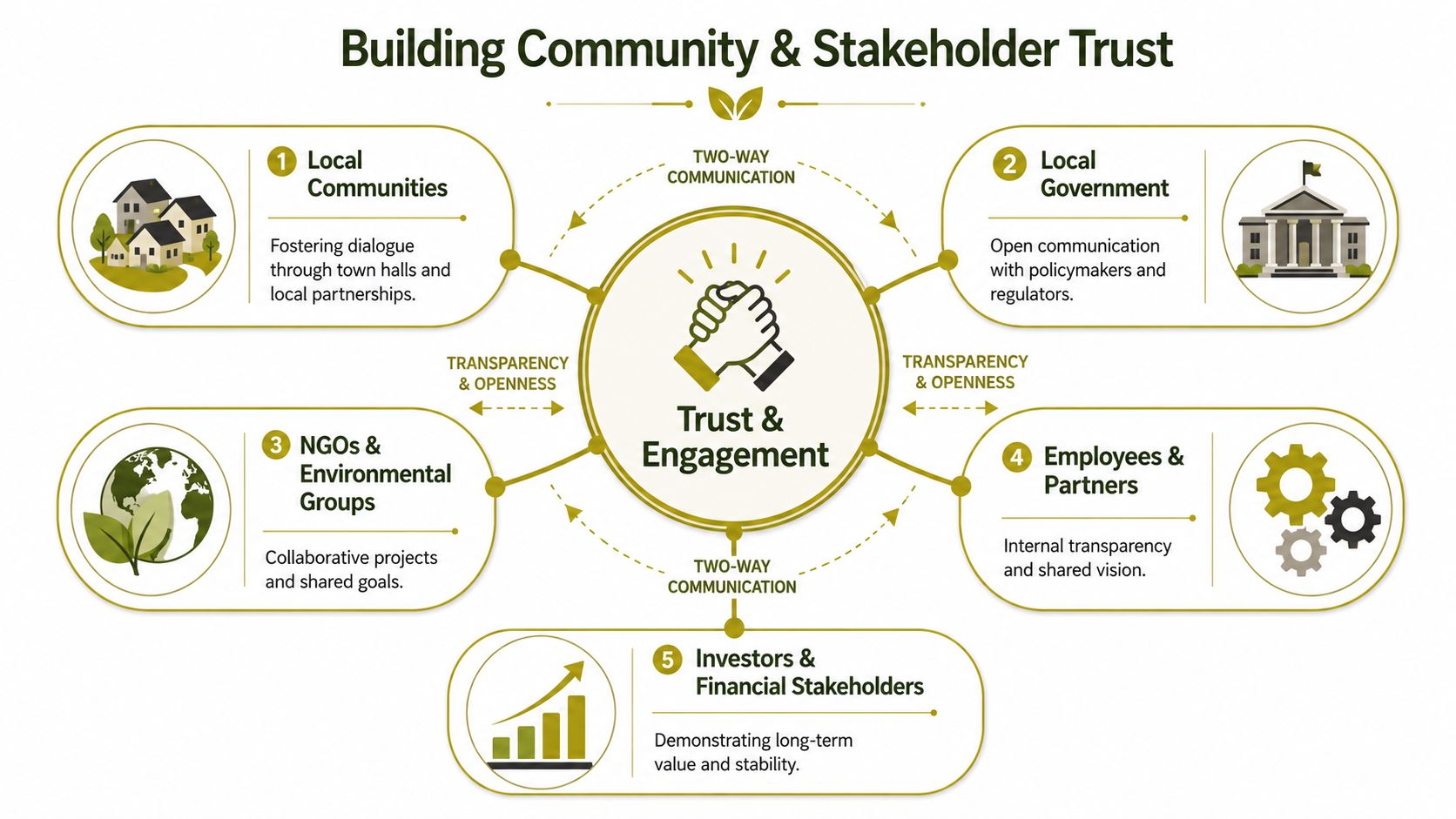
Start with a stakeholder map, not a mailout
Before the first public event, identify the people and groups who can influence acceptance, delay or support. That usually includes residents, councillors, MPs or MSPs where relevant, planning officers, local businesses, landowners, campaign groups, environmental bodies, schools and community organisations.
The mistake is treating them as one audience. They aren't. A local business owner may focus on procurement opportunities. A resident may worry about traffic, view impact or construction disruption. A councillor may care most about process and whether the developer has handled consultation properly.
A simple stakeholder map should track three things:
- Level of influence: Who can shape outcomes or local opinion.
- Primary concern: What they're most likely to ask or challenge.
- Preferred channel: Public meeting, small briefing, email update, site visit or one-to-one conversation.
Consultation has to feel real
Bad consultation is easy to spot. The boards look polished, the language is vague, and the answers sound rehearsed. People leave thinking the decision has already been made.
Good consultation is less theatrical. It gives clear information, records objections accurately and shows where feedback can alter detail, timing, mitigation or community benefit design. Sometimes that means saying, plainly, “This part is fixed, this part can still change.”
If you want a broader operational view of how engagement supports delivery, this piece on driving project success through engagement is useful because it frames stakeholder work as a practical project discipline, not just a communications exercise.
Communities don't expect perfection. They expect honesty, access and evidence that speaking up can influence something.
What to do when opposition forms early
Opposition isn't always a sign your communications failed. Some resistance is inevitable in visible infrastructure projects. The question is whether your response lowers heat or hardens positions.
Use this approach:
- Acknowledge the concern in the words people are using. Don't sanitise it.
- Answer with specifics. Timings, mitigation, route changes, landscaping, traffic management and contact points matter more than values language.
- Keep a visible local presence. A hotline nobody answers and an inbox that takes a week to reply damages trust fast.
- Show your workings. Explain how decisions are made, who signs off and what constraints exist.
- Correct misinformation without sounding contemptuous. Publicly humiliating critics almost always backfires.
Rebuilding trust after a rough patch
Sometimes a project starts badly. A consultation goes wrong. Residents find out from social media before they hear from the company. A senior figure says something clumsy. At that point, the right move isn't more volume. It's a reset.
That usually means a smaller number of clearer commitments, visible follow-through and better local channels. Carlos Alba Media has published practical thinking on how organisations can rebuild trust after reputational strain, and the same principles apply strongly in renewables where memory is long and scepticism travels quickly.
Trust in this context is cumulative. People watch whether you answer the difficult email, whether meeting notes are accurate, whether mitigation appears when promised and whether the same faces return to the community instead of vanishing after the consultation phase.
Communicating with Investors and Regulators
Investors and regulators don't need the public narrative repeated back to them with more polish. They need a tighter operating story. The language changes. So does the proof required.
For investors, the central question is whether the business can execute through uncertainty. For regulators and planning authorities, the question is whether the project is compliant, coherent and aligned with wider system needs. If your communications blur those audiences together, both groups lose confidence for different reasons.
What investors want to hear
Investor communications should reduce ambiguity. That doesn't mean pretending risk has vanished. It means showing that management understands the risk profile and can explain it in a disciplined way.
Useful investor messaging often centres on:
- Project maturity: What stage the asset or pipeline is at and what remains unresolved.
- Execution credibility: Who is delivering, what dependencies matter and how decisions are governed.
- Market relevance: Why the project fits demand, grid realities or broader energy system needs.
- Resilience of the proposition: How the business speaks about delays, policy shifts, supply-chain friction and community pressure.
The tone matters as much as the content. Discerning audiences usually trust sober language over exuberant claims. If every update sounds triumphant, people assume management is hiding discomfort somewhere.
What regulators and planning bodies need
Regulatory communication rewards precision. It has less tolerance for broad branding language and much more interest in process, evidence, mitigation and consistency. The same project that can be framed publicly through benefits and vision needs to be framed for authorities through compliance, technical clarity and procedural seriousness.
A practical comparison helps:
| Audience | Communication priority | Language that tends to work |
|---|---|---|
| Investors | Confidence in delivery and long-term viability | Disciplined, commercial, risk-aware |
| Regulators and planners | Compliance, system fit, mitigation, transparency | Precise, factual, procedural |
That doesn't make PR irrelevant here. It makes it more exacting. Investor decks, policy briefings, consultation summaries, executive remarks and regulatory submissions all need message discipline. Contradictions between them get noticed.
The avoidable mistake
One common error is overselling certainty to investors while soft-pedalling complexity with regulators or local authorities. That gap creates reputational exposure. If one audience hears “straightforward pathway” and another sees a long list of unresolved issues, trust erodes across the board.
The better approach is consistency of substance with adaptation of emphasis. The facts should hold together. The framing should shift. Investors need to know why the project can create value. Regulators need to know why it can proceed responsibly. Both need evidence that leadership understands the territory.
Your 24/7 Crisis and Issue Management Plan
Every renewables business says it takes reputation seriously. Far fewer have a crisis plan that would stand up at 6.30am on a Wednesday when a planning decision leaks, a local campaign group posts damaging footage, or a reporter calls with allegations and a tight deadline.
That's when preparation stops being a nice governance document and becomes operational protection.

The plan you need before the incident
A serious crisis playbook should name decision-makers, out-of-hours contacts, approval routes, legal escalation points, spokespersons and initial holding lines for likely scenarios. In renewables, those scenarios often include planning rejection, environmental complaints, safety incidents, activist campaigns, contractor disputes, executive misconduct allegations and supply-chain controversy.
What matters is speed with control. The first response doesn't need every answer. It does need ownership, accuracy and a visible process.
A practical plan usually includes:
- A response cell: Communications, operations, legal, senior leadership and relevant project leads.
- Scenario-based holding statements: Short first responses that can be issued quickly without sounding evasive.
- Monitoring system: Media, social, stakeholder and political tracking so the team knows what's moving.
- Spokesperson matrix: Who speaks on broadcast, who handles trade media, who briefs local stakeholders.
Why improvised responses usually fail
In a crisis, businesses tend to default to one of two bad instincts. They say too little for too long, which creates a vacuum, or they say too much before facts are stable, which creates corrections and credibility loss.
A structured response avoids both. It gives the organisation enough discipline to acknowledge the issue, state what is known, show what happens next and keep tone aligned across channels.
Newsroom reality: If you don't give journalists a usable, timely response, they'll publish the version assembled from everyone else.
This is one area where external support can be critical. A specialist firm such as Carlos Alba Media can provide crisis communications planning, media handling and access to media lawyers through its crisis communications plan guidance and related support. That's not a substitute for internal leadership. It's a way to keep leadership effective under pressure.
A quick readiness check
Ask your team these questions and see how fast the answers come back:
| Question | If the answer is unclear, you have a gap |
|---|---|
| Who approves the first statement out of hours? | Delay and mixed messaging |
| Who speaks if the chief executive is unavailable? | Spokesperson vacuum |
| What are the top likely crisis scenarios? | Poor preparation |
| How will local stakeholders be informed? | Trust damage beyond media coverage |
A crisis plan isn't pessimism. It's operational realism. In a sector exposed to politics, local scrutiny and technical risk, the issue isn't whether pressure will arrive. It's whether the business will look composed when it does.
Measuring PR Impact to Prove Business Value
One of the worst habits in PR reporting is pretending volume equals value. It doesn't. A pile of low-grade mentions can flatter a dashboard and do very little for reputation, planning confidence or pipeline growth.
That matters even more in renewables, where one well-placed piece of earned coverage can shift stakeholder perception more than a long list of forgettable clips.
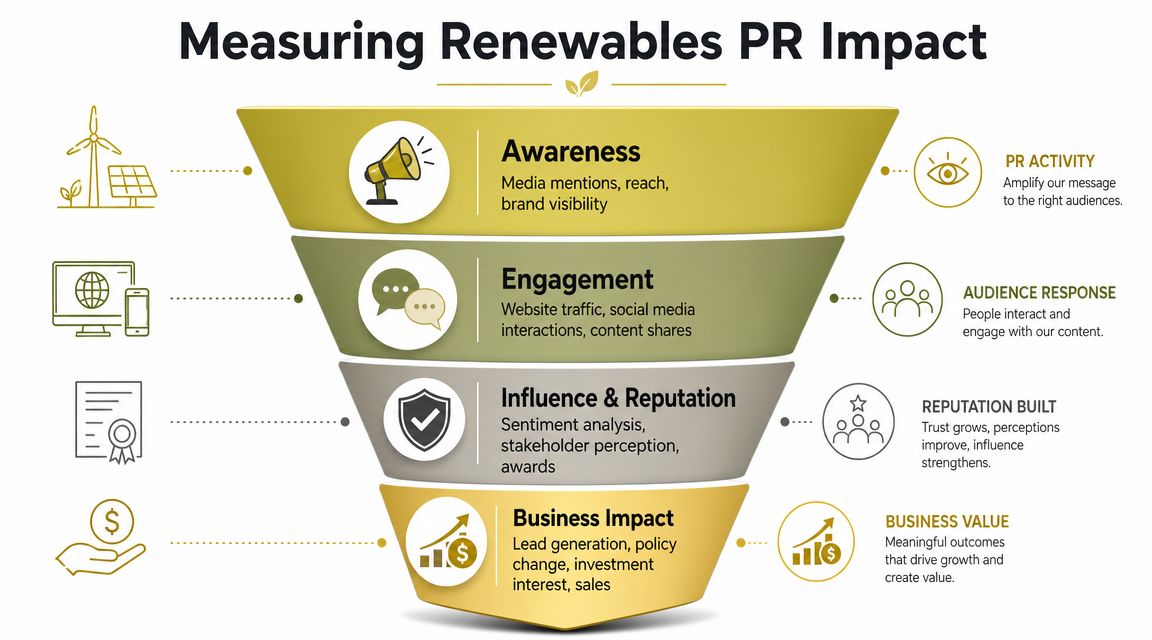
Start with trust, then build a ladder
Broad PR research reports that 92% of consumers trust earned media more than advertising, and the same body of guidance argues that effective evaluation should track a ladder from awareness to engagement to action, rather than stopping at clip counts, as outlined in this PR measurement overview.
That's the right logic for renewables public relations. Awareness matters, but only as a first stage. If you stop there, you can't tell whether coverage changed anything that matters to the business.
A more useful framework looks like this:
Awareness
Reach, prominence, share of voice, target-media presence.Engagement
Sentiment, message pull-through, quality of discussion, web referrals from earned coverage.Business impact
Investor interest, stakeholder responses, consultation participation quality, leads, policy movement or other defined outcomes.
What to put on the dashboard
The cleanest PR dashboards answer board-level questions, not agency vanity questions. Was the business more visible in the right places? Did the core messages appear accurately? Did sentiment hold during contentious moments? Did coverage generate qualified traffic or meaningful stakeholder action?
That means combining media monitoring with owned-channel and business data.
| Level | Better metric | Weaker substitute |
|---|---|---|
| Visibility | Share of voice in target outlets | Raw number of clips |
| Quality | Message pull-through and sentiment | Headline count alone |
| Action | Referral traffic, enquiries, leads, policy impact | Generic “reach” totals |
For teams trying to connect communications with broader commercial reporting, it also helps to review how adjacent functions define success. This guide on how to optimize marketing KPIs for B2B is useful because it reinforces the same principle. Metrics should ladder into decisions, not sit in isolation.
The measurement mistake that keeps repeating
A lot of teams still celebrate publicity that doesn't move any strategic audience. They count mentions, praise the volume and move on. That's comforting, but it tells leadership very little.
The tougher standard is better. Set PR goals as a change in a defined audience, by a defined amount, over a defined period. Then track whether earned media contributed to that change through awareness, sentiment and action signals. That's how PR starts to look like a business function rather than an activity report.
When measurement is built that way, you can defend spend, refine messages and spot weak points early. You also get a more honest picture of what's working. Sometimes one trade feature is worth more than a week of broad outreach. Sometimes regional coverage matters more than national attention because it influences the stakeholders closest to a project. Good measurement exposes those truths.
If your business needs senior-level support on renewables public relations, stakeholder communications or crisis preparedness, Carlos Alba Media offers newsroom-informed PR and digital counsel from former national journalists and experienced agency operators who understand how scrutiny works in practice.