
You’ve built something worth talking about. A product that solves a real problem. A service people need. A business with substance behind it. Yet the coverage doesn’t come, journalists don’t call, and your competitors seem to appear in the right places while you stay invisible.
That gap hurts more than ego. It affects sales conversations, investor confidence, recruitment, partnerships, and trust. When a prospect searches your business and finds little beyond your own website and social channels, you lose authority before the meeting even starts.
Founders often come to the search for PR support at this exact point. They’re not looking for vague “brand awareness”. They want momentum. They want a sharper story, better media judgement, and someone who knows the difference between a decent idea and a headline. They also want to avoid wasting money on an agency that dazzles in the pitch and disappears in the work.
That’s why learning how to choose a pr agency matters. This isn’t a procurement exercise. It’s a decision about who gets to shape your public reputation, challenge your assumptions, and speak on your behalf during critical moments.
Your Story Deserves to Be Told
A common scenario looks like this. A founder has spent years building a serious business. The product is good. Customers rate it highly. The team has done the hard yards. But when they send a press release, nothing happens. Or worse, they hire an agency that talks a big game, sends generic pitches, and delivers a monthly report full of clippings that don’t move the business forward.
The frustration is usually rooted in one issue. The story hasn’t been shaped for the world of editors, producers, reporters, and commercial pressure.
Former journalists see this quickly. Newsrooms don’t reward effort. They reward relevance, timing, clarity, and a strong angle. If your message sounds like everyone else’s, it won’t land. If it reads like internal company language rather than a proper story, it won’t travel. If the spokesperson can’t deliver a sharp quote when a producer needs one, the opportunity goes elsewhere.
That’s why a founder shouldn’t think about PR as “getting in the press”. The more useful frame is strategic visibility. You’re trying to become easier to trust, easier to remember, and easier to choose.
A good agency helps you do that by finding the tension in your story. What’s changed in the market. Why your offer matters now. Which audience needs to hear it first. How your message should differ for The Herald, BBC Scotland, trade media, podcasts, and LinkedIn.
If your story still feels broad or unfinished, it’s worth tightening the narrative before you appoint anyone. A clear explanation of your positioning is the foundation of better media work, better content, and better interviews. Carlos Alba Media’s guide to brand storytelling is a useful starting point if your business has expertise but struggles to express it in a way people remember.
Good PR rarely starts with distribution. It starts with editorial judgement.
Define Your Mission Before You Engage
A founder calls three agencies, asks for ideas, sits through three polished pitches, then wonders why the quotes vary so wildly. In nearly every case, the problem started before the agencies got involved. The business had no firm objective, no clear budget range, and no view on what internal support it could provide.

Agencies can only price and plan properly when the brief is grounded in business reality. If you want senior-level attention without big-agency waste, give people something precise to respond to.
Start with the outcome, not the activity
Press coverage is an output. Your mission is the outcome behind it.
For a UK or Scottish SME, that usually means one of four things. You need to look credible to investors. You need demand around a launch or trading period. You need authority in a specialist sector. Or you need protection, because a reputational wobble would hurt sales, recruitment, or partnerships.
Set that out plainly. “We need to build trust with public sector buyers in Scotland before tendering in Q4” is a workable brief. “We want more PR” is not.
Good agencies will ask sharper questions, but they should not be guessing the basics. A proper communications strategy for a growing business gives them the commercial context they need to choose the right media, message, timing, and spokesperson.
Be specific about what success looks like
Founders do not need a finished PR plan before the first conversation. They do need a clear position on what would count as progress.
Answer these before you send a brief:
- Who needs to believe us? Customers, buyers, investors, partners, regulators, or future hires.
- What business moment are we supporting? Fundraising, expansion, recruitment, a new service, a reputation reset, or steady profile building.
- Which channels matter enough to measure? Regional press, national news, trade titles, broadcast, podcasts, newsletters, LinkedIn, or a mix.
- Who will speak on the record? Founder, commercial lead, technical expert, or someone else with real authority.
- What can the business supply quickly? Approvals, data, customer examples, images, diary access, and interview availability.
Smaller businesses often come unstuck when the founder wants national coverage, the ops team cannot turn approvals in under three days, and nobody has agreed who can comment publicly. That gap costs time, and time is what you are buying.
If you are also deciding between outside strategic support models, this breakdown of fractional CMO vs marketing agency is useful context. PR agencies work best when the company already knows whether it needs strategic direction, delivery capacity, or both.
Set the budget range early
Do this before chemistry calls and before proposals.
A realistic budget range changes the quality of the conversation. It tells an agency whether to build a focused regional media programme, a national thought leadership push, or a short project around a launch. Without that range, you tend to get one of two things. A vague proposal padded with options, or an ambitious plan that falls apart as soon as fees are discussed.
For many SMEs, the better question is not “What does PR cost?” It is “What level of senior input and output can we sustain for six months?” That is a more honest way to assess value. Former journalists who now run agencies tend to be blunter about this because we know how hard it is to create usable media opportunities without time, access, and decision speed.
You do not need a perfect figure on day one. You do need a ceiling, a preferred monthly range, and clarity on whether content production, photography, travel, events, or media training sit inside or outside the fee.
Further context on planning and expectation-setting can help here:
Check whether your team can support the work
PR runs on access, judgement, and speed. If your business cannot feed the process, even a good agency will struggle to produce consistent results.
Before you appoint anyone, get these basics in order:
- Core messaging: a plain-English explanation of what you do, who it helps, and why it matters now
- Spokespeople: named people who are available, credible, and prepared to speak externally
- Proof points: wins, hires, launches, partnerships, customer outcomes, market data, or founder insight
- Assets: headshots, product or site images, bios, boilerplate, and previous coverage
- Sign-off process: who approves comments, content, and reactive responses, and how quickly
This prep work is not admin. It is the difference between paying for advice and paying for drift.
The founders who get the best from an agency usually arrive with a defined mission, a sensible budget range, and a realistic view of their own internal capacity. That gives the agency room to do serious work instead of spending the first month trying to pin down basics.
The Agency Conundrum Big Name vs Specialist Insight
A large London agency can look reassuring on paper. Big client list. Impressive office. Familiar logo wall. Dense proposal. Lots of specialist departments. For some businesses, that setup makes sense. For many SMEs, it doesn’t.
The reason is simple. Reputation and attention aren’t the same thing.

What founders often misunderstand about scale
The larger the agency, the more carefully you need to inspect who will handle your account. In a big firm, the senior people often lead the pitch, shape the first strategy, then step back. Day-to-day delivery can fall to junior staff who are learning on your budget.
That isn’t always wrong. Plenty of junior executives are bright and capable. But if you need crisis judgement, message discipline, or nuanced media handling, experience matters.
One overlooked issue is client portfolio saturation. The sharpest wording on this comes from this PR agency selection article, which notes the risk of becoming a “very important client to one small firm instead of one of many clients to a more established firm”. That trade-off matters to founders who need direct access for media training or crisis support, where the quality of counsel from senior practitioners, not junior coordinators, is paramount.
That point gets missed because agency reviews often reward surface indicators. Awards. Headcount. Famous names. Those things can signal competence, but they don’t tell you whether your business will get the agency’s best brains on a Tuesday afternoon when a journalist calls with a difficult question.
Boutique doesn’t mean limited
Many founders hear “specialist” and assume “small”. Then they hear “small” and assume “less capable”. That’s often the wrong conclusion.
A specialist consultancy can be stronger than a larger agency where it counts:
- Senior access: the people doing the thinking are often the people doing the work
- Sharper judgement: fewer layers means faster decisions and clearer accountability
- Better fit for SMEs: less overhead usually means less waste
- Newsroom realism: former journalists know what editors ignore and what gets picked up
This matters in Scotland and across the UK, where regional nuance matters. Media in Glasgow, Edinburgh, Aberdeen, London, and national trade circles don’t all respond to the same framing. A specialist team with newsroom experience often spots that quickly.
For founders thinking more broadly about external leadership support, this question overlaps with a wider marketing decision. Cemoh has a useful piece on fractional CMO vs marketing agency that helps clarify when you need strategic leadership, execution capacity, or both.
Ask who picks up the phone when things go wrong
This is the test I’d use if I were hiring an agency for a founder-led business.
If bad news lands at 7am, who do you speak to?
If a producer wants a spokesperson in two hours, who briefs them?
If your founder gives a shaky answer in a live interview, who fixes the fallout?
The answer should name a person, not a process.
One agency model that suits this need is the senior-led specialist consultancy. Carlos Alba Media, for example, is built around former national news journalists and agency practitioners with international brand experience, offering services across media relations, crisis communications, digital content, media training and brand strategy through its PR agency services. That’s not the only valid model, but it is one that aligns well with SMEs that want direct senior input without network-agency overhead.
If you need judgement more than volume, choose the team that has already worked where your story needs to land.
How to Build Your Agency Shortlist
Once you know what you need, don’t start with Google rankings alone. A good shortlist comes from filtering for fit, not visibility. Some agencies are excellent at marketing themselves and ordinary at serving clients. Others look understated online but have the right experience, judgement and contacts.
Start where credibility is easier to verify
For UK businesses, begin with recognised directories and trusted recommendations. The PRCA member directory is useful. So are referrals from founders, lawyers, investors, non-executive directors, and in-house marketers who’ve managed agency relationships.
Regional context matters too. If your business is based in Scotland, ask whether the agency understands Scottish media, business networks, and public-facing institutions, or whether it treats Scotland as an afterthought from a London plan.
Build a longlist first. Then cut it down hard.
A workable shortlist usually includes:
- Relevant sector exposure: hospitality, tech, tourism, property, professional services, or your actual category
- Evidence of senior practitioners: not just a founder biography and a hidden junior delivery team
- Clear service match: media relations, crisis support, content, social, training, or a blended brief
- Geographic fit: genuine UK reach with regional understanding where needed
Read the website like an editor, not a buyer
Most agency websites are polished. That isn’t proof of capability. Read them with a bit of scepticism.
Check the case studies. Are they specific, or are they padded with vague language? Does the agency explain what problem it solved, what approach it took, and what kind of outcome mattered? If everything sounds interchangeable, the strategy probably is.
Then read the team page closely. This is one of the best filters available.
Look for signs of actual operating experience:
- Former journalists: people who know what a newsroom needs and what makes a story stand up
- Agency operators: staff who’ve worked on substantial accounts and understand campaign delivery
- Specialist backgrounds: crisis communications, media training, stakeholder work, digital content, SEO, or brand strategy
- Named senior involvement: visible proof that experienced people are in the day-to-day
For a founder concerned about personal visibility and reputation, this wider issue matters too. ContentRemoval.com has a useful guide to digital reputation protection for leaders that helps sharpen your thinking about how public perception is managed beyond traditional media relations.
Cut the list by behaviour, not branding
You can learn a lot before you ever book a chemistry call.
Drop agencies that:
- Rely on slogans instead of substance: lots of adjectives, little method
- Hide the team: no clear indication who works on accounts
- Promise coverage too easily: serious PR people know they can pitch, not guarantee editorial decisions
- Look thin on current activity: stale insights, old case studies, little sign of live thinking
Keep agencies that show:
- Editorial intelligence: they understand angles, timing, and news value
- Commercial understanding: they grasp your business model, not just your headline
- Straight answers: they can explain what they would do in plain English
- A point of view: they’re willing to challenge a weak story, not just flatter you
A shortlist should feel narrower than is comfortable. If every option looks interchangeable, you haven’t filtered hard enough.
Asking the Right Questions to Find Your Partner
The interview stage is where appearances fall away. This is the point where you stop asking what an agency offers and start testing how it thinks. Most founders ask soft questions and get polished answers. Better questions create useful tension.
Questions that reveal strategic judgement
Start with the business problem, not the service list. Ask the agency to explain what they think the challenge is.
Useful prompts include:
- What’s your first reading of our story? This shows whether they can find the angle quickly.
- Who do you think should hear from us first, and why? Good agencies prioritise audiences rather than trying to talk to everyone.
- What would you not lead with? This is often the best question in the room. Weak agencies say everything is important.
- If you were an editor, what would make you ignore us? Former journalists tend to answer this sharply.
Then push on execution:
- Walk me through a campaign for a client like us that didn’t go to plan. What changed?
- How do you decide whether something is a press release, a comment opportunity, a feature pitch, or content for owned channels?
- How do you prepare a founder for broadcast or hostile questions?
- If there’s no obvious news hook this month, what do you do instead of forcing it?
These questions matter because PR work often goes wrong in the grey areas. The issue usually isn’t effort. It’s judgement.
Questions about the team, not the agency logo
It is common for many hires to fall apart. The founder buys the senior team and gets handed the junior bench.
Ask plainly:
- Who will work on our account every week?
- Who writes the media materials?
- Who handles press calls out of hours?
- How often will senior leadership be involved?
- Can we meet the people who would run the work?
If the agency resists that level of transparency, take it seriously.
You should also ask how they manage practical realities:
- What do you need from us in the first month to do good work?
- How do approvals work if a journalist is on deadline?
- What reporting will we receive, and how do you explain whether it’s working?
One old industry metric still appears in proposals, so it’s worth addressing directly.
Ask how they measure success beyond AVE. If they can’t answer that cleanly, they may be selling outputs instead of outcomes.
Questions about media relationships and realism
A lot of agencies claim strong contacts. Very few explain what that means in practice.
Ask:
- Which journalists or producers would realistically care about our sector, and why?
- How do you tailor a pitch for regional media versus nationals?
- What makes a spokesperson usable from an editor’s point of view?
- What would make you tell us not to pitch a story yet?
You’re not asking for names to collect in a spreadsheet. You’re checking whether the agency understands how media decisions are made.
A strong answer sounds grounded. It references audience, timing, angle, confidence in the spokesperson, and whether the story deserves outreach yet. A weak answer sounds like a boast.
Use a scorecard so the decision isn’t all gut feel
Founders often know within ten minutes who they like. That instinct matters, but it shouldn’t make the decision on its own. Use a scorecard after every meeting while the details are fresh.
| Criteria | Weighting (1-5) | Agency A Score | Agency B Score | Agency C Score |
|---|---|---|---|---|
| Strategic understanding of the business | 5 | |||
| Quality of senior team involvement | 5 | |||
| Media judgement and realism | 5 | |||
| Relevant sector experience | 4 | |||
| Crisis and spokesperson capability | 4 | |||
| Reporting and measurement clarity | 4 | |||
| Cultural fit and communication style | 4 | |||
| Budget fit and value | 4 | |||
| Ability to challenge constructively | 3 | |||
| Confidence in day-to-day delivery | 5 |
Use the scorecard properly:
- Score immediately: don’t wait until the end of the week
- Write one line of evidence: why you gave that mark
- Compare weighted totals: not just raw scores
- Discuss gaps internally: where did an agency feel impressive but vague?
The right partner usually wins on consistency. Not the flashiest slides. Not the biggest name. The team that understood the brief, challenged weak assumptions, named the delivery people, and spoke with confidence grounded in experience.
Sealing the Deal and Setting Up for Success
Appointing the agency isn’t the end of the decision. It’s the start of the relationship that will determine whether the work gets traction or drifts into frustration. A lot of PR engagements fail because the contract is loose, the onboarding is rushed, and expectations stay unstated.
Read the contract like an operator
A good PR agreement should be clear, boring, and precise. If it’s full of airy language and thin on detail, slow down.
Check these points carefully:
- Scope of work: what is included, what is excluded, and what counts as additional work
- Team allocation: which people are named, what level they are, and how senior oversight is defined
- Reporting cadence: when updates happen and what they include
- Response expectations: especially if crisis support or reactive press work is part of the brief
- Notice period: how either side can end the relationship
- Asset ownership: who owns copy, creative assets, media lists developed for the account, and strategic materials
If anything feels slippery in conversation, make it explicit in writing.
Build the first 90 days properly
Most agency relationships don’t need more enthusiasm. They need better operational discipline.
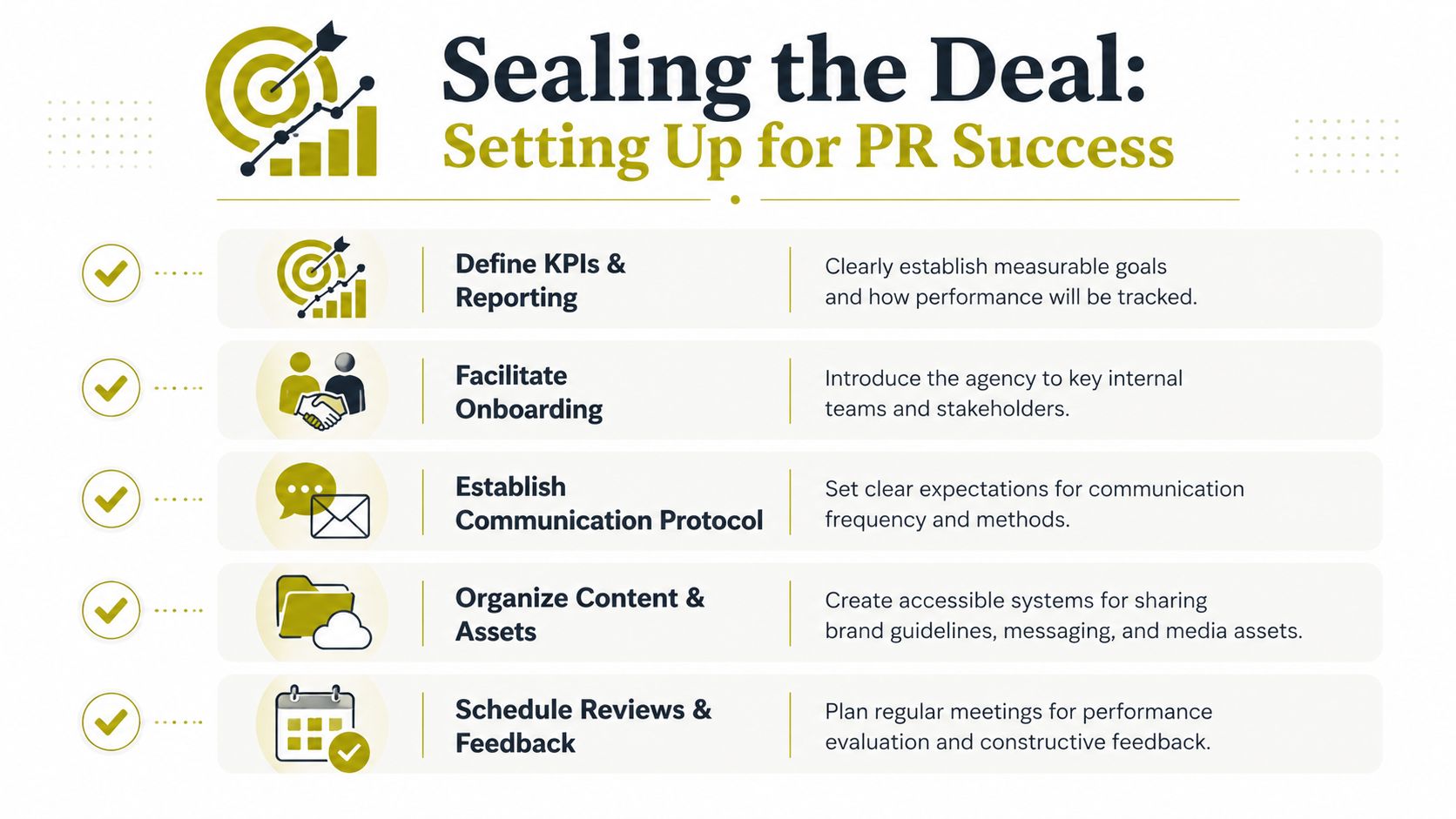
A strong start usually includes:
Kick-off with decision-makers present
Don’t leave the agency with a middle layer only. They need direct access to the people shaping the business.Message alignment
Agree the business story, red lines, proof points, and priorities before any outreach starts.Fast access to assets
Share logos, founder bios, headshots, photography, product notes, previous coverage, and approval routes early.Communication rules
Decide who speaks to whom, how quickly urgent requests are answered, and when regular check-ins happen.Early review points
Book review meetings in advance so the relationship doesn’t drift into passive monthly reporting.
The best onboarding feels almost over-prepared. That’s a good sign.
Watch for red flags before and after signature
A few warning signs should stop you in your tracks.
Be cautious if the agency:
- Promises certainty in editorial outcomes: they can pitch strongly, but they can’t control independent newsrooms
- Avoids naming the delivery team: that often signals a bait-and-switch
- Pushes generic monthly activity: volume without judgement rarely helps
- Resists clear KPIs: ambiguity protects underperformance
- Needs constant chasing in the sales process: service usually gets worse after signature, not better
Also watch your own side. Clients can sabotage good agency work by delaying approvals, changing priorities weekly, or withholding access to senior people.
A healthy partnership has mutual obligations:
- The agency brings judgement, execution, and candour
- The client brings clarity, access, and timely decisions
Set the tone for honest conversation
If something isn’t working, say it early. Don’t let disappointment harden into silence.
Ask direct questions:
- What’s landed well so far?
- What isn’t resonating yet?
- Are we giving you enough material?
- Are we aiming at the right outlets?
- Does our spokesperson need more preparation?
The best agencies won’t be defensive. They’ll diagnose, adjust, and keep the focus on what the business needs.
Your Agency Is Your Strategic Partner Not Just a Supplier
The right PR agency doesn’t just send emails to journalists. It helps you decide what’s worth saying, when to say it, and who should say it. It protects your reputation when pressure rises. It sharpens your message when the market gets noisy. It gives founders something many have too little of, which is experienced outside judgement.
That’s the standard to use when deciding how to choose a pr agency. Not who has the nicest deck. Not who drops the biggest client names. The question is whether the agency can think with you, challenge you, and represent you well when there’s a genuine opportunity or a genuine risk.
For SMEs and start-ups, especially in Scotland and across the UK, senior attention matters. So does practical media knowledge. So does a team that understands both editorial logic and commercial reality.
PR also works best when it doesn’t sit in a silo. Your media work should support your wider digital presence, content, search visibility, and spokesperson profile. If you’re tightening that broader mix too, Publer’s guide to optimizing your social media plan is a sensible companion read alongside your PR planning.
Choose a partner you can trust in a quiet month and in a difficult one. That’s usually the right choice.
If you want senior-led advice on your shortlist, brief, or agency review, speak to Carlos Alba Media. The team works across Scotland and the wider UK on media relations, crisis support, digital strategy and spokesperson training, with former national journalists and experienced agency operators handling the work.