
TL;DR: A communications strategy is a high-level plan that aligns all your messaging and outreach with your business goals. It’s the reason behind your PR, social, email and content activity, and in the UK 64% of communicators prioritise communicating strategy, values and purpose while 72% of employees lack a full understanding of company strategy when that alignment is missing, according to UK communications statistics cited here.
You can usually tell when a business is operating without one. The LinkedIn feed is active but inconsistent. A press release goes out because somebody said it might help. The website says one thing, the sales deck says another, and the founder is answering journalist questions off the cuff.
That isn’t a communications strategy. It’s activity.
For SMEs, especially in Scotland and across the wider UK, the problem isn’t usually lack of effort. It’s lack of direction. Good businesses often communicate a lot and still fail to build trust, visibility or commercial momentum because each piece of output sits on its own.
A proper strategy fixes that. It tells you what you’re trying to achieve, who needs to hear from you, what they need to believe, where to reach them, and how you’ll know whether any of it worked. That’s the difference between making noise and building a reputation.
The most effective strategies tend to borrow from two worlds at once. One is the discipline of a newsroom, where every line has to earn its place and every claim must stand up. The other is digital marketing, where every channel should connect to measurable outcomes. That combination matters if you want communications to help the business grow, not just keep it busy.
From Chaos to Clarity The Purpose of a Communications Strategy
A common SME pattern looks like this. You post when there’s time. You send email updates when sales dip. You ask for PR support when a launch is already next week. Then everyone wonders why the response feels patchy.

That kind of output creates motion, but not momentum. The business is communicating, yet nobody can clearly say what the communication is meant to change. Awareness? Trust? Better quality leads? Investor confidence? Staff alignment? If the answer shifts every week, the audience feels that instability immediately.
Why random activity rarely compounds
When communications are reactive, each piece gets judged in isolation. A social post didn’t perform. An email didn’t convert. A media pitch didn’t land. The temptation is to swap channels, redesign assets or publish more often.
Usually the issue sits higher up.
A communications strategy gives all that activity a job to do. It connects your message to a business objective, so the newsletter supports the product launch, the launch supports the wider brand position, and the media coverage reinforces the same story your customers see on your site. If you want a sharper example of how narrative discipline works, this guide to brand storytelling is useful because it shows how message consistency shapes recall and trust.
Communications should reduce confusion, not create more of it.
What clarity changes in practice
Once a business has a strategy, the daily decisions get easier. You stop asking, “Should we be on this platform?” and start asking, “Does this channel help us reach the audience that matters for this goal?”
That shift sounds small. It saves time, budget and internal friction.
A strategy also helps when the business grows. New hires, agency partners, freelance designers and sales teams all need the same core picture. Without that, one team talks about affordability, another pushes premium quality, and the founder starts speaking like neither.
Here’s what usually improves first:
- Message discipline: The same core narrative appears across PR, web copy, investor material and social content.
- Better prioritisation: Teams stop chasing every channel and focus on the ones that fit the audience and objective.
- Stronger judgement: It becomes easier to reject requests that create noise but don’t move the business forward.
- More confidence under pressure: When scrutiny lands, you’re not inventing your public position in real time.
That’s the purpose of a communications strategy. It turns scattered output into a clear operating system for reputation, visibility and growth.
What a Communications Strategy Is (And What It Is Not)
Monday starts with a sales request for LinkedIn posts, a recruiter wants help fixing employer brand, the founder wants press coverage for a product update, and compliance needs tighter wording on the website. Without a strategy, each request gets handled in isolation. The business stays busy, but the market hears a patchwork message.
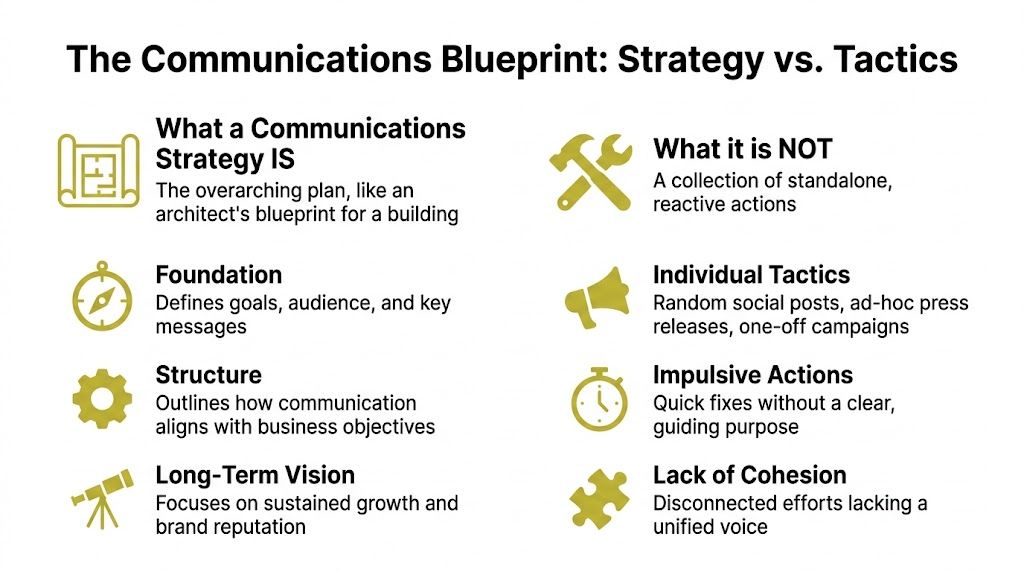
A communications strategy sets the line of travel. It defines what the business needs communications to achieve, which audiences matter most, what those audiences need to hear, and how success will be judged. The communications plan sits underneath it. That is where deadlines, deliverables, owners and campaign activity belong.
For UK SMEs, the distinction matters because resources are tight. In regulated sectors, the cost of inconsistency is higher still. A health, legal, financial or B2B tech firm cannot afford one message in a sales deck, another in the press, and a third on social. High-growth businesses have a different version of the same problem. Teams scale quickly, channels multiply, and message drift creeps in before anyone notices.
What it is
At its simplest, what is a communications strategy? It is a decision-making framework for business communication.
It connects communications to commercial reality. That usually means growth, reputation, recruitment, investor confidence, customer retention, change management, or risk reduction. It also forces choices. Not every audience deserves equal attention. Not every channel needs a budget. Not every piece of content should be created just because a competitor is doing it.
A useful strategy answers five practical questions:
- What business outcome are we supporting?
- Which audiences matter most right now?
- What should each audience understand, believe or do?
- Which channels fit the audience, message and budget?
- How will we measure whether the work is working?
Those questions sound simple. They are. The hard part is being disciplined enough to answer them clearly.
I have seen businesses with decent products waste six months because nobody settled the basics. The founder wanted authority in the trade press. The sales team wanted lead generation content. HR wanted culture messaging. All valid goals. None were prioritised, so the output became diluted and performance was hard to judge.
What it is not
A communications strategy is not a content calendar, a channel list, or a pile of activity.
Posting three times a week is not a strategy. Sending press releases when news appears is not a strategy. Running paid social because organic reach is weak is not a strategy. Those are tactics. They may be useful, but only if they serve a defined objective.
It also is not a branding workshop dressed up as strategic work. Attractive language about vision and tone has limited value if nobody can connect it to customer behaviour, reputation outcomes or pipeline quality.
Many SMEs frequently lose time. Activity feels productive, especially in founder-led businesses under pressure to show momentum. But output without a clear strategic thread creates familiar problems: mixed messages, duplicated effort, weak recall, and teams arguing about channels instead of results. The same discipline sits behind strong media relations strategy and execution. Start with the story, the audience and the purpose. Then choose the tactic.
Practical rule: If a proposed campaign, channel or message cannot be explained in one sentence linked to a business goal, it needs reworking or dropping.
The trade-off leaders need to accept
Strategy does take time upfront. That is the honest trade-off.
For a small business, that can feel uncomfortable. Founders often want immediate output because the pressure is immediate: leads need to come in, investors need updates, and competitors are visible. But skipping strategy usually creates slower execution later. Copy gets rewritten, campaigns drift, agencies receive conflicting briefs, and internal teams pull in different directions.
Good strategy speeds up the right work. It gives the business a filter for decisions under pressure. If a channel fits the audience, the message supports the goal, and the result can be measured, it moves. If not, it waits.
That is what a communications strategy is for. It does not add theory. It reduces waste, sharpens judgement and gives a growing business a more reliable way to communicate.
The Five Core Components of a Powerful Strategy
A communications strategy only works if it can guide decisions under pressure. That means it can’t stay vague. It needs structure.
A useful framework comes from the standard five-part model of objective-setting, audience segmentation, channel selection, content planning and performance measurement, set out in this overview of communication strategy fundamentals. For SMEs, that structure matters because limited time and budget leave little room for guesswork.
Objectives and key messages
Start with the business outcome, not the content output.
If the leadership team says, “We need more press coverage,” that’s still too low-level. Ask what the coverage is supposed to achieve. Better quality leads? Increased trust with investors? Support for recruitment? Reassurance during change? A strategy should tie communications to an outcome the business values.
SMART thinking helps here, but don’t let the acronym make the work feel bureaucratic. The main point is discipline. A strong objective is specific enough to guide action and narrow enough to measure.
Then come the key messages. At this stage, many firms either overcomplicate or oversimplify. They produce long blocks of copy nobody remembers, or slogans so airy they say nothing. The best approach is often a message house:
- Core message: The central idea you want every audience to retain.
- Supporting pillars: The proof points that make the core message credible.
- Audience adaptation: A version of the same story shaped for customers, media, staff, regulators or investors.
If those pieces contradict each other, the strategy is already off course.
Target audience
SMEs often define audience too broadly. “Business owners.” “Consumers.” “Hospitality brands.” That’s not enough to make channel or message decisions.
A useful audience definition includes role, pressure point, motivation and likely objection. A founder raising investment and a procurement lead buying services may both read the same article, but they care about different details. One wants confidence in leadership and trajectory. The other wants clarity, reliability and evidence of delivery.
Questions worth asking include:
- What does this audience already believe about us?
- What are they sceptical about?
- What information would help them act?
- Which sources do they trust first?
- What tone will they respond to?
Audience work is where many communications strategies become sharper overnight. Once you stop writing for “everyone”, relevance improves.
Channels and tactics
Pick channels based on audience behaviour and business need, not fashion.
If you need credibility in a regulated sector, broadcast interviews, trade media, founder briefings and tightly managed website content may matter more than chasing viral clips. If you need search visibility for a service-led business, SEO-led content and social distribution may do more than broad awareness activity. If you need internal alignment during a sensitive period, direct briefings beat polished public posts.
A cross-channel approach usually works better than relying on one platform alone. The same communication strategy resource linked above argues for combining channels rather than overcommitting to a single one, and that matches what most experienced teams see in practice.
For businesses trying to connect PR with digital execution, this look at PR and social media is useful because it shows how one channel can amplify another instead of competing with it.
Strong strategy doesn’t ask every channel to do the same job. It gives each one a role.
Content planning and timing
Content planning is where strategy becomes visible.
This is not just a monthly calendar. It is the decision about which stories deserve emphasis, what proof supports them, when they should land, and how they connect to key moments in the business. Product launch, funding round, recruitment drive, event season, regulatory change, crisis exposure, partner announcement. These moments should not arrive as surprises to the comms function.
Timing matters as much as message. A good story released at the wrong moment can disappear. A weak story sent on the perfect day still stays weak.
Useful planning prompts include:
- Which story themes will we own this quarter?
- What proof, commentary or case material do we already have?
- What assets do sales and leadership need from communications?
- Where are the pressure points that require pre-approved messaging?
Measurement and review
If a strategy can’t be reviewed candidly, it isn’t finished.
Measurement should be built in at the start. Otherwise teams fall back on easy numbers that flatter rather than inform. Open rates can be helpful. Reach can be helpful. Coverage volume can be helpful. None means much on its own.
Look for evidence that communications changed something relevant. Did the right people engage? Did journalists use the intended message? Did inbound conversations improve in quality? Did stakeholders understand the issue faster? Did a key audience move from uncertainty to confidence?
Review cadence matters too. Quarterly works well for many SMEs because it is frequent enough to spot drift without creating panic over every weekly fluctuation. Annual strategy with no in-year review often becomes stale. Endless daily tinkering becomes noise.
The five components are simple on paper. The challenge is keeping them connected. Objectives shape messages. Messages depend on audience insight. Audience insight determines channels. Channels affect content format and timing. Measurement tells you whether the whole thing deserves to continue.
Building Your First Communications Strategy A Simple Template
The first version doesn’t need to be fancy. It does need to be usable.
Most SME owners don’t need a forty-page strategy deck. They need a working document that helps them make better decisions this month, this quarter and during the next difficult moment. The most practical version is usually question-led and short enough that the leadership team will read it.
Research on strategic communications points to the value of reliable data, structured feedback mechanisms and regular measurement cycles, especially when organisations need to adjust channels and content over time. It also notes that pre-defined crisis communication plans reduce confusion and build trust, which is why preparation matters before anything goes wrong, as outlined in this piece on strategic communicator insights.
A one-page template that works
Use these prompts.
| Component | Goal / Question | Example for a Tech SME | Sample KPI |
|---|---|---|---|
| Objective | What business outcome must communications support? | Strengthen investor-readiness ahead of UK expansion | Investor meeting requests |
| Audience | Who most needs to understand and trust the business? | Early-stage investors, tech journalists, strategic partners, future hires | Quality of inbound enquiries |
| Key messages | What three points must stay consistent? | Clear market need, credible leadership, commercially useful product | Message pull-through in coverage and conversations |
| Channels | Where will those audiences actually engage? | LinkedIn, targeted media outreach, founder interviews, website thought leadership, email briefings | Engagement from target audiences |
| Content plan | What stories and proof will we publish? | Founder commentary, product explainers, customer problems solved, hiring updates, sector insights | Response to priority content themes |
| Measurement | How often will we review and adapt? | Monthly dashboard, quarterly review, feedback after key announcements | Improvement in lead quality and stakeholder responses |
| Crisis readiness | What do we say if scrutiny lands? | Holding lines, spokesperson roles, approval route, legal escalation | Speed and clarity of response |
That table is enough to start if the thinking behind it is sound.
The questions that sharpen the draft
A first strategy usually improves when someone pushes back on weak wording. If you write “increase awareness”, ask among whom. If you write “build credibility”, ask with what proof. If you write “use social media”, ask why that channel beats the alternatives.
These are the questions worth keeping on the page:
- What business change are we supporting?
- Which audience matters first, not eventually?
- What does that audience need from us to move forward?
- What evidence makes our claim believable?
- Which channels deserve focus, and which ones are distractions?
- How will feedback change the strategy next quarter?
Build in listening, not just broadcasting
One of the easiest mistakes is treating a communications strategy like a publishing machine. It isn’t. You need listening loops.
That can be as simple as tracking recurring sales objections, media questions, client FAQs, investor feedback and internal concerns after major announcements. Those signals often reveal where the strategy is weak. If journalists keep misunderstanding the offer, the messaging may be too broad. If prospects like the content but still ask basic credibility questions, proof is missing. If staff interpret a change differently from leadership, internal and external messages may be out of step.
A strategy becomes useful when it helps you respond consistently, not when it produces more documents.
For regulated or exposed businesses, add one more page. Who approves statements, who speaks on record, what happens if a journalist calls unexpectedly, and when legal review is needed. In a crisis, clarity beats creativity every time.
Common Pitfalls That Undermine Your Communications
Monday starts with a customer complaint on LinkedIn. By lunchtime, sales is using one explanation, the founder is giving another, and the website still says something else. Nothing is technically broken, but trust starts slipping fast. That is how weak communications usually show up in SMEs. Not as one dramatic failure, but as a series of small inconsistencies that make the business look less credible than it is.

For UK SMEs, especially in regulated sectors or businesses growing faster than their processes, these problems are common. Time is tight. One person may be covering PR, content, social, internal updates and customer messaging. Under that pressure, teams default to activity. They publish, react, post and respond. What they do not always do is decide what each communication needs to achieve, who needs to hear it first, and what proof will stand up if someone challenges the claim.
The mistakes that show up most often
A frequent mistake is treating one channel as the strategy. LinkedIn can be useful. Trade press can be useful. Email can be useful. None of them can do the job of strategy on their own. Channel choice comes after decisions about audience, message, evidence and priority.
Another problem is message inflation. I see this often in high-growth firms that want to look bigger, safer or more advanced than they can yet prove. The copy sounds polished, but it avoids specifics. Journalists spot that quickly. So do buyers doing due diligence, procurement teams comparing suppliers, and investors looking for gaps between the story and the substance.
Crisis planning is often missing too. That matters more than many founders expect. In healthcare, finance, legal services, property, education and B2B tech, scrutiny can come from clients, regulators, staff or the press with very little warning. If nobody knows who approves a statement, who speaks externally, or what can be said without legal review, response time slows and risk goes up.
What poor strategy looks like in practice
These are the warning signs I would act on early:
- Tactic-first planning: The team commissions content, media outreach or social posts before agreeing what business result they need to influence.
- Audience blur: Prospects, partners, investors, staff and regulators all get roughly the same message, even though each group needs different information.
- Thin proof: Claims are broad, but case studies, data, client examples, certifications or expert commentary are missing.
- No response structure: There is no holding statement, no spokesperson preparation and no clear approval route when criticism lands.
- Vanity reporting: The dashboard shows reach, impressions and engagement, but not qualified leads, sales conversations, referral interest or changes in sentiment.
- Split voice: The founder sounds one way, sales another, and the website a third.
The opposite mistake shows up as well. Some teams write long strategy documents full of abstract language that never influence a press reply, campaign brief or stakeholder update. If the plan cannot help the team make a better decision on a busy Tuesday, it is not doing its job.
For teams that need a practical planning structure around goals, audiences and channel choices, this marketing strategy planning template is a useful starting point.
Why newsroom discipline helps
Newsrooms train people to pressure-test a story before it goes public. That habit is valuable in business communications.
A former journalist will usually ask sharper questions earlier. What is the claim? What proves it? Where is the vulnerability? What would a sceptical customer, trade reporter or regulator ask first? Those questions save time because they expose weak messaging before it becomes a public problem.
If your claim will not survive a sceptical phone call from a reporter or producer, it is not ready.
That approach is particularly useful for SMEs with limited margin for error. If you do not have a large brand budget to absorb confusion, every message needs to work harder. It needs to be clear, defensible and aligned with a commercial goal. That is what keeps communications from becoming noise.
Measuring Success What KPIs Actually Matter for Growth
Monday starts with a flurry of activity. A trade title covers your announcement, LinkedIn numbers jump, the sales team says “good response,” and by Friday the founder asks a fair question: what did any of that do for the business?
That is the point where many UK SMEs get stuck, especially in high-growth or regulated sectors where communications has to do more than create noise. It has to support revenue, trust and decision-making. A summary on Sociabble about communication strategy and measurement cites a wider SME measurement gap, including claims that many businesses struggle to quantify communications impact and very few connect earned media with SEO or conversion outcomes in a disciplined way. The source for that summary is Sociabble’s article on communication strategy, so treat those figures as secondary reporting rather than a primary industry dataset.
The practical fix is simple. Measure communications against business movement, not platform activity.
Start with outcomes the board would care about
A dashboard full of reach, clicks and impressions can look busy while telling you very little. In my experience, the stronger starting point is a commercial or reputational outcome, then a short list of KPIs that show whether communications helped produce it.
For an SME, that usually means asking:
- Did the right audience pay attention?
- Did they understand the message we needed them to understand?
- Did trust increase, hesitation reduce, or the sales conversation get easier?
- Did they take an action with business value?
Those actions vary by sector. In SaaS, it may be demo requests from the right ICP. In a regulated service business, it may be enquiries from qualified buyers who mention the exact proof points you pushed in media and content. In B2B manufacturing, it may be distributor conversations, specification requests or shorter sales cycles after targeted trade coverage.
The KPIs that deserve space on the report
The right measures depend on the job communications is doing. These tend to stand up better than vanity metrics.
| Goal | Useful KPI examples | Why it matters |
|---|---|---|
| Brand visibility | Branded search volume, direct traffic to priority pages, share of voice in relevant trade coverage, referral traffic from earned media | Shows whether awareness is building among people already looking for a solution like yours |
| Lead generation | Enquiries from target sectors, demo requests, contact form quality, assisted conversions from campaign content | Connects communications work to pipeline, not just attention |
| Reputation | Message pull-through in coverage, sentiment in stakeholder feedback, quality of inbound questions, response time and accuracy during scrutiny | Tests whether people understood and trusted what was said |
| Recruitment and retention | Quality of applicants, application source, employee feedback on strategic updates, engagement with leadership communications | Useful for businesses competing for scarce talent |
| Investor or partner confidence | Meeting requests, follow-up questions after announcements, visits to proof-heavy pages, time spent on case studies or compliance pages | Indicates whether serious decision-makers found the story credible |
One more point matters here. Digital and PR teams should not measure in silos. If a podcast appearance lifts branded search, if trade coverage improves conversion on a landing page, or if founder commentary drives stronger retargeting audiences, the reporting should show that chain clearly. Good SMEs do not need more data. They need cleaner cause and effect.
What to stop treating as proof
Likes, impressions and follower growth have a place. They are supporting signals.
They do not prove that the audience was commercially relevant, that the message was understood, or that trust improved. The same caution applies to crude earned media valuation models. A big number attached to a press mention might make a report look tidy, but it rarely helps a founder decide where to invest next.
A better test is more demanding. Did the coverage include the message you needed? Did it appear in an outlet your buyers, partners or regulators respect? Did it create a measurable next step?
For social and owned channels, it helps to track a smaller set of customer engagement metrics that connect attention with action, rather than reporting every available number because the platform offers it.
Good measurement answers one question clearly: what changed, and why does it matter?
Use a reporting rhythm your team will actually maintain
Monthly reporting works for operational visibility. Quarterly review works for judgement.
That split matters for resource-constrained SMEs. A live monthly view should track a handful of indicators such as branded search, target enquiries, assisted conversions, message pull-through and referral traffic from earned media. The quarterly review is where you examine patterns. Which topics generate qualified interest. Which spokespeople get quoted accurately. Which campaigns attract the wrong audience and waste follow-up time.
That is how communications earns its budget. Not through inflated activity reports, but through evidence that it helped the business win attention from the right people, build trust faster and create better commercial conversations.
When to Hire an Agency The Carlos Alba Media Advantage
There comes a point where doing communications in-house starts costing more than it saves. Not always in money. Often in missed opportunities, avoidable errors and weak execution.
That point usually arrives when the business needs more than content production. It needs judgement. National media exposure. Stronger message discipline. Better crisis readiness. A clear line between what can be said, what should be said and what should wait. That’s senior communications work, and many SMEs don’t need it full time but do need it at key stages.

The trigger points are usually obvious
Consider external support when any of these are true:
- You’re entering a higher-stakes market: National media, investors, regulators or major partners now influence growth.
- You work in a regulated or exposed sector: A weak statement or untrained spokesperson can create outsized problems.
- You need joined-up PR and digital thinking: Coverage, search visibility, content and conversion can’t sit in separate silos.
- You’re too close to the story: Founders often need an outside view to simplify the message and remove assumptions.
- A tough moment is approaching: Restructure, complaint, legal sensitivity, funding pressure or public scrutiny requires calm preparation.
An experienced agency should bring pattern recognition. It should know what reporters ask next, what stakeholders notice first and where messaging commonly breaks down.
Why specialist background matters
Carlos Alba Media has a clear advantage. The agency is Scottish-led, works across London and Glasgow, and brings senior-level counsel without big-agency overheads. In addition, its DNA is unusually practical. Everyone at Carlos Alba Media is either a former national news journalist or has agency experience working with international brands.
That matters because communications is not only about creativity. It is about judgement under pressure.
Former national journalists understand deadlines, scrutiny, what makes an angle stand up, and how a weak line can unravel on air or in print. Agency operators with international brand experience understand consistency, campaign execution and measurable performance across channels. Put those together and SMEs get a partner that can handle reputation, visibility and conversion in the same conversation.
If you want a broader view of the kinds of signals that reveal whether audience response is improving, this guide to customer engagement metrics is a useful companion read. It helps frame which interactions suggest real interest rather than surface-level attention.
The practical value for SMEs
For a growing business, that blend is difficult to build internally. You might have a strong marketer but no media operator. Or a capable PR freelancer but no digital strategist. Or a founder doing spokesperson duties without training. An agency with newsroom instincts and modern marketing fluency closes those gaps faster.
The right agency should make your communications simpler, sharper and easier to prove.
That is especially valuable for SMEs that need national exposure, media training, web and content performance, or crisis management tied to legal reality rather than vague reassurance. In those moments, you don’t need more output. You need experienced counsel.
If your business needs a communications strategy that can survive scrutiny and drive measurable growth, speak to Carlos Alba Media. The team combines former national news journalists and experienced brand-side operators to help SMEs and established organisations sharpen their message, secure meaningful coverage, strengthen digital performance and prepare for the moments that matter most.