
Most advice on press releases writing starts in the wrong place. It starts with format.
That’s backwards.
A journalist doesn’t care whether your boilerplate is polished if the story itself isn’t worth opening. On a live newsdesk, no one rewards effort. They reward relevance, speed, clarity and trust. If your release reads like marketing copy dressed up as news, it gets binned.
The reason press releases still matter is simple. The form was built for urgency and accuracy. The modern press release was born from a crisis. On 28 October 1906, Ivy Lee wrote one to give direct, factual information about a fatal Pennsylvania Railroad train crash, and The New York Times printed it verbatim, setting the standard for transparent communication that still shapes media expectations today (history of the press release).
That original lesson hasn’t changed. The strongest release is not the loudest one. It is the one that makes a busy editor think, “I can use this.”
Why Most Press Releases Fail and How Yours Won't
Most failed releases are not unlucky. They are misjudged before the first sentence lands.
They fail because someone treated the job like brand promotion when the recipient needed a usable news item. Newsrooms don’t exist to validate a company’s self-image. They exist to sort signal from noise, fast.
What a newsroom actually sees
A release arrives in an inbox already competing with dozens of others. The editor scans the subject line, the first line, maybe the second. If it opens with adjectives, mission statements or “we are delighted”, it has already lost momentum.
The common errors are predictable:
- Marketing language first: “Leading”, “cutting-edge”, “groundbreaking” and similar filler tell a journalist nothing.
- No real angle: The sender knows why the company cares, but hasn’t explained why readers would.
- Buried facts: The actual development sits in paragraph four after scene-setting nobody asked for.
- Weak proof: Claims appear with no verifiable detail, no named spokesperson with authority, and no context.
- Too much copy: If it rambles, it won’t be rescued.
A useful companion list of common press release mistakes to avoid is worth keeping nearby because many weak releases repeat the same avoidable habits.
The fix is not cleverer copy
The fix is a change in mindset. Stop writing as the brand. Start writing as the reporter who may need to turn your material into a story quickly.
That means asking different questions:
- What is new here?
- Why now?
- Who does it affect?
- What can be verified immediately?
- What would an editor lift from this without rewriting half of it?
Practical rule: If your first paragraph sounds like a website homepage, it isn’t a press release yet.
What works instead
Good press releases writing respects the reader’s workload. It gets to the point early, uses plain English, and gives the editor enough to act without making them work to uncover the story.
That usually means:
| What fails | What works |
|---|---|
| Brand-led opening | Fact-led opening |
| Vague claims | Specific, checkable detail |
| Corporate tone | Neutral newsroom tone |
| Long intro | Immediate angle |
| Generic quote | Quote with judgement or implication |
Journalists aren’t hostile to releases. They are hostile to wasted time.
If you make the story easy to see, easy to trust and easy to use, your odds improve quickly. That’s the entire game.
The Newsworthiness Litmus Test Before You Write a Word
Most companies don’t have a writing problem first. They have a judgement problem.
Before drafting anything, test whether the announcement belongs in a press release at all. Some updates should go on your website, in a client email, or on LinkedIn. A release is for information with a credible claim on editorial attention.
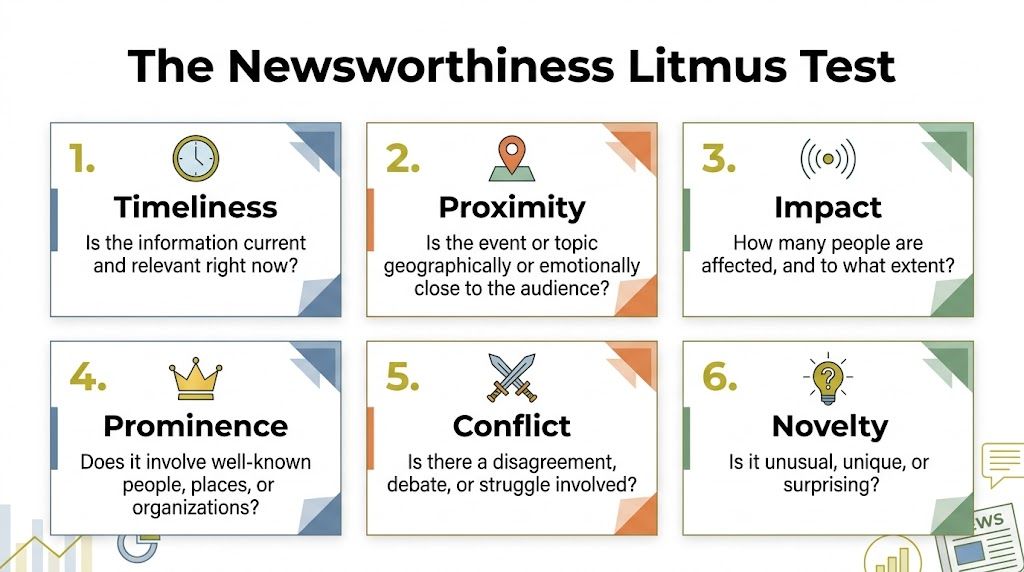
Ask six hard questions
Use this test before you touch the headline.
Timeliness
Is this happening now, or tied to something happening now? A launch next quarter is not news today unless there’s a current reason it matters.Proximity
Why should this outlet’s audience care? Geography matters, but so does emotional proximity. A local employer, a regional policy shift, or a problem people recognise can create relevance.Impact
Does this affect customers, staff, suppliers, investors, a community, or a wider sector? Impact does not have to be national to be strong.Prominence
Does the story involve a recognisable person, brand, institution or partner? This can strengthen a marginal angle, but it won’t save a weak one.Conflict
Is there tension, challenge, scrutiny, risk, or a decision under debate? Conflict often sits underneath business stories even when clients try to smooth it away.Novelty
Is there something unusual here? A first, a change, a reversal, a response, a smart workaround, or a surprising result.
If you only have one weak answer, stop
A routine hire with no wider angle is not usually a press release. A feature update with no customer relevance is not usually a press release. An anniversary with no fresh hook is often just internal comms wearing a suit.
A stronger approach is to rebuild the angle around a real consequence.
Compare these two:
- “Firm launches new booking platform”
- “Scottish hospitality firm launches booking platform designed to cut guest friction during peak tourism periods”
The second still needs evidence, but at least it points to a public-facing reason for the story.
A release doesn’t need to be dramatic. It does need to matter to someone beyond the sender.
Regional angle matters more than most founders realise
For Scottish businesses, this matters even more. UK media has a London-centric bias, and press releases from Scotland receive 35% less pickup, while hyper-local angles tied to Scottish economic policies can boost regional coverage by 40% (regional press release angle data).
That changes how you frame the story.
A founder in Glasgow pitching a national tech trend with no regional hook may struggle. The same founder linking a launch to Scottish hiring, tourism demand, public policy, infrastructure, or local supply chains gives an editor a clearer reason to care.
A working filter for SMEs
Use this quick decision table before drafting.
| If your announcement is… | Better route |
|---|---|
| Minor internal update | Website news post |
| Promotional offer | Marketing campaign |
| Thoughtful response to an industry shift | Comment pitch or bylined article |
| New partnership with local relevance | Press release |
| Crisis response or correction | Press statement or release |
| Award with wider sector significance | Press release with targeted outreach |
How to find the angle
The angle is rarely the company action alone. It is usually one of these:
- A problem solved: What friction, delay, cost or risk does this change address?
- A consequence: Who benefits, who loses, who has to adapt?
- A regional tie-in: Why is this especially relevant in Scotland, London, or a specific local market?
- A timing hook: Why today, not six weeks ago?
- A human face: Which founder, customer or expert can explain the stakes plainly?
If you can’t answer those cleanly, don’t write the release yet. Interrogate the story first.
The shortest honest test
Write one sentence beginning with: “Its relevance is clear because…”
If the sentence turns into slogan language, the angle is weak.
If it turns into a verifiable public-interest point, you probably have something worth sending.
Anatomy of a Press Release That Journalists Actually Read
A usable release is built like a clean news story. It doesn’t tease. It doesn’t wander. It gets the important material to the top and keeps the rest in descending order of value.
That discipline matters because UK journalists receive over 50 pitches a week and reject 82% of them, often because they are too promotional or too long. Releases under 300 words that lead with hard facts see a 4x higher pickup rate (press release structure and pickup data).

The headline does one job
The headline is not an ad. It is a clean summary.
Good:
- Scottish software firm launches compliance tool for hospitality operators
- Glasgow manufacturer expands into London after retail contract win
Weak:
- Award-winning innovator unveils game-changing future of compliance
- Exciting new chapter for leading Scottish business
The strong version names the action. The weak version asks the reader to trust your enthusiasm.
Your first paragraph carries the release
If the top paragraph fails, the rest rarely gets read.
Include the essential facts immediately:
- who
- what
- where
- when
- why it matters
Keep it tight. Short sentences help. Specific nouns help more.
A working example:
Glasgow-based travel tech company Northline today launched a booking management platform for independent hotels, aimed at simplifying reservation handling during peak visitor periods across Scotland.
That gives the editor something to work with. It isn’t flashy, but it is functional.
Structure it like an editor would
The inverted pyramid remains the most practical model for press releases writing.
- Lead with the news
- Add the important support
- Insert context and implications
- Close with boilerplate and contact details
If the final two paragraphs vanished, the story should still stand.
For a broader explanation of how this fits within earned coverage strategy, this primer on what media relations is is useful.
What belongs in the body copy
After the lead, every paragraph should earn its place.
Use the body to add:
- relevant context
- operational detail
- consequences for customers or sector
- one useful quote
- any supporting point that helps the newsroom assess credibility
Do not use the body for:
- long company history
- every product feature
- internal praise
- claims that legal or editorial teams can’t verify
- keyword stuffing
A quick quality check is to remove every adjective and see whether the release still holds up. If not, it’s probably built on spin.
Quotes should sound like a person, not a committee
Most press release quotes are dead on arrival because they say nothing a narrator could not have said more clearly.
A quote should add one of three things:
- judgement
- implication
- forward view
Bad quote:
“We are thrilled to announce this exciting milestone.”
Better quote:
“Independent operators often lose time to fragmented booking systems. We built this to simplify one part of a pressured working day.”
That second quote gives a journalist a line they might use.
Boilerplate signals professionalism
The boilerplate is not the place for reinvention. Keep it stable and factual.
Include:
- what the company does
- where it is based
- sector focus
- any relevant background
Then finish with a real press contact. Name, email, phone. If a journalist cannot quickly reach someone who can answer follow-up questions, the chance may die there.
A short release beats a padded one
Editors do not reward bulk. They reward economy.
Use this rough model:
| Element | What it should do |
|---|---|
| Headline | Summarise the development |
| First paragraph | Deliver the core facts |
| Second paragraph | Add substance or context |
| Quote | Add insight, not fluff |
| Final paragraph | Close with relevant background |
| Boilerplate and contact | Make follow-up easy |
Later in the workflow, a visual walkthrough can help teams train their eye for pacing and structure:
The small cues editors notice
Experienced journalists spot professionalism from tiny signals.
They notice when:
- names, titles and spellings are consistent
- dates are unambiguous
- quotes are attributed properly
- the tone stays neutral
- attachments are not chaotic
- the release can be skimmed in seconds
Newsdesk test: If someone can understand the story from your headline and first two sentences, you’ve given yourself a chance.
That’s what most templates miss. The format matters, but function matters more.
Optimising for Discovery and Smart Distribution
A good release hidden in the wrong place is still wasted work.
Distribution isn’t one tactic. It’s a decision about how broad the story is, how targeted the audience is, and how much context a journalist will need before they act on it.
SEO helps, but only if the release still reads like news
Keyword use in press releases writing should be invisible. If the phrase fits naturally in the headline, intro and one or two body references, that’s usually enough. If every sentence starts sounding like a search query, the editorial value collapses.
Think in terms of searchable clarity:
- name the product, service or issue plainly
- include the place if regional relevance matters
- use the language your audience uses
- avoid internal jargon unless the trade press expects it
A release can support discovery on your own site, in search, and in newsroom research later. It should never sound like it was written for an algorithm first.
Wire or direct pitch
This choice depends on the story.
Use direct outreach when:
- the story needs explanation
- the target list is small and specialist
- the angle should be adapted by outlet
- exclusivity or advance briefing matters
Use a wire when:
- the announcement is formal and broad
- stakeholders beyond journalists need to see it
- you need a clear public record
- the release supports wider corporate or crisis communication
Many SMEs overuse wires and underuse judgement. A wire can distribute. It cannot create relevance.
For businesses trying to improve earned coverage rather than publish announcements, this guide on how to get press coverage is a helpful companion to release planning.
The journalist list matters more than the send button
A tight, accurate media list beats a bloated spreadsheet every time.
Match the release to people, not just publications:
- sector reporter
- regional business editor
- broadcast producer
- trade title editor
- freelance writer who regularly covers your beat
If you’re building lists in-house and need a practical way to locate the right contact details, this resource on how to find someone's email for outreach can save time. The key is to verify relevance before you send anything.
Follow-up etiquette that doesn’t annoy people
Bad follow-up is one of the quickest ways to damage future opportunities.
Use this standard:
| Follow-up move | Keep it | Cut it |
|---|---|---|
| Short email adding one useful line of context | Yes | |
| Asking if they saw your release five minutes after sending | Yes | |
| Offering interview access or asset support | Yes | |
| Re-sending the full release repeatedly | Yes | |
| Calling a newsroom without a real reason | Yes | |
| Tailoring a note to an outlet’s patch | Yes |
A good follow-up adds value. It might offer a spokesperson, clarify a local angle, or point to a timely hook. A bad one just asks for confirmation that your email exists.
Senders often think persistence proves seriousness. Journalists usually read it as extra admin unless the follow-up contains new value.
Timing and packaging
A release should arrive in a form that is easy to process:
- clean subject line
- paste key text into the email body
- include links to assets rather than huge attachments when possible
- make the contact person available
- flag embargoes clearly if relevant
Then be realistic. Even strong stories can miss on a busy day. Distribution is not a vending machine. It is the part of the job where targeting and timing either support the story or sabotage it.
Measuring Success and Leveraging Your Coverage
A release that generates coverage has done only half its job.
The fundamental question is whether that coverage changed anything that matters to the business. Too many teams stop at counting clippings, then wonder why PR feels busy but hard to value.

Start with business outcomes, not vanity metrics
A placement in a respected outlet can be useful. Ten weak mentions may be less useful than one strong one.
Measure against outcomes such as:
- Referral traffic: Did the coverage send visitors to the right page?
- Lead quality: Did inbound enquiries improve after publication?
- Sales support: Did the coverage help your team build trust in live conversations?
- Brand credibility: Can you now point to third-party validation in a category where trust matters?
- Search footprint: Did your owned content gain extra visibility around the topic?
A practical way to support this is to connect PR activity with your wider digital reporting stack. If your team is already investing in visibility and conversion, these online public relations services show how earned media, content and search can work together.
Squeeze value from every good hit
Coverage should not disappear after one LinkedIn post.
Use it across:
- sales decks
- investor materials
- website trust sections
- founder outreach
- speaker bios
- recruitment pages
- email nurturing sequences
If the story appeared in a strong publication, extract the central proof point and put it where buyers and partners make decisions.
Learn from misses without guessing
When a release gets little traction, don’t default to “journalists ignored us”. Diagnose it.
Ask:
- was the angle newsworthy?
- was the intro too soft?
- did the list match the story?
- did we send at a bad moment?
- did the quote add anything?
- was there enough proof to trust the claim?
Editorial reality: A failed release is often useful data. It shows whether the issue was story judgement, execution, or targeting.
Build a simple post-campaign review
A short debrief is enough if it is honest.
| Review question | What to note |
|---|---|
| Which outlets engaged? | Relevance of the angle |
| Which lines got picked up? | What wording resonated |
| Which links were clicked? | What readers wanted next |
| Which follow-ups worked? | What kind of added context helped |
| What stalled coverage? | Missing proof, timing, or poor fit |
Strong PR teams improve because they treat each release as both communication and feedback loop. That’s how coverage turns into a repeatable commercial asset instead of a one-off win.
Press Release Templates and Real-World Examples
Templates are useful only when people understand why each part exists. Copying the shape without understanding the editorial logic usually produces bland copy.
For regulated sectors, the standard has to be higher. Claims must be verifiable, readability scores should exceed 60, and a multi-stage approval process involving legal review can reduce critical errors by 40% (regulated-sector press release rigour).
A clean template you can use
Headline
State the news plainly.
Subheading
Add one line of consequence or context if needed.
Dateline
City, date.
Opening paragraph
Deliver the core news in one tight paragraph. Include who, what, where and why it matters.
Second paragraph
Add the most useful support. This might be operational detail, market context or audience impact.
Quote
Use one spokesperson who can add judgement or practical meaning.
Final body paragraph
Add any final context, availability, timeline or next-step detail.
Boilerplate
Short factual summary of the company.
Press contact
Named person with direct details.
Example one for a Scottish tech startup
Headline
Edinburgh software startup launches compliance platform for independent care providers
Opening paragraph
Edinburgh-based software company Alder Lane has launched a compliance platform designed for independent care providers, with tools intended to simplify record handling and internal reporting across regulated settings.
Why it works
The line tells the editor what happened and who it matters to. It avoids hype and makes the sector relevance obvious.
Second paragraph
The platform is being introduced to help smaller operators manage recurring documentation tasks more consistently and prepare information for inspection and internal review.
Why it works
It explains the practical problem. Editors respond better to operational relevance than product adjectives.
Quote
“Smaller providers often carry the same reporting pressure as larger groups without the same internal resource,” said [Name], founder of Alder Lane. “We built the platform to make one demanding part of the job more manageable.”
Why it works
The quote adds interpretation and human understanding. It does not repeat the lead.
Example two for a hospitality brand
Headline
Highland hotel group recognised with national hospitality award
Opening paragraph
A Highland hotel group has received a national hospitality award following recent investment in guest experience and staff development across its properties.
Why it works
Awards alone can be weak. This version links recognition to business actions and gives the story a little more substance.
Second paragraph
The group said the recognition reflects a wider focus on service consistency, team training and destination-led visitor experience at a time when regional operators are working hard to stand out.
Why it works
It broadens the story beyond self-congratulation and ties it to a wider sector challenge.
Quote
“It is a reflection of the work our teams do every day in front of guests,” said [Name], managing director. “Recognition is welcome, but the fundamental value is the standard it asks us to keep meeting.”
Why it works
The quote sounds like a person. It is restrained and credible.
Final checks before release
Run every draft through this short review:
- Verifiable claims only
- Plain English over internal jargon
- One strong angle, not three weak ones
- A quote that adds meaning
- A real approval path for sensitive sectors
In press releases writing, template discipline helps. Editorial judgement matters more.
Frequently Asked Questions About Press Release Writing
Should a press release ever cover bad news
Yes. Some of the most important releases do. Crisis communication demands speed, accuracy and restraint.
Start with what is confirmed. State what happened, what action has been taken, and who media should contact. Do not pad it with branding language. The more serious the issue, the more damaging spin becomes.
Can AI help write a press release
Yes, but it shouldn’t be left unsupervised. AI can help with first drafts, headline variants, transcription and summarising briefing notes. It cannot be trusted to invent proof, legal nuance or a credible quote.
If you use AI, every factual line needs human verification. Every quote needs a real speaker’s approval.
Should I add images or video
Often, yes, if they are relevant and lawful to use. Multimedia can boost press release engagement by 650%, but 62% of UK SME releases with visuals fail compliance checks under GDPR and ASA rules. AI-generated images or quotes also require clear disclosure (multimedia compliance in press releases).
The practical takeaway is simple:
- use visuals that support the story
- clear usage rights first
- label AI-assisted assets properly
- avoid anything that could mislead journalists or audiences
How long should a press release be
As short as the story allows. If you can make the point cleanly in a few sharp paragraphs, do that. Padding a weak story never strengthens it.
Do journalists still want press releases
Yes, when the release is useful. They don’t want brochure copy. They want something accurate, relevant and easy to turn into coverage.
If you want senior help from people who’ve worked on real newsdesks, Carlos Alba Media brings former national news journalists and agency specialists together to craft press releases that stand up to scrutiny, land with the right outlets, and support wider reputation and growth goals across Scotland, London and beyond.