
A lot of founders hit the same wall. The product is good. Customers who find it tend to stay. The website is live, the LinkedIn page is active, maybe some paid spend is ticking along, yet the business still feels oddly invisible.
You search your own category and see competitors quoted in trade titles, interviewed on podcasts, mentioned in national coverage, and appearing in the conversations that shape buying decisions. Your firm might be better. It just isn’t being seen the same way.
That’s where online public relations services matter. Not as a vanity exercise, and not as a softer cousin of marketing. Done properly, online PR turns expertise into visibility, visibility into credibility, and credibility into commercial momentum. It helps buyers trust you before a sales call, gives journalists a reason to cover you, and gives search engines stronger signals about your authority.
That shift is why PR now sits much closer to growth strategy than many SMEs realise. The global PR market is projected to reach £129 billion by 2026, up from £88 billion (avaansmedia.com). That projection tells you something important. Businesses aren’t investing in PR because it sounds elegant. They’re investing because reputation, reach, search visibility, and trust now move together.
If your current marketing feels like hard work for too little recognition, PR may be the missing layer. If you want a useful primer on the wider visibility challenge before going deeper, this guide on building brand awareness is a sensible place to start.
Introduction From Invisible to Influential
A good SME can stay hidden for years.
That sounds harsh, but it’s true. I’ve seen firms with serious expertise lose attention to louder competitors with better timing, sharper positioning, and stronger media handling. The market doesn’t always reward the best operator first. It often rewards the clearest story.
Why visibility breaks down
Most founders start with sensible instincts. They update the website. They post on social. They sponsor an event. They send a press release when something big happens. Then nothing much follows.
The problem usually isn’t effort. It’s that scattered activity doesn’t create authority.
Online public relations services solve a different problem from paid ads. Ads buy visibility for a period. PR earns attention from sources people already trust. That includes digital news outlets, industry publications, podcasts, newsletters, broadcasters, and influential social channels.
Practical rule: If your message only appears where you paid to place it, buyers treat it like marketing. If it appears where an editor, producer, host, or respected industry voice chose to feature it, buyers treat it differently.
What this changes for an SME
For a founder, strong PR work does four things at once:
- It sharpens your message: Journalists won’t publish waffle. That discipline improves your positioning.
- It raises trust: Third-party coverage carries weight your own website can’t.
- It strengthens search visibility: Good coverage often supports your wider digital footprint.
- It creates sales context: Prospects arrive warmer when they’ve already heard of you.
The firms that benefit most aren’t always the biggest. They’re often the ones that can explain, in plain English, why they matter now.
What Online PR Actually Means in 2026
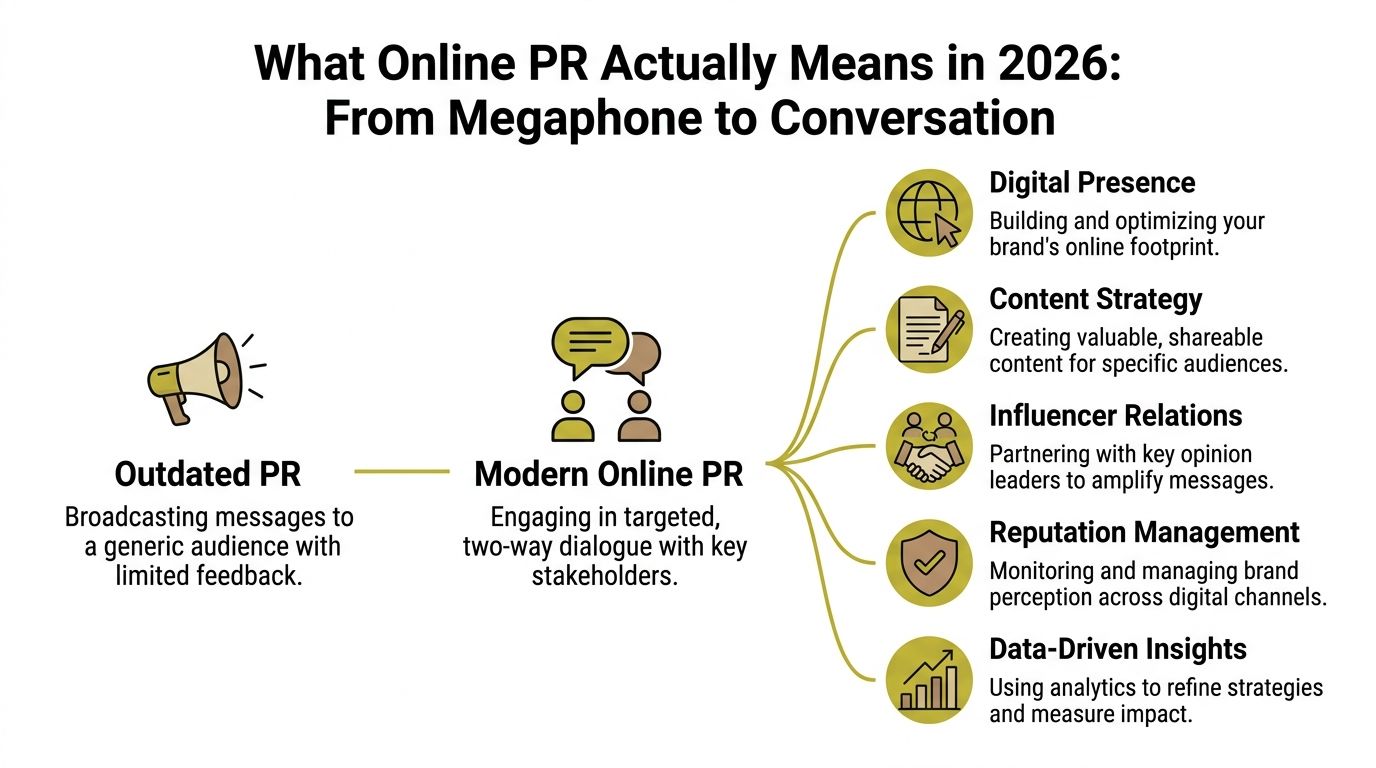
Old PR was a megaphone. You pushed one message out and hoped somebody heard it.
Modern online PR is closer to a radar system linked to a newsroom desk. It listens first, spots movement early, identifies what matters to specific audiences, then sends the right story into the right channel with a reason for someone to care.
It’s not just media outreach anymore
If an agency still treats PR as “writing a press release and blasting it out”, you’re looking at an outdated model.
Modern online public relations services combine several disciplines:
- Story development: finding an angle that fits public interest, business relevance, or sector timing
- Media relations: pitching journalists, editors, producers, and hosts with something usable
- Reputation management: tracking how your brand is discussed and responding when needed
- Search support: earning coverage that helps your authority online
- Audience insight: using data to understand what people are reacting to
- Channel amplification: extending earned coverage through owned and social channels
The UK market has moved decisively in this direction. The UK has seen a 49% increase in search interest for “digital PR” since 2020, with a further 9% growth in the past two years (BuzzStream digital PR statistics). That’s not a niche trend. It signals that UK businesses now see PR as a mainstream part of growth.
What online PR does that advertising can’t
Advertising gives you control. PR gives you credibility.
That difference matters. Buyers know you wrote your ad. They know you approved your website copy. They assume your social posts present your best side. But if a respected journalist quotes you, if a trade publication features your insight, or if a podcast host brings you on to discuss an industry issue, your expertise has been filtered through someone else’s judgement.
That’s why online PR often works well for firms with a complex offer, a long sales cycle, or a trust barrier.
A useful companion read on this point is Fame’s take on B2B public relations strategies, especially if your business sells into considered, committee-led buying environments rather than quick consumer transactions.
Listening is part of the job
The best PR teams don’t start by talking. They start by listening.
That includes monitoring:
- Journalist demand: what reporters are asking for right now
- Market language: the phrases your customers use
- Competitive positioning: who owns the conversation in your niche
- Reputation signals: praise, complaints, recurring misconceptions
- Timing cues: legislation, funding rounds, launches, reports, and seasonal hooks
If your PR partner never talks about listening, they’re probably guessing. If they’re guessing, your media pitch will sound like everyone else’s.
For businesses trying to connect PR with social momentum, owned channels, and audience response, this overview of PR and social media is worth reading.
The Four Arenas of Modern PR Impact
Most SMEs think of PR as one thing. It isn’t. It’s four connected arenas, each with a different job.
If you handle them in silos, results stay patchy. If you connect them properly, one good story can travel much further than the original placement.

Digital media
This is the arena often implied when online PR is discussed.
It covers online news outlets, trade publications, niche industry sites, expert commentary platforms, digital magazines, and newsletter ecosystems. A good placement here can do three jobs at once. It can build credibility, send referral traffic, and support your wider search presence.
What works:
- Original angles: fresh data, a strong founder point of view, real market insight
- Fast response: journalists work to tight deadlines
- Clean assets: quotes, bios, facts, imagery, and a clear spokesperson
- Relevance: one personalized pitch beats a generic media list blast
What doesn’t:
- Corporate sludge: “We are delighted to announce” rarely survives a newsroom
- Mass outreach with no angle
- Stories that matter only to your internal team
Broadcast
Broadcast still matters because it changes perceived stature.
That includes TV, radio, podcasts, streamed interviews, and panel appearances. Founders often underestimate how much a strong podcast interview or radio spot can shape trust. A prospect who hears you answer live questions gets a far better read on your competence than they do from polished homepage copy.
Broadcast also exposes weak spokespeople quickly. If the message is confused, defensive, vague, or too salesy, listeners notice.
A decent spokesperson can explain a difficult issue simply. A strong spokesperson can do it under pressure without sounding rehearsed.
For SMEs in regulated, technical, or high-risk sectors, this arena deserves serious preparation. Media training is not cosmetic. It prevents avoidable mistakes.
Modern print
Print hasn’t disappeared. It has changed function.
A print feature in a respected title still carries weight, especially for premium, regional, or reputation-led brands. But much of the value now often comes from what print triggers next. A newspaper or magazine mention can be repurposed into LinkedIn content, sales collateral, website trust signals, and further digital outreach.
Print also shapes internal stakeholder confidence. Investors, board members, partners, and prospective hires still respond to seeing a business featured in a recognised publication.
The strongest print stories usually have one of these qualities:
- They reflect a wider trend
- They offer a distinctive regional or sector angle
- They include a credible human story
- They arrive with proper editorial discipline
Social and influencer
Many PR plans wobble because businesses mistake volume for influence.
Social and influencer work in PR isn’t just posting links or paying creators. It’s about building a credible conversation around your brand, often by using trusted voices to interpret, discuss, or amplify your story.
In UK digital PR, social listening tools like Brandwatch and Meltwater deliver granular, real-time analytics on brand sentiment and share of voice, which is particularly useful for SMEs and startups in sectors such as Scottish tech and tourism. That matters because modern PR decisions should respond to live audience behaviour, not just campaign calendars.
A well-run social PR approach can help you see:
- Which themes are gathering momentum
- Where confusion about your brand is emerging
- Which journalists, creators, or commentators shape opinion in your niche
- When a small complaint is turning into a bigger reputational issue
If you want a plain-English explanation of the relationship side of this work, this guide on media relations covers the fundamentals well.
Why Your SME Cannot Afford to Ignore Online PR
Founders usually become interested in PR for one of two reasons. They either want growth, or they’ve realised silence has a cost.
Both are valid. A business that no one credible talks about has to work harder in every sales conversation.
PR reduces friction in the buying journey
When online public relations services are doing their job, buyers don’t meet your business cold.
They’ve seen your founder quoted. They’ve noticed your company in a sector title. They’ve heard your name on a podcast. They’ve searched you and found third-party coverage instead of just your own sales pages.
That changes the tone of the first conversation. Less time goes on proving you’re legitimate. More time goes on solving the buyer’s problem.
It gives you better measures than vanity metrics
A lot of weak PR reporting hides behind impressions. Impressions have their place, but they don’t tell a founder much about business impact.
UK digital PR measurement frameworks now focus on share of voice, branded search lift, and assisted conversions, connecting PR activity more directly to pipeline growth. That’s the right shift for SMEs because it moves the conversation away from “how many people might have seen this?” to “did this increase visibility among the people who matter, and did it influence action?”
Here’s what those measures mean in practice:
- Share of voice: how much of the relevant category conversation your brand owns compared with competitors
- Branded search lift: whether more people are actively searching for your business after coverage or campaigns
- Assisted conversions: whether PR played a role before an enquiry, demo request, booking, or sale
Commercial test: If your PR report can’t explain what changed in awareness, search behaviour, or conversion paths, it isn’t finished.
It supports other functions inside the business
PR is rarely just about leads.
It can help recruitment by making your firm look credible to senior hires. It can help partnerships because potential collaborators can see evidence of market relevance. It can help investor conversations because external validation lowers perceived risk. It can also steady a business during uncertainty by making sure your side of the story is available and visible.
The alternative is usually more expensive
If you ignore PR, you don’t avoid the need for reputation. You just outsource it to chance.
Then your brand is defined by scattered reviews, a thin search presence, competitor noise, and whatever people infer from the absence of coverage. That leaves marketing carrying too much weight and sales having to manufacture trust from scratch.
For a founder watching budgets carefully, the useful question isn’t “Can we afford PR?” It’s “How long can we afford to stay hard to trust?”
Choosing Your PR Partner Service Models and Pricing
PR buying goes wrong when founders purchase the wrong model, not just the wrong agency.
Some businesses need a steady drumbeat. Others need a short, focused burst around a launch, funding event, or reputational issue. Many need something in between.
The three common models
The structure matters because it shapes how your agency thinks, plans, and allocates senior time.
| Model Type | Typical Cost (UK) | Best For | Key Advantage |
|---|---|---|---|
| Monthly retainer | Varies by agency, scope, and seniority | SMEs needing ongoing visibility, reputation support, or regular media engagement | Consistency and relationship-building over time |
| Project-based fee | Varies by launch, campaign size, and deliverables | Product launches, events, funding announcements, reports, or defined campaigns | Clear scope and short-term focus |
| Hybrid model | Varies depending on the retainer base and add-on projects | Firms that need baseline support plus occasional campaign pushes | Flexibility without starting from zero each time |
What each model feels like in practice
A monthly retainer suits businesses that want sustained media presence, thought leadership, social listening, and reputation management. It gives an agency room to build momentum, refine angles, and respond quickly when opportunities appear.
The trade-off is commitment. PR rarely performs well if you expect major authority gains from one month of work.
A project model works when the brief is bounded. Launching a new service. Opening a venue. Publishing a report. Entering a new market. It’s useful when the story has a clear beginning and end.
The downside is loss of continuity. Once the project ends, the media engine often stops with it.
A hybrid model is often sensible for SMEs. Keep a lean monthly programme running, then add campaign intensity when needed. That avoids the stop-start pattern that weakens media relationships.
What to ask about pricing
Don’t just ask, “What’s your fee?” Ask what drives it.
Look for clarity on:
- Senior involvement: who does the work
- Scope: strategy, outreach, content, reporting, spokesperson prep, crisis support
- Access: whether you get direct contact with decision-makers
- Responsiveness: especially if an issue breaks outside office hours
- Deliverables: what is produced regularly, and what is extra
A cheaper proposal can cost more if it buys junior account handling, vague reporting, and a recycled media list.
If pricing sounds low but the agency can’t explain who is crafting the story, who is pitching it, and how they’ll measure movement, you’re probably buying activity rather than judgement.
How to Select the Right PR Agency for Your Business
A PR agency isn’t just a supplier. If you choose well, they become an extension of your judgement in public.
That matters because they won’t only handle your good news. At some point, they may shape your response when a journalist calls unexpectedly, a customer complaint catches fire online, or a spokesperson says the wrong thing in public.

Start with the team, not the deck
Agency decks are easy to polish. Teams are harder to fake.
Ask who will lead the account. Ask what newsroom, broadcast, sector, or brand experience they’ve had. Ask whether the people pitching stories have ever sat on the receiving end of hundreds of weak pitches. That perspective changes the quality of the work.
This is one reason specialist firms can be a better fit than broad agencies. At Carlos Alba Media, the model is built around former national news journalists and agency professionals who’ve worked with international brands. That tends to matter when the brief needs editorial judgement rather than generic outreach.
Questions worth asking in the first meeting
Most founders ask about contacts and coverage. Reasonable questions, but not enough.
Ask these instead:
- How would you position our story if you had to pitch it tomorrow?
- What would you stop us saying because journalists won’t care?
- How do you measure impact beyond coverage volume?
- What’s your process when a reputational issue starts on social outside office hours?
- Who signs off messaging in a fast-moving situation?
- What do you need from us each month to make the relationship work?
- How involved will senior people be after the sale?
Those questions expose whether you’re talking to strategists or presenters.
Crisis readiness is not optional
Existing online PR advice often skips a practical problem for SMEs. Many smaller firms need round-the-clock awareness but can’t fund an enterprise-sized crisis team. Yet even one negative social media comment can significantly harm a business, and the need for 24/7 crisis management for resource-constrained SMEs remains underserved (RPR Firm on PR challenges in the digital world).
A good agency should be able to explain a lean, realistic crisis process.
That includes:
- Monitoring workflows: what gets watched, by whom, and when
- Escalation routes: who gets alerted first and how quickly
- Response thresholds: what deserves acknowledgement, correction, or legal review
- Spokesperson control: who can speak publicly under pressure
- Message discipline: one agreed line, not five contradictory ones
If they can’t answer that cleanly, they’re not ready.
A short explainer on media handling can help sharpen your thinking before agency interviews:
Red flags you should take seriously
Some warning signs are obvious. Others hide behind confidence.
Watch for:
- Guaranteed coverage promises: no credible PR professional controls an editor’s decision
- Too much emphasis on press releases: a release is a tool, not a strategy
- No clear measurement language: if they can’t discuss outcomes properly, reporting will be weak
- Junior-only servicing: common, and often expensive in the long run
- Overly broad sector claims: “we work across everything” usually means shallow understanding
- No crisis framework: dangerous for any visible business
Good agencies don’t promise certainty. They promise judgement, preparation, and sharp execution.
Real-World Success Stories from UK Businesses
PR becomes easier to understand when you look at the kinds of situations it solves.
These examples reflect patterns seen across UK SMEs and growth-stage brands. They are illustrative scenarios, not quantified case studies.
A Scottish tech startup that needed authority fast
The challenge was familiar. A strong product, a technical founder, and very little public profile outside existing contacts.
The useful move wasn’t flooding journalists with product claims. It was reframing the company’s expertise around a wider industry issue. Once the story became relevant to market change rather than internal ambition, national and trade interest became much more realistic.
The result was a stronger public footprint, warmer investor conversations, and better-quality inbound interest. The coverage mattered, but the positioning mattered more.
A hospitality brand trying to look premium, not just busy
Hospitality businesses often make the mistake of chasing noise. Offers, events, local buzz, and influencer activity can create attention without building stature.
A better route is coordinated PR. Regional and national features, strong imagery, founder or executive interviews, and disciplined social amplification can make a venue or experience feel established rather than merely active. That’s particularly useful for tourism and lifestyle brands trying to attract visitors, partners, and press beyond their immediate area.
The difference is tone. Premium brands don’t sound desperate for attention. They give editors and audiences a story worth choosing.
An established SME that needed to own its niche
Some firms don’t need broader fame. They need category authority.
For those businesses, thought leadership usually beats generic announcements. Opinion pieces, expert commentary, podcast appearances, and timely reaction to sector developments can turn a capable operator into the name journalists and buyers call first.
That change doesn’t happen because the company suddenly became smarter. It happens because the market can now see expertise in public.
What these stories have in common
They weren’t built on PR stunts.
They worked because someone answered four basic editorial questions properly:
- Why this business
- Why this story
- Why now
- Why would anyone outside the company care
Founders who can answer those clearly are already halfway to a stronger PR programme.
Your Next Steps to Building a Powerful Online Presence
Most SMEs don’t need louder marketing. They need clearer authority.
That’s a key value of online public relations services. They help your business appear in the places that shape trust, not just the places you control. They also force a discipline many firms avoid. What’s the actual story? Why does it matter now? Who needs to hear it first?
Start with a simple audit
Before you speak to any agency, check the basics.
- Search your brand name: what appears on page one
- Review your founder visibility: are your views visible anywhere credible
- Check your latest news section: does it read like marketing filler or real updates
- Look at your social footprint: does it support your authority or dilute it
- Assess your spokesperson readiness: could your senior team handle an interview tomorrow
If podcast appearances are part of your channel mix, this guide on how to grow your podcast is a useful practical resource because PR and podcast strategy often reinforce each other when handled well.
Choose discipline over noise
A small number of sharp stories beat a large number of forgettable announcements.
Good PR rarely starts with “we need coverage”. It starts with “we need the right people to understand what we do, trust us faster, and remember us when it counts.”
That’s the standard worth aiming for. Not buzz. Not vanity. Not a monthly pile of clippings with no commercial meaning. Just a stronger public presence that helps the business move.
If you want to review your current visibility, message, and media readiness, Carlos Alba Media offers PR and digital marketing support for SMEs, start-ups, and established organisations across Scotland and the wider UK, with services spanning media relations, digital strategy, and crisis communications.