
You’re probably reading this after one of two experiences.
You hired someone because they “knew social”, posted constantly, made the feed look busier, and gave you monthly reports full of reach, likes, impressions and little else. Or you’re about to hire your first senior social lead and you’re trying to avoid that mistake.
That decision matters more now than it did a few years ago. In the UK, social media users reached around 68 million in early 2025, representing over 97% of the internet user base according to DataReportal. That level of saturation creates two problems for founders. Your customers are there, but so is everyone else. Visibility is no longer a publishing problem. It’s a strategy problem.
Founders don’t need more posting. They need experts in social media who can connect audience behaviour, commercial goals, brand risk and channel execution. That’s a very different hire from a junior content creator or a freelancer who knows how to edit short-form video.
A proper social strategist should be able to think like a marketer, write like a journalist, anticipate like a press officer and report like an operator. In high-stakes sectors such as hospitality, finance and public-facing consumer brands, that mix matters.
Why Your Last Social Media Hire Probably Failed
Monday morning. The numbers look busy enough to reassure a junior team. Posts went out, comments got replies, a few videos picked up views, and the feed looks alive. Then important questions start. Bookings are flat. Lead quality is poor. Compliance has already queried two posts. Senior management wants to know what social is contributing, and nobody can answer with confidence.
That failure usually starts before the hire walks through the door.

Founders say they need “someone to do our social media” and then recruit for visible output. The polished portfolio wins. The candidate who looks sharp on LinkedIn wins. The lower monthly rate wins. Three months later, the channels are active, but the business is no further forward.
That gap is not a posting problem. It is a seniority problem.
Activity hides weak judgement
A feed can look productive while the strategy underneath is thin. Anyone can keep channels moving. Senior social expertise shows up somewhere else. It shows up in message discipline, channel choice, risk judgement, audience targeting, escalation handling, and knowing when social should support sales, PR, recruitment, reputation, or customer retention.
In agency work, this is the pattern I see repeatedly. Businesses hire for execution when they need judgement. That mistake is expensive in hospitality, where timing, reviews, and local reputation can affect demand fast. It is worse in regulated finance, where one careless claim, one missing disclaimer, or one poorly handled complaint can create a compliance issue as well as a marketing one.
A strategic hire asks better questions early. What commercial pressure is the business under? Where does trust break down in the buying journey? What can be said publicly, by whom, and with what approval process? Which channel matters for the audience you need, not the audience your team likes using?
Those are not creator questions. They are operator questions.
Practical rule: If a candidate spends more time discussing content volume than business outcomes, risk, and conversion paths, you are looking at production capability, not senior strategy.
Bad hires are expensive for reasons founders underestimate. Salary is one line on the spreadsheet. The bigger loss sits in management time, slow decision-making, muddled brand positioning, weak leads, and months of activity that trained the market to ignore you. This breakdown of the cost of a bad hire is a useful resource before you sign anything.
High-stakes sectors need more than channel fluency
Crowded social channels reward clarity and speed, but high-stakes businesses also need restraint. A good hospitality operator knows how to turn guest experience, seasonality, partnerships, and local relevance into demand. A good finance social lead knows how to handle scrutiny, approvals, reputation risk, and buyer hesitation without sounding like legal copy.
That is why senior experience from adjacent disciplines matters. People with newsroom training tend to be better at finding the underlying story, pressure-testing claims, tightening language, and spotting risk before it becomes a public problem. A specialist team such as Carlos Alba Media, built around former national news journalists and agency operators, treats social as a communications function with commercial accountability. If you want a clearer sense of that standard in practice, these social media engagement strategies are a useful benchmark.
What founders usually hired instead
The failed hire usually falls into one of four categories:
- A content creator without commercial range who understands formats and trends but cannot connect them to revenue, bookings, or pipeline.
- A junior coordinator promoted too early and asked to make strategic decisions they have never been trained to make.
- A broad marketer with no channel depth who treats LinkedIn, Instagram, TikTok, and paid social as minor variations of the same job.
- A personal brand specialist who grew their own audience but has never worked inside a regulated business, a multi-site hospitality group, or a reputation-sensitive brand.
Any of those people can do useful work with the right support.
They are the wrong answer when the business needs a strategic partner with proven senior judgement.
The first question, therefore, isn’t who to hire. It is what business problem the hire must solve, and what level of experience that problem requires.
Before You Hire Define Your Commercial Goals
A strong social hire starts with a business brief, not a job advert.
Founders who skip this step usually end up buying output. Founders who do it properly buy capability.
According to Statista, UK businesses investing in expert-led social media marketing saw a 25% increase in ROI from 2020-2025, while SMEs reported 2.5x higher customer acquisition rates. The reason is simple. Social works better when it’s tied to commercial objectives from day one.
Write the brief your future hire needs
If your current brief says “grow our Instagram” or “increase engagement”, it isn’t a brief. It’s a placeholder.
A usable founder brief answers five things:
- What business result matters most
- Who you need to influence
- What action you want them to take
- What constraints exist
- What success looks like over the next year
That doesn’t need to be a polished strategy document. It does need to be specific enough that a serious candidate can respond with a plan.
Two businesses can need completely different experts
A hospitality brand and a regulated fintech might both say they need experts in social media. In practice, they need very different people.
Hospitality and tourism
A hotel group, visitor attraction or destination brand often needs social to create demand, shape perception and convert interest into enquiries or bookings. The creative work matters, but so does pace. Questions of timing, seasonality, reviews, partnerships and customer service often sit close together.
The strongest hire in this category usually understands:
- Audience intent linked to travel planning and local discovery
- Visual storytelling that sells an experience without looking generic
- Community management when guest complaints become public
- Partnership campaigns with venues, talent, tourism bodies or creators
A strategist in this space should be able to connect social activity with website behaviour, lead capture, booking patterns or demand signals.
Regulated and high-risk sectors
A founder in finance, legal, health, property investment or another sensitive category needs something else. The challenge isn’t just visibility. It’s trust, accuracy and governance.
That hire should be able to work with:
- Approval workflows before content goes live
- Clear evidence standards around claims
- Risk-sensitive messaging when markets or customer sentiment shift
- Escalation routes for legal, compliance or reputational issues
In these environments, the wrong post can create more work than the right campaign creates value.
A senior social hire for a regulated business should sound comfortable around compliance, approvals and risk. If they act as if those constraints are a nuisance, they’re not right for the role.
Replace vague goals with operational ones
“Increase engagement” is not a commercial goal. It’s a possible by-product.
Use goals that a candidate can build against. For example:
| Weak goal | Better commercial goal |
|---|---|
| Get more followers | Increase qualified inbound enquiries from social |
| Be more visible | Improve share of voice in a defined market segment |
| Post more often | Build a repeatable content system tied to launches, sales activity or reputation priorities |
| Improve Instagram | Use the right channels to support bookings, investor confidence, lead generation or customer retention |
Questions to settle before you hire
Founders should be able to answer these in writing:
- Audience question: Who are we trying to reach first, and what do they need to believe before they buy?
- Offer question: Which product, service or commercial priority should social support most strongly?
- Channel question: Where does our audience already pay attention, and where are we wasting effort?
- Measurement question: Which actions matter more than vanity metrics?
- Risk question: What could go wrong publicly, and who signs off if it does?
Budget should follow complexity, not wishful thinking
A common mistake is hiring one person and expecting them to be strategist, copywriter, designer, editor, community manager, analyst and crisis lead. That’s not a role. That’s a department.
Be honest about what you’re buying. If you need strategic thinking plus execution across multiple platforms, paid support, reporting and rapid-response handling, your budget needs to reflect that. If you only need channel maintenance for a small brand with low risk, the role can be narrower.
The best founders don’t ask, “How cheaply can we get someone?” They ask, “What level of judgement does this business need?”
What success should look like in 12 months
A social hire should be able to help you reach a better market position, not just a busier feed.
By the end of year one, you should expect to see some combination of the following:
- Sharper messaging that the wider team can reuse
- A clearer view of audience response by platform and content type
- A reliable reporting rhythm tied to business outcomes
- Better alignment between social, PR, sales and website conversion
- Fewer reactive mistakes because approval and escalation are organised
If you can’t define those outcomes before you hire, the candidate can’t be accountable for delivering them.
Finding and Vetting True Social Media Strategists
The market is crowded with people who know how to look experienced.
That’s not the same as being experienced.
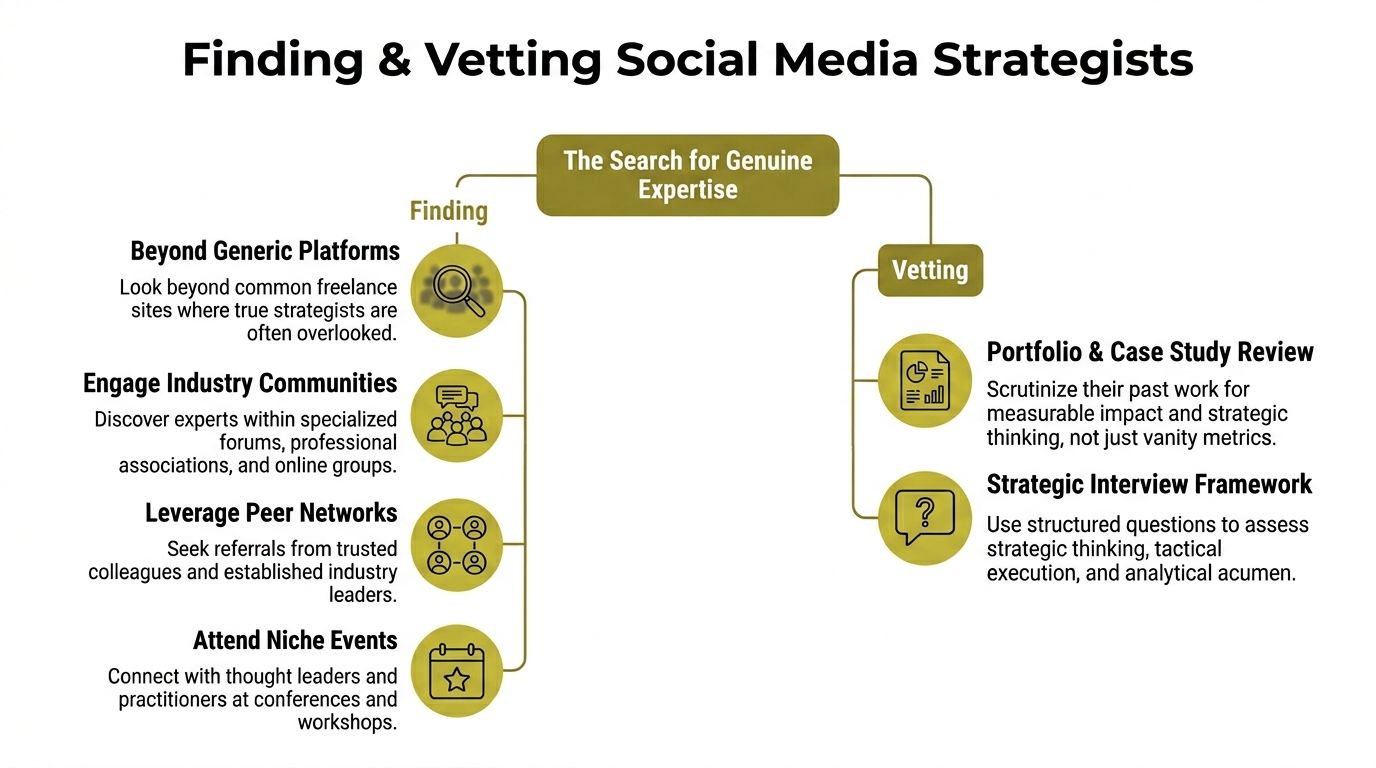
One of the biggest problems for founders is that social expertise is hard to verify from the outside. Plenty of candidates can present polished decks, attractive content samples and fluent platform talk. Far fewer can show how they diagnose a business problem, make trade-offs, and protect a brand when pressure lands.
That challenge is made worse by a wider credibility issue. Research highlighted by the Berkman Klein Center notes that nearly one-third of social media research had undisclosed industry ties in a preprint study, which is a useful reminder that founders should value transparent, verifiable credentials over glossy authority signals Berkman Klein Center.
Where serious candidates usually come from
Generic freelance marketplaces can work for production support, but they’re a weak place to source senior strategic counsel.
Better routes include:
- Peer referrals from founders, marketers and commercial directors who’ve seen the person work under pressure
- Industry communities where specialists discuss execution rather than self-promotion
- LinkedIn networks where you can inspect how they think in public
- Specialist agencies with a clear point of view and documented senior experience
If you’re comparing delivery models, it helps to understand what a specialist social media management firm typically handles versus what an in-house strategist or independent consultant owns. The best choice depends on how much senior input, production capacity and responsiveness your business needs.
One factual option in the UK market is Carlos Alba Media’s social media marketing company service, which combines senior communications experience with social delivery. The important point isn’t the provider. It’s the model. You want access to judgement, not just hands on keyboards.
Green flags that signal strategic depth
A founder should look for evidence of thinking, not just output.
They can explain business context
Strong candidates don’t jump straight into content ideas. They ask about margins, sales cycle, customer objections, internal approvals, seasonality, competitors and risk exposure.
That tells you they understand social as part of a business system.
Their case studies sound operational
A good case study should show what the problem was, what choices were made, what changed and how performance was assessed. It shouldn’t sound like an awards entry or a mood board.
Listen for language around audience segmentation, testing, conversion paths, escalation, messaging refinement and reporting discipline.
They have verifiable senior experience
A background in national news journalism, corporate communications, PR, or serious agency work is often a strong signal. People from those environments are trained to find a story, pressure-test a claim, meet deadlines, and work with accuracy in critical situations.
That matters in hospitality when a guest incident breaks online. It matters in finance when wording has consequences. It matters anywhere a founder’s name is attached to the brand.
Founders should prefer candidates whose credibility can be checked in the open. Actual bylines, known brands, campaign ownership and references beat inflated job titles every time.
Red flags founders miss too often
The danger signs are usually visible early.
They lead with follower growth
Follower count can matter, but on its own it tells you very little. Candidates who centre every conversation on audience growth often struggle to discuss conversion quality, brand positioning or channel purpose.
Their portfolio is all aesthetics
Good design helps. It doesn’t prove strategic competence.
A strong feed can hide weak targeting, poor offer alignment and no measurable commercial effect.
They use vague case studies
Be cautious if every result sounds impressive but can’t be unpacked. Ask what the starting point was, what changed in the plan, what channels were involved, and what counted as success.
If answers stay fluffy, move on.
They treat every platform the same
Real experts in social media understand platform behaviour, audience intent and content mechanics differ by channel. A person who proposes the same approach everywhere is usually operating from habit, not judgement.
A simple vetting scorecard
Use this when reviewing candidates:
| Signal | Weak evidence | Strong evidence |
|—|—|
| Commercial understanding | Talks about posting and trends | Talks about pipeline, demand, trust and conversion |
| Communication skill | Generic captions and buzzwords | Clear messaging, audience logic, strong writing |
| Risk awareness | “We can just react if needed” | Knows approvals, escalation and issue handling |
| Analytical ability | Reports reach and likes | Connects content to business outcomes |
| Credibility | Unverifiable claims | Checkable work history and references |
A founder doesn’t need to become a social specialist to hire well.
You need to learn how to separate confidence from competence.
The Interview Questions That Uncover Real Expertise
CVs are easy to optimise.
Interviews still matter because they show how a person thinks when they can’t hide behind polished decks.

A good interview for experts in social media shouldn’t feel like a quiz on platform features. It should feel like a working session. You’re testing judgement, clarity, prioritisation and temperament.
There’s another reason to push beyond generic questions. According to Uncommon Insights, expert-led strategies can achieve a 4.2x engagement lift, but the same analysis warns of 70% opacity in AI-content efficacy, which can waste 20-30% of budget. That means your interview should probe whether a candidate understands both opportunity and risk.
Ask for thinking, not opinions
Bad interview question: “How do you grow an audience?”
It invites rehearsed answers.
Better question: “You’ve joined us on Monday. By Friday, what would you need to know before you touch our channels?”
A strong candidate will talk about audience, commercial priorities, past performance, tone, approvals, analytics access, competitor positioning and risk review. A weak one will talk about content pillars and posting cadence before they understand the business.
Use three lines of questioning
Strategic thinking
These questions show whether the candidate can build from business reality.
Ask things like:
- Walk me through a 90-day plan for our business if we wanted social to support market entry in Glasgow.
- What would you stop doing first if you inherited our current channels?
- How would you decide which platforms deserve attention and which should be deprioritised?
- What would you need from sales, PR or leadership to make social commercially useful?
What you’re listening for is prioritisation. Good strategists know social teams have finite time and budget. They make choices.
Practical application
Here, you test whether they can translate theory into workable execution.
Ask:
- Show me how you’d turn one product launch into channel-specific content for LinkedIn, Instagram and email support.
- What reporting would you send after the first month, and what would you leave out?
- How do you use tools such as Google Analytics 4, native platform insights, UTM tracking, Hootsuite, Sprout Social or Brandwatch in practice?
- When would you use short-form video, and when would you avoid it?
Practical operators usually answer with process. They’ll mention asset gathering, approvals, testing, segmentation, attribution and review cycles.
Here’s a useful external perspective before you run those interviews:
Crisis temperament
This separates polished marketers from senior communications people.
Ask sector-specific scenarios.
For hospitality:
- A guest posts a damaging allegation that starts gaining traction. What happens in the first hour?
- A key partner is criticised publicly. How does your team respond on owned channels?
For regulated sectors:
- How do you keep content engaging while staying inside compliance boundaries?
- What do you do when legal, compliance and commercial teams disagree on wording?
The right answer isn’t one script. It’s a clear operating mindset. Escalate quickly. Verify facts. Align internal decision-makers. Respond proportionately. Preserve trust.
The best candidate won’t sound excited by crisis. They’ll sound calm.
Watch how they handle trade-offs
Every serious social role involves competing priorities.
Brand versus performance. Speed versus accuracy. Founder voice versus team capacity. Organic effort versus paid support. Creative ambition versus compliance. AI-assisted production versus brand safety.
Ask direct trade-off questions:
- When is a post not worth publishing, even if the team has spent time on it?
- What would make you advise against using AI-generated content in a campaign?
- How do you handle a founder who wants to chase every trend?
A strategic hire should be willing to disagree with you intelligently.
What good answers sound like
Good answers usually contain some version of the following:
- a clear diagnosis before tactics
- channel-specific thinking
- awareness of internal workflow
- sensible measurement
- realism about resources
- calm handling of reputational exposure
Weak answers usually rely on trend language, creator jargon and broad claims about “authenticity” without any operating detail.
End with one final test
Give the candidate a small pre-interview or post-interview task.
Not a free strategy. A thinking sample.
For example:
| Task | What it reveals |
|---|---|
| Audit one channel and identify the three biggest strategic issues | Prioritisation and commercial sense |
| Draft a response framework for a public complaint | Judgement under reputational pressure |
| Outline a monthly reporting template | Measurement maturity |
| Suggest what to stop, start and continue | Ability to make decisions |
If a candidate can’t think clearly in a contained exercise, they won’t suddenly become strategic once hired.
Contracts KPIs and Onboarding for Success
A good hire can still fail inside a vague contract and a messy onboarding process.
Founders often assume the hard part is selecting the person. It isn’t. The hard part is building a structure that lets a capable operator do useful work and be judged fairly.
The core discipline here is ROI. A practical methodology for social measurement includes SMART goals, multi-touch attribution models that can reveal up to 40% more of social’s contribution, and KPI tracking such as 2-5% click-through rates, while avoiding the vanity metrics trap linked to 85% of failed campaigns, according to Traffic Radius.
Contract for outputs and decision rights
Your contract should do more than state a fee and a notice period.
It should define what the person is responsible for, what they are not responsible for, and how decisions get made.
Include:
- Scope of work covering channels, content types, reporting and response responsibilities
- Approval process stating who signs off content, campaigns and reactive statements
- Access and ownership for accounts, creative files, data and historic assets
- Service expectations around communication, meeting cadence and response windows
- Escalation rules for legal, compliance or reputational issues
If you don’t define these early, minor confusion turns into delay. Delay turns into mediocre work.
Choose KPIs that a business can use
A founder should care about social metrics only if they help explain business movement.
That means likes and follower changes rarely belong at the top of the report. They can sit lower down as context. They should not be mistaken for proof of value.
Better KPI groups look like this:
Commercial indicators
- Qualified enquiries from social
- Lead quality by platform
- Conversion rate from social traffic
- Bookings, demos or sales conversations influenced by social
- Cost per acquisition, where relevant and properly tracked
Strategic indicators
- Message pull-through across campaigns
- Audience response to priority themes
- Share of voice versus named competitors
- Content contribution to launches, PR moments or sales enablement
Operational indicators
- Turnaround time on approvals
- Response quality to customer issues
- Consistency of reporting
- Execution against agreed campaign calendar
Reports should help management make decisions. If the report can’t tell you what to do next, it’s just a document.
Monthly retainer expectations in the UK
Exact pricing varies widely by sector, scope, risk level and whether creative production is included. The table below is a practical planning tool rather than a universal rate card.
| Level of Expertise | Typical Role | Monthly Retainer (SME) | Core Deliverables |
|---|---|---|---|
| Entry-level support | Coordinator or junior freelancer | Lower end of market, usually suited to execution-only needs | Scheduling, basic content publishing, light community management |
| Mid-level management | Experienced manager or consultant | Mid-market retainer for channel ownership with reporting | Content planning, platform management, monthly reporting, coordination with internal teams |
| Senior strategic counsel | Specialist consultant or agency lead | Higher retainer reflecting judgement, risk handling and cross-channel planning | Strategy, campaign planning, stakeholder alignment, analytics interpretation, crisis-ready guidance |
| Specialist high-stakes support | Senior agency team for regulated or reputation-sensitive brands | Premium retainer based on complexity and responsiveness | Governance, approvals, issue handling, strategic content, reporting tied to commercial and reputational priorities |
The key is fit. Over-hire and you waste money. Under-hire and you create risk.
Onboarding should remove excuses quickly
A good onboarding process creates momentum in the first month.
Give your new hire access to what they need immediately:
- Platform access with the right admin controls
- Google Analytics 4 and any dashboard tools
- Brand guidelines, core messages and tone documents
- Past campaign reports and channel history
- Product, service and commercial priorities
- Stakeholder map covering founder, marketing, sales, PR, legal and compliance contacts
- Competitor set and any market intelligence you already hold
Then agree a short operating plan.
First 30 days
Focus on diagnosis. Audit channels. Review analytics. Understand customer journey gaps. Clarify roles.
Days 30 to 60
Fix fundamentals. Refine messaging. Set the reporting baseline. Improve workflow.
Days 60 to 90
Launch the first properly measured initiatives. Review results. Adjust allocation of effort.
Don’t leave attribution until later
Founders often postpone measurement discipline because they want to “get moving first”.
That’s backwards.
If social contributes to discovery, trust-building and conversion, you need a way to see that contribution before campaign volume increases. UTM parameters, GA4 events, CRM handoff points and a sensible reporting cadence should be agreed early. Otherwise, the person doing the work gets judged on incomplete data, and management starts defaulting back to vanity metrics.
A serious operator won’t resist that scrutiny.
They’ll insist on it.
Your Expert Is a Partner Not a Post Scheduler
If you remember one thing, make it this.
You are not hiring someone to keep the feed alive. You are hiring someone to make social useful to the business.
That distinction changes everything. It changes the brief, the candidate profile, the interview, the contract and the way performance is judged. It also changes who belongs in the room. In many SMEs, the best social hire sits closer to commercial leadership, PR, customer insight and reputation management than founders first assume.
The strongest experts in social media don’t behave like content vending machines. They ask awkward questions. They challenge weak assumptions. They push back on rushed ideas that create risk or waste. They build systems, not just posts.
That’s why background matters.
A person shaped by journalism or senior agency work usually brings habits that SMEs badly need: accuracy under pressure, sharper interviewing, tighter writing, better story judgement, and a more realistic understanding of what happens when something public goes wrong. Those habits are especially valuable in hospitality, tourism, finance and any founder-led brand where reputation travels fast.
If your business needs social to support growth and trust at the same time, treat this hire like a strategic appointment. The process should be rigorous because the consequences are commercial.
For founders weighing whether social belongs inside a broader communications brief, it’s worth looking at how PR and social media work together when they’re handled as one discipline rather than separate silos.
Done properly, this isn’t an expense line you tolerate.
It’s capability you build.
If you want senior support rather than more noise, Carlos Alba Media works with start-ups, SMEs and established brands that need social media strategy tied to commercial outcomes, reputation management and clear messaging. The team’s background in national news journalism and agency work means the advice is built for real-world scrutiny, not vanity metrics.