
Your phone starts vibrating before you have finished your first coffee. A customer has posted a video. Staff are forwarding screenshots from WhatsApp. Someone from a national newsroom has left a voicemail asking for comment by 10am. Your legal adviser wants caution. Your operations team is still trying to work out what happened. Meanwhile, silence is already being interpreted as guilt.
That is how most business crises begin. Not with a neat briefing note, but with noise, confusion and pressure from three directions at once.
For founders and senior teams, this is the moment when reputation stops being a brand exercise and becomes an operational problem. Every delayed response creates room for rumour. Every inconsistent line gives journalists, customers and competitors something else to pull apart. A crisis communications agency exists to bring order to that moment. The right one does not add drama. It slows the pulse, sets priorities and helps the business speak clearly when everyone around it is reacting.
When Your Reputation Is on the Line
At 8:12am, a founder is answering Slack messages, a journalist is asking for comment, and customers are posting screenshots before the business has established the facts. That is the point where a live issue turns into a reputation problem.

For SMEs and startups, the pressure is sharper. They rarely have an in-house press office, a general counsel on standby, and a board used to hostile scrutiny. They have a founder, a small leadership team, and a lot to lose if the wrong line goes out first.
What panic looks like in practice
Panic is rarely loud inside a business. It looks organised for the first 20 minutes. Then the cracks show.
One person starts drafting a statement before legal has reviewed the facts. Customer support replies to inbound complaints with language that does not match the holding line. A senior leader posts on LinkedIn to sound human, but ends up creating a quote that can be lifted into a headline. By lunchtime, the problem is no longer just the original incident. It is the contradiction, the delay, and the visible uncertainty.
That is where specialist crisis counsel earns its keep. Good advisers do not just write cleaner copy. They impose sequence, tighten approvals, and help leaders say enough to be credible without saying so much that they create legal or regulatory trouble.
That balance matters.
The strongest support for smaller firms often comes from teams that combine newsroom judgement with legal coordination. A former journalist will spot the question behind the question and know what makes a weak line look evasive. A lawyer will identify where an apology, an admission, or a promise creates exposure. Together, that mix gives founders something many large agencies struggle to provide at an affordable level. Senior judgement, quickly applied, without layers of process.
Why the business consequences are greater than many founders anticipate
Reputation damage now spreads through search results, group chats, staff screenshots, review platforms, trade press, and regulator interest at the same time. A cyber incident, a people issue, or a product failure can move from internal problem to public test of leadership in a few hours.
You can see that pressure in recent reporting on cyber disruption affecting major UK retailers, including Marks & Spencer and Harrods. You can also see it in official reporting from the Information Commissioner's Office on personal data breach trends. The lesson for smaller businesses is straightforward. Public scrutiny is no longer reserved for listed companies and household names.
Practical rule: if an issue could force you to answer to customers, staff, regulators, investors, and journalists on the same day, treat it as a crisis.
The work does not stop once the calls slow down. The hardest phase often comes later, when the business has to prove it learned something, fixed something, and deserves trust again. That is why recovery planning matters as much as day-one response, especially for companies doing the slower work of rebuilding trust after a public setback.
What a Crisis Communications Agency Does
At 8:12 a.m., a founder is on the phone with IT, HR has seen staff messages circulating internally, a journalist has emailed for comment, and the legal team wants every word checked before anything goes out. In that moment, a crisis communications agency does not just write statements. It brings order to a fast-moving situation so the business can make sound decisions under pressure.
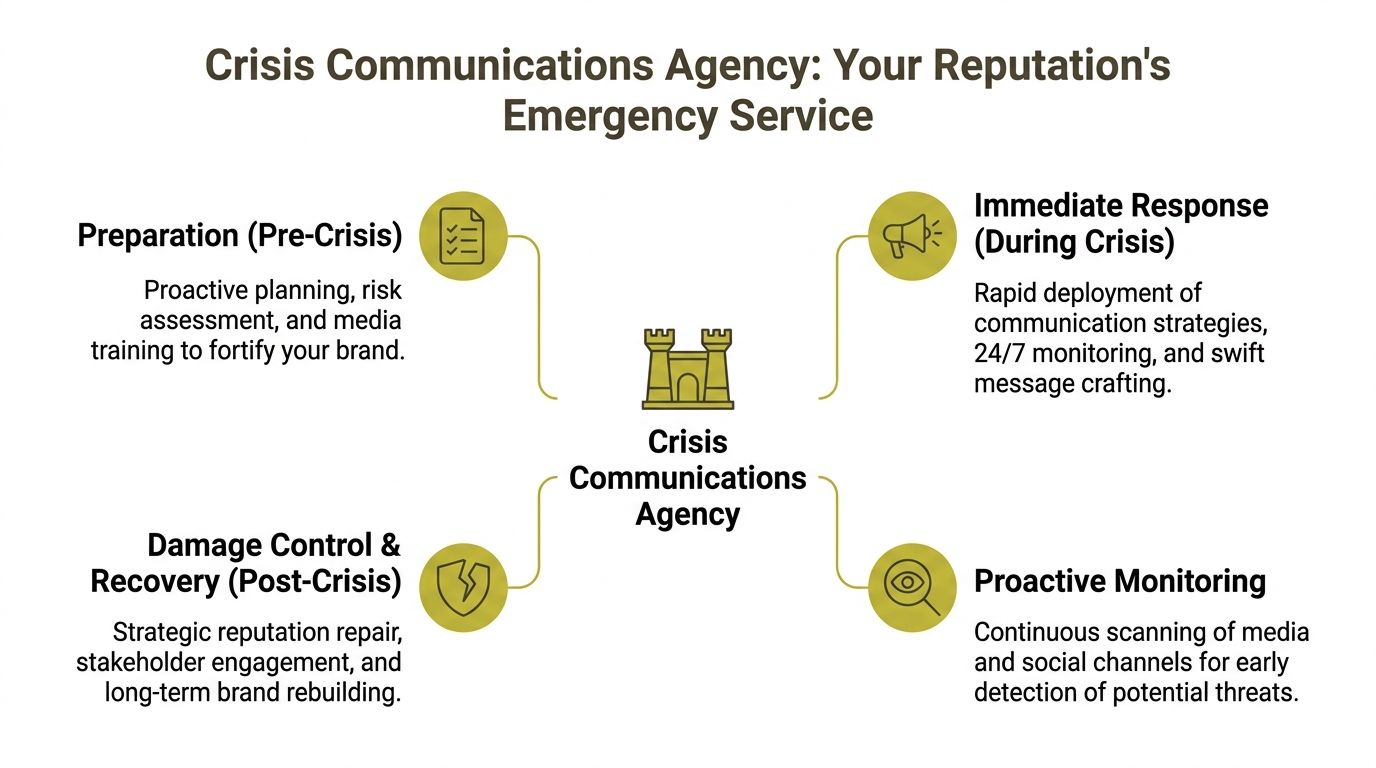
A good agency handles two jobs at once. It helps contain immediate reputational risk, and it gives leadership a clear process for facts, approvals, media handling, and stakeholder communication. That second part is where weak responses usually fail. The issue itself may be manageable. Confused ownership, mixed messages, and delayed decisions often make it worse.
Before the crisis
The strongest crisis work starts before anyone is asking questions.
Preparation usually covers:
- Risk mapping: identifying the issues most likely to test trust, from cyber incidents and service failures to allegations involving senior staff.
- Draft response lines: preparing holding statements and stakeholder messages that can be adapted quickly after hours.
- Decision roles: agreeing who approves statements, who speaks publicly, and who needs to stay out of the chain.
- Media training: preparing leaders for hostile questions, short deadlines, and interviews where one loose phrase becomes the headline.
For SMEs and startups, this work needs to be proportionate. A ten-person leadership team does not need the same structure as a listed company. It does need a plan that works at 6 a.m. on a Sunday. Reviewing real crisis communications examples for growing businesses usually shows the same pattern. Companies cope better when roles and first-response language are settled in advance.
During the crisis
Once the issue is live, the agency becomes part newsroom, part control room, part senior adviser.
Its job usually includes:
Establishing what is true
Early accounts are often incomplete or wrong. The agency helps leadership separate verified facts from assumption, and stops untested internal chatter reaching customers or journalists.Drafting the first outward response
That may be a holding statement, customer email, internal note, media line, regulator response, or social post. Each version needs the same factual core.Handling media pressure
Deadlines are fixed. Journalists work with what they have. Former reporters know which questions are coming next, what editors will challenge, and which answers are likely to sound evasive.Advising leadership on judgement
The legally safest wording is not always the best public response. Sometimes saying less protects the business. Sometimes saying too little creates mistrust. Good counsel weighs liability, scrutiny, and audience expectation together.Keeping channels aligned
Press, staff communication, customer support, social media, and investor updates cannot contradict each other. If they do, the inconsistency becomes part of the story.
Why journalistic insight and legal partnership matter
This blend of skills is where smaller businesses often get better value from a specialist team than from a large generalist agency.
Former journalists understand how a story is shaped before publication. They know what makes a reporter keep calling, what makes an editor hold back, and when a line will survive contact with a sceptical newsroom. Pair that with media lawyers who can advise on defamation, privacy, regulatory exposure, or active disputes, and you get advice grounded in both public reality and legal risk.
That combination is especially useful for SMEs and startups. They rarely have in-house press officers, experienced general counsel, and senior comms leads sitting in the same room. They still face the same pressure when a story breaks. A specialist crisis team with journalistic judgement and legal backup can close that gap without the cost and process layers that often come with larger agencies.
Carlos Alba Media fits that model. The team includes former national news journalists and agency professionals, with 24/7 media crisis management delivered in partnership with UK media lawyers. For smaller businesses, that means access to senior counsel that is practical, fast, and tied to the way stories develop.
Key takeaway: a crisis communications agency protects decision quality under pressure. The best ones help you say the right thing, at the right time, with a clear view of how journalists, stakeholders, and lawyers will each assess it.
Common Scenarios That Demand Expert Help
At 8:15 a.m., a founder is dealing with what looks like a routine problem. By 11:00 a.m., customers are posting screenshots, staff are sharing concerns internally, and a reporter is asking for comment by noon. The operational issue has become a reputational one.
That shift happens fast, especially in smaller businesses where the same people are trying to run the response, protect customers, brief staff and answer the press at once.
The issues that escalate fastest
Certain scenarios repeatedly push SMEs and startups into crisis territory:
Data breaches and cyber incidents
These create two pressures at the same time. Technical teams need time to establish what happened, while customers, regulators and journalists want clear answers straight away.Executive misconduct allegations
Boards and founders often want to wait for a full internal picture. External audiences usually judge the business earlier than that, based on whether it appears serious, fair and in control.Product or service failures
If people feel misled, let down or put at risk, a service problem can stop being a customer support issue quickly.Staff complaints made public
Internal grievances can become public tests of leadership judgment, culture and consistency. Once employees believe they need outside channels to be heard, press interest often follows.Review pile-ons and social media backlash
These cases are often dismissed too early. A cluster of angry posts can shape search results, trigger media enquiries and harden stakeholder opinion before a leadership team has agreed a response.
Large listed companies get the attention, but the pattern is not unique to them. A startup with venture backing, a regional hospitality group or an ecommerce brand can face the same pressure once an allegation starts to travel across customer channels, staff networks and the press.
What SMEs often miss
The first mistake is definitional. Many founders reserve the word "crisis" for fraud, arrests, insolvency or a national headline.
In practice, the threshold is lower. A crisis begins when trust is under material pressure from the people your business depends on.
That can mean:
- Customers questioning safety, reliability or honesty
- Staff losing confidence in leadership
- Investors or partners asking whether they need distance
- Journalists framing one incident as part of a wider pattern
I have seen small companies lose control of a story because they treated repetition as noise. Three customer complaints, one former employee post and a press enquiry can point to the same problem. At that stage, the issue is no longer routine communications.
A useful benchmark is to review real cases where that line was crossed. These crisis communications examples show how different incidents create the same pressure on decision-making, message discipline and leadership judgment.
Why outside help matters in these moments
Expert help is not only for the biggest disasters. It matters when the facts are still incomplete, legal risk is emerging, and every draft statement could affect staff confidence, customer behaviour or future coverage.
That is where a specialist team with newsroom judgment and legal support often gives SMEs better value than a large generalist agency. Former journalists can assess what will interest a reporter, what will sound evasive, and what is likely to survive hostile questioning. Media lawyers can advise on defamation, privacy, regulatory exposure and active disputes before a rushed statement creates a second problem.
The trade-off is real. A forceful public denial may reassure some customers, but increase legal risk. A cautious holding line may protect a legal position, but look cold or evasive if it ignores obvious human concern. Good crisis counsel handles that tension early, before inconsistent messages leave the business exposed.
The cost of treating a serious issue as routine
Routine communications work on planned timelines and standard approvals. Crisis communications work under scrutiny, with incomplete facts and competing risks.
If a business responds with ad hoc emails, delayed sign-off and vague social replies, people notice. Customers read confusion. Journalists read weakness. Regulators may read poor governance.
The triggering event always matters. The response often decides how long the story lasts, how hard it bites, and whether it becomes the incident people remember about the company.
The First Hour Is Critical for 24/7 Response
The first hour does not require perfect answers. It requires control.
That is where many businesses stumble. One group argues for silence until every fact is confirmed. Another wants to post immediately to stop speculation. Both instincts are understandable. Neither works on its own.

What the first hour should achieve
A disciplined first-hour response does four things:
- Acknowledges reality without guessing
- Shows the business is active rather than frozen
- Protects credibility by avoiding speculation
- Buys time for a fuller and fact-checked statement
That is the job of a holding statement. It is not a substitute for a full response. It is a bridge between the first alert and the moment when you can speak in more detail.
The tension between speed and strategy is real. Current coverage still lacks strong UK-specific examples showing how organisations balance fast response with measured messaging, and there is limited practical guidance on differentiating holding statements from fuller responses in a round-the-clock news cycle, as noted in this discussion of why speed is not strategy in crisis communications.
What goes wrong without a plan
An unprepared company often follows a familiar pattern.
First, it says nothing while senior people debate wording. Then a partial comment appears on social media. After that, a press statement lands that does not match what customers have already been told. Staff hear updates externally before hearing them internally. By then, the organisation is no longer setting the pace.
A 24/7 retained partner changes that rhythm. It means someone is already on hand to assess risk, draft the first line and brief the spokesperson before the issue hardens into a narrative.
One part of readiness is visible leadership under pressure. Executive interview handling often matters as much as the statement itself, which is why targeted media training for executives belongs in crisis preparation rather than as an afterthought.
Practical rule: your first message should say what you know, what you are doing next, and when people will hear from you again.
A short explainer can help teams understand the pace and discipline required in the opening stage of a live issue.
Speed without panic
Fast does not mean loose.
A strong crisis communications agency helps a business move quickly while keeping language accurate, lawful and human. That balance is the value of 24/7 support. Not noise. Not spin. Controlled movement in the first hour, when delay and contradiction do the most damage.
How to Choose Your Crisis Communications Partner
A founder gets a call from a journalist at 6:40pm on a Friday. The allegation is sensitive. Legal risk is real. Staff will hear about it within the hour if the story is published online first. The wrong partner will start with process, credentials and a junior account team. The right one will ask for the documents, test the facts, speak to legal, draft a holding line and prepare the spokesperson.
That is the standard to buy against.
For SMEs and startups, the decision is rarely about finding the biggest name. It is about finding senior counsel you can reach quickly, with the reporting instincts to understand how a story will be framed and the legal discipline to avoid making the problem worse. That mix is often more useful, and more affordable, than a large agency structure built for enterprise procurement.
What to test before you appoint anyone
Start with how the agency operates under pressure.
Senior involvement from day one
Ask who answers the phone in a live matter and who writes the first statement. If senior people sell the brief but disappear once work starts, expect delays, diluted judgement and unnecessary risk.Journalistic judgement
Former reporters know what makes a line usable, evasive or dangerous. They understand deadlines, what a newsdesk will chase next, and how a vague answer becomes a hostile headline.Legal coordination
Reputation advice has to stand up legally. Ask how the agency works with solicitors or media lawyers, how approvals are handled, and what happens when the legally safest line is not the most credible public line. That tension comes up often.Fit for your risk profile
Product recalls, workplace allegations, regulatory issues and founder conduct stories all behave differently. A partner does not need to specialise only in your sector, but it does need to recognise the pressure points fast.Clear access and decision rights
You should know who drafts, who signs off, who briefs the spokesperson and how out-of-hours contact works. If those answers are fuzzy during the pitch, they will be worse in a live issue.
Why smaller organisations need a sharper filter
Smaller businesses often buy too much theatre and not enough judgement.
A startup or SME usually does not need layers of account management, long reporting chains or a polished crisis playbook that nobody can use at 9pm. It needs direct access to people who can handle facts, media pressure and legal sensitivity without wasting time. That is where a specialist model has an edge. Former journalists working closely with legal partners can give smaller organisations the same strategic protection they need, without the overhead that comes with a large generalist agency.
Ask practical questions, not branding questions:
- Who drafts the first response and who approves it?
- How quickly can you brief our founder, CEO or chair?
- What is your process if a reporter calls outside office hours?
- How do you work with our solicitor or your own media lawyer contacts?
- What changes in your approach for a lean team with no in-house press office?
The answers should be specific. Good agencies can describe the workflow plainly because they have done it before.
Red flags that should slow the process down
Some warning signs are easy to miss in a polished pitch.
Promises about coverage
No credible adviser can guarantee how journalists or commentators will treat a live story.Generic plans
Templates help. Cut-and-paste crisis documents do not. If the advice sounds interchangeable across any sector or issue, it probably is.PR talk without governance
If the agency focuses on publicity and says little about internal communications, legal review, evidence handling or spokesperson preparation, the service is incomplete.No named senior counsellor
In a crisis, the relationship matters. You need to know which experienced person will make judgement calls with you.
Tip: Ask the agency to talk through a Friday evening enquiry about a serious allegation against a senior employee. Listen for sequencing, legal awareness and newsroom realism. That answer will tell you far more than a credentials deck.
A sensible benchmark
The strongest crisis partner usually brings three things together. Calm judgement. Newsroom understanding. Legal coordination.
That combination matters especially for SMEs and startups, where one bad line can create both reputational and legal exposure, and there is rarely a large in-house team to catch mistakes. Specialist firms are often better placed to provide that blend than large agencies built around scale.
Carlos Alba Media is one example of that model, offering 24/7 media crisis management with UK media lawyer partnerships and a team made up of former national news journalists or agency professionals with international brand experience.
Choose for access, judgement and how the team works with lawyers under pressure. Logo size is secondary.
Understanding Agency Costs and Retainer Models
At 6:40pm on a Friday, a founder gets a call from a journalist about a safety complaint, an investor has started texting, and the company has no in-house press team. In that moment, the question is not whether crisis support costs money. The question is what delay, confusion and poor judgement would cost instead.
Crisis communications fees make more sense when you look at the service in operational terms. You are buying access to experienced counsel, out-of-hours availability, clear decision-making, and a team that can work with lawyers before a quote or email creates a bigger problem.
Pricing varies because the underlying job varies. A startup with occasional press exposure may need a senior adviser on call and a modest amount of planning. A regulated SME facing recurring scrutiny may need regular scenario work, media handling protocols, and agreed lines with external counsel. A live product issue, employment allegation or data incident can also shift fast from a contained brief to a multi-week matter involving press, staff, customers and legal review.
That is why serious agencies should explain pricing in plain English. Clients should hear who is on the account, what happens outside office hours, how approval rounds are managed, and when a contained issue becomes a larger brief with additional fees. If an agency cannot explain that clearly before signing, cost control during a live crisis is unlikely to improve.
Comparing common models
| Model Type | Best For | Typical Cost Structure | Key Benefit |
|---|---|---|---|
| Monthly retainer | Businesses with regular exposure, investor scrutiny, regulatory risk, or an active press profile | Fixed monthly fee covering agreed access, planning work and response support | Faster activation and better readiness |
| Project-based fee | A defined issue with a clear start point and limited scope | One-off fee tied to a specific brief and deliverables | Cost clarity for contained matters |
| Block of hours | SMEs and startups that need experienced support without a full retainer | Pre-purchased hours used when needed | Senior input without a long-term commitment |
For many SMEs and startups, the best value often sits between the two extremes. They do not need a large agency team with layers of account handling. They do need a senior operator who understands how journalists frame a story and can pull in a media lawyer quickly when wording, disclosure or liability become sensitive. That blend is usually more affordable, and more useful, than paying for scale you will never use.
What to ask before signing
Price matters. Structure matters more.
Ask these questions before you agree terms:
- What work is included before any crisis happens
- Whether evenings, weekends and holidays are covered
- Which senior person will lead advice on a live issue
- How legal review is handled, and whether the agency already works with specialist media lawyers
- What triggers extra fees if the matter widens
- Whether media training, holding statements, Q&As and simulations are included or billed separately
Retainers can be sensible if they buy readiness, rehearsal and immediate access to a named senior counsellor. They are poor value if they amount to a monthly insurance payment with no real planning behind it. Project fees can work well for a contained matter, but they often become strained when new allegations emerge, journalists keep calling, or internal stakeholders start adding approval layers.
The cheapest proposal on paper can turn into the most expensive option in practice. If the account is staffed by juniors, if partner time is hard to reach, or if legal coordination sits outside the model, the business usually pays later in delay, rework and avoidable exposure.
How Senior Counsel Shapes Real-World Outcomes
At 6:12 a.m., a founder sees an email from a broadcast producer asking for comment on a customer safety allegation before 9. By 6:20, screenshots are already moving internally, legal wants every word checked, operations is still confirming the facts, and someone suggests waiting until the company knows more.
This is the point where senior counsel changes the outcome.
Paper plans help. Live judgement decides whether a business sounds credible, evasive, human, or out of its depth. In a real incident, facts arrive unevenly, internal priorities clash, and journalists test the weakest part of the story first. A seasoned adviser brings order fast. They know which facts matter now, which lines create risk, and which answers will harden suspicion.
Public trust can fall quickly when an organisation appears slow, detached or defensive in the early stages of a serious event. Coverage of the aftermath of Grenfell regularly points to those failures in tone and leadership, and to the lasting effect they had on confidence in the council, as reported by the BBC in its coverage of the borough’s trust ratings and response.
The pattern is familiar. Trouble rarely starts with one disastrous sentence. It grows when leaders seem absent, when statements read like process notes, and when nobody addresses the human reality of what has happened.
For smaller businesses, the pressure is sharper. There is often no in-house press office, no spare senior team, and no buffer between the founder’s reputation and the company’s. One poor interview can alter how customers, investors and partners judge the business for months.
Senior counsel earns its value in those tight margins.
A former journalist will read an incoming enquiry differently from a generalist adviser. The first question is not only what happened. It is what the reporter thinks happened, what they can stand up in copy, who else they have called, and whether the story is being framed as a one-off failure or evidence of a wider pattern. That shapes the response.
The legal side matters just as much. In practice, the strongest results come when communications and legal advice are aligned early, not traded off against each other in separate rounds of approval. Lawyers protect the business from saying something inaccurate or prejudicial. Crisis advisers protect it from sounding sterile, aloof or needlessly combative. SMEs and startups usually do better with a partner who already knows how to work with specialist media lawyers than with a large agency model that adds layers but not judgement.
Preparation is still less common than it should be. The Chartered Institute of Public Relations has published research and guidance showing many organisations still lack a properly tested crisis plan, with smaller firms tending to be less prepared than larger ones. That gap shows up when the first serious call comes in. The issue is rarely effort. It is a shortage of experienced people who can make clear decisions under pressure.
That is why senior-led support produces different results. It shortens the debate, improves the first holding line, protects evidence, keeps options open, and helps leadership speak in a way that is accurate and believable.
Under pressure, fewer better decisions beat louder activity every time.
Building Resilience Before the Crisis Hits
The strongest organisations do not wait for a crisis to start taking communications seriously.
They prepare key messages. They know who approves what. They train spokespeople before a camera appears. They decide in advance how legal, leadership and communications will work together when time is short.
That is what resilience looks like in practice.
A crisis communications agency should help a business build that resilience, not just react once the phones start ringing. The immediate response matters, but the longer-term value is in reducing confusion, sharpening accountability and protecting trust before it is tested in public.
For SMEs and startups, this matters even more. They often have less institutional buffer, fewer dedicated specialists and a closer link between founder reputation and company reputation. One mishandled incident can distract the whole leadership team for weeks. One well-managed response can show steadiness, honesty and competence at exactly the moment stakeholders are judging the business most closely.
The practical standard is simple. Choose a partner that understands newsrooms, can work cleanly with legal advisers, and gives you access to senior people when pressure hits. Avoid firms that sell polish without process, or visibility without judgement.
Trust is hard won and easily shaken. The work of crisis planning is not glamorous, but it is one of the clearest ways to protect the value you have spent years building.
If your organisation needs calm, senior-level support before or during a live issue, Carlos Alba Media provides crisis communications, media handling and executive support for SMEs, startups and established brands across Scotland and the wider UK.