
Finding a top-tier PR agency in the UK is about more than just firing off press releases. It’s about finding a partner who can build your brand’s authority, earn trust with investors and customers, and ultimately drive real business growth. This guide is your playbook for finding, vetting, and partnering with the right agency for your start-up or SME.
Why Your UK Business Needs a PR Partner Now
Let’s be honest. In a market as crowded as the UK, a brilliant product or service just isn't enough. If no one knows you exist, you don't really have a business. Think of strategic public relations as the engine that pulls your brand out of the shadows and into the spotlight, making it an essential investment, not just a 'nice-to-have' expense.
For a start-up, the right PR partner can completely change the game. Imagine your next investor meeting, but this time you’re armed with recent, positive coverage in a national newspaper. Picture top talent seeking you out because they see your company as a genuine industry leader. This is what good PR does—it builds a reputation that opens doors and fuels your growth.
Getting Senior Expertise Without the City Price Tag
Many founders hesitate, put off by the eye-watering fees charged by large, traditional PR agencies. The good news is the industry has changed. The trick is to find a partner who delivers that senior-level thinking without the prohibitive overheads.
This is where specialist firms like Carlos Alba Media come in. Our model is built on a simple premise: every client works directly with seasoned professionals. Everyone who works for Carlos Alba Media is a former national news journalist or has agency experience of working with international brands. You’re never handed off to a junior.
Expert Insight: When you hire an agency like ours, you aren't just paying for press outreach. You're buying decades of newsroom experience and high-level brand strategy. It’s this insider knowledge that helps you bypass the usual agency layers and get straight to impactful results.
A Clear Path to Finding Your Partner
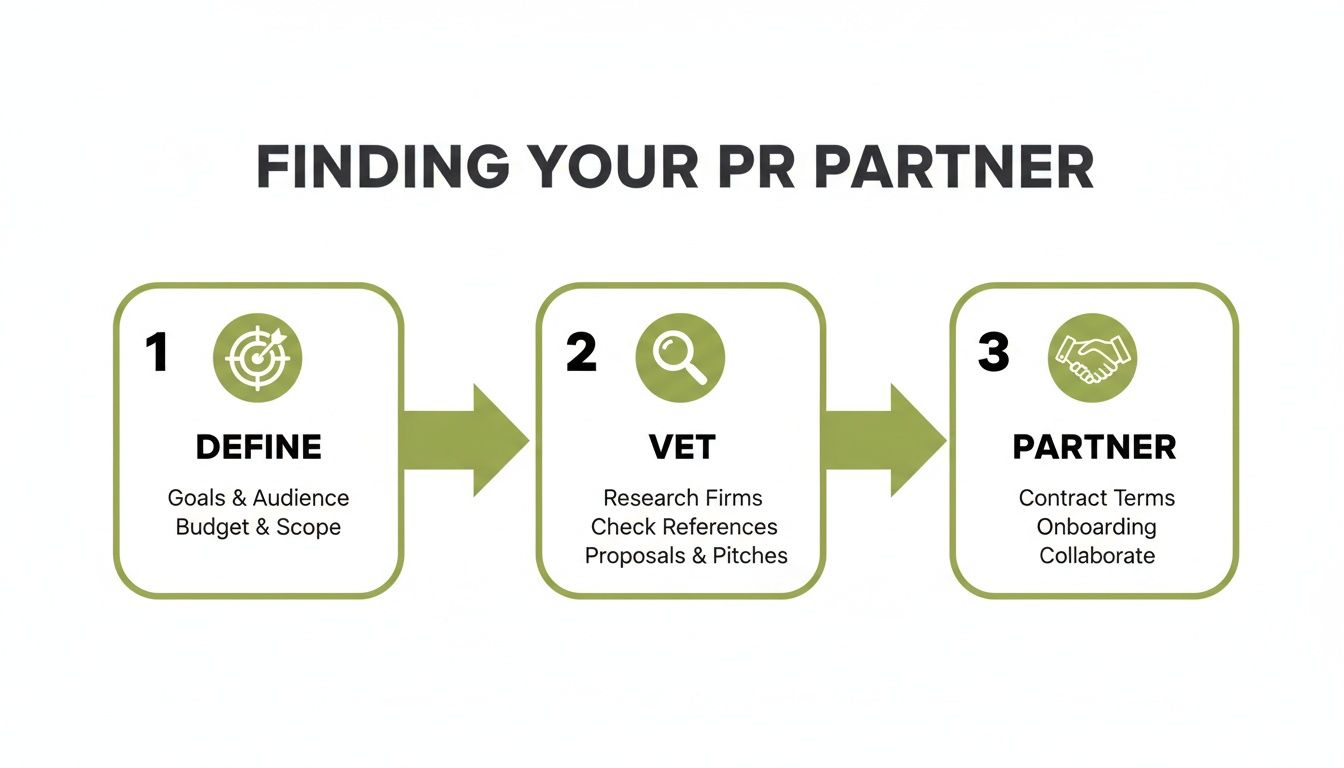
Finding the right agency doesn’t have to be a headache. I’ve always found it helps to break the search down into a few key phases: first, get crystal clear on your own needs. Then, vet your potential partners. Finally, you can formalise the partnership.
To help you get started, here's a quick checklist outlining the key phases we'll cover in this guide.
Your PR Agency Search At a Glance
| Phase | Key Action | Why It Matters |
|---|---|---|
| 1. Define | Clarify your goals, budget, and what success looks like. | A clear brief prevents you from wasting time on agencies that are a poor fit. |
| 2. Vet | Research agencies, check their track record, and interview a shortlist. | This is where you test for genuine expertise, cultural fit, and relevant experience. |
| 3. Partner | Finalise contracts, set expectations, and begin the onboarding process. | A strong start ensures a smooth and productive long-term relationship. |
This table provides a simple roadmap for the journey ahead, helping you stay organised and focused on what's important.
The process I’ve outlined below follows this straightforward logic, giving you a clear path forward.
The UK’s public relations sector is a powerhouse, which speaks to its vital role in business today. In the third quarter of 2026, there were approximately 73,800 public relations professionals working across the United Kingdom. For ambitious start-ups and SMEs, this vast talent pool means you can access senior-level expertise affordably and position your brand to be seen, trusted, and chosen. You can explore more data on the UK's PR workforce to get a better sense of the landscape.
Defining Your Goals Before You Search
Before you even think about typing ‘PR agency UK’ into Google, stop. The single biggest mistake I see founders make is rushing to hire an agency without a clear idea of what they actually want to achieve.
Hiring a PR firm is a serious investment, not just of money, but of your time. Without a specific destination in mind, you're just paying for activity, not results. It’s like setting off on a road trip with no map and hoping you end up somewhere great. A vague goal like “get more press” is a recipe for disappointment.

What Do You Really Want to Achieve?
Your PR goals can't exist in a vacuum; they have to be directly wired into your core business objectives. What would genuinely move the needle for you right now? Are you gearing up for a funding round and need to build investor confidence? Is your sales pipeline looking a bit thin, and you need to generate high-quality leads?
A good PR partner can help with concrete, tangible outcomes. We often see clients coming to us with goals like these:
- Building Credibility: Securing features in top-tier national or trade press to position a founder as a go-to expert and the business as a serious player.
- Driving High-Quality Leads: Running targeted campaigns that speak directly to your ideal customer, pushing them to your website to book a demo or make a purchase.
- Boosting Brand Awareness: Making your brand a household name in your sector, so you’re the first one that comes to mind.
- Managing Reputation: Getting ahead of potential crises or navigating a live issue to protect the trust you’ve worked so hard to build.
Knowing which of these is your priority is crucial. For example, if your main focus is on learning how to build brand awareness, you'll need an agency with a different skill set than one that specialises purely in crisis management. This clarity helps you filter out the noise and find the right fit.
Matching Agency Models to Your Needs
Once your goals are crystal clear, you can start looking at the different kinds of PR agencies out there. The PR world isn't one-size-fits-all, and what works for a global corporation is almost certainly wrong for a fast-growing UK start-up.
A full-service agency will offer everything from PR and social media to events and digital marketing. They can be a solid choice for large companies with massive budgets, but there's a real risk your account will be handed off to a junior team member and you'll get lost in the noise. On the other hand, a boutique agency is typically smaller and more specialised, offering a focused, hands-on service.
This is where a firm like Carlos Alba Media comes in. We’ve deliberately structured our agency to be lean and expert-led. Everyone who works for Carlos Alba Media is a former national news journalist or has agency experience of working with international brands.
We built our agency on a simple principle: start-ups and SMEs deserve the same senior-level expertise as big corporations, but without the eye-watering price tag. When you work with us, your strategy is built and delivered by people who have spent their careers inside newsrooms and leading campaigns for top brands.
This model gives you the agility of a boutique specialist combined with the deep, hard-won experience you’d normally only find at a huge firm. You get direct access to strategists who know instinctively how to shape a story that journalists will actually want to cover—because they used to be those journalists. That insider knowledge is what turns an ignored press release into a front-page story that delivers real, measurable value for your business.
How to Vet and Shortlist Your Top PR Agencies
Right, you’ve got your goals sorted. Now comes the hard part: sifting through the hundreds, if not thousands, of UK PR agencies to find the right one. A quick Google search will unleash a tidal wave of options, so you need a plan to cut through the marketing noise and find a genuine partner.
Start by asking around. Tap into your professional network for recommendations from people you trust. Industry awards and trade publications can point you in the right direction, too, but don’t let a shiny trophy be the only reason an agency makes your list. The real detective work starts when you land on their website.
Digging Deeper Than the Homepage
An agency’s website is its shop window, polished to perfection to draw you in. Your job is to look past the gloss and hunt for cold, hard proof of their abilities. My advice? Go straight to their case studies or ‘Our Work’ section.
You’re looking for evidence that they’ve delivered real results for businesses like yours – whether that’s in the same sector, at a similar stage of growth, or with the same commercial goals.
- Do they talk in vague terms like ‘impressions’, or do they show concrete outcomes like lead generation, sales uplift, or a measurable increase in market share?
- Are their case studies detailed? Do they explain the initial challenge, the strategy they built, and the specific results they achieved?
- Can you see named clients and read authentic testimonials? Vague, anonymous praise is a major red flag.
This is your first and most important filter. If an agency can't clearly and proudly show off its past successes, it's highly unlikely they'll deliver your future ones. This is especially true for B2B companies, where proving a direct link to business growth is non-negotiable. We've put together some more thoughts on what to look for in a great B2B public relations agency if you need to dig deeper.
Who Will Actually Be Doing the Work?
This is the single most critical question to ask, and it's one that founders often overlook. Big, traditional agencies love to send their senior directors – the A-team – to pitch for your business. But once the contract is signed, your account is often passed down to a junior executive. You end up paying a premium for expertise you never actually get.
You must ask this question directly: “Who from your team will be my day-to-day contact and responsible for delivering our results?” A vague answer is a deal-breaker. You need to know the seniority and experience of the people handling your brand every single day.
It’s a problem we were determined to solve when we founded Carlos Alba Media. We deliberately structured our agency to eliminate the classic bait-and-switch. Everyone who works for Carlos Alba Media is a former national news journalist or has agency experience of working with international brands. This means the same seasoned expert who shapes your strategy is the one who executes it. You get direct access to senior-level thinking from day one because we don’t have any junior account handlers.
In a competitive market, this senior-led approach matters more than ever. The UK PR agency sector has shown impressive resilience, posting an overall growth rate of 7.3% in a recent industry report. For SMEs and start-ups, this means you're investing in a specialist service that must deliver, making your choice of agency a crucial business decision. You can read the full research on the agency growth report to get a feel for the current trends.
Checking for Real Media Connections
Finally, look for proof of genuine, hard-won media relationships. Any agency can claim to have a ‘great network’, but can they prove it? Scrutinise their recent coverage.
Are they consistently getting clients into the specific publications you want to be featured in? Do they have a healthy mix of national, trade, and broadcast results?
An agency run by former journalists has an immediate, built-in advantage here. We don’t just have a database of contacts; we have personal relationships built over years spent in the newsroom. We know how to frame a story because we’ve been on the receiving end of thousands of pitches. That insider knowledge is often the difference between an ignored email and a feature story in a top-tier publication.
Insightful Questions to Ask Every Potential Agency

You’ve done the hard work of whittling down the contenders, and now you have a shortlist of agencies that look good on paper. This next stage—the interview—is where you separate the real deal from the slick sales pitch.
This isn't the time for easy questions. You need to dig deep with prompts that cut through the fluff and reveal how an agency truly thinks and operates. Your aim is to get a feel for their strategic mind, the team's genuine experience, and how they’ll actually deliver and measure results.
The right questions will tell you everything you need to know.
Questions About Strategy and Approach
First things first, you need to test their strategic thinking. Any agency can promise to chase headlines. A great PR partner, however, builds a strategy that ties directly back to your business goals. They should have already done their homework on your company, your competitors, and your industry.
Here are a few questions to get the ball rolling:
- "Based on what you already know about us, what would your priorities be in the first 90 days?"
- "Can you walk me through a campaign for a business similar to ours? What was the strategy, and what were the tangible business results—not just the media clippings?"
- "Which specific journalists or publications do you see as vital for reaching our audience, and what’s your reasoning?"
Listen for specifics. A strong answer will show they’ve thought about your commercial reality and understand your unique position. If you get a vague response about "building brand awareness" with no concrete ideas, that’s a major red flag.
An agency’s answer here is incredibly revealing. If they can't outline a clear, initial direction, they're likely just going to run a standard playbook. And standard playbooks rarely deliver exceptional results.
This is where having senior-level experts in your corner makes all the difference. At Carlos Alba Media, our team is made up of former national news journalists and strategists with experience on international brands. We don't have to guess what makes a story compelling; we know from years of first-hand experience. It allows us to build strategies grounded in the reality of what actually gets a journalist's attention.
Questions About The Team and Their Experience
This is a critical area. You absolutely must find out who, specifically, will be working on your account day-to-day. The classic agency "bait-and-switch"—where the impressive senior team from the pitch is swapped out for a junior account handler—is a real and frustrating problem.
Don't be shy about asking direct questions:
- "Who will be my main point of contact, and who else makes up the team?"
- "What is their specific experience, and is it possible to meet them before we sign anything?"
- "What is your agency’s staff turnover rate like?"
A confident agency will be more than happy to introduce you to the people who will be your partners. A high staff turnover rate can be a symptom of a chaotic work environment, which often leads to inconsistent service and a revolving door of contacts for you.
Questions About Execution and Measurement
Finally, you need to be crystal clear on how the agency will translate strategy into action and demonstrate its value. Their answers should give you total confidence in their processes and their commitment to delivering a tangible return on your investment.
- "How do you measure the success of a PR campaign beyond simple media impressions?"
- "What does your reporting actually look like, and how often can we expect updates?"
- "How do you secure media opportunities? What are your relationships with key journalists in our sector truly like?"
You're looking for an agency that speaks the language of business metrics—things like website traffic, lead quality, and share of voice—not just vanity metrics. They should have a transparent, easy-to-understand reporting process.
When the conversation turns to media relations, a top-tier PR agency UK will speak with authority about their network. These aren't just names in a database; they are relationships built on years of mutual respect with journalists. It's that deep-rooted trust that turns a simple pitch into a published story.
Measuring PR Success: What Really Matters?
The days of weighing a stack of press clippings to judge a PR campaign’s value are, thankfully, long gone. If you’re investing in PR, it needs to do more than just generate noise; it has to contribute to your bottom line. Anything less, and you're not getting your money's worth.
So, how do you track success in a way your board and your bank balance will actually understand? It’s about moving past vanity metrics and focusing on what truly signals growth. This is where sharp storytelling meets smart data.
Moving Beyond Big, Empty Numbers
For too long, some agencies have hidden behind impressive-sounding numbers that mean very little in reality. An article seen by a million people is practically useless if none of them are potential customers. A modern PR agency in the UK won't just report on reach; they'll help you focus on the metrics that matter.
These are the kind of key performance indicators (KPIs) that connect PR activity directly to business growth:
- Referral Traffic: How many people are clicking through to your website from a media feature? This is a brilliant, tangible sign that your story has captured someone’s interest enough to make them act.
- Lead Quality: Are the enquiries coming from PR-driven traffic of a higher quality? You might find they convert faster or have a greater lifetime value, showing your message is hitting home with the right crowd.
- Share of Voice (SOV): How often is your brand being mentioned in your target media compared to your main competitors? A rising SOV shows you’re successfully cutting through the noise and starting to own the conversation in your sector.
- Message Resonance: Are journalists and publications repeating the key messages from your campaign? This is a clear indicator that your agency has successfully shaped the narrative and your core value proposition is landing.
The most crucial shift is from measuring outputs (like the number of articles secured) to measuring outcomes (like an increase in qualified demo requests). A great agency partner will be as obsessed with your business goals as you are.
This data-driven approach is quickly becoming the industry standard. In fact, recent research shows that UK PR professionals are prioritising strategy and data more than ever, with 96% of comms teams using data to inform their campaigns. It allows smart agencies to deliver sharper, results-focused work with a measurable return. You can read the full PR census findings to see just how much the industry is evolving.
The Power of Newsroom Instinct and Digital Savvy
Connecting PR to genuine business growth takes a unique blend of skills. You need the creative, story-driven instinct of a seasoned journalist combined with the analytical rigour of a digital marketer. This is exactly what today’s businesses need to stand out.
At Carlos Alba Media, this hybrid expertise is the foundation of everything we do. Everyone who works for Carlos Alba Media is a former national news journalist or has agency experience working with international brands. This background gives our clients a powerful dual advantage.
Our newsroom experience means we know instinctively how to craft a story that will grab an editor’s attention. We don't just guess what works; we know because we’ve been the ones on the other side of the desk, commissioning stories.
At the same time, our deep experience in digital strategy means we know how to use modern analytics to prove its worth. We track everything, from the quality of backlinks and improvements in your website's domain authority to how PR and social media campaigns work together to drive real conversions. You can learn more about our integrated PR and social media approach and see how we connect activity to tangible results.
This combination ensures our campaigns aren’t just creative and compelling, but also demonstrably effective. We give our clients clear, jargon-free reports that show exactly how our work is impacting their bottom line. It’s about creating stories that don’t just get read—they get results.
Building a Winning Agency Partnership
You’ve chosen your PR agency. That’s a massive step, but it’s just the starting line. The real work is about to begin: turning that signed contract into a powerful, results-driven collaboration. This is where you lay the groundwork for a relationship that feels less like a supplier and more like a natural extension of your own team.
It all starts with a solid onboarding process. This means getting the contracts finalised with a crystal-clear scope of work, setting a regular rhythm for calls and updates, and dedicating proper time to a detailed kickoff meeting. The goal of that first session? To completely immerse the agency in your world—your vision, your commercial targets, your customers, and your biggest challenges. The more context they have, the better they'll perform.
How to Be a Great Client
A brilliant agency partnership is a two-way street. You rightly have high expectations for them, but they need you to be an active participant to truly deliver their best work. Honestly, being a great client is a strategic advantage.
To get the most out of the relationship, focus on these key things:
- Feed Them Information: Keep your agency in the loop on everything. Business developments, new customer data, internal changes—you never know where the next great story will come from.
- Be Ready to Act Fast: When a journalist is staring down a deadline, speed is everything. Being available to provide a quick quote or jump on a call can be the difference between landing a feature and missing out entirely.
- Trust the Experts You Hired: You chose them for their specialist knowledge. Give them the autonomy to guide the strategy and listen to their advice, especially when it comes to navigating the tricky media landscape.
When you’re weighing up potential partners, look for one with a genuine client-centric approach for modern agencies. This mindset is crucial because it means the agency is focused on your success, not just on ticking off tasks from a list.
A truly great agency relationship is built on mutual trust and shared ambition. They should be as invested in your business goals as you are, celebrating your wins and proactively solving challenges alongside you. This is the hallmark of a genuine partnership.
Finding a Partner Who Becomes Part of Your Team
Ultimately, you’re not just buying a service; you’re investing in a team of expert advisors. You want a PR agency UK that gives you the senior-level thinking and swift execution needed to make your brand unmissable.
This is where the structure and expertise of a firm like Carlos Alba Media really stand out. Everyone who works for Carlos Alba Media is a former national news journalist or has agency experience working with international brands. This model means you always have a seasoned professional guiding your strategy and running your campaigns. It’s about building a team that integrates so seamlessly, it feels like they’re right there in the room with you.
If you need that kind of dedicated, expert support, our public relation consulting services are designed to provide exactly that.
Answering Your Key Questions About Hiring a PR Agency

If you’re starting the search for a PR partner, you’ve probably got a lot of questions swimming around. It’s completely normal. Let’s tackle some of the most common ones we hear from founders and business owners across the UK.
What’s a Realistic PR Budget in the UK?
This is the big one, isn't it? The honest answer is that costs vary dramatically based on an agency's size, the seniority of the team working on your account, and what you need them to do. A reputable agency's retainer will usually start at a few thousand pounds per month, but the big, full-service agencies in London can command far more.
The real question isn't about cost, but value. A modern agency model like ours at Carlos Alba Media is built to deliver senior-level expertise without the eye-watering overheads. This means your budget goes directly into getting results, not funding fancy offices or a bloated admin team.
How Quickly Can We Expect to See Results?
PR isn't an overnight fix. While a "quick win" can sometimes land within the first few weeks, real, strategic PR is about building sustainable momentum. You should start to see a tangible impact and the foundations of solid media credibility within the first 3-6 months.
Any good partner will map out clear 30, 60, and 90-day goals with you. This isn't just about managing expectations; it's about demonstrating progress right from the get-go.
This is where experience really shows its worth. At Carlos Alba Media, every single person is a former national news journalist or has worked with major international brands. We know what makes a story work because we used to be the ones deciding. That insider knowledge means we can hit the ground running and secure meaningful coverage faster. We know what it takes to get journalists to open an email.
Does My Agency Need to Be Based in London?
Don't get hung up on a postcode. Your focus should always be on finding the right expertise and a team that gets your business, not just one with a swanky London address. The media world is no longer confined to the M25, and exceptional talent is found all over the UK.
A firm with a footprint in multiple key cities, like our teams in London and Glasgow, offers the best of both worlds. You get national media connections, but also valuable regional insights and a much more cost-effective structure. Look at an agency's track record and their contacts in your specific industry first. That’s what truly matters.
Ready to work with a PR agency in the UK that delivers senior-level results without the traditional agency price tag? Carlos Alba Media combines newsroom instinct with smart digital strategy to make your brand unmissable. Book a no-obligation chat with us today.