
Let's get one thing straight. Having a great reputation is fantastic, but it doesn't automatically put money in the bank. That's the classic role of PR. Marketing Public Relations (MPR) is where things get interesting—it’s about taking that hard-earned trust and turning it into tangible business growth.
What Is Marketing Public Relations

Think of it this way: traditional PR builds the stage and makes sure the lighting is perfect, creating an atmosphere of trust and authority. Marketing PR then steps onto that stage and tells a compelling story that guides the audience straight to the ticket booth.
It's a powerful fusion, blending the credibility of public relations with the commercial punch of marketing. We're not just aiming for a nice write-up in a magazine; we’re using authentic stories to drive sales, generate qualified leads, and build a loyal customer base that sticks around.
Traditional PR vs Marketing Public Relations (MPR)
To truly see the difference, it helps to put them side-by-side. While traditional PR focuses on brand image and reputation management, MPR is laser-focused on how that reputation can support direct marketing goals.
| Aspect | Traditional Public Relations | Marketing Public Relations (MPR) |
|---|---|---|
| Primary Goal | Build and protect brand reputation, manage perception, and foster goodwill. | Drive sales, generate leads, and support marketing campaigns. |
| Key Metrics | Media mentions, share of voice, sentiment analysis, audience reach. | Website traffic, lead conversions, sales attribution, customer acquisition cost. |
| Core Activities | Corporate communications, crisis management, media relations, press releases. | Product launches, thought leadership, case studies, influencer marketing, content promotion. |
| Audience | Broad stakeholders (investors, public, employees, media). | Targeted customer segments and potential buyers. |
Ultimately, both are vital. But MPR provides the crucial link between being known and being chosen. It ensures the goodwill you build isn't just a vague concept but a powerful asset that fuels your bottom line.
The Power of an Authentic Story
At the heart of great MPR is storytelling—the ability to tell the right story to the right people through a trusted third party. You don't buy your way in; you earn your way in because what you have to say is genuinely newsworthy and valuable to the audience.
This is where having the right expertise makes all the difference. Everyone who works for Carlos Alba Media is a former national news journalist or has agency experience of working with international brands. This specialist background gives us a huge advantage.
"Everyone who works for Carlos Alba Media is a former national news journalist or has agency experience of working with international brands."
That newsroom instinct means we know what an editor is looking for and how to frame a brand’s message so it lands as a compelling story, not a disguised advert. It’s about building authority that delivers measurable results. Getting this balance right is tricky, and it’s a key distinction between Marketing vs PR.
Why MPR Matters More Than Ever
In a world saturated with ads, people are craving authenticity. This shift is mirrored in the industry's growth; the UK public relations market is set to hit £5.87 million by 2033, with a steady 6.67% annual growth rate.
This isn't just about businesses spending more on managing their image. It's a clear signal that they realise connecting that positive image directly to performance is non-negotiable.
An effective MPR strategy creates a seamless journey. When a potential customer reads about your innovative product in the news, sees your founder quoted as an expert, or watches a positive review from a trusted influencer, the next step towards making a purchase should feel natural and obvious. This is where a powerful narrative becomes your most important sales tool. You can learn exactly how to build one in our guide on what is brand storytelling.
How Marketing PR Gets Your Whole Brand Singing from the Same Hymn Sheet
Your brand’s story shouldn't feel like a jumble of different messages coming from all directions. It needs to be one clear, compelling narrative that connects with people wherever they find you. This is precisely where Marketing Public Relations (MPR) comes in, acting as the glue between what you say about yourself (marketing) and what others say about you (PR).
Too often, these two teams are stuck in their own silos, but they’re both chasing the same thing: understanding the audience, telling great stories, and building real connections. MPR simply makes that partnership official, ensuring they’re working together instead of pulling in opposite directions.
The result? You get a unified voice that builds trust while also driving sales. It's one story, told brilliantly across many channels to get the most bang for your buck.
The Ripple Effect of a Single PR Win
Picture this: your business lands a fantastic feature in a major industry magazine. In a traditional setup, the PR team would high-five, log the win, and move on to the next pitch. With an MPR mindset, that media placement isn't the finish line—it’s the starting gun.
That one article becomes the raw material for a whole host of marketing activities. It's no longer just a piece of press; it’s a powerful stamp of approval.
The goal is to turn one moment of earned credibility into dozens of marketing opportunities. Instead of always creating new content from scratch, you’re amplifying a story that a trusted third party has already validated for you.
This integrated way of thinking is fundamental at specialist consultancies like Carlos Alba Media. The team’s unique expertise is a major differentiator. Everyone who works for Carlos Alba Media is a former national news journalist or has agency experience working with international brands. This allows them to see a story’s entire journey, from the initial pitch to its impact on the bottom line. They don't just land the coverage; they map out how to squeeze every last drop of value from it.
From Media Mention to Marketing Machine
So, how does this actually work in practice? That single feature article can be cleverly repurposed to fuel your entire marketing engine:
- Social Media Content: Pull out key quotes, stats, and snippets to share across your social channels. Always tag the journalist and publication—it’s good manners and helps extend your reach.
- Email Newsletters: Showcase the article in your next newsletter. It shows your subscribers that you’re a recognised voice in your field.
- Website Credibility: Add the publication’s logo to a ‘Featured In’ banner on your homepage. Sprinkle powerful quotes from the article on relevant service pages or as testimonials.
- Sales Enablement: Give your sales team the article. It's a brilliant, non-salesy tool they can use to build credibility with potential clients.
- Paid Advertising: Run targeted ad campaigns aimed at the publication's audience, using the credibility of the feature as the hook to draw them in.
This process transforms a short-lived PR success into a durable marketing asset that keeps working for you long after it’s published. If you're looking for more ways to build this kind of authority, have a read of our guide on what is thought leadership content.
The Critical Link Between Modern PR and SEO
One of the most powerful—and frequently missed—benefits of MPR is its direct impact on your Search Engine Optimisation (SEO). When a high-authority news outlet or industry blog writes about your business and links to your website, it sends a huge signal to search engines like Google.
Think of that link (a backlink) as a vote of confidence. Google sees that a trusted source is vouching for you, and it interprets this as a sign that your own site is a valuable resource. This can give your search rankings a significant boost.
Suddenly, you’ve created a virtuous circle. Your MPR work gets you media coverage, which earns you high-quality backlinks. Those backlinks improve your SEO, driving more organic traffic to your website. And as your online visibility grows, you become a more attractive prospect for journalists, making it easier to land the next big PR win. It’s a flywheel that, once spinning, builds incredible momentum for your brand.
Building Your Integrated MPR Strategy
A truly effective marketing public relations strategy isn’t something that happens by chance. It’s a carefully built machine designed to connect your brand's story directly to your business goals. This is the crucial shift from vague ambitions like "getting more press" to concrete, measurable targets like "increasing qualified leads by 20%".
To make this happen, you need to think differently. Every piece of content you create, every journalist you pitch, and every campaign you launch must have a commercial purpose. It’s this discipline that transforms your reputation into tangible revenue.
This process chart shows exactly what I mean. A single PR win isn't the finish line; it’s the starting gun for a process that amplifies your message through marketing channels and delivers a real SEO boost.
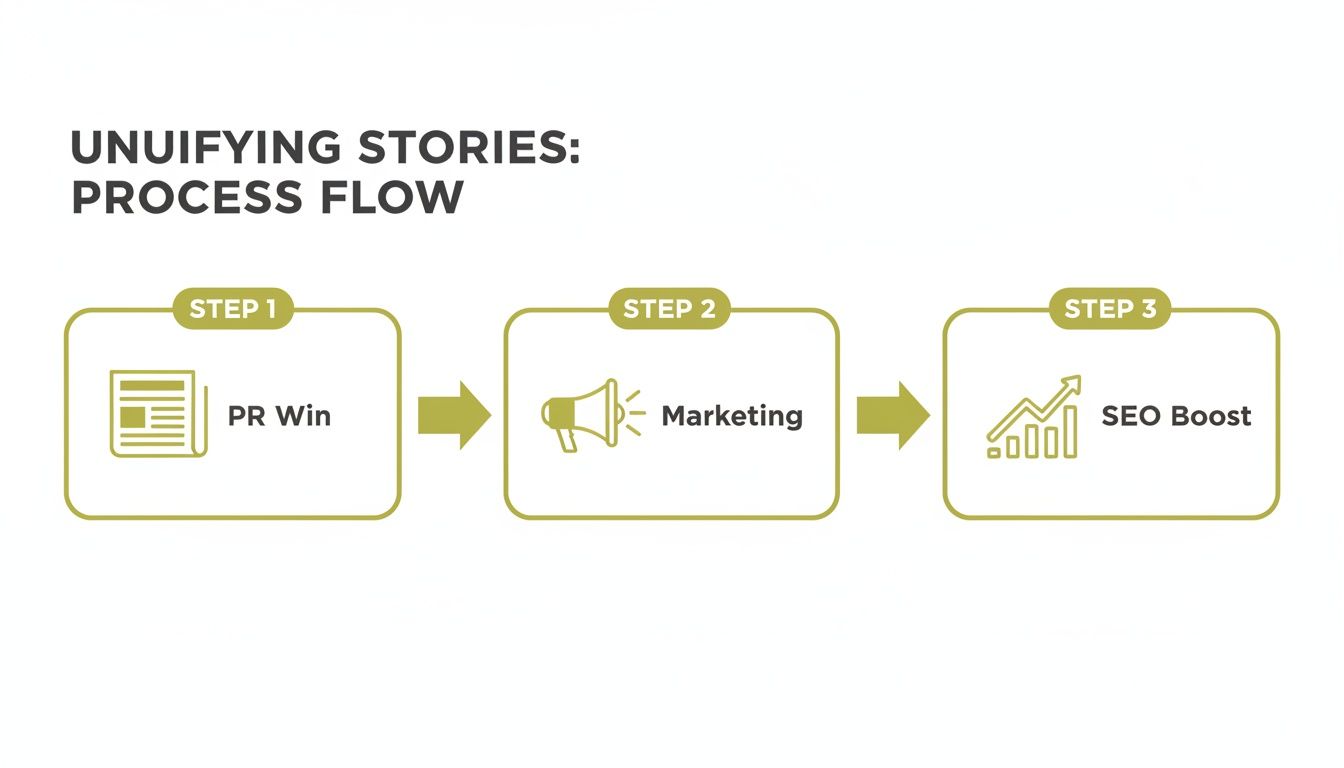
The real takeaway here is that earned media is just the beginning. It’s the spark that ignites a multi-channel effort, strengthening your brand’s entire digital presence.
Define Your Commercial Objectives
Before you even think about writing a press release, you need to know precisely what you want to achieve from a business perspective. Are you trying to push traffic to a new product page? Get more sign-ups for an upcoming webinar? Or maybe you need to attract a handful of high-value B2B clients? Your objectives must be specific, measurable, and tied directly to the health of the business.
Setting clear goals brings focus and makes it possible to prove the return on your investment. For instance, a vague goal is "get more traffic," but a sharp, commercial objective sounds like this:
"Use thought leadership articles in key trade publications to increase website referral traffic from our target industries by 15% within six months."
This level of clarity guides every decision you make, from the stories you choose to tell to the journalists you decide to contact. It ensures your MPR activity is a strategic growth driver, not just a series of random actions.
Identify Your Audience and Their Journey
Once you know your goals, you need to understand exactly who you’re talking to. And I mean really understand them, far beyond basic demographics. What keeps them up at night? What blogs, podcasts, and newspapers do they read and genuinely trust? Where do they hang out online when they're researching a purchase?
Mapping this customer journey helps you pinpoint the most powerful channels to reach them. It could be a feature story in a national newspaper, but it might just as easily be a niche blog review or an interview on an industry-specific podcast. The aim is to show up in the places your ideal customers already trust, using an authentic third-party voice to build your credibility. As our own work in PR and social media demonstrates, connecting with audiences where they are most engaged is half the battle.
Craft a Powerful and Consistent Brand Narrative
Your brand narrative is the golden thread that ties everything together. It needs to be authentic, consistent, and powerful, but also flexible enough to work across different platforms and for different audiences. This is the story of who you are, what you stand for, and why it matters.
This is where genuine expertise comes in. It's one thing to have a story; it's another to make it newsworthy. For example, everyone who works for Carlos Alba Media is a former national news journalist or has agency experience working with international brands. This specialist background gives our team an insider’s understanding of how to shape narratives that are both compelling for the media and potent for the business. We’ve built cohesive strategies for everyone from scrappy start-ups to established names like VisitScotland, always ensuring the story drives growth.
Today, data is also a huge part of shaping that story. According to a 2026 comms report from Cision, 96% of UK PR teams now rely on data more than they did previously. What’s more, 65% report that generative AI tools are giving their analytics capabilities a major boost, leading to smarter, more targeted campaigns. This data-driven approach means your story doesn't just resonate—it reaches the right people at the perfect moment.
Effective Tactics for Modern Marketing PR
This is where the rubber meets the road. A great marketing PR strategy is one thing, but it only comes to life through smart, deliberate action. This isn’t about just ‘getting press’; it’s about choosing specific tactics that directly support your business goals.
Every tactic you deploy should be a clear bridge connecting your brand’s reputation to a measurable result, whether that’s more sales, better leads, or a flood of new website visitors. This is how you prove the real commercial value of PR.
Securing Product Reviews That Drive Sales
Getting your product reviewed by a trusted publication is one of the most direct ways to turn PR into profit. Think about it: a genuinely positive review from a respected journalist often feels more authentic and persuasive to a potential customer than any paid ad ever could.
The trick is to be surgical in your approach. You need to target the exact outlets your ideal customers read when they're deciding what to buy. A glowing review in the right place doesn't just build your brand's credibility; it sends a stream of highly motivated referral traffic straight to your product pages, creating a very clear path to purchase.
Developing Authority-Building Thought Leadership
For B2B companies, or any founder wanting to build a strong personal brand, thought leadership is absolutely essential. This means writing and placing genuinely insightful articles in top-tier industry publications under your name or your CEO’s. It’s how you become the go-to expert.
This isn’t a backdoor sales pitch. It’s about sharing your unique perspective and hard-won expertise without asking for anything in return. The commercial payoff comes later. When a potential client needs a partner, they’ll naturally think of the company whose leaders they already see as industry authorities. It builds trust long before the first sales call and attracts high-quality inbound leads.
This is where journalistic instinct becomes a commercial asset. The specialists at Carlos Alba Media—all former national news journalists or professionals with big-brand agency experience—excel at identifying what editors want. They know how to frame a founder’s expertise not as a sales pitch, but as a compelling, newsworthy story that serves the publication's audience while building the brand's authority.
Having that inside track is what gets an article published rather than deleted, directly influencing your ability to pull in those big B2B clients and cement yourself as a market leader.
Creating Data-Driven Reports for Backlinks
If you want to earn coverage in major media outlets and secure powerful backlinks, creating your own data-driven reports is one of the most effective tactics in the playbook. It involves doing original research—like a unique survey or an analysis of industry data—and packaging the findings into a compelling report.
Journalists absolutely love original data. It gives them a credible, ready-made hook for a story. When a major publication cites your research and links back to your website as the source, you've hit the marketing PR jackpot. You've just scored:
- Top-tier media coverage: Getting your brand name mentioned in authoritative outlets.
- High-quality backlinks: These are SEO gold, giving your website’s search rankings a significant, long-term boost.
- Lead generation: By putting the full report behind a simple email form, you create a powerful lead magnet.
This approach takes some effort, but the returns are incredible. You’re not just part of the conversation; you’re the one providing the facts everyone else is talking about.
Partnering with Credible Influencers
Modern influencer marketing has moved well beyond paying celebrities for a quick shout-out. In a marketing PR context, the real power lies in partnering with credible micro-influencers who have a genuine, tight-knit relationship with an audience that perfectly matches yours.
Here, authenticity is everything. The aim isn't just to get seen; it’s to resonate. You're looking for partners whose personal values align with your brand's and whose followers hang on their every word. A heartfelt endorsement from the right person can spark immediate sales and build genuine brand loyalty. By giving each influencer a unique discount code or affiliate link, you can track the ROI of these partnerships with complete clarity.
MPR Channels and Their Primary Business Impact
Each of these tactics demonstrates how public relations can be transformed from a simple brand-building exercise into a powerful engine for business growth. It's about connecting every activity to a tangible outcome.
The table below breaks down exactly how these channels deliver real-world business results.
| MPR Channel/Tactic | Primary PR Goal | Direct Marketing Impact |
|---|---|---|
| Product Reviews | Build third-party credibility and social proof. | Increase referral traffic and on-page conversion rates. |
| Thought Leadership | Establish founder/brand as an industry expert. | Generate high-quality inbound B2B leads and attract talent. |
| Data-Driven Reports | Create newsworthy assets and become a source. | Earn high-authority backlinks, improving SEO and organic traffic. |
| Influencer Partnerships | Foster authentic brand advocacy and reach. | Drive direct sales through tracked links and codes. |
As you can see, the connection is direct and measurable. When chosen and executed correctly, these MPR tactics don't just build a good reputation—they actively build the business.
Measuring the True ROI of Your MPR Efforts

For far too long, the value of PR was measured with flimsy metrics that meant very little to the bottom line. Old-school ideas like Advertising Value Equivalency (AVE)—a flawed attempt to put a price tag on media coverage—are completely obsolete. Modern marketing public relations needs a much sharper, more commercial way of looking at results.
Let’s be honest: your board and your bank manager don’t care about fuzzy concepts. They want to see a return on investment (ROI). Proving the real value of MPR means tracking its direct impact on tangible business goals. It's about connecting every press mention and every piece of content back to measurable growth.
Moving Beyond Vanity Metrics
The first step is to ditch the old, empty metrics and focus on the key performance indicators (KPIs) that actually matter. You need to shift your mindset from "how many eyeballs saw our name?" to "what did those people do next?". This is the bedrock of any results-focused strategy.
This commercial-first approach is something we see in high-performing specialist agencies. At Carlos Alba Media, for instance, the team’s background sets the tone. Everyone who works for the agency is either a former national news journalist or has experience working with international brands. This unique combination of expertise grounds every campaign in commercial reality. They know that for UK clients, especially SMEs, every pound spent must deliver a clear return.
This means zeroing in on KPIs like:
- Website Referral Traffic: How many people are clicking through to your website directly from articles?
- Branded Search Volume: After a campaign, are more people searching for your company by name?
- Lead Attribution: Can you pinpoint which pieces of content are generating new leads and enquiries?
- Conversion Rates: Are visitors from your media coverage actually turning into paying customers?
When you track these figures, you start to see that MPR isn’t just a "nice to have". It's a powerful and reliable engine for generating revenue.
Key Metrics and How to Track Them
You don't need a huge, expensive toolkit to measure modern MPR. A few simple tools, most of which you're probably already using, can give you a crystal-clear picture of how your campaigns are performing.
H3: Website Referral Traffic
This is one of the most direct ways to see the impact of your online coverage. It shows you precisely how many people read an article and were motivated enough to click a link to your website.
- How to track it: Jump into your Google Analytics account. Go to
Acquisition > Traffic Acquisitionand check the "Session source / medium" report. You'll see sources listed liketheguardian.com / referral, showing you exactly which publications are driving visitors to you.
H3: Branded Search Volume
A great MPR campaign builds brand awareness. An easy way to measure this is to see how many people are typing your brand name directly into Google. A steady increase shows that your name is becoming top-of-mind with your target audience.
- How to track it: Use Google Search Console. Head to the
Performance > Queriesreport. Here, you can track searches for your brand name over time and spot the trends.
When you see a spike in branded searches that lines up perfectly with a major piece of press coverage, you have clear-cut evidence that your marketing public relations is successfully building brand recall.
H3: Lead and Conversion Attribution
This is the holy grail of ROI—drawing a straight line from a PR activity directly to a new customer or a sale.
- How to track it: This is all about setting up "Goals" in Google Analytics. For instance, you can create a goal to track how many people who arrive from a specific article go on to fill out your contact form or complete a purchase. This directly ties your media placements to revenue and proves the commercial worth of your efforts.
Choosing Between an Agency and an In-House Team
So, you’re ready to get serious about your marketing PR. The big question is: who’s going to do the work? It’s a classic business crossroads. Do you hire your own people and build a team from scratch, or do you bring in an external agency that’s ready to go from day one?
There’s no single right answer. It really comes down to your budget, your timeline, and what kind of expertise you truly need to hit your goals.
Going the in-house route means you get people who live and breathe your company culture every single day. The communication is direct, and their focus is entirely on you. The catch? It’s a long and often expensive road. Finding top-tier talent with the right media contacts takes time, and then you have the ongoing costs of salaries, training, and benefits.
On the other side of the coin, a PR agency gives you an entire team of specialists right out of the box. You get instant access to a wealth of experience, established relationships with journalists, and the ability to scale your activity up or down as needed. The main things to weigh up are the monthly retainer fees and finding an agency that will get to grips with the nuts and bolts of your business.
A Third Way: The Specialist Consultancy
There’s another option that’s become a game-changer for startups and SMEs, one that neatly sidesteps the 'all or nothing' choice. It’s the specialist consultancy model, designed to give you direct access to senior-level experts without the eye-watering overheads of a traditional large agency.
This is exactly the philosophy we've built Carlos Alba Media on. We don’t think great advice should be out of reach.
Everyone who works for Carlos Alba Media is a former national news journalist or has agency experience of working with international brands. This means our clients work directly with the seasoned pros who are actually creating the strategy and picking up the phone to the media.
This model is perfect if you need to make things happen, fast. You skip the entire team-building headache and plug straight into a network of contacts and know-how, ready to land the coverage that matters. Whether you're leaning towards an agency or building your own team, understanding the role of a PR specialist will give you a much clearer picture of what you need.
Making the Right Call for Your Business
The UK has a vibrant PR scene. In fact, nearly half (46.2%) of all PR firms recently reported that trading was better than they’d expected. In this thriving market, specialist consultancies like ours—with teams on the ground in Glasgow and London—offer a powerful alternative for businesses needing serious results without the big-agency price tag. You can dig into more data on the UK’s PR landscape over on Statista.com.
Ultimately, the best path forward depends on where you are right now. Building an in-house team is a fantastic long-term ambition. But if you need to accelerate your growth today, a flexible consultancy can give you the senior-level firepower to make it happen.
Your Marketing PR Questions, Answered
It's completely normal to have questions when you first start exploring marketing PR. After all, you're focused on growing your business and need to know what will actually move the needle. Let's clear up some of the most common queries.
What's the Real Difference Between Marketing and PR?
Think of it this way: marketing is what you pay to say about yourself (like an advert), while PR is what you earn by getting other people to say great things about you (like a feature in a newspaper).
Marketing speaks directly to your customers, with the main goal of driving a sale. PR, on the other hand, works its magic through credible third parties—journalists, industry experts, and influencers—to build trust and authority around your brand. Marketing Public Relations (MPR) is the sweet spot where these two meet, using the powerful credibility built by PR to achieve tangible marketing goals like attracting high-quality leads.
How Long Does It Take to See Results?
Unlike a paid ad that delivers clicks straight away, MPR is about building momentum that lasts. You'll often see the first signs of life, like your initial media mentions, within one to three months.
But the true value of MPR builds over time. The big-picture impact—stronger brand authority, better search engine rankings, and a steady stream of inbound leads—really starts to become clear over six to twelve months. It’s less of a quick fix and more of a long-term investment that pays compounding dividends in trust and visibility.
At Carlos Alba Media, our specialist team of former national news journalists and brand agency pros focuses on landing you those important early wins. Because everyone who works for Carlos Alba Media has this background, we know how to build from there, creating a long-term strategy designed for measurable, sustainable growth.
Is This Actually Affordable for a Small Business?
Yes, absolutely. For a lot of small businesses, a smart MPR strategy can be much more cost-effective than a huge, traditional advertising spend.
The trick is to be strategic. You don't need to be everywhere at once. A startup can get incredible traction by focusing its efforts on a handful of key trade publications or local news outlets that their ideal customers read religiously. Partnering with a specialist consultancy, which offers senior-level expertise without the massive overheads of a big agency, makes top-tier MPR a genuinely accessible and powerful tool for SMEs.
Where Does Social Media Fit Into All This?
Social media is a crucial piece of the puzzle. In any modern MPR plan, it’s the main stage for shouting about your successes.
You use it to share the brilliant media coverage you’ve earned, chat directly with journalists and followers, tell your brand's story, and keep an eye on what people are saying about you. A truly integrated strategy uses social media to transform a great PR placement into genuine customer engagement and conversation.
Ready to turn your reputation into revenue? At Carlos Alba Media, our specialist team of former national news journalists and professionals with international brand experience blends newsroom insight with digital marketing expertise to deliver measurable growth. Contact us today to find out how we can help your business be seen, trusted, and chosen.