
Your phone lights up at 8.40 on a Tuesday with a screenshot of your own front door and a caption you didn't write. A local Facebook group has picked it up. A customer has emailed asking if it's true. Nobody on your team knows the full story yet, and the first journalist will call within the hour.
That gap between the moment an issue becomes public and the moment you know what happened is where reputations get made or destroyed. You can't fill it with a full account, because you don't have one. You fill it with something shorter and more disciplined: a holding statement.
The short answer to what is a holding statement is that it's a first response, not a final one. Most definitions stop at "acknowledge the issue". That misses the part that does the work. A holding statement is a promise, and the promise only counts if you keep it.
What a Holding Statement Is and How It Differs
A journalist calls while your team is still checking what happened. A customer is waiting for an answer, but a full account would risk putting unconfirmed details on the record. A holding statement gives a brief, accurate response and sets a clear time for the next update.
That update time is part of the statement's promise. If the investigation is still underway at that point, say so and provide the update anyway. A statement that sets a deadline and then misses it can deepen uncertainty; one that keeps the commitment gives people a dependable point of contact while the facts are being established.
Holding statement, full statement, press release
These documents serve different purposes and belong at different stages of a response.
| Document | Purpose | Timing | Facts included | Typical length |
|---|---|---|---|---|
| Holding statement | Acknowledge the issue and set the next update | Within the first hour | Verified facts only | One short paragraph |
| Full media statement | Explain what happened and the response | Once initial checks are complete | Confirmed findings and actions | Several paragraphs |
| Press release | Make a formal announcement of the agreed position | After leadership and legal sign-off | Full agreed account | Multi-section document |
A holding statement is usually the first text a journalist, customer or regulator reads. Keep it short enough to clear quickly, but specific enough to answer the immediate question. Its job is to hold the position until a fuller account is ready, while the team does the work needed to meet the promised update time.
What a Holding Statement Must Contain and Where Drafts Fail
A holding statement does more than acknowledge a problem. It commits the organisation to a next update, so the message is only as credible as the team's ability to meet that deadline.
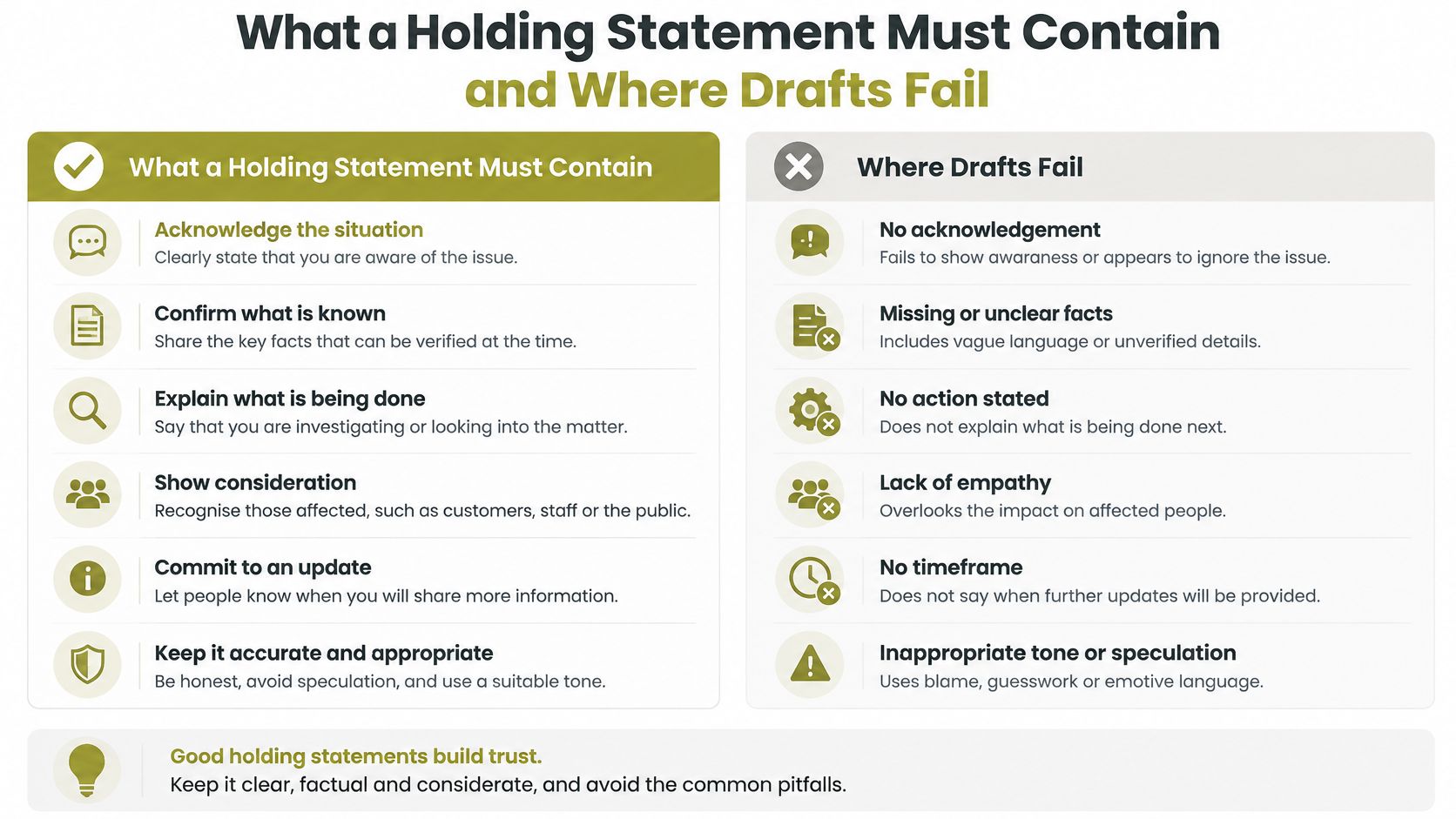
Four elements make the commitment work:
- Acknowledgement. Name the issue plainly. “Our booking system was offline from 8am on Tuesday” is more useful than “We're aware some customers had trouble booking.”
- Confirmed facts. Include only details verified by someone with direct knowledge, such as the person responsible for the system or site.
- The open question. State what remains unknown and what is being checked. Naming the gap is more credible than implying the cause is settled.
- The next update. Give a specific time, not a general promise to keep people informed. Set a deadline the team can meet, even if there is no new information.
Here is one workable version:
We can confirm our booking system was offline from 8am on Tuesday. Customers could not complete purchases. The cause is still being traced. We will update by 4pm today, including if nothing has changed.
Thirty-four words. Before release, check that each fact has an owner who can verify it, that no speculation reads as certainty, and that someone is responsible for publishing the promised update.
Where drafts break down
Common failures often come down to a missing commitment, an unsupported explanation or poor coordination:
- Acknowledgement without a clock. “We are aware of an issue” leaves readers without useful information or a reason to wait for the next update. State when they will hear from you.
- A guessed cause. “This appears to be a cyber attack” can become a damaging quote if the cause turns out to be a failed update. Describe what is being checked, and avoid promises such as “this will never happen again.”
- Conflicting versions. Different wording on the website, in a press line and on social media creates contradictions. Keep one approved text and publish it across channels.
- Names released too early. Do not name victims, suspects or injured staff until police or legal counsel clears the information.
- Silence after the statement. The Local Government Association's internal communications guidance advises publishing times for future updates and keeping that commitment even when there are no new details. “No change since 8am, next update at 6pm” keeps the promise without overstating progress.
The Cabinet Office's 2025 risk perception survey found that 84% of UK respondents considered it very or somewhat important for the government to share information about plans for large-scale emergencies or disasters. The finding concerns government, but the practical lesson for organisations is clear: a missed update can make a careful first statement look evasive or unreliable.
When to Issue One and When a Full Statement Is Better
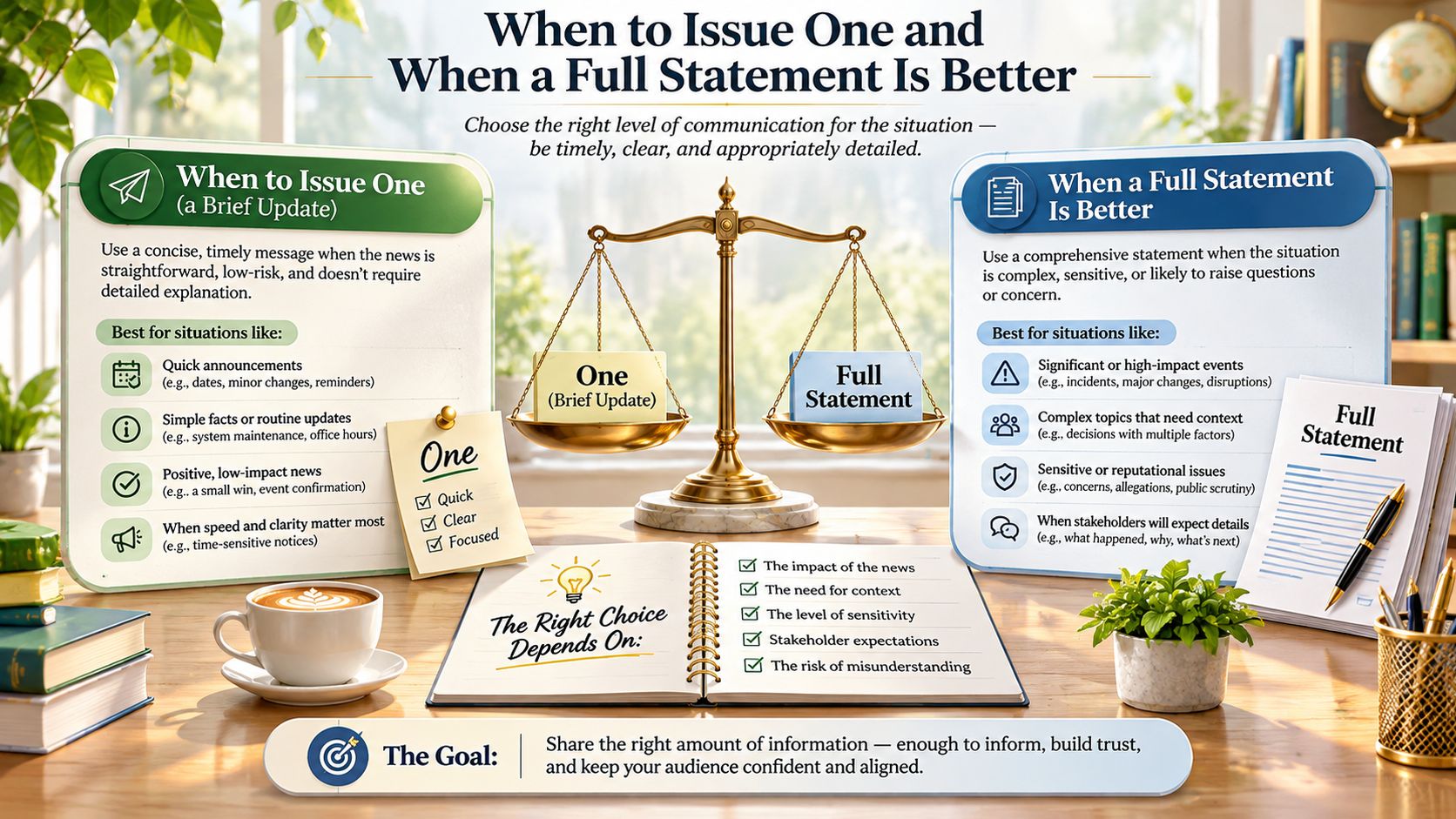
Two tests decide it. Is the issue already public, or about to be? And are the facts still incomplete? When both answers are yes, silence hands the story to someone else, and a holding statement is the right instrument. When the facts are verified, the holding position becomes an obstacle.
| Situation | Issue a holding statement? | Reasoning |
|---|---|---|
| Social media posts spreading a rumour about your business | Yes, within the hour | Stops speculation and sets the update time |
| Product recall or safety concern under investigation | Yes, agreed with the regulator first | Regulators may need to clear details before release |
| Incident linked to a police or terrorism-related investigation | Yes, only after police consultation | Premature disclosure can compromise the investigation |
| Facts fully verified and outcome known | No, issue a full statement instead | The holding position is no longer needed |
| Routine service change with no media interest | No | A holding statement would create a crisis where none exists |
The governance layer matters more than many organisations expect. ProtectUK's guidance on crisis communication plans is explicit that plans should define holding statements, roles, responsibilities, resources and procedures for following the police lead. After a hostile-actor or terrorism-related incident, organisations shouldn't release incident details to media or external audiences without prior police consultation, because early disclosure can compromise an investigation, expose sensitive information or issue instructions that conflict with the emergency services.
Practical rule: in a high-risk incident, one liaison and one authorised spokesperson. Everyone else refers enquiries to the statement.
Say why detail can't be released yet, rather than pretending there's nothing to say. Then synchronise: insurers, solicitors, regulators, affected customers and your own digital channels should all be working from identical wording. Contradictory messages between your press office and your customer services inbox become a second crisis with a much longer tail than the first.
How to Draft and Release a Holding Statement in the First Hour
The sequence below is the one to rehearse, because you won't invent it under pressure. Here's the full order of work.
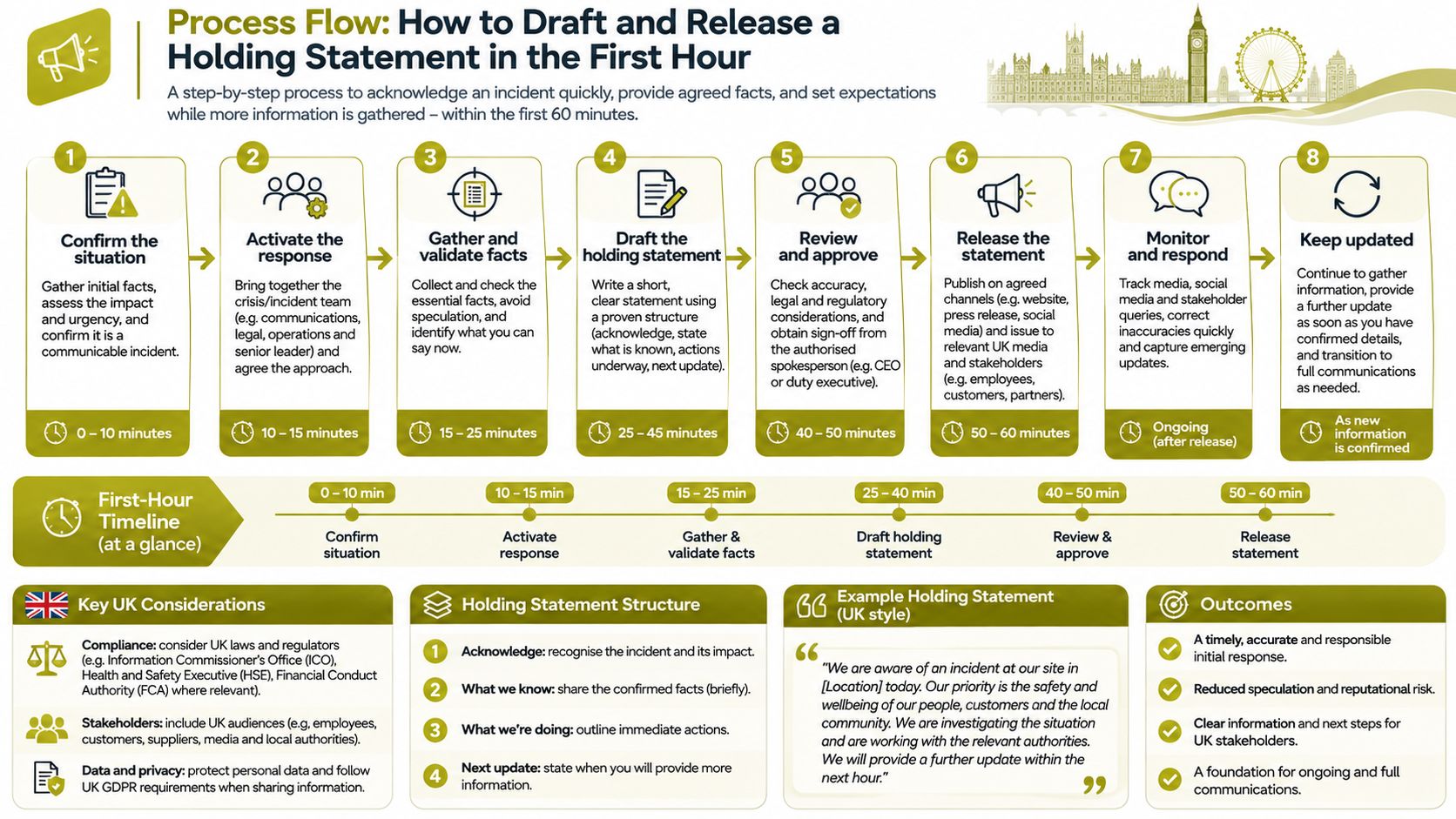
- Verify before you write. Establish what happened, where, when and who is affected, checked with the lead person on the ground. Anything unconfirmed stays out of the draft rather than going in as a placeholder.
- Name the decision-maker and the voice. One senior person who can approve the text, one spokesperson who fronts it. Statements that need three signatures die in the gap.
- Start from the pre-agreed lines. Adapt what's in your crisis plan instead of opening a blank document. This is the step teams skip and then regret, because writing from scratch at 9pm is how errors enter.
- Draft to length. Around 50 to 100 words. Longer means you've started explaining, and explaining is the job of the full statement.
- Clear it. Legal counsel always, and in regulated sectors the regulator or the police lead. In a safety incident, the emergency services are a clearing house, not a courtesy call.
- Brief staff before the public. Your receptionist and your call centre shouldn't learn the position from a journalist. Send the approved text internally first, with a line on where to route enquiries.
- Publish where the conversation is happening. Website notice, press office inbox and social accounts, all carrying the same words. There's a run of worked crisis communications examples that shows how differently these land when the channels are out of step.
- Log the decision and the reason. Who approved what, at what time, and why. That record is what protects you in a review or a regulatory conversation three months later.
A finished first hour looks unremarkable: the statement is live in every channel, the crisis team is assembled, the update time is in the diary and the decision log has an entry. The aim is a routine, not a performance.
Why Newsroom Standards Decide Whether the Line Holds
A holding statement can fail on one unsupported clause. Newsroom standards help expose that weakness before publication: verify the facts, distinguish confirmed information from assumption, and check whether each promise can be kept. The Skills England occupational standard for journalists sets out requirements for accurate, impartial, balanced and verifiable reporting, including checking information against multiple sources where necessary. Apply the same discipline to a holding line. A suspected cause, an uncleared detail or an update time the organisation cannot meet can undermine everything else in the statement. Legal review belongs alongside editorial review, particularly where media law and ethics may affect what can be said.
Newsroom judgement is built through experience and training. A Reuters Institute study of UK journalists found that 46% had worked in journalism for more than 20 years and 20% for more than 30 years, while 5% had two years or less in the profession. A crisis line needs that level of scrutiny, not just a quick read for tone.
Training also covers the practical risks of publication. Written evidence to Parliament reports that around 1,500 students a year work toward the National Council for the Training of Journalists qualification, with subjects including shorthand, court reporting, media law, digital reporting and data use. It also reports that 81% of UK journalists hold a journalism qualification, and that 81% of those qualified hold an NCTJ award.
Readers may already be sceptical. In 2024, 23% of Britons said they trusted journalists as a whole to tell the truth, according to YouGov. An unverified clause can therefore weaken the whole message. So can a promised update that never arrives. The update time is part of the statement's credibility: publish only a time the team can meet, then provide a clear update even if key facts remain unconfirmed.
Carlos Alba Media, founded by former national newspaper editor Carlos Alba, applies newsroom discipline when pressure-testing holding lines before issue. Its value is not just a sharper sentence. The line must match what the organisation knows, what it can say and when it will report back.
Confirm Your Holding Statement Process Before a Crisis Hits
At 9pm on a Sunday, an incident needs a response, but the person authorised to approve one is unavailable. Set the out-of-hours decision route before a crisis, with a named deputy who can act when the usual approver cannot.
Prepare three to five templates for plausible scenarios, such as an outage, safety concern, data issue, high-profile complaint or supply failure. Leave clear spaces for confirmed facts: “Our [system] was offline from [time] on [date].” Store the drafts somewhere the response team can reach if email or the intranet is unavailable.
Put the spokesperson, liaison and sign-off steps in writing. Then check that the process works in practice: who confirms the facts, who approves the wording, and who can meet the promised update time? A holding statement is a promise to communicate again, so the team must know who owns that update and how it will be issued. For the wider framework, see this guide to developing a crisis communications plan. Sift AI's crisis communication playbook offers further guidance on mapping stakeholders and channels before an incident.
A client has retained Carlos Alba Media's services for more than five years. Familiarity with a business can help keep its holding lines consistent with its voice and the commitments it can make.
Carlos Alba Media provides 24/7 media crisis management in partnership with leading UK media lawyers. Founded and run by former national newspaper editor Carlos Alba, the agency can help pressure-test holding lines before an incident puts them to the test. Visit Carlos Alba Media to start a conversation.