
Word-of-mouth marketing is the deliberate work of creating experiences, proof and stories that customers want to pass on, so that people who trust them send new buyers your way. Many UK shoppers say reviews and comments from fellow customers have influenced a purchase.
A new customer contacts you, mentions a friend's name and seems comfortable discussing a purchase before you have explained much. You are pleased, but you cannot say what prompted the recommendation or how to encourage another one.
For a small business, that gap is the opportunity. Recommendations can be run like any other acquisition channel: make the experience worth describing, give prospective buyers evidence they can check for themselves, and track whether introductions become worthwhile customers. There are legal and ethical limits on how far you can push, and the strongest results come from validating genuine praise rather than manufacturing it.
What Word of Mouth Marketing Means in Plain English
An advert is a shop window you pay to light up. A recommendation is a friend pointing you through the door and explaining why you should go inside.
Say you run a local computer repair business. Your advert promises reliable service, but a customer tells a neighbour that you recovered their documents, explained the problem plainly and charged the agreed price. The customer supplies evidence, not just visibility.
In Nielsen's 2013 Global Survey of Trust in Advertising, 81% of British respondents trusted recommendations from friends and family, making personal recommendations the most trusted advertising format measured in the UK, according to The Media Leader's report of the Nielsen survey. It's a historical benchmark, not a forecast of what your next campaign will achieve.
Why recommendations help small businesses
A prospective buyer has questions your headline can't fully answer. Will you turn up? Will the product work as described? Will you help if something goes wrong?
Someone who's already bought from you can answer those questions in everyday language. That can help a start-up or SME reach beyond its advertising budget, although earning those recommendations still takes staff time, dependable delivery and follow-up.
Useful advocacy might take several forms:
- A personal introduction connecting you with someone who needs your service.
- A detailed review explaining what happened and who the offer suits.
- A customer story showing the problem, your contribution and the outcome.
Practical rule: Write the sentence you'd like a customer to say to a friend. If it could describe any competitor, make it more specific.
A recommendation can make a relevant offer easier to choose. It can't rescue something people don't need, excuse unreliable delivery or make an unsuitable purchase appropriate.
Organic and Amplified Word of Mouth Compared
Organic, amplified and digital word of mouth compared
| Type | What drives it | Who controls it | Main measure |
|---|---|---|---|
| Organic word of mouth | Customers talking unprompted after a good experience | Customers, not the business | Referral source and repeat rate |
| Amplified word of mouth | Seeded stories, referral rewards, influencer or PR hooks | The business, shaped by customer response | Referral conversions and reach of shared content |
| Digital word of mouth | Reviews, comments and user-generated posts | Platforms and public audiences | Review volume, rating and sentiment |
Organic word of mouth starts without a campaign prompt. A customer describes your business because the experience mattered to them, whether that means an excellent meal or a straightforward explanation of a difficult mortgage application.
You can improve the conditions for those conversations, but you can't buy an unprompted opinion. Paying someone to deliver a prescribed endorsement changes the nature of the communication.
What amplification changes
Amplified word of mouth gives people a deliberate reason or opportunity to share. You might create a referral offer, publish a useful customer case study or give a journalist a credible local story that readers then discuss.
The business controls the starting material, not the final conversation. Customers may describe a different benefit from the one you expected, question your claims or decide the story isn't worth passing on.
For example, an accountant might produce a plain-English checklist for business owners preparing their records. A client forwards it to a colleague because it solves an immediate problem. The checklist creates the opportunity, but the client decides whether sharing it will help someone.
Digital word of mouth isn't a separate motivation. It's a setting. An unsolicited review can be organic, while a customer post prompted by a campaign can be amplified. Both can remain publicly searchable after the original conversation ends.
Choose the right measure
The table's measures answer different questions. Referral source helps you identify introductions, while repeat rate tells you whether customers return. Neither alone proves that someone recommended you.
For amplified activity, separate distribution from results. People sharing a referral offer is useful information, but completed purchases tell you whether the offer attracted buyers. For digital activity, read the substance of reviews alongside ratings so you understand what customers value.
Most SMEs need dependable delivery and sensible amplification. Start with the former, then give customers accurate material they can reuse.
If you can't name the customer outcome someone would describe to a friend, improve the offer before paying to amplify it.
Real Examples of Word of Mouth Working in Practice
Hypothetical café scenario: a regular sees a friend's photograph of a neighbourhood café's signature pastry. They visit, enjoy the food and friendly service, then suggest the café when colleagues discuss where to get lunch.
Hypothetical service-business scenario: an owner finds a local IT specialist through search. The specialist resolves a frustrating email problem and explains how to prevent it recurring, so the owner later introduces them to another business.
An ordinary customer interaction can provide the substance of a recommendation.

Follow the sequence
Research involving 2,000 UK adults, reported by Retail Gazette, found that 63% had visited a shop or hospitality venue in the previous year after being influenced by social-media content; 79% of those visitors subsequently recommended the business, posted about it or left a review, rising to 89% among Gen Z.
The useful pattern is discovery, experience, then further advocacy. It isn't evidence that every social post produces a visit or that every visitor makes a referral.
Apply that sequence to the hypothetical businesses:
- The café needs a describable attraction. The signature pastry gives customers something more concrete to mention than good food.
- The IT specialist needs reusable evidence. With permission, a short account of the problem and resolution gives customers or business partners something accurate to forward.
- A hospitality venue needs a complete experience. Say a guest discovers a hotel through social content, enjoys a well-managed stay and then leaves a detailed review. The booking journey and service must support the promise made online.
For ways to present customer evidence clearly, social proof inspiration from Gainsty offers formats to consider. Choose a format that helps buyers judge relevance, rather than decorating a page with praise.
Give partners usable material
Coordinating a story also matters when several organisations are involved. Our VisitScotland campaign work included strategic communications planning, audience segmentation and targeting, a multi-platform social media strategy, and content marketing and asset creation.
Partnership work involved engaging event organisers, local tourism boards, hotels, airlines and cultural institutions to align messaging, gather assets and amplify the message. For a smaller business, the principle is practical: give partners approved photographs, accurate descriptions and a clear reason the story matters to their audiences.
Tactics That Generate and Scale Recommendations
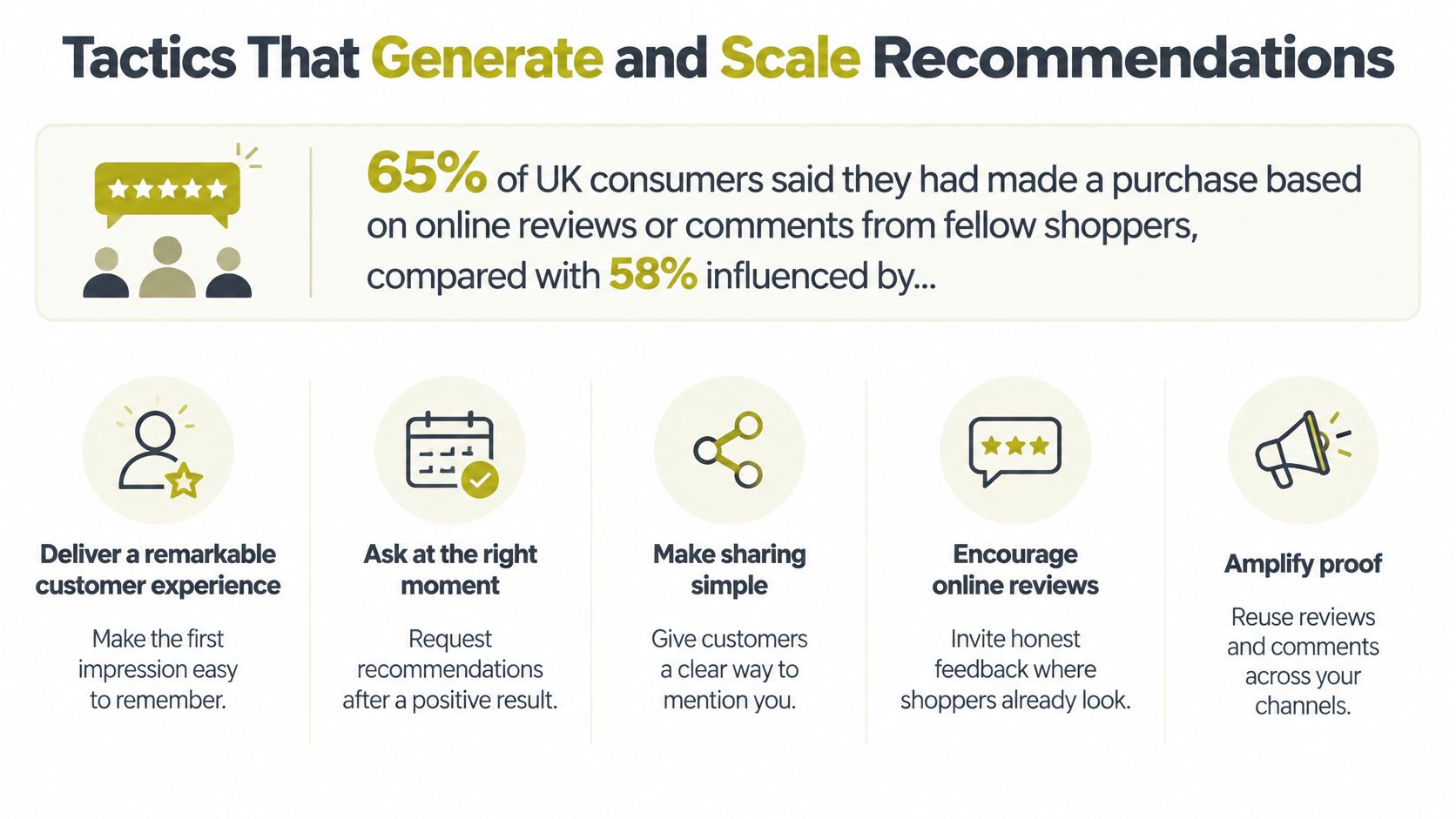
In Akeneo's 2025 survey of approximately 250 UK consumers, 65% said they'd made a purchase based on online reviews or fellow shoppers' comments, compared with 58% influenced by social-media endorsements, as reported by FashionNetwork. The same report describes a UK study of 384 university students in which electronic word of mouth on shopping websites had more influence on online purchase intention than electronic word of mouth on social media.
That supports a practical priority: make customer evidence useful where people evaluate your offer, not only where they discover it.
Use this visual as a reminder of the activities that support sharing.
Start with delivery, then increase reach
Improve the product experience. Map the journey from enquiry to follow-up and choose a frustrating moment to improve. Clear delivery updates or a useful extra may be more memorable than another feature. The common slip is adding something customers neither need nor mention.
Make service personal and accountable. Set a response standard for enquiries and give each unresolved problem an owner. A careful recovery gives a disappointed customer a reason to reconsider their opinion, although it doesn't guarantee advocacy. Avoid scripted replies that ignore the actual complaint.
Build a simple referral programme. Give each advocate a unique code, explain the reward for both parties and make the conditions easy to find. Check that the reward is worthwhile without making the purchase unprofitable. Confusing exclusions can undermine an otherwise attractive offer.
Seed products selectively. Shortlist a small group of credible people whose audiences match your buyers. Explain the product, disclosure expectations and any factual limitations, then leave room for an honest account. Don't mistake a large following for relevant influence or dictate a supposedly independent opinion.
Develop a specific PR hook. Write a concise story built around a substantiated customer result, a genuine local first or a timely issue. Include a number only when you can prove it. Pitch relevant journalists rather than sending the same announcement indiscriminately.
Help people share accurately
Plan permission, context and reuse before collecting customer material. A structured approach to user-generated content campaigns helps keep customer contributions connected to a clear purpose.
For professional-services businesses, employees can also explain useful work in their own voices. Ploot's guidance on how to activate employees as LinkedIn advocates is a practical planning resource, provided participation is voluntary and employment relationships remain clear.
This video offers another format for exploring the topic.
Measuring Word of Mouth Marketing Results
Discovery is not revenue. A customer hearing your name is different from enquiring, buying and remaining profitable to serve.
A survey of 1,500 UK adults, described by Adobe Express, found that 52% discover brands through word-of-mouth recommendations, while product quality at 73% and affordable pricing at 70% remained the leading purchase factors. Those are discovery and purchase-factor findings, not evidence of a guaranteed sales uplift.
Private conversations create an attribution problem. Someone might hear about you over lunch, search your name later and buy through your website. Your analytics could record a search visit while missing the introduction that prompted it.
Word of mouth KPIs and how to track them
| Metric | What it shows | How to track it |
|---|---|---|
| Referral share of new customers | How many buyers name a customer or friend as their source | CRM ‘how did you hear about us?’ field |
| Review volume and rating | Peer evidence on your offer | Monthly export from review platforms |
| Branded search growth | Awareness spreading beyond your own channels | Search Console branded query trend |
| Referral code conversion | Direct sales from tagged advocates | Unique code per customer |
| Lifetime value of referred customers | Whether advocates bring better customers | CRM cohort split by acquisition source |
Build a usable record
Start with your own baseline, not an industry percentage. Record current enquiry sources, review activity and sales before introducing a campaign.
Add a source field to your customer relationship management system, or CRM. Keep personal referrals, reviews, customer social posts and editorial coverage separate, and allow customers to describe overlapping influences rather than forcing an inaccurate choice.
Ask what first introduced the business and what helped the customer decide. Those answers can reveal different contributions: a colleague created awareness, but a detailed case study supplied reassurance.
Use tagged links and advocate codes where appropriate. Record completed sales, cancellations, rewards and delivery costs so you can judge commercial value rather than celebrating code usage alone.
Look beyond the final click
Social listening helps you find public recommendations and recurring concerns. OGTool's guide to social listening can help you consider monitoring options, but no tool can reveal every private message or offline conversation.
Keep review records connected to operational action. A consistent online review management process makes it easier to distinguish growing advocacy from repeated complaints.
For a stronger test, compare similar areas or audience groups with and without the referral campaign. Keep other activity as consistent as practical, and acknowledge differences in seasonality, customer mix and exposure.
Treat rising branded searches as a clue to investigate, not proof that a referral campaign caused additional sales.
At the end of each month, review three chosen metrics against your baseline. For a small service business, referral enquiries, enquiry-to-sale rate and referred-customer value make a workable starting set. Decide whether to change the offer, the sharing route or the customer experience, then record that decision so the next review has context.
Pitfalls, Legal Limits and Ethical Lines
A recommendation spends the recommender's credibility as well as their words. When a friend vouches for a plumber and the job goes badly, both reputations take the hit. A 2025 Checkatrade study of 2,000 nationally representative UK adults found that 49% had been disappointed by a recommendation, while 30% of people who trusted friends' or partners' recommendations said they didn't check online reviews afterwards.
The gap exists because a recommendation rarely transfers cleanly. A trusted friend may have hired a tradesperson for a different job, eaten at a restaurant under different management or used a professional service with a very different scope. Buyers who treat one person's good outcome as a guarantee of their own are the ones who end up disappointed.
Common word of mouth pitfalls and fixes
| Pitfall | Why it backfires | Fix |
|---|---|---|
| Paying for or writing reviews | Fake or disguised reviews can breach UK consumer law and destroy trust | Ask real customers for honest feedback only |
| Rewarding only five-star reviews | Skews ratings and invites regulator attention | Invite feedback from all eligible customers |
| Undisclosed influencer seeding | Hides the commercial relationship from the audience | Label paid or gifted posts clearly |
| Counting every like as a referral | Overstates the effect on sales | Track tagged referrals and CRM source fields |
| Ignoring negative reviews | Lets complaints spread through the same peer network | Reply specifically and fix recurring issues |
Keep incentives separate from opinions
A referral reward works like a finder's fee: it pays for an introduction under disclosed terms. It crosses the line when it purchases a favourable review or requires someone to hide a commercial relationship.
The UK's Digital Markets, Competition and Consumers Act 2024 addresses fake reviews and gives the Competition and Markets Authority enforcement powers. Don't commission fabricated customer experiences, write reviews while pretending to be a customer or make rewards conditional on praise.
Advertising disclosure follows the same logic. Clearly identify advertising relationships in paid or gifted influencer activity, and check the applicable advertising-code requirements before publication. A buried hashtag or a vague thank-you leaves the audience misled even when the post itself is honest.
Protect customers and make claims checkable
Referral emails and texts can engage UK privacy and electronic-marketing rules. Check the applicable consent requirements before sending, and don't treat a customer's submission of a friend's contact details as that friend's permission to receive marketing. A shared phone number is an introduction, nothing more.
For reputation-sensitive work, keep permission records, evidence for claims and a clear escalation route, and take specialist legal advice before launching any campaign that makes comparative or endorsement claims. A working knowledge of media law and ethics helps you spot which claims need that check before publication.
Buyers who have been let down once check harder the next time. Help them validate your recommendations with recent reviews, clear prices, relevant qualifications and specific descriptions of what is included. Verification is what turns a recommendation into a sale.
Confirm Your First Word of Mouth Plan
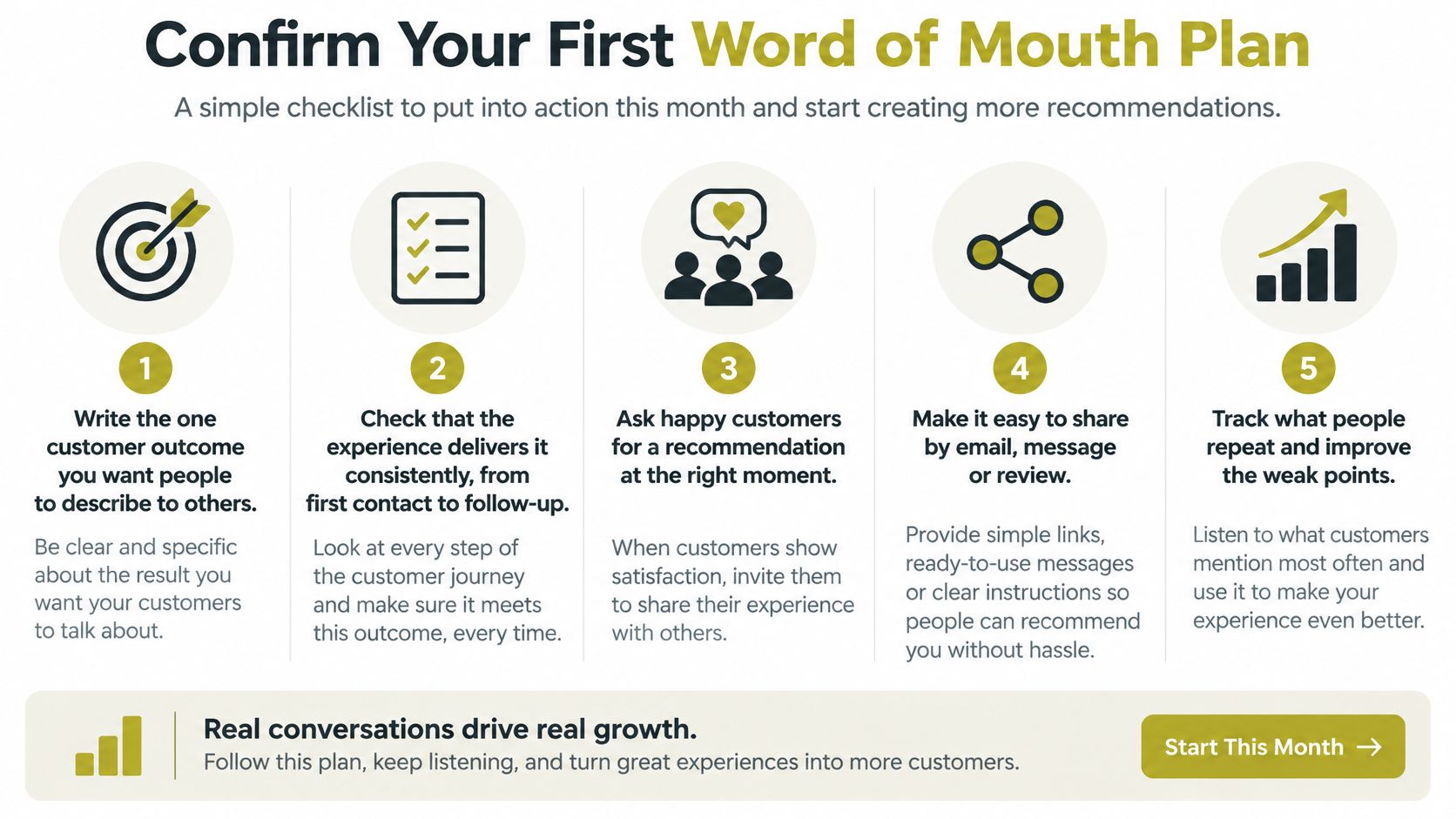
Treat it like a small acquisition channel: one promise, one route for recommendations, and one way to count them. Use this checklist to turn a general intention into work you can complete this month.
Define the customer outcome. Write the specific result you want someone to describe to another person. Use the customer's language rather than a brand slogan. If the outcome cannot be checked after delivery, tighten it.
Check delivery. Review first contact, purchase, fulfilment and after-sale support. Fix any gap that makes the promised outcome unreliable.
Record discovery. Add a ‘how did you hear about us?’ CRM field and give the person handling enquiries responsibility for completing it.
Choose a referral route. Set a clear reward for the advocate and new customer, check the economics and issue a unique code to each advocate so a recommendation can be traced.
Invite honest reviews. Include all eligible customers rather than selecting only those you expect to praise you. Set a response standard and assign responsibility for replies.
Run a focused amplification test. Choose a substantiated PR story or relevant influencer-seeding opportunity. Make commercial relationships clear and keep the scope manageable.
Review and decide. Compare your selected metrics with the baseline at month-end. Record what you'll continue, stop or change.
Put the checklist where the team sees it: next to the CRM report or the weekly sales meeting agenda. A step with no owner is not part of the plan yet.
Give the story a clear foundation
Carlos Alba Media is a Scottish-led PR and digital marketing agency founded and run by former national newspaper editor Carlos Alba. The consultancy blends newsroom insight with modern brand building, so editorial judgement about what makes a story credible and shareable sits at the start of the work.
Client work begins by helping organisations define their brand's character and what it stands for. That gives campaigns a clear foundation for publicising work to potential customers, industry partners, regulators and investors, with evidence buyers can check before they repeat a recommendation.
This week, choose the customer outcome you want people to repeat. Write it down, then ask a recent customer whether it accurately describes what they received.
Carlos Alba Media offers PR, digital content and social media support to help businesses explain their work clearly and put credible evidence in front of relevant audiences. Visit Carlos Alba Media to discuss how your customer outcomes could become a focused communications plan with practical measures of success.